
About CAIIB BFM 2027 Exam Series
📖 Table of Contents
- BFM at a glance
- Who can sit for BFM and what it costs
- Why the CAIIB BFM 2027 paper feels harder than JAIIB
- Module A: International Banking
- How to study Module A
- Module B: Risk Management
- How to study Module B
- Module C: Treasury Management
- How to study Module C
- Module D: Balance Sheet Management
- How to study Module D
- How the numerical questions work
- A 90 day plan that fits a working banker
- Mistakes that cost marks every cycle
- What comes after BFM
- Sources
CAIIB Bank Financial Management 2027: BFM Paper Guide
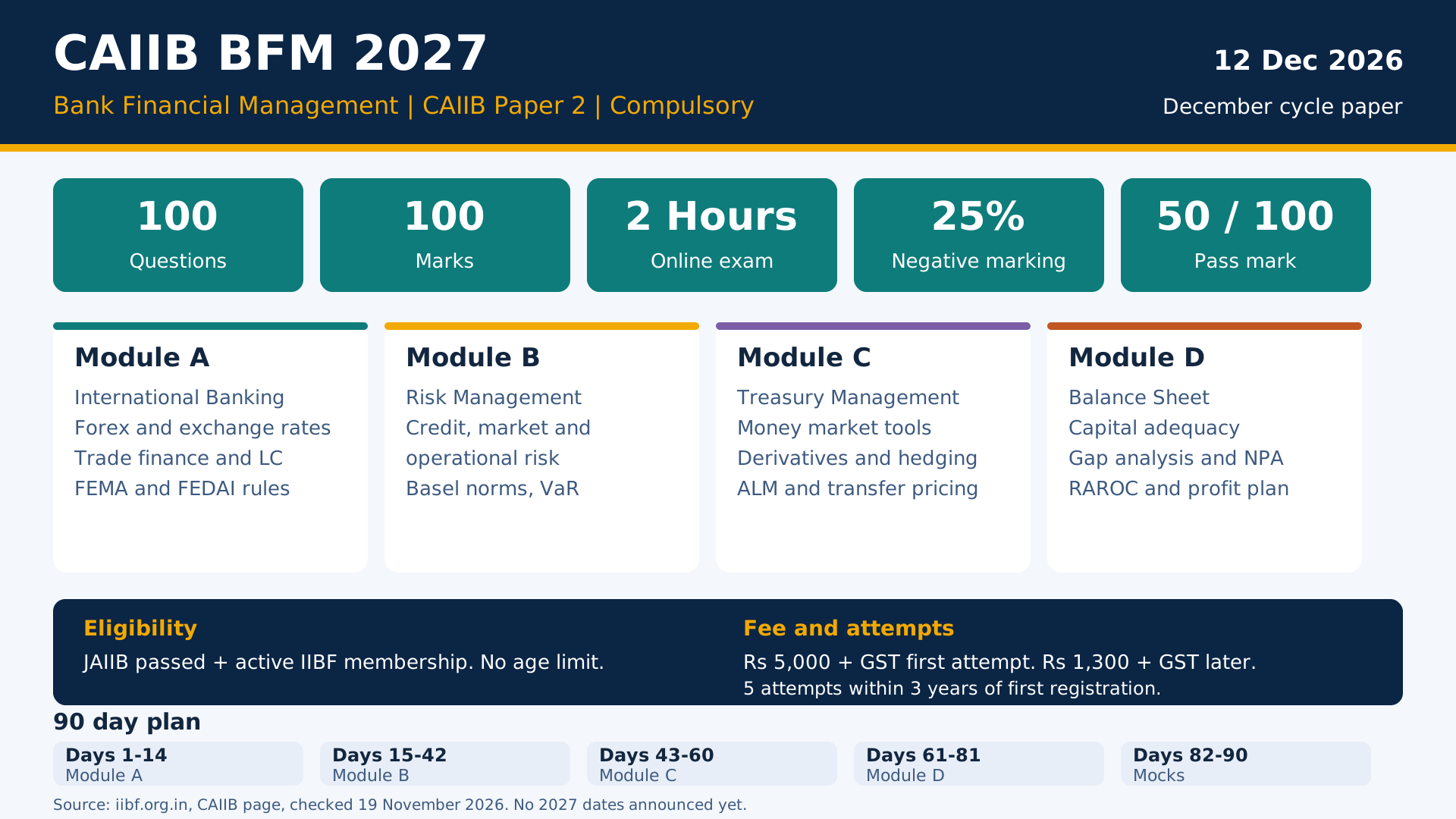
Bank Financial Management, known as BFM, is Paper 2 of the CAIIB exam and it carries 100 questions for 100 marks in 2 hours. The CAIIB BFM 2027 paper follows this same pattern. You need 50 marks to pass it, and negative marking of 25 percent applies, so a wrong answer costs a quarter mark. The paper ran on 12 December 2026 in the December cycle, and the June cycle paper ran on 7 June 2026, both online, according to the official IIBF CAIIB page.
No 2027 dates exist yet. IIBF has not announced the 2027 schedule as of 19 November 2026, and any date you see for 2027 on a coaching site is a guess, so plan around the twice a year rhythm and check the IIBF page before you register.
Four modules make up the paper. International Banking opens it, Risk Management follows, then Treasury Management, then Balance Sheet Management. The four names sound like four small subjects. They are not.
Each one connects to the next, and the paper tests those connections more than it tests memory. A question on a forward contract can turn into a question on treasury profit, and a question on capital adequacy can turn into a question on balance sheet planning. That is the whole character of BFM, and it is also why bankers who passed JAIIB with ease still find this paper hard.
This guide walks through the paper the way a working banker should study it. It covers the pattern, the pass rule, the fee, the attempt limit, each module in depth, the numerical questions that carry no options, a 90 day plan, and the mistakes that cost marks every cycle.
BFM at a glance
| Item | Detail |
|---|---|
| Paper | Bank Financial Management, CAIIB Paper 2, compulsory |
| Questions | 100 objective questions |
| Marks | 100 marks, 1 mark per question |
| Time | 2 hours, online mode |
| Negative marking | 25 percent of the marks of the question |
| Pass mark | 50 out of 100, or 45 with 50 percent aggregate in one attempt |
| Medium | English and Hindi |
| December 2026 paper date | 12 December 2026 |
| June 2026 paper date | 7 June 2026 |
| First attempt fee | Rs 5,000 plus GST |
| Second to fifth attempt fee | Rs 1,300 plus GST per attempt |
The pass rule deserves a second look because many candidates read it wrong. The standard pass is 50 marks in the paper. The second route lets you pass a paper with 45 marks if your total across all five papers in one attempt reaches 50 percent, which is 250 marks out of 500.
Oliveboard states this rule as 50 per paper or 45 with 50 percent aggregate in one attempt, and the same 250 aggregate figure appears in other tracker guides. The 45 mark route only helps if you sit all five papers in one attempt and score well in the rest, so treat 50 as your real target and treat 45 as a safety net you hope you never need.
Some numerical questions carry no options at all. You solve the sum and type the answer into a box. Myonlineprep notes this directly, and the IIBF store guide says the same about numerical questions in BFM. This changes how you must prepare.
A candidate who only practises multiple choice questions will freeze on a blank box, because there is nothing to eliminate and no clue hiding in the options. Your practice must include sums you solve from scratch, with a calculator, under time pressure, and you must write the steps down until the method becomes automatic.
Who can sit for BFM and what it costs
Only a banker who has already passed JAIIB can register for CAIIB, and you must hold an active IIBF membership with the subscription paid up. The IIBF CAIIB page states the exam is for members only. There is no age limit, which surprises some candidates, and the exam runs twice a year, in the May June window and again in the November December window. JAIIB itself has four papers, Indian Economy and Indian Financial System, Principles and Practices of Banking, Accounting and Financial Management for Bankers, and Retail Banking and Wealth Management.
Its November 2026 papers ran on 1, 22, 28 and 29 November 2026. Its first attempt fee is Rs 4,000 plus GST, with Rs 1,300 plus GST for the second to fifth attempts.
The CAIIB fee is Rs 5,000 plus GST for the first attempt and Rs 1,300 plus GST for each of the second, third, fourth and fifth attempts. Those figures come from the official IIBF CAIIB page, checked on 19 November 2026. For the December 2026 cycle, registration with the normal fee ran from 13 to 19 September 2026, then with Rs 100 extra from 20 to 26 September, then with Rs 200 extra from 27 September to 8 October 2026. The June 2026 cycle followed the same shape, with normal fee registration from 4 to 10 March 2026 and the paper dates spread from 31 May to 21 June 2026.
The attempt rule is the one that catches people out. IIBF gives you 5 attempts to finish CAIIB, within a maximum of 3 years from the date of your first registration, whichever ends first. The attempts need not run back to back. An attempt counts the moment you apply, whether or not you turn up for the exam.
If the window lapses, you must enrol afresh and you lose credit for papers you already passed. That last point matters more than it sounds. A passed paper is a real asset, and a careless registration can throw it away, so never register for a cycle you know you cannot prepare for.
The money side explains why bankers take this exam seriously. A clerk who clears JAIIB gets 1 increment, and a clerk who clears CAIIB gets 2 more increments, which adds up to 3 increments across the two exams. An officer gets 1 increment for JAIIB and 1 for CAIIB, which adds up to 2 increments. Several trackers agree on those counts, including Anuj Jindal and the IIBF store guides, and they all add that the exact rupee value follows the bipartite settlement and your own bank circular.
Guidely, using the 12th Bipartite Settlement, puts a JAIIB increment at about Rs 1,340 a month for a clerk and about Rs 2,000 a month for a probationary officer, while Adda247 puts a CAIIB increment at about Rs 2,680 a month for a clerk and about Rs 4,000 a month for a probationary officer. Those rupee figures come from trackers, not from IIBF, and they change with each settlement, so confirm the current figure with your HR department before you quote it to anyone.
Why the CAIIB BFM 2027 paper feels harder than JAIIB
JAIIB tests whether you know banking. BFM tests whether you can use banking. The difference shows up in the questions. A JAIIB question asks you to name a concept.
A BFM question hands you a situation, a set of numbers, and a decision, then asks what a bank should do next. The jump is real, and it hits hardest in the numerical questions, where a wrong formula gives a wrong answer and the blank box offers no rescue.
Working bankers carry one more handicap, and it is time. A branch officer who reaches home at 8 in the evening has maybe two useful hours before sleep, and BFM needs steady daily work rather than weekend bursts. The syllabus is wide, the numbers need practice, and the case based questions need a calm head. Weekend only study fails here more often than it works, and the candidates who pass are usually the ones who built a small daily habit and kept it for three months.
The paper also punishes a common habit from JAIIB days, which is reading the book once and trusting memory. BFM rewards the opposite. You read a concept, you solve five sums on it the same day, you write down the formula in your own words, and you revisit it after a week. Memory fades fast on formulas you never used, and the exam falls two or three months after you first read the chapter, so revision is the main event.
One thing to respect is the marking rule. The official IIBF notice that introduced the revised syllabi prescribes negative marking at 25 percent of the marks allotted to the question, so a wrong answer on a one mark question costs a quarter mark. Many coaching sites still print no negative marking, but the IIBF notice is the official word. Guess only when you can rule out at least two options.
A wrong answer costs a quarter mark, so attempt a question only when you can rule out at least two options. The only questions that need care are the type the answer numericals, where a careless slip wastes the time you spent, and the case based questions, where one wrong reading can cost you three or four marks at once.
Module A: International Banking
International Banking is the first module, and it is the friendliest entry point into the paper. It covers foreign exchange, exchange rates, trade finance, FEMA, correspondent banking, and the rules that govern cross border banking. Most of the questions here test clear concepts and clean arithmetic, and a banker who handles forex at the branch already knows half the vocabulary. The module still needs care, because the arithmetic has traps, and the traps repeat every cycle.
Start with exchange rates. You must know direct and indirect quotations cold, because the exam loves to flip them. In a direct quote, the home currency comes first in the way the rate reads, and in an indirect quote it reads the other way round, and a candidate who mixes the two up will invert every answer in the set. Cross rates come next.
When no direct rate exists between two currencies, you pass through a third currency, and the multiplication or division depends on which side each quote sits. Practise cross rates until you can do them without thinking, because they appear in the type the answer sums too, where no options will save you from an inverted rate.
Forward rates follow the same logic with one extra layer. A forward premium means the forward rate sits above the spot rate, and a forward discount means it sits below. The premium or discount follows the interest rate gap between the two currencies, and the exam tests this link again and again.
If the home currency carries the higher interest rate, the home currency trades at a forward discount, and the reverse holds when the foreign currency carries the higher rate. Write that rule on a card and keep it in front of you while you practise, because it is the kind of rule that feels obvious when you read it and slippery when you solve a sum under time pressure.
Forex arithmetic sits at the heart of this module. The syllabus lists foreign exchange arithmetic with concepts and examples, and the exam draws on it heavily. You will meet buying and selling rates, TT rates, bills rates, forward cover, and the margin a bank adds.
Each of these has a fixed method, and the method matters more than the numbers. A candidate who understands why a bank buys at a lower rate than it sells will rarely make an arithmetic error, while a candidate who only memorised the steps will stumble the moment the question changes the currency pair.
Derivative products appear here as well, and you should learn them as tools with a job, not as definitions to recite. A forward contract locks a rate for a future date. An option buys the right, but not the duty, to exchange at a set rate. A swap exchanges cash flows between two parties.
Each product answers a different risk, and the exam often asks which product fits a given situation. An exporter who wants certainty about the rupees he will receive needs a different product from an importer who wants protection with room to gain if the rate moves his way, and the question will expect you to tell the two apart.
Trade finance is the second big block in this module. Documentary letters of credit run under UCPDC 600, and you must know the roles of the parties, the types of credit, and the documents a bank checks before it pays. The exam tests the principle that banks deal in documents, not in goods.
A bank pays when the documents match the credit, even if the goods themselves are a matter for the buyer and seller to settle. That single principle answers a surprising number of questions, and it is worth more than a page of memorised definitions.
Export and import finance follow. Pre shipment finance helps an exporter buy raw material and make the goods, and post shipment finance helps him wait for the buyer to pay. The two stages carry different risks and different documents, and the exam will test whether you know which stage a given facility belongs to. ECGC covers the risk that a foreign buyer does not pay, and EXIM Bank supports export finance at the national level.
FEMA sets the legal frame for foreign exchange transactions in India, and FEDAI sets the rules that banks follow in the forex market. RBI guidelines sit above all of it, and the exam expects you to know which body does what, so keep a short note that separates FEMA, FEDAI, RBI, ECGC and EXIM Bank by their job.
Correspondent banking and NRI accounts round out the module. A correspondent bank acts for another bank in a foreign centre, and nostro and vostro accounts are the two sides of that same relationship. One bank calls the account nostro, the other calls it vostro, and the exam will test that simple mirror. NRI accounts, the Liberalised Remittance Scheme, and the rules on foreign investment in India also appear, and they connect back to FEMA.
Treat this module as your scoring base. It is the most predictable part of the paper, and a strong score here gives you room to breathe in the harder modules.
How to study Module A
Give this module the first two weeks of your plan. Read the chapter, then solve every forex sum in the book, then solve them again a week later without looking at the answers. Keep a formula sheet with no more than 15 lines on it, and rewrite it from memory every Sunday.
If you cannot rewrite it, the sheet still needs work. That test is harsh and it works.
Module B: Risk Management
Risk Management is the biggest module in BFM and it is the one that decides most results. It covers what risk is, how banks find it, measure it, control it, and report it, and it runs through credit risk, market risk, operational risk, liquidity risk, and the Basel framework that ties them together. Candidates call this module heavy, and they are right, but the weight is manageable once you see the shape of it. Every risk type follows the same four steps, which are identification, measurement, monitoring, and control, and once you learn that shape you can hang every topic on it.
The module opens with the link between risk, capital and return. A bank that takes more risk must hold more capital, and it must earn a higher return to justify that capital. That link is the reason capital adequacy rules exist at all.
A bank with thin capital and large risks is a bank that can fail from a single bad year, and the regulator exists to stop that failure from hurting depositors. Keep that picture in mind while you study the Basel rules, because the rules stop looking like dry numbers and start looking like answers to a real problem.
Credit risk is the risk that a borrower does not pay, and it is the oldest risk in banking. The syllabus covers the credit risk management framework, the organisation structure, risk identification, measurement, control and monitoring, policies at the transaction level and at the portfolio level, the loan review mechanism, and credit risk mitigation. Rating methodology sits inside this topic, and you must know how banks rate borrowers, what risk weights mean, and how collateral and guarantees reduce the capital a bank must hold. Securitisation and credit derivatives appear here too, as tools that move credit risk from one party to another, and the exam will ask what each tool actually does rather than how it is defined.
Credit migration is a favourite exam topic. A borrower rated well today can slip a notch tomorrow, and the bank must track that movement because the capital charge changes with the rating. Counterparty risk is the related idea that the other side of a deal may fail before the deal settles, and it matters most in derivatives and interbank deals. The loan review mechanism is the bank checking its own book, loan by loan, to catch trouble early, and the exam often frames it as a control rather than a report, which is the right way to think about it.
Market risk is the risk that prices move against the bank, and it covers interest rates, exchange rates, equity prices and commodity prices. The module lists the market risk management framework, the organisation structure, risk identification, measurement, monitoring and control, risk reporting, trading liquidity, and mitigation. The tools here have names you must know precisely. Value at Risk, called VaR, estimates the most a bank can lose over a set period with a set level of confidence.
Basis Point Value measures how much a position gains or loses when rates move by one basis point. Downside potential and stress testing ask what happens when markets move far more than normal, and back testing checks whether the VaR model itself was right by comparing its forecasts with real losses.
Operational risk is the risk of loss from failed processes, failed systems, human error, or outside events, and it includes fraud and legal risk. It is the hardest risk to measure, because it does not follow a neat formula like credit or market risk. The exam tests the categories of operational risk, the ways banks collect loss data, and the controls that reduce it, from maker checker rules to system access controls to business continuity plans. Integrated risk management then pulls the three risks together, because a single event can hit a bank on more than one side at once.
Liquidity risk deserves its own attention because it kills banks faster than any other risk. A bank can hold good assets and still fail if it cannot pay what falls due today, and the syllabus covers liquidity risk management and the Basel III framework on liquidity. The two ratios to know are the Liquidity Coverage Ratio, which asks whether the bank holds enough high quality liquid assets to survive 30 days of stress, and the Net Stable Funding Ratio, which asks whether the bank funds its long term assets with stable long term money. Both ratios exist because the 2008 crisis showed that banks can run out of cash long before they run out of capital.
Basel is the thread that runs through the whole module, and you must learn it as a story in three parts. Basel I set the first capital accord with a simple capital charge for credit risk. The 1996 amendment added a capital charge for market risk. Basel II added the three pillars, which are minimum capital requirements, the supervisory review process, and market discipline, and it added a capital charge for operational risk.
Basel III raised the quality and quantity of capital, added the capital conservation buffer and the countercyclical capital buffer, set a limit on total exposure relative to capital as a backstop to risk weighted measures, and added the liquidity ratios. Systemically important financial institutions face extra requirements because their failure would hurt the whole system, and risk based supervision is the regulator watching riskier banks more closely. That story, told in order, is easier to remember than a list of terms, and the exam rewards candidates who know the order.
How to study Module B
Give this module four weeks, which is more than any other module gets. Read one risk type per week and solve case based questions on it before you move on. Draw the Basel story as a timeline on one page, with the year, the change, and the reason for the change in each row.
Keep a second page for VaR, Basis Point Value, stress testing and back testing, with one worked example under each term. If you can explain each tool in two plain sentences, you are ready for the exam questions on it.
Module C: Treasury Management
Treasury Management is the module where the paper turns practical. A bank treasury manages money, and the syllabus covers what a treasury does, the products it deals in, the markets it works in, and the risks it runs. The module also links treasury to asset liability management, which is why it sits between Risk Management and Balance Sheet Management in the book.
Candidates who work in a treasury love this module. Candidates who never sat in one find it abstract, and the fix is to tie every concept to a real treasury job, like funding the branch network for the day or investing surplus cash overnight.
The module starts with the concept of a treasury and its functions. The old view treated treasury as a back office that handled cash and compliance. The modern view treats it as an integrated function that manages liquidity, funds the bank, invests surplus money, handles forex, and earns a profit where it can.
Globalisation pushed banks toward this integrated model, and the syllabus traces that shift. The organisation of a treasury matters too, because the front office deals, the mid office checks risk and limits, and the back office settles and accounts, and the separation between them is a control that stops one person from dealing and hiding the result.
Treasury products fill the next block. The money market gives the treasury its daily tools, and you must know call money, notice money, term money, treasury bills, commercial paper, certificates of deposit, and repos. Each instrument has a tenure, a set of users, and a purpose, and the exam tests whether you can match the instrument to the need. A bank that needs cash for two days uses a different instrument from a bank that wants to park surplus for three months, and the question will give you the need and ask for the instrument.
CRR, SLR and the Liquidity Adjustment Facility sit in this module as policy tools that shape what the treasury can do. CRR is the share of deposits a bank must park with RBI, and SLR is the share it must hold in approved securities. The LAF lets banks borrow from RBI or park money with RBI overnight, and the rates on those two windows frame the short term interest rate in the system. A treasury manager watches these rates every morning because they set the price of money for the day, and the exam will test that link between policy and practice.
Derivatives appear again here, this time from the treasury side. Forwards, futures, options and swaps are the four tools, and the treasury uses them to hedge interest rate risk and exchange rate risk. Interest rate futures let a bank lock a rate for a future date, and the syllabus covers the mechanics of hedging with them.
Bond portfolio management is the related skill of holding government securities, watching their prices move with rates, and hedging the portfolio when the view changes. Credit default swaps and options on bonds extend the same idea to credit risk, and the exam will test the purpose of each tool rather than the fine print of its pricing.
Treasury control and supervision is the part of the module that candidates skip and then regret. Limits, daily marking to market, reporting lines, and audit checks are what keep a treasury from blowing up, and the syllabus gives them real space. The exam asks about the controls because the regulator cares about them, and a candidate who knows the dealing room controls will pick up marks that others leave behind. The integration of domestic and global operations is the last block, and it asks how a bank runs one treasury across currencies and time zones without losing control of its positions.
The link between treasury and asset liability management is the most important idea in this module, and it is also the bridge to Module D. The treasury is the arm that carries out the asset liability decisions, by raising funds, placing surplus, and using derivatives to shape the balance sheet. Transfer pricing is the tool that charges each business unit for the funds it uses and credits each unit for the funds it raises, so that a branch that gathers cheap deposits gets credit for it and a branch that lends long gets charged for it. The policy environment sets the rules inside which all of this happens, and the exam will ask how a change in rates or policy flows through to the treasury book.
How to study Module C
Give this module two and a half weeks. Make one page for each money market instrument with tenure, users and purpose in three short lines. Make a second page for the four derivatives with the risk each one hedges and one example each. Then read the asset liability link twice, because it returns in Module D with numbers attached, and a candidate who already understands the idea will learn the numbers fast.
Module D: Balance Sheet Management
Balance Sheet Management is where the whole paper comes together, and it is the module that most candidates find the hardest to finish. It covers the components of a bank balance sheet, capital adequacy under Basel norms, asset classification and provisioning, liquidity management, interest rate risk management, and RAROC with profit planning. The module is wide, and it is the most numerical part of the paper after Module A, so it rewards the candidate who practises sums and punishes the candidate who only reads.
Start with the balance sheet itself. A bank balance sheet lists what the bank owns and what it owes, and the syllabus asks you to know the components on both sides and how each one is managed. Deposits fund the bank, advances earn the income, investments park the surplus, and capital absorbs the losses.
Asset liability management is the job of keeping those two sides in balance, so that the bank can pay what falls due, earn a spread on what it lends, and stay within the risk limits the board set. Asset liability management is the daily work of a bank, and the exam frames it that way.
Capital adequacy is the heart of this module. The Basel norms set the minimum capital a bank must hold against its risks, and the syllabus covers the scope of application, Pillar 1 minimum capital requirements, Pillar 2 supervisory review, and Pillar 3 market discipline. You must know the difference between Common Equity Tier 1, Additional Tier 1 and Tier 2 capital, and you must know how risk weighted assets are built, because the capital adequacy ratio is capital divided by risk weighted assets, and the exam will ask you to compute it or to say what moves it. A bank that grows its loan book without raising capital will watch its ratio fall, and a bank that shifts from risky loans to government securities will watch it rise, and those two movements explain most of the questions on this topic.
Asset classification and provisioning is the next block, and it connects directly to the profit and loss account. A loan that stops paying becomes a non performing asset, and the bank must classify it by age and set aside provisions against it. Provisions eat into profit, so a rise in bad loans hits the bank twice, once in lost income and once in the provision charge.
The exam tests the classification buckets, the provisioning percentages, and the effect of NPAs on profitability, and it often wraps the topic in a case where a bank reports a profit fall and asks what caused it. The answer is usually the provision number, and the candidate who spots it fast saves time for the harder sums.
Liquidity management returns here with more depth than in Module B. The definition, the dimensions and the role of liquidity risk management all appear, along with the methods to measure and manage it. Gap analysis is the central tool. You sort assets and liabilities into time buckets, you find the gap in each bucket, and you see whether the bank faces a shortage or a surplus in that period.
A negative gap in the short buckets means the bank must find funds soon, and a positive gap means it holds surplus it can place. The exam will give you a gap table and ask what it means, so practise reading gap tables until the answer jumps out at you.
Interest rate risk management is the companion topic. Interest rate risk arises because assets and liabilities reprice at different times, and a rate move can shrink the bank spread. The syllabus lists the sources of interest rate risk, its effects, the measurement techniques, the strategies to control it, and the RBI guidelines on it. The tools include gap analysis, duration analysis, and simulation, and each one answers a different question.
Gap analysis shows the timing mismatch, duration shows the price sensitivity of the whole book, and simulation shows what happens to earnings under different rate paths. Learn them as three lenses on the same risk, and the exam questions become easy to sort.
RAROC and profit planning close the module, and they close the paper too. RAROC, which stands for risk adjusted return on capital, asks whether a loan or a business earns enough to justify the capital it consumes. A loan that earns a high return but eats a lot of capital can be a worse deal than a loan that earns less but eats little capital, and RAROC is the measure that shows it. Profit planning then asks how the bank sets targets for income, cost and profit, and how it tracks them.
EVA, or economic value added, is the related idea that a bank creates value only when it earns more than the cost of its capital. The exam likes these topics because they test judgement, not memory, and a candidate who can reason about them will do well even on questions he has never seen before.
How to study Module D
Give this module three weeks, and spend half the time on sums. Practise capital adequacy ratios, gap tables, and provisioning sums until the steps feel automatic. Keep a one page note for each of the five topics in this module, with the definition in one line, the formula in one line, and one worked example under it. That note becomes your revision sheet in the last week, and it is worth more than the whole book at that stage.
How the numerical questions work
Numericals are the part of BFM that candidates fear most, and the fear is out of proportion to the difficulty. The sums in this paper use a small set of formulas, and the same formulas repeat in different clothes. Forex arithmetic, forward rates, capital adequacy, gap analysis, VaR, and RAROC cover most of the numerical questions, and a candidate who masters those six areas will handle the bulk of the paper. The rest is reading the question slowly enough to pick the right numbers out of the ones given, because the exam loves to add a spare figure that tempts you into the wrong formula.
The type the answer sums need a different habit from multiple choice sums. With options, you can work backwards from the answers, and you can spot a wrong step when your answer is not among the choices. With a blank box, you have no such check, so you must build your own. Solve the sum, then solve it again by a second route if one exists, and check that the two answers agree.
If they do not agree, you made a slip, and the slip is usually in the rate direction or in a decimal place. That double check takes 20 seconds and it saves marks, so practise it until it becomes a reflex.
Keep a formula book with no more than 30 formulas in it, and test yourself on it every week. A formula book with 100 formulas is a book you will never open. A book with 30 formulas is a book you will use daily. Write each formula in your own words under the symbols, so that you know what each letter means, and add one worked example to each formula in the first month.
In the last month, cover the examples and solve them from the formula alone. That is the whole method, and it is enough.
Time matters as much as accuracy. The paper gives you 120 minutes for 100 questions, which is 72 seconds per question on average. The theory questions should take you 40 seconds each, which leaves you more than two minutes for each numerical and case based question. Work in three passes.
In the first pass, answer every question you know at once and mark the rest. In the second pass, solve the numericals you marked, with the calculator, slowly. In the third pass, read the case based questions again and answer them with a fresh eye. Do not solve a hard numerical in the first pass, because it will eat the time of five easy questions, and those five easy questions are worth five marks while the hard one is worth one.
A 90 day plan that fits a working banker
Ninety days is enough for the CAIIB BFM 2027 paper if you study two hours a day and keep every Sunday for revision and mock tests. The plan below splits the time by module weight, not by page count, because Module B and Module D carry the most marks and deserve the most days. Adjust the dates to your cycle, and keep the shape of the plan even if you start late. A late start with a good shape beats an early start with no shape.
| Days | Focus | Daily work |
|---|---|---|
| 1 to 14 | Module A International Banking | Read one topic and solve 10 forex sums, then rewrite the formula sheet |
| 15 to 42 | Module B Risk Management | Read one risk type per week and draw the Basel timeline, then solve case questions |
| 43 to 60 | Module C Treasury Management | Read treasury products and make instrument cards, then practise hedging sums |
| 61 to 81 | Module D Balance Sheet Management | Practise capital adequacy and gap sums daily and revise provisioning rules |
| 82 to 90 | Full revision and mock tests | One mock test every second day with a same day review of every wrong answer |
Mock tests are the part of the plan that candidates skip, and they are the part that matters most. A mock test shows you which module leaks marks, how long you spend on numericals, and whether your three pass method actually works under pressure. Take at least five full mock tests before the exam, and review each one the same day while the mistakes are still fresh.
A wrong answer you review becomes a mark you will not lose again, and a wrong answer you ignore will repeat itself on exam day. The CAIIB BFM 2027 mock tests on this site follow the same pattern as the real paper, with 100 questions in 2 hours and 25 percent negative marking, so use them to rehearse the real day, not just to check your knowledge.
Revision needs a system of its own. Keep three sheets of paper, one for formulas, one for Basel and regulatory numbers, and one for the mistakes you made in mock tests. Read those three sheets every morning in the last two weeks, and add to them whenever a mock test shows you a gap. On the last day before the exam, read only those three sheets.
Do not open a new book on the last day. A new book on the last day adds worry, not marks.
Mistakes that cost marks every cycle
The first mistake is reading only the theory and skipping the sums. BFM is a numerical paper in its heart, and a candidate who reads the book twice without solving a single sum will score lower than a candidate who reads it once and solves 200 sums. The second mistake is the opposite, which is solving sums without learning the concept behind them.
A formula without the idea behind it breaks the moment the question changes its shape, and the exam changes shapes often. Learn the idea first, then the formula, then the sums, in that order.
The third mistake is ignoring the case based questions. Case based questions carry several marks on one passage, and a candidate who never practised them will read slowly, panic, and lose the whole set. Practise at least two case sets a week from the second month onward, and read the passage twice before you look at the questions.
The fourth mistake is registering for a cycle you cannot prepare for, and burning one of your five attempts. The attempt counts the moment you apply, so register only when your plan is real and your dates are free.
The fifth mistake is studying the wrong edition of the book. IIBF lists the 2026 edition of Bank Financial Management from Macmillan Education India on its CAIIB page, and the syllabus has run under the revised structure since May 2023. An old book from the pre 2023 syllabus will teach you the wrong paper list and the wrong pass rule, and it will waste weeks of your time. Check the edition before you start, and check the IIBF page for the current rules before you register.
The sixth mistake is trusting a 2027 date from a coaching site. No 2027 dates exist as of 19 November 2026. The December 2026 cycle is the live one, with BFM on 12 December 2026, and the next cycle dates will appear on the IIBF page first.
What comes after BFM
BFM is Paper 2, and it sits in the middle of the CAIIB set. The other compulsory papers are Advanced Bank Management, Advanced Business and Financial Management, and Banking Regulations and Business Laws, and you must also clear one elective from Rural Banking, Human Resources Management, Information Technology and Digital Banking, Risk Management, and Central Banking. A candidate who passes BFM should move straight to the next paper while the study habit is still warm, because the hardest part of CAIIB is keeping the habit alive across five papers.
Many bankers preparing for CAIIB also track other banking exams for colleagues and family, and the same study discipline helps there too. SBI PO 2027, IBPS PO 2027, IBPS Clerk 2027, RBI Grade B 2027, NABARD Grade A 2027, SEBI Grade A 2027, SIDBI Grade A 2027, UGC NET Management 2027, UPPSC PCS 2027, and SSC GD 2027 are the exams aspirants ask about most, and each one has its own pattern and syllabus on this site. The habit that clears BFM, which is daily sums, weekly revision, and mock tests under time pressure, is the same habit that clears any of them.
Start with the formula sheet. Pick one module, read it today, and solve ten sums on it before you sleep. That is the whole secret of this paper, and it fits in one evening. The rest is repetition.
Sources
IIBF CAIIB page on iibf.org.in, which lists the December 2026 and June 2026 paper dates, the fee of Rs 5,000 plus GST for the first attempt and Rs 1,300 plus GST for later attempts, the five electives, and the 2026 Macmillan edition books, checked 19 November 2026. The IIBF revised syllabus circular for JAIIB, DBF, SOB and CAIIB, which sets the 5 attempts in 3 years rule and the 50 out of 100 pass mark, as reproduced on the Modelexam site. Oliveboard CAIIB syllabus and exam pattern pages for the four BFM modules, the 50 per paper or 45 with 50 percent aggregate pass rule, and the 25 percent negative marking rule. PW CAIIB BFM syllabus page for the module topics and the type the answer numerical questions.
Guidely CAIIB BFM syllabus page for the detailed topic lists under each module. Myonlineprep CAIIB syllabus page for the module breakdown, the online mode, and the 30 June cutoff for developments in September to February exams. Adda247 CAIIB exam page for the December 2026 dates, the registration windows, and the increment figures. Anuj Jindal JAIIB and CAIIB salary page and Guidely JAIIB salary increment page for the clerk and officer increment counts and the 12th Bipartite Settlement rupee figures.