
About JAIIB IE IFS 2027 Exam Series
📖 Table of Contents
- Why IIBF put this paper first
- Pattern and pass marks
- Module A: Indian Economic Architecture
- Module B: Economic Concepts Related to Banking
- Module C: Indian Financial Architecture
- Module D: Financial Products and Services
- How IE and IFS differs from the other JAIIB papers
- The current affairs habit
- A 90 day plan for Paper 1
- Mistakes that cost marks in Paper 1
- Where this paper fits in your banking career
- What to do next
- Sources
JAIIB Indian Economy and Indian Financial System 2027: IE IFS Paper Guide
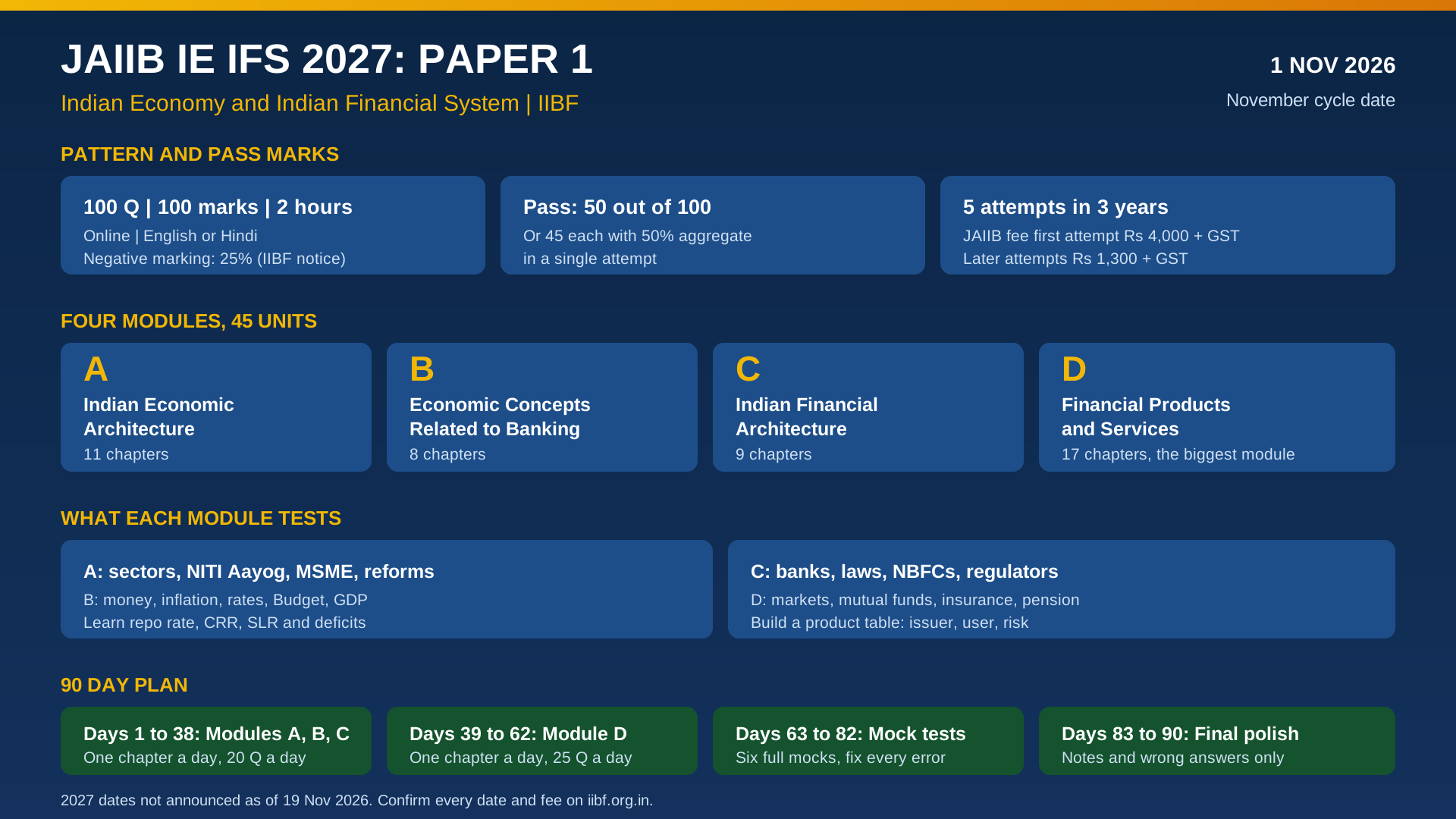
The JAIIB IE IFS 2027 paper, Indian Economy and Indian Financial System, is Paper 1 of JAIIB. It carries 100 objective questions for 100 marks, and you get two hours. IIBF held this paper on 1 November 2026 in the November cycle, the first of the four JAIIB papers. The paper has four modules: Indian Economic Architecture, Economic Concepts Related to Banking, Indian Financial Architecture, and Financial Products and Services. You pass with 50 marks, or with at least 45 marks in each paper and a 50 percent aggregate across all papers in a single attempt. This JAIIB IE IFS 2027 guide covers the full syllabus, the pattern, the way this paper differs from the other JAIIB papers, and a 90 day plan.
Bankers call this paper the most current affairs heavy paper in JAIIB, and they are right. The economy changes every year. The Budget changes tax and spending. The Reserve Bank of India changes rates. New financial products appear. The syllabus stays fixed, but the questions follow the news. A candidate who reads only the book will miss questions that a candidate who follows the news will answer in seconds. That gap decides many results.
Why IIBF put this paper first
IIBF revised the JAIIB syllabus in 2023, and the revision made Indian Economy and Indian Financial System the first paper. It replaced the earlier Legal and Regulatory Aspects paper in the first slot. The change tells you what IIBF values. A banker should understand the economy before learning banking operations. Loans, deposits, and interest rates all sit inside an economy, and a banker who cannot read the economy cannot price a loan well.
The paper serves a practical purpose in branch work. A branch officer who understands inflation can explain to a customer why deposit rates move. A credit officer who understands the priority sector can spot a loan that qualifies for priority sector treatment. An officer who understands the financial system can tell a customer where a mutual fund sits in the system and how it differs from a bank deposit. The paper turns everyday branch conversations into informed conversations.
The paper also sets up the other JAIIB papers. Principles and Practices of Banking assumes you know how the financial system works. Accounting and Financial Management for Bankers assumes you know what the money market and the capital market do. Retail Banking and Wealth Management assumes you know the products that Module D covers. A strong Paper 1 makes the other three papers easier, and a weak Paper 1 makes them harder. Start here, and start well.
Pattern and pass marks
IE and IFS follows the standard JAIIB pattern. You face 100 objective questions for 100 marks. You get two hours. The exam runs online at an IIBF centre. You choose English or Hindi at registration, and IIBF does not ordinarily permit a change later. Most trackers report no negative marking for JAIIB, but the official IIBF notice that introduced the revised syllabi prescribes negative marking at 25 percent of the marks allotted to the question, so a wrong answer on a one mark question costs a quarter mark. This guide follows the official IIBF notice, so read the latest IIBF notification before your exam to settle the point.
| Item | Detail |
|---|---|
| Paper number | Paper 1 of JAIIB |
| Questions | 100 objective questions |
| Marks | 100 marks |
| Time | 2 hours |
| November 2026 date | 1 November 2026 |
| Pass mark | 50 out of 100 |
| Aggregate route | 45 in each paper with 50 percent aggregate in one attempt |
| Medium | English or Hindi |
| Mode | Online |
The pass rule has two routes. You pass by scoring 50 marks out of 100 in this paper. You also complete JAIIB if you score at least 45 marks in each paper and an aggregate of 50 percent across all papers in a single attempt. The aggregate route helps a candidate who scores 46 in this paper but scores 60 or more in the others. Keep every paper above 45, and the aggregate rule can save a cycle.
IIBF gives you five attempts to complete JAIIB, within a maximum of three years from the date of registration for the first attempt, whichever comes earlier. The five attempts need not be consecutive. An attempt counts once you apply, whether you appear or stay away. Credits stay valid until the limit expires, so a paper you have passed stays passed. If you fail to complete JAIIB within three years or five attempts, you must re enrol afresh.
Class of pass depends on your first physical attempt only, which means an attempt in which you sat for at least one paper. First Class needs 60 percent or more in aggregate with a pass in every subject. First Class with Distinction needs 70 percent or more in aggregate and 60 or more in each subject. A strong first attempt in Paper 1 lifts your aggregate for the whole exam, so treat this paper as a scoring chance rather than a hurdle.
The November 2026 cycle ran the four JAIIB papers on 1, 22, 28, and 29 November 2026. Paper 1 came first, on 1 November 2026. The May 2026 cycle ran the papers in the first half of May, and Bankers Club puts the Paper 1 date at 3 May 2026. No 2027 schedule has been announced as of 19 November 2026, so do not trust any 2027 date you read on a coaching site. Check the IIBF website for the 2027 calendar when it appears.
Module A: Indian Economic Architecture
Module A covers the Indian economic architecture, and it carries 11 chapters in the IIBF course book. It opens with an overview of the Indian economy, then moves through the sectors of the economy, economic planning in India and NITI Aayog, the role of the priority sector and MSME in the Indian economy, and infrastructure including social infrastructure. It then covers climate change, sustainable development goals, issues facing the Indian economy, globalisation and its impact on India, economic reforms, foreign trade policy, foreign investments and economic development, and international economic organisations such as the World Bank and the International Monetary Fund.
Start Module A with the structure of the economy. Learn the three sectors: agriculture, industry, and services. Learn which sector employs the most people and which sector contributes the most to GDP. The two answers differ, and the exam asks about the gap. Agriculture employs the largest share of workers, while services contribute the largest share of output. That single fact explains much of Indian economic policy, including the focus on rural incomes and the push for manufacturing jobs.
Economic planning needs careful reading. The Planning Commission gave way to NITI Aayog, and the exam asks what changed. NITI Aayog works as a think tank and a policy body. It does not allocate plan funds the way the Planning Commission did. Learn the structure of NITI Aayog, its Governing Council, and its role in cooperative federalism. Learn the difference between a five year plan and the current system of three year action agendas and longer vision documents.
The priority sector and MSME chapter matters to every branch officer. Priority sector lending covers agriculture, micro enterprises, small enterprises, education, housing, social infrastructure, and renewable energy, among others. MSME stands for micro, small, and medium enterprises. Learn the investment and turnover limits that define a micro, small, and medium enterprise, because the exam asks for the limits. Learn the priority sector targets that banks must meet, and learn what happens when a bank falls short. Your branch targets come from this chapter, so the reading should feel familiar.
Infrastructure gets its own chapter, and it covers both physical and social infrastructure. Physical infrastructure covers transport, energy, and communications. Social infrastructure covers health and education. Learn the financing models for infrastructure, including public private partnerships. Learn why infrastructure projects need long term finance, and why banks find them hard to fund from short term deposits.
Globalisation, economic reforms, and foreign trade form the second half of Module A. Learn the 1991 reforms: liberalisation, privatisation, and globalisation. Learn the difference between foreign direct investment and foreign portfolio investment. Learn the main export and import items, and learn the role of the World Trade Organisation. Learn the World Bank and the International Monetary Fund as separate bodies with separate jobs: the World Bank lends for development projects, and the International Monetary Fund lends to countries that face balance of payments trouble.
Climate change and sustainable development goals close the module. Learn the 17 sustainable development goals by theme, and learn the ones that touch banking: poverty, hunger, clean energy, decent work, and climate action. The exam asks about the goals in simple ways, such as which goal covers clean water or quality education. A single reading of the goal list, done well, answers those questions.
Module B: Economic Concepts Related to Banking
Module B covers economic concepts related to banking, and it carries 8 chapters. It opens with the fundamentals of economics, types of economies, microeconomics and macroeconomics. It then covers supply and demand, money supply and inflation, theories of interest, business cycles, monetary policy and fiscal policy, the system of national accounts and GDP concepts, and the Union Budget.
Supply and demand sounds simple, and the exam tests it in banking situations. Learn how a rise in the repo rate changes the demand for loans. Learn how a fall in deposit rates changes the supply of deposits. Learn the difference between a movement along a curve and a shift of the curve. The exam likes questions that put a banking fact inside an economics frame.
Money supply and inflation form the core of this module. Learn the measures of money supply: M1, M2, M3, and M4. Learn the components of each measure. Learn the difference between demand pull inflation and cost push inflation. Learn the consumer price index and the wholesale price index, and learn which one the Reserve Bank of India targets. The Reserve Bank of India targets consumer price inflation, and the exam asks that fact in many forms.
Theories of interest matter because banking runs on interest. Learn the main theories at a simple level: the classical theory, the loanable funds theory, and the liquidity preference theory. You do not need a degree in economics. You need to match each theory to its main idea and its main thinker. Learn the difference between the nominal rate of interest and the real rate of interest. The real rate equals the nominal rate minus inflation, and that subtraction explains why a high deposit rate can still lose money in real terms when inflation runs higher.
Business cycles cover expansion, peak, contraction, and trough. Learn the signs of each phase. Learn how banks behave in each phase: lending grows in expansion, and non performing assets rise in contraction. Learn the role of the central bank in smoothing the cycle through monetary policy.
Monetary policy and fiscal policy deserve the most time in Module B. Monetary policy comes from the Reserve Bank of India. Learn the repo rate, the reverse repo rate, the marginal standing facility, the cash reserve ratio, and the statutory liquidity ratio. Learn what each tool does to liquidity. Learn the Monetary Policy Committee, its composition, and its meeting cycle. Fiscal policy comes from the government. Learn the Union Budget, the fiscal deficit, the revenue deficit, and the primary deficit. Learn the difference between direct taxes and indirect taxes.
The system of national accounts and GDP concepts closes the module with the numbers that describe the economy. Learn GDP, GNP, NNP, national income, and per capita income. Learn GDP at market prices and GDP at factor cost. Learn real GDP and nominal GDP. Learn the three methods of measuring GDP: production, income, and expenditure. The exam asks for definitions and for the formula that links the measures.
The Union Budget chapter ties the module together. Read the latest Budget every year, and note the fiscal deficit target, the capital expenditure figure, and the major schemes for agriculture, MSME, and infrastructure. The exam asks about the Budget in the cycle after it is presented, so a Budget read in February pays off in a May or November exam.
Module C: Indian Financial Architecture
Module C covers the Indian financial architecture, and it carries 9 chapters. It opens with an overview of the Indian financial system, then covers the Indian banking structure, banking laws, development financial institutions, microfinance institutions, non banking financial companies, insurance companies, financial regulators and their roles, and reforms and developments in the banking sector.
Start with the structure of the financial system. Learn the four parts: financial institutions, financial markets, financial instruments, and financial services. Learn how money moves from savers to borrowers through banks and through markets. Learn the difference between the money market and the capital market. The money market handles short term funds, and the capital market handles long term funds.
The Indian banking structure needs a clear map. Learn the Reserve Bank of India at the top, then commercial banks, then cooperative banks. Commercial banks split into public sector banks, private sector banks, foreign banks, regional rural banks, small finance banks, and payments banks. Learn what each type can do and cannot do. Payments banks, for example, can accept deposits up to a limit but cannot lend. Small finance banks serve unserved and underserved sections. Regional rural banks serve rural areas with sponsorship from a public sector bank.
Banking laws form a short but high scoring chapter. Learn the Reserve Bank of India Act 1934 and the Banking Regulation Act 1949. Learn the main sections that the exam asks about: the power of the Reserve Bank of India to inspect banks, to issue directions, and to impose penalties. Learn the Banking Regulation Act provisions on licensing, capital, and management. Skip memorising section numbers for every provision. Learn the ones the book highlights.
Development financial institutions, microfinance institutions, and non banking financial companies each get a chapter. Learn the role of development financial institutions in long term project finance. Learn the microfinance model: small loans to groups, joint liability, and high repayment rates. Learn the difference between a bank and a non banking financial company: a non banking financial company cannot accept demand deposits, and it does not form part of the payment and settlement system in the same way a bank does.
Insurance companies and financial regulators close the module. Learn the Insurance Regulatory and Development Authority of India and its role. Learn the Securities and Exchange Board of India, the Pension Fund Regulatory and Development Authority, and the Insolvency and Bankruptcy Board of India. Learn which regulator covers which market. The exam asks regulator matching questions every cycle, and they are easy marks if you have a clear table in your notes.
Reforms and developments in the banking sector form the last chapter. Learn the Narasimham Committee recommendations, the move to Basel norms, the prompt corrective action framework, and the Insolvency and Bankruptcy Code. Learn the recent mergers of public sector banks. These topics link the history of banking reform to the branch you work in today.
Module D: Financial Products and Services
Module D covers financial products and services, and it carries 17 chapters, the most of any module. It opens with financial markets, then covers the money market, capital markets and stock exchanges, fixed income markets, foreign exchange markets, and the interconnectedness of markets. It then covers merchant banking, derivatives, factoring, forfaiting and TReDS, venture capital, lease finance and hire purchase, credit rating and credit scoring, mutual funds, insurance products, pension products, para banking services by banks, and REITs and InvITs.
Module D rewards a product by product approach. Take one product per day. Learn what it is, who uses it, and what risk it carries. A mutual fund pools money from many investors and invests it in securities. A derivative draws its value from an underlying asset. A credit rating grades the creditworthiness of a borrower or an instrument. A REIT, or real estate investment trust, lets investors hold property assets in small units. An InvIT, or infrastructure investment trust, does the same for infrastructure assets.
The money market chapter covers treasury bills, commercial papers, certificates of deposit, call money, and repo transactions. Learn the maturity of each instrument and the issuer of each instrument. Treasury bills come from the government. Commercial papers come from companies. Certificates of deposit come from banks. The exam asks these matching questions often.
The capital market chapter covers stock exchanges, the primary market, and the secondary market. Learn the difference between an initial public offer and a follow on public offer. Learn the role of the Securities and Exchange Board of India in the capital market. Learn the main indices: the Sensex and the Nifty. Learn what a circuit breaker does.
Fixed income markets cover debt and bond markets. Learn the difference between a government security and a corporate bond. Learn the link between bond prices and interest rates: when rates rise, bond prices fall. Learn the yield curve and what an inverted yield curve signals. These ideas appear in both Module D and the CAIIB papers, so learn them well now.
The foreign exchange market chapter covers exchange rates, the participants in the market, and the role of the Reserve Bank of India in managing the rupee. Learn the difference between a fixed exchange rate and a floating exchange rate. Learn the current account and the capital account. Learn the main items in each account.
Merchant banking, derivatives, factoring, forfaiting, and TReDS cover services that banks offer to companies. Learn what a merchant banker does in an issue of shares. Learn the four main derivatives: forwards, futures, options, and swaps. Learn factoring as the sale of receivables, and forfaiting as the sale of export receivables. Learn TReDS as the platform where MSME receivables trade.
Venture capital, lease finance, and hire purchase cover alternate finance. Learn venture capital as funding for early stage companies with high growth potential. Learn lease finance as the use of an asset for rent without ownership. Learn hire purchase as the use of an asset with ownership passing after the last instalment. Learn credit rating and credit scoring as tools that grade risk, and learn the main rating agencies in India.
Mutual funds, insurance products, and pension products cover the products that banks sell to retail customers. Learn the types of mutual funds: equity, debt, hybrid, and index funds. Learn the difference between an open ended fund and a close ended fund. Learn term insurance, endowment plans, and unit linked insurance plans. Learn the National Pension System and the Atal Pension Yojana. Your branch sells these products, so the chapter should read like a product manual you already know.
Para banking services by banks close the module with the services banks offer beyond deposits and loans: bancassurance, mutual fund distribution, demat services, and pension distribution. Learn the rules that govern each service. Banks earn fee income from these services, and the exam asks how.
How IE and IFS differs from the other JAIIB papers
Paper 1 differs from Paper 2 in scope. Paper 2, Principles and Practices of Banking, tests banking operations: deposits, loans, clearing, and customer service. Paper 1 tests the economy and the system in which those operations sit. Paper 2 asks how a bank opens an account. Paper 1 asks why the central bank sets the rate that shapes the account. A candidate who knows only branch procedure will score well in Paper 2 and poorly in Paper 1.
Paper 1 differs from Paper 3 in method. Paper 3, Accounting and Financial Management for Bankers, tests numerical skill: balance sheets, ratios, and capital budgeting. Paper 1 tests understanding: concepts, institutions, and linkages. Paper 3 has right answers that you calculate. Paper 1 has right answers that you recall and apply. Give Paper 3 more sums and Paper 1 more reading and revision.
Paper 1 differs from Paper 4 in freshness. Paper 4, Retail Banking and Wealth Management, tests products and processes that change slowly. Paper 1 tests an economy that changes every quarter. A Paper 4 note from last year still works. A Paper 1 note from last year misses the latest Budget, the latest monetary policy, and the latest market data. Refresh your Paper 1 notes in the last month before the exam.
Paper 1 also differs in its mix of memory and logic. Module A and Module C ask for memory: names, dates, limits, and structures. Module B asks for logic: how a rate change moves through the economy. Module D asks for both: product features and the logic of risk and return. Study Module A and Module C with flashcards. Study Module B with diagrams. Study Module D with product tables.
The current affairs habit
Paper 1 punishes candidates who stop reading the news, so build a daily habit. Read the business page every morning. Note the repo rate after each monetary policy meeting. Note the fiscal deficit target after each Budget. Note the GDP growth figure after each quarterly release. Note any change in priority sector rules or MSME limits. Write each fact in a single line in a notebook, with the date. Review the notebook every Sunday.
Follow the Reserve Bank of India and the government as your two main sources. The Reserve Bank of India publishes the monetary policy statement, the financial stability report, and the annual report. The government publishes the Union Budget and the Economic Survey. Read the summaries of these documents. You do not need to read every page. You need the headline numbers and the policy direction.
IIBF sets a cut off for the rules it examines. For the CAIIB December 2026 papers, the cut off was 30 June 2026, as reported by SJA Learning. JAIIB follows a similar practice. Facts that change after the cut off stay out of the exam. That rule helps you, because it limits the news you must track. Ask your coaching source or the IIBF notification for the cut off date of your cycle, and focus your news reading on the period before it.
A 90 day plan for Paper 1
Ninety days is enough for JAIIB IE IFS 2027 if you study every day, and the plan below fits around branch work. It gives the most time to Module D, because Module D has the most chapters, and the second most time to Module A. It leaves the last 20 days for mock tests and revision.
Days 1 to 12 belong to Module A. Read one chapter per day. Write a one page note per chapter. Learn the sector shares, the NITI Aayog structure, the priority sector targets, and the MSME limits by heart. Solve 20 questions per day from a question bank. Mark every question you get wrong, and write the correct fact beside it.
Days 13 to 24 belong to Module B. Read one chapter per day. Draw the diagrams for supply and demand, for the business cycle, and for the transmission of monetary policy. Learn the money supply measures, the inflation indices, and the deficit definitions. Solve 20 questions per day. Practise the GDP formulas until you can write them from memory.
Days 25 to 38 belong to Module C. Read one chapter per day, with two days for the banking structure chapter. Build a table of regulators and their markets. Build a table of bank types and their powers. Learn the two banking laws and their main provisions. Solve 20 questions per day.
Days 39 to 62 belong to Module D. Read one chapter per day, with extra days for the money market, the capital market, and mutual funds. Build a product table: product, issuer, user, maturity, and risk. Solve 25 questions per day, because Module D carries the most questions in the exam.
Days 63 to 72 belong to revision round one. Take three full mock tests of 100 questions in two hours. Score each test. List every wrong answer with the reason. Relearn the weak chapters. Read your Module A and Module C notes every morning, because memory fades fastest there.
Days 73 to 82 belong to revision round two. Take three more full mock tests. Your score should rise by at least 10 marks. If Module D still scores low, give it three extra days and cut time from your strongest module. Read the latest Budget summary and the latest monetary policy statement once more.
Days 83 to 90 belong to final polish. Read only your notes and your wrong answer list. Take one last mock test if you have the energy, but stop taking new tests two days before the paper. Sleep well the night before. Reach the centre early. Carry your admit card and a valid photo identity card.
Mistakes that cost marks in Paper 1
The first mistake is treating Paper 1 as general knowledge. The paper tests the syllabus, and the syllabus has 45 units across four modules. General knowledge helps, but it cannot replace the book. Read the IIBF course book first, and use the news to update it.
The second mistake is skipping Module D because it looks long. Module D has 17 chapters, and candidates often leave it for the end and then run out of time. Module D carries a large share of the questions. Start Module D early, or at least start it on schedule. A chapter a day finishes it in under three weeks.
The third mistake is memorising numbers without dates. A GDP figure from 2023 will not answer a question about 2026. Write the date beside every number in your notes. When a number changes, cross out the old one and write the new one with the new date.
The fourth mistake is ignoring the aggregate rule. A score of 46 in Paper 1 still passes if every paper scores at least 45 and the aggregate reaches 50 percent. Many candidates abandon Paper 1 after a bad mock test. Keep every paper above 45, and let your strong papers carry the aggregate.
The fifth mistake is reading without solving questions. The exam asks questions, so practise questions. Solve at least 1,500 questions for Paper 1 alone before the exam. That number works out to about 17 questions a day over 90 days. Use mock tests for the last month, and use chapter tests for the first two months.
Where this paper fits in your banking career
Paper 1 builds the economic sense that every banking exam rewards, and it links to the exams that brought you into banking. Clerks who entered through SBI Clerk 2027 or IBPS RRB Clerk 2027 often find the priority sector and MSME chapters familiar from their induction training. Specialist officers who joined through IBPS SO 2027 use the financial markets chapters in their daily work. Economics graduates who cleared RBI Grade B DEPR 2027 find Module B the easiest part of JAIIB, and officers who aim for NABARD Grade B 2027 or PFRDA Grade A 2027 already know much of Module C. Bankers who watch IRDAI Assistant Manager 2027, SIDBI Grade A 2027, and IFSCA Grade A 2027 will see the same regulators and the same products in those syllabi. State service aspirants who read UPPSC PCS 2027 material will find Module A overlaps with the economy portion of that syllabus. Each of those exams has its own guide on this site, and each one rewards the same habit: steady daily study with mock tests.
What to do next
Open the IIBF website and read the latest JAIIB notification. Confirm your membership, your medium, and the Paper 1 date for your cycle. Buy the IIBF course book for Indian Economy and Indian Financial System. Start Module A tomorrow for JAIIB IE IFS 2027, one chapter a day, with 20 questions before you sleep. The paper rewards the candidate who starts early and reads the news every day, and that candidate can be you.
Sources
IIBF official website at iibf.org.in, read on 19 November 2026. IIBF JAIIB Rules and Syllabus 2026, as reported by SJA Learning, read on 20 September 2026. Bankers Club JAIIB IE and IFS syllabus 2026 page, retrieved 19 November 2026. Oliveboard JAIIB IE and IFS syllabus and JAIIB syllabus pages, retrieved 19 November 2026. Adda247 JAIIB syllabus page, retrieved 19 November 2026. SJA Learning JAIIB IE and IFS page and CAIIB guide, retrieved 19 November 2026. Testbook JAIIB exam date and registration pages, retrieved 19 November 2026. Guidely JAIIB salary increment page, published 13 November 2026.