
About Delhi Judicial Service 2027 Exam Series
📖 Table of Contents
- Delhi Judicial Service 2027 notification has not come out yet
- What this exam gives you: a Civil Judge chair in Delhi
- Three stages, and only two of them count for rank
- Prelims: 200 questions, 200 marks, one 60 percent wall
- Mains: four papers, 850 marks, the paper most candidates misjudge
- Viva voce: 150 marks of temperament
- Who can apply: age 32, an LLB, enrolment
- The practice rule changed three times in 18 months
- BNS, BNSS and BSA now sit inside the syllabus
- What the job pays
- Books that cover this syllabus without waste
- A 90 day plan for a working candidate
- Seven mistakes that cost good candidates a rank
- If Delhi stays silent, these exams keep your year alive
- Sources
Delhi Judicial Service 2027: Pattern, Syllabus, Eligibility, Age Limit and Cut Off
The Delhi Judicial Service 2027 notification has not come out yet. The High Court of Delhi released the last cycle in November 2023 for 53 posts of Civil Judge (Junior Division), and no fresh advertisement for this service had appeared on the court website as of 19 November 2026. That single fact shapes everything in this guide. You prepare from the last notified pattern, you watch the practice rule that changed three times in 18 months, and you refuse to plan around dates nobody has announced.
This guide gives you the full Delhi Judicial Service 2027 picture on that honest basis. It covers the three stage selection, the 200 mark Prelims, the four paper Mains worth 850 marks, the 150 mark viva voce, the age limit of 32 plus the LLB and enrolment rules, the pay scale, the new criminal codes, the last cycle cutoff, a 90 day plan and the mistakes that push good candidates out of the final list. Every number here traces back to a source named at the end, and every place where sources disagree says so in plain words.
Delhi Judicial Service 2027 notification has not come out yet
Say it plainly so no coaching advertisement can confuse you. The High Court of Delhi has not released a Delhi Judicial Service notification for 2026 or 2027 as of 19 November 2026. Trackers that checked the court website on that date found no open Civil Judge advertisement.
The 2026 notification pages on the big preparation sites all carry the same line: awaited. Do not pay any fee, do not fill any form, and do not trust any date that cites no notification number.
The last real cycle tells you how this exam moves. The High Court issued the 2023 notification on 6 November 2023 for 53 vacancies: 44 existing and 9 anticipated. Applications ran from 7 November to 29 November 2023.
The Prelims first carried a date of 10 December 2023, then moved to 17 December 2023. The Prelims result came on 2 February 2024.
Mains ran on 13 and 14 April 2024. The Mains result came on 7 January 2025, and 153 candidates reached the viva voce. The final result came on 4 March 2025, and a court notification dated 13 August 2025 recorded 53 candidates recommended for appointment.
Read those two dates with care. One marks the result declaration, the other marks the formal recommendation record, and guides that quote only one of them create needless confusion.
Before 2023, the cycle before that advertised 123 posts in March 2022, and the 2019 cycle advertised 45 posts. Vacancies swing widely from cycle to cycle, so nobody can predict the 2027 number from history. A tracker estimate of 60 to 80 posts for 2026 floats around the web. Treat it as a guess, because that is all it is.
One more confusion needs clearing up before you read further. The Delhi Higher Judicial Service Examination 2026 is a different exam. It advertised 27 posts for experienced advocates and judicial officers, took applications from 1 July to 15 July 2026, and held its Prelims on 26 July 2026.
If a page shows you July 2026 dates and calls them DJS dates, it has mixed the two services. This guide covers the entry level Civil Judge (Junior Division) exam only.
What this exam gives you: a Civil Judge chair in Delhi
Clear this exam and you join the Delhi Judicial Service as a Civil Judge (Junior Division), also called Judicial Magistrate First Class in the criminal courts. You hear civil suits and criminal trials in the district courts of Delhi, at Tis Hazari, Patiala House, Saket, Rohini, Dwarka, Karkardooma or Rouse Avenue. The work sits at the base of the justice system, where most citizens meet a court for the first time.
The High Court of Delhi conducts the whole recruitment itself, under the Delhi Judicial Service Rules, 1970. No public service commission stands between you and the court.
Delhi draws the sharpest law graduates in the country for three reasons. The posting stays in the national capital, the pay starts at the top of the national judicial matrix, and the bar around the exam keeps the peer group strong. That third reason cuts both ways.
The Prelims qualifying mark of 60 percent for general candidates stands higher than the 50 percent most states ask, and the 2023 Prelims cutoff for general candidates closed at 160.75 out of 200. You need accuracy under pressure, and you need it across a very wide syllabus.
Three stages, and only two of them count for rank
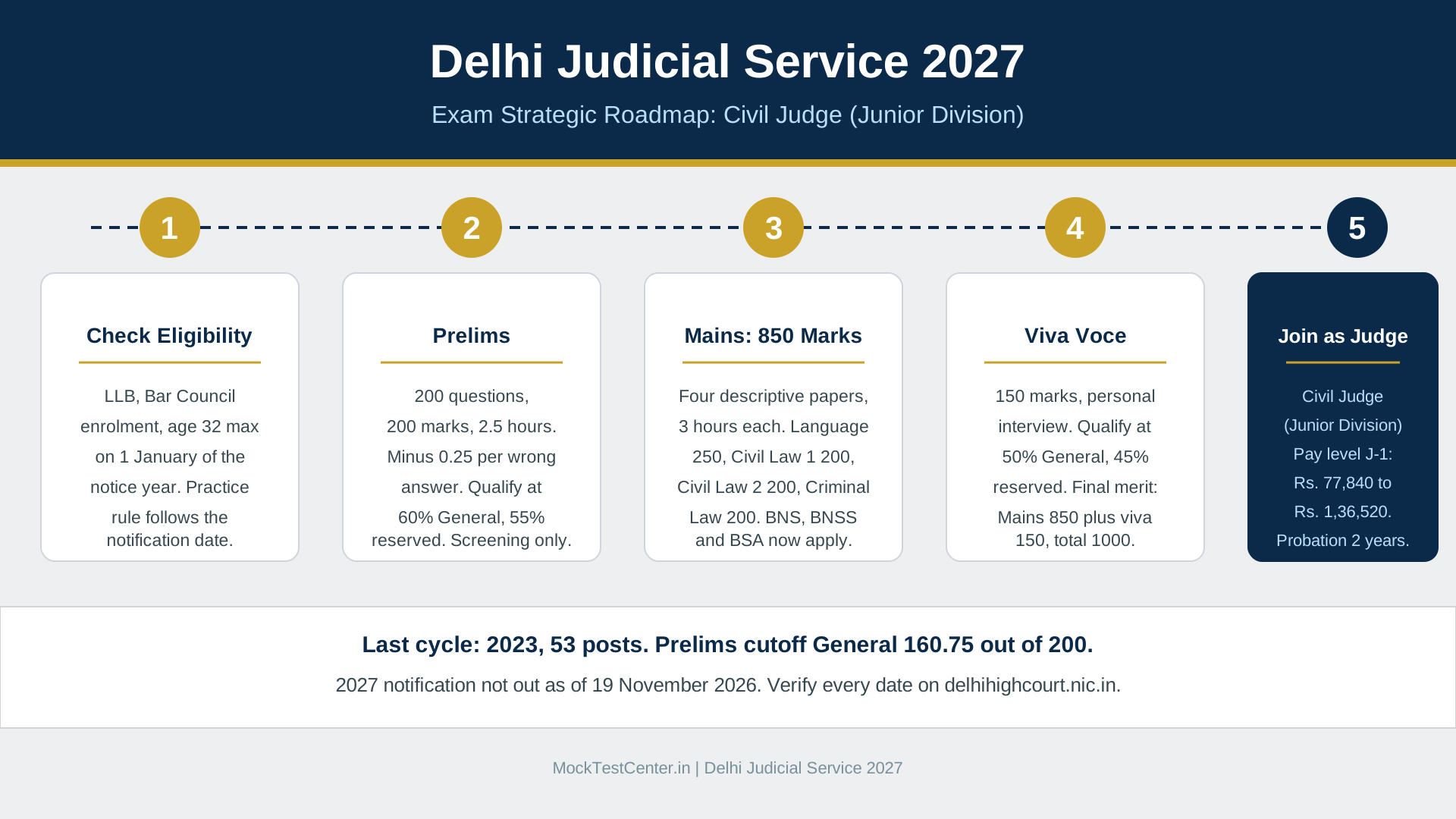
The DJS exam runs in three stages. Prelims screens. Mains ranks. The viva voce tests temperament.
Prelims marks carry zero weight in the final merit list. A candidate who tops Prelims and slips in Mains loses to a candidate who only scraped through Prelims and wrote strong Mains papers. That rule should change how you split your time. Give Prelims the respect it demands, but give Mains the hours that decide your rank.
| Stage | Format | Marks | What it decides |
|---|---|---|---|
| Preliminary Examination | Objective, one paper | 200 | Screening only, who reaches Mains |
| Main Examination | Descriptive, four papers | 850 | Rank, with viva voce |
| Viva Voce | Personal interview | 150 | Rank, with Mains |
| Final merit | Mains plus viva voce | 1000 | Selection and rank |
Each stage has its own qualifying line, and clearing one stage never carries marks into the next. Candidates who miss the Mains aggregate by a few marks fall out entirely, however well they scored in Prelims. The table above stays the same across recent cycles, and the 2027 notification will confirm it or change it. Check the notification the day it appears.
Prelims: 200 questions, 200 marks, one 60 percent wall
Prelims is a single objective paper of 200 questions, each worth one mark, to finish in 2 hours 30 minutes. Every wrong answer costs 0.25 marks. The paper tests general legal knowledge and aptitude plus English and objective type legal problems across a long list of subjects.
The 2023 notification fixed the qualifying line at 60 percent for general candidates and 55 percent for reserved categories, meaning Scheduled Castes and Scheduled Tribes, with eligible Persons with Disabilities included. That line is a floor. The actual cutoff runs higher, because only a fixed number of candidates can sit for Mains.
The 2023 Prelims cutoff for general candidates closed at 160.75 out of 200, a figure the High Court published with the result on 2 February 2024. Read that number twice. A candidate needed roughly four out of every five marks to reach Mains.
The 60 percent rule lets you into the race only if the cutoff falls that low, and in 2023 it fell nowhere near that low. Aim for 165 or above in your mock tests, and treat anything under 150 as a warning sign rather than a safe score.
Speed shapes this paper as much as knowledge does. Two hundred questions in 150 minutes gives you 45 seconds per question, and the negative marking punishes fast guesses. Candidates who attempt all 200 questions in the DJS exam usually lose more to wrong answers than they gain from lucky hits.
A better rule: attempt the questions you know, mark the ones you can narrow to two options, and leave the pure guesses alone. Four wrong guesses erase one right answer, so a guess needs better than even odds to pay.
The Prelims syllabus names the Constitution of India, the Code of Civil Procedure 1908, the Code of Criminal Procedure 1973 alongside its successor, the Indian Penal Code alongside the Bharatiya Nyaya Sanhita, the Indian Evidence Act alongside the Bharatiya Sakshya Adhiniyam, the Indian Contract Act 1872; the Limited Liability Partnership Act 2008; the Arbitration and Conciliation Act 1996; the Specific Relief Act 1963; the Limitation Act 1963; the Protection of Children from Sexual Offences Act 2012; and the Commercial Courts Act 2015. General knowledge, current legal affairs and English round out the paper. The official syllabus also names both old and new criminal laws, so learn the new sections with the old section beside them.
Constitution and criminal law carry the heaviest weight in most analyses of past papers, with civil procedure close behind. But DJS Prelims spreads marks widely enough that no single subject rescues a weak paper. A candidate strong in Constitution and weak in Limitation or the Commercial Courts Act bleeds marks in exactly the short questions that decide the cutoff. Cover every named Act at least once, and revise the small Acts in the last fortnight, because short Acts produce short questions that most candidates skip.
Mains: four papers, 850 marks, the paper most candidates misjudge
Mains is a descriptive written exam of four papers, each running 3 hours. Paper 1, General Legal Knowledge and Language, carries 250 marks. Paper 2, Civil Law 1, carries 200 marks. Paper 3, Civil Law 2, carries 200 marks.
Paper 4, Criminal Law, carries 200 marks. The total is 850. Mains has no negative marking, because you write answers, and the examiners read them. Your handwriting shows on the page, and so do your structure and your command of the law.
Paper 1 splits into two sections. Section 1, General Legal Knowledge, carries 100 marks and tests current legal affairs plus important judgments and constitutional developments. Section 2, Language, carries 150 marks and tests essay writing, precis writing, translation from English to Hindi and Hindi to English, and general English proficiency.
Most candidates misjudge this paper badly. They treat it as the easy paper and give it the least preparation, then lose 40 or 50 marks to rivals who practised essays and translations every week. In a merit list decided by single marks, Paper 1 often separates the selected from the waiting list.
Paper 2, Civil Law 1, covers substantive civil law. The syllabus names the Indian Contract Act, the Sale of Goods Act, the Specific Relief Act, Hindu law and Muslim law, the law of torts, the Delhi Rent Control Act, and the Delhi Municipal Corporation Act and New Delhi Municipal Council Act. Paper 3, Civil Law 2, covers procedural civil law: the Code of Civil Procedure, the Law of Evidence, the Limitation Act and the Registration Act. Paper 4, Criminal Law, covers criminal procedure, substantive criminal law and evidence in criminal matters, now read through the three new codes: the Bharatiya Nyaya Sanhita, the Bharatiya Nagarik Suraksha Sanhita and the Bharatiya Sakshya Adhiniyam.
One naming trap deserves a warning. Some preparation sites list the fourth Mains paper as Civil Law 3. That label is wrong.
The 2023 notification and the standard pattern name four papers, and the fourth is Criminal Law. A few sites also split Paper 1 into two separate papers and call the exam five papers. The mark total stays 850 either way, so count papers by marks, and you will see the real structure.
Now the qualifying marks, where honest guides must flag a conflict. The 2023 notification set the Mains qualifying line at 40 percent in each paper and 50 percent in aggregate for general candidates, with 35 percent in each paper and 45 percent in aggregate for SC and ST candidates and for eligible PwD candidates. Several preparation sites repeat those figures. But a Delhi High Court judgment dated 6 February 2026, arising from the 2023 cycle, records the Mains qualifying rule as 35 percent in each paper and 45 percent in aggregate, without splitting the figures by category in that passage.
The two versions may describe different categories, or the court may have restated the rule for the petitioner before it. This guide states both and asks you to treat the 2027 notification as the final word. Do not build your target score on the lower figure. Aim for 50 percent in every paper and 55 percent overall, and the conflict stops mattering to you.
Mains rewards a specific skill that Prelims never tests: judgment writing under time pressure. You must state the issue, cite the provision, apply the facts and reach a reasoned answer, all inside a fixed word limit and a fixed hour count. Candidates who know the law but write in long unbroken paragraphs lose marks to candidates who write shorter, headed, step by step answers.
Practise one full answer a day from the second month of preparation, in your own hand, with a timer running. Your first ten answers will feel slow. Your fiftieth will feel like the exam.
Language deserves its own warning inside Mains. Paper 1 asks for translation both ways between English and Hindi. Candidates from English medium schools often lose marks on the Hindi to English passage, and candidates from Hindi medium schools often lose marks on the English essay.
Both groups need the same cure: translate one short legal passage each way every day, and read one good editorial a day in the weaker language. The skill builds slowly, and it refuses to build in the last week.
Viva voce: 150 marks of temperament
The viva voce is a personal interview worth 150 marks. The High Court calls candidates who clear Mains, in order of merit, and a panel of judges tests legal knowledge and current affairs and personality, plus suitability for judicial office. The qualifying line in viva voce is 50 percent for general candidates and 45 percent for reserved categories. In the 2023 cycle, 153 candidates reached this stage for 53 posts, so roughly one in three interview candidates took a chair.
Interview panels in Delhi ask about the law you studied, the judgments of the last year, and the practical problems of a trial court. They also watch how you handle a question you cannot answer. A candidate who says plainly that she does not know, and then reasons aloud from first principles, often scores better than a candidate who bluffs with confidence.
The panel has heard every bluff before. It has also heard honest reasoning, and it rewards that.
Prepare for the interview from the day you start Mains, because the gap between the Mains result and the interview runs short. Keep a notebook of the major judgments of the last twelve months, one line each, with the holding and the reason. Read the Delhi High Court cause lists and the district court news with a working judge in mind. And practise speaking your answers aloud, because knowledge that lives only on paper freezes when a judge asks you to explain it in words.
Who can apply: age 32, an LLB, enrolment
Eligibility for Delhi Judicial Service 2027 rests on Rule 14 of the Delhi Judicial Service Rules, 1970, as amended. Three conditions decide it. You must be a citizen of India.
You must hold a law degree that qualifies you for enrolment as an advocate under the Advocates Act, 1961. And you must meet the age limit and the practice condition in force for that notification.
The degree rule is simple. A three year LLB or a five year integrated LLB from a university recognised by the Bar Council of India qualifies you. No minimum percentage in LLB applies, and no LLM is needed.
Final year students do not qualify, because the degree and the Bar Council enrolment must stand complete by the last date for applications. Enrol with your State Bar Council as soon as you graduate, because enrolment paperwork takes weeks and the application window in 2023 lasted only 23 days.
The age limit is a maximum of 32 years on 1 January of the year in which applications are invited. There is no minimum age. The reference date moves with the notice, so if the High Court advertises in February 2027, your age counts as on 1 January 2027. Age relaxation adds 5 years for SC and ST candidates, taking the limit to 37, and 5 years for ex servicemen and Short Service Commissioned Officers.
Persons with Disabilities get 10 years in the general category, taking the limit to 42, and 15 years for SC and ST candidates with disability, taking the limit to 47. Delhi Judicial Service gives no age relaxation to OBC candidates, a point that surprises candidates who come from states where OBC relaxation is routine. There is no limit on the number of attempts, so long as you stay inside the age limit.
Character and fitness form part of the rules too. The notification asks for a certificate of good character, and the High Court verifies antecedents before appointment. A pending criminal case or a disciplinary record can end a candidature even after selection, so disclose what the form asks for and keep your record clean.
One practical check before you apply: confirm that your enrolment certificate, your degree certificate and your caste or disability certificate, if any, all carry the same name spelling and the same date of birth. Mismatches across documents cause more application rejections than most candidates expect, and the short application window leaves little time to fix them.
The practice rule changed three times in 18 months
This section matters more than any other in this guide, because most pages on the web now carry an outdated version of the rule. The eligibility rule on practice at the Bar moved three times between May 2025 and August 2026, and a fourth development in a Bombay High Court case in late 2026 added a further twist. Read the timeline, then apply it to your own situation.
On 20 May 2025, the Supreme Court decided All India Judges Association v. Union of India and restored a minimum of three years of practice at the Bar for Civil Judge (Junior Division) exams across India. The court counted practice from the date of provisional enrolment as an advocate, and it said the rule would govern future recruitment cycles only, so cycles already underway stayed untouched. Delhi followed by amending Rule 14 on 6 February 2026, and the amended rule asked for not less than three years of practice as an advocate on the last date for applications.
On 21 August 2026, the Supreme Court changed course in Bhumika Trust v. Union of India, citation 2026 INSC 904, decided by a 2 to 1 majority. The court kept a practice condition in substance but cut it to one year, and it built a transition around that cut. For notifications issued up to 31 March 2027, all law graduates stay eligible without practice, and the court treats them as having completed one year of practice.
For notifications issued from 1 April 2027 onward, candidates need at least one year of actual practice at the district court level. Selected candidates then complete one year of training at a State Judicial Academy and one year of law clerkship under judicial supervision, and the court treats those two years as the balance of the practice the 2025 judgment had wanted. The scheme runs for five years from the judgment date.
Apply that to Delhi. If the High Court issues the next Civil Judge notification on or before 31 March 2027, fresh law graduates can apply with no practice at all. If the notification comes on or after 1 April 2027, you need one year of actual district court practice before you apply.
The date of the notification decides it, and the year you graduated does not. A candidate who enrols in January 2027 and sees a notification in February 2027 applies as a fresh graduate. The same candidate facing a notification in May 2027 needs a year of practice first.
One more twist arrived in November 2026, and it shows why you must read the notification rather than a summary. The Bombay High Court upheld a Maharashtra corrigendum that limited the deemed one year practice benefit to law graduates who had obtained their degrees before 22 August 2025. The court read the Bhumika Trust directions as a whole and held that the deemed benefit rested on the year that had passed since the 2025 judgment. That ruling binds Maharashtra recruitment, and it does not bind Delhi directly.
Still, it signals that High Courts may read the transition narrowly, so Delhi candidates should enrol early, keep proof of practice from day one, and read the Delhi notification line by line when it appears. If you graduated in 2026, enrol now, practise in a district court, and keep a diary of your appearances. The diary costs nothing and it may decide your eligibility.
For comparison, other states run their own Civil Judge exams under the same Supreme Court framework, and their notifications will each state their own practice position. Madhya Pradesh runs the MP Civil Judge 2027 exam, Bihar runs the Bihar Judicial Service 2027 exam, Rajasthan runs the Rajasthan Judicial Service 2027 exam, and Haryana runs the Haryana Judicial Service 2027 exam. The Supreme Court framework applies to all of them, but each High Court or commission writes its own notification, so never carry a Delhi rule into another state without checking that state.
BNS, BNSS and BSA now sit inside the syllabus
On 1 July 2024, three new criminal codes came into force across India. The Bharatiya Nyaya Sanhita replaced the Indian Penal Code of 1860. The Bharatiya Nagarik Suraksha Sanhita replaced the Code of Criminal Procedure of 1973.
The Bharatiya Sakshya Adhiniyam replaced the Indian Evidence Act of 1872. Cases for offences before that date still run under the old codes, and cases for offences on or after that date run under the new codes. A Civil Judge in Delhi now applies both sets of law every week, because old cases take years to finish.
The Delhi syllabus names both old and new codes, so your preparation must carry both. Learn the new section beside the old section for every provision you study. The BNS has 358 sections against 511 in the old IPC, so the code is shorter but the changes run deep. Sedition under section 124A of the IPC is gone, and section 152 of the BNS punishes acts that endanger the sovereignty, unity or integrity of India.
Organised crime appears as a named offence in section 111 of the BNS, and a terrorist act appears in section 113. Community service now counts as a punishment for petty offences. The BNSS brings Zero FIR and e-FIR, a trial in absentia under section 356 for proclaimed offenders, and a chargesheet clock of 90 days with an extension up to 180 days. Forensic examination is mandatory for offences carrying seven years or more.
Examiners love this transition, because it tests whether you studied the current law or last year notes. Expect Prelims questions that ask for the new section number, and expect Mains problems that turn on the difference between the old and new provision. A candidate who writes IPC 302 for murder in a Mains answer about an offence from 2025 shows the examiner that the notes are old.
Keep a two column table for the forty provisions that appear most often, old section on the left and new section on the right, and revise it weekly. Two columns beat a thick book here, because the exam rewards quick recall of the new number.
One caution on section numbers. Sources disagree on a few conversions, and one widely shared MCQ set lists murder under a section that other guides place elsewhere. Do not trust a single conversion table. Check each number against the bare Act before you write it in a Mains answer, and cite the provision you verified rather than the one a guide printed.
What the job pays
A Civil Judge (Junior Division) selected through Delhi Judicial Service 2027 starts in pay level J-1 of the judicial pay matrix, at Rs. 77,840 basic pay, running up to Rs. 1,36,520. The matrix comes from the Second National Judicial Pay Commission, and the Supreme Court has directed states to implement it, so the figure is uniform across India at the basic pay level. Delhi adds dearness allowance, house rent allowance at capital city rates, and judicial allowances on top.
Guides that track in hand pay put the starting gross around Rs. 1,15,000 to Rs. 1,30,000 a month, with in hand pay lower after the National Pension System deduction. The exact in hand figure moves with the dearness allowance rate, so treat any single number as an estimate.
After five years of service, the first assured career progression takes the officer to J-2, starting at Rs. 92,960. Promotion then runs through Civil Judge (Senior Division) and on to District Judge, with the District Judge entry level at J-5, starting at Rs. 1,44,840, and the super time scale reaching Rs. 1,99,100 at J-7. The probation period is two years. During probation you train at the Delhi Judicial Academy, sit with senior judges, and learn court management before you take independent charge of a court.
The job carries more than pay. A Civil Judge gets an official residence or house rent allowance, a vehicle or conveyance allowance and medical facilities, with leave that follows judicial service rules. The work also carries a weight that no allowance measures.
You decide bail, you record evidence, you pass orders that change lives, and you do it in open court with advocates watching every word. Candidates who want the chair only for the salary usually discover the weight in their first year. Candidates who want the work usually find the salary enough.
Books that cover this syllabus without waste
Judiciary preparation drowns candidates in books, so keep the shelf small and read each book twice rather than ten books once. For the Constitution, read M.P. Jain Indian Constitutional Law for depth and J.N.
Pandey for quick revision. For criminal law, start with Ratanlal and Dhirajlal on the Bharatiya Nyaya Sanhita with the bare Act beside it, and R.V.
Kelkar on criminal procedure, now read through the BNSS. Evidence needs a commentary too. Ratanlal and Dhirajlal or Batuk Lal on the Bharatiya Sakshya Adhiniyam both do the job.
For civil procedure, C.K. Takwani remains the standard text, and you should read the bare Act section by section after each chapter.
For contract, Avtar Singh covers the Indian Contract Act and the Sale of Goods Act in one place. For torts, R.K. Bangia gives you the principles in short chapters. For Hindu law, Paras Diwan covers marriage and succession, with adoption included, without excess detail.
For the Delhi specific Acts, read the bare Acts themselves, because the Delhi Rent Control Act and the Delhi Municipal Corporation Act rarely get good commentary chapters, and the exam asks directly from their sections. Buy the bare Acts for every subject on the syllabus and mark them as you study. A marked bare Act beats a clean guidebook in the last month.
Add two habits to the book list. First, read one leading judgment a week from the Supreme Court and the Delhi High Court, and write its holding in two lines. Second, solve previous year papers from Delhi and from two other states, because Delhi borrows question styles from other judiciary exams. Previous papers teach you the level of the DJS exam better than any guide, and they show you which chapters the examiners return to year after year.
A 90 day plan for a working candidate
Ninety days is enough to build a serious Delhi Judicial Service 2027 attempt if you already know the basics, and it is enough to finish the syllabus once if you study full time. The plan below assumes six hours a day, five days a week, with weekends for tests and revision. Adjust the hours to your life, but keep the order, because the order is what makes it work.
Days 1 to 30 build the base. Read the Constitution, the BNS, the BNSS and the BSA in that order, two hours a day, and finish CPC and Contract in the same month. Write short notes as you read, one page per chapter, in your own words.
Solve 50 Prelims questions a day from previous papers, and mark every wrong answer with the provision it tested. Do not touch Mains answer writing yet, except for one essay a week, because the base comes first.
Days 31 to 60 shift the weight to Mains. Keep one hour a day for Prelims revision, and give the rest to Civil Law 1, Civil Law 2 and Criminal Law as written subjects. Write one full answer a day, timed.
Ask a senior or a mentor to check two answers a week. Start the language paper now, with one translation each way every day and one precis every third day. Add current legal affairs from the last six months, one hour a day, because Paper 1 rewards candidates who follow live law.
Days 61 to 90 turn into test mode. Take one full Prelims mock every third day and one Mains paper every week. Sit both in exam conditions with a timer running.
Revise your short notes rather than opening new books. Revisit the small Acts, starting with Limitation and Registration, then the Commercial Courts Act and POCSO, because short Acts produce the questions that decide the cutoff.
In the last seven days, stop learning new topics. Read your notes, your two column BNS table, and your judgment notebook. Sleep eight hours before the exam. A tired mind loses more marks than an unread chapter ever could.
If you work full time, cut the plan to three hours a day and stretch it to six months, but keep the same sequence. Base first, then writing, then tests. Candidates who start with tests and skip the base usually plateau at 130 marks in Prelims and never find out why.
Seven mistakes that cost good candidates a rank
First, candidates prepare for Prelims and forget Mains. They clear the 200 mark paper and then face four descriptive papers with no writing practice. Start Mains writing in the second month, whatever your Prelims score says.
Second, candidates study the old criminal codes and ignore the new ones. The DJS exam now tests BNS, BNSS and BSA, and an answer that cites only the IPC reads as outdated. Learn the new sections beside the old ones from the start.
Third, candidates guess too much in Prelims. Four wrong answers erase one right answer, and a paper full of guesses bleeds marks fast. Leave the questions you cannot narrow down, and let the candidates who guess fight the cutoff from below.
Fourth, candidates ignore Paper 1 of Mains. The language skills in Paper 1 carry 150 marks, and most candidates give them no weekly practice. A rival who writes clean English and translates well takes those marks from you without knowing more law than you do.
Fifth, candidates read the practice rule from a single guide and stop there. The rule changed three times in 18 months, and the next notification may read differently again. Enrol early, practise, keep proof, then read the notification itself.
Sixth, candidates wait for the notification before they start. The Delhi cycle runs slowly, and the gap between notification and Prelims can be as short as five weeks, as it was in 2023. Start now, and treat the notification as a date announcement, not a starting gun.
Seventh, candidates study alone through the whole cycle. A small group of three or four serious candidates, meeting once a week to discuss answers and test each other, catches blind spots that solo study misses. Pick the group for seriousness, and keep it small enough that everyone speaks.
If Delhi stays silent, these exams keep your year alive
A judiciary candidate who waits for one notification wastes a year when the notification slips. The same preparation covers several exams, so apply widely and let the exam calendar decide your first attempt. Uttar Pradesh runs the UPPSC PCS J 2027 exam for Civil Judge posts, and its pattern mirrors Delhi closely enough that your Delhi notes carry over. Law graduates who want a teaching path can sit the UGC NET Law 2027 exam, which tests the same core subjects in objective form.
The UPPSC APO 2027 exam opens prosecution work for law graduates, and the UPPSC PCS 2027 exam offers the general administrative services for candidates who want a wider choice. Teaching posts also stay open through the UPPSC Assistant Professor 2027 exam and the UPPSC Lecturer GIC 2027 exam, both of which suit law graduates who want a classroom career beside the courtroom. Apply to the exams that fit your age and your degree, and keep Delhi Judicial Service 2027 as your first choice, because a second exam in the same year keeps your preparation sharp and your options open.
Sources
Delhi High Court, delhihighcourt.nic.in, for the official notification and results, plus the Delhi Judicial Service Rules, 1970 as amended. Utkarsh and Career Power for the 2023 notification details, 53 vacancies, Prelims date of 17 December 2023 and the Mains paper split. Law Prep Tutorial and TopRankers for the syllabus, the Prelims qualifying marks of 60 percent and 55 percent, and the 2023 Prelims cutoff of 160.75 for general candidates. Delhi High Court judgment dated 6 February 2026 in W.P.(C) 10517/2025 for the 2023 cycle timeline, the Mains dates of 13 and 14 April 2024, the 153 candidates shortlisted for viva voce, and the conflicting Mains qualifying figures flagged in this guide. Linking Laws for the Delhi Judicial Service Rules text, including Rule 24 pay level J-1 at Rs. 77,840 to Rs. 1,36,520. Supreme Court judgments in All India Judges Association v. Union of India, 20 May 2025, and Bhumika Trust v. Union of India, 2026 INSC 904, 21 August 2026, for the practice rule timeline, with Live Law and Lucid Law for the analysis of the Bhumika Trust transition. Ministry of Home Affairs position, as reported by current affairs trackers, for the new criminal codes coming into force on 1 July 2024. TopRankers for the status of the 2026 notification as not released, and 9Curry for the check of the Delhi High Court website on 19 November 2026 showing no open Civil Judge advertisement.







