
About Haryana Judicial Service 2027 Exam Series
📖 Table of Contents
- Has the 2027 notification come out?
- The three year practice rule changed the entry gate
- Age and pay: why Haryana draws a crowd
- The exam in three stages
- Prelims: 125 questions, two hours, one trap
- Mains: five papers, 900 marks, one hard rule
- Civil Law I, 200 marks
- Civil Law II, 200 marks
- Criminal Law, 200 marks
- English, 200 marks
- Hindi, 100 marks
- Viva voce: 200 marks of who you are
- Who can apply
- Syllabus, subject by subject
- Books and bare acts that earn their keep
- A 90 day plan that fits around a job
- Mistakes that cost seats
- How to apply when the Haryana Judicial Service 2027 notification comes
- Ten more mock tests to keep your preparation moving
- Sources
Haryana Judicial Service 2027: HCS Judicial Branch Exam Guide
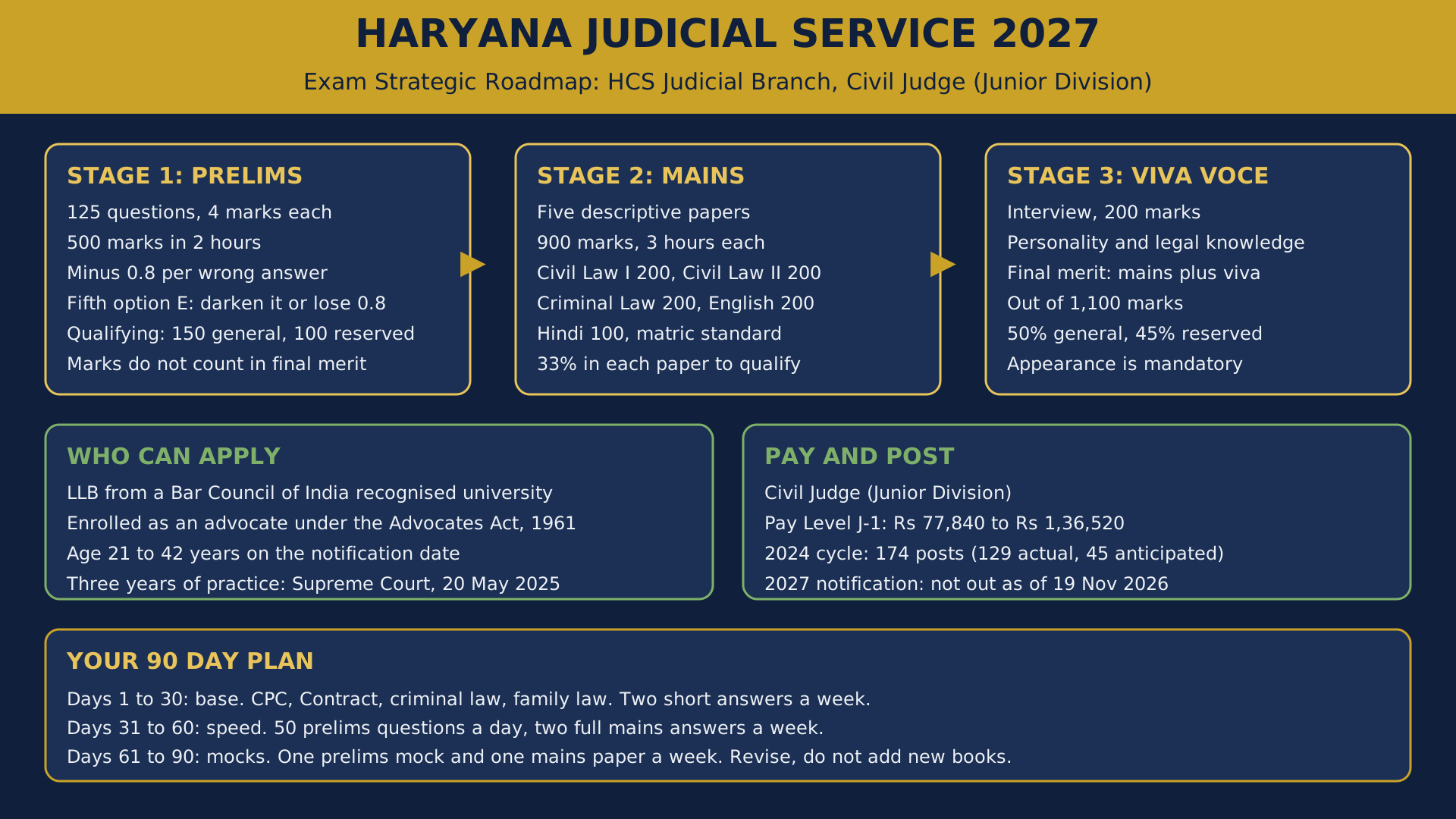
The Haryana Judicial Service 2027 notification has not come out yet. As of 19 November 2026, the Haryana Public Service Commission has published no fresh advertisement for Civil Judge (Junior Division), and the last cycle remains Advertisement Number 01 of 2024. That cycle offered 174 posts, ran its preliminary exam on 3 March 2024, held mains from 12 to 14 July 2024, and declared its final result on 16 October 2024. So the 2027 cycle is a waiting game right now, and the smart move is to prepare on the 2024 pattern while watching the Commission website for the new notice.
This Haryana Judicial Service 2027 guide covers the whole HCS Judicial exam on that basis. You will find the three stages, the exact marks and qualifying lines, the syllabus paper by paper, the new three year practice rule that changed entry for everyone, the pay, the books, a 90 day plan, and the mistakes that sink good candidates. Every number here comes from the 2024 notification as reported by the Commission and the High Court, or from the Supreme Court judgment and the Haryana rule amendment that followed it. Where sources disagree, this guide says so instead of picking the neater number.
Has the 2027 notification come out?
No. A check of the Commission website on 19 November 2026 found no new recruitment notification for the judicial branch, and the 2024 advertisement remains the latest one on record. The Commission runs this exam in cycles rather than every year, so a gap after the 2024 cycle surprises nobody who has followed it. The Haryana Judicial Service 2027 cycle will follow the same three stage shape unless the new notification changes it.
The cycle before that one, the 2020 to 21 recruitment, advertised 256 posts, held its preliminary exam on 13 November 2021, ran mains from 20 to 22 May 2022, interviewed candidates from 5 to 23 September 2022, and declared its final result on 21 October 2022. Gaps of two to three years between cycles have happened before.
Do not trust any date you see on a coaching poster or a social media post until the Commission publishes it. The only two places that count are the Commission website at hpsc.gov.in and the Punjab and Haryana High Court website at highcourtchd.gov.in. The notification normally appears on both.
When it lands, it will carry the vacancy count and the age calculation date, the fee and the syllabus, plus the exam calendar in one document. Read that document end to end before you fill the form, because the notification overrules every guide on the internet, including this one.
One warning about vacancy numbers. The 2024 cycle advertised 174 posts, made of 129 actual vacancies plus 45 anticipated vacancies. The 2020 to 21 cycle advertised 256 posts, made of 239 direct recruitment posts plus 17 anticipated vacancies. Anticipated vacancies depend on retirements and promotions that may or may not fall vacant, so treat the headline number with care and read the category split in the notification itself.
The three year practice rule changed the entry gate
Here is the change that matters most for the 2027 cycle. On 20 May 2025, the Supreme Court decided All India Judges Association v. Union of India, citation 2025 INSC 735, and restored the rule that a candidate for Civil Judge (Junior Division) must have three years of practice as an advocate.
A bench led by Chief Justice B R Gavai, with Justice A G Masih and Justice K Vinod Chandran, held that trial judges need real exposure to courts, litigants and briefs, plus evidence and courtroom procedure, before they take up adjudicatory work. The Court counted the three years from the date of provisional enrolment with a State Bar Council, rather than from the date a candidate clears the All India Bar Examination, so administrative delay in the bar exam leaves the period untouched.
The rule existed until 2002. The Court removed it that year after the Shetty Commission recommended opening the service to fresh law graduates, and for more than two decades a law graduate could sit for the exam straight out of college. The 2025 judgment reversed that position.
Haryana moved fast to give it effect. On 7 August 2026, the Haryana government notified the Punjab Civil Service (Judicial Branch) Haryana Amendment Rules, 2026, which insert a requirement of practice as an advocate for not less than three years, counted from provisional enrolment or registration with the concerned State Bar Council, as on the last date fixed for submitting the application.
That amendment also reshaped the service itself. It divides the service into two grades, Civil Judge (Junior Division) and Civil Judge (Senior Division), and sets out how a Civil Judge (Junior Division) with a minimum of five years of service earns designation as Civil Judge (Senior Division) on a seniority cum merit basis. It also maps the old pay scales onto the new J-1 to J-5 pay levels, with the entry level J-1 starting at Rs 77,840 in the first year and rising to Rs 1,36,520 by the twentieth year.
Now the complication. A later order of the Supreme Court, reported in 2026, relaxed the three year rule for a limited window. Under that transitional arrangement, law graduates can apply for Civil Judge (Junior Division) examinations notified between 20 May 2025 and 31 March 2027 even without three years of practice.
The Court treated such candidates as having completed one year of active practice, and directed one year of intensive training plus one year of structured law clerkship after selection, with those two years counting as the remaining practice. The exact terms of that order need a careful read when the next HPSC notification arrives, because the notification will state the eligibility rule that actually applies to the 2027 cycle. Do not assume the relaxation covers you. Check the notification, then check it again.
What does this mean in practice? If you enrolled with a State Bar Council in 2023 or earlier, you likely meet the three year condition for a 2027 notification on any reading. If you enrolled in 2024 or 2025, your position turns on the transitional order and the wording of the new notification.
If you are still in law school or you graduate in 2026 or 2027, enrol with your State Bar Council at the first chance and keep your enrolment certificate safe, because the clock runs from provisional enrolment. Keep the experience certificate format in mind too. The practice period needs proof, and the Court spoke of a certificate from an advocate with at least ten years of standing, endorsed by the Principal Judicial Officer or a court designee. Collect that paperwork while the advocate who knows your work is easy to reach, rather than hunting for it in the last week before the form closes.
Age and pay: why Haryana draws a crowd
Haryana gives candidates one of the widest age windows in the country. The 2024 notification fixed the age limit at 21 to 42 years, with the calculation date set as 31 January 2024, the last date for applications. Age relaxation follows Haryana government rules for SC and ST candidates, plus BC and PwBD candidates, and ex-servicemen candidates. One summary of the rules puts the ceiling for SC, ST and BC candidates of Haryana at 47 years, but the notification for the 2027 cycle will state the exact relaxations, so treat 47 as a reported figure and confirm it when the notice comes out.
The lower end of the window matters as much as the upper end. A candidate must have turned 21 by the calculation date. A final year law student who has not yet received the degree by the last date of application cannot apply, because the rules ask for the LLB degree by that date. Plan your attempt around the degree date, not the exam date.
Pay explains part of the rush. A Civil Judge (Junior Division) joins at Pay Level J-1, with the scale running from Rs 77,840 to Rs 1,36,520 under the revised pay matrix that the August 2026 amendment notified. The old scale ran from Rs 27,700 to Rs 44,700, so the revision lifts the entry pay sharply.
The first Assured Career Progression stage moves the scale to level J-2, starting at Rs 92,960, and the second stage reaches level J-3, starting at Rs 1,11,000. Senior Division stages run higher still, with level J-5 starting at Rs 1,44,840. Those figures come from the Haryana amendment as reported in August 2026, and the 2027 notification will confirm the pay that applies to the new batch.
Money alone does not explain the draw. Haryana posts its judges in district courts across a compact state, the High Court sits at Chandigarh, and the service carries the security and standing of the state judicial service. Add the wide age window and the large vacancy counts of recent cycles, 256 posts in the 2020 to 21 cycle and 174 in the 2024 cycle, and the rush makes sense.
It also explains the competition. More than 8,000 candidates qualified for the mains in the 2020 to 21 cycle, and 455 candidates reached the interview stage after mains. Those numbers should set your preparation standard.
You are not competing against the syllabus. You are competing against thousands of law graduates who have read the same books.
The exam in three stages
HPSC runs the HCS Judicial Branch exam in three stages. The preliminary exam screens candidates. The main written exam tests depth.
The viva voce tests the person. The table below gives the shape at a glance. The sections after it fill in the detail.
| Stage | Format | Marks | What it decides |
|---|---|---|---|
| Preliminary exam | Objective, 125 questions, OMR sheet | 500 | Who reaches mains |
| Main written exam | Descriptive, five papers | 900 | Who reaches the viva voce |
| Viva voce | Interview | 200 | Final merit, with mains marks |
Final merit rests on mains plus viva voce only, out of 1,100 marks. Preliminary marks play no part in the final list. That single fact should shape your timetable. Give prelims enough respect to clear it, then pour your best months into mains answer writing, since mains plus viva decide your rank.
Prelims: 125 questions, two hours, one trap
The Haryana Judicial Service 2027 prelims is an objective screening test on OMR sheets, and the HCS Judicial prelims follows the 2024 pattern unless the new notice changes it. It carries 125 multiple choice questions, four marks each, for a total of 500 marks, and candidates get two hours. Each question offers five options, labelled A to E. The fifth option is the trap that catches careless candidates.
You must darken the circle for A, B, C or D if you attempt the question, and you must darken E if you leave it unattempted. Failure to darken any of the five circles costs 0.8 marks, the same penalty as a wrong answer.
Marking works like this. A correct answer earns four marks. A wrong answer loses 0.8 marks, which is 20 percent, or one fifth, of the marks for the question.
A blank answer loses 0.8 marks too, because the 2024 notification summary states the deduction applies where no circle is darkened. Some coaching summaries mention the penalty only for wrong answers, so the blank answer rule deserves a careful read in the next notification. Either way, the message stays the same.
Never leave a circle blank, and never guess blindly. Darken E when you do not know the answer, and guess only when you can eliminate two or three options with confidence.
The qualifying line is 150 marks out of 500 for general category candidates, which is 30 percent, and 100 marks for reserved category candidates, which is 20 percent. Clearing that line gets you to mains. Scoring far above it gets you nothing extra, because prelims marks stay out of the final merit.
The design frees you from perfectionism in prelims. Your job is to cross the line safely, with a margin for a harsh paper, and to save your energy for mains.
What does prelims ask? The syllabus matches the mains syllabus, plus general knowledge. Expect questions on the Constitution, CPC, Contract Act, Evidence Act and IPC, plus the new criminal codes, Hindu law, Muslim law, limitation, registration, the Punjab Courts Act and the Haryana Rent Act, plus current affairs with a legal edge.
The 2024 paper followed that shape. Prepare prelims from the same bare acts and notes you use for mains, and add a short daily habit of current legal developments, recent Supreme Court and High Court judgments, and new amendments. One judgment a day, read properly, beats a month of rushed reading before the exam.
Speed decides prelims. Two hours for 125 questions leaves under a minute per question, including the time to darken circles on the OMR sheet. Practice with a timer and an OMR sheet from the start, not in the last week.
Mark the questions you skip, darken E for them as you go, and come back only if time remains. Candidates lose marks every year by darkening circles in a hurry at the end, and a wrong row on an OMR sheet can cost four questions at once.
A short note on history. The 2017 preliminary exam was scrapped by the Punjab and Haryana High Court after a paper leak, so no valid 2017 question paper exists for practice. Use the 2019 and 2021 papers, plus the 2024 paper, and treat any paper labelled 2017 with suspicion.
Mains: five papers, 900 marks, one hard rule
Mains is the exam in the Haryana Judicial Service 2027 cycle. Five descriptive papers, three hours each, 900 marks in total. The Commission supplies bare copies of legislative enactments in the hall, and the exam runs in English except for the language paper. Your handwriting and your structure decide your rank here, along with your command of sections, because the same syllabus that gave you a screening test in prelims now asks you to write full answers with reasons and illustrations, plus case law.
The five papers are Civil Law I for 200 marks, Civil Law II for 200 marks, Criminal Law for 200 marks, English for 200 marks, and Hindi in Devanagari script for 100 marks. That adds up to 900. Each paper carries its own minimum.
No candidate earns credit in a paper without at least 33 percent in it. The language paper has its own 33 percent condition for the viva call, and the aggregate condition is stricter still. A candidate needs at least 50 percent in the aggregate of all written papers to reach the viva voce, or 45 percent for SC and ST candidates, plus BC and PwBD candidates, and ex-servicemen candidates. For the final selection, the same 50 percent and 45 percent lines apply to the aggregate of mains plus viva voce, out of 1,100 marks.
Read those lines again, because they punish lopsided preparation. A candidate who scores 75 percent in criminal law and 25 percent in Hindi fails the paper minimum and goes home. A candidate who clears every paper at 40 percent but misses the 50 percent aggregate also goes home.
You need depth in every paper and consistency across all five. That is the design. A judge needs all of it, not one strong subject.
Civil Law I, 200 marks
Civil Law I covers the Code of Civil Procedure, the Punjab Courts Act as applicable to Haryana, the Indian Contract Act, the Indian Partnership Act, the Sale of Goods Act, the Specific Relief Act, the Indian Evidence Act and now the Bharatiya Sakshya Adhiniyam, 2023, plus the Haryana Urban (Control of Rent and Eviction) Act, 1973. The Limitation Act also touches this paper. CPC dominates the paper, so treat it as the spine.
Learn the sections and orders that courts use every day, res judicata, the place of suing, pleadings and interim orders, plus execution and appeals, and practise drafting the issues a court frames in a civil suit. Contract law rewards candidates who can state the rule, apply it to the facts, and cite the section in one paragraph. Rent law rewards candidates who know the Haryana Act rather than a generic summary of rent control.
Civil Law II, 200 marks
Civil Law II covers Hindu law, Mohammedan law, customary law, the law of registration, and the law of limitation. Family law takes the largest share, so give it the largest share of your time. Hindu marriage and adoption, plus succession and partition, Muslim marriage and divorce, plus maintenance and inheritance, and the customs that govern families in Haryana and Punjab all appear here.
Limitation is short but scoring, because its articles reward exact recall. Registration is shorter still, but candidates who skip it hand away easy marks. Write family law answers with the statute first and the case law second, and keep the facts of leading cases ready in two lines each.
Criminal Law, 200 marks
Criminal Law covers the Indian Penal Code and now the Bharatiya Nyaya Sanhita, 2023, the Code of Criminal Procedure and now the Bharatiya Nagarik Suraksha Sanhita, 2023, plus the Indian Evidence Act and now the Bharatiya Sakshya Adhiniyam, 2023. The three new criminal laws came into force on 1 July 2024, so the 2024 mains already sat in the new regime, and the 2027 cycle will sit in it fully. Study the new codes as the primary text and keep the old codes for case law, because courts still cite old code judgments while applying new sections.
Learn the new section numbers alongside the old ones, and practise the mapping in your notes until it feels automatic. General exceptions, offences against the body and property, plus offences against women and children and offences against the state, carry heavy weight in the substantive part. FIR, arrest, bail, investigation, cognizance, charge and trial procedure, plus plea bargaining and appeals, carry the procedure part.
Evidence runs through both. Relevancy and admissions, plus confessions, dying declarations, electronic records, burden of proof and estoppel, plus examination of witnesses.
English, 200 marks
The English paper tests essay writing and vocabulary. Comprehension and corrections complete the paper. Candidates treat it as a formality and lose rank over it, because 200 marks is the same weight as an entire law paper.
Write one essay a week on legal and social topics, starting now. Get it checked by someone who will mark it hard. Read a serious newspaper daily and note how its editorial writers build an argument in 800 words. That habit feeds the essay and the comprehension, plus the viva, at once.
Hindi, 100 marks
The Hindi paper runs in Devanagari script at the standard of the matriculation examination of the Board of School Education, Haryana. It carries 100 marks and its own 33 percent minimum, so a candidate who ignores it risks the whole attempt. If your schooling was in English medium, start Hindi early and treat it as a scoring paper rather than a chore. Daily translation practice, ten lines from English to Hindi and ten lines back, builds the speed and accuracy the paper demands.
Viva voce: 200 marks of who you are
The viva voce carries 200 marks, and appearance is mandatory. The board tests personality and general outlook, plus communication and suitability for judicial office, along with the legal knowledge that the written papers could not fully show. Final merit adds viva marks to mains marks, and the candidate needs 50 percent of the combined 1,100 in aggregate for selection, or 45 percent for the reserved categories named earlier.
Prepare for the viva the way you would prepare for a court appearance, not the way you would prepare for a test. Know your own application form, your district, your law college, your enrolment details, and the reason you want the bench. Read the leading judgments of the last year and form a view on each one, because the board will ask what you think, not only what the Court held.
Keep your answers short and direct, and honest. A candidate who says "I do not know" to one question keeps credibility for the next answer. A candidate who invents an answer loses it for the whole interview.
Who can apply
The 2024 notification kept the HCS Judicial education rule simple. A candidate needs a degree of Bachelor of Laws from a university recognised by the Bar Council of India, and the degree must entitle the candidate to enrolment as an advocate under the Advocates Act, 1961. The degree must be in hand by the last date of application. Enrolment as an advocate under the Advocates Act, 1961, plus the applicable rules, forms part of the eligibility, and the 2027 notification will state the practice condition in line with the Supreme Court judgment and the Haryana amendment discussed above.
Age runs from 21 to 42 years on the calculation date the notification fixes. For the 2024 cycle, that date was 31 January 2024. Relaxation follows Haryana government rules for the reserved categories.
Nationality is Indian citizenship, as the rules require. Candidates should also expect a Hindi condition, because the service works in Hindi and English and the mains paper tests Hindi at matriculation standard, so check the notification for any matriculation level Hindi requirement before you apply.
Read the reservation rules with care. Haryana reserves posts for SC, BC-A and BC-B candidates of Haryana, plus EWS, ex-servicemen and PwD candidates, and the benefit of reservation and fee concession goes to Haryana domicile candidates in those categories. Candidates from other states apply as general category candidates for most purposes, and the fee table reflects that.
The 2024 fee was Rs 1,000 for male candidates of the general category, including dependent sons of ex-servicemen of Haryana, and for male candidates of general and all reserved categories of other states. All female candidates paid Rs 250, as did male and female candidates of the reserved categories of Haryana (SC, BC-A, BC-B, ESM, EWS). PwD candidates of Haryana with at least 40 percent disability paid nothing. The fee is non refundable, so confirm your category and your eligibility before you pay.
Syllabus, subject by subject
HPSC does not publish a separate syllabus PDF. The Haryana Judicial Service 2027 syllabus lives inside the notification, under the Punjab Civil Service (Judicial Branch) Rules, 1951, as applicable to Haryana and amended on 7 November 2023, and now read with the August 2026 amendment. That is worth knowing, because it means the notification is the syllabus. Download it, print the syllabus pages, and pin them above your desk.
Prelims follows the mains syllabus and adds general knowledge. That one line tells you how to prepare. Build your base from the mains subjects, then add current affairs and general knowledge on top, rather than preparing prelims as a separate exam with separate books. The Constitution deserves a place in that base even though the mains papers do not list it as a separate paper, because prelims asks Constitution questions every year and a judge needs it daily.
Civil Law I asks for CPC, the Punjab Courts Act, Contract, Partnership, Sale of Goods and Specific Relief, plus Evidence and the Haryana Rent Act. Civil Law II asks for Hindu law and Mohammedan law, plus customary law. Registration and limitation complete the paper.
Criminal Law asks for the substantive criminal code, the procedure code and evidence, now under the new codes. English asks for essay writing and vocabulary work. Comprehension and corrections complete the paper.
Hindi asks for language skill at matriculation standard in Devanagari script. General knowledge in prelims covers current events, with an emphasis on legal and constitutional developments.
Two subjects deserve extra attention. First, the new criminal codes. The 2024 notification already showed the new laws beside the old ones, and coaching summaries of the 2026 syllabus list BNS, BNSS and BSA as the operative texts.
Candidates who study only the old criminal codes will write old section numbers in a new code exam. Pair every old section with its new number in your notes, and revise the pairs weekly until the new numbers come first to mind. Second, Haryana local law.
The Punjab Courts Act as applicable to Haryana and the Haryana Urban (Control of Rent and Eviction) Act, 1973, are state specific, and candidates from other states often skip them. Those two acts are among the easiest marks in the paper for anyone who reads the bare text.
Books and bare acts that earn their keep
Buy fewer books and read them more often. A judiciary attempt fails more often from shallow reading of ten books than from deep reading of four. Start with the bare acts for every subject in the syllabus, because the exam tests the statute and the Commission supplies bare acts in the mains hall.
Read the act, then read a commentary on the difficult parts, then write answers from memory. That order builds recall that survives exam pressure.
For CPC, C K Takwani remains the standard commentary, and the bare act should stay open beside it. For Contract, Avtar Singh gives a clear account. Pollock and Mulla covers the hard points.
For Evidence and now BSA, Batuk Lal explains the concepts in a way that suits answer writing. Ratanlal and Dhirajlal on the law of evidence covers the case law. Ratanlal and Dhirajlal on BNS gives the structure for the new criminal codes, and R V Kelkar on criminal procedure does the same, and a good comparative table of old and new sections belongs in your notes from day one.
Mulla and Paras Diwan cover Hindu law. Mulla and Aquil Ahmad do the same for Muslim law. For the Constitution and prelims general knowledge, M P Jain gives the depth, and a yearly current affairs compilation keeps the recent developments in order.
Previous year papers count as a book for any HCS Judicial candidate. Solve the 2024 prelims paper and the 2021 mains papers under timed conditions, then compare your answers with the bare acts. The 2020 to 21 mains ran from 20 to 22 May 2022, and the 2024 mains ran from 12 to 14 July 2024, so those papers reflect the current pattern.
Mark the questions you got wrong, trace each one to the section it tested, and revise that section the same day. That loop, repeated for a month, teaches more than a new book.
A 90 day plan that fits around a job
Many Haryana judiciary candidates work as practising advocates or hold other jobs, so this plan assumes three focused hours on working days and six on free days. It also assumes the Haryana Judicial Service 2027 notification has not yet fixed its dates, so the plan builds the base first and peaks later, when the calendar is known.
Days 1 to 30 build the base. Read CPC and Contract in the morning hour, criminal law in the second hour, and family law in the third. Keep a single notebook per subject.
Each notebook holds sections and illustrations, plus one case per rule. Write two short answers a week, 250 words each, and check them against the bare act. Read one judgment a day from the Supreme Court or the Punjab and Haryana High Court, and note its holding in three lines. Start Hindi translation practice now, ten lines a day, so the language paper never becomes a crisis.
Days 31 to 60 add speed and prelims. Keep the morning subject reading, and use the second hour for prelims practice, 50 questions a day from previous papers and a question bank, with the OMR habit of darkening E for questions you skip. Use the third hour for mains answer writing, two full answers a week of 800 words each, timed.
Revise the new criminal code mappings every Sunday, and write one English essay a week. By day 60, you should have finished one full reading of every mains subject.
Days 61 to 90 turn to revision and mocks. Give the first hour to revision of your notebooks, the second to a timed mock, and the third to analysing the mock against the bare acts. Take one full prelims mock a week and one full mains paper a week.
Cut new reading in this phase, except for current affairs and new judgments. Sleep properly in the last week, and keep your documents ready, enrolment certificate, degree, caste or category certificate if any, and identity proof, so the form takes an hour rather than a day.
Mistakes that cost seats
The first mistake is preparing for prelims and mains as two separate exams. Prelims is a screening test with a 150 mark line for general candidates, and mains decides rank. Candidates who spend eight months on objective questions and two months on answer writing arrive at mains unable to write. Start answer writing in the first month, even if the answers are rough.
The second mistake is ignoring the language papers. English carries 200 marks and Hindi carries 100, and both carry minimums. A law graduate who writes well in English and poorly in Hindi can fail the Hindi minimum and lose the attempt. Give both papers a weekly slot from the start.
The third mistake is studying the old criminal codes only. The new codes have been in force since 1 July 2024, and the 2027 cycle will examine them. Candidates who quote old section numbers without the new ones will look out of date to an examiner who works with the new codes daily. Learn both numbers, and lead with the new one.
The fourth mistake is skipping the fifth option rule in prelims. Leaving a circle blank costs 0.8 marks, the same as a wrong answer, so darken E for every question you do not attempt. Candidates who rush the OMR sheet in the last five minutes lose marks they had already earned.
The fifth mistake is waiting for the Haryana Judicial Service 2027 notification to start. The 2024 cycle gave candidates 26 days between the start of applications on 5 January 2024 and the last date on 31 January 2024, and the prelims followed on 3 March 2024. That is less than two months from the notice to the first exam.
Candidates who start after the notification cannot cover five mains papers in that window. Start now, on the 2024 pattern, and let the notification fix your dates.
How to apply when the Haryana Judicial Service 2027 notification comes
Watch hpsc.gov.in and highcourtchd.gov.in, and apply through the Commission portal when the link opens. Keep your documents ready before the window opens, because the last date in the 2024 cycle fell 26 days after applications began, and late corrections are rarely possible. Fill the form in one sitting, check the category and the fee, plus the photograph and signature specifications, pay the fee online, and save the submitted form and the payment receipt.
Note the age calculation date in the notification and count your age on that date, not on the exam date. Note the enrolment and practice conditions too, and attach the experience certificate in the format the notification asks for, if it asks for one.
Ten more mock tests to keep your preparation moving
Judiciary preparation rewards breadth, and a mock test in a neighbouring exam sharpens the same skills. These ten mock tests cover other judicial and law exams, and each one is live now, so you can start them while you wait for the Haryana notification.
- Delhi Judicial Service 2027: the closest cousin to Haryana, with a similar three stage pattern and a Delhi specific paper.
- MP Civil Judge 2027: Madhya Pradesh tests the same civil and criminal core with its own state law questions.
- Bihar Judicial Service 2027: Bihar runs a large judiciary exam on the same five paper mains shape.
- Rajasthan Judicial Service 2027: Rajasthan adds its own local laws to the standard judiciary syllabus.
- UPPSC PCS J 2027: Uttar Pradesh runs one of the largest judicial exams in the country, with heavy competition.
- UGC NET Law 2027: a good test of legal theory and jurisprudence for candidates who want depth.
- UPPSC APO 2027: the Assistant Prosecution Officer exam tests criminal law and procedure in depth.
- UPPSC PCS 2027: the state civil services exam suits candidates who want a second option alongside the judiciary.
- UPPSC Assistant Professor 2027: a teaching route for law postgraduates who want an academic career.
- UPPSC Lecturer GIC 2027: a lectureship exam for candidates who want to teach law and allied subjects.
Sources
HPSC Advertisement Number 01 of 2024 for 174 Civil Judge (Junior Division) posts, as reported by the Commission and by Study IQ; Toprankers; Jagran Josh; Scroll; News18, with applications from 5 to 31 January 2024, prelims on 3 March 2024, mains from 12 to 14 July 2024, mains result on 24 August 2024, and final result on 16 October 2024. HPSC Civil Judge 2020 to 21 recruitment for 256 posts, with prelims on 13 November 2021, mains from 20 to 22 May 2022, interviews from 5 to 23 September 2022, and final result on 21 October 2022, as reported by Jagran Josh; Scroll; Toprankers. Exam pattern and qualifying marks, 125 questions, 500 marks, minus 0.8 per wrong answer, fifth option E, 150 marks general and 100 marks reserved in prelims, 33 percent per mains paper, 50 percent aggregate general and 45 percent reserved, viva voce 200 marks, as stated in the 2024 notification summaries by LawPrep Tutorial; Toprankers; LawBhoomi; Maansarovar Law Centre.
Supreme Court judgment of 20 May 2025 in All India Judges Association v. Union of India, 2025 INSC 735, restoring the three year practice rule, as reported by The Amikus Qriae and CaseMine. Haryana amendment of 7 August 2026, the Punjab Civil Service (Judicial Branch) Haryana Amendment Rules, 2026, including the three year practice condition and the revised J-1 to J-5 pay matrix, as reported by ThePrint.
Later Supreme Court transitional order relaxing the three year rule for examinations notified between 20 May 2025 and 31 March 2027, as reported by LawFiles in 2026. New criminal laws, BNS, BNSS and BSA, in force from 1 July 2024, and the Haryana mains syllabus under the new codes, as set out by Toprankers and Vidhi Judicial. No new HPSC judicial notification as of 19 November 2026, as checked on hpsc.gov.in and reported by 9curry. Official websites: the Haryana Public Service Commission at hpsc.gov.in and the High Court of Punjab and Haryana at highcourtchd.gov.in.







