
About UPPSC PCS J 2027 Exam Series
📖 Table of Contents
- The rule that changes who can apply
- What a Civil Judge does
- The 2022 cycle, start to finish
- Prelims in plain words
- Mains: six papers, 1000 marks
- The interview, 100 marks
- Prelims syllabus: what the two papers ask
- Who can apply
- Fee and how to apply
- Pay and career
- Books that cover the syllabus
- A six month plan that fits a law exam
- Mocks and answer writing
- Mistakes that cost good candidates marks
- Check these six things when the notice arrives
- Sources
UPPSC PCS J 2027: Civil Judge Exam Pattern, Syllabus, Eligibility and Age
UPPSC PCS J 2027 is the Uttar Pradesh Judicial Service Civil Judge (Junior Division) Examination, the exam that picks Civil Judges for the courts of Uttar Pradesh. The Uttar Pradesh Public Service Commission runs it on the requisition of the Allahabad High Court. The exam has three stages, Prelims, Mains and interview.
The last cycle, Examination 2022, filled 303 posts and ended with the final result on 30 August 2023. The next notification has not come out yet, as of 19 November 2026, so no 2027 dates, no 2027 vacancies and no 2027 cut off exist anywhere in this guide. What exists is the pattern, the syllabus and the last cycle, and that is what this guide covers in full.
One fact matters more than any other for the next cycle. On 20 May 2025, the Supreme Court restored the rule that a candidate must have three years of practice as an advocate before sitting for the Civil Judge (Junior Division) exam. Fresh law graduates could sit directly under the old rule.
Under the new rule, they cannot. The rule applies to recruitments notified after 20 May 2025, which means it will shape the next UPPSC notification. Read the section on eligibility first if you finished LLB recently, because it decides whether you can apply at all.
The rule that changes who can apply
The Supreme Court gave its judgment on 20 May 2025 in All India Judges Association v. Union of India, 2025 SCC OnLine SC 1184. The Court restored the three year minimum practice requirement for direct recruitment to the Civil Judge (Junior Division) cadre.
The Court had removed that requirement in 2002, on the Shetty Commission recommendation, so that fresh law graduates could enter service directly. The 2025 judgment reverses that position. The Court said the experiment of appointing fresh law graduates had created many problems in judicial administration, and courtroom exposure builds the skills a judge needs.
The practice period counts from the date of provisional enrolment with the State Bar Council, and not from the date of passing the All India Bar Examination. Experience as a law clerk to a judge also counts toward the three years. The practice must be certified by a Principal District Judge for practice before lower courts, or by a senior advocate with at least ten years of standing for practice before a High Court, duly endorsed by the designated officer. On 14 August 2026, the Court declined a plea to treat judicial officer experience as equal to practice as an advocate under this rule, so the rule remains in force.
The judgment applies prospectively. It does not apply to recruitment processes notified before 20 May 2025, and it does not disturb past appointments. The next UPPSC PCS J notification will show how the commission applies it, and the exact wording in that notification will settle the question for Uttar Pradesh. Until then, a law graduate who plans to sit for UPPSC PCS J 2027 should enrol with the Bar Council at once and start counting the three years from the enrolment date.
One tracker page claims a Supreme Court judgment of 21 August 2026 changed the practice requirement. That date conflicts with the 20 May 2025 judgment and with the 14 August 2026 order declining to modify it, so this guide uses 20 May 2025 and flags the other date as unverified. Another tracker page says the AIBE exam and three years of experience are both needed for eligibility. The three year practice rule comes from the Supreme Court judgment, and the AIBE is a separate requirement for enrolment, so do not mix the two.
What a Civil Judge does
A Civil Judge (Junior Division) sits in the district courts of Uttar Pradesh and decides civil cases and criminal cases as a Judicial Magistrate. The post is the entry level of the Uttar Pradesh Judicial Service. A judge at this level hears civil disputes up to a set pecuniary limit, tries criminal cases as a magistrate, records evidence, writes judgments, and passes orders that affect the lives of the people before the court. The work is courtroom work, in Hindi and English, with the Code of Civil Procedure, the criminal procedure code and the evidence law open on the desk every day.
New appointees undergo one year of compulsory training at the State Judicial Academy before they take up judicial work, as the Supreme Court directed in the same 2025 judgment. The training covers court procedure, judgment writing, case management and the conduct expected of a judge. A candidate who clears the exam should expect a year of training, not an instant posting.
The career grows by promotion. A Civil Judge (Junior Division) rises to Civil Judge (Senior Division) and Chief Judicial Magistrate, and then to District and Sessions Judge. The pay rises with each step.
The post carries a government residence, a vehicle with a driver in many districts, medical benefits and the respect that the office commands in the district. It also carries long hours, a heavy case load, and the weight of deciding cases that change lives.
That weight is why the exam tests more than memory. The Mains asks for judgment writing, framing of charges and issues, and practical questions on evidence and procedure. The interview tests whether the candidate has the judgment and the character for the office. A candidate who only memorises bare Acts will clear the Prelims and struggle in the Mains, because the Mains tests how the law works in a courtroom.
The 2022 cycle, start to finish
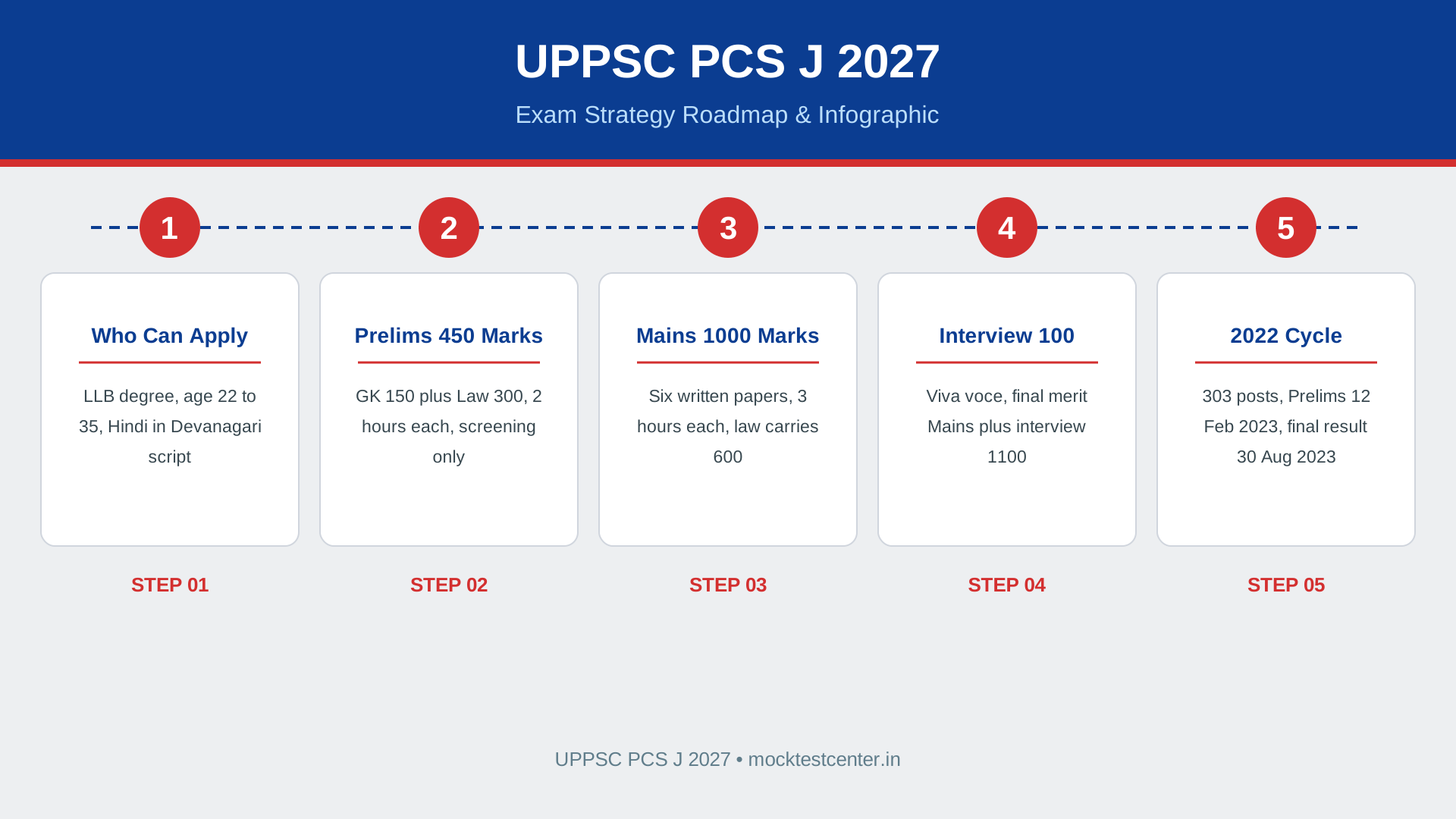
The last cycle shows how fast this exam can move when it runs clean. Applications opened on 10 December 2022 for 303 posts of Civil Judge (Junior Division). A total of 79,565 candidates applied.
The Prelims ran on 12 February 2023, and 50,837 candidates appeared. The Prelims result came on 16 March 2023, and 3,145 candidates qualified for the Mains.
The Mains ran from 23 to 25 May 2023, and 3,019 candidates appeared. The Mains result came on 1 August 2023, and 959 candidates qualified for the interview. Interviews ran from 16 to 28 August 2023.
The final result came on 30 August 2023, within 48 hours of the last interview, and 302 candidates were selected. One post stayed undecided because of an interim order of the Allahabad High Court. The whole cycle, from applications to final result, took under nine months.
Women took 165 of the 302 selected posts, which is about 55 percent, and 15 of the top 20 ranks went to women. Nishi Gupta of Kanpur topped the exam, Shishir Yadav of Prayagraj took the second rank, and Rashmi Singh of Kasganj took the third rank. A revised final result came on 30 August 2024, a year later, for the 303 Civil Judge posts.
Those numbers tell a candidate two things. First, the funnel is steep. About 64 percent of applicants appeared for the Prelims, about 6 percent of those who appeared reached the Mains, and about 0.6 percent of those who appeared for the Prelims were finally selected.
Second, the exam rewards steady preparation across all three stages, because each stage cuts hard. A candidate who prepares only for the Prelims will not survive the Mains, and a candidate who prepares only for the Mains will not reach it.
The next cycle has no notification yet. One tracker expects the notification in December 2026 to January 2027, and another expected it in June to July 2026, which passed without a notification, so predictions have already failed once. A third tracker estimates the vacancy count at 250 to 400, which is a guess from past trends, and not an official figure.
This guide gives no vacancy number for the next cycle, because no official number exists. Check uppsc.up.nic.in for the notification, and plan around the syllabus until it arrives.
Prelims in plain words
The Prelims has two objective papers, each two hours long, for a total of 450 marks. Paper 1 is General Knowledge, worth 150 marks. Paper 2 is Law, worth 300 marks.
Both papers are multiple choice questions, and both carry negative marking of one third of a mark for each wrong answer. A blank answer costs nothing.
| Paper | Subject | Marks | Time |
|---|---|---|---|
| Paper 1 | General Knowledge | 150 | 2 hours |
| Paper 2 | Law | 300 | 2 hours |
| Total | 450 | 4 hours |
The Prelims is a screening test only. Its marks do not count toward the final merit. A candidate needs only to clear the cut off to reach the Mains, and the Mains decides the rank.
The minimum qualifying mark is 40 percent for most candidates and 35 percent for SC and ST candidates, which means 180 marks out of 450 for most candidates and 157.5 marks for SC and ST candidates. Trackers also report the same 40 percent and 35 percent rule for the Mains, so a candidate must clear the line at both stages.
The Law paper carries twice the marks of the General Knowledge paper, so it decides who clears the screen. A candidate with strong law and weak general knowledge will usually clear the Prelims, while a candidate with strong general knowledge and weak law will usually not. Give the Law paper two thirds of your Prelims time, and treat General Knowledge as the support paper.
Negative marking shapes every guess in the Law paper. In a 300 mark paper, a wrong guess costs one third of a mark, and a run of careless guesses can cost ten marks before you notice. Guess only after removing at least one wrong option, and leave the question blank if you cannot remove any. A mock is the place to practise this judgment, so that the habit feels natural on exam day.
Candidates who also follow the UPPSC PCS 2027 exam will see a different Prelims there, with two papers of 200 marks each and a different syllabus, so do not mix the two patterns. The UPPSC APO exam is the other law exam of the commission, for Assistant Prosecution Officers, and its pattern differs again, with its own papers and its own interview.
Mains: six papers, 1000 marks
The Mains is a written exam of six compulsory papers, each three hours long, for a total of 1000 marks. There are no optional papers. Every candidate writes all six papers, and the three law papers carry 600 of the 1000 marks. That ratio should shape your timetable from the first week, because law is where the exam is won and lost.
| Paper | Subject | Marks | Time |
|---|---|---|---|
| Paper 1 | General Knowledge | 200 | 3 hours |
| Paper 2 | English Language | 100 | 3 hours |
| Paper 3 | Hindi Language | 100 | 3 hours |
| Paper 4 | Law 1, Substantive Law | 200 | 3 hours |
| Paper 5 | Law 2, Procedure and Evidence | 200 | 3 hours |
| Paper 6 | Law 3, Penal, Revenue and Local Laws | 200 | 3 hours |
| Total | 1000 | 18 hours |
Paper 1, General Knowledge, is worth 200 marks. It covers history of India and Indian culture, geography of India, Indian polity, Indian economy, India and the world, international affairs and institutions, science and technology, communications and space, and current national issues and topics of social relevance. It includes the same nine social welfare Acts that the Prelims lists, so a candidate who prepares those Acts once can use them in both stages.
Paper 2, English Language, is worth 100 marks, split into essay writing for 50 marks, precis writing for 30 marks, and translation of a passage from Hindi to English for 20 marks. Paper 3, Hindi Language, is worth 100 marks in the same split, essay writing for 50 marks, precis writing for 30 marks, and translation of a passage from English to Hindi for 20 marks. The two language papers together carry 200 marks, and they test whether a judge can write clearly in both languages, because judgments in Uttar Pradesh are written in both.
Paper 4, Law 1 or Substantive Law, is worth 200 marks. It covers the Law of Contracts, the Law of Partnership, the Law of Easements and Torts, Transfer of Property including the principles of equity that apply to it, Equity with special reference to Trusts and Specific Relief, Hindu Law, Mohammedan Law, and Constitutional Law. Constitutional Law alone carries 50 marks, which is a quarter of this paper, so give it a quarter of your time for this paper.
Paper 5, Law 2 or Procedure and Evidence, is worth 200 marks. It covers the Law of Evidence, now the Bharatiya Sakshya Adhiniyam of 2023, Criminal Procedure, now the Bharatiya Nagarik Suraksha Sanhita of 2023, and the Code of Civil Procedure of 1908, including the principles of pleading. The questions focus on practical work, framing charges and issues, dealing with witness evidence, writing judgments and conducting cases. This paper tests the daily work of a judge more directly than any other paper in the exam.
Paper 6, Law 3 or Penal, Revenue and Local Laws, is worth 200 marks. Penal law, the Bharatiya Nyaya Sanhita of 2023, carries 50 marks. Revenue and local laws carry 150 marks, and the questions on local laws are compulsory. The Acts are the Uttar Pradesh Revenue Code of 2006, the Uttar Pradesh Urban Buildings (Regulation of Letting, Rent and Eviction) Act of 1972, the Uttar Pradesh Regulation of Urban Premises Tenancy Act of 2021, the Uttar Pradesh Municipalities Act of 1916, the Uttar Pradesh Panchayat Raj Act of 1947, the Uttar Pradesh Consolidation of Holdings Act of 1953, and the Uttar Pradesh Urban Planning and Development Act of 1973.
The local laws paper is where many candidates lose marks, because national level books cover these Uttar Pradesh Acts thinly or not at all. A candidate who reads the bare Acts for these seven laws, and makes short notes on each one, will score here where others leave blanks. One hundred and fifty marks is too much to leave to chance.
The interview, 100 marks
The interview, also called the viva voce or personality test, is the final stage and carries 100 marks. Only candidates who clear the Mains are called for it. The marks are added to the 1000 Mains marks for the final merit list out of 1100 marks. The Prelims marks play no part in the final merit at all.
UPPSC judges a candidate's suitability for the Uttar Pradesh Judicial Service on merit, ability, character, personality and physique. Expect core law from the Mains papers, recent Supreme Court and Allahabad High Court judgments, and questions on your academic and professional background and why you chose judicial service. Current affairs and Uttar Pradesh related issues come up as well. The panel may ask about the three year practice rule and your own experience at the Bar, because the 2025 judgment has made practice part of the story of every new candidate.
A candidate who scores well in the Mains and poorly in the interview can still lose a rank, because 100 marks is enough to move a candidate up or down the list by many places. Prepare for the interview by reading judgments every week, by knowing the facts of your own practice, and by forming clear views on current legal issues. A panel can tell the difference between a candidate who has read the news and a candidate who has thought about it.
Prelims syllabus: what the two papers ask
Paper 1, General Knowledge, covers history of India and Indian culture, ancient, medieval and modern India, the national movement, and Indian art, architecture, religion and literature. It covers geography of India, physical features, rivers, climate, soils, resources, population and Uttar Pradesh geography. It covers Indian polity, Constitution basics, Parliament, State Legislature, Panchayati Raj and constitutional bodies.
It covers the Indian economy, budget, planning, banking, government schemes and economic surveys. It covers India and the world, foreign policy, bilateral ties, UN bodies and regional groupings. It covers science and technology, communications and space, everyday science, ISRO missions, defence technology, IT and communications. It covers current national issues and topics of social relevance, issues affecting persons with disabilities and senior citizens, and offences against women and children.
The General Knowledge paper also names nine social welfare Acts, and questions come directly from them. The Acts are the Rights of Persons with Disabilities Act of 2016, the Maintenance and Welfare of Parents and Senior Citizens Act of 2007, the Dowry Prohibition Act of 1961, the Protection of Women from Domestic Violence Act of 2005, the Sexual Harassment of Women at Workplace (Prevention, Prohibition and Redressal) Act of 2013, the Pre-Conception and Pre-Natal Diagnostic Techniques Act of 1994, the Medical Termination of Pregnancy Act of 1971, the Indecent Representation of Women (Prohibition) Act of 1986, and the Protection of Children from Sexual Offences Act of 2012. Learn each Act by its year, its purpose, and its key provisions, because the paper asks about all three.
Paper 2, Law, covers ten subjects. Jurisprudence covers schools of law, sources of law, custom, precedent and legislation, rights and duties, ownership and possession, legal personality, and liability. International Organisations covers the UN and its principal organs, specialised agencies, the International Court of Justice, the WTO, the IMF, the World Bank and regional bodies. Current International Affairs covers treaties, international court rulings and legal developments from the last 12 to 18 months.
The Indian Constitution covers the Preamble, Fundamental Rights in Articles 12 to 35, Directive Principles of State Policy, Union and State executives and legislatures, the Supreme Court, High Courts, subordinate courts in Articles 233 to 237, Centre State relations, emergency provisions and constitutional amendment under Article 368. The Transfer of Property Act of 1882 covers general principles, lis pendens, part performance, sale, mortgage, lease, exchange, gift and actionable claims. The Law of Contract, the Indian Contract Act of 1872, covers formation, consideration, capacity, free consent, void agreements, contingent contracts and quasi contracts, breach and remedies, indemnity, guarantee, bailment, pledge and agency. The Code of Civil Procedure of 1908 covers jurisdiction, res sub judice and res judicata, pleadings, interim orders, judgment and decree, execution, appeal, reference, review and revision.
The criminal law subjects have new names and new numbers. The Indian Penal Code of 1860 is now the Bharatiya Nyaya Sanhita of 2023, the Code of Criminal Procedure of 1973 is now the Bharatiya Nagarik Suraksha Sanhita of 2023, and the Indian Evidence Act of 1872 is now the Bharatiya Sakshya Adhiniyam of 2023. All three came into force on 1 July 2024.
The syllabus has not changed in substance, but the questions now use the new section numbers, so a candidate who memorises the old IPC section numbers will mark wrong answers. Learn the new sections for the offences that appear most, general exceptions, abetment and conspiracy, offences against the body, property, women and children, and the new offence of organised crime. For procedure, learn criminal courts, arrest and bail, FIR and investigation, charges, trials, maintenance under Section 144 of the BNSS, plea bargaining and appeals. For evidence, learn relevancy, admissions and confessions, dying declarations, expert opinion, documentary and electronic evidence, burden of proof, estoppel and examination of witnesses.
UPPSC has not issued a new syllabus since the 2022 advertisement, so the papers and marks are unchanged. Two things have changed around it. The criminal laws changed on 1 July 2024, and the practice requirement changed on 20 May 2025. The syllabus stays the same, but the law inside it has moved, and the eligibility around it has moved too.
Who can apply
Under the 2022 cycle, a candidate needed a bachelor degree in law, an LLB, from a recognised university, or enrolment as an advocate, and a thorough knowledge of Hindi in the Devanagari script. The age limit was 22 to 35 years, counted as on 1 July of the recruitment year. Relaxation went up by five years for SC, ST and OBC candidates, by 15 years for Divyangjan candidates, and by three years plus the period of service for ex-servicemen. A candidate also needed Indian citizenship, good character, and medical fitness, and a candidate with a serious criminal case should read the notification with care before applying.
The 2025 Supreme Court judgment adds the three year practice rule on top of those conditions, for recruitments notified after 20 May 2025. A candidate for the next cycle will need an LLB, enrolment with the State Bar Council, three years of practice counted from provisional enrolment, and the certificate that proves it. Law clerk experience counts. The AIBE is the exam that completes enrolment, and it is not the same as the three year rule, so keep the two separate in your mind.
Whether the next notification keeps the age limit at 22 to 35 years, and whether it keeps the same relaxations, will be known only when the notification comes. Trackers report the same figures for the next cycle, but no official figure exists yet, so treat the age and relaxation figures in this guide as the last cycle figures, and check the new notification before you apply.
There is no limit on the number of attempts, as long as you stay inside the age limit and meet the practice rule. Graduates who want college teaching rather than the bench may look at the UPPSC Assistant Professor 2027 exam instead. A candidate who misses the cut off in one cycle can sit again in the next cycle, and many selected candidates in the 2022 cycle had sat for the exam before. The practice rule changes the timing, though, because a candidate now needs three years at the Bar before the first attempt, so the first attempt comes later than it used to.
Fee and how to apply
The application fee for the last cycle was 125 rupees for General, OBC and EWS candidates, 65 rupees for SC and ST candidates and ex-servicemen, and 25 rupees for Divyangjan candidates. The fee is non refundable, so confirm your eligibility before you pay. The fee for the next cycle will be stated in the new notification, and it may change, so do not plan around the old figures as if they were fixed.
Applications go online through the UPPSC portal at uppsc.up.nic.in. One Time Registration, called OTR, is compulsory before you fill the form. Get your OTR number at otr.pariksha.nic.in at least 72 hours before you apply.
Your category, domicile, gender, date of birth and other details are taken from OTR, so fill it with care. Keep your application number and password safe from the day you apply, because the admit card, the answer key and the result all need the same login.
Apply early in the window when the notification comes, and keep a copy of the filled form, the fee receipt and the application number. Check your photo, your signature, your category and your subject choices before you submit, because the correction window fixes small errors and never fixes a wrong choice. Read the notification in full before you apply, because the notification is the only document that binds the commission, and this guide is only a summary of the last cycle.
Pay and career
The pay of a Civil Judge (Junior Division) is the one figure on which sources disagree most, so this section gives both figures and the reason for the gap. The 2022 notification listed the pay scale as 27,700 rupees to 44,700 rupees. Several trackers now quote a starting monthly pay of about 77,840 rupees, with a range up to 1,36,520 rupees, under the Seventh Pay Commission, with an entry basic pay of 56,100 rupees. One tracker also quotes 22,700 rupees to 47,700 rupees, which is an older scale.
The gap comes from the pay revision. The notification quoted the older scale, and the Seventh Pay Commission revision raised the entry pay. The figure of about 77,840 rupees a month is the starting pay most trackers quote after the revision, plus house rent allowance, medical benefits, dearness allowance and other judicial allowances. The new notification will state the current scale, so check it before you count on any figure.
The career path runs upward by promotion. A Civil Judge (Junior Division) becomes a Civil Judge (Senior Division) and Chief Judicial Magistrate, then a District and Sessions Judge. Senior posts carry higher pay, up to about 2,05,700 rupees a month for senior district judges, and High Court judges draw a fixed pay above that. The post also carries a government residence, official staff, and the standing that the office holds in the district.
Compare this with the other UPPSC law post, the UPPSC APO 2027 exam, which leads to prosecution work rather than the bench, and with the UPPSC RO ARO 2027 exam, which is a secretariat post for graduates of any stream. A law graduate who wants the bench should pick PCS J, and a law graduate who wants prosecution work should pick APO, because the two posts test different skills and lead to different careers.
Books that cover the syllabus
Law rewards candidates who read the bare Acts, so start there. Buy the bare Acts for the Constitution, the Indian Contract Act, the Transfer of Property Act, the Code of Civil Procedure, the Bharatiya Nyaya Sanhita, the Bharatiya Nagarik Suraksha Sanhita and the Bharatiya Sakshya Adhiniyam. Read each Act with a notebook, and mark the sections that appear in past papers. A bare Act with your own notes beats a guide book with someone else notes, because the paper quotes the Act itself.
For the Constitution, M. P. Jain on Indian Constitutional Law is the standard book, and it covers the topics the paper asks about in depth.
For contract, Avtar Singh on the Law of Contract is the standard book. For transfer of property, the standard texts cover sale, mortgage, lease, exchange, gift and actionable claims with case law. For torts, Ratanlal and Dhirajlal on the Law of Torts is the standard book. For the new criminal laws, use a book written for the BNS, BNSS and BSA, because a book written for the IPC, CrPC and Evidence Act will give you the old section numbers, and the paper now uses the new ones.
For Uttar Pradesh local laws, read the bare Acts themselves, because no single guide covers all seven Acts well. The Uttar Pradesh Revenue Code of 2006, the Rent Act of 1972, the Tenancy Act of 2021, the Municipalities Act of 1916, the Panchayat Raj Act of 1947, the Consolidation of Holdings Act of 1953, and the Urban Planning and Development Act of 1973 each need their own notes. Make a one page note per Act, with its purpose, its key sections and its key definitions, and revise those pages every week.
For General Knowledge, use a standard book for the static part and a newspaper for the current part. Read one national newspaper every day, and note the legal developments, Supreme Court judgments and government schemes that the paper can ask about. For the nine social welfare Acts, read the bare Acts or a short book on social legislation, and learn each Act by year, purpose and key provisions.
For the language papers in the PCS J syllabus, practise essay writing, precis writing and translation every week, because those skills grow only by writing. Buy a book of essays and a book of precis practice, and translate one passage from Hindi to English and one from English to Hindi each week. A candidate who writes well in both languages can score 150 out of 200 in the two language papers, and that score covers many weak spots elsewhere.
Buy the latest edition of each book, and check the edition year before you pay. A book from before July 2024 will teach the old criminal laws, so check that the book covers the BNS, BNSS and BSA before you buy it. Keep one book per subject open at a time, and finish one book before you buy the next. A shelf full of unread books helps no one, and a single book read twice beats three books read once.
A six month plan that fits a law exam
Six months divide into three parts, and each part has one job. Months 1 and 2 build the base. Read the bare Acts for the Prelims Law paper in the PCS J syllabus, one subject a week, and make short notes as you read.
Give General Knowledge one hour a day, and give the nine social welfare Acts one week of their own. End each week with a previous year Prelims paper, solved without a time limit, and mark the questions you got wrong.
Months 3 and 4 build depth and writing. Start the Mains subjects, Law 1, Law 2 and Law 3, with the bare Acts and one standard book per subject. Start answer writing in the same phase, two Mains answers a day, with a timer, and one judgment writing exercise a week.
Write one essay, one precis and one translation each week for the language papers. This is the phase where weak subjects show themselves, and the right move is to give the weakest subject the most hours, even when the strongest subject feels better to study.
Months 5 and 6 build exam fitness. Sit for a full Prelims mock every third day, 450 marks in four hours, in one sitting, with no phone and no notes. Sit for one Mains paper a week in full, three hours, with a timer.
Analyse each mock the same evening, and write down three things, the topics that cost marks, the question types that ate time, and the silly errors. Revise only from your notes and your error list in the last month, and stop learning new material ten days before the exam.
Working candidates and practising advocates can follow the same plan with smaller daily hours. Two hours a day for six months beats six hours a day for two months, because the syllabus needs repetition more than it needs long sittings. Keep a simple daily log, date, hours, subjects covered, questions solved, and the log itself will keep you honest when motivation dips. Court work counts as study for the practical papers, because framing issues and reading evidence in a real case teaches what a book cannot.
The UPPSC Lecturer GIC 2027 exam leads to teaching in government inter colleges, and the UPPSC Assistant Engineer 2027 exam is a technical post for engineering graduates, so each UPPSC exam needs its own plan even when the commission is the same. The UPPSC Staff Nurse 2027 exam and the UPPSC Medical Officer 2027 exam are medical posts with their own syllabi, and a law graduate should not borrow their timetables.
Mocks and answer writing
A mock test measures, and the analysis after it teaches. Sit for the Prelims mock in exam conditions, four hours, two papers, one sitting, with no break and no phone. Analyse the mock the same day, while the questions still feel fresh.
Sort every wrong answer into three piles, knowledge gap, silly error, and time pressure. Knowledge gaps need a return to the bare Act. Silly errors need a slower reading habit.
Time pressure needs more timed sets. A mock without this sorting wastes four hours, because the score alone teaches nothing.
Mains mocks need a different analysis. After each paper, count the answers you finished, the answers you left, and the answers that crossed the word limit. Most candidates lose marks not on knowledge but on unfinished papers.
The fix is speed, and speed comes from writing daily, not from reading more. Practise judgment writing separately, because Paper 5 asks for it directly. Take a set of facts, frame the issues, discuss the evidence, and write the judgment in the format a court uses, with a clear finding on each issue.
Use the negative marking rule in the last fifteen minutes of every Prelims paper. With one third of a mark lost for a wrong answer, every unanswered question is a choice, not a loss. Guess with sense, remove the options you know are wrong, and pick from what remains.
If you cannot remove even one option, leave the question blank. A mock is the place to practise this judgment, so that the habit feels natural on exam day.
Take mocks from the full syllabus, and keep Prelims mocks and Mains mocks separate. Your Prelims mocks should stay inside the PCS J pattern, because a mixed mock hides your weak subjects. Keep a running table of your mock scores, Prelims and Mains separately, and watch the trend across weeks, because a rising trend tells you the plan works and a flat trend tells you to change the plan.
Mistakes that cost good candidates marks
The first mistake is studying the old criminal laws. The IPC, CrPC and Evidence Act are gone from the exam, and the BNS, BNSS and BSA have replaced them. A candidate who memorises the old section numbers will mark wrong answers in the Prelims and write wrong sections in the Mains. Check every book you buy for the new laws, and learn the new section numbers for the offences that appear most.
The second mistake is ignoring the three year practice rule. A fresh law graduate who prepares for a year and then finds the notification needs three years of practice has lost that year. Enrol with the Bar Council at once, and start counting from the enrolment date. If you are still in law college, plan your first attempt three years after enrolment, and use those three years to practise and prepare.
The third mistake is skipping the Uttar Pradesh local laws. Paper 6 carries 150 marks of revenue and local laws, and candidates who leave those Acts unread give away a sixth of the Mains. Read the seven Acts, make one page notes for each, and revise them every week.
The fourth mistake is reading law last and General Knowledge first. Law carries 300 marks in the Prelims and 600 marks in the Mains, while General Knowledge carries 150 marks in the Prelims and 200 marks in the Mains. A candidate who gives equal time to both has the balance backwards. Give law two thirds of your time from the first week.
The fifth mistake is taking mocks and skipping the analysis. A mock score without analysis is a number without a lesson, and a candidate who repeats the same errors in ten mocks learns nothing from any of them. Analyse every mock, write the error list, and fix one error type before the next mock.
The sixth mistake is trusting unofficial dates and vacancy numbers. Websites guess the notification date and the vacancy count every year, and candidates who plan around a guessed number lose months. Trust only the official portal, and plan around the syllabus until the notice arrives.
Check these six things when the notice arrives
Read the notice on uppsc.up.nic.in, and check six things in order. First, the practice rule, and whether your enrolment date gives you three years by the date the notification sets. Second, the age limit and whether your date of birth falls inside the window for your category.
Third, the vacancy count, because the 2022 cycle had 303 posts and the next cycle will state its own number. Fourth, the fee for your category. Fifth, the application window and the last date for fee payment. Sixth, the syllabus link, to confirm the papers and marks have stayed the same, and to check whether the criminal law sections have moved again.
Apply early in the window, and keep a copy of the filled form, the fee receipt and the application number. Check your photo, your signature, your category and your enrolment details before you submit, because the correction window fixes small errors and never fixes a wrong claim. Then return to your plan, and let the notice change your dates, not your study.
Your preparation starts before the notice, and the notice only sets the dates. A candidate who has read the bare Acts, written the judgments, solved the previous year papers and taken the mocks will meet the notice with calm, and a candidate who waits for the notice will meet it with panic. Start now, and let UPPSC PCS J 2027 find you ready.
Candidates who want a forest post can read the UPPSC ACF RFO 2027 page, and candidates aiming for school teaching can read the UPPSC TGT 2027 page, because UPPSC runs many exams beside PCS J, and each one has its own pattern and its own dates.
Sources
UPPSC PCS J Examination 2022 cycle dates and figures as reported by India TV, Times of India, Times Now, Jagran Josh and StudyIQ, all agreeing on 303 posts, Prelims on 12 February 2023, Mains from 23 to 25 May 2023, and the final result on 30 August 2023. Pattern and syllabus detail as reported by TopRankers, Careers360, LawPrep Tutorial and PW Live, checked against each other in November 2026. Supreme Court judgment of 20 May 2025 in All India Judges Association v.
Union of India, 2025 SCC OnLine SC 1184, as reported by Drishti Judiciary, The Law Advice and the Central University of South Bihar journal, with the 14 August 2026 order declining to modify it. The official notice on uppsc.up.nic.in is the final word on every date, rule and figure in this guide.







