About MP Civil Judge 2027 Exam Series
📖 Table of Contents
- The 2027 notification is not out, so prepare from the last cycle
- How the MP Civil Judge 2027 exam fits together
- Prelims: 150 questions in two hours, no negative marking
- Mains: four papers, 400 marks, and the real selection
- The interview is only 50 marks, and it still decides ranks
- Who can apply for the Madhya Pradesh Judicial Service exam
- The 2022 cycle ended with 145 empty posts
- Pay, probation and what the job looks like
- The new criminal codes now run the criminal law syllabus
- Books that cover this paper without wasting your year
- A 90 day plan that respects the shape of this paper
- Mistakes that cost candidates a year
- Where to check for the 2027 notification
- Sources
MP Civil Judge 2027: Pattern, Syllabus, Eligibility and the Hard Lessons of the Last Cycle
As of 19 November 2026, the Madhya Pradesh High Court has not issued the MP Civil Judge 2027 notification. No dates exist yet. No vacancy count exists yet.
Anyone who quotes 2027 dates or 2027 posts today is guessing, and this page will not do that. What exists is the last full cycle, Exam 2022, and it tells you almost everything you need to plan the next one.
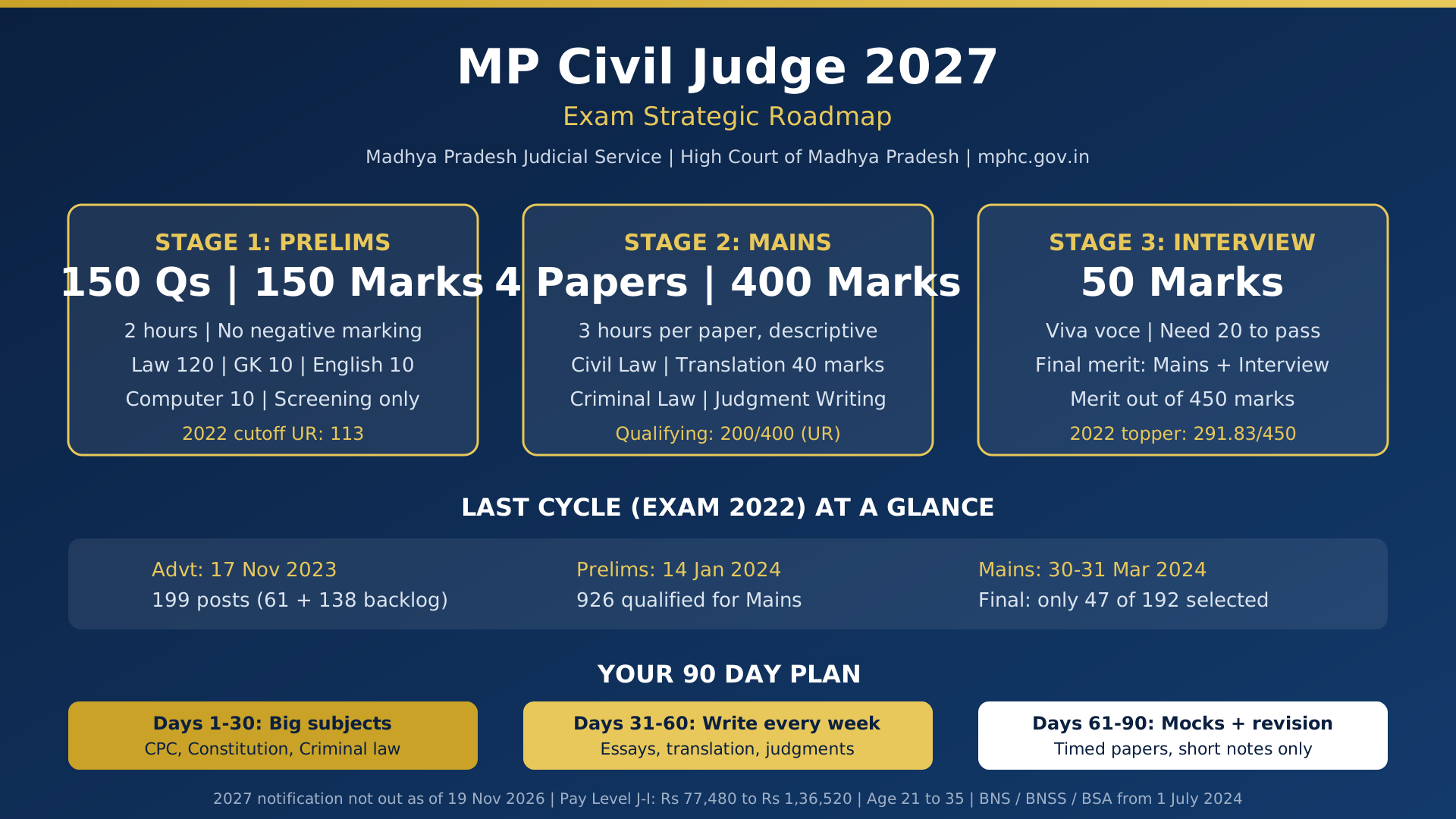
That cycle opened with an advertisement dated 17 November 2023. It listed 199 posts, 61 current and 138 backlog. The prelims ran on 14 January 2024. The mains ran on 30 and 31 March 2024.
The mains result came on 10 May 2024. The final result followed much later, and it ended in a way no coaching brochure mentions: out of 192 posts in the final round, only 47 candidates were selected and 145 posts stayed empty. Keep that number in mind while you read the rest of this guide, because it shapes every sensible decision about this exam.
The MP Civil Judge exam fills the post of Civil Judge, Junior Division, entry level, in the Madhya Pradesh Judicial Service. The High Court of Madhya Pradesh runs it from Jabalpur, and its official site is mphc.gov.in. The exam has three stages. Prelims is an objective screening test of 150 marks.
Mains is four descriptive papers of 100 marks each. The interview carries 50 marks. Prelims marks never enter the final merit list. The final merit list uses Mains plus interview, 450 marks in all.
The 2027 notification is not out, so prepare from the last cycle
Every judiciary cycle in Madhya Pradesh has followed the same broad shape for years, and the 2022 advertisement is the freshest full document available. A check of the High Court recruitment pages on 27 October 2026 found no newer Civil Judge advertisement. A guide published in May 2025 said the same thing in plainer words: the MPCJ 2025 notification was yet to be released. So the honest position is simple.
The 2027 cycle will arrive when the High Court advertises it, and the pattern, syllabus and eligibility below come from the 2022 cycle and the service rules as amended up to 18 September 2026. If the next advertisement changes a rule, the advertisement wins. Check mphc.gov.in before you fill any form.
This matters more than it sounds, because MP has changed its own rules more than once between cycles. The service rules were amended on 22 June 2023 and again on 18 September 2026. The practice rule for fresh graduates has been fought over in the Supreme Court through 2025 and 2026.
The criminal law syllabus changed under your feet on 1 July 2024, when the new criminal codes came into force. A candidate who prepares from a 2021 blog post will study the wrong codes and the wrong eligibility rule. Prepare from the last advertisement and the current rules, and treat everything older as background.
One more warning belongs here. Several job portals carry a 2026 MP Civil Judge listing that claims 158 posts. No official advertisement supports that number in the material reviewed for this page, and one such page even cites a Supreme Court ruling dated 20 May 2024, a date that does not match the real judgment of 20 May 2025.
Do not plan around portal listings. The High Court site is the only source that counts.
How the MP Civil Judge 2027 exam fits together
Prelims is a filter. You sit 150 multiple choice questions in two hours, one mark each, with no negative marking. The High Court fixes minimum qualifying marks and a cutoff per category, and only candidates above the cutoff reach Mains.
Your prelims score then disappears. It buys you a Mains hall ticket and nothing else.
Mains is the exam. Four papers, 100 marks each, three hours each, all descriptive. Papers one and two run on one day, papers three and four on another day. You need the minimum qualifying marks in Mains to reach the interview, and your Mains score carries into the final merit list.
The interview, called viva voce, carries 50 marks. You need at least 40 percent in it, which is 20 marks, or you are out no matter how well you wrote Mains. The final merit list adds Mains and interview, out of 450.
That is the whole game. Prelims gets you in the door, Mains builds your rank, and the interview can still take it away.
The 2022 cycle also shows how thin the margin can be. The topper, Bhamini Rathore from Indore, scored 291.83 out of 450. The second rank scored 281.83.
Ten marks separated rank one from rank three. In an exam scored out of 450, a single Mains answer can move you ten ranks. That is why the preparation advice later in this page spends so much time on answer writing and judgment writing, and so little on collecting study material.
Prelims: 150 questions in two hours, no negative marking
The prelims paper has 150 questions and 150 marks, and the clock gives you two hours. Each question carries one mark. There is no negative marking, so an unanswered question and a wrong answer cost exactly the same: nothing, except the mark you did not earn.
That single fact changes how you attempt the paper. You answer everything, and you spend your time on the questions you can actually solve instead of guarding against a penalty that does not exist.
The paper splits into two parts. Part one is law, and part two is general knowledge, English and computer knowledge. The law part carries the heavy weight, and the 2022 advertisement gives the subject wise break up. The Code of Civil Procedure carries 20 questions. The Code of Criminal Procedure carries 15.
The Evidence Act carries 15. The Indian Penal Code carries 15. The Constitution carries 5. The Contract Act carries 8. The Transfer of Property Act carries 7.
The Specific Relief Act carries 6. The MP Land Revenue Code carries 5. The MP Accommodation Control Act carries 5. The Negotiable Instruments Act carries 5. The Limitation Act carries 4.
The Information Technology Act carries 4. The Juvenile Justice Act carries 3. The Protection of Children from Sexual Offences Act carries 3. That adds to 120 questions of law.
General knowledge carries 10, English carries 10, and computer knowledge carries 10, which makes up the remaining 30.
Two honest flags belong here. First, some coaching pages give the Constitution 10 questions instead of 5, and one interview with a 2019 rank holder describes the law part as 110 marks with 40 marks for general knowledge, English and computers. The table above follows the subject wise break up published with the 2022 notification, and it adds to exactly 150, which is a good sign.
Treat the 5 mark figure for the Constitution as the notification figure and the 10 mark figure as a coaching site variant. Second, the old codes in that table are the codes as they stood in the 2022 advertisement. The new criminal codes now govern the syllabus, and the section on the new codes later in this page explains what changed.
The prelims cutoff in the 2022 cycle shows how the filter actually behaved. The High Court declared the prelims result on 10 March 2024. The cutoffs were 113 for unreserved, 109 for OBC, 89 for SC and 82 for ST, out of 150. A total of 926 candidates qualified for Mains.
The minimum qualifying marks were 90 for unreserved and 82 for the reserved categories, so the cutoff sat well above the minimum for unreserved candidates. An older table floating on coaching sites lists the 2022 prelims cutoff as 82 for unreserved, 38 for OBC, 36 for SC and 114 for ST. That table contradicts the official result notification dated 10 March 2024, which is the document that counts, and its ST figure of 114 sits above its unreserved figure of 82, which makes no sense on its face. Use the official notification figures.
What should you take from those numbers? A prelims score near 113 was the line for unreserved candidates in the last cycle, and the line moves with the paper. Aim for 120 plus in mocks, because a paper that feels easy will push the cutoff up, and a paper that feels hard will not save a candidate who left easy marks on the table.
The three non law sections carry 30 marks, which is one fifth of the paper, and they are the cheapest marks in the exam. Candidates who ignore computers and English hand 20 marks to everyone else before the law questions even start.
Mains: four papers, 400 marks, and the real selection
Mains is four papers of 100 marks each, three hours each, all descriptive. Nothing in Mains is objective. You write answers, essays, translations and judgments by hand, and your handwriting, your structure and your section numbers all get read by a human examiner. This is where the exam is won, and it is also where most candidates lose it, because they prepare for Mains the way they prepared for prelims, by reading and underlining, instead of by writing.
Paper one is Civil Law and Procedure. It covers the Constitution of India, the Code of Civil Procedure 1908, the Indian Contract Act 1872, the Limitation Act 1963, the Specific Relief Act 1963 and the Transfer of Property Act 1882. This is the paper that rewards a candidate who knows the sections cold. CPC carries the most weight here, and the examiner expects you to cite section numbers and orders alongside the idea itself.
Paper two is Court Practice, Writing Skill, Current Legal Knowledge and Translation. It is the most unusual paper in any state judiciary exam, and it is the one candidates underprepare for. It carries an article on a legal issue for 20 marks, an article on a social issue for 20 marks, a legal precis or briefing for 20 marks, and translation from English to Hindi and Hindi to English for 40 marks. Translation alone is 40 percent of this paper.
A candidate who cannot translate cleanly in both directions starts this paper 40 marks down, and no amount of essay polish recovers that. If you studied in English medium and your Hindi is rusty, this paper decides your result. Practice translation every week, not in the last month.
Paper three is Criminal Law and Procedure. It covers the criminal codes, the Evidence Act, the MP Land Revenue Code 1959, the MP Accommodation Control Act 1961 and the Negotiable Instruments Act 1881, chapters 13 and 17. In the 2022 advertisement these were the Indian Penal Code, the Code of Criminal Procedure 1973 and the Indian Evidence Act 1872. For the next cycle, read the new codes section of this page before you open any criminal law book.
Paper four is Judgment Writing. It carries framing of charges for 10 marks, framing of issues for 10 marks, a civil judgment for 40 marks and a criminal judgment for 40 marks. This paper is worth 100 marks, which is a quarter of Mains, and it tests a skill no MCQ paper can test: whether you can think like a judge on paper.
You get a set of facts, and you must frame the issues, apply the law, weigh the evidence and write an order that reads like a court wrote it. Candidates who have never written a full judgment before the exam discover in the hall that a judgment follows a structure of its own, with a verdict that grows out of the reasoning. It has a structure, a discipline and a tone, and the only way to learn it is to write judgments in practice and have someone mark them.
The qualifying marks for Mains need a careful note, because the sources disagree. The 2022 cycle required 200 out of 400 for unreserved candidates and 190 out of 400 for reserved category candidates, according to a report on the final result. The mains result sheet of the earlier 2021 cycle states 50 percent aggregate for unreserved and OBC and 45 percent for SC and ST. A news report on the court case that followed the 2022 result says the 1994 rules as amended in June 2023 require 50 percent in each paper for general and OBC candidates, while SC and ST candidates need 45 percent in each paper and 50 percent in aggregate, and the Hindi version of the same amendment says SC and ST need only 45 percent in aggregate.
These figures cannot all be right at the same time. The safe reading is that unreserved candidates should target 50 percent in every paper and 50 percent in aggregate, and reserved category candidates should check the exact rule in the advertisement they apply under. The next advertisement is the only document that settles this.
The interview is only 50 marks, and it still decides ranks
The interview carries 50 marks, and you need at least 40 percent, which is 20 marks, to stay in the race. Candidates who clear Mains but score below 20 in the interview are not selected, whatever their written score. The interview tests personality, communication, general awareness and legal knowledge, and the 2022 cycle shows how much it moves the final order.
The topper finished on 291.83 out of 450, and the gap between rank one and rank three was barely ten marks. An interview score ten marks above the next candidate can erase a Mains deficit of the same size.
Interview panels in MP have a reputation for asking about the district you come from, the courts you have visited, and the cases you have actually seen. Book law alone will not carry that conversation. A candidate who has spent time in a district court, watched proceedings, and can talk about what a civil judge does on an ordinary Tuesday will sound different from a candidate who has only read about it.
If you are still a student, start visiting your district court now. Sit in the back, watch how matters are called, and note how judges speak to lawyers and litigants. It costs nothing, and it shows in the interview room.
Who can apply for the Madhya Pradesh Judicial Service exam
The eligibility rules come from the Madhya Pradesh Judicial Service (Recruitment and Conditions of Service) Rules 1994, as amended up to 18 September 2026, and from the advertisement of the cycle you apply in. The advertisement always wins if the two differ, so read it line by line when it comes out. The rules below are the position as it stands now.
Age first. You must have reached 21 years and must not have completed 35 years on the first day of January of the year following the year in which applications are invited. In plain terms, the 2022 cycle counted age as on 1 January 2024, and the band was 21 to 35.
MP natives get three years of relaxation, which takes the upper limit to 38. Government servants get relaxation up to 38 as well. Other relaxations for SC, ST, OBC and persons with disabilities follow the state rules in force for that cycle, and the advertisement will list them.
Education next. You need a Bachelor degree in Law from a university recognised by the Bar Council of India. A three year LLB and a five year integrated LLB both count.
The 2022 advertisement added an alternative route for outstanding law graduates: a candidate who passed every examination at the first attempt with 70 percent aggregate, 50 percent for SC and ST, could apply without practice. That route matters, because it is the door the Supreme Court litigation has been arguing about ever since.
The practice rule is the part you must understand properly, because it changed twice in eighteen months and it decides whether a fresh graduate can even fill the form. Madhya Pradesh amended Rule 7(g) of its service rules in 2024 to require three years of legal practice for entry level judiciary posts. That amendment was challenged in the Supreme Court, and the challenge delayed the 2022 cycle by about eleven months, with no revised prelims results or mains results for a long stretch. Then the Supreme Court itself stepped in.
On 20 May 2025, the Supreme Court decided All India Judges Association v. Union of India and restored the requirement of at least three years of practice at the Bar for Civil Judge (Junior Division) posts across India. The practice period counts from provisional enrolment with the State Bar Council.
The Court said fresh law graduates had been entering the trial judiciary without courtroom exposure, and that had caused problems. The direction applied to future recruitment, and states were told to amend their rules to match.
Then, on 21 August 2026, a three judge bench of the Supreme Court modified that position in Bhumika Trust v. Union of India, citation 2026 INSC 904. The bench was led by Chief Justice Surya Kant, with Justice Augustine George Masih agreeing and Justice K. Vinod Chandran dissenting.
The new scheme works like this. For recruitment notifications issued up to 31 March 2027, all law graduates may apply without completing three years at the Bar, and they are deemed to have completed one year of active practice. If selected, they undergo one year of training at a State Judicial Academy followed by one year of structured law clerkship before regular appointment. For notifications issued on or after 1 April 2027, candidates must have at least one year of actual Bar practice before the exam, followed by the same one year of training and one year of clerkship.
The scheme runs for five years, after which the Court will review it on evidence about recruitment quality, training and performance.
What does that mean for MP Civil Judge 2027? It depends on a single fact nobody knows yet: the date of the notification. If the High Court notifies before 31 March 2027, the transitional window applies and fresh graduates can apply.
If it notifies on or after 1 April 2027, one year of actual practice becomes the entry ticket. And there is a wrinkle.
The Bombay High Court held in November 2026 that the deemed practice benefit covers law graduates who obtained their degrees before 22 August 2025, and it refused to extend it to 2026 graduates. That reading is being debated, and other High Courts may read the same judgment differently. So a 2026 graduate planning for MP should not assume the transitional window covers them.
Enrol with the Bar Council, start practice or a clerkship, and keep a paper trail of every appearance and every certificate. The eligibility rule is now a moving target, and the candidate who has one year of genuine practice is safe under every reading of it.
One more eligibility point, and it is practical. The 2022 advertisement ran into litigation because two petitioners, Neha Kothari and Rudresh Singh Bais, challenged the practice rule, and their prelims results were kept in sealed cover under a Supreme Court order dated 15 December 2023. Litigation is now part of this exam. Keep copies of every certificate, every enrolment paper and every fee receipt, and keep them for years after the exam ends.
The 2022 cycle ended with 145 empty posts
This is the section other guides leave out, and it is the most useful one in this page. The final result of the 2022 cycle was declared on 12 November, and out of 192 posts only 47 candidates were selected. For 43 unreserved posts, 41 candidates were selected. For 9 OBC posts, 5 were selected.
For 18 SC posts, 1 candidate was selected. For 121 ST posts, not a single candidate was selected. A total of 145 posts stayed vacant, and the High Court in Jabalpur ordered the examination cell to prepare a revised list by relaxing the minimum marks, with 45 percent for SC and 40 percent for ST in Mains, and a relaxation in the 20 marks required in the interview.
Read those numbers slowly, because they say three things. First, the binding constraint in this exam is the number of candidates who can clear Mains and the interview. The applicant count never decides anything on its own. Second, the ST backlog is the heart of the vacancy story.
The advertisement carried 109 ST backlog posts out of 138 backlog posts, and the final result filled none of the 121 ST posts. Third, the final cutoff is the one that matters. The final cutoffs for the 2022 cycle were 265.42 for unreserved, 236.32 for OBC, 203.68 for SC and 208.32 for ST, out of 450. Those are coaching site figures, not an official release, so treat them as indicative, but they sit in the right range: the topper scored 291.83, and the unreserved cutoff of 265.42 sits about 26 marks below that.
There is also a plain conflict in the vacancy count that you should know about. Summaries of the advertisement say 199 posts, 61 current and 138 backlog. The official prelims result notification dated 10 March 2024 counts 61 current and 134 backlog, which is 195 posts, and it records 926 candidates qualifying for Mains.
The final result covered 192 posts. The count moved between the advertisement, the prelims result and the final result, and no single figure is wrong on its own. It is a reminder to quote the vacancy number with its date and its document attached.
What should a candidate do with this? Two things. If you belong to a reserved category, understand that the exam has repeatedly failed to fill reserved posts, and that the Court itself has ordered relaxation of the minimum marks. That keeps the exam hard.
It means the system wants qualified candidates from these categories and keeps falling short. And whatever your category, understand that clearing prelims is the easier half of the job. The 2022 prelims passed 926 candidates for Mains, and only 47 were finally selected. The funnel narrows at Mains, and it narrows brutally at the interview.
Pay, probation and what the job looks like
A Civil Judge, Junior Division, entry level, sits in pay level J-I. The service rules as amended up to 18 September 2026 give the scale as Rs 77,480 to Rs 1,36,520. Some coaching sites quote Rs 77,840 as the starting basic, and older pages still show the pre revision scale of Rs 27,700 to Rs 44,770.
The official rules document is the source to trust, and it says 77,480. On top of basic pay come dearness allowance, house rent allowance, medical benefits and other allowances, and government quarters are available in many districts. The exact take home pay moves with the dearness allowance rate, so do not trust any single monthly figure a coaching site prints.
The probation period is two years. After selection, you train at the judicial academy and then take up posting as a Civil Judge and Judicial Magistrate First Class. The work is trial court work: civil suits, criminal trials, bail matters, remand, evidence, and orders that affect real people the same day you pass them.
The promotion path runs upward through the junior division grades. The rules list the next steps as Junior Division Grade II first ACP at level J-II, Rs 92,960 to Rs 1,36,520, after five years, and Grade I second ACP at level J-III, Rs 1,11,000 to Rs 1,63,030. Beyond that lie the senior division and the district judiciary, and the departmental competitive exam quota for higher posts stands at 25 percent after the Supreme Court restored it in the 2025 judgment.
One thing candidates rarely ask about, and should, is where they will live. MP has 52 districts, and a new civil judge can be posted to any of them. District towns in MP are not Indore and Bhopal.
Court infrastructure, housing and schools vary widely. If you cannot imagine living in a small district town for years, think about that now, not after selection.
The new criminal codes now run the criminal law syllabus
On 1 July 2024, three new criminal laws came into force across India. The Bharatiya Nyaya Sanhita 2023 replaced the Indian Penal Code. The Bharatiya Nagarik Suraksha Sanhita 2023 replaced the Code of Criminal Procedure 1973.
The Bharatiya Sakshya Adhiniyam 2023 replaced the Indian Evidence Act 1872. Any judiciary exam notified after that date tests the new codes, and MP is no exception. Current syllabus pages for MP list BNS, BNSS and BSA at 15 questions each in prelims, which mirrors the old weightage for IPC, CrPC and Evidence.
That sounds clean. The coaching pages tell a messier story. Some syllabus pages updated for 2026 still list the Indian Penal Code and the Code of Criminal Procedure by their old names, and at least one major coaching page lists the Evidence Act at 5 questions in one table and 15 in another. The coaching pages disagree with each other, and none of them is the advertisement.
The right approach is to study the new codes as your primary text and keep the old section numbers alongside them. Old case law still matters, because the courts decided most of the principles under the old codes, and the new codes carry those principles forward with new numbers. Learn both numbers for every important section. In Mains paper three, write the new section number first and add the old one in brackets where it helps the examiner follow you.
A few new code points deserve your attention early. BNS adds organised crime and snatching as offences, and it brings community service into the list of punishments. BNSS changes the procedure for bail, remand and trial timelines, and it allows trials in the absence of a proclaimed offender in defined cases.
BSA recognises electronic records far more fully than the old Evidence Act did. These are the points examiners reach for first when a new code comes into the syllabus, because they are the points where the new law actually differs from the old one. A candidate who can explain what changed, and why, scores more than a candidate who memorised the new numbers without understanding them.
The MP local laws do not change with the codes, and they are the part of the syllabus that separates MP from every other state. The MP Land Revenue Code 1959 and the MP Accommodation Control Act 1961 together carry 10 prelims questions and a share of Mains paper three. Candidates from other states skip these two Acts and lose those marks.
Candidates from MP who studied them in college have a real edge here. Give them a full week each in your plan.
Books that cover this paper without wasting your year
MP rewards depth in a small set of books. Buying more books will not add marks. For the Constitution, use a standard commentary and the bare text, and read one good book on constitutional law rather than three thin ones. For CPC, Mulla or Takwani, with the bare Act always open beside it.
For Contract, TPA, Specific Relief and Limitation, the standard commentaries by Pollock and Mulla or Avtar Singh cover the ground, and the bare Acts matter more than any guide. For criminal law under the new codes, use a current BNS, BNSS and BSA commentary published after July 2024, and check the section numbers against the bare Acts, because early editions of new commentaries carry errors. Ratanlal and Dhirajlal remains the reference for the old code principles that the new codes carry forward.
For the MP local laws, the bare Acts with a state commentary are enough, and you should read the MP Land Revenue Code in full at least once. For translation and essay writing, no book replaces practice. Read one Hindi newspaper editorial and one English editorial every day, and translate a paragraph in each direction.
For judgment writing, read real judgments from the MP High Court site, and study their structure: facts, issues, evidence, reasoning, order. Then write your own judgments from problem questions and get them checked by a teacher or a practising lawyer.
Previous year papers are your most honest study material. Solve the 2022 prelims paper under exam conditions, then the 2021 and 2019 papers. Mark every question you got wrong and trace it back to the section it came from.
That exercise will show you your weak subjects faster than any test series, and it costs nothing. Mock tests help after that, because they add time pressure and ranking, but a mock test cannot replace the bare Acts. Read the Acts first, then test yourself.
A 90 day plan that respects the shape of this paper
Ninety days is enough to prepare well if you already know the law from college. Starting from zero needs more time. This plan assumes you finished LLB and remember the outline of each subject. It works in three blocks of thirty days, and it puts writing practice in from the first week, because writing is the skill that decides Mains.
Days 1 to 30 belong to the big subjects. Give CPC ten days, the Constitution five, Contract and TPA five together, and criminal law ten days under the new codes with old numbers beside them. Read one subject a day in depth, and close each day by writing twenty MCQs from that subject or solving twenty from a previous paper.
In the same block, start translation. Thirty minutes a day, one paragraph each way, every day without exception. Also start reading one MP High Court judgment a day, and copy its structure into a notebook: facts, issues, evidence, reasoning, order.
Days 31 to 60 belong to the second tier and to writing. Cover Specific Relief, Limitation, the MP Land Revenue Code and the MP Accommodation Control Act, the Negotiable Instruments Act, the IT Act, the Juvenile Justice Act and POCSO. These are shorter subjects, and each one takes a day or two.
In this block, write two essays a week, one legal and one social, of about 150 words each, because paper two sets its essays at that length. Write one full judgment a week, alternating civil and criminal. Sit one full prelims mock every Sunday, 150 questions in two hours, and review every wrong answer the same evening.
Days 61 to 90 belong to revision and exam conditions. Revise the big subjects in the first ten days, the second tier in the next five, and then run full mocks: two prelims mocks a week and one full Mains paper a week under timed conditions. In the last ten days, stop learning new material.
Re-read your short notes, your translation notebook and your judgment structures. Sleep properly in the last week. A tired candidate makes errors in a 150 question paper that a rested candidate does not.
If you are also preparing for other judiciary exams, the overlap helps. The civil law papers are close across states, and the criminal law is now common after the new codes. The differences sit in the local laws and in paper two.
MP paper two, with its 40 marks of translation, has no twin anywhere else. If you prepare for Delhi Judicial Service 2027 or Bihar Judicial Service 2027 alongside MP, keep a separate notebook for MP translation and MP local laws, because those are the marks other states will not teach you.
Candidates who pair MP with Rajasthan Judicial Service 2027 or Haryana Judicial Service 2027 should do the same, and those who also sit for UPPSC PCS J 2027 will find the civil law overlap generous but the translation paper entirely their own problem. A law graduate who wants a backup in the academic line can look at UGC NET Law 2027, and MP graduates aiming at prosecution or the state services can compare notes with UPPSC APO 2027, UPPSC PCS 2027, UPPSC Assistant Professor 2027 and UPPSC Lecturer GIC 2027. The point is simple. One core preparation serves many exams, but MP pays you for two things nobody else tests the same way: translation and MP local laws.
Mistakes that cost candidates a year
The first mistake is preparing for prelims and calling it preparation. Prelims is a filter with no negative marking, and a candidate who only solves MCQs will reach Mains and find they cannot write a judgment, cannot translate a paragraph, and cannot frame an issue. Start writing in week one.
The second mistake is studying the old criminal codes. The 2022 advertisement used IPC, CrPC and the Evidence Act. The next cycle will use BNS, BNSS and BSA. A candidate who answers with old section numbers and never mentions the new codes will look like they stopped studying in June 2024.
The third mistake is ignoring the 30 non law marks in prelims. General knowledge, English and computers carry 10 marks each. Ten marks in computers is often the difference between clearing prelims and missing the cutoff by two marks.
The fourth mistake is treating translation as a language problem instead of a marks problem. Translation is 40 marks in Mains paper two. It is the single largest block in any one paper. A candidate who cannot translate loses more marks there than a weak essay ever costs.
The fifth mistake is waiting for the notification before starting. The last cycle moved fast. The advertisement came on 17 November 2023 and prelims ran on 14 January 2024, which is under two months.
A candidate who starts on notification day has about eight weeks to cover a syllabus that takes months. Start now, from the last cycle, and adjust when the advertisement arrives.
The sixth mistake is believing a cutoff table from a coaching site. Cutoffs move with the paper, the posts and the litigation. The 2022 prelims cutoff for unreserved candidates was 113, and the final cutoff was 265.42 out of 450, but those numbers describe one cycle.
Your target should be a score, not a rank in a table. Aim for 120 plus in prelims mocks and 55 percent in Mains mocks, and the cutoff will take care of itself.
Where to check for the 2027 notification
Check the High Court of Madhya Pradesh site at mphc.gov.in, under recruitment and results. That is the only place the advertisement will appear first. The MP Judicial Service Rules 1994, as amended up to 18 September 2026, are also published on the same site, and they are the document to read before you trust any summary.
Do not rely on job portals for dates, and do not pay any agent who promises a form link before the advertisement exists. The application process runs online through the High Court portal, and the fee, the dates and the document list will all sit inside the advertisement itself.
As of 19 November 2026, the position is this. No 2027 notification, no 2027 vacancy count, no 2027 dates. The last cycle is fully documented, the rules are current to September 2026, and the Supreme Court has set the eligibility framework through March 2027 and beyond it.
Prepare from those facts, write every week, and check the High Court site every week. The notification will come, and the candidates who are already writing judgments when it arrives will be the ones who clear Mains.
Sources
High Court of Madhya Pradesh, MP Judicial Service (Recruitment and Conditions of Service) Rules 1994 as amended up to 18 September 2026, mphc.gov.in.
High Court of Madhya Pradesh, prelims result notification No. 46/Exam/CJ/2022 dated 10 March 2024.
Supreme Court of India, All India Judges Association v. Union of India, judgment dated 20 May 2025.
Supreme Court of India, Bhumika Trust v. Union of India, 2026 INSC 904, judgment dated 21 August 2026.
Live Law, report on the Bhumika Trust judgment, 27 October 2026, and report on the Bombay High Court deemed practice ruling, November 2026.
Dainik Bhaskar English, report on the 2022 final result and the High Court order on relaxation, 2025.
Drishti Judiciary, MP Judiciary Exam 2025 complete guide, 8 May 2025.
Toprankers, MP Judiciary syllabus and exam pattern pages, 2026.
Maansarovar Law Centre, MP Judicial Services Exam 2022 syllabus and pattern.
Shishya, MP Civil Judge exam facts from the Exam 2022 advertisement dated 17 November 2023, checked 27 October 2026.