
About UPPSC APO 2027 Exam Series
📖 Table of Contents
- What an Assistant Prosecution Officer does
- Where the 2027 cycle stands right now
- The three stages, and what each one decides
- Prelims in detail: 150 questions in two hours
- Mains in detail: six papers, 500 marks, three days
- The interview and the final merit list
- Who can apply: the eligibility rules
- Age limit and relaxations
- The 2025 cycle: what actually happened
- The law syllabus in depth
- Fee and salary: the numbers that stay fixed
- Books that cover the syllabus without waste
- A 90 day plan that fits real life
- Mock test strategy: how to use mocks without wasting them
- Mistakes that cost good candidates marks
- What to check the day the 2027 notice arrives
- Sources
UPPSC APO 2027: Pattern, Eligibility, Syllabus and Cut Off
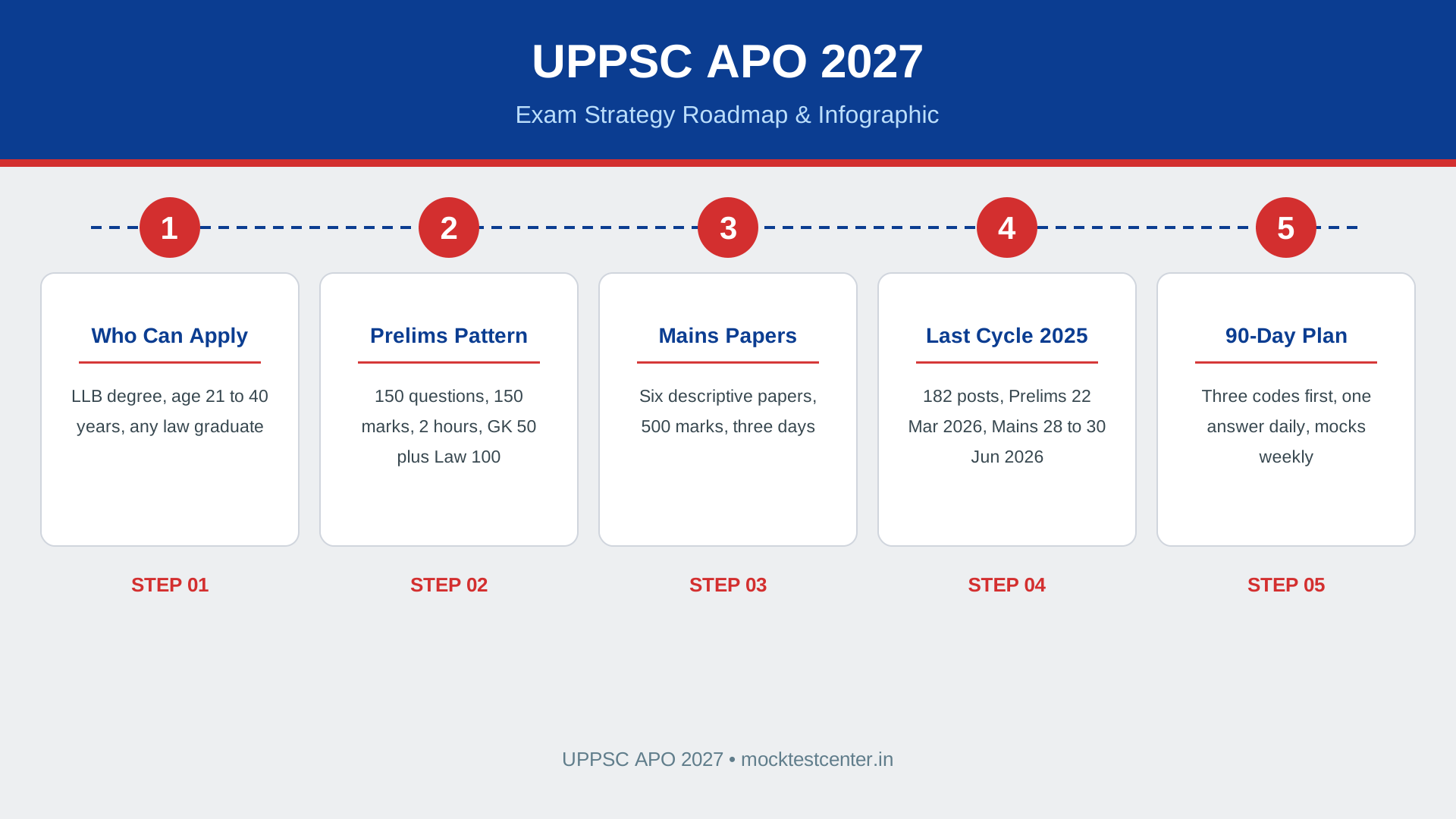
UPPSC APO 2027 will open Assistant Prosecution Officer posts in Uttar Pradesh for law graduates. The selection runs in three stages. A Prelims screening test carries 150 questions for 150 marks. A Mains written exam carries six descriptive papers for 500 marks. An interview carries 50 marks. Only Mains and interview marks decide the final merit list, 550 marks in all.
The 2027 notification has not come out yet, as of 19 November 2026. This guide rests on the last cycle, advertisement A-8/E-1/2025, and it says clearly where the facts end and the waiting begins. Any website that gives you a fixed 2027 exam date today is guessing.
What an Assistant Prosecution Officer does
An Assistant Prosecution Officer presents the case of the state in criminal courts. When the police file a charge sheet, the prosecution officer studies it, checks whether the evidence supports the charges, and argues the case before the magistrate or the sessions judge. The officer examines witnesses, cross examines the witnesses of the defence, and places the law before the court.
The work sits at the meeting point of law and investigation. A good prosecution officer reads the case diary carefully, spots the gaps in the evidence before the defence does, and prepares the witnesses for the questions they will face. The officer also advises the police during investigation, on which sections apply and which evidence the court will need.
The post is a Group B gazetted post in the prosecution department of Uttar Pradesh. A new officer usually starts in a district court, and rises through the prosecution service with experience. The starting pay sits in Level 8 of the pay matrix, and the post carries dearness allowance, house rent allowance, and travel allowance as per government rules.
The job suits a law graduate who likes court work more than office work. The day runs on hearings, case files, and the discipline of preparing a brief before the court rises. A candidate who has watched a criminal trial, even once, understands the job better than a candidate who has only read about it.
Many candidates prepare for this exam alongside the UPPSC PCS J 2027 exam, because the law portions overlap, and one preparation feeds both attempts, though the two exams test law in different ways.
Where the 2027 cycle stands right now
No 2027 notification exists yet. UPPSC releases its notifications on the official portal, uppsc.up.nic.in, and the APO 2027 notice will appear there first. As of 19 November 2026, no 2027 dates, no 2027 vacancy count, and no 2027 fee exist in any official notice.
The last cycle is still running. Mains was held from 28 to 30 June 2026, and the Mains result is still awaited as of 18 November 2026. The 2027 notification will come only after the 2025 cycle moves further, so candidates should expect a wait, and should use the waiting time to build the law base that the Mains papers demand.
The honest way to use the waiting time is to start with the pattern and the syllabus from the last cycle. The pattern has stayed stable, and the syllabus for the new criminal laws changes little from one cycle to the next. Preparation that starts now will still count when the notice arrives. Only the dates, the fee, and the vacancy count will change with the new advertisement.
The three stages, and what each one decides
The selection has three stages, and each stage has a different job. Prelims screens. Mains ranks. The interview tests the person behind the marks.
Prelims is an objective test of 150 questions for 150 marks, held in two hours. It only shortlists candidates for Mains. Prelims marks stay out of the final merit list, so a high Prelims score earns nothing beyond a Mains admit card, and a score just above the cut off earns exactly the same chance in Mains as a top score.
Mains is the stage that decides rank. It has six descriptive papers for 500 marks, spread over three days. The papers test General Hindi, General English, General Knowledge, Criminal Law and Procedure, the law of evidence, and other Acts. The marks in Mains carry the whole weight of the written selection.
The interview, called the Personality Test, carries 50 marks. A panel tests the candidate's legal knowledge, communication, and fitness for prosecution work. The final merit list adds Mains marks and interview marks, 550 marks in all, and the appointment follows that list, category by category. Medical examination and document verification follow selection.
That split shapes the whole preparation. Prelims needs speed and breadth, because 150 questions in 120 minutes leave less than a minute per question. Mains needs writing practice, because six descriptive papers reward the candidate who can write a clear legal answer under time pressure. The interview needs the habit of explaining a legal point in plain words, without hiding behind jargon.
Prelims in detail: 150 questions in two hours
The UPPSC APO 2027 Prelims has two parts. Part 1, General Knowledge, carries 50 questions for 50 marks. Part 2, Law, carries 100 questions for 100 marks. Each question carries one mark, and a wrong answer costs 0.33 marks. The paper runs for two hours in a single sitting, and it is held offline on an OMR sheet.
General Knowledge covers General Science, current events of national and international importance, history of India, the Indian National Movement, Indian Polity and Economy, and World Geography and Population. The official syllabus gives a question count for each topic. General Science carries 8 questions. Current events carry 10 questions. History of India carries 8 questions. The Indian National Movement carries 8 questions. Indian Polity and Economy carry 8 questions. World Geography and Population carry 8 questions.
Law carries two thirds of the paper, and it decides the Prelims result more than any other part. The law portion covers the Bharatiya Nyaya Sanhita 2023, the Bharatiya Nagarik Suraksha Sanhita 2023, the Bharatiya Sakshya Adhiniyam 2023, the Indian Constitution, and the UP Police Act and Regulations. The official syllabus gives a question count for the two largest parts. The Bharatiya Nyaya Sanhita carries 30 questions. The Bharatiya Sakshya Adhiniyam carries 20 questions. The remaining 50 questions spread across the Bharatiya Nagarik Suraksha Sanhita, the Constitution, and the UP Police Act, though the exact split for those three was not verified in this pass, and the article flags that gap.
The new criminal laws are the heart of this paper. The Bharatiya Nyaya Sanhita replaced the Indian Penal Code. The Bharatiya Nagarik Suraksha Sanhita replaced the Code of Criminal Procedure. The Bharatiya Sakshya Adhiniyam replaced the Indian Evidence Act. A candidate who still prepares from the old IPC, CrPC, and Evidence Act will lose marks on the sections that changed, and the changes are many, with new sections, new punishments, and new procedures.
Speed decides Prelims more than knowledge does. A candidate who knows the answer but reads slowly will leave questions unmarked. Practise with a timer from the first week, and learn to skip a hard question in seconds instead of fighting it for three minutes. With negative marking of 0.33 per wrong answer, a blind guess costs marks, so mark an answer only when you can remove at least one wrong option.
Mains in detail: six papers, 500 marks, three days
The UPPSC APO 2027 Mains is fully descriptive, and it runs over three days in Lucknow. The six papers carry 500 marks in all, and each paper has its own time limit. The timetable from the last cycle shows the shape of the three days.
Day one, 28 June 2026, held General Hindi in the morning, from 9 in the morning to 12 noon, for 100 marks, and General English in the afternoon, from 2.30 to 4 in the afternoon, for 50 marks. Day two, 29 June 2026, held General Knowledge in the morning, from 9 to 10.30, for 50 marks, and Criminal Law and Procedure in the afternoon, from 2.30 to 5.30, for 100 marks. Day three, 30 June 2026, held the Evidence Act paper in the morning, from 9 to 12 noon, for 100 marks, and the Other Acts paper in the afternoon, from 2.30 to 5.30, for 100 marks.
General Hindi carries 100 marks and runs to high school standard. General English carries 50 marks and also runs to high school standard. General Knowledge carries 50 marks and follows the same syllabus as the Prelims General Knowledge portion. Criminal Law and Procedure carries 100 marks and covers the Bharatiya Nyaya Sanhita, the Bharatiya Nagarik Suraksha Sanhita, and the UP Police Act. The Evidence paper carries 100 marks and covers the Bharatiya Sakshya Adhiniyam. The Other Acts paper carries 100 marks and covers 16 central and Uttar Pradesh specific special laws, a figure that comes from a single tracker and stays flagged here.
One detail needs a flag. Some tracker pages list General English and General Knowledge as three hour papers. The official timetable from the last cycle gives them one and a half hours each, and this guide uses the timetable figures. The same pages also list a four paper Mains of 400 marks with an interview of 100 marks, and that scheme is wrong for this cycle. The correct scheme is six papers for 500 marks and an interview of 50 marks, and the article states it plainly so that no candidate prepares for the wrong scheme.
One tracker records a qualifying rule for Mains, 40 percent in each paper, and 35 percent for SC and ST candidates. That rule comes from a single source, and the article flags it, because the advertisement is the only final word on qualifying marks, and a candidate should confirm the rule in the new advertisement.
Mains rewards writing, not memory alone. A candidate who knows the section number but cannot explain it in a paragraph will score less than a candidate who writes a clear answer with the section, the illustration, and a decided case. Practise writing one full answer every day, with a timer, and the hand will learn the pace that three hour papers demand.
The interview and the final merit list
The interview carries 50 marks, and it follows Mains. Only candidates who clear Mains reach the panel. The panel usually has senior officers and legal experts, and it tests the candidate in conversation, not in a written paper.
Expect questions that start from the candidate's own degree and the new criminal laws. The panel may ask what changed when the Bharatiya Nyaya Sanhita replaced the Indian Penal Code, or how a trial runs under the Bharatiya Nagarik Suraksha Sanhita, or what the Bharatiya Sakshya Adhiniyam says about electronic evidence. The panel wants to see whether the candidate can apply a section to a real case, not whether the candidate can recite the section number.
General awareness also enters the interview. The panel may ask about a recent judgment, a current debate on criminal justice, or a case in the news in Uttar Pradesh. A candidate who reads legal news with a prosecutor's eye, asking what the state should have argued, answers these questions better than a candidate who only memorises headlines.
The final merit list adds Mains and interview marks, 550 in all. The commission prepares the list category by category, and the appointment follows the list. Medical examination and document verification follow selection, and the candidate joins the prosecution department named in the appointment letter.
Candidates who also prepare for UPPSC PCS 2027 should note that the PCS interview carries a larger weight, and the two interviews reward different habits, so the preparation should not be copied from one exam to the other.
Who can apply: the eligibility rules
The degree rule is simple. A candidate needs a Bachelor of Laws degree, an LLB, from a recognised university or institution. A three year LLB and a five year integrated law degree both count. The advertisement for the last cycle asked for the LLB as a completed qualification, and a candidate who had not finished the degree by the last date could not claim the post.
One tracker says the commission gives preference to candidates with two or more years of Territorial Army service, or with an NCC B certificate. That claim comes from a single source, and the article flags it, because preference rules matter only when two candidates tie, and the advertisement is the only final word on them.
Indian citizenship is required. The commission also applies the domicile rules of Uttar Pradesh for reservation benefits, so a candidate from another state can apply, but the reservation benefit goes only to Uttar Pradesh domicile candidates in the reserved categories.
There is no limit on the number of attempts in the advertisement, as long as the candidate stays within the age limit. A candidate who misses the cut off in one cycle can sit again in the next, and many selected officers qualified on their second or third attempt.
Candidates who track UPPSC Lecturer GIC 2027 should note that the lecturer post needs a postgraduate degree in the subject, while the APO post needs only the LLB, so the two posts suit different stages of a law graduate's career.
Age limit and relaxations
The age limit for the last cycle ran from 21 years to 40 years, counted as on 1 July 2025. That means a general category candidate needed to be born between 2 July 1985 and 1 July 2004. The new advertisement will name its own cut off date, and the new date will shift the birth window by the same number of years.
Relaxation in the upper age limit follows the rules of the Uttar Pradesh government. One tracker records three years for OBC candidates, taking the limit to 43 years, and five years for SC and ST candidates, taking the limit to 45 years. Those exact figures come from a single source, and candidates should confirm the relaxation table in the new advertisement, because a wrong age calculation can waste a whole application.
Ex-servicemen, dependents of freedom fighters, skilled players, and persons with disabilities get relaxation under separate rules, and each group needs the certificate that proves the claim. The certificate check happens at document verification, and a missing certificate at that stage ends the candidature, even after selection.
Age counts from the date the advertisement names, not from the exam date. A candidate who turns 41 a month after the cut off date still qualifies, and a candidate who turns 21 a month after the cut off date does not. Read the date in the advertisement first, and count from there.
The 2025 cycle: what actually happened
The last cycle ran under advertisement A-8/E-1/2025, and its dates are now a matter of record. The notification date itself carries a small conflict. Most detailed sources record 16 September 2025, while one tracker records 13 September and another records 12 September. This guide uses 16 September 2025, the majority date, and flags the other two claims.
Applications ran from 16 September to 16 October 2025. The fee was 125 rupees for General, EWS, and OBC candidates, made of a 100 rupee exam fee and a 25 rupee online processing fee. The fee for SC and ST candidates carries a conflict. Most sources record 65 rupees, while one tracker records 105 rupees for SC and ST and ex-servicemen. This guide uses 65 rupees, the majority figure, and flags the 105 rupee claim. The fee for persons with disabilities was 25 rupees.
Prelims was held on 22 March 2026. A total of 93,419 candidates applied, and 50,795 appeared. The result came on 30 April 2026, as a list of qualified roll numbers, with no marks and no qualifying status shown. A total of 2,856 candidates qualified for Mains, against 182 posts. That means about 16 candidates fought for each post at the Mains stage.
Mains was held from 28 to 30 June 2026. One point needs a clear correction. The brief for this package recorded the Mains date as 17 June 2026, from the UPPSC exam calendar. The actual Mains ran from 28 to 30 June 2026, and several sources confirm the three day window with the paper by paper timetable. The 17 June date was the tentative calendar date, and the commission revised it before the exam.
The Mains centre also carries a conflict. Most sources record Lucknow as the Mains centre. One tracker records Prayagraj. This guide uses Lucknow, the majority figure, and flags the Prayagraj claim. The Mains result is still awaited as of 18 November 2026, and the cut off for every stage stays unreleased, because the commission releases category wise cut off marks for all three stages together, only after the final selection list comes out.
Candidates who prepare for UPPSC RO ARO 2027 will see a different rhythm there, because the RO and ARO selection runs on a Prelims and a Mains of a different shape, and the two exams should not be confused.
The law syllabus in depth
The UPPSC APO syllabus divides into three blocks, and each block needs a different method. The first block is the Bharatiya Nyaya Sanhita 2023. It covers the general principles of criminal liability, the punishments, and the offences against the body, against property, against the state, and against public order. Learn each offence with its section, its ingredients, and its punishment, and keep a notebook for the sections that changed from the old Indian Penal Code, because the paper tests the changes directly.
The second block is the Bharatiya Nagarik Suraksha Sanhita 2023. It covers investigation, arrest, bail, charge, trial, and appeal. Learn the procedure in order, from the first information report to the judgment, and practise with a flow chart for each stage, because procedure questions reward the candidate who knows what happens next, not the candidate who knows one section in isolation.
The third block is the Bharatiya Sakshya Adhiniyam 2023. It covers relevancy, admissions, confessions, dying declarations, expert opinion, and electronic evidence. Electronic evidence deserves extra hours, because the new law gives it a larger place than the old Evidence Act did, and the paper has already started testing it.
The Constitution and the UP Police Act close the law syllabus. The Constitution portion covers fundamental rights, the directive principles, the judiciary, and the provisions that govern criminal justice. The UP Police Act portion covers the organisation of the police in Uttar Pradesh, the powers of police officers, and the regulations that govern their work. These two parts carry fewer questions than the three codes, but they separate candidates whose law scores are close.
General Knowledge needs a separate notebook, with history, polity, economy, geography, science, and current events. Give it one hour a day from the start, because the General Knowledge portion carries 50 marks in Prelims and 50 marks in Mains, and a candidate who ignores it loses 100 marks across the two stages.
Fee and salary: the numbers that stay fixed
The fee for the last cycle was 125 rupees for General, EWS, and OBC candidates, 65 rupees for SC and ST candidates, and 25 rupees for persons with disabilities. The fee is non refundable, and the candidate pays it online at the time of application. The new advertisement will carry its own fee table, and the figures may change, so check the table before you pay.
The salary sits in Level 8 of the pay matrix, with a grade pay of 4,800 rupees under the 7th Pay Commission. The starting basic pay is 47,600 rupees a month, running up to 1,51,100 rupees. Dearness allowance, house rent allowance, and travel allowance add to the basic pay as per government rules.
One tracker estimates the in hand salary at 60,000 to 80,000 rupees a month, including allowances. That figure is an estimate, not an official figure, and it depends on the posting, because house rent allowance differs between a city posting and a small town posting. A new Assistant Prosecution Officer should expect a comfortable starting salary, and the real value of the post lies in the court work and the career ladder, not in the first month's pay alone.
Books that cover the syllabus without waste
Law candidates should start with the bare Acts, because the paper tests the sections themselves. Keep a copy of the Bharatiya Nyaya Sanhita 2023, the Bharatiya Nagarik Suraksha Sanhita 2023, and the Bharatiya Sakshya Adhiniyam 2023 on the desk, and read them in small parts every day. A bare Act with short notes in the margin beats a guide book read twice.
For the Bharatiya Nyaya Sanhita, use a standard commentary that explains each section with illustrations and decided cases. For the Bharatiya Nagarik Suraksha Sanhita, use a commentary that gives the procedure in order, with the timelines for each stage. For the Bharatiya Sakshya Adhiniyam, use a book that covers relevancy and electronic evidence in depth, because those two topics carry the most questions.
For the Constitution, use a standard book on Indian polity, and keep a notebook for the articles that govern criminal justice, the fundamental rights, and the powers of the courts. For the UP Police Act, use the Act itself with the regulations, and learn the sections that govern arrest, investigation, and the duties of a police officer.
General Hindi needs one book, Samanya Hindi by Lucent Publications. General English needs a standard grammar book at high school level, with practice in essay, precis, and comprehension. General Knowledge needs one book, Objective General Knowledge by Lucent Publications, plus a daily newspaper and a monthly current events magazine. Buy the latest edition of each book, and check the edition year before you pay.
Previous year papers deserve a special place. Solve the Prelims papers of the last cycles, and read the Mains question papers that the commission lists in its previous paper archive under advertisement A-8/E-1/2025. A shelf full of unread books helps no one. One book read twice beats three books read once.
Candidates who also prepare for UPPSC Assistant Professor 2027 can share the General Hindi and General Knowledge books with this exam, because the general portion overlaps, and one set of books can serve both preparations.
A 90 day plan that fits real life
Ninety days divide into three parts, and each part has one job. Days 1 to 30 build the base. Read the three codes in order, Bharatiya Nyaya Sanhita first, then Bharatiya Nagarik Suraksha Sanhita, then Bharatiya Sakshya Adhiniyam, and make short notes as you read. Give law three hours a day and General Knowledge one hour a day. End each week with a previous year paper, solved without a time limit, and mark the questions you got wrong.
Days 31 to 60 build speed and writing. Start timed practice, one full Prelims paper every third day, and one descriptive answer every day, written with a timer. Revise your notes every Sunday, and rewrite the notes that feel thin. This is the phase where weak subjects show themselves, and the honest move is to give the weakest subject the most hours, even when the strongest subject feels better to study.
Days 61 to 90 build exam fitness. Sit for a full mock every second day, in exam conditions, with a timer and no phone. Write at least one full Mains paper a week in this phase, in three hours, by hand, because the hand needs practice as much as the mind does. Analyse each mock the same evening, and write down three things, the subjects that cost marks, the question types that ate time, and the silly errors. Revise only from your notes and your error list in the last ten days, and stop learning new material five days before the exam.
Working candidates can follow the same plan with smaller daily hours. Two hours a day for ninety days beats six hours a day for thirty days, because the syllabus needs repetition more than it needs long sittings. Keep a simple daily log, date, hours, subjects covered, questions solved, and the log itself will keep you honest when motivation dips.
Candidates who prepare for UPPSC Staff Nurse 2027 will find the same log useful, because the habit of a daily record works for every exam, and one log can serve both preparations, even when the subjects differ.
Mock test strategy: how to use mocks without wasting them
A mock test measures, and the analysis after it teaches. Sit for the mock in exam conditions, two hours for Prelims, three hours for a Mains paper, one sitting, no break, no phone, no notes. Law mocks test section recall and application, so practise those two skills in every mock.
Analyse the mock the same day, while the questions still feel fresh. Sort every wrong answer into three piles, concept gap, silly error, and time pressure. Concept gaps need a return to the bare Act. Silly errors need a slower reading habit. Time pressure needs more timed sets. A mock without this sorting wastes hours, because the score alone teaches nothing.
Use the negative marking rule in the last fifteen minutes of every Prelims paper. With a penalty of 0.33 marks for a wrong answer, a blind guess costs marks, so mark an answer only when you can remove at least one wrong option. Guess with sense, remove the options you know are wrong, and pick from what remains. A mock is the place to practise this, so that the habit feels natural on exam day.
For Mains, the mock serves a different purpose. Candidates who prepare for UPPSC Assistant Engineer 2027 face a different mock, because the engineering papers test numerical speed, while the law papers test writing. Write the answers by hand, in the time the paper allows, and then read them aloud. An answer that sounds clear when read aloud will read clear to the examiner. Keep a running table of your mock scores, Prelims and Mains separately, and watch the trend across weeks, because a rising trend tells you the plan works and a flat trend tells you to change the plan.
Candidates who track UPPSC Medical Officer 2027 should note that the medical mock needs a different method, because the screening test there is a single paper of 150 questions, and the law mocks here should stay inside the APO syllabus.
Mistakes that cost good candidates marks
The first mistake is preparing from the old laws. Candidates read the Indian Penal Code, the Code of Criminal Procedure, and the Indian Evidence Act for months, and then find the paper asking about sections that exist only in the new codes. Buy the new bare Acts first, and read the old laws only to understand what changed.
The second mistake is reading General Knowledge last. General Knowledge carries 50 marks in Prelims and 50 marks in Mains, and candidates who leave it to the final month score far below their law level. One hour a day from day one keeps General Knowledge level with law, and a level General Knowledge score saves many borderline results.
The third mistake is collecting books instead of finishing them. Many law candidates memorise section numbers and skip the illustrations. The paper tests sections through cases, so a candidate who knows the number and not the idea behind it gives away marks.
The fourth mistake is taking mocks and skipping the analysis. A mock score without analysis is a number without a lesson, and a candidate who repeats the same errors in ten mocks learns nothing from any of them. Analyse every mock, write the error list, and fix one error type before the next mock.
The fifth mistake is trusting unofficial dates and cut offs. Websites guess the 2027 dates every year, and some pages publish expected cut offs that have no official source. The commission has released no cut off for any stage of the last cycle, and it will release the cut offs only with the final result. Trust only the official portal, and plan around the syllabus until the notice arrives. Candidates who prepare for UPPSC ACF RFO 2027 face the same guessing game, and the same rule applies there, trust the portal, not the rumour.
What to check the day the 2027 notice arrives
Read the UPPSC APO 2027 notice on the official portal, uppsc.up.nic.in, and check six things in order. First, the application window and the last date for fee payment. Second, the vacancy count, to confirm that the post has posts in the new cycle. Third, the age cut off date, to confirm that you fall inside the 21 to 40 window.
Fourth, the fee for your category. Fifth, the exam pattern and the syllabus link, to confirm that the Prelims and Mains scheme has stayed the same, and that the new criminal laws still form the core of the UPPSC APO syllabus. Sixth, the correction window dates.
Apply early in the window, and keep a copy of the filled form, the fee receipt, and the application number. Check your photo, your signature, your category, and your subject before you submit, because the correction window fixes small errors and never fixes a wrong category. Then return to your plan, and let the notice change your dates, not your study.
Your preparation starts before the notice, and the notice only sets the dates. A candidate who has covered the three codes, solved the previous year papers, and taken the mocks will meet the notice with calm, and a candidate who waits for the notice will meet it with panic. Start now, and let UPPSC APO 2027 find you ready. Candidates who also watch UPPSC Polytechnic Lecturer 2027 can use the same checklist on the day its notice arrives, because the six checks work for every UPPSC advertisement.
Sources
The facts in this guide come from the UPPSC official portal, uppsc.up.nic.in, and from tracker pages that quote the official advertisement A-8/E-1/2025 and the UPPSC exam calendar 2026, including Testbook, TopRankers, Drishti Judiciary, PW, The Law Pillar, Kanoonpedia, and CareerPower. The 2025 cycle dates, the Prelims result, the Mains timetable, and the fee rest on those trackers, because the official advertisement PDF could not be fetched directly in this pass. Re-check every date and every figure against the official notice when the 2027 advertisement arrives.







