
About Bihar Judicial Service 2027 Exam Series
📖 Table of Contents
- Where the Bihar Judicial Service 2027 exam stands right now
- What a Civil Judge (Junior Division) actually does in Bihar
- Who can apply: degree, age and the practice rule that changed twice
- The prelims: two papers, 250 marks, no place in the merit list
- The Mains: eight papers, 1,050 marks, and the stage that decides selection
- Interview and final merit: 100 marks that move ranks
- The new criminal codes changed the syllabus, and old notes will cost you marks
- Choosing your three optional papers
- Books and sources that cover the syllabus without wasting your time
- A 90 day plan that fits around a job or a law practice
- Mistakes that cost Bihar judiciary candidates their selection
- What to do next
- Sources
Bihar Judicial Service 2027: Civil Judge Exam, Pattern, Syllabus and Preparation
The Bihar Judicial Service 2027 cycle has no notification yet. That is the first fact any serious candidate needs, and it changes how you should prepare. The live cycle is the 33rd Bihar Judicial Services Competitive Examination, notified by the Bihar Public Service Commission on 23 February 2026 for 173 posts of Civil Judge (Junior Division). Its preliminary exam, set for 3 June 2026, stands postponed after a Supreme Court interim order, and BPSC has announced no new date as of 19 November 2026. So the 2027 branding on this page means one thing: prepare now for the next cycle, using the 33rd cycle as the pattern, because BPSC has not opened a fresh form.
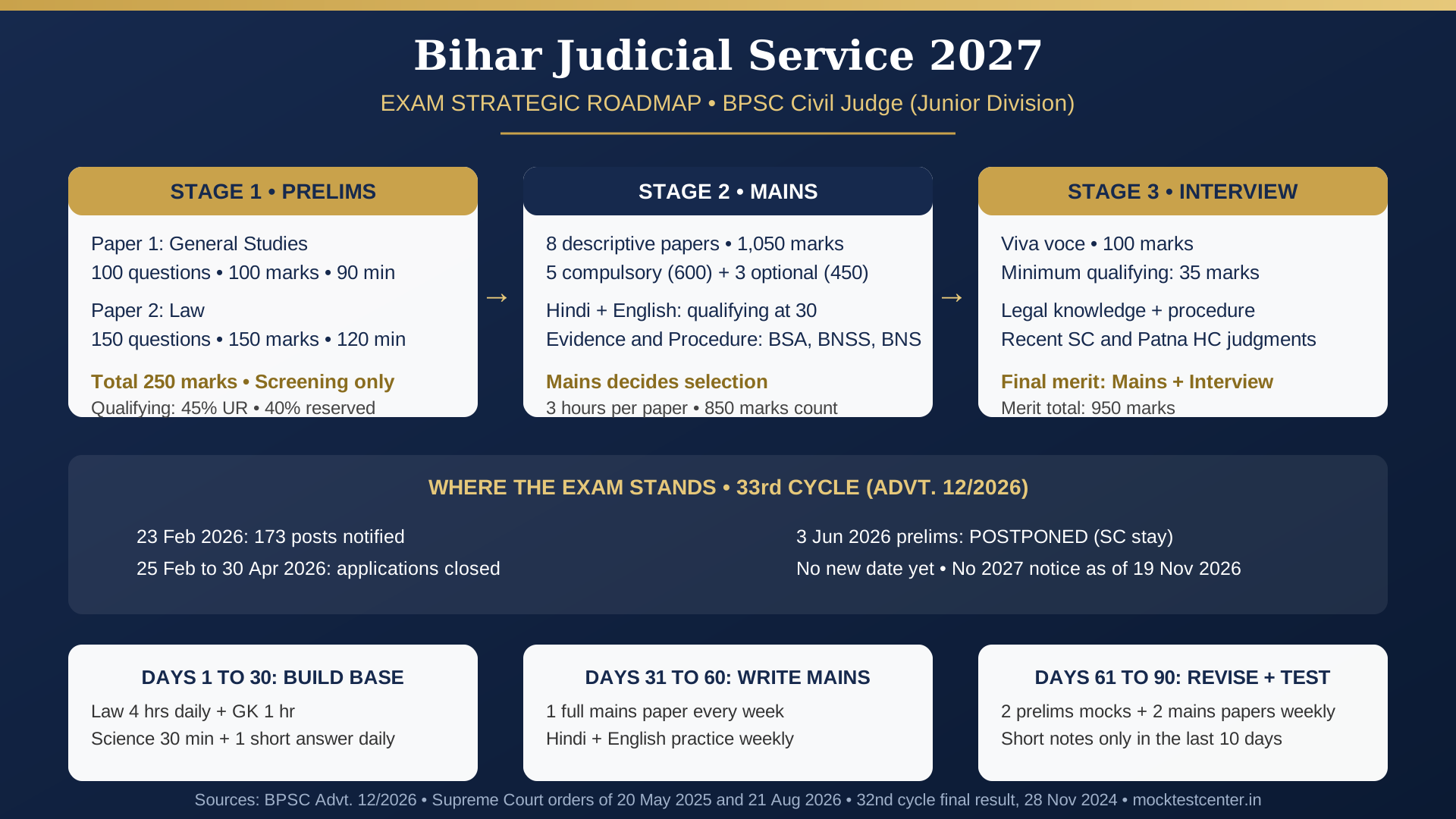
BPSC runs this exam in three stages. Prelims screen candidates with two objective papers worth 250 marks. Mains test writing with eight descriptive papers worth 1,050 marks. A 100 mark interview closes the process. Final merit comes from Mains plus interview only. Prelims marks never enter the merit list.
Read this page in this order if you are short on time. First, the section on where the 33rd cycle stands, because it decides whether you can still apply. Second, the eligibility section, because the Supreme Court changed the practice rule twice in eighteen months and the old advice is now wrong. Third, the Mains pattern, because Mains decides selection and most candidates prepare for it last, which is backwards.
Where the Bihar Judicial Service 2027 exam stands right now
BPSC published Advertisement Number 12/2026 on 23 February 2026. The advertisement opened 173 posts of Civil Judge (Junior Division). Applications ran from 25 February 2026, through the BPSC portal. Trackers disagree on the closing date. Several list 18 March 2026, the date in the original advertisement. Others, including TopRankers and Result Bharat, record an extension to 30 April 2026. The extension looks right, since BPSC issued a postponement notice on 25 May 2026, weeks after 18 March, and the application window had plainly run longer than the first date. Treat 30 April 2026 as the closing date and 18 March as the original date that got extended.
The preliminary exam was set for 3 June 2026 in Patna, in two sittings. BPSC postponed it until further orders. The reason was a Supreme Court interim order dated 22 May 2026 in Writ Petition (Civil) Number 1110/2025. BPSC put the postponement notice out on 25 May 2026. Its official exam calendar, in the version dated 14 August 2026, still carries the 33rd Bihar Judicial Services with the remark "Stay orders from Honourable Supreme Court". No revised date has appeared since. Any site or video giving you a new prelims date is guessing. Check the BPSC website for the next notice instead of trusting a date from a coaching page.
Everyone who applied stays in the process. The postponement cancels no application and no fee. Candidates who did not apply cannot join the 33rd cycle now. Their route is the next cycle, which BPSC has not notified. That is why this Bihar Judicial Service 2027 page carries the 2027 tag. It is a preparation page for the next notification, built on the last one, and it says so plainly rather than pretending a 2027 form exists.
The 32nd cycle shows how long a full cycle runs. BPSC notified it as Advertisement Number 23/2023. The preliminary exam took place on 4 June 2023. One report puts the prelims date at 14 June 2023, but most trackers record 4 June, so use 4 June. Mains ran from 25 to 29 November 2023. The Mains result came on 30 August 2024. Interviews ran from 12 to 23 November 2024. BPSC declared the final result on 28 November 2024. That is roughly twenty months from notification to final result. Plan your preparation on that scale. A candidate who starts only after the next notification appears will face the Bihar Judicial Service 2027 Mains with a few months of writing practice behind them, and Mains punishes that.
One more number from the 32nd cycle needs a warning. BPSC notified 155 vacancies in Advertisement 23/2023. Result reports describe the drive as 154 posts, and 153 candidates made the final merit list. Harshita Singh topped the exam. The gap between 155 and 154 has no public explanation in the sources I read. It may come from a vacancy withdrawn after notification, or from a reporting error. Either way, quote the notified figure as 155 and the filled figure as 153, and do not smooth the difference away.
What a Civil Judge (Junior Division) actually does in Bihar
A selected candidate joins the Bihar Civil Service (Judicial Branch) as a Civil Judge (Junior Division), also called a Judicial Magistrate First Class. The posting is a district or sub divisional court in Bihar. The work is trial court work. Civil suits, criminal trials, bail matters, remand, evidence recording, orders and judgments. A new judge handles a heavy cause list from the first year. The training year exists because the courtroom gives no grace period.
Pay follows the Second National Judicial Pay Commission matrix. The entry level, J-1, carries a basic pay of Rs 77,840 to Rs 1,36,520 a month. Trackers put the starting gross pay, with dearness allowance and house rent allowance added, near Rs 1,15,000 to Rs 1,30,000 a month. Older pages still quote the pre revision scale of Rs 27,700 to Rs 44,770. That older figure comes from the pre SNJPC scale and no longer describes the entry basic pay. Use the J-1 figure. The exact in hand amount moves with the posting city, the dearness allowance rate and deductions, so no single in hand number stays true for every officer.
Promotion runs on a clear ladder. Civil Judge (Junior Division) moves to Senior Division, then to Additional District Judge and District Judge, with assured career progression stages in between. Selection to the High Court bench comes much later and only for a few. The first promotion matters more than the last one for most officers, because Senior Division brings bigger courts and heavier trials. Five to seven years of clean service typically precede that step, though the exact timing follows vacancy and seniority rules.
The job suits a particular temperament. You read files all day. You hear both sides and decide. You write orders that higher courts will read. You manage a courtroom where lawyers, litigants, clerks and police all want your time at once. Candidates who love argument for its own sake often enjoy the bar more. Candidates who like deciding, writing and closing files tend to fit the bench better. Think about that before you spend two years preparing.
Bihar is not the only state judiciary exam worth your time. Many candidates prepare for Delhi Judicial Service 2027, MP Civil Judge 2027, Rajasthan Judicial Service 2027 and Haryana Judicial Service 2027 alongside Bihar, because the core law subjects overlap heavily. One set of notes on Constitution, Contracts and Evidence serves all four, and the extra work is the state specific GK and the local pattern of each exam.
Who can apply: degree, age and the practice rule that changed twice
Eligibility has three parts: a law degree, an age band and practice at the Bar. The degree rule is simple. You need a Bachelor of Laws, three year or five year integrated, from a university or institute recognised by the Bar Council of India. The 33rd advertisement sets no minimum percentage in LLB. You also need Indian citizenship. Keep your enrolment certificate, degree and Class 10 certificate ready, because BPSC calculates age from the Class 10 certificate.
Age runs on two different cut off dates, and the pair confuses almost everyone. Minimum age is 22 years as on 1 August 2025. Maximum age is 35 years as on 1 August 2022 for unreserved men. Women, reserved category candidates and persons with disabilities get relaxation up to 40 years. The odd pairing, minimum counted in 2025 and maximum counted in 2022, comes straight from the advertisement. Do not "correct" it in your head. Check your own dates against the advertisement when the next notification arrives, because BPSC can shift both cut off dates.
The practice rule is where old guidance turns dangerous. The 33rd advertisement required three years of practice as an advocate, counted from provisional enrolment with the State Bar Council, as on 23 February 2026. Law clerk experience counted toward that period. That requirement came from the Supreme Court judgment of 20 May 2025 in All India Judges Association v Union of India. The Court restored the three year practice condition after more than two decades in which fresh law graduates could sit for Civil Judge (Junior Division) exams directly. The Court reasoned that trial judges deal with pleadings, evidence, advocates and litigants from day one, so some courtroom exposure should precede appointment. It also directed one year of training before a selected candidate presides over a court.
Then the Court softened its own order. On 21 August 2026, a three judge bench led by Chief Justice Surya Kant, with Justice Augustine George Masih concurring and Justice K. Vinod Chandran dissenting, reviewed the May 2025 judgment. The majority kept the principle that courtroom exposure matters, but it changed how the principle works. For recruitment notifications issued between 20 May 2025 and 31 March 2027, all law graduates can apply, with no practice requirement. The Court treats those candidates as having completed one year of active practice. On selection they serve one year as trainee judicial officers and then one year of structured clerkship under judicial supervision. For notifications issued on or after 1 April 2027, the rule becomes one year of active practice before the exam, followed after selection by one year of training and one year of clerkship.
Work out what that means for Bihar. The 33rd cycle falls inside the waiver window, since BPSC notified it on 23 February 2026. Fresh graduates were eligible to apply, and BPSC has not announced whether it will reopen the form for fresh graduates after the review verdict. The next Bihar cycle, if BPSC notifies it after 1 April 2027, will likely require one year of active practice. If BPSC notifies it before that date, the waiver window still covers it. The notification date decides your eligibility, so read that date first in any new advertisement. Enrol with your State Bar Council early even if you plan to sit as a fresh graduate. Enrolment starts the clock that later notifications will measure, and the certificate of practice that the 2025 judgment demanded may return in some form.
One practical note follows from the training and clerkship scheme. A candidate selected under the waiver does not walk into a courtroom as a full judge on day one. The first year is training at the judicial academy, and the second year is clerkship. Treat that as two years of learning on full pay, not as a delay. The officers who use those two years well, reading judgments, watching senior judges and learning court management, settle faster than officers who treat training as a holiday.
The prelims: two papers, 250 marks, no place in the merit list
Prelims is a screening test. BPSC holds it in offline mode on OMR sheets. Two papers, both objective. Paper 1 covers General Studies: 100 questions, 100 marks, 90 minutes. Paper 2 covers Law: 150 questions, 150 marks, 120 minutes. Total time is 210 minutes. Total marks are 250. You need 45 percent to qualify if you are unreserved, and 40 percent if you belong to a reserved category. That means 112.5 marks for unreserved candidates in practice, since BPSC applies the percentage to the total. Fall below the line and Mains stays closed to you, however strong your law knowledge is.
Prelims marks stay out of the final merit list. The final list uses Mains and interview marks only. That fact shapes strategy. Prelims rewards breadth and speed. You answer 250 questions in 210 minutes, which leaves about 50 seconds per question. You cannot afford to wrestle with any single question. Mark it, move on, return if time allows. Mains rewards depth and writing. The two stages need different preparation, and candidates who prepare for both the same way usually clear neither.
Negative marking is the one prelims fact I could not settle from the advertisement itself. One careful tracker, Shishya, states that the pages of Advertisement 12/2026 it read do not state negative marking at all. Several prep sites report that prelims has no negative marking, with one mark per correct answer and no penalty for a wrong or unattempted answer. The safer reading is this: no negative marking appears in the sources, but the advertisement stays silent on it, so confirm the rule in the next official notice before you decide how freely to guess. If no negative marking applies, attempt every question. If a later notice introduces a penalty, that advice flips at once.
Paper 1, General Studies, covers General Knowledge and current affairs, including the history of India and Bihar, the geography of India and Bihar, Indian polity and economy, the Indian National Movement and elementary general science. Bihar specific content carries real weight here. Questions on Bihar history, Bihar geography, Bihar administration and recent Bihar current affairs appear every year. A candidate who studies national GK and skips Bihar gives away the easiest marks in the paper.
Paper 2, Law, covers six subjects: Law of Evidence and Procedure, Constitutional and Administrative Law of India, Hindu Law and Muhammadan Law, Law of Transfer of Property with Principles of Equity, Law of Trusts and Specific Relief, Law of Contracts and Torts, and Commercial Law. All five Mains optional subjects already appear here, so prelims law preparation doubles as Mains optional preparation. That overlap is the best efficiency in the whole exam. Every hour you spend on Constitutional Law or Contracts in prelims pays again in Mains.
Cut offs from the 32nd cycle show the standard you must beat. For the written Mains stage, the unreserved cut off was 442 marks. EWS stood at 418, EBC at 377, BC at 408, SC at 349 and ST at 371. BPSC has not published a prelims cut off in the sources I read, and prelims cut offs move with the paper, so treat 45 percent as the floor and aim far above it. A candidate who scrapes past prelims at the qualifying line enters Mains with no advantage, since prelims marks vanish. The aim in prelims is a comfortable margin, not a bare pass.
The Mains: eight papers, 1,050 marks, and the stage that decides selection
Mains is a written descriptive exam. Eight papers, three hours each, 1,050 marks in total. Five compulsory papers carry 600 marks. Three optional papers, chosen from five law subjects, carry 450 marks. Every paper is descriptive. You write answers, not tick boxes. That single difference explains why so many strong prelims candidates fail Mains. They know the law but cannot put it on paper under time pressure.
The five compulsory papers are General Knowledge including Current Affairs at 150 marks, Elementary General Science at 100 marks, General Hindi at 100 marks, General English at 100 marks, and Law of Evidence and Procedure at 150 marks. Hindi and English are qualifying papers. You need 30 marks in each. Their marks do not enter the merit list. One tracker, PW Live, puts the qualifying mark at 33 instead of 30. Most sources, including the detailed pattern pages, say 30. Use 30 and treat 33 as the conflicting figure. Either way, the warning is the same: a candidate can score brilliantly in law papers and still fall out of the race by neglecting Hindi or English. The two language papers decide nothing in the merit list, yet they can end a candidacy.
General Knowledge including Current Affairs, at 150 marks, is the biggest compulsory paper after Evidence and Procedure. It rewards steady reading more than last minute cramming. Current affairs from the twelve months before the exam dominate, with Bihar events, national policy, court judgments and major appointments all in play. Elementary General Science, at 100 marks, tests school level science: physics, chemistry, biology and everyday applications. Law graduates fear it most, which is exactly why it offers easy marks to anyone who revises Class 10 level science properly.
Law of Evidence and Procedure, at 150 marks, is the most important compulsory paper. It now runs on the new codes. The Bharatiya Sakshya Adhiniyam, 2023, the Bharatiya Nagarik Suraksha Sanhita, 2023, the Bharatiya Nyaya Sanhita, 2023, and the Code of Civil Procedure, 1908, form its core. Old IPC, CrPC and Evidence Act answers will not fetch marks here. The paper tests how procedure actually moves a case: investigation, charge, trial, evidence, judgment, appeal. Learn it as a sequence, not as a list of sections.
The optional papers decide the top of the merit list. You choose any three of five, each worth 150 marks. The five are Constitutional and Administrative Law of India; Hindu Law and Muhammadan Law; Law of Transfer of Property, Principles of Equity, Law of Trusts and Specific Relief; Law of Contracts and Torts; and Commercial Law. All five already appeared in Prelims Paper 2, so your prelims study gives you a base in each. Choose on strength, not on rumour. A subject you studied well in LLB, with good notes and past paper practice, beats a subject that toppers call scoring but you have never opened.
| Mains paper | Marks | Duration | Counts in merit |
|---|---|---|---|
| General Knowledge including Current Affairs | 150 | 3 hours | Yes |
| Elementary General Science | 100 | 3 hours | Yes |
| General Hindi | 100 | 3 hours | No, qualifying at 30 marks |
| General English | 100 | 3 hours | No, qualifying at 30 marks |
| Law of Evidence and Procedure | 150 | 3 hours | Yes |
| Optional paper 1 (chosen from five) | 150 | 3 hours | Yes |
| Optional paper 2 (chosen from five) | 150 | 3 hours | Yes |
| Optional paper 3 (chosen from five) | 150 | 3 hours | Yes |
| Total | 1,050 | Eight sittings | 850 marks count in merit |
Mains qualifying works like this. Candidates need 35 percent in the written exam to reach the interview, according to the pattern pages for the 32nd cycle. Interview shortlisting runs at roughly one candidate for every three vacancies, based on Mains performance. In the 32nd cycle, 1,675 candidates cleared prelims for Mains, 463 cleared Mains for the interview, and 458 appeared for it. The funnel narrows hard at Mains. Roughly one in four Mains candidates reached the interview, and roughly one in three interview candidates made the final list.
Interview and final merit: 100 marks that move ranks
The interview, called viva voce, carries 100 marks. You need 35 percent, which is 35 marks, to qualify. BPSC adds interview marks to Mains marks, excluding Hindi and English, to build the final merit list. The merit total is 950 marks: 850 from Mains papers that count, plus 100 from the interview.
The final cut offs from the 32nd cycle show how tight the race gets. Unreserved candidates needed 538 marks out of 950. EWS needed 511. EBC needed 481, BC needed 502, SC needed 455 and ST needed 479. The gap between the written cut off and the final cut off tells the story. An unreserved candidate needed 442 in the written stage and 538 in the final total, so the interview added about 96 marks at the margin. Interview marks swing ranks by dozens of places. A candidate with a middling Mains score and a strong interview can overtake a candidate with the reverse profile.
Interview panels test legal knowledge, procedural law, recent Supreme Court and Patna High Court judgments, Bihar history, administration and current issues, communication, analytical skill, judicial temperament and suitability for the bench. Memory alone will not carry you through it. Panels ask a candidate to reason through a problem, to see both sides, to hold a view under questioning and to change it when a better argument appears. Mains answer writing trains exactly that skill, which is another reason to write through preparation rather than only reading.
Women candidates form a large share of every Bihar judiciary list. In the 32nd final list, 35 women were selected for the 61 general category vacancies, and six women held the top ranks. The Times of India reported that result on 29 November 2024. Reservation for women runs at 35 percent of posts in the state, and the 32nd advertisement carried 51 of 155 posts for women. That share shapes the competition. It also means the exam rewards the candidates who actually sit in the hall, not any one group.
The new criminal codes changed the syllabus, and old notes will cost you marks
Three new criminal laws came into force on 1 July 2024. The Bharatiya Nyaya Sanhita, 2023, replaced the Indian Penal Code. The Bharatiya Nagarik Suraksha Sanhita, 2023, replaced the Code of Criminal Procedure, 1973. The Bharatiya Sakshya Adhiniyam, 2023, replaced the Indian Evidence Act, 1872. Parliament passed all three in December 2023, the President gave assent on 25 December 2023, and commencement notifications dated 23 February 2024 fixed 1 July 2024 as the start date. One provision stays out of force: Section 106(2) of the BNS, which deals with causing death by rash and negligent driving, has not been brought into force.
The numbers changed with the names. BNS has 358 sections against 511 in the IPC. BNSS has 531 sections against 484 in the CrPC. BSA has 170 sections against 167 in the Evidence Act. Cases that began before 1 July 2024 continue under the old codes, so the date of the offence decides which law applies, not the date of the FIR. A candidate who cites IPC section numbers in a Mains answer written in 2027 will look like a candidate who stopped studying in 2023. Learn the new section numbers for the provisions that matter most: offences against the human body, offences against property, organised crime, mob lynching, snatching, community service as a punishment, zero FIR, e FIR, timelines for investigation and trial, electronic records as evidence, and the BSA certificate under Section 63.
The 33rd cycle syllabus names the new codes directly. Its Law of Evidence and Procedure paper lists BSA, BNSS, BNS and CPC. Prelims Paper 2 still carries the old subject title "Law of Evidence and Procedure", but the content now runs on BSA and BNSS. Any book or note set that teaches evidence through the Indian Evidence Act without mapping each provision to BSA is a liability. Buy the bare acts. Read them beside your textbook. When a textbook cites the old Act, write the new section number in the margin that same day, because the mapping fades fast if you leave it for revision week.
Civil law did not change the same way. The Code of Civil Procedure, 1908, the Transfer of Property Act, the Indian Contract Act, the Specific Relief Act and the Hindu and Muslim personal laws still run the civil side of the syllabus. That stability helps. A candidate can trust older civil law books in a way that no longer works for criminal law. Spend the saved time on procedure, because procedure is where Bihar Mains separates candidates. A good Evidence and Procedure paper needs the sequence of a trial in your head: FIR, investigation, charge sheet, charge, evidence, arguments, judgment, appeal, revision. Sections attach to that sequence. Without the sequence, sections float loose and answers read like a bare act index.
Choosing your three optional papers
Every optional paper carries 150 marks, and all five draw on subjects you already met in LLB. The choice matters less than the preparation, but a bad choice still costs marks. Pick subjects where you have notes, interest and past paper practice. Then commit. Changing an optional paper midway through preparation wastes the one resource you cannot recover, which is time.
Constitutional and Administrative Law suits candidates who follow current affairs and court judgments. The syllabus runs from the Constitution, Articles 1 to 395 and the Schedules, through Fundamental Rights, Directive Principles and Fundamental Duties, writs under Articles 32 and 226, judicial review and public interest litigation, delegated legislation, principles of natural justice, tortious liability of the State, government contracts, promissory estoppel, legitimate expectation, proportionality, and the Lokpal and Lokayukta. It rewards candidates who read judgments as they come out. It punishes candidates who memorise articles without understanding how courts use them.
Hindu Law and Muhammadan Law suits candidates with a strong memory for personal law rules. Marriage, divorce, succession, adoption, guardianship, gifts, wills and wakfs fill the paper. The subject is compact and scoring for candidates who revise it in cycles. It turns dry fast for candidates who dislike personal law, and a dry subject is one you will avoid revising.
Transfer of Property with Equity, Trusts and Specific Relief suits candidates who like precise rules. Sale, mortgage, lease, exchange, gift, actionable claims, trusts and specific performance form a tight system. The paper rewards short, exact answers. It punishes vague writing, because a wrong section number in this paper is easy for an examiner to spot.
Law of Contracts and Torts suits almost everyone, because every law graduate studied both. Offer, acceptance, consideration, breach, damages, negligence, nuisance, defamation and vicarious liability all appear. The danger is overconfidence. Candidates assume they know Contracts because they passed it in college, then discover in Mains that college knowledge answers half a question and no more.
Commercial Law suits candidates with an interest in business statutes. Sale of Goods, Negotiable Instruments, partnership, companies and banking law fill the paper. It overlaps usefully with Contracts, since both turn on agreement and obligation. Candidates who pick Commercial Law as a third optional often find it the easiest to revise late, because its concepts repeat across the other papers.
A common pattern works for many candidates: Constitutional Law first, because it overlaps with prelims GS and current affairs; Contracts and Torts second, because it is familiar and broad; and one of Hindu Law, Transfer of Property or Commercial Law third, based on personal strength. That is a pattern, not a rule. Your own LLB marks by subject tell you more than any pattern. Check them before you choose.
Books and sources that cover the syllabus without wasting your time
Start with the bare acts. BNS, BNSS, BSA, CPC, the Transfer of Property Act, the Indian Contract Act, the Specific Relief Act and the Constitution belong on your desk in print. No commentary replaces the text of the law in a Mains answer. Examiners reward candidates who quote the right section and apply it, and they notice when a candidate paraphrases a textbook instead of the statute.
For the Constitution, M.P. Jain on Indian Constitutional Law remains the standard reference, with D.D. Basu as the alternative for candidates who want a shorter text. For evidence under BSA, Batuk Lal on the Law of Evidence gives the old Act structure that you must then map to BSA section by section, so pair it with the BSA bare act and a conversion table. For criminal procedure under BNSS, R.V. Kelkar on Criminal Procedure remains the reference, again mapped to BNSS. For BNS itself, Ratanlal and Dhirajlal on the Bharatiya Nyaya Sanhita is the commentary most candidates reach for. For Contracts, Avtar Singh covers the Indian Contract Act cleanly. For Torts, R.K. Bangia is the usual choice. For Transfer of Property, R.K. Sinha or Mulla, depending on how much depth you want. For Hindu Law, Paras Diwan. For Muslim Law, Mulla. For CPC, C.K. Takwani.
General Knowledge needs a different shelf. A good yearbook, a monthly current affairs magazine and a Bihar specific GK book cover the paper. Lucent General Knowledge works for static GK. For Bihar, a dedicated Bihar GK book plus the state government website and the Patna High Court website keep you current on Bihar administration, schemes and appointments. Read one newspaper daily, and keep a notebook of judgments and appointments rather than trusting memory. The notebook matters more than the newspaper, because the notebook is what you revise.
Previous year papers are the highest value material in the whole list. The 32nd cycle papers, and older Bihar judiciary papers where you can find them, show the question style, the length of answers expected and the topics BPSC returns to. Solve them in exam conditions. Three hours, no book, handwritten answers. Then compare your answers with the bare act and a good commentary, not with a coaching key alone. Coaching keys help with facts. They do not teach you how an examiner reads an answer.
Mock tests on this site follow the same pattern as the real BJS exam: prelims papers with 250 questions and Mains papers with descriptive answers. Use them to measure speed and to find weak subjects. A mock test that only tells you a score wastes your time. A mock test that shows you which subject leaked marks earns its place in your week. Take one BJS exam prelims mock every week and one Mains paper every week from the second month onward. Score both strictly, and change the next week plan based on the result.
Some candidates keep a second option open outside the judiciary. UPPSC PCS J 2027 tests similar law subjects, UGC NET Law 2027 suits those who want a teaching route, UPPSC APO 2027 covers prosecution work, and UPPSC PCS 2027, UPPSC Assistant Professor 2027 and UPPSC Lecturer GIC 2027 offer wider state service and teaching paths. A second option helps only if it shares your preparation. Pick one that overlaps with Bihar law, not one that pulls you into a new syllabus.
A 90 day plan that fits around a job or a law practice
Ninety days is short, so the plan below assumes you already hold an LLB and know the basic subjects. It gives law the largest share, because law carries 150 of 250 prelims marks and 600 of 850 merit marks in Mains. It keeps GK and science moving every day in small doses, because those papers punish neglect more than they reward intensity.
Days 1 to 30 build the base. Study four hours of law daily: Constitutional Law and Contracts in the first fortnight, then Evidence and Procedure with BSA and BNSS in the second. Spend one hour daily on GK, split between Bihar static GK and current affairs. Spend thirty minutes on science, from a Class 10 level book. Write one short answer daily, even a single paragraph, because writing is a muscle and it stiffens fast. Take a prelims mock at the end of week two and another at the end of week four, and log every wrong answer by subject.
Days 31 to 60 shift to Mains writing. Keep two hours of law reading daily, but add two hours of answer writing. Write one full Mains paper every week in three hours, handwritten, without books. Cover all three optional papers at least once each in this phase. Start Hindi and English practice now, one essay and one precis each week, because the qualifying papers need steady practice rather than a last week panic. GK moves to revision: one hour daily, with a focus on the last twelve months of current affairs and on Bihar.
Days 61 to 90 turn into revision and testing. Take two prelims mocks per week. Write two Mains papers per week. Revise short notes daily instead of opening new books. Rework every question you got wrong in earlier mocks. In the last ten days, stop learning new topics. Read your short notes, your judgment notebook and your BNS, BNSS and BSA section maps. Sleep properly in the last week. A tired candidate misreads questions, and misreading costs more marks than any gap in knowledge.
Candidates who work full time need a smaller version of the same plan, not a different one. Two hours on weekdays and six hours on weekends comes to about 22 hours a week, which is enough if the hours stay focused. Cut social media during study blocks. Study in the morning before work if you can, because willpower runs out by evening. Tell your family and your chamber the plan, so they protect the hours instead of filling them.
Mistakes that cost Bihar judiciary candidates their selection
The first mistake is preparing for prelims as if it were the whole exam. Prelims marks vanish. Mains decides selection. Candidates who spend eight months on objective questions and two months on writing arrive at Mains with knowledge they cannot express. Start answer writing in the first month, even if the answers are rough. Rough answers in month one become good answers by month six.
The second mistake is ignoring Hindi and English. Thirty marks in each paper sounds small. It ends candidacies every cycle. Law graduates who studied in English medium assume Hindi needs no practice, then lose marks on essay, precis and translation. Practise both languages weekly from the start. The qualifying line is low, but you still have to cross it.
The third mistake is studying the old criminal codes. IPC, CrPC and Evidence Act section numbers no longer answer Mains questions. Some candidates still revise from notes written before 2024 because their coaching material has not been updated. Check the publication date on every criminal law book you use. If it predates July 2024 and lacks a BNS, BNSS and BSA mapping, replace it.
The fourth mistake is choosing optional papers by rumour. A subject tops one year and drops the next. Your own strength decides your score far more than any trend. Pick the three subjects you know best, then prepare them well. A candidate who scores 100 in a familiar optional beats a candidate who scores 70 in a fashionable one.
The fifth mistake is skipping Bihar. Bihar history, geography, administration, schemes, rivers, districts, folk culture and current affairs appear in prelims GS, in Mains GK and in the interview. Candidates from outside Bihar lose marks here more than anywhere else. Candidates from Bihar lose marks here too, because living in a place is not the same as studying it. Learn the state the way you would learn a subject.
The sixth mistake is waiting for the notification. The 33rd cycle shows why. BPSC notified it in February 2026 and postponed prelims in May 2026, and no new date has come. A candidate who waits for a date announcement starts months behind a candidate who started with the last syllabus. The Bihar Judicial Service 2027 syllabus changes slowly. The pattern changes slowly. Start now, and adjust when the next notification lands.
What to do next
Open the BPSC website and read Advertisement Number 12/2026 in full. It is the most recent official statement of the pattern, the syllabus and the eligibility rules. Then enrol with your State Bar Council if you have not done so, because the practice clock runs from enrolment and the next notification will measure it. Then pick your three optional papers and buy the bare acts for BNS, BNSS and BSA. Take a prelims mock test this week to find your weak subjects, and write your first Mains answer the same week. The exam rewards the candidate who starts writing early and keeps writing. Begin that habit today.
Sources
BPSC Advertisement Number 12/2026 for the 33rd Bihar Judicial Services Competitive Examination, published 23 February 2026, 173 posts of Civil Judge (Junior Division), on the BPSC website. BPSC postponement notice dated 25 May 2026 and BPSC official exam calendar version dated 14 August 2026, both on the BPSC website. Supreme Court judgment of 20 May 2025 in All India Judges Association v Union of India, restoring the three year practice rule. Supreme Court review order of 21 August 2026, reported by Live Law, reducing the practice condition to one year for notifications from 1 April 2027 and waiving it for notifications between 20 May 2025 and 31 March 2027. Supreme Court interim order dated 22 May 2026 in Writ Petition (Civil) Number 1110/2025, reported by Study Desk. 32nd Bihar Judicial Services final result of 28 November 2024 and cut off marks, reported by The Telegraph, The Times of India, ET Now and Study IQ. 32nd cycle pattern and vacancy details, reported by Adda247, Jagran Josh and Examcart. 33rd cycle pattern, syllabus and eligibility, reported by TopRankers, Exam Charcha, Law Curate and Shishya. Bharatiya Nyaya Sanhita, Bharatiya Nagarik Suraksha Sanhita and Bharatiya Sakshya Adhiniyam commencement on 1 July 2024, from India Code and the Ministry of Home Affairs notifications. Second National Judicial Pay Commission pay matrix, Level J-1 at Rs 77,840 to Rs 1,36,520, reported by Study IQ, Eduguide360 and Quizzory.







