
About Rajasthan Judicial Service 2027 Exam Series
📖 Table of Contents
- The practice rule changed twice, and the second change helps fresh graduates
- Who can apply for the RJS exam
- The 2025 cycle finished in ten months, and it shows how fast RJS moves
- The 2024 cycle filled 222 posts, and the number needs unpacking
- Prelims: 100 questions, 100 marks, no negative marking
- Mains: four papers, 300 marks, and the law papers decide the result
- The interview carries 35 marks and tests judgment, not memory
- What a Civil Judge does in Rajasthan
- Pay: two figures circulate, and both need explaining
- The new criminal laws changed the syllabus, and old books can mislead you
- What the top guides get wrong about RJS
- Books that cover the RJS exam syllabus
- A 90 day plan for the RJS exam
- Mistakes that cost good candidates marks in the RJS exam
- Check these things the day the notice arrives
- Sources
Rajasthan Judicial Service 2027: Civil Judge Exam Pattern, Syllabus, Eligibility and Age
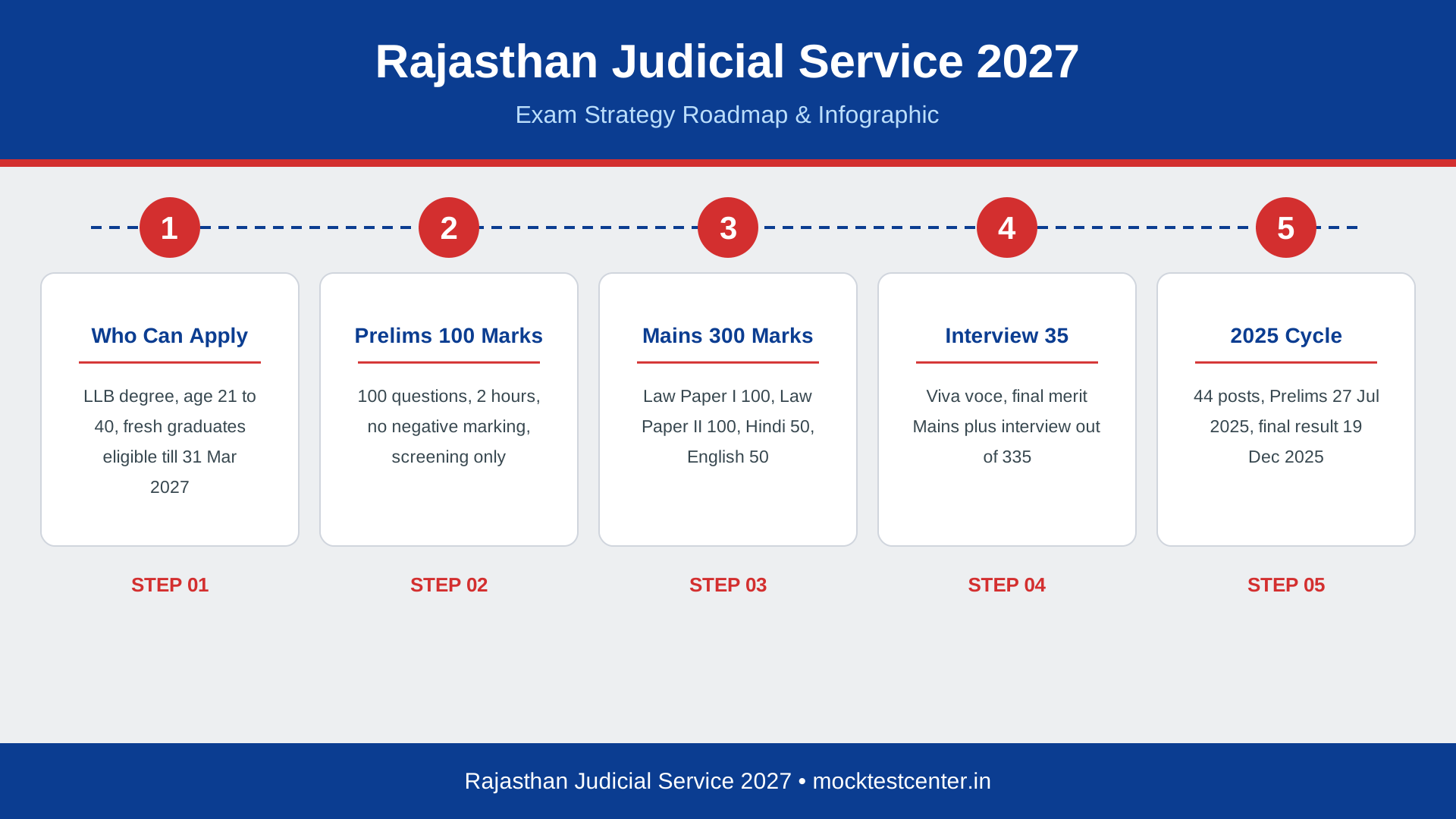
Rajasthan Judicial Service 2027 is the exam that picks Civil Judges for the district courts of Rajasthan. The Rajasthan High Court runs it, and the post it fills is Civil Judge in the Civil Judge Cadre. The exam has three stages, Prelims, Mains and interview, and the final merit comes from Mains plus interview out of 335 marks.
The 2027 notification has not come out yet, as of 19 November 2026. No 2027 dates, no 2027 vacancy count and no 2027 cut off exist. This guide works from the pattern, the syllabus and the last two cycles, because those are the facts a candidate can plan around today.
The last cycle, RJS 2025, filled 44 posts and ended with the final result on 19 December 2025. The cycle before it, RJS 2024, filled 222 posts and ended with the final result on 27 October 2024.
One fact shapes the next cycle more than any other. The Supreme Court changed the practice rule for Civil Judge exams twice in sixteen months. On 20 May 2025 it restored a three year practice requirement.
On 21 August 2026 it replaced that requirement with a transitional scheme. Read the section on the practice rule before you read anything else if you finished LLB recently, because it decides whether you can apply and what you must do after selection.
The practice rule changed twice, and the second change helps fresh graduates
The Supreme Court gave its judgment on 20 May 2025 in All India Judges Association v. Union of India, 2025 SCC OnLine SC 1184. The Court restored the rule that a candidate for direct recruitment as Civil Judge (Junior Division) must have three years of practice at the Bar.
The Court had removed that rule in 2002, on the Shetty Commission recommendation, so fresh law graduates could enter service directly. The 2025 judgment reversed that position after more than two decades. The Court said trial judges deal with pleadings, evidence, advocates and litigants from the first day, and practical exposure matters before a person takes up adjudicatory work.
Practice counted from provisional enrolment with the State Bar Council, and the Court also directed at least one year of training for selected candidates before they presided over a court.
Rajasthan had never required practice before that judgment. The RJS 2024 notification asked only for an LLB degree from a recognised university, and the RJS 2025 notification did the same. Both notifications came out before the May 2025 judgment or under the old position, so no RJS candidate has yet faced a practice requirement in an actual notification. The rule would have hit the next notification hard, because it would have kept every fresh graduate out for three years.
Then the Court changed course. On 21 August 2026, in Bhumika Trust v. Union of India, 2026 INSC 904, a three judge Bench led by Chief Justice Surya Kant modified the 2025 directions by a 2 to 1 majority, with Justice K. Vinod Chandran dissenting. The new scheme works in two parts, and the date of the recruitment notification decides which part applies to you.
For notifications issued from 20 May 2025 up to 31 March 2027, all law graduates can apply even without practice at the Bar. The Court treats such candidates as having completed one year of active practice, and it asks for no certificate of practice for that deemed year. Selected candidates then undergo one year of intensive training at the State Judicial Academy and one year of structured law clerkship under judicial supervision. The Court treats those two years as equal to the remaining two years of practice.
For notifications issued on or after 1 April 2027, a candidate must have at least one year of actual practice at the Bar before sitting for the exam, supported by a certificate of practice. Selected candidates still complete the same one year of academy training and one year of clerkship. Higher legal education does not count toward the practice requirement, so an LLM year does not substitute for practice. The scheme stays in force for five years from the judgment, and the Court will review it after that period on the basis of experience.
What this means for RJS 2027 depends on one date nobody knows yet, the date of the next notification. If the Rajasthan High Court issues the notice on or before 31 March 2027, fresh graduates can apply under the transitional scheme, and they will train as Trainee Judicial Officers after selection. If the notice comes on or after 1 April 2027, a candidate needs one year of actual practice first.
Check the notification date the day it appears, because that date, not your graduation year, decides your eligibility. The High Court and the State Government must also amend the Rajasthan Judicial Service Rules, 2010 to fit the new scheme, and the amended rules will state the position in plain words.
Do not confuse this rule with the AIBE. The All India Bar Examination is a separate enrolment requirement, and passing it does not count as practice. Practice means active work at the Bar after enrolment, and the certificate comes from the court or a senior advocate as the rules prescribe. A candidate who enrols now and starts practice at once builds the one year the post April 2027 scheme asks for, while a candidate who waits loses that year.
Who can apply for the RJS exam
You need a bachelor degree in law, an LLB, from a university recognised under the Advocates Act, 1961. A three year LLB and a five year integrated LLB both qualify. The Rajasthan Judicial Service Rules, 2010 govern the exam, and the notification for each cycle states the exact eligibility on its own terms.
The age limit in the current notifications is 21 to 40 years. The RJS 2025 notification counted age as of 1 January 2026, and the RJS 2024 notification counted age as of 1 July 2024 in the trackers that quoted it, so the reckoning date changes with each notification and you must read it in the notice itself. The original 2010 Rules set the limit at 23 to 35 years, and the amended Rules on the High Court site set it at 21 to 40 years, which matches the recent notifications. That change explains why older guides still quote 23 to 35, and those guides are out of date.
Relaxation adds five years to the upper age limit for SC, ST, OBC and women candidates. Widow and divorcee women can apply up to 45 years, and a widow must produce a death certificate for her husband from the competent authority while a divorcee must produce proof of divorce. Persons serving the State, Panchayat Samitis, Zila Parishads or public sector undertakings in substantive capacity had a 40 year upper limit in the older text, and that clause now stands deleted in the amended Rules on the High Court site, so do not rely on it. The exact relaxation table in the next notification will govern, and it can differ from the last one.
Reservation follows Rule 10 of the Rajasthan Judicial Service Rules, 2010. SC candidates get 16 percent of the advertised posts, ST candidates get 12 percent, OBC candidates get 21 percent, and More Backward Classes get 1 percent. Women get 30 percent of the posts category wise, and one third of that women quota goes to widows and divorcees in the ratio of 80 to 20.
Persons with benchmark disabilities get 3 percent horizontal reservation category wise. The RJS 2024 notification reserved 9 of its 222 posts for PwBD candidates, with 2 for blindness and low vision, 3 for deaf and hard of hearing, 2 for locomotor disability and 2 for autism. A Supreme Court judgment of 3 March 2025 in the Rajasthan PwD recruitment cases pressed the High Court on transparency for PwD candidates, after only 11 PwD candidates reached the Mains in 2024 when the 15 times rule suggested 135 should have qualified, so PwD candidates should check the notification and the result lists with care.
You must be an Indian citizen, and you must meet the character and fitness conditions the Rules set. The notification also asks for documents that prove your degree, your age, your category and your enrolment, and a wrong claim in the form can end a candidature even after selection, so check every entry before you submit.
The 2025 cycle finished in ten months, and it shows how fast RJS moves
The Rajasthan High Court issued the RJS 2025 notification on 27 February 2025, as Advertisement Number RHC/Exam Cell/RJS/CJC/2025/1287, for 44 posts of Civil Judge. Applications ran from 1 March 2025 at 1 pm to 30 March 2025 at 5 pm, through the High Court portal. The Prelims took place on 27 July 2025 at Jodhpur and Jaipur, and the Prelims result came on 19 August 2025.
The Mains ran on 11 and 12 October 2025, again at Jodhpur and Jaipur. The Mains result came in November 2025, and the final result came on 19 December 2025.
Two tracker dates disagree on the Mains result, and the disagreement is worth noting. PW Live and LawPrep Tutorial put the Mains result on 11 November 2025, while other trackers put it on 13 November 2025. The Times Bull report on the Mains result says 169 candidates qualified for the interview, while the Bhaskar English report on the final result says interviews ran for 136 candidates.
Both numbers cannot be right, and the High Court PDF is the only source that settles it. This guide reports the conflict rather than picking one figure.
The final result tells a clear story. Madhulika Yadav topped the state with 205.5 marks out of 335, Pragya Gandhi took second place with 204 marks, and Ambika Rathore took third place with 196 marks. Women took 28 of the 44 posts, and women held all five top positions, with only one man in the top ten.
Rahul Bansiwal, who took the 31st rank, was 21 years and 3 months old on the result date, which shows how young the top of this exam can be. The final cut off for General candidates stood at 190.5 marks, and the Mains cut off for General candidates stood at 150 marks, according to tracker tables that quoted the High Court lists.
The 2025 cycle matters for a second reason. It ran entirely under the old eligibility position, before the practice rule changed anything, and it finished in under ten months from notification to final result. A candidate who starts now and treats the syllabus as the plan does not need to wait for the notice to begin.
The 2024 cycle filled 222 posts, and the number needs unpacking
The Rajasthan High Court issued the RJS 2024 notification on 9 April 2024, as Advertisement Number 783 of 2024, for 222 posts of Civil Judge. Applications ran from 9 April to 8 May 2024, and the fee window ran to 18 May 2024 for at least some categories after an extension. The Prelims took place on 23 June 2024, the answer key came on 25 June 2024, and the Prelims result came on 15 July 2024. The Mains ran on 31 August and 1 September 2024, the Mains result came on 1 October 2024, interviews ran from 16 to 26 October 2024, and the final result came on 27 October 2024, with a corrigendum on 7 November 2024.
The 222 posts were not one year of vacancies. They covered three years at once, with 83 posts for 2022, 57 posts for 2023 and 82 posts for 2024. That split explains why trackers quote 57 for 2023 and 83 for 2022, and why the 2024 cycle looks so much bigger than the 44 posts of 2025.
The High Court had not run a Civil Judge recruitment for the 2022 and 2023 vacancies, so it bunched them into a single advertisement. A candidate who reads 222 as the normal annual intake will misjudge the next cycle, because the normal intake in a single year has run far lower.
The cut offs for 2024 show how high the bar sits. In the Prelims, General candidates needed 73 marks out of 100, OBC NCL and EWS candidates needed 68, SC candidates needed 55 and ST candidates needed 54. In the Mains, General candidates needed 131 marks out of 300, OBC candidates needed 123, EWS candidates needed 126.5, and SC and ST candidates needed 105.
In the final merit, General candidates needed 164.5 marks out of 335, SC candidates needed 136.5 and ST candidates needed 136. The Prelims cut off for General candidates at 73 out of 100, with no negative marking, tells you that the Prelims rewards accuracy across the whole paper, not clever guessing on a few questions.
Go back one more cycle and the pattern holds. The High Court advertised 120 posts on 22 July 2021, with 89 posts for 2020 and 31 posts for 2021. The Prelims ran on 28 November 2021, the result came on 11 January 2022, and the selection process ended on 30 August 2022, with appointments on 9 March 2023. The vacancy count swings from 44 to 222 because the High Court advertises backlog years together when it falls behind, and a candidate cannot predict the next count from the last one.
Prelims: 100 questions, 100 marks, no negative marking
The Prelims is an objective test of one paper, with 100 multiple choice questions for 100 marks, in 2 hours, on an OMR sheet. Each correct answer earns 1 mark, and a wrong answer costs nothing, because the RJS Prelims has no negative marking. That single fact changes how you should attempt the paper, and it separates RJS from many other judicial service exams that deduct a third of a mark for each wrong answer.
The paper splits by weightage, not by separate sections with separate timings. Law carries 70 percent of the paper, and language carries 30 percent, with 15 percent for Hindi and 15 percent for English. The law questions follow the syllabus for Mains Law Paper I and Law Paper II, so Prelims preparation and Mains preparation use the same books and the same bare Acts, and a candidate who reads only for the Prelims wastes the effort. The language questions test proficiency in Hindi and English, with grammar, comprehension and usage, and they decide the Prelims for candidates whose law scores sit close together.
The qualifying marks for the Prelims are 45 percent for General, OBC and EWS candidates, and 40 percent for SC, ST, PwD and ex-servicemen candidates. Qualifying marks only open the door to the Mains, because the Prelims marks do not count toward the final merit at all. The High Court admits about fifteen times the number of vacancies, category wise, to the Mains, and the actual cut off in 2024 and 2025 ran well above the qualifying marks, at 73 and 78 for General candidates in the two cycles, so treat 45 percent as the floor and aim for 75 or above.
The law syllabus for the Prelims covers civil law, criminal law and the Rajasthan statutes that a Civil Judge uses every day. On the civil side it lists the Code of Civil Procedure 1908, the Constitution of India, the Indian Contract Act 1872, the Limitation Act 1963, the Specific Relief Act 1963, the Transfer of Property Act 1882, the Interpretation of Statutes, the Rajasthan Rent Control Act 2001, the Rajasthan Court Fees and Suits Valuation Act 1961, the Rajasthan Land Revenue Act 1956, the Partnership Act 1932, the Registration Act 1908, Hindu law on marriage, succession, adoption, maintenance and guardianship, and Mohammedan law on marriage, divorce, maintenance, succession and adoption.
On the criminal side it lists the Bharatiya Nyaya Sanhita 2023, the Bharatiya Nagarik Suraksha Sanhita 2023, the Bharatiya Sakshya Adhiniyam 2023, the Juvenile Justice (Care and Protection of Children) Act 2015, the Negotiable Instruments Act 1881 Chapter 17, the Probation of Offenders Act 1958, the Protection of Women from Domestic Violence Act 2005, the Protection of Children from Sexual Offences Act 2012, the Sexual Harassment of Women at Workplace Act 2013, the Indecent Representation of Women (Prohibition) Act 1986, the Information Technology Act 2000 and the Rajasthan Excise Act 1950. Older guides still list the Indian Penal Code, the Code of Criminal Procedure and the Indian Evidence Act beside the new codes, and you should study the new codes first and use the old codes only to compare a section that changed.
The English section tests tenses, articles and determiners, active and passive voice, direct and indirect speech, coordination and subordination, modals that express obligation, condition, permission and possibility, antonyms and synonyms. The Hindi section tests word formation through sandhi, samas, upsarg and pratyay, word types such as tatsam, ardha tatsam, tatbhav, deshaj and videshi, nouns, pronouns, verbs, adjectives and avyay, grammar categories such as ling, vachan, purush, kaal, paksh and vachya, idioms and proverbs, administrative and legal terminology, and sentence correction. A candidate from outside Rajasthan often loses marks here, because the Hindi paper uses the grammar of the language as it is taught in Rajasthan, not the Hindi of daily speech.
Attempt every question in the Prelims, because a blank answer and a wrong answer both earn zero, and a guess has a one in four chance of earning a mark. That does not mean guess wildly on every question you do not know, because a random guess still wastes the time you could spend on a question you can solve. Mark the questions you can answer at once, return to the ones that need a second look, and fill the remaining answers in the last ten minutes. Read the question stem twice when it uses words such as except, not, incorrect or false, because those words flip the answer and they cause more lost marks than hard law does.
Mains: four papers, 300 marks, and the law papers decide the result
The Mains is a descriptive written exam of four papers for 300 marks. Law Paper I carries 100 marks in 3 hours, Law Paper II carries 100 marks in 3 hours, the Hindi Essay paper carries 50 marks in 2 hours, and the English Essay paper carries 50 marks in 2 hours. The two law papers carry two thirds of the Mains marks, and they also carry the qualifying conditions, so they deserve two thirds of your preparation time.
To reach the interview, a candidate must score at least 35 percent in each law paper and 40 percent in aggregate in the Mains. The High Court calls about three times the number of vacancies, category wise, for the interview. The interview itself carries 35 marks, and the final merit adds the Mains marks and the interview marks, out of 335. A candidate who scores 150 in the Mains and 25 in the interview finishes at 175, while a candidate who scores 140 in the Mains and 30 in the interview finishes at 170, so the interview can move a candidate up or down by a few ranks but it cannot rescue a weak Mains score.
Law Paper I covers civil law and procedure. It lists the Constitution of India, the Code of Civil Procedure 1908, the Indian Contract Act 1872, the Bharatiya Sakshya Adhiniyam 2023, the Limitation Act 1963, the Specific Relief Act 1963, the Transfer of Property Act 1882, the Interpretation of Statutes, the Rajasthan Rent Control Act 2001, the Rajasthan Court Fees and Suits Valuation Act 1961, the Rajasthan Land Revenue Act 1956, Hindu law, the Partnership Act 1932, the Registration Act 1908 and Mohammedan law. It also asks for order writing and judgment writing, which means the paper tests whether you can turn the law into a reasoned order, not only whether you can state a section.
Law Paper II covers criminal law and procedure. It lists the Bharatiya Nagarik Suraksha Sanhita 2023, the Bharatiya Nyaya Sanhita 2023, the Bharatiya Sakshya Adhiniyam 2023, the Juvenile Justice Act 2015, the Negotiable Instruments Act 1881 Chapter 17, the Probation of Offenders Act 1958, the Protection of Women from Domestic Violence Act 2005, the POCSO Act 2012, the Indecent Representation of Women Act 1986, the Sexual Harassment of Women at Workplace Act 2013, the Rajasthan Excise Act 1950 and the Information Technology Act 2000. It also asks for framing of charge and judgment writing, so you must practise writing a charge and a judgment in the form a court uses, with facts, issues, reasoning and order, and not as an essay.
The language papers look small at 50 marks each, and they fool candidates every year. The Hindi Essay paper asks for an essay in Hindi on a legal theme, a social and economic issue, or Rajasthan culture and heritage, and it tests whether you can argue in clear Hindi with correct grammar and structure. The English Essay paper asks the same in English, and it tests comprehension, vocabulary and analysis.
Together the two papers carry 100 marks out of 300, which is a third of the Mains, and a candidate who ignores them gives away the margin that separates selection from rejection. The final cut off for General candidates in 2025 stood at 190.5 out of 335, which means a candidate needed about 57 percent overall, and the language papers often supply the extra marks that law papers cannot.
Mains answers need structure. Start each answer with the provision or the principle in one line, then apply it to the facts, then state the result. Quote section numbers where you know them, and do not guess a section number when you are unsure, because a wrong section number reads worse than no section number.
Write judgments in the order a court writes them, with facts, points for determination, discussion, findings and order, and keep the language plain. A judge who reads the paper wants to see whether you can decide, and a long essay that never decides fails even when it shows knowledge.
Previous year papers show the pattern better than any guide can. Solve the 2024 and 2025 Mains papers under timed conditions, with the same 3 hour limit for a law paper and the same 2 hour limit for a language paper, and mark your own answers against the bare Acts. Note which Acts repeat every year, and note which topics the paper asks as short notes and which it asks as long questions. CPC, the Constitution, the Contract Act and BNS repeat in every cycle, and the Rajasthan statutes appear in both the Prelims and the Mains, so a candidate who skips the Rajasthan Acts loses marks in both stages.
The interview carries 35 marks and tests judgment, not memory
The interview, or viva voce, carries 35 marks, and it has no separate minimum qualifying mark. The panel tests personality, communication, confidence, awareness and suitability for judicial office, and it asks questions that mix general awareness with law. The LawBhoomi syllabus guide notes that the panel also gives marks for proficiency in Rajasthani dialects and knowledge of local customs, which matters in a state where a Civil Judge hears litigants who speak Marwari, Mewari, Shekhawati, Hadoti, Dhundhari and other dialects in the course of a working day.
Prepare for the interview from your own form. The panel reads your detailed application form, and it asks about your education, your home district, your enrolment, your practice if any, and the choices you made in the Mains. A candidate who topped the Mains but cannot explain a gap in the form, or a subject in the law degree, loses marks fast.
Read the leading judgments of the Supreme Court and the Rajasthan High Court from the last two years, because the panel often opens with a recent judgment and asks what you think of it. Follow Rajasthan news, with the High Court, the district courts, the state government and the legal aid system, because a Civil Judge works inside that system from the first posting.
Speak plainly in the interview, and answer the question the panel asked, not the question you prepared. If you do not know an answer, say so in one line and move on, because a long guess wastes the panel time and shows poor judgment. Dress in the form the profession expects, reach the venue early, carry the documents the call letter lists, and keep your phone switched off. The interview is short, and the panel forms its view in the first few minutes, so calm and clarity count more than a rehearsed speech.
What a Civil Judge does in Rajasthan
A Civil Judge (Junior Division) in Rajasthan hears civil suits, decides interim applications, records evidence, writes judgments and orders, and also works as a Judicial Magistrate First Class on the criminal side. The post sits at the base of the district judiciary, and it is the first court most litigants ever see. The judge decides rent disputes under the Rajasthan Rent Control Act, land and revenue matters that reach the civil court, contract and property disputes, family matters within jurisdiction, and criminal cases that the Magistrate courts handle, including cases under the Negotiable Instruments Act and the Protection of Women from Domestic Violence Act.
The work needs the same skills the exam tests. CPC governs the civil side, BNSS governs the criminal procedure, BSA governs evidence, and the language papers test the Hindi and English a judge writes every day. A judge who cannot write a clear order in Hindi or English slows the court, and a judge who cannot frame an issue or a charge correctly sends the case up in appeal.
That is why the Mains asks for judgment writing and framing of charge, and why the interview asks about local dialects and customs. The exam tests the skills of the job itself, using academic subjects as its material.
The career moves through Assured Career Progression and promotion. A Civil Judge (Junior Division) moves to the Senior Division, then to District Judge, and the pay rises at each stage. The service is governed by the Rajasthan Judicial Service Rules, 2010, and the Rajasthan High Court controls postings, transfers and training through the Rajasthan State Judicial Academy at Jodhpur.
Pay: two figures circulate, and both need explaining
Two pay figures circulate for a Rajasthan Civil Judge, and guides that quote only one of them mislead the reader. The older figure comes from the Rajasthan Judicial Service Rules and the Law and Legal Affairs Department, and it puts the entry pay of a Civil Judge (Junior Division) at 27,700 rupees to 44,700 rupees per month, with the full scale running 27,700 to 44,770 rupees in the 2021 advertisement, and the first ACP stage at 33,090 to 45,850 rupees and the second ACP stage at 39,530 to 54,010 rupees. The 2025 advertisement quoted by Sarkari Naukri Front lists the pay as 77,840 to 1,36,520 rupees, and Jagran Josh reports the same figure for the 2025 recruitment.
The second figure comes from the Second National Judicial Pay Commission, known as SNJPC, whose recommendations the Supreme Court accepted and ordered states to implement. Under SNJPC, the entry basic pay of a Civil Judge (Junior Division) is 77,840 rupees per month, in the J-1 grade, rising to 1,36,520 rupees, with the first ACP stage at 92,960 to 1,36,520 rupees and the second ACP stage at 1,11,000 to 1,63,030 rupees. TopRankers puts the gross pay at about 1.13 lakh rupees per month and the in hand pay at about 90,000 to 95,000 rupees per month, depending on the dearness allowance rate and the city of posting. The old scale still appears in the Rules text and in older trackers, while the SNJPC scale is the figure the recent notifications use, so a candidate should read the pay scale in the next notification itself and treat the SNJPC figure as the current entry basic pay.
Allowances add to the basic pay, with dearness allowance revised twice a year, house rent allowance by city category, and medical and other admissible allowances. A judge also gets an annual increment of 3 percent of basic pay. The exact in hand figure changes with the dearness allowance rate on the date of joining, so no guide can state it as a fixed number, and any guide that does is guessing.
The new criminal laws changed the syllabus, and old books can mislead you
The Bharatiya Nyaya Sanhita 2023, the Bharatiya Nagarik Suraksha Sanhita 2023 and the Bharatiya Sakshya Adhiniyam 2023 came into force on 1 July 2024, and they replaced the Indian Penal Code 1860, the Code of Criminal Procedure 1973 and the Indian Evidence Act 1872. The RJS Prelims of 23 June 2024 ran just before that date, and the RJS 2025 cycle ran entirely under the new codes. Questions now use the new section numbers, and a candidate who learns only the old section numbers will miss the question even when the candidate knows the law.
Study the new codes from the bare Acts first, and keep a comparison table beside you that maps the old section to the new section for the provisions the exam asks most. BNS covers offences against the body, offences against property, offences against the state, and the new offences the code added, and BNSS covers investigation, inquiry, trial, bail and the procedure a Magistrate follows. BSA covers relevancy, admissions, confessions, dying declarations, expert opinion and electronic records, and it changes the proof of electronic evidence in ways the old Evidence Act did not. The Mains Law Paper II asks these codes together with the allied Acts, so read them as a set, not as three separate books.
Do not throw away the old codes entirely. The High Court still decides cases that began under the old law, and the Mains may ask how a provision changed from the old code to the new code. A short note that states the old position, the new position and the reason for the change earns more marks than a long note that states only the new section. Use a current edition of the bare Acts, dated 2025 or later, and check the publisher date on the cover before you buy, because a 2023 edition will not have the final text.
What the top guides get wrong about RJS
The guides that rank for RJS agree on the pattern, and they disagree on the details that matter. One guide says the Rajasthan Public Service Commission conducts the exam, and that is wrong. The Rajasthan High Court conducts it, at Jodhpur, and the RPSC has no role in it. The official site is hcraj.nic.in, and the application portal sits on the High Court site, so any guide that sends you to the RPSC site sends you to the wrong place.
Several guides still show the old IPC, CrPC and Evidence Act names beside the new ones without saying which set the paper uses now, and a candidate who trusts those guides will revise the wrong section numbers. Several guides quote the interview at 100 marks, and that figure belongs to other state judicial exams, not to RJS, where the interview carries 35 marks. Several guides guess the next notification date and the next vacancy count, and those guesses have no source, because the High Court has issued no notice for the next cycle as of 19 November 2026.
The fee is the clearest example of the confusion. PW Live, TopRankers and LawsStudy quote the RJS 2024 fee as 1,000 rupees for General candidates, 750 rupees for OBC and EWS candidates, and 500 rupees for SC, ST and PwD candidates. CareerDec, Government Daily Jobs and Sarkari Jobers quote it as 1,250 rupees for General and other state candidates, 1,000 rupees for OBC and EWS candidates, and 750 rupees for SC, ST and PH candidates.
Both sets cannot be right for the same notification, and this guide reports both sets rather than choosing one, because the official notification PDF is the only source that settles it. Check the fee in the next notification before you pay, and do not rely on a tracker figure.
Several guides also skip the practice rule entirely, or they quote the 20 May 2025 judgment without the 21 August 2026 modification. A candidate who reads only those guides will think fresh graduates cannot apply at all, when the transitional scheme lets them apply for any notification issued up to 31 March 2027. That is the gap this guide fills, and it is the first thing you should check when the next notice appears.
Books that cover the RJS exam syllabus
Buy the bare Acts first, because the RJS exam tests the text of the law and the paper quotes it. Keep a current edition of the Constitution of India, the Code of Civil Procedure 1908, the Indian Contract Act 1872, the Transfer of Property Act 1882, the Specific Relief Act 1963, the Limitation Act 1963, the Bharatiya Nyaya Sanhita 2023, the Bharatiya Nagarik Suraksha Sanhita 2023, the Bharatiya Sakshya Adhiniyam 2023, the Rajasthan Rent Control Act 2001, the Rajasthan Land Revenue Act 1956, the Rajasthan Court Fees and Suits Valuation Act 1961 and the Rajasthan Excise Act 1950 on your desk, and read the section before you read any guide on it. A guide explains the law, and the bare Act states it, and the Mains rewards the candidate who states it in the words the Act uses.
For the Constitution, use a standard commentary that covers Articles 12 to 35, Articles 36 to 51, the Union and State executive and legislature, the judiciary, and the amendment power, because those parts repeat in the RJS exam every year. For CPC, read a book that covers jurisdiction, res judicata, pleadings, interim orders, execution and appeals, and practise drafting a plaint, a written statement and an interim application, because the Mains asks for order writing and the Prelims asks the procedure in detail. For the Contract Act, read the formation of contract, consideration, capacity, free consent, void and voidable agreements, performance, breach and remedies, and the special contracts on indemnity, guarantee, bailment, pledge and agency.
For BNS, BNSS and BSA, use a commentary written for the new codes, dated 2025 or later, and not a book that only adds the new section numbers to an old IPC commentary. Read the chapters on general exceptions, offences against the body and property, investigation and trial, bail and the procedure before a Magistrate, and the BSA chapters on relevancy, admissions and electronic records. For the Rajasthan statutes, use the bare Acts with a short commentary, because the national guides give them only a few pages and the RJS exam gives them real weight in both stages of the RJS exam.
For Hindi and English, use a grammar book for each language and a book of essays that covers legal themes, social and economic issues, and Rajasthan culture and heritage. Write one essay a week in each language, on a topic from the news or from the syllabus, and get it checked by a teacher or a senior who has cleared a judicial service exam. For general preparation on the RJS exam, solve the previous year papers of the RJS exam from 2021, 2024 and 2025, and add the papers of the Delhi Judicial Service, the Madhya Pradesh Civil Judge exams and the Bihar Judicial Service for extra practice on judgment writing, because those papers test the same skills in a similar form. Rajasthan Judicial Service 2027 candidates who build their preparation on the bare Acts and the previous year papers will find the paper familiar on the day, and that familiarity is worth more than any new book bought in the last month.
A 90 day plan for the RJS exam
A 90 day plan works only if it fits the pattern of the RJS exam, and the pattern gives the law papers two thirds of the Mains marks and the Prelims no negative marking. The plan below assumes you have read the bare Acts once already, and it gives each day a clear task, because a plan that says study law for a day is not a plan at all. Adjust the hours to your own day, but keep the order, because the order is what builds the score.
Days 1 to 30 build the base. Read CPC and the Constitution in the morning, and BNS and BNSS in the afternoon, with one hour for Hindi grammar and one hour for English grammar each day. Write short notes on each section you read, in your own words, with the section number at the top.
Solve 50 Prelims questions a day from the previous year papers, and mark the ones you got wrong in a separate notebook with the correct section beside them. On Sundays, revise the notes of the week and write one Hindi essay and one English essay. By day 30 you should have finished CPC, the Constitution, BNS and BNSS once, and you should know your weak Acts by name.
Days 31 to 60 build the Mains. Read the Contract Act, the Transfer of Property Act, the Specific Relief Act, the Limitation Act and BSA in the morning, and the Rajasthan statutes in the afternoon, with judgment writing practice three days a week. Write one full law paper a week under the 3 hour limit, and one language paper a week under the 2 hour limit, and mark them against the bare Acts the next day.
Solve a full Prelims mock of 100 questions every Sunday in 2 hours, on an OMR sheet if you can get one, because the RJS exam Prelims runs on OMR and the habit of filling the sheet matters. By day 60 you should have written at least four law papers and four language papers, and your answer structure should feel fixed.
Days 61 to 90 sharpen the score. Revise the short notes every morning, and solve two full Prelims mocks a week with a strict 2 hour limit. Write a judgment or an order every second day, alternating civil and criminal, and frame a charge at least five times before the exam.
Read the leading judgments of the last two years in the last two weeks, and revise the Rajasthan statutes in the last week, because they are the easiest marks to lose by neglect. In the last three days, stop learning new law, revise your notes, check your admit card and your documents, and sleep well, because a tired mind loses more marks in the Prelims than a weak topic does.
Keep a mock test log through the whole 90 days. Write the date, the paper, the score, the time taken, and the three topics that cost you the most marks, and revise those three topics before the next mock. A candidate who takes ten mocks without a log repeats the same errors ten times, while a candidate who takes five mocks with a log fixes the errors and raises the score. Rajasthan Judicial Service 2027 rewards the candidate who fixes errors, not the candidate who collects mocks.
Mistakes that cost good candidates marks in the RJS exam
The first mistake is reading only the national Acts and skipping the Rajasthan statutes. The Rajasthan Rent Control Act, the Rajasthan Land Revenue Act, the Rajasthan Court Fees and Suits Valuation Act and the Rajasthan Excise Act appear in the Prelims and in the Mains, and a candidate who skips them gives away marks that other candidates collect with a week of reading. Read them early, and revise them in the last week, because they are short Acts with direct questions.
The second mistake is learning the old section numbers and never learning the new ones. The paper now asks BNS, BNSS and BSA, and a candidate who answers with an IPC section number shows the examiner a book from before 1 July 2024. Learn the new section for every provision you revise, and keep the old section beside it only as a memory aid.
The third mistake is treating the language papers as a formality. Hindi and English together carry 100 marks out of 300 in the Mains, and the Prelims gives language 30 percent of its paper, so a candidate who ignores language loses a third of the exam. Write an essay every week in each language from the first month, and learn the Hindi grammar the syllabus lists, because the grammar questions have fixed answers and they reward a candidate who prepares them.
The fourth mistake is writing Mains answers as essays when the paper asks for a judgment or an order. A judgment has facts, points for determination, discussion, findings and order, and a charge has the offence, the section, the time, the place and the person, and an answer that ignores that form loses marks even when the law in it is right. Practise the form until it feels automatic, and use it every time.
The fifth mistake is trusting a guessed notification date or a guessed vacancy count. Websites guess the date and the count every year, and a candidate who plans around a guess either rushes or relaxes at the wrong time. The High Court has issued no notice for the next cycle as of 19 November 2026, so plan around the syllabus and check hcraj.nic.in for the notice, and let the notice set your dates when it arrives.
The sixth mistake is waiting for the notice before starting. The 2025 cycle ran from notification to final result in under ten months, and the Prelims came less than five months after the notification, so a candidate who starts on the notice date has too little time to read the bare Acts, write the judgments and take the mocks. Start now, with the syllabus in front of you, and let Rajasthan Judicial Service 2027 find you ready.
Check these things the day the notice arrives
Read the notice on hcraj.nic.in, and check seven things in order. First, the practice rule, and whether the notification date falls on or before 31 March 2027, which decides whether the transitional scheme applies to you. Second, the age limit and the reckoning date for your category. Third, the vacancy count and the category split, because the 2024 cycle had 222 posts across three years and the 2025 cycle had 44 posts, and the next count will be its own number.
Fourth, the fee for your category, because trackers disagree on the last fee and only the notice settles it. Fifth, the application window and the last date for fee payment. Sixth, the exam centres, which were Jodhpur and Jaipur in the last two cycles. Seventh, the syllabus link, to confirm the papers and marks have stayed the same, and to check whether the criminal law sections have moved again.
Apply early in the window, and keep a copy of the filled form, the fee receipt and the application number. Check your photo, your signature, your category and your enrolment details before you submit, because the correction window fixes small errors and never fixes a wrong claim. Then return to your plan, and let the notice change your dates, not your study.
A candidate who has read the bare Acts, written the judgments, solved the previous year papers and taken the mocks will meet the notice with calm, and a candidate who waits for the notice will meet it with worry. Start now, and let the RJS exam find you ready. Candidates who compare RJS with other exams can read the Haryana Judicial Service 2027 page, the UPPSC PCS J 2027 page, the UPPSC APO 2027 page, the UPPSC PCS 2027 page, the UPPSC Assistant Professor 2027 page, the UPPSC Lecturer GIC 2027 page, and the UGC NET Law 2027 page, because each exam has its own pattern, and a candidate who knows the differences plans better.
Sources
Rajasthan High Court, Rajasthan Judicial Service Rules 2010 as amended up to 27 December 2018, on hcraj.nic.in, for the age limit, reservation and the scheme of examination. RJS 2024 notification of 9 April 2024, Advertisement 783 of 2024, for 222 posts, and the 2024 result dates and cut offs, as reported by PW Live, Adda247, StudyIQ, The Telegraph and the Times of India, all agreeing on Prelims 23 June 2024, Prelims result 15 July 2024, Mains 31 August to 1 September 2024, Mains result 1 October 2024 and final result 27 October 2024.
RJS 2025 notification of 27 February 2025, Advertisement 1287, for 44 posts, and the 2025 result dates, as reported by Testbook, Drishti Judiciary, Legal Bites and PW Live, with the final result of 19 December 2025 and the topper Madhulika Yadav at 205.5 marks as reported by Bhaskar English and LawPrep Tutorial. Pattern and syllabus detail as reported by LawBhoomi and LawPatra, checked against the Judicial Adda scheme of examination and the High Court Rules. Supreme Court judgment of 20 May 2025 in All India Judges Association v.
Union of India, 2025 SCC OnLine SC 1184, and the judgment of 21 August 2026 in Bhumika Trust v. Union of India, 2026 INSC 904, as reported by Live Law, LawFiles, Raw Law and Legal Chariot, with the dissent of Justice K. Vinod Chandran noted.
Pay detail as reported by TopRankers, Jagran Josh, Oliveboard and LawPrep Tutorial, with the SNJPC scale and the older Rules scale both stated. The official notice on hcraj.nic.in is the final word on every date, rule and figure in this guide.







