
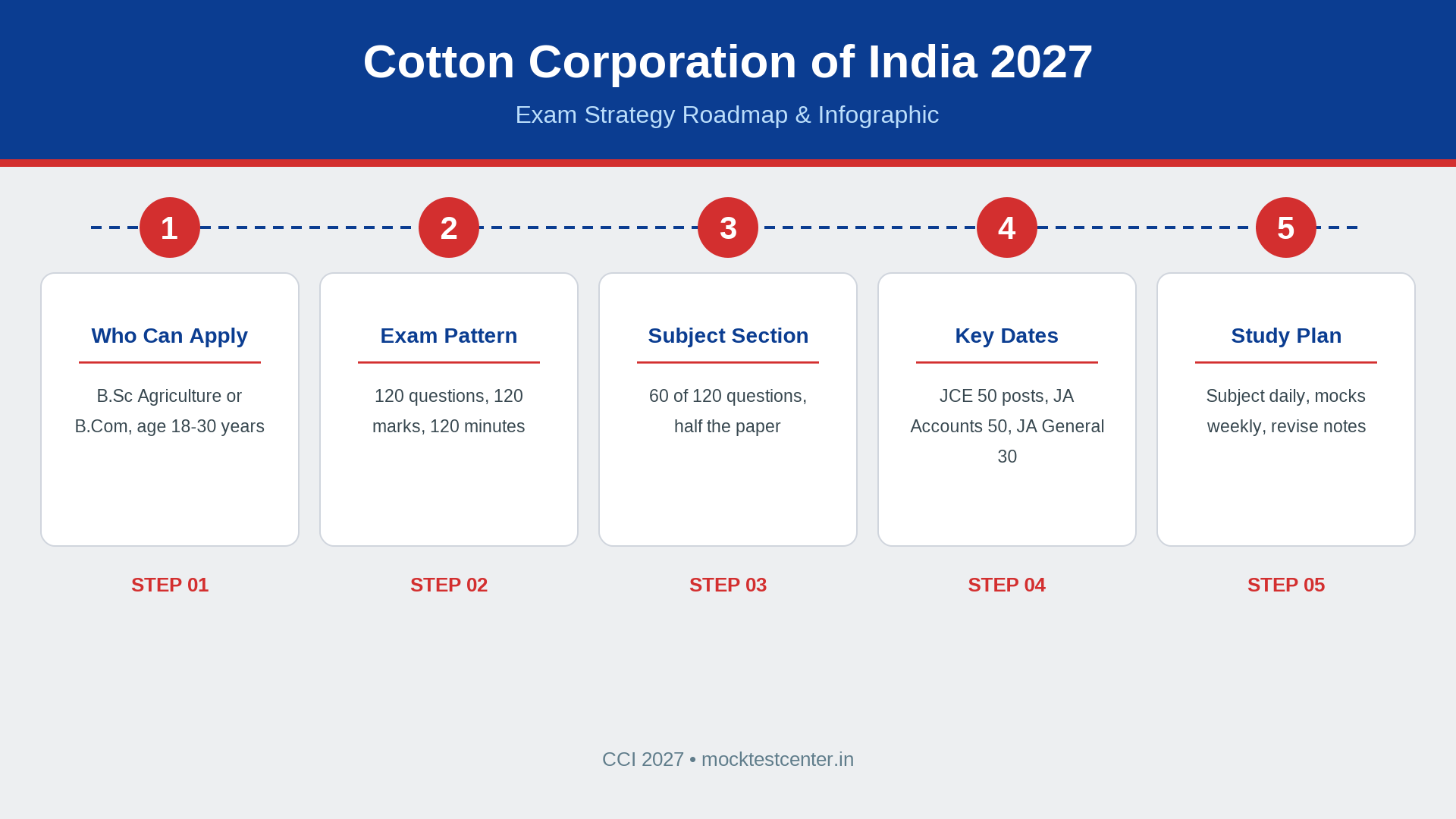
About Cotton Corporation of India 2027 Exam Series
📖 Table of Contents
- What this job actually is
- The 2026 cycle in one place
- The three posts side by side
- Who can apply for Junior Commercial Executive
- Who can apply for Junior Assistant in Accounts and General
- How the online test works
- Junior Commercial Executive pattern and syllabus
- Junior Assistant Accounts pattern and syllabus
- Junior Assistant General pattern and syllabus
- The 2025 pattern was different, and that matters
- Pay, probation, bond and posting
- What the job looks like day to day
- A study plan that fits 120 questions in 120 minutes
- Common mistakes that cost marks
- Other regulatory exams worth a look
- Sources
Cotton Corporation of India 2027
What this job actually is
The Cotton Corporation of India, usually called CCI, is the government company that buys cotton from farmers when the market price falls below the minimum support price. It was set up on 31 July 1970 under the Companies Act 1956. It works under the Ministry of Textiles and holds Mini Ratna Category I status. Its head office is Kapas Bhavan, Plot 3A, Sector 10, CBD Belapur, Navi Mumbai 400614. Its company identity number is U51490MH1970GOI014733.
CCI is the nodal agency for cotton price support. When the price of fair average quality kapas falls below the minimum support price announced by the government, CCI buys the cotton from farmers at the support price, and it buys without any quantitative limit. That promise is what stops distress sales in the cotton belt. In a normal year CCI also buys cotton commercially, so that textile mills get raw material in the lean season. The cotton season runs from 1 October to September the next year.
The network is large. CCI works through about 500 procurement centres in more than 150 districts across 11 major cotton growing states, including Gujarat, Maharashtra, Telangana, Andhra Pradesh, Karnataka, Madhya Pradesh, Rajasthan, Haryana, Punjab, Odisha and Tamil Nadu. The number of branches is reported differently in different places, with figures of 15, 17 and 19 branches in circulation, so this page does not fix one number. The scale is the point. A new recruit joins a field organisation, not a single office building.
This page covers one recruitment that fills three posts: Junior Commercial Executive, Junior Assistant in Accounts, and Junior Assistant in General. The three posts share one online test format of 120 questions in 120 minutes, but the subjects inside the test are not the same. The Accounts post tests accounting for half the paper. The General post has no subject section at all. The Commercial Executive post tests agriculture and cotton for half the paper. Picking the wrong post is the first mistake, and it happens before the preparation even starts.
The 2026 cycle in one place
The latest full cycle was the 2026 recruitment. The notification came out on 9 July 2026. Applications ran online from 9 July 2026 at 10 in the morning to 24 July 2026 at 11.55 at night. The application window was only 16 days, which is short, and a candidate who waited for the last day risked a server rush. The exam was held on 1 September 2026, as per tracker reporting. The city intimation slip came out on 18 August 2026 and the answer key came out on 3 September 2026. No notification for a 2027 cycle has been released as of 23 November 2026, so every date below belongs to the 2026 cycle unless this page says otherwise.
The 2026 drive announced 148 vacancies in all, as per tracker reporting. That total covers more posts than the three on this page, including Assistant Manager and Management Trainee posts. The post wise split of the remaining 18 vacancies beyond the three posts here was not verified in this pass, so this page does not print it. The three posts on this page account for 130 of the 148 vacancies, which makes this the bulk of the drive.
| Item | 2026 cycle |
|---|---|
| Notification date | 9 July 2026 |
| Applications | 9 to 24 July 2026 |
| Junior Commercial Executive posts | 50 |
| Junior Assistant Accounts posts | 50 |
| Junior Assistant General posts | 30 |
| Total vacancies in the drive | 148 [S] |
| City intimation slip | 18 August 2026 |
| Exam date | 1 September 2026 [S] |
| Answer key | 3 September 2026 [S] |
| Official website | cotcorp.org.in |
Applications go in online only, through the Recruitment link on cotcorp.org.in. The 2025 notification stated this plainly, and the 2026 cycle followed the same route. No other mode of application is accepted. Any addendum or corrigendum is published only on the corporation website, so a candidate should check that site rather than trust a forwarded message.
The 2025 cycle gives a useful comparison. Advertisement DR/CCI/2025, dated 9 May 2025, offered 147 posts: Management Trainee in Marketing 10, Management Trainee in Accounts 10, Junior Commercial Executive 125, and Junior Assistant in the Cotton Testing Lab 2. Applications ran from 9 to 24 May 2025. The 2026 cycle cut the Commercial Executive intake from 125 to 50 and added the two Junior Assistant posts in Accounts and General. A smaller intake means a higher cutoff for the same number of applicants, so plan for a tight cycle.
The three posts side by side
All three posts sit in the same pay scale, Rs 22,000 to Rs 90,000 under the IDA pattern. All three carry a probation of 12 months and a service bond of three years. The differences are in the degree asked for and in the test. The table below puts the three posts next to each other so the choice is easy to see.
| Post | Posts in 2026 | Degree needed | Subject section in test |
|---|---|---|---|
| Junior Commercial Executive | 50 | B.Sc Agriculture, 50 percent | Agriculture and cotton, 60 questions |
| Junior Assistant Accounts | 50 | B.Com, 50 percent | Accounting and commerce, 60 questions |
| Junior Assistant General | 30 | Any graduation, 50 percent | None, general sections only |
A candidate with a B.Sc in Agriculture can apply for the Commercial Executive post and also for the Junior Assistant General post, since that post accepts any graduation. A candidate with a B.Com degree can apply for the Accounts post and also for the General post. The notification for each cycle fixes whether one candidate may apply for more than one post, so read that line before paying the fee twice. The 2025 notification said the eligibility of a candidate is checked only at the document verification stage, which means a wrong application can survive until the last step and then fail. Check the degree line first.
The General post is the open door in this recruitment. It takes any graduation, and its test has no subject section, so a candidate from any stream can compete on general ability alone. That also makes it the most crowded post in raw numbers, because 30 posts draw applicants from every degree. The Accounts post is narrower, and the Commercial Executive post is narrowest of all, since it needs an agriculture degree. Narrower posts mean fewer rivals, but they also mean the subject section decides the rank.
Who can apply for Junior Commercial Executive
The CCI Junior Commercial Executive post needs a B.Sc in Agriculture from a recognised university, with an aggregate of 50 percent marks. SC, ST and PwBD candidates need 45 percent. No work experience is needed. The age limit is 18 to 30 years, with the maximum age counted as on the date of the advertisement, which was 9 July 2026 in the latest cycle. The minimum age of 18 years applies as on the date of advertisement in the 2025 notification, and the same frame was used in 2026 reporting.
Age relaxation follows government rules. SC and ST candidates get five years. OBC candidates in the non creamy layer get three years. Persons with benchmark disabilities get ten years, and the relaxation rises to 15 years for PwBD candidates from SC or ST and to 13 years for PwBD candidates from OBC. Jammu and Kashmir domicile for the period 1980 to 1989 carries five years. Ex servicemen get relaxation as per government rules. The full table sits in the advertisement, and the advertisement is the final word.
One detail from the 2025 notification is worth knowing. CCI employees in regular or temporary service who applied for the Commercial Executive post could apply with any graduation in the 10 plus 2 plus 3 pattern, with age relaxation limited to the number of years they had served in CCI. That is an internal route, not a general one. An outside candidate must hold the agriculture degree.
Only Indian citizens can apply. The candidate must be medically fit, since the selection ends with document verification and a medical check where applicable. A candidate who was dismissed, terminated or removed by any public sector undertaking, bank or government organisation is not eligible, as per the 2025 notification.
Who can apply for Junior Assistant in Accounts and General
The CCI Junior Assistant Accounts post needs a B.Com degree with at least 50 percent marks. SC, ST and PwBD candidates need 45 percent. The CCI Junior Assistant General post needs a graduation degree in any discipline with at least 50 percent marks, again 45 percent for SC, ST and PwBD candidates. No prior work experience is needed for either post. Both posts carry the same age limit, 18 to 30 years, with the maximum age counted as on the date of publication of the advertisement.
The percentage bar is the filter that surprises people. A B.Com graduate with 48 percent marks cannot apply for the Accounts post, even though the degree is right. A graduate with 49 percent cannot apply for the General post either. The marks are counted in aggregate across the degree, and the result must be declared before the application. A final year student whose result is still awaited should read the advertisement line on this point, because the 2025 notification treated eligibility as fixed on the advertisement date.
The two Junior Assistant posts look similar from the outside, and the pay is the same, but the work is not. The Accounts post sits with vouchers, ledgers, bills, payments and audit work in a branch or head office accounts section. The General post sits with procurement support, records, correspondence and office work, often at a procurement centre or branch office. A commerce graduate who likes numbers will fit the Accounts post. A graduate who wants field exposure and does not want to be tested on accounting will fit the General post better.
One application decision matters here. The Accounts test gives 60 of its 120 questions to accounting and commerce. A B.Com graduate who has forgotten the subject will score badly in half the paper, and no amount of general ability can cover that gap. The General test has no subject section, so the same candidate can compete on English, reasoning, quant, general knowledge and computers alone. A commerce graduate should take an honest mock in accounting before choosing between the two posts.
How the online test works
Selection has two main stages: an online test, then document verification. Tracker reporting for the 2026 cycle adds a skill test or medical test where applicable, and the 2025 notification provided for a medical check. There is no interview in this recruitment. The online test alone decides who goes to document verification, which makes the test the whole contest.
The online test has 120 objective questions of multiple choice type, carrying 120 marks, to be attempted in 120 minutes. Each correct answer gets 1 mark. Each wrong answer loses 0.25 marks. An unanswered question loses nothing. The paper is in five or six parts, depending on the post, and the level of the paper matches the educational qualification prescribed for the post.
One minute per question is the headline, but the real split is different. The general sections are short questions that a prepared candidate answers in 30 to 45 seconds. The subject section has longer questions that need a full minute or more. A candidate who spends two minutes on a hard quant question is spending the time of two subject questions. The test rewards a candidate who moves on fast and returns only if time is left.
Negative marking changes the maths. Four wrong answers wipe out one correct answer. A candidate who guesses on 20 questions and gets 5 right and 15 wrong scores 5 minus 3.75, which is 1.25 marks for 20 attempts. The same candidate, leaving those 20 blank, scores zero on them and keeps the time for questions they know. Blind guessing loses marks and time together. A guess is worth it only when two options can be ruled out with confidence.
The online test is the only scored stage, so there is no second paper to rescue a bad day. That is different from the multi stage exams in the same regulatory family, such as NABARD Grade A, where a Phase 2 paper and an interview follow the preliminary test, or SEBI Grade A and RBI Grade B, which also run in phases. In CCI, one paper of 120 questions fixes the list. Preparation should match that fact: mocks under real timing matter more here than notes alone.
Junior Commercial Executive pattern and syllabus
The 2026 pattern for the CCI Junior Commercial Executive post has six sections. General English has 10 questions. Reasoning Ability has 10 questions. Quantitative Aptitude has 15 questions. General Knowledge has 10 questions. Computer Proficiency has 15 questions. Subject Knowledge in agriculture has 60 questions. The total is 120 questions for 120 marks in 120 minutes, with negative marking of 0.25 marks per wrong answer.
| Section | Questions | Marks |
|---|---|---|
| General English | 10 | 10 |
| Reasoning Ability | 10 | 10 |
| Quantitative Aptitude | 15 | 15 |
| General Knowledge | 10 | 10 |
| Computer Proficiency | 15 | 15 |
| Subject Knowledge, Agriculture | 60 | 60 |
| Total | 120 | 120 |
Half the paper is the subject section, so half the preparation time should go there. The subject syllabus, as printed in the official 2025 notification annexure, covers agricultural marketing, trade and practices, farm power and machinery, agricultural entomology, crop pest and their management, agricultural microbiology, soil microbiology, principles of agricultural agronomy, field crops, weed management, organic farming, dimension of agricultural extension, and cotton procurement, cotton area, production, yield and the cotton scenario in India and abroad.
The cotton topics inside that list are the edge this post offers. CCI is a cotton company, and the notification lists cotton procurement, cotton area, production, yield and the domestic and international cotton scenario as part of the syllabus. A candidate who knows the cotton growing states, the procurement system, the minimum support price mechanism, the ginning and pressing chain and the difference between kapas and lint will answer questions that a general agriculture graduate misses. The CCI website carries the procurement story in its own words, and reading it once is preparation, not general knowledge.
The general sections follow the standard syllabus. English covers articles, prepositions, vocabulary, reading and comprehension, synonyms and jumbled sentences. Reasoning covers syllogism, coded inequalities, direction and distance, ordering and ranking, blood relation, data interpretation, coding and decoding, deductive logic, data sufficiency, series compilation, puzzles and pattern completion. Quant covers ratio and proportion, time and work, speed and distance, percentages and averages, profit, loss and discount, probability, and simple and compound interest. General knowledge covers Indian geography, Indian trade and economy, current affairs in India and the world, scientific research, awards, sports and world geography. Computer proficiency covers computer basics, hardware and software, MS Office, networking, internet, operating systems and keyboard shortcuts.
The general sections carry 60 marks together, which is exactly half the paper. A candidate cannot win on the subject section alone if the general sections are weak, because the subject section caps at 60 marks. The plan that works is simple: lock the general sections to a steady 45 plus marks, then let the subject section push the total up. A candidate who scores 50 in the subject section and 30 in the general sections finishes behind a candidate who scores 45 in the subject section and 45 in the general sections.
Junior Assistant Accounts pattern and syllabus
The Accounts post uses the same six section shape as the Commercial Executive post, with the subject section swapped to accounting. General English has 10 questions. Reasoning Ability has 10 questions. Quantitative Aptitude has 15 questions. General Knowledge has 10 questions. Computer Proficiency has 15 questions. Subject Knowledge has 60 questions. The total is 120 questions for 120 marks in 120 minutes, with negative marking of 0.25 marks per wrong answer.
| Section | Questions | Marks |
|---|---|---|
| General English | 10 | 10 |
| Reasoning Ability | 10 | 10 |
| Quantitative Aptitude | 15 | 15 |
| General Knowledge | 10 | 10 |
| Computer Proficiency | 15 | 15 |
| Subject Knowledge, Accounts | 60 | 60 |
| Total | 120 | 120 |
The subject syllabus for the Accounts post covers financial accounting, cost accounting, taxation, business law, auditing, financial management, financial markets and institutions, organisation theory, organisation behaviour and human resource management. Inside financial accounting, the notification syllabus lists accounting standards, including AS 1 on disclosure of accounting policies, AS 2 on valuation of inventories, AS 3 on cash flow statements, AS 6 on depreciation accounting, AS 7 on construction contracts, AS 9 on revenue recognition, AS 10 on accounting for fixed assets, AS 13 on accounting for investments and AS 14 on accounting for amalgamation.
Cost accounting in the syllabus covers the nature and functions of cost accounting, installation of a cost accounting system, cost concepts in income measurement, profit planning, cost control and decision making, job costing, process costing, activity based costing, volume cost profit relationship, incremental analysis and differential costing, responsibility accounting and divisional performance measurement. Taxation covers income tax definitions, basis of charge and incomes that do not form part of total income. Auditing covers audit concepts, auditing and assurance standards, preparation for an audit, internal control, vouching, verification of assets and liabilities, company audit, audit report and special audit.
The general sections are the same as the Commercial Executive post, question for question in weight. English 10, reasoning 10, quant 15, general knowledge 10 and computers 15. A commerce graduate who prepared for bank clerk exams will find these sections familiar, and the computer section will feel easy after daily MS Office use. The risk is the opposite one: a candidate who spends all the time on accounting and treats the general sections as a revision exercise will drop 10 to 15 marks that were there for the taking.
The Accounts post rewards a B.Com graduate who kept the books. The 60 subject questions test the degree itself, not tricks. A candidate who revises the standards by number, the cost methods by name and the audit steps in order will answer most of them directly. A candidate who only reads summaries will hesitate on the exact standard numbers, and the options in this section are built to punish hesitation.
Junior Assistant General pattern and syllabus
The General post is the odd one out, and that is its appeal. Its test has five sections and no subject section. General English has 20 questions. Reasoning has 20 questions. Quantitative Aptitude has 25 questions. General Knowledge has 25 questions. Computer Proficiency has 30 questions. The total is 120 questions for 120 marks in 120 minutes, with negative marking of 0.25 marks per wrong answer.
| Section | Questions | Marks |
|---|---|---|
| General English | 20 | 20 |
| Reasoning | 20 | 20 |
| Quantitative Aptitude | 25 | 25 |
| General Knowledge | 25 | 25 |
| Computer Proficiency | 30 | 30 |
| Total | 120 | 120 |
Computer proficiency is the biggest section here, with 30 questions, which is a quarter of the whole paper. That surprises many candidates, and it is the easiest place to gain an edge. The computer syllabus covers computer basics, hardware and software, MS Office, networking, internet, keyboard shortcuts and computer terminology. A candidate who uses a computer daily can finish this section fast and accurately, and the saved minutes go to quant and reasoning.
The syllabus lists for the General post in tracker sources also include the agriculture subject topics, such as agricultural marketing, farm power and machinery, entomology, crop pest management, microbiology, agronomy, field crops, weed management, organic farming, agricultural extension, cotton procurement and general administration. That list is confusing, because the General pattern has no subject section to put those topics in. This page treats the five section pattern as the real structure, since the section table adds to 120 without any subject section, and it flags the agriculture topic list for the General post as unverified. A candidate should not spend weeks on agriculture for a paper that has no agriculture section, but a light reading of cotton and MSP basics is still useful for the general knowledge section.
The General post suits a candidate who is balanced rather than deep. No single section carries more than 30 marks, so a weak section costs less than it does in the other two posts. The flip side is that no single section can rescue the total either. A candidate needs steady marks in all five sections, and the cutoff will punish a zero in any one of them. Give the computer section the respect its 30 marks deserve, and give quant a daily slot, since 25 questions of arithmetic decide more than any other section here.
The 2025 pattern was different, and that matters
A candidate who downloads an old paper will find a different test. The official 2025 notification gave each post five parts, not six. General English had 15 questions, reasoning 15, quant 15, general knowledge 15 and subject knowledge 60. There was no computer proficiency section. The total was still 120 questions for 120 marks in 120 minutes, with the same marking of plus 1 and minus 0.25. The 2026 cycle changed the split to 10, 10, 15, 10, 15 and 60, adding computers and cutting English, reasoning and general knowledge from 15 to 10 each.
That change is a warning against old material. A 2025 mock gives 15 English questions and no computer questions. A 2026 paper gives 10 English questions and 15 computer questions. A candidate who practises only on 2025 mocks will walk into the hall with the wrong time plan and no computer revision. Always check the pattern in the notification of your own cycle, and treat any mock that follows an older pattern as practice for speed only, not as a model paper.
The fee changed between the two cycles as well. The 2025 fee was Rs 1,500 for General, EWS and OBC candidates, made of a Rs 1,000 application fee plus Rs 500 intimation charges, and Rs 500 for SC, ST, ex servicemen and PwBD candidates, made of nil application fee plus Rs 500 intimation charges. The 2026 fee was Rs 1,770 for General, EWS and OBC and Rs 590 for SC, ST, ex servicemen and PwBD, because 18 percent GST was added on top. The fee is non refundable, and a candidate who pays less than the prescribed fee gets the application rejected.
The vacancy counts moved too. The Commercial Executive post fell from 125 posts in 2025 to 50 posts in 2026. The Junior Assistant post in the Cotton Testing Lab, 2 posts in 2025, does not appear in the 2026 reporting for the three posts on this page. The 2026 drive added the Junior Assistant Accounts and General posts, which did not exist in the 2025 advertisement. Recruitment shapes change every cycle in this organisation, and the next notification may change them again. Do not carry a 2025 or 2026 number into a 2027 application without reading the new advertisement.
Pay, probation, bond and posting
The pay scale for all three posts is Rs 22,000 to Rs 90,000 under the IDA pattern. That is the scale printed in both the 2025 notification and the 2026 reporting. Dearness allowance under IDA rules, house rent allowance based on the posting location, medical benefits, paid leave with leave encashment, provident fund, gratuity and leave travel concession sit on top of the basic pay, as per tracker reporting of the 2026 notification. The exact take home pay moves with dearness allowance and the place of posting, so this page does not print a fixed monthly figure. Any website that prints one fixed salary number for this post is guessing.
Probation lasts 12 months of active service from the date of joining. Completion of 12 months does not by itself confirm the employee in service. The management confirms the employee in writing, and only then does the service become permanent. That line sits in the 2025 notification, and a candidate should read it as it is written.
The service bond is mandatory. The selected candidate must serve a minimum of three years in the corporation after joining, or pay three months basic pay as on the date of separation in place of the service. Three years is a real commitment, and it should be weighed before applying. A candidate who plans to use this post as a short stop before another exam will pay for the exit.
Posting can be anywhere in India, and for the Commercial Executive post it is generally in cotton growing areas. The work sits at market yards, procurement centres and branch offices, and the posting depends on the needs of the corporation. A candidate who joins should expect rural and small town postings in the early years, with field work as part of the job. Transfers are a normal part of service in a procurement organisation.
What the job looks like day to day
A Junior Commercial Executive assists in cotton procurement and marketing operations. The day can start at a market yard or procurement centre, where farmers bring kapas for sale. The work includes checking the quality of the cotton, recording the arrivals, coordinating with the market committee and the ginning factory, and keeping the procurement and stock records straight. The officer also prepares reports on procurement and market activity and assists senior officials in operational and administrative tasks.
The cotton season sets the rhythm. Arrivals begin in October and run through the season, and the workload peaks when arrivals are heavy. During the peak, the hours are long and the work is physical, with dust, heat and long days at the yard. During the lean months, the work moves to records, reports, sales and preparation for the next season. A candidate who likes desk work only will struggle in the peak months. A candidate who likes field work will find these years the most useful of their career.
A Junior Assistant in Accounts works on the money side: vouchers, bills, payments, receipts, ledger entries, bank reconciliation and audit support. The work is regular, office based and detail heavy. A mistake in a voucher or a payment file is found in audit, so accuracy matters more than speed. A Junior Assistant in General works on office administration, correspondence, records, procurement support and coordination between the centre, the branch and the head office. Both assistant posts are office posts, and both need clean records and steady output rather than field stamina.
All three posts need comfort with computers. The test itself now gives 15 or 30 questions to computer proficiency, and the job needs MS Office, email and the corporation systems every day. The Kapas Kisan app and the Cott-Ally app are part of how CCI now works with farmers, from registration and slot booking to MSP rates and payment status. A recruit who is slow on a computer will feel it from the first week.
A study plan that fits 120 questions in 120 minutes
The plan below assumes 12 weeks and a candidate who can give three hours a day. A candidate with more time can stretch the subject section. A candidate with less time should cut the general knowledge reading first, never the subject section.
Weeks 1 to 4 are for the base. Finish the subject syllabus once, in full, with notes. For the Commercial Executive post that means agronomy, soil science, entomology, plant pathology, horticulture, plant breeding, agricultural economics and the cotton topics. For the Accounts post that means financial accounting with the standards, cost accounting, taxation, auditing and financial management. For the General post that means quant formulas, reasoning types and computer basics. Alongside the subject, do 20 quant questions and 20 reasoning questions a day, and read English for 20 minutes a day.
Weeks 5 to 8 are for the general sections. Take each general section in turn and finish its question types: English grammar and comprehension, reasoning puzzles and syllogisms, quant arithmetic and data interpretation, general knowledge with a focus on agriculture, economy, geography and current affairs, and computers with MS Office and shortcuts. Take one full mock a week under real timing, 120 questions in 120 minutes, and spend an hour after each mock on the wrong answers only.
Weeks 9 to 12 are for mocks and revision. Take two full mocks a week, then three in the last two weeks. Keep a notebook of every question type that repeats as a mistake, and revise only that notebook in the final week. In the last three days, stop learning new topics. Revise the subject notes, the formula list and the computer shortcuts, and take one last mock two days before the exam, not the day before.
Time inside the paper needs a plan too. Start with the sections you score best in, so the marks are banked early. Keep the subject section for the middle of the paper, when the mind is warm, and leave 10 minutes at the end for review. Mark a hard question and move on at once. A question that takes more than 90 seconds is a question that is eating two other questions.
Common mistakes that cost marks
The first mistake is applying for the wrong post. A B.Com graduate who applies for the Commercial Executive post cannot pass the degree check. An agriculture graduate who applies for the Accounts post will face 60 accounting questions with no accounting degree. Read the degree line twice, then pay the fee.
The second mistake is trusting an old pattern. The 2025 paper had no computer section and 15 questions each in English, reasoning and general knowledge. The 2026 paper added computers and cut those sections to 10 each. A candidate who practises the old split will misjudge the paper on the day.
The third mistake is ignoring the computer section. It carries 15 questions in two of the posts and 30 questions in the General post. Those are the easiest marks in the paper for a candidate who uses a computer every day, and they are the most commonly skipped in preparation. Fifteen marks lost here need 15 marks gained in the subject section to cover, and the subject section does not give marks away.
The fourth mistake is guessing through negative marking. At minus 0.25 per wrong answer, four wrong answers cancel one right answer. A candidate who attempts all 120 questions with guesses on 30 of them will usually score lower than a candidate who attempts 100 questions with care. Leave a question blank when no option can be ruled out.
The fifth mistake is waiting for the last day to apply. The 2026 window was 16 days, and the site slows on the last day in every recruitment. A fee payment that fails at 11 at night on the last day is an application that never happened. Apply in the first week, and keep the printout and the fee receipt.
Other regulatory exams worth a look
A candidate preparing for the Cotton Corporation of India exam is already preparing for other regulatory and public sector exams. The general sections overlap heavily, and the subject section is the only part that changes. NABARD Grade A suits agriculture graduates who want a rural development bank, and its agriculture and rural development section rewards the same study. NABARD Grade B is the senior version of the same path. SEBI Grade A and RBI Grade B suit candidates who want a financial regulator, and their general sections match this paper closely.
IRDAI Assistant Manager, SIDBI Grade A, IFSCA Grade A and PFRDA Grade A are the other regulatory options in the same family. FSSAI Assistant is a further option for candidates open to a food safety regulator. One set of general notes can feed all of these, with only the subject section changing per exam.
Sources
Official notification for the 2025 cycle, advertisement DR/CCI/2025 dated 9 May 2025, published on cotcorp.org.in. CCI corporate facts, including the 31 July 1970 establishment date, the Kapas Bhavan head office and the MSP role, from CCI documents on cotcorp.org.in. The 2026 cycle facts, including the 9 July 2026 notification date, the 50 Junior Commercial Executive posts, the 80 Junior Assistant posts, the fee of Rs 1,770 and Rs 590, the six section pattern and the 1 September 2026 exam date, rest on secondary reporting by Oliveboard, Testbook, Adda247 and CareerPower, since the official 2026 notification PDF was not fetched directly in this pass. Re-verify every 2026 figure against the official notification before the next cycle opens.







