
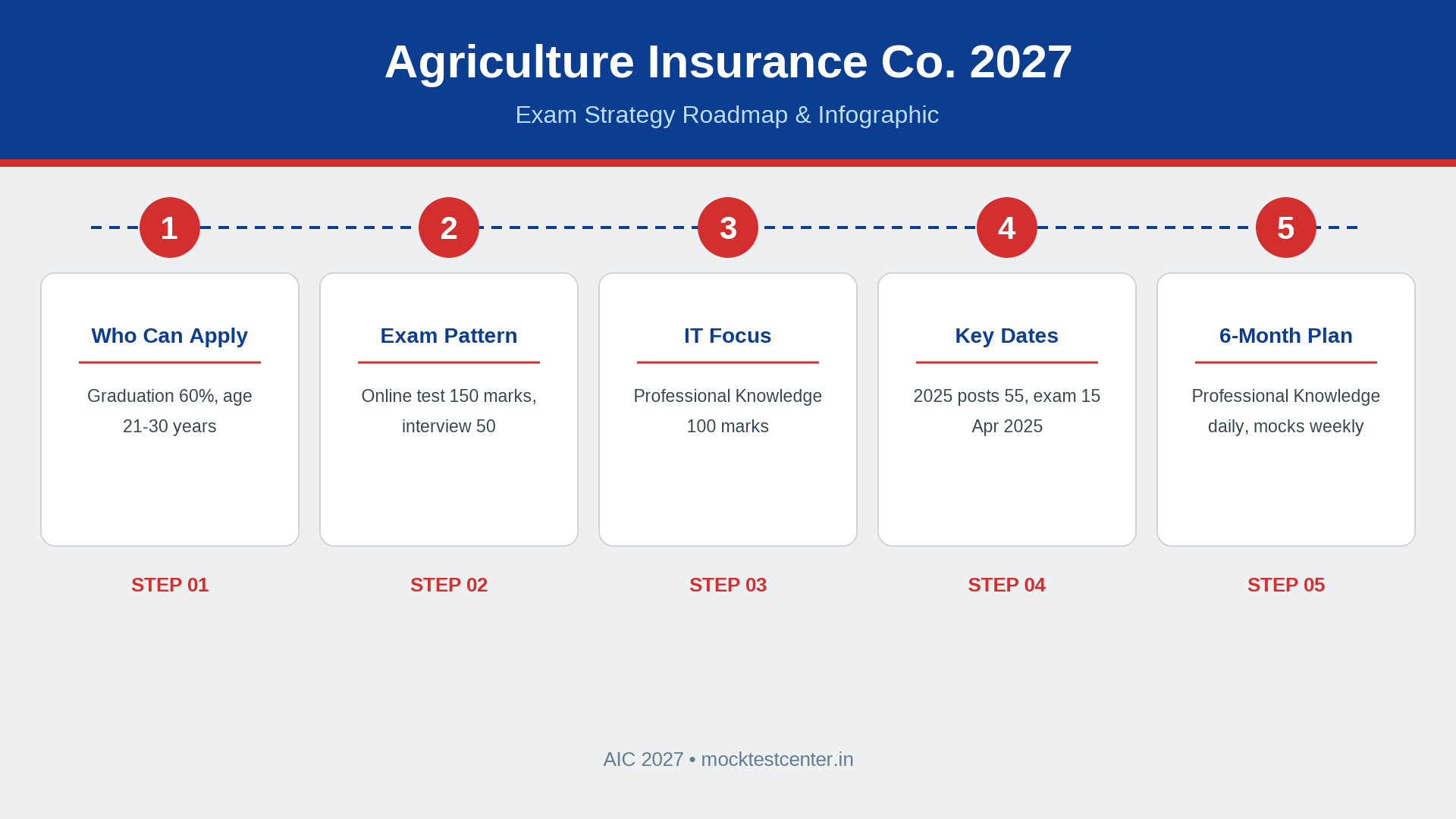
About Agriculture Insurance Company 2027 Exam Series
📖 Table of Contents
- What this job actually is
- The 2025 cycle in one page
- Who can apply: age and relaxation
- Education for each discipline
- The IT discipline in detail
- How selection works
- Exam pattern for Generalist candidates
- Exam pattern for Actuarial candidates
- Exam pattern for IT candidates
- What to study in each section
- Salary, training, probation and bond
- Why crop insurance knowledge gives you an edge
- A six month study plan that fits a working candidate
- Common mistakes that cost marks
- Documents and the application form
- What is still unknown about 2027
- Sources
Agriculture Insurance Company 2027
What this job actually is
Agriculture Insurance Company of India Limited, usually called AIC, is the public sector company that insures Indian farmers against crop loss. It was incorporated on 20 December 2002 under the Companies Act 1956 and it started business on 1 April 2003. Its head office is in New Delhi. The company works under the administrative control of the Ministry of Finance and under the operational supervision of the Ministry of Agriculture. Six public sector institutions promoted it. The General Insurance Corporation holds 35 percent, NABARD holds 30 percent, and four public sector general insurers, National Insurance, New India Assurance, Oriental Insurance and United India Insurance, hold 8.75 percent each. The authorised capital at incorporation was 1,500 crore rupees and the paid up capital was 200 crore rupees.
AIC is the leading implementing agency for the Pradhan Mantri Fasal Bima Yojana, or PMFBY, which the Government launched from Kharif 2016 and which replaced the earlier National Agricultural Insurance Scheme. It also implements the Weather Based Crop Insurance Scheme and the Coconut Palm Insurance Scheme, and it runs yield based and weather based crop insurance in nearly 500 districts. Roughly 20 to 25 million farmers are covered under its schemes, which makes it one of the largest crop insurers in the world by the number of farmers served. More than 86 percent of those farmers are small and marginal farmers holding two hectares or less.
The Management Trainee post is the entry route into AIC as an officer. A trainee who completes training is absorbed as an Administrative Officer in Scale I. The 2025 cycle offered 55 Management Trainee posts across three disciplines, Generalist, Information Technology and Actuarial. The Generalist discipline had 30 posts, Information Technology had 20 and Actuarial had 5. This page is built for the 2027 cycle, and it is written for all three disciplines, with extra detail for IT because that is where most readers of this page will sit. No notification for the 2027 cycle has been released as of 23 November 2026, so every date and number below comes from the 2025 cycle and is labelled as such. Do not treat a 2025 figure as a 2027 promise.
Why does this exam matter when the vacancy count is small? Fifty five posts is a small intake, and that is exactly the point. A small intake with a simple two stage selection, one online test and one interview, rewards a candidate who prepares with focus. There is no preliminary test to clear first and no long chain of mains papers. One good day in the online test and one solid interview can change the result. The trade off is that the cutoff stays high, because thousands of graduates apply for a few dozen seats.
The 2025 cycle in one page
The 2025 cycle moved fast. The detailed notification was released on 29 January 2025 on the official website, aicofindia.com. Online applications opened on 30 January 2025 and closed on 20 February 2025. The admit card was released on 4 April 2025. The online examination was held on 15 April 2025. The merit list was released on 8 July 2025. From notification to merit list, the whole cycle took under six months, and the gap between the last date to apply and the exam was under two months. A candidate who waits for the notification to start studying will not have enough time. The sensible approach is to treat the 2025 pattern as the working pattern and start now, then adjust if the 2027 advertisement changes anything.
| Item | 2025 cycle |
|---|---|
| Organisation | Agriculture Insurance Company of India Limited |
| Post | Management Trainee |
| Disciplines | Generalist 30, Information Technology 20, Actuarial 5 |
| Total posts | 55 |
| Notification | 29 January 2025 |
| Apply online | 30 January to 20 February 2025 |
| Admit card | 4 April 2025 |
| Online exam | 15 April 2025 |
| Merit list | 8 July 2025 |
| Selection | Online exam 150 marks plus interview 50 marks |
| Fee | 1,000 rupees for most candidates, 200 rupees for SC, ST and PwBD |
| Official website | aicofindia.com |
The category wise split of the 55 posts in 2025 was 16 for UR, 19 for OBC, 9 for SC, 5 for ST and 6 for EWS, as reported by Oliveboard from the notification. That split is useful for one reason only. It shows that the OBC pool was the largest single pool in 2025, which is unusual, and it reminds a candidate that the discipline wise and category wise split can move in either direction in the next advertisement. Check the 2027 advertisement for the fresh split instead of assuming the 2025 numbers will repeat.
Who can apply: age and relaxation
The age limit in the 2025 cycle was 21 to 30 years. The cutoff date is where the secondary sources disagree, and the disagreement matters, so read this part with care. Oliveboard and Adda247, both reporting the notification, put the cutoff at 1 December 2024. Testbook puts the cutoff at 1 March 2025. A candidate born between those two dates would be eligible under one reading and ineligible under the other, so do not rely on this page for the cutoff. Wait for the 2027 advertisement and read the exact date there before you apply. This page uses the 1 December 2024 date because two independent secondary reports of the notification agree on it, and it flags the other date here so you are not caught out.
Age relaxation in 2025 followed government norms. SC and ST candidates received five years, OBC candidates received three years, and PwBD candidates received ten years. Ex servicemen received five years and defence service personnel disabled in operations received three years. A candidate claiming relaxation needs the certificate in the format the advertisement asks for, and the certificate must be valid on the date the advertisement fixes. A common and avoidable error is to apply under a relaxed category with a certificate that expired or that was issued in the wrong format. Get the certificate checked well before the application window opens.
Nationality followed the usual pattern for public sector recruitment. Indian citizens were eligible, and subjects of Nepal and Bhutan and Tibetan refugees who came to India before 1 January 1962 were eligible under the conditions the notification laid down. There was no limit on the number of attempts in the 2025 cycle, as long as the candidate stayed inside the age limit. That is a small comfort in a small intake exam, because it means a candidate who misses once can return, but it also means the competition includes repeat candidates who know the paper well.
Education for each discipline
Education is where the three disciplines split apart, and it is the first decision a candidate has to make. Apply for one discipline only, and pick the one where your degree fits cleanly. The 2025 rules, as reported by Oliveboard and Adda247 from the notification, were as follows.
For the Generalist discipline, a candidate needed graduation or post graduation in any discipline, with at least 60 percent marks in either degree for UR, OBC and EWS candidates and 55 percent for SC, ST and PwBD candidates. That is a wide gate, and it is why the Generalist discipline draws the largest crowd. A degree in any subject qualified, so engineers, commerce graduates, arts graduates and science graduates all competed in the same pool.
For the Actuarial discipline, a candidate needed graduation or post graduation in Statistics, Mathematics, Actuarial Sciences, Economics or Operations Research, with at least 60 percent marks for UR, OBC and EWS candidates and 55 percent for SC, ST and PwBD candidates. There was also an alternative route, a bachelor or master degree in any discipline with the same marks, which sat alongside the subject specific route. If you hold an actuarial qualification or you are working through actuarial papers, this discipline is the natural fit, but read the advertisement line by line, because the alternative route makes the eligibility wider than it first looks.
For the Information Technology discipline, a candidate needed a B.E. or B.Tech, an M.E. or M.Tech in Computer Science or Information Technology, or an MCA from a recognised university, with at least 60 percent marks for UR, OBC and EWS candidates and 55 percent for SC, ST and PwBD candidates. That alone was not enough. The candidate also needed certification in at least one essential skill area, from Software Development, Network Administration, System Administration or Information Security. Adda247, reporting the notification in detail, lists the skill areas with examples. Software Development covered Angular, J2EE, MySQL, PL SQL, Java Full Stack, Java Developer, Unix Shell, Android, Python and Django, API development and integration in Java and Python, React Native mobile app development and front end development including UI and UX. Network Administration covered deep packet tracing, network troubleshooting and tools like Nmap, Putty and Linux. Keep your certificate ready before you apply, because the application form is not the place to discover that a certificate is missing.
Marks matter in a way that surprises first time candidates. The 60 percent bar applies to either the graduation degree or the post graduation degree, so a candidate with a weaker graduation score and a stronger post graduation score can still qualify. Check your own marksheets against the rule before you pay the fee, because the fee is not refunded if your application is rejected on eligibility.
The IT discipline in detail
The IT discipline deserves its own section, because its paper looks nothing like the Generalist paper. In the Generalist paper, the four objective sections share the marks almost evenly. In the IT paper, one section carries two thirds of the online test. Professional Knowledge in IT is 100 questions for 100 marks out of the 140 objective marks, and the other four objective sections are 10 marks each. A candidate who treats the IT paper as a general aptitude test will fail, however strong their reasoning or English may be. The paper is a professional knowledge test with a small aptitude tail, not the other way round.
That shape tells you how to divide your time. Roughly two thirds of your study hours should go to professional knowledge, and the rest should go to reasoning, English, general awareness and quantitative aptitude together, plus descriptive English practice. Inside professional knowledge, the notification skill areas give you the map. Software development, databases, networks, operating systems, system administration and information security are the obvious blocks. A candidate with a computer science degree has already covered most of this in college, but college notes are not exam notes. The exam asks for applied knowledge, the kind that shows up in a certification syllabus, so revise with a certification book or a standard reference in hand rather than with semester notes alone.
The certification requirement is also a preparation hint. If you hold a certificate in one of the four essential skill areas, that area is probably your strongest, so build your professional knowledge revision around it and then extend outward. If your certificate is old, refresh it. A certificate earned three years ago in a framework you have not touched since will not carry you through 100 professional knowledge questions.
One more practical point about the IT discipline. The descriptive English test is the same for all three disciplines, two questions for 10 marks in 30 minutes, and it is easy to ignore while chasing the 100 mark professional section. Do not ignore it. Ten marks in a 150 mark test is a large share when the cutoff is tight, and descriptive English is the section where a prepared candidate can take nearly full marks with a modest amount of practice. Write one essay and one precis every week from now until the exam.
How selection works
Selection in the 2025 cycle had two scored stages and one qualifying check. Stage one was the online examination for 150 marks, with objective and descriptive sections. Stage two was the interview for 50 marks. The final merit list was based on the combined score out of 200, online exam plus interview. Shortlisted candidates then went through a pre recruitment medical examination. There was no separate preliminary test and no group discussion in the 2025 cycle.
The online examination had a minimum qualifying mark. A candidate needed 60 percent in the online examination if they belonged to the General, OBC or EWS category, and 55 percent if they belonged to the SC, ST or PwBD category. That qualifying mark applied to the online examination as a whole. Scoring above it did not guarantee an interview call, because the interview shortlist depended on the number of vacancies and the scores of other candidates. Scoring below it meant no interview, whatever your rank might have been.
Negative marking applied to the objective sections. One fourth of the marks assigned to a question was deducted for each wrong answer, and a blank answer attracted no penalty. With one mark per question in most sections, a wrong answer cost 0.25 marks. That is a gentle penalty by the standards of government exams, but it still punishes blind guessing. The working rule is simple. If you can eliminate two options, attempt the question. If you are guessing between all four options, leave it blank. In the Actuarial paper the professional knowledge questions carry more than one mark each, so a wrong answer there costs more, and the same rule applies with even greater force.
The interview carried 50 marks, which is one fourth of the final total. Secondary reporting puts the minimum interview score for final selection at 25 out of 50, subject to the discretion of the company, and this page records that figure as secondary reporting, not as a verified notification line. The interview panel for a crop insurance company will ask about agriculture, insurance and the candidate's own discipline. A Generalist candidate should be ready to talk about PMFBY, crop cycles, and why crop insurance matters to a small farmer. An IT candidate should be ready to talk about how technology supports insurance, from satellite data and weather stations to claim settlement systems. An Actuarial candidate should be ready to talk about risk, pricing and how a crop insurance premium is worked out. Read the company before the interview, not the night before it.
Exam pattern for Generalist candidates
The Generalist paper had 142 questions for 150 marks in 150 minutes. The objective part ran for 120 minutes and the descriptive part for 30 minutes. The sections were Test of Reasoning with 40 questions for 40 marks, Test of English Language with 25 questions for 25 marks, Test of General, Current Affairs and Insurance Awareness with 35 questions for 35 marks, and Test of Quantitative Aptitude and Computer Literacy with 40 questions for 40 marks. The descriptive English test had 2 questions for 10 marks. The objective sections other than English were offered in English and Hindi. English was English only.
| Section | Questions | Marks | Duration |
|---|---|---|---|
| Test of Reasoning | 40 | 40 | 120 minutes |
| Test of English Language | 25 | 25 | Objective block |
| General, Current Affairs and Insurance Awareness | 35 | 35 | Objective block |
| Quantitative Aptitude and Computer Literacy | 40 | 40 | Objective block |
| Descriptive English, essay and precis | 2 | 10 | 30 minutes |
| Total | 142 | 150 | 150 minutes |
Two features of this pattern deserve attention. First, reasoning and quantitative aptitude with computer literacy together carry 80 of the 150 marks, so a candidate who is strong in those two blocks starts the paper with a real advantage. Second, the general awareness section is not general knowledge in the usual sense. It is general awareness with current affairs and insurance awareness folded in, which means crop insurance, government schemes for farmers, and the insurance sector all sit inside one 35 mark block. A candidate who revises only banking awareness will leave marks on the table.
The descriptive English test is worth a closer look. Adda247 and Testbook describe it as essay and precis writing. Oliveboard, in its Generalist pattern table, describes it as essay and letter writing. Both cannot be right about the same paper, and this page flags the conflict rather than picking one version quietly. Practice both forms. An essay and a precis each week, plus an occasional formal letter, covers either version, and the practice itself is what improves the score.
Exam pattern for Actuarial candidates
The Actuarial paper had 122 questions for 150 marks in 150 minutes, with the same split of 120 minutes for the objective part and 30 minutes for the descriptive part. The sections were Test of Reasoning with 30 questions for 30 marks, Test of English Language with 10 questions for 10 marks, Test of General, Current Affairs and Insurance Awareness with 10 questions for 10 marks, Test of Quantitative Aptitude and Computer Literacy with 30 questions for 30 marks, Test of Professional Knowledge in Actuarial Science with 40 questions for 60 marks, and Descriptive English with 2 questions for 10 marks.
| Section | Questions | Marks | Duration |
|---|---|---|---|
| Test of Reasoning | 30 | 30 | Objective block |
| Test of English Language | 10 | 10 | Objective block |
| General, Current Affairs and Insurance Awareness | 10 | 10 | Objective block |
| Quantitative Aptitude and Computer Literacy | 30 | 30 | Objective block |
| Professional Knowledge, Actuarial Science | 40 | 60 | Objective block |
| Descriptive English | 2 | 10 | 30 minutes |
The Actuarial paper is the only one where a question is worth more than one mark. Each professional knowledge question carries 1.5 marks, so the section is worth 60 marks from 40 questions. That changes the arithmetic of the paper. A candidate who answers 30 of the 40 professional questions correctly has already banked 45 marks, nearly a third of the whole test. It also changes the risk. A wrong answer in this section costs 0.375 marks under the one fourth rule, so guessing here is more expensive than anywhere else in the paper. The professional syllabus covers probability, statistics, mortality and life tables, interest theory, risk theory and the mathematics of insurance pricing, which is the core of actuarial work. A candidate with actuarial papers behind them will recognise the territory at once. A candidate without that background should not choose this discipline on a whim.
Exam pattern for IT candidates
The IT paper had 142 questions for 150 marks in 150 minutes, again with 120 minutes for the objective part and 30 minutes for the descriptive part. The sections were Test of Reasoning with 10 questions for 10 marks, Test of English Language with 10 questions for 10 marks, Test of General, Current Affairs and Insurance Awareness with 10 questions for 10 marks, Test of Quantitative Aptitude with 10 questions for 10 marks, Test of Professional Knowledge in IT with 100 questions for 100 marks, and Descriptive English with 2 questions for 10 marks.
| Section | Questions | Marks | Duration |
|---|---|---|---|
| Test of Reasoning | 10 | 10 | 120 minutes |
| Test of English Language | 10 | 10 | Objective block |
| General, Current Affairs and Insurance Awareness | 10 | 10 | Objective block |
| Quantitative Aptitude | 10 | 10 | Objective block |
| Professional Knowledge, IT | 100 | 100 | Objective block |
| Descriptive English | 2 | 10 | 30 minutes |
Read that table once more, because it decides your whole preparation. Forty marks of aptitude and awareness sit beside 100 marks of professional knowledge. The aptitude sections are small enough that a bad day in one of them costs at most 10 marks, while a bad day in professional knowledge can cost 30 or 40. Time management inside the paper follows the same logic. Do not spend 40 minutes on 10 reasoning questions while 100 professional questions wait. Move through the small sections briskly, bank the easy marks, and give professional knowledge the time it deserves. The objective block is 120 minutes for 140 questions, which is under a minute per question on average, so speed matters as much as knowledge. Mock tests are the only honest way to learn that pace.
What to study in each section
Reasoning in this exam is the standard aptitude fare, and the best preparation is the same as for any banking or insurance test. Puzzles and seating arrangements, syllogisms, blood relations, coding and decoding, direction sense, inequalities, series and data sufficiency cover most of the section. The Generalist paper gives this section 40 marks, so it deserves real time there. In the IT paper it is only 10 marks, so a quick daily set is enough. Do not buy a new reasoning book for this exam alone. Use the book you already own and finish it.
English Language tests comprehension, grammar and vocabulary at a moderate level. Reading comprehension passages, cloze tests, error spotting, sentence improvement, para jumbles and fill in the blank questions make up the bulk of the section. The descriptive test sits on top of this, so your English preparation should include writing from the start. Read one good English newspaper every day, not for current affairs alone but for sentence structure. A candidate who reads regularly writes better essays without extra effort, because the rhythm of clear sentences stays in the mind.
General, Current Affairs and Insurance Awareness is the section most candidates underestimate. The current affairs part covers the last six to eight months before the exam, with weight on agriculture, rural development, government schemes and the insurance sector. The insurance awareness part covers the basics of insurance, types of insurance, the Insurance Regulatory and Development Authority of India, and the structure of the Indian insurance industry. The agriculture part covers crop seasons, major crops, minimum support prices, and the schemes that touch farmers directly. Keep a notebook for this section. Write down one page of notes every day and revise the notebook every Sunday. A notebook you wrote yourself beats a printed monthly magazine you never opened.
Quantitative Aptitude covers arithmetic, number series, simplification, data interpretation, quadratic equations and mensuration at the level of a clerical or officer aptitude test. Computer Literacy, which is paired with quantitative aptitude for Generalist and Actuarial candidates, covers the basics of computers, hardware and software, operating systems, the internet, MS Office and cyber security. A graduate who uses a computer every day already knows most of this, but the exam asks for terms and definitions, so a short revision of a computer awareness book is worth doing.
Professional Knowledge for IT covers the subjects of a computer science degree with an applied bias. Data structures and algorithms, database management systems and SQL, operating systems, computer networks, software engineering, programming in Java and Python, web development and cyber security are the core blocks. The notification skill areas add a practical layer, with frameworks like Angular and Django, tools like Nmap and Putty, and areas like API development and front end design. Revise from standard textbooks and certification material, and solve previous year questions from similar IT officer exams to learn the question style. Professional Knowledge for Actuarial covers probability and statistics, financial mathematics, life contingencies, risk theory and insurance mathematics, and the best preparation is the actuarial curriculum itself.
Descriptive English needs a method, not talent. An essay needs a clear introduction, three or four paragraphs that each make one point, and a short conclusion. A precis needs the passage read twice, the main points listed, and the summary written in one third of the original length in your own words. Practice with a timer. Thirty minutes for two questions is tight, and a candidate who has never written under time pressure will spend too long on the essay and rush the precis. Ten marks is ten marks, and in a small intake exam it can be the difference between an interview call and a miss.
Salary, training, probation and bond
The pay is the reason this small exam attracts so many applicants. During the one year training period, a Management Trainee receives a consolidated pay of 60,000 rupees per month, with no additional allowances specified for that period. On successful completion of training, the trainee is absorbed as an Administrative Officer in Scale I. The basic pay at absorption is 50,925 rupees in the scale of 50,925 to 96,765 rupees, and the gross monthly salary is approximately 90,000 rupees depending on the place of posting, including allowances such as dearness allowance, house rent allowance and other benefits.
The service conditions after absorption are where the secondary sources disagree, so this section states the notification aligned version and flags the other version plainly. Adda247, reporting the notification, and ixambee, in its detailed salary page, agree on the following. The training period is one year. On absorption as Scale I, the officer serves a probation period of one year, which may be extended by a further six months. The officer must give an undertaking cum guarantee bond to serve AIC for a minimum of three years, including the probation period. If the officer resigns before completing that period, they are liable to pay liquidated damages equal to the consolidated pay received during the training period.
Other secondary pages, including Testbook and Oliveboard, describe a two year probation period and a four year service bond. Those pages appear to mix the training period with the probation period, counting one year of training plus one year of probation as two years, and counting the bond differently. This page uses the notification aligned version above, and it records the conflict in the package notes so that the 2027 advertisement can settle it. The practical point for a candidate is the same under either version. This is not a job to join and leave in a year. The bond and the training investment mean AIC expects a commitment, and a candidate should apply only if they are willing to stay.
Career growth after absorption follows the officer cadre of a public sector insurer. A Scale I Administrative Officer can rise through the scales on performance and internal examinations, into senior officer and managerial roles, and into specialist streams in underwriting, claims, actuarial work, reinsurance and information technology. The insurance sector is smaller than banking, which means fewer transfer options, but it also means a specialist builds deep knowledge fast. An IT officer who learns the crop insurance business, satellite data, weather data and claim systems becomes hard to replace, and that is a good place to be in any organisation.
Why crop insurance knowledge gives you an edge
Most candidates prepare for this exam as if it were another banking test. That is a mistake, and it is also an opportunity. The general awareness section carries insurance awareness inside it, and the interview will certainly touch agriculture and insurance. A candidate who understands crop insurance walks into both with an advantage that no amount of reasoning practice can buy.
Start with the problem crop insurance solves. A farmer borrows money, sows a crop, and then depends on rain, pests and disease. One bad season can wipe out the income of the year and leave a loan unpaid. Crop insurance transfers part of that risk from the farmer to the insurer, so that a failed crop does not become a failed loan and a lost livelihood. AIC was created for exactly this purpose, to give Indian farming a specialist insurer rather than leaving crop risk as a side business of general insurers.
Then learn the schemes. PMFBY, launched from Kharif 2016, is the flagship scheme. It covers yield losses from prevented sowing to post harvest losses, and the farmer pays a low premium, 2 percent for Kharif crops, 1.5 percent for Rabi crops and 5 percent for commercial and horticultural crops, with the rest shared by the central and state governments. The Weather Based Crop Insurance Scheme pays on weather parameters like rainfall and temperature rather than on measured yield. The Coconut Palm Insurance Scheme covers coconut palms. Knowing these three schemes, their premium rates and their basic design will answer a large share of the insurance awareness questions and will give you real material for the interview.
Then learn the company. AIC is promoted by six public sector institutions, it is under the Ministry of Finance, it operates in nearly 500 districts, and it covers around 20 to 25 million farmers. Those four facts alone will answer most company questions in the interview. Add the incorporation date, 20 December 2002, the start of business, 1 April 2003, and the head office in New Delhi, and you have the company profile covered. Finally, follow the news. Any change in PMFBY, any state joining or leaving a scheme, any large claim settlement after a flood or a drought, is likely to appear in the current affairs part of the paper. The exam rewards candidates who connect the syllabus to the news.
A six month study plan that fits a working candidate
Most candidates for this exam are either final year students or working graduates, so the plan below assumes two to three hours a day, not eight. Six months is enough if the hours are regular. Three months is enough if you already know the aptitude sections. One month is not enough for a first time candidate, so start now.
Months one and two are for foundations. Finish the reasoning and quantitative aptitude basics, build an English reading habit, and start the general awareness notebook. IT candidates should begin professional knowledge revision in month one, because that section is the largest. Actuarial candidates should do the same with their professional syllabus. Take one sectional mock test every week, not to score marks but to learn where you are weak.
Months three and four are for depth. Move from learning to practice. Solve previous year papers from AIC and from similar insurance and banking officer exams. Revise the general awareness notebook every week. Start descriptive English practice, one essay and one precis a week, timed. IT candidates should add a second professional knowledge source in these months, because one book always leaves gaps.
Months five and six are for mocks and revision. Take one full length mock test every week in month five and two a week in month six. Analyse every mock the same day. Write down every question you got wrong, find the concept behind it, and revise that concept before the next mock. A mock test that is not analysed is only a rehearsal, and a rehearsal without correction repeats the same errors. In the last two weeks, stop learning new topics. Revise the notebook, revise formulas, revise professional knowledge short notes, and keep the daily newspaper habit going. Sleep properly in the last week. A tired candidate loses more marks to silly errors than to hard questions.
One practical note on mock tests. Use mock tests that follow the 2025 pattern for your discipline, with the right section weights. A Generalist mock will not prepare an IT candidate, because the IT paper is 100 marks of professional knowledge. A generic banking mock will not prepare any AIC candidate, because it has no insurance awareness and no descriptive English. Check the pattern of every mock before you buy it.
Common mistakes that cost marks
The first mistake is applying for the wrong discipline. A commerce graduate who applies for IT without an engineering degree or an MCA will be rejected. An arts graduate who applies for Actuarial without the required subjects will be rejected. Read the education rules for your discipline and match your degree to them exactly before you pay the fee.
The second mistake is ignoring the qualifying mark. A candidate needs 60 percent in the online examination in the General, OBC and EWS categories and 55 percent in the SC, ST and PwBD categories. A score of 55 percent is not enough for a General category candidate, however good the interview might have been. Aim for 70 percent in mocks, so that exam day nerves still leave you above the line.
The third mistake is blind guessing. Negative marking of one fourth of a mark per wrong answer is gentle, but twenty blind guesses will cost five marks, and five marks can be the whole gap between selection and rejection in a 55 post exam. Guess only when you can eliminate at least two options.
The fourth mistake is neglecting descriptive English. Ten marks out of 150 is a large share, and it is the easiest share to improve, because the format is fixed and the practice is simple. Candidates who never write an essay before the exam discover in the hall that thirty minutes is very short.
The fifth mistake is preparing for a banking exam and hoping it will do. The reasoning and quantitative sections overlap with banking, but the insurance awareness section and the professional knowledge sections do not. A candidate who has never read about PMFBY will drop marks in general awareness and will struggle in the interview, where the panel will expect the candidate to know something about the company they want to join.
The sixth mistake is trusting tracker websites for dates. Several tracker pages still carry 2025 dates, projected 2026 dates and even contradictory dates on the same page. One page in our research gave the exam date as 25 February 2025 in one place and 15 April 2025 in another. The real exam was on 15 April 2025. Check aicofindia.com for the 2027 notification and treat every other date as unconfirmed until the company publishes it.
Documents and the application form
The application in the 2025 cycle was online only, through aicofindia.com, with the fee paid through an online payment gateway. The fee was 1,000 rupees for most candidates and 200 rupees for SC, ST and PwBD candidates, described as intimation charges only for the latter group. Keep the payment receipt and the final submitted application printout. The application window in 2025 was 22 days, from 30 January to 20 February, which is short, so keep your documents ready before the window opens.
The document list is the usual one for a public sector recruitment, and it is worth preparing now. A scanned photograph and signature in the size the advertisement fixes, a valid photo identity proof, degree certificates and marksheets for the qualifying degree, the IT certification for IT candidates, a caste certificate in the prescribed format for candidates claiming relaxation, a PwBD certificate where applicable, and an ex serviceman discharge certificate where applicable. The name on every document should match the name on the identity proof. A mismatch between a marksheet and an identity card is a common reason for trouble at document verification, and it is entirely avoidable.
Fill the form in one sitting, slowly. Choose the discipline once and check it before you submit, because the discipline decides your paper. Choose the exam centre from the list in the advertisement and pick a centre you can actually reach. Enter the email address and phone number you use every day, because the admit card and all communication will go there. After submission, download the application and keep it with the fee receipt until the recruitment is over.
What is still unknown about 2027
No notification for the 2027 cycle has been released as of 23 November 2026. That sentence is the most important one on this page for a candidate planning around 2027. The 2025 cycle is the reference, and it is a good reference, but it is not a promise. The number of posts may rise or fall. The discipline wise split may change. The fee may change. The exam pattern may change, although the 2025 pattern is now the settled shape of this exam and a large change is unlikely without notice.
What can a candidate do while waiting? Prepare on the 2025 pattern, keep the documents ready, and check aicofindia.com regularly, especially the careers section. Do not pay any website or agent that claims to have the 2027 dates or a confirmed vacancy count. No private website can know the vacancy count before the company publishes it. Do not join any group that sells a leaked paper. There is no leaked paper, and the money is lost either way.
The honest expectation, based on the 2025 cycle, is a notification early in the year, a short application window of about three weeks, and an exam about two months after applications close. That is an expectation, not a date. Treat it as a reason to start studying now, not as a timetable to plan around. When the notification comes, this page will be updated, and the first thing to check will be the vacancy count, the discipline split, the age cutoff date and the fee.
Sources
Official website of Agriculture Insurance Company of India Limited, aicofindia.com, visited 23 November 2026, for the company profile, the logo and the careers section. AIC MT exam pattern 2025, Oliveboard, for the discipline wise pattern tables and the eligibility rules reported from the notification. AIC Recruitment 2025 notification report, Oliveboard, for the vacancy split, the age cutoff of 1 December 2024, the fee and the interview and medical stages. AIC MT Recruitment 2025, Adda247, for the notification date of 29 January 2025, the application window, the exam date of 15 April 2025, the admit card date of 4 April 2025, the training and probation terms and the detailed IT skill list. AIC Management Trainee salary and job profile, Testbook, for the 60,000 rupees training pay, the Scale I basic pay of 50,925 rupees and the merit list date of 8 July 2025. AIC Management Trainee eligibility and syllabus pages, Testbook, for the alternative age cutoff date and the pattern tables. Agriculture Insurance Company of India, Wikipedia, for the incorporation date, the promoter shareholding, the authorised capital and the PMFBY role. Pradhan Mantri Fasal Bima Yojana, Government of India, pmfby.gov.in, for the premium rates and the scheme design.
Other regulatory exams on this site that share preparation with AIC include the NABARD Grade A 2027 Mock Test, the SEBI Grade A 2027 Mock Test, the IRDAI Assistant Manager 2027 Mock Test, the RBI Grade B 2027 Mock Test, the SIDBI Grade A 2027 Mock Test, the PFRDA Grade A 2027 Mock Test and the IFSCA Grade A 2027 Mock Test. Insurance awareness and general awareness preparation overlaps across these exams, while the professional knowledge sections stay specific to each one.







