About Punjab TET 2027 Exam Series
📖 Table of Contents
- Punjab TET 2027 at a glance
- What Punjab TET is and what it is not
- The 2026 cycle, date by date
- Who can apply: Paper 1
- Who can apply: Paper 2
- Age limit and domicile
- Punjab TET exam pattern: Paper 1
- Punjab TET exam pattern: Paper 2
- How long is the paper
- Qualifying marks: the line you must cross
- The 2026 result in numbers
- The syllabus, section by section
- Fee and how to apply
- A 90 day plan that fits the real paper
- Mistakes that cost candidates marks
- Where to check next
- Sources
Punjab TET 2027: Complete Exam Guide
Punjab TET 2027 is the next round of the Punjab State Teacher Eligibility Test, the test that decides who may apply for government school teaching jobs in Punjab. The 2027 notice has not been published as of 21 November 2026, so this guide anchors on the last full cycle, the 2026 round run by the State Council of Educational Research and Training, known as SCERT Punjab. That round opened on 6 February 2026, held its exam on 15 March 2026 and declared its result in April 2026. Every date, fee and pattern in this guide comes from that cycle, and every place where the next notice could change the picture is marked in plain words.
The first fact to fix in your mind is that Punjab TET 2027 gives you eligibility and nothing else. Passing it puts a certificate in your hand. It does not put you on a merit list for a teaching post, and it does not guarantee an interview call. Teacher recruitment in Punjab happens through separate advertisements, and PSTET is one of the conditions you must meet before you can apply for those posts. Candidates who treat the test as a job exam prepare for the wrong thing. Candidates who treat it as a licence prepare for the right thing, and they usually clear it on the first attempt.
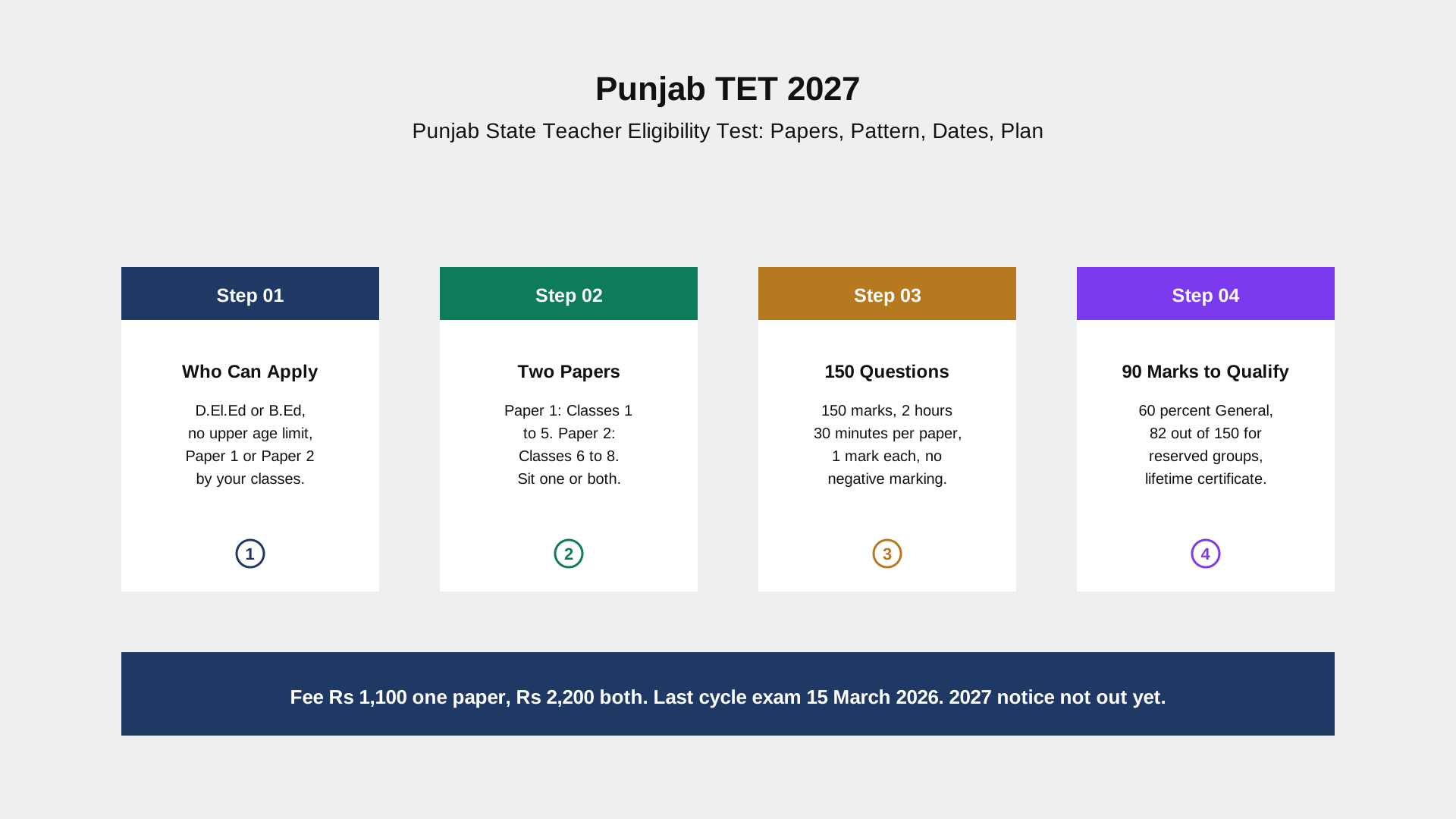
The second fact is that the test has two papers and you choose the one that matches the classes you want to teach. Paper 1 covers Classes 1 to 5, the primary stage. Paper 2 covers Classes 6 to 8, the upper primary stage. A candidate who wants to teach at both stages sits both papers. Each paper has 150 questions for 150 marks, each question carries 1 mark, and there is no negative marking, so a wrong answer costs you only the mark you did not earn. The qualifying line is 60 percent for general category candidates, which is 90 marks out of 150, and 55 percent for SC, ST and OBC candidates, which is 82 marks out of 150.
Punjab TET 2027 at a glance
| Detail | Punjab TET 2027, as last run in the 2026 cycle |
|---|---|
| Full name | Punjab State Teacher Eligibility Test (PSTET) |
| Conducting body in 2026 | State Council of Educational Research and Training (SCERT) Punjab |
| Posts offered by this test | None, this is an eligibility test only |
| Papers | Paper 1 for Classes 1 to 5, Paper 2 for Classes 6 to 8 |
| Questions and marks | 150 questions, 150 marks per paper, 1 mark per question |
| Duration per paper | 2 hours 30 minutes in the 2026 cycle |
| Negative marking | None in either paper |
| Qualifying marks | General 90 out of 150 (60 percent), SC, ST and OBC 82 out of 150 (55 percent) |
| Certificate validity | Lifetime under current NCTE guidelines |
| Fee in 2026 | Rs 1,100 for one paper, Rs 2,200 for both papers, General and OBC, Rs 550 and Rs 1,100 for SC, ST and PH, ex servicemen exempt |
| Last cycle dates | Notification 6 February 2026, applications 6 to 20 February 2026, exam 15 March 2026, result April 2026 |
| 2027 notification | Not published as of 21 November 2026 |
| Official portal in 2026 | pstet2025.org |
| Age limit | No upper age limit in the 2026 notification, see the eligibility section for the minimum age question |
What Punjab TET is and what it is not
Punjab runs its teacher recruitment in two layers, and PSTET is the lower layer. The test checks whether you know enough about child development, language, mathematics and your subject to stand in front of a class. The recruitment advertisement that follows checks everything else: your degree, your training, your documents, your place in the merit list. A PSTET certificate is the ticket that lets you enter that second layer. Without it, your application for a Punjab government teacher post will be rejected at the first check, however strong your degree is.
That is why the test has no vacancy number attached to it. News sites that print a vacancy count for PSTET are mixing it up with a teacher recruitment drive. The 2026 notification named no posts, because there were no posts to name. It named two papers, a fee, an exam date and a qualifying mark. The teaching posts come later, in advertisements from the Punjab education department, and those advertisements will state how many posts exist and which subjects they cover. Keep the two things apart in your head, and you will never be misled by a headline that promises PSTET vacancies.
The certificate you earn has lifetime validity under the current NCTE guidelines. That is a change from the older rule, under which the certificate lasted seven years from the date of the result. Several pages that describe the 2026 cycle still print the seven year figure, because they copied it from older notifications. The result reports for the 2026 cycle, including the Telegraph report of April 2026, state that the certificate is now valid for life, replacing the earlier seven year period. The National Council for Teacher Education fixed lifetime validity for TET certificates, and Punjab follows that rule. A candidate who qualified in 2024 or 2025 holds a lifetime certificate too, and does not need to sit the test again to stay eligible.
One more distinction matters before you plan. Punjab TET is a state test for Punjab government and government aided schools. It does not make you eligible for central government teaching posts, and it does not replace the Central Teacher Eligibility Test, known as CTET. The two tests have similar patterns and similar syllabi, so preparation for one helps with the other, but the certificates are separate. A candidate who wants both should sit both. A candidate who wants only Punjab schools needs only PSTET.
The 2026 cycle, date by date
The 2026 cycle moved fast. SCERT Punjab released the notification on 6 February 2026 and opened online applications the same day on the portal pstet2025.org. Candidates had fourteen days to apply, with the window closing on 20 February 2026. A correction window ran from 21 to 23 February 2026 for limited changes such as name, date of birth, photograph, signature and contact details. The exam was held on Sunday 15 March 2026. The provisional answer key came out on 16 March 2026, objections were accepted from 17 to 21 March 2026, the final answer key was published on 28 March 2026, and the result followed in April 2026.
Two details in that timetable need a note, because the sources disagree on them. The result date is reported as 2 April 2026 by FreeJobAlert and the Times of India, and as 7 April 2026 by Careers360 and Testbook. Both dates describe the same result declaration, and the gap is likely the difference between the first scorecard link going live and the wider announcement. This guide records both and treats 7 April 2026 as the date the result was fully available. The admit card date also differs between sources. Careers360 puts the admit card on 9 March 2026, while FreeJobAlert lists the admit card window as 21 to 23 February 2026, which is the same window it lists for corrections and looks like a copy error on that page. Candidates should expect the admit card about a week before the exam, which fits 9 March for a 15 March exam.
The cycle before that, the 2024 round, shows how the timetable can stretch. The Punjab School Education Board, known as PSEB, released that notification on 16 October 2024 and held the exam on 1 December 2024. The answer key came out on 11 December 2024. The result was declared in early 2025, reported as 19 February 2025 by Testbook, and a revised result followed on 28 August 2025 after objections to the provisional answer key were resolved. That history carries a practical lesson. Answer keys in PSTET get challenged, and challenged keys get revised, so a candidate should always check the final answer key and the revised result, not only the first result link.
The 2024 round also shows a change in who runs the test. PSEB ran the 2024 round, and its portal was pstet.pseb.ac.in. SCERT Punjab ran the 2026 round, and its portal was pstet2025.org. The exam itself did not change shape between the two rounds, but the conducting body and the website did. That is why this guide names the body on the current notice as the authority. When the 2027 notice appears, check which body and which portal it names, and use only that portal. Old portals stay on the internet long after they stop working, and a candidate who applies on an old portal applies nowhere.
Who can apply: Paper 1
Paper 1 is for candidates who want to teach Classes 1 to 5. The qualification is a mix of school education and teacher training, and the notification lists several combinations that all lead to the same door. The main route is Senior Secondary, that is Class 12, with at least 50 percent marks, plus a pass or final year appearance in a two year Diploma in Elementary Education, known as D.El.Ed. A candidate in the final year of D.El.Ed may apply, and the pass must be complete by the time of appointment. A second route takes Senior Secondary with at least 45 percent marks plus a two year D.El.Ed, under NCTE norms. A third route takes Senior Secondary with at least 50 percent marks plus a four year Bachelor of Elementary Education, known as B.El.Ed. A fourth route takes Senior Secondary with at least 50 percent marks plus a two year Diploma in Education in Special Education.
Graduates have a route too. A graduate with at least 50 percent marks and a Bachelor of Education, known as B.Ed, may apply for Paper 1, but must complete a six month Bridge Course in Elementary Education within two years of appointment. That bridge course condition is easy to miss and expensive to ignore. A B.Ed holder who clears Paper 1 without knowing about it can still be appointed, but the appointment carries the condition, and the course must be finished inside the two year window. Read that clause in the notification before you choose this route, and plan the course into your first two years of service.
The percentage rules have a purpose that is worth understanding. The 50 percent mark in Class 12 is the standard line. The 45 percent line exists for candidates whose D.El.Ed admission followed older NCTE regulations that accepted 45 percent. The notification, not a coaching website, decides which line applies to you. If your Class 12 score sits between 45 and 50 percent, read the exact wording of the notification for your cycle and check whether your D.El.Ed admission year and the NCTE rule in force at that time put you on the right side of the line. Do not guess this. A wrong guess here costs the whole application at document verification.
Who can apply: Paper 2
Paper 2 is for candidates who want to teach Classes 6 to 8. The base is graduation, plus teacher training aimed at the upper primary stage. The main routes are graduation plus a two year D.El.Ed, graduation with at least 50 percent marks plus a one year B.Ed, and graduation with at least 45 percent marks plus a one year B.Ed under NCTE norms. Senior Secondary with at least 50 percent marks plus a four year B.El.Ed also qualifies, as does Senior Secondary with at least 50 percent marks plus a four year BA B.Ed or B.Sc B.Ed integrated course. A graduate with at least 50 percent marks plus a one year B.Ed in Special Education qualifies as well.
Paper 2 keeps its demands narrow. A postgraduate degree is absent from the list, and a subject specific degree in the subject you want to teach is absent too, though the recruitment advertisement that follows will ask for exactly that. PSTET Paper 2 checks your teaching eligibility in general terms. The subject you choose in the 60 mark section of Paper 2 should match the subject you plan to teach, because the recruitment stage will test that subject in depth, and a mismatch between your Paper 2 stream and your teaching subject will show up there. Choose the stream that matches your graduation subject, not the stream that looks easiest in the syllabus.
Final year candidates may apply for Paper 2 as well, on the same terms as Paper 1. A candidate appearing in the final year of D.El.Ed or B.Ed may sit the test, and the qualification must be complete before appointment. That rule helps final year students, but it also creates a trap. A candidate who clears PSTET in the final year and then fails the final year examination holds a certificate that cannot be used until the training qualification is complete. Keep the training course as the priority, and treat PSTET as the second task, not the first.
Age limit and domicile
The 2026 notification set no age limit for PSTET, neither a minimum nor a maximum. FreeJobAlert states this plainly, and the Careers360 and Adda247 pages for the 2026 cycle say the same. A candidate of any age who holds the right qualification may sit the test. That is unusual among government exams, and it is one reason PSTET draws candidates who finished their training years ago and are returning to teaching after a gap. There is no upper age limit to worry about, and no age relaxation table to study, because there is no age rule to relax.
One source disagrees on the minimum age. The PW Live page for the 2024 cycle says the minimum age is 18 years with no upper age limit. That is consistent with the 2026 position in practice, since a candidate who has finished Class 12 and a two year training course will be at least 18 in almost every case. This guide records the 2026 notification position, which is no specified minimum or maximum age, and notes the 18 year figure as the practical floor that follows from the qualification itself. If the 2027 notification states a minimum age, that statement will govern.
Domicile matters in a narrow way. Candidates from outside Punjab may sit PSTET, but the 2026 notification treats non Punjab domicile candidates as General category candidates, whatever their reserved category status in their home state. That affects the qualifying mark. An out of state SC candidate must score 90 out of 150, the general line, not 82. It also affects later recruitment, where reservation benefits in Punjab government posts go to Punjab domicile candidates. An out of state candidate should plan on the general category line from the start, and should not count on reservation benefits that the Punjab rules do not give to non domicile candidates.
Punjab TET exam pattern: Paper 1
Paper 1 has five sections of 30 questions each, and every section is compulsory. Child Development and Pedagogy carries 30 marks. Language 1 carries 30 marks. Language 2 carries 30 marks. Mathematics carries 30 marks. Environmental Studies carries 30 marks. The total is 150 questions for 150 marks. Each question has four options and one right answer. Each right answer earns 1 mark. A wrong answer earns nothing and loses nothing, because there is no negative marking in PSTET. A blank answer also earns nothing. The paper is held offline on an OMR sheet, with pen and paper, and the candidate marks answers by darkening circles.
The five sections are equal in marks, and that equality is the first thing a preparation plan should respect. A candidate who gives mathematics three times the hours that pedagogy gets is preparing for a different exam. Each section is 30 marks, which is one fifth of the paper, and each section can move the result by the same amount. The qualifying line is 90 marks, which means a candidate needs three full sections right, or the equivalent spread across all five. A candidate who scores 25 in each of four sections and 10 in the fifth reaches 110 and clears the paper with room to spare. A candidate who scores 30 in two sections and 8 in each of the other three reaches 84 and fails. Spread wins this paper. Depth in one section alone does not.
Language 1 in Punjab is Punjabi, and Language 2 is English. Both are compulsory, and both test language skill plus the pedagogy of teaching that language. That means the language sections ask two kinds of questions. One kind tests whether you know the language: comprehension passages, grammar, vocabulary, correct usage. The other kind tests whether you know how to teach it: how children learn a first language, how a second language is introduced, what errors tell a teacher about a child, how reading and writing develop. A candidate who is fluent in Punjabi and English but has never thought about how children learn language will drop marks in the pedagogy half of each language section. Read the pedagogy of language development as its own topic, not as a side note to grammar.
Mathematics in Paper 1 covers the content of primary school mathematics and the pedagogy of teaching it. The content is number systems, fractions, decimals, measurement, geometry, patterns, data handling and simple problem solving. The pedagogy asks how children build number sense, what mistakes reveal about understanding, and how a teacher moves a child from counting to calculating. Environmental Studies covers the world around the child: family, food, shelter, water, travel, things we make and do, and the living world, plus the pedagogy of teaching EVS through observation and activity. Child Development and Pedagogy covers growth and learning, inclusive education, children with special needs, learning and teaching at the elementary level, and the ideas of Piaget, Vygotsky and other thinkers whose names appear in the syllabus.
Punjab TET exam pattern: Paper 2
Paper 2 shares three sections with Paper 1 and replaces the other two with a single 60 mark stream. Child Development and Pedagogy carries 30 marks, framed around learners aged 11 to 14. Language 1, Punjabi, carries 30 marks. Language 2, English, carries 30 marks. The fourth part is the chosen stream, 60 marks, picked from Mathematics and Science for a mathematics or science teacher, Social Studies for a social studies teacher, or another subject named in the notification for specialist teachers such as physical education, art or music. The total is again 150 questions for 150 marks, 1 mark each, no negative marking, offline OMR.
The 60 mark stream is where Paper 2 is won or lost. It is 40 percent of the paper, twice the size of any other section. A candidate who scores 45 out of 60 in the stream and 20 out of 30 in each of the three common sections reaches 105 and clears the paper. A candidate who scores 25 in the stream needs near perfect scores elsewhere to reach 90. Choose the stream that matches your graduation subject and your teaching subject, then give it the largest share of your preparation time. The stream syllabus follows the upper primary school books, and the notice cautions that questions may be pitched as high as Class 11 and 12 level in content, even though the teaching level is Classes 6 to 8. That caution matters. A science graduate who revises only the Class 6 to 8 books will meet questions that assume deeper subject knowledge, and a social studies graduate who revises only dates and names will meet questions that ask for causes and connections.
Mathematics and Science as a stream covers number systems, algebra, geometry, mensuration and data handling on the mathematics side, and food, materials, living things, motion, electric current, magnets, natural events and resources on the science side, with pedagogy for each. Social Studies covers history, geography, civics and economics at the upper primary level, with the same emphasis on teaching method. The specialist streams follow the same shape: subject content plus subject pedagogy. In every stream, the pedagogy questions reward candidates who have actually taught or who have studied how a topic is taught, not only candidates who know the topic. A candidate who can solve every algebra problem but cannot explain how to introduce algebra to a Class 7 child will lose the pedagogy marks inside the stream.
One pattern question comes up every cycle: can a candidate sit Paper 2 without sitting Paper 1, and can a candidate sit both papers on the same day? The answer to the first part is yes. The papers are independent, and a candidate who wants only upper primary teaching sits only Paper 2. The answer to the second part depends on the timetable in the notification. In the 2026 cycle both papers were held on the same day, 15 March 2026, and candidates who applied for both papers sat both. The 2027 notification will state the session timings, and candidates who apply for both papers should expect a long day with two papers of 2 hours 30 minutes each.
How long is the paper
The duration question has a conflict in the sources, and this guide states it openly. The 2026 cycle pages from Adda247 and the syllabus guide put the duration at 2 hours 30 minutes per paper. That is 150 minutes for 150 questions, which is one minute per question. Older pattern pages, including a page that reproduces the official pattern in detail, put the duration at one hour and 30 minutes for the same 150 questions, which would be 36 seconds per question. The older figure appears on pages that describe earlier cycles, and the 2 hours 30 minutes figure appears on pages that describe the 2026 cycle. This guide uses 2 hours 30 minutes, because it is the figure attached to the most recent cycle, and flags the one hour 30 minutes figure as the older pattern that some sites still print.
One minute per question is a comfortable pace on paper and a tight pace in practice, because the OMR sheet adds its own time. Darkening 150 circles, checking the question number against the circle number, and keeping the sheet clean takes several minutes across the paper. A candidate who reads at exam speed and answers in order will finish with time to spare. A candidate who gets stuck on hard questions early will run short at the end. The practical rule is simple. Answer the easy questions first, mark the hard ones and come back, and keep at least ten minutes at the end for the OMR sheet. The last ten minutes are for checking that every attempted question has a darkened circle and that no circle is half darkened or darkened against the wrong number. A right answer in the head that is not darkened on the sheet scores nothing.
Qualifying marks: the line you must cross
The qualifying marks are fixed percentages, not cut offs that move with the paper. General category candidates need 60 percent, which is 90 marks out of 150. SC, ST and OBC candidates need 55 percent, which is 82 marks out of 150. There is no separate qualifying mark per section. A candidate may score low in one section and high in another, and the total is what counts. There is also no interview and no second stage inside PSTET. The score is the whole result. Cross the line and you qualify. Fall short by one mark and you do not, and there is no rounding up and no grace mark.
The 82 mark figure deserves a small note, because 55 percent of 150 is 82.5, not 82. The notification states 82 out of 150 as the reserved category line, and every source that lists the marks repeats 82. Treat 82 as the line. A reserved category candidate with 82 marks qualifies. A candidate with 81 does not. Do not aim for the line. Aim for 100 or more, because the paper has no negative marking and a candidate who attempts all 150 questions with honest preparation will pick up marks from educated guesses that a cautious candidate leaves behind. With no penalty for a wrong answer, leaving a question blank is the only certain way to score zero on it.
The result is published as a scorecard that shows paper wise marks, total score and qualifying status. The scorecard is the document that matters. Keep a printed copy and a digital copy, because the eligibility certificate that follows is issued on the basis of the scorecard, and the certificate download window may close. The Telegraph reported that successful candidates in the 2026 cycle could download their official eligibility certificates within two weeks of the result declaration. Check the portal in that window. A certificate that is never downloaded is still valid, but a candidate who needs it for a recruitment advertisement that opens a month later will want it in hand, not in a portal queue.
The 2026 result in numbers
The 2026 result gives the best sense of how hard the test is. The Telegraph reported that 28,243 candidates qualified in Paper 1 out of 53,474 who appeared. That is a pass rate of about 53 percent, which means just over half the candidates who sat Paper 1 cleared it. That is a kinder pass rate than most government recruitment exams, where single digit pass rates are common, and it reflects the nature of the test. PSTET is a qualifying test with a fixed line, and the paper checks a minimum standard rather than ranking candidates for a fixed number of seats. A candidate who meets that standard passes.
That does not make the test easy. Half the candidates who appeared for Paper 1 did not clear it, and the reasons are visible in the pattern. Candidates fail because they ignore one section entirely, usually pedagogy or environmental studies, and then cannot make up the marks elsewhere. Candidates fail because they prepare from CTET books alone and miss the Punjabi language section, which is 30 marks in both papers and has no parallel in CTET. Candidates fail because they treat the test as a general knowledge exam and spend weeks on current affairs that the syllabus barely mentions. The syllabus is the map. Child development, language pedagogy, primary mathematics, environmental studies and the chosen stream are the whole paper, and current affairs is not a section in either paper.
There is also a numbers trap that catches candidates every cycle. The pass rate of about 53 percent for Paper 1 in 2026 looks encouraging, but it is the pass rate among candidates who appeared, and appearing candidates are already a filtered group. They are candidates who held or were pursuing D.El.Ed or B.Ed, who paid the fee, who travelled to the centre and who sat for two and a half hours. The candidates who never applied, or who applied and stayed home, are not in the number. A serious candidate should read the pass rate as evidence that the line is reachable, not as evidence that the line is low.
The syllabus, section by section
Child Development and Pedagogy is the section that surprises first time candidates most, because it is 30 marks in both papers and it is unlike anything in a graduation syllabus. It covers the concept of development and its link with learning, principles of development, influence of heredity and environment, socialisation, Piaget, Kohlberg and Vygotsky, the concept of child centred and progressive education, critical thinking, learning and motivation, factors that help learning, language and thought, and the assessment of learning. It also covers inclusive education in depth: the education of children with special needs, learning difficulties, the role of the teacher in an inclusive classroom, and the rights of children with disabilities. The questions are usually short case situations. A teacher faces a child who cannot read, a child who disrupts the class, a child who learns slowly. The right answer is the response that a trained teacher would give, and the wrong answers are responses that sound strict or sound kind but teach nothing.
Language 1, Punjabi, tests proficiency in Punjabi and the pedagogy of teaching a first language. The proficiency part covers comprehension passages, grammar, vocabulary, synonyms and antonyms, correct usage, and the structure of the language. The pedagogy part covers how children acquire a first language, how reading and writing develop, how a teacher builds vocabulary, and how language errors are understood as stages of learning rather than as faults. A candidate who speaks Punjabi at home has an advantage in the proficiency half, and no advantage at all in the pedagogy half, unless the candidate has studied language development. That is the section where home fluency misleads people. Fluency answers the grammar questions. It does not answer the questions about how a child learns to read.
Language 2, English, follows the same two part shape. The proficiency part covers comprehension passages, grammar, vocabulary and correct usage at the level of a school teacher, not at the level of a literature graduate. The pedagogy part covers second language learning, the difference between learning a first language and a second language, how a teacher introduces English to children whose first language is Punjabi, and how errors in a second language are treated. Candidates who studied in English medium schools have a small advantage here, and candidates who studied in Punjabi medium schools should give this section extra time. Thirty marks is one fifth of the paper, and a weak English section is the most common reason Punjabi medium candidates fall short of 90.
Mathematics for Paper 1 is primary school mathematics with a pedagogy layer. The content runs through numbers, fractions, decimals, factors and multiples, measurement of length, weight, capacity, time and money, shapes and spatial understanding, patterns, and data handling. The pedagogy asks how children form number concepts, what common errors mean, how a teacher uses concrete objects before abstract symbols, and how mathematics is taught through daily life. The questions test teaching skill through mathematics. A graduate in mathematics who has never thought about how a seven year old learns subtraction will answer the content questions and miss the pedagogy questions in the same section.
Environmental Studies for Paper 1 covers the child and the world around the child. Family and friends, food, shelter, water, travel, things we make and do, and the living world are the themes, taken from the primary school EVS books. The pedagogy asks how EVS is taught through observation, activity and field visits, how a teacher connects the classroom to the home and the village, and how environmental awareness is built in young children. Treat it as a school subject with its own books, and its questions come from those books. A week spent reading the primary EVS books is worth more in this section than a month of general knowledge reading.
Paper 2 stream syllabi follow the upper primary books. Mathematics and Science covers number systems, algebra, geometry, mensuration, data handling, food and nutrition, materials around us, living things, motion, force, electric current, magnets, natural phenomena and natural resources, with pedagogy for each topic. Social Studies covers history from the early period to the modern period with special attention to Punjab, geography of India and the world, the Constitution and government, and economics at the school level, again with pedagogy. The specialist streams follow the same pattern for their subjects. In every stream, the books for Classes 6 to 8 are the base, and the notice warns that content may be pitched up to Class 11 and 12 level, so a candidate should read one level above the teaching level for the core topics.
Fee and how to apply
The 2026 fee was Rs 1,100 for one paper and Rs 2,200 for both papers for General, OBC and other state candidates. SC, ST and physically handicapped candidates paid Rs 550 for one paper and Rs 1,100 for both. Ex servicemen were exempt from the fee entirely. The fee is non refundable and is paid online through debit card, credit card, net banking or other payment gateways on the portal. The fee is paid as the last step of the application, and the application is complete only when the fee is paid and the confirmation page is generated. A candidate who fills the form and never pays has not applied.
Applying is an online process only, and the steps in the 2026 cycle show the shape it will take again. The candidate visits the official portal and clicks the new registration link, enters a valid email address and mobile number, and verifies both with a one time password. The candidate then logs in with the registered email and password and fills personal details, address, educational qualifications and the paper choice. A scanned photograph and signature are uploaded in the format and size the portal specifies. The fee is paid online. The confirmation page and fee receipt are downloaded and printed. Keep both, because the registration number and the fee receipt are needed for the admit card and for any later correction.
Three application mistakes recur every cycle. The first is choosing the wrong paper, or choosing one paper when the candidate is eligible for both and wants to teach at both stages. The paper choice cannot be changed after the correction window closes, and the fee difference cannot be adjusted later. The second is uploading a photograph or signature that does not meet the size or format rule, which can hold up the admit card. The third is using a mobile number or email address that the candidate does not check, because the portal sends the registration details, the admit card alert and the result alert to those contacts. Use a number and an email that you will still own when the result comes out, months after the application.
A 90 day plan that fits the real paper
Ninety days is enough for PSTET if the days follow the pattern of the paper. The paper has no single dominant section, so the plan gives each section its own slot every week. The first thirty days build the base. Child Development and Pedagogy gets one hour a day, because it is the section most candidates have never studied and it appears in both papers. Language 1 and Language 2 share an hour a day, with Punjabi and English on alternate days, half proficiency and half pedagogy. Mathematics or the Paper 2 stream gets one hour a day. Environmental Studies for Paper 1 gets thirty minutes a day. One full mock test every Sunday, 150 questions in 2 hours 30 minutes on an OMR sheet if possible, with the result reviewed the same evening.
Days 31 to 60 turn the base into exam skill. The pedagogy section gets a second pass, this time through case questions rather than theory, because the exam asks what a teacher would do, not what a book says. The language sections get daily comprehension practice, one passage a day in each language, timed. The mathematics section gets daily problem sets from the primary books, and the stream section for Paper 2 gets the upper primary books read end to end. Mock tests move to twice a week, and the review after each test gets a written note: which section lost marks, and whether the loss was knowledge, speed or a careless circle on the OMR sheet. The note matters more than the score. A score tells you where you stand. A note tells you what to fix.
Days 61 to 90 are for revision and speed. No new topic starts after day 65. The pedagogy notes get read end to end twice. The language pedagogy terms get written out from memory once a week until they come out clean. The mathematics formulas and the EVS themes get a daily half hour of revision. Mock tests run every other day in the last two weeks, always in one sitting, always timed, always with the rule that no question is left blank, because there is no negative marking and a guess is worth more than a blank. The last three days are light. Short revision, early sleep, no new material. A tired candidate misreads pedagogy cases, and a misread case loses a mark that a fresh candidate keeps.
Two habits run through all ninety days. First, study from the school books for content and from a pedagogy book for method, and keep the two separate in your notes. The school books give you what to teach. The pedagogy book gives you how children learn it. The exam tests both, and a candidate who mixes them up studies neither well. Second, practise on OMR sheets. The paper is offline, and candidates who have only ever clicked answers on a screen lose time and make marking errors on paper. Print OMR sheets, darken circles by hand, and time yourself. The hand needs practice as much as the head.
Mistakes that cost candidates marks
The most expensive mistake is preparing for CTET and assuming PSTET is the same paper. The two tests share child development and pedagogy, and they share the two paper shape, but PSTET has Punjabi as Language 1, and Punjabi is 30 marks in each paper. A candidate who prepares only from CTET books walks into the exam with no Punjabi preparation and needs near perfect scores in the other four sections to reach 90. Give Punjabi its full share from day one, including the pedagogy of teaching Punjabi as a first language.
The second mistake is ignoring pedagogy because it looks like common sense. Pedagogy questions are written so that the common sense answer is often wrong. A question about a child who cannot read may offer a strict answer, a kind answer and a teaching answer, and the teaching answer is the one that diagnoses the difficulty and plans the next step. Common sense picks the kind answer. Training picks the teaching answer. Study the pedagogy properly, with case questions, and the section becomes the most reliable 30 marks in the paper.
The third mistake is leaving questions blank. There is no negative marking in PSTET, so a blank answer is the worst possible choice on any question. A candidate who cannot eliminate even one option should still darken a circle, because a guess has a one in four chance and a blank has none. Across 20 guessed questions, random guessing alone adds about five marks, and educated guessing adds more. Five marks is the difference between 85 and 90, which is the difference between failing and qualifying.
The fourth mistake is trusting the wrong website for dates. PSTET has changed its conducting body and its portal between cycles, and old portals and old notifications stay visible on search results long after they stop working. The 2027 notification, when it appears, will name the body and the portal for that cycle. Check that portal, and treat every other date as a rumour until the notice confirms it. The same caution applies to the fee. The 2026 fee is the best guide to the 2027 fee, but the notice will state the figure, and the notice is the only source that counts.
The fifth mistake is waiting for the notification before starting. The 2026 window ran for only fourteen days, from 6 to 20 February 2026. A candidate who started preparing on the day the notice came out had about five weeks before the exam on 15 March. A candidate who started in November had four months. The syllabus is fixed by NCTE norms and changes little between cycles, so preparation that starts now is preparation for the real paper, not for a guess. Start with pedagogy and Punjabi, the two sections that take the longest to build, and the notice will find you ready.
Where to check next
The places that matter are the SCERT Punjab portal used in the 2026 cycle, pstet2025.org, and the PSEB portal used in earlier cycles, pstet.pseb.ac.in. The 2027 notification will name the portal for its own cycle, and that portal is where the notice, the application link, the admit card, the answer key and the result will appear first. Everything else is a copy. When the notice lands, read four things before you pay: the conducting body, the paper you are eligible for, the fee for your category, and the exam date. If the pattern differs from the one in this guide, this page will be updated and the mock tests will be rebuilt to match.
Until then, the work is the same. Pedagogy every day, Punjabi and English on alternate days, mathematics or your stream alongside, environmental studies in a daily half hour for Paper 1, and a mock test every week in the real pattern of 150 questions in 2 hours 30 minutes with no negative marking. The certificate is lifetime, the line is 90 marks, and the exam rewards the candidate who treated the months before the notice as preparation time, not as waiting time.
Sources
FreeJobAlert, PSTET Notification 2026 Out, Apply Online, Exam Date, Eligibility and Syllabus, 7 February 2026, with notification 6 February 2026, applications 6 to 20 February 2026, exam 15 March 2026, fee Rs 1,100 for one paper and Rs 2,200 for both, qualifying marks 60 percent and 55 percent. Adda247, PSTET 2026 Notification Out, Check Eligibility and Apply Online Dates, with exam 15 March 2026, duration 2 hours 30 minutes, conducting body SCERT Punjab. Careers360, PSTET 2026 Exam, Result Declared, Scorecard, Qualifying Marks, with result 7 April 2026 and admit card 9 March 2026. Testbook, PSTET Result 2026, with result 7 April 2026, certificate validity lifetime, Paper 1 qualifying 90 out of 150 and reserved 82 out of 150. The Telegraph, PSEB Announces PSTET Result 2025 for Teacher Recruitment, 7 April 2026, with Paper 1 qualified 28,243 out of 53,474, certificate valid for life, certificates downloadable within two weeks. Testbook, PSTET Revised Result 2025, with exam 1 December 2024, result 19 February 2025, revised result 28 August 2025, validity lifetime. PW Live, PSTET 2024, Answer Key Out, Result Date, Certificate, with notification 16 October 2024, exam 1 December 2024, answer key 11 December 2024, minimum age 18 years, no upper age limit. GovtJobsLive, PSTET Exam Pattern Details, with 150 MCQs per paper, no negative marking, qualifying 90 out of 150 and 82 out of 150, and the older duration and seven year validity figures. ExamSyllabusHub, PSTET Syllabus, Paper 1 and Paper 2 Pattern Explained, with 150 questions per paper, 2 hours 30 minutes, no negative marking, Punjabi as Language 1 and English as Language 2, content pitched up to Class 11 and 12. State Council of Educational Research and Training Punjab, PSTET portal pstet2025.org, and Punjab School Education Board, PSTET portal pstet.pseb.ac.in.