
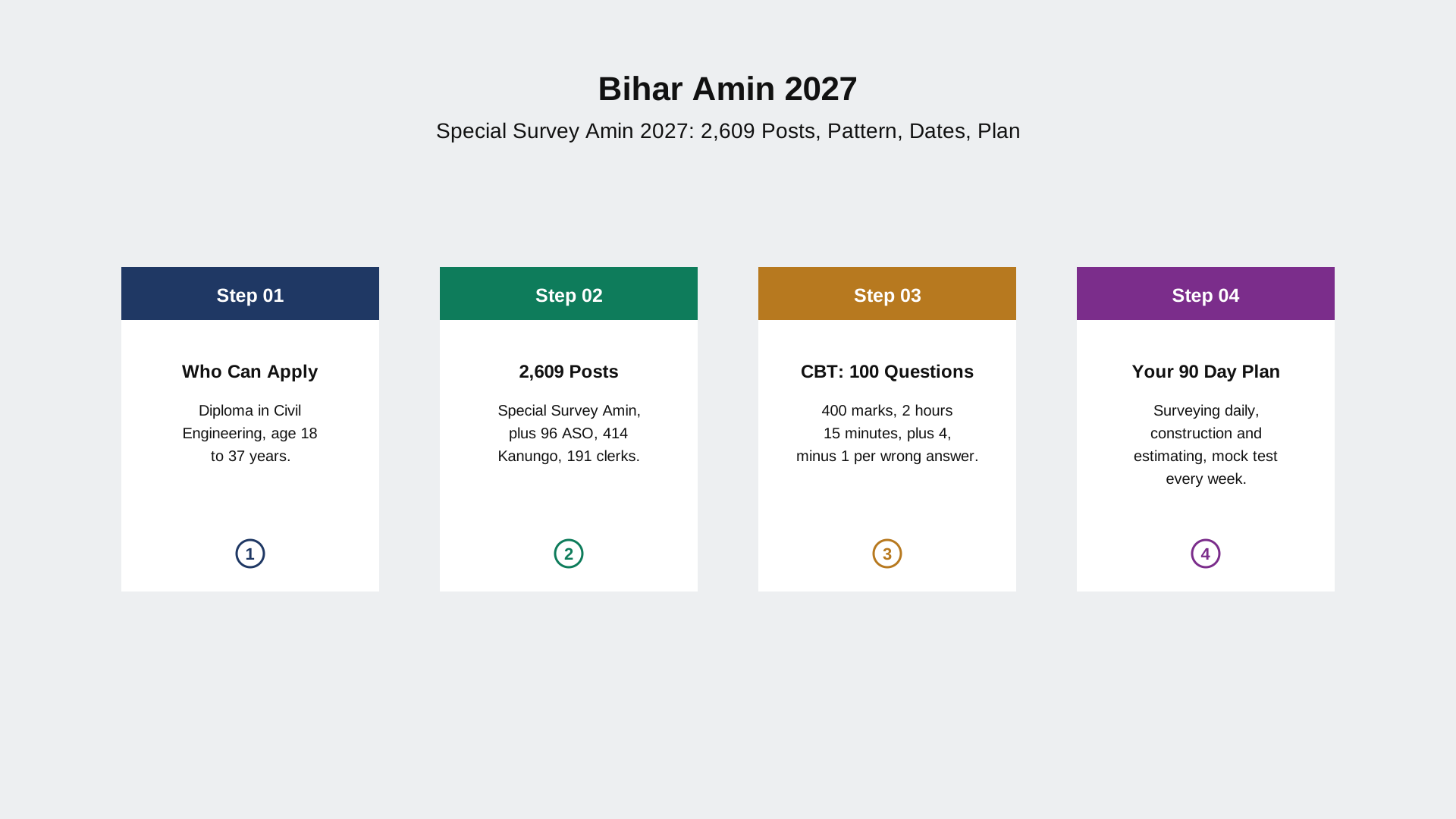
About Bihar Amin 2027 Exam Series
📖 Table of Contents
- Bihar Amin 2027 at a glance
- Two different Amin jobs share one name
- The November 2026 announcement, in plain words
- Who can apply for Special Survey Amin
- Bihar Amin exam pattern: what the paper looks like
- What an Amin actually does all day
- The syllabus, subject by subject
- How the 2023 cycle played out
- The money question
- A 90 day plan that fits the real paper
- Mistakes that cost candidates marks
- Where to check next
- Sources
Bihar Amin 2027: Complete Exam Guide
The Bihar Amin 2027 cycle starts with a number that is hard to ignore. On 18 November 2026, the state revenue and land reforms minister announced 2,609 new Special Survey Amin posts, part of a 3,310 post drive to finish the special land survey across Bihar. The minister said appointments should be complete by February 2027 and the notification was expected within days. As of 21 November 2026, the formal advertisement with its number, dates and fee had not been published, so this guide anchors on the last full cycle and marks every new figure as announced, not yet notified.
The last full cycle was the 2023 Special Survey recruitment run by the Bihar Combined Entrance Competitive Examination Board, known as BCECEB. It advertised 8,244 Special Survey Amin posts out of 10,101 posts in total. The written test was a computer based test of 100 questions for 400 marks, held over 2 hours 15 minutes, with 4 marks for a right answer and 1 mark cut for a wrong one. The entry ticket was a diploma in civil engineering. The fee was Rs 800 for general, EWS, BC and EBC candidates and Rs 400 for SC, ST and disabled candidates.
That is the exam this guide prepares you for. The new drive uses the same post name, the same department and the same survey work, so the 2023 pattern is the best working map until the new notice lands. Where the new announcement differs, this guide says so in plain words instead of guessing.
Bihar Amin 2027 at a glance
| Detail | Bihar Amin 2027, as announced and as last run |
|---|---|
| Conducting body | Bihar Combined Entrance Competitive Examination Board (BCECEB), for the Department of Revenue and Land Reforms |
| Post | Special Survey Amin |
| New posts announced | 2,609 Amin posts, part of a 3,310 post drive announced 18 November 2026 |
| Last full cycle | 2023, 8,244 Special Survey Amin posts out of 10,101 posts in total |
| Advertisement for 2027 cycle | Not published as of 21 November 2026; notification expected within days of the 18 November 2026 announcement |
| Education | Diploma in Civil Engineering from a recognised institute (Special Survey Amin) |
| Age limit | 18 to 37 years for men, 18 to 40 years for women, as on 1 January 2023 in the last cycle |
| Fee in last cycle | Rs 800 for general, EWS, BC and EBC; Rs 400 for SC, ST and disabled candidates |
| Exam | Computer based test, 100 questions, 400 marks, 2 hours 15 minutes |
| Marking | 4 marks for a right answer, 1 mark cut for a wrong answer |
| Pay in last cycle | Honorarium of Rs 31,000 a month, plus Rs 4,000 a month for laptop, internet and mobile for 12 months |
| Selection | Computer based test, then document verification |
| Official website | bceceboard.bihar.gov.in |
Two different Amin jobs share one name
The first thing to get straight is that Bihar has had two kinds of Amin recruitment, and most websites mix them up. One is the regular Amin post under the Department of Revenue and Land Reforms. The other is the Special Survey Amin, a contract post created for the special land survey. They share a name and a department, and almost nothing else.
The regular Amin post asked for a Class 12 pass. BCECEB ran it under Advertisement No. BCECEB(Rev) 20/2019, with 1,767 posts. Applications opened on 23 December 2019, the computer test ran on 10, 11 and 12 August 2021, and the result came out on 23 October 2021. A separate small drive for the Department of Environment, Forest and Climate Change, Advertisement No. BCECEB(EFCC) 02/2020, offered 40 Amin posts, also for Class 12 pass candidates, with a fee of Rs 700 for general candidates and Rs 350 for SC, ST and disabled candidates, and a regular pay scale of Level 3, Rs 21,700 to Rs 69,100.
The Special Survey Amin is a different job. It asks for a diploma in civil engineering, not a Class 12 pass. It pays an honorarium, not a regular pay scale. The 2019 drive offered 4,950 Special Survey Amin posts. The 2023 drive offered 8,244. The November 2026 announcement offers 2,609. Each of these drives sat inside a larger package with Assistant Settlement Officers, Kanungos and clerks, all hired for the survey.
This matters because the preparation is different. A Class 12 pass candidate cannot apply for Special Survey Amin, and a diploma holder who prepares for the regular Amin paper will find the Special Survey paper far more technical. Three out of every four questions in the Special Survey test come from civil engineering. If a website tells you that a Class 12 pass is enough for Bihar Amin 2027, it is describing the old regular post, not the drive that is actually coming.
The 2027 branding on this page follows the new drive. The minister announced it in November 2026 with appointments aimed at February 2027, and the exam cycle will run into 2027. The post itself is the Special Survey Amin, and the diploma rule is the one that counts.
The November 2026 announcement, in plain words
On 18 November 2026, Revenue and Land Reforms Minister Dilip Kumar Jaiswal told reporters in Patna that the department would recruit 3,310 people to speed up the special land survey. The break up he gave was 96 Assistant Settlement Officers, 414 Special Survey Kanungos, 2,609 Special Survey Amins and 191 clerks. He said the government aimed to complete all appointments by February 2027, and the notification was expected within the next couple of days.
That is the full verified picture as of 21 November 2026. No advertisement number has been published. No application dates have been published. No fee has been published. No exam date has been published. One tracker site claims applications ran from 5 November to 5 December 2026, but that claim cannot stand next to the minister saying on 18 November that the notification was still to come. This guide does not repeat that claim as fact.
The February 2027 target is worth reading carefully. It is an appointment target, not an exam date. A 2,609 post drive needs a notification, an application window of about a month, a computer test, answer keys, results and document checks. The 2023 cycle took roughly a month just for applications, from 13 April to 12 May 2023. A February finish means the notice has to move fast, and candidates who wait for the notice before starting to study will be late.
The survey itself is the reason the numbers are so large. Bihar is running a special survey to rebuild its land records village by village, plot by plot. An Amin measures plots, draws maps, checks boundaries and records who holds what. The state needs thousands of them at once, which is why the 2023 drive was 8,244 strong and why the new drive, at 2,609, still looks big next to most state recruitments.
Who can apply for Special Survey Amin
The entry ticket is a full time diploma in civil engineering from a recognised institute. That rule comes from the 2023 notification and from the eligibility pages BCECEB has published since. A degree in civil engineering also fits, because it covers the diploma syllabus and more, but the minimum the notice asks for is the diploma. An ITI certificate in surveyor trade was accepted for the old regular Amin post in some cycles, and a few websites still list it for this post. It does not apply to Special Survey Amin, and a candidate who relies on it will be turned away at document verification.
The age rule in the 2023 cycle was 18 to 37 years for men and 18 to 40 years for women, counted as on 1 January 2023. Age relaxation followed Bihar government rules for reserved categories, with the usual extra years for SC, ST, OBC and EBC candidates and for disabled candidates. The new notice will set its own cut off date, and that date decides everything. A candidate who turns 38 a week before the cut off is out, and a candidate who turns 38 a week after it is in. Watch the cut off date in the notice, not the announcement speeches.
Indian citizenship is required. The 2023 fee was Rs 800 for general, EWS, BC and EBC candidates of either sex and Rs 400 for SC, ST and disabled candidates, paid online. The fee for the new drive has not been announced, and the 2023 figure is the best guide to what it will look like. Candidates should keep a scanned photo, a scanned signature, the diploma certificate and a valid photo identity proof ready before the window opens, because a one month window leaves no time to chase documents.
One point the new notice will settle is whether Bihar domicile matters for reservation. Bihar recruitments normally give reservation benefits only to Bihar domicile candidates, while candidates from other states can apply under the unreserved category. This guide does not state a domicile rule for the 2027 drive, because the notice has not been published. Read that clause in the notice before you pay the fee.
Bihar Amin exam pattern: what the paper looks like
The Special Survey Amin test is a computer based test with 100 questions and 400 marks, to be finished in 2 hours 15 minutes. That is the Bihar Amin exam pattern reported for the 2023 cycle, and it is the pattern the mock tests on this site follow. Section A is civil engineering, with 75 questions for 300 marks. Section B is general studies, with 25 questions for 100 marks. Each question carries 4 marks. Each wrong answer costs 1 mark.
Two warnings belong here. First, the 75 and 25 split comes from tracker pages that reproduced the 2023 pattern, not from an official BCECEB PDF this guide could read directly. One tracker page prints a different split, 50 questions of civil engineering and 50 of general studies, also for 400 marks. The 75 and 25 split appears on more pages and matches the 2 hour 15 minute duration and the 100 question count that mock test sellers also use, so this guide follows it and flags the other split as unverified. Second, the new notice may change the pattern. If it does, the mock tests on this site will be rebuilt to match, and this page will be updated.
The marking scheme shapes how you should play the paper. Four marks for a right answer and 1 mark cut for a wrong one means a blind guess needs better than one in four odds to pay off. With four options per question, a pure guess breaks even on average and loses once you count the questions you would have left blank. The practical rule is simple. Answer what you know, attempt what you can narrow to two options, and leave the rest alone. A candidate who attempts 85 questions with 70 right and 15 wrong scores 265. A candidate who attempts all 100 with the same 70 right and 30 wrong scores 250. The second candidate worked harder and scored less.
Time is the other constraint. Two hours 15 minutes for 100 questions is 81 seconds per question on average, but the two sections do not take equal time. General studies questions are mostly one line recall, and a prepared candidate clears most of them in under a minute each. Civil engineering questions need working, especially surveying numericals and estimating problems, and they can take two minutes each without you noticing. The plan that works is to take general studies first, bank those marks fast, and then give civil engineering the long stretch it needs.
| Section | Questions | Marks | What it covers |
|---|---|---|---|
| A, Civil Engineering | 75 | 300 | Surveying, building construction, concrete, structures, hydraulics, transport, estimating |
| B, General Studies | 25 | 100 | General science, current events, history, geography, polity, economy, reasoning |
| Total | 100 | 400 | 2 hours 15 minutes, 4 marks right, 1 mark cut wrong |
What an Amin actually does all day
An Amin is the person who turns land on the ground into land on paper. In a village, the Amin walks the plots with a chain or a total station, measures lengths and angles, fixes boundaries, and draws the map that becomes the record. When two neighbours argue over where one field ends and the next begins, the Amin's measurement settles it. When the survey team records a plot, the Amin notes the khata number, the khesra number, the area and the name of the holder.
The special survey makes this job bigger than the old Amin work. Bihar's land records carry decades of gaps, and the special survey is a fresh measurement of every plot, not a patch on the old record. The Amin works in a team with a Kanungo, who supervises a group of Amins, and an Assistant Settlement Officer, who settles objections. The Amin is the bottom of that chain and also the part that touches the ground, so the quality of the whole survey rests on the Amin's measurements.
It is field work, not desk work. The Amin spends the day outdoors, in heat and rain, walking from plot to plot. Candidates who picture a quiet office job should think again. The work also needs care with people, because a measurement that takes land from one family and gives it to another will be argued about on the spot. Patience counts for as much as the chain.
The tools have changed. The old chain and tape still matter, and the syllabus still tests them, but the survey now uses total stations, GPS based measurement and digital maps. A diploma holder who has used a total station in practicals has an edge over one who has only read about it.
The syllabus, subject by subject
The civil engineering section follows the diploma syllabus, and the topic list is long. Surveying sits at the centre, because it is the job itself. Basic surveying covers chain surveying, compass surveying, levelling and contouring. Advanced surveying covers theodolite work, tacheometry, curves and total station work. A candidate who is weak in surveying is weak in the section that decides the merit list, so surveying gets the largest share of study time in this guide.
Building construction and construction materials come next, with concrete technology close behind. These three topics overlap heavily, and studying them together saves time. A question on curing is a concrete question and a construction question at the same time. Estimating and costing follows, and it is the section where candidates lose marks they should have kept, because the numericals look easy and the units trap the careless. Write the unit next to every number you work out, and the trap stops working.
The rest of the civil list is theory of structures, design of steel and reinforced concrete structures, geotechnical engineering, hydraulics, water resources engineering, transportation engineering, engineering mechanics, mechanics of materials, building planning and drawing, applied physics, applied chemistry, engineering graphics, introduction to IT systems, fundamentals of electrical and electronics engineering, and mathematics. That is a wide net, and no candidate covers all of it to the same depth. The smart play is depth in surveying, construction, concrete and estimating, and working familiarity everywhere else, because the paper rewards the candidate who answers the core topics cold and picks up scattered marks elsewhere.
General studies is the smaller section, 25 questions, and it still decides ranks. It covers general science, current events, history, geography, Indian polity and economy, mental ability and reasoning. The reasoning questions are the most reliable marks in the whole paper, because they need no memorised facts. The current events questions need a habit, not a cram session. Fifteen minutes a day with a Bihar focused news summary, kept up for three months, beats a week of panic reading before the exam. Bihar specific facts earn their place here, because a state recruitment paper asks about the state it serves.
How the 2023 cycle played out
The 2023 drive is the closest thing to a rehearsal for 2027. BCECEB published the notification on 13 April 2023 for 10,101 posts across four posts: 355 Assistant Settlement Officers, 758 Special Survey Kanungos, 8,244 Special Survey Amins and 744 Special Survey Clerks. Applications ran from 13 April to 12 May 2023. The fee was Rs 800 for general, EWS, BC and EBC candidates and Rs 400 for SC, ST and disabled candidates. The age limits were 18 to 37 years for men and 18 to 40 years for women as on 1 January 2023, with 21 as the minimum age for the Assistant Settlement Officer and clerk posts.
Those numbers put the new drive in perspective. The 2023 Amin figure, 8,244, is more than three times the 2,609 announced for the new drive. A candidate who reads only the 2027 headlines might think 2,609 is the largest Amin drive ever. The 2023 cycle was bigger. The new drive is still large, the largest since 2023. That is good news for candidates in one way. The 2023 cycle proved BCECEB can run a drive of this size and that the computer test, document check and merit list machinery works. It is also a warning. The 2023 drive drew an enormous number of applicants, and the cut offs reflected that crowd.
The 2019 drive is worth a line too. It offered 4,950 Special Survey Amin posts and 550 regular Amin posts in the same package, and it shows the pattern of how Bihar hires for this work: big survey drives every few years, with a gap in between. The gap is the opportunity. Candidates who start during the gap, while others wait for the notice, arrive at the exam with months of preparation behind them.
Selection in the 2023 cycle rested on the computer test, followed by document verification. The merit list came from the test score. That is a clean system, and it is kind to the prepared candidate. There is no interview to rescue a weak test score and no interview to sink a strong one. Your rank is your score, so every mark in the test counts in full.
The money question
Special Survey Amin is a contract post, and candidates should understand what that means before they apply. The 2023 cycle paid an honorarium of Rs 31,000 a month, plus Rs 4,000 a month for laptop, internet and mobile expenses for 12 months. That is Rs 35,000 a month in hand for the first year, with the Rs 4,000 part tied to the survey work and its equipment.
Reports about the new drive quote Rs 35,000 a month for the Amin post. That figure matches the 2023 total of Rs 31,000 plus Rs 4,000, so it may be the same package described as one number. Or the honorarium itself may have risen to Rs 35,000. This guide cannot settle that from the announcement speeches, and it will not pretend to. The notice will state the figure, and the notice is the only source that counts.
One tracker site lists the post at Pay Level 4, Rs 25,500 to Rs 81,100 a month. That is a regular government pay scale, and it does not fit a contract honorarium post. It looks like a figure borrowed from a different recruitment and pasted into this one. This guide does not use it. A candidate who joins expecting a regular pay scale with annual increments and a pension will be disappointed, and a candidate who joins knowing it is a contract honorarium for survey work will judge the offer fairly: good monthly pay for a diploma holder, field work, and a fixed term tied to the survey.
The contract question matters for planning. Survey work ends when the survey ends. A wise candidate treats the post as a strong job with a fixed horizon and keeps preparing for the next regular recruitment while working. The diploma and the field experience both help in later exams, including the BTSC Junior Engineer test, where work experience can add marks.
A 90 day plan that fits the real paper
Ninety days is enough if the days are used in the right order. The paper is three quarters civil engineering, so the plan gives civil engineering three quarters of the time. General studies gets a daily slot, not a weekend, because daily contact beats weekend cramming.
Days 1 to 30 build the base. Surveying first, two hours a day, working through chain surveying, levelling, contouring and theodolite problems with a notebook, not just reading. One hour a day on building construction and concrete technology together. Thirty minutes a day on general studies, split between a news summary and one reasoning set. One full mock test every Sunday, 100 questions in 2 hours 15 minutes, with the result reviewed the same evening. The review matters more than the test. Every wrong answer gets a one line note: what the right answer was and why you missed it.
Days 31 to 60 add the rest of the civil syllabus. Estimating and costing gets an hour a day, because its numericals need practice, not reading. Theory of structures and design of steel and reinforced concrete structures share an hour. Geotechnical engineering, hydraulics, water resources and transportation get a rotating slot. General studies keeps its thirty minutes, and the news notes start to form a revision file. Mock tests move to twice a week, and the review notes start to repeat, which is how you know the weak spots are shrinking.
Days 61 to 90 are for revision and speed. No new topic starts after day 65. The surveying notebook gets read end to end twice. The estimating formulas get written out from memory once a week until they come out clean. Mock tests run every other day in the last two weeks, always in one sitting, always timed, always with the same rule as the real paper: general studies first, civil engineering second, guesses only when two options are left. The last three days are light. Short revision, early sleep, and no new material. A tired candidate makes the mistakes that a fresh one avoids, and the negative marking punishes tired mistakes at 1 mark each.
Two habits run through all ninety days. First, write formulas and definitions by hand. Surveying and estimating are hand skills as much as head skills, and the hand remembers what the eye forgets. Second, keep a mistakes book. One page per mock test, one line per error. By day 90 that book is the most valuable thing you own, because it holds every trap you have already fallen into once and will not fall into again.
Mistakes that cost candidates marks
The most expensive mistake is preparing for the wrong Amin. Candidates who study from Class 12 level material, or from general studies heavy books, walk into a paper that is three quarters civil engineering and wonder where the questions went. Check the post name in the notice. If it says Special Survey Amin, the diploma syllabus is the paper.
The second mistake is ignoring general studies because it is only 25 questions. Those 25 questions are 100 marks, a quarter of the paper, and they are the cheapest marks in the test. A candidate who scores 220 in civil engineering and 40 in general studies loses to a candidate who scores 200 in civil and 80 in general studies. The second candidate studied less overall and scored more.
The third mistake is guessing. The 1 mark penalty looks small next to 4 marks for a right answer, but it adds up fast. Thirty wrong guesses cost 30 marks, which is more than most candidates gain from the seven or eight lucky guesses inside them. Leave a question blank when you cannot cut it to two options.
The fourth mistake is waiting for the notification before starting. The minister said the notice was days away on 18 November 2026. A candidate who starts on the day the notice comes out has about a month of preparation if the 2023 timetable repeats. A candidate who started in November has three months. The exam does not wait for late starters, and the merit list does not forgive them either.
The fifth mistake is trusting tracker dates. Websites that claim the application window already ran from 5 November to 5 December 2026 were publishing dates before the minister had even announced the drive. Check bceceboard.bihar.gov.in and the department site, and treat every other date as a rumour until the notice confirms it.
Where to check next
The two places that matter are the BCECEB site at bceceboard.bihar.gov.in and the Department of Revenue and Land Reforms. The notice, the application link, the admit card and the result will all appear on the BCECEB site first. Everything else is a copy. When the notice lands, read four things before you pay: the post name, the cut off date for age, the fee for your category, and the exam pattern. If the pattern differs from the one in this guide, this page will be updated and the mock tests will be rebuilt to match.
Until then, the work is the same. Surveying every day, construction and concrete alongside it, estimating numericals by hand, general studies in a daily half hour, and a mock test every week. The 2,609 posts are real, the announcement is real, and the exam will reward the candidate who treated November as the start of preparation, not the start of waiting.
Sources
Times of India, Revenue dept to fill 3,310 posts to expedite land survey, 18 November 2026. United News of India, Bihar to appoint 3,310 special land surveyors, 18 November 2026. Bihar Combined Entrance Competitive Examination Board, Amin pages on bceceboard.bihar.gov.in, including the EFCC Amin 2020 notices and results. Bihar Job Portal, BCECEB Amin Recruitment 2020 and BCECEB LRC Amin Recruitment 2020, with Advertisement No. BCECEB(Rev) 20/2019, 1,767 posts, and CBT dates 10 to 12 August 2021. Jagran Josh, BCECEB Recruitment 2020 for 40 AMIN Posts, 23 September 2020. AdmitCards, Bihar DLRS Amin and Other Various Post Online Form 2023, 13 April to 12 May 2023, 8,244 Special Survey Amin posts, fee Rs 800 and Rs 400. OnlineJobsHub, 10,101 Special Survey Assistant, Amin and Special Survey Clerk Recruitment 2023. PW Live, Bihar AMIN Eligibility Criteria 2025, diploma in civil engineering and age 18 to 37 years. ToppersExam, Bihar Amin Syllabus 2026 and Exam Pattern, 100 questions, 400 marks, 2 hours 15 minutes. MockTester Online, Bihar Amin Recruitment 2026, syllabus and salary details.







