About Goa Police Constable 2027 Exam Series
📖 Table of Contents
- Goa Police Constable 2027 at a glance
- The 2026 cycle so far
- 479 posts, split three ways
- Who can apply
- The two tier test, and why CBT I is a filter
- CBT II decides the merit list
- Physical standards and the PET
- The Konkani test inside CBT I
- Fee and pay
- How to prepare in 90 days
- What the tracker sites get wrong
- Before the next notification
- Sources
Goa Police Constable 2027: Complete Exam Guide
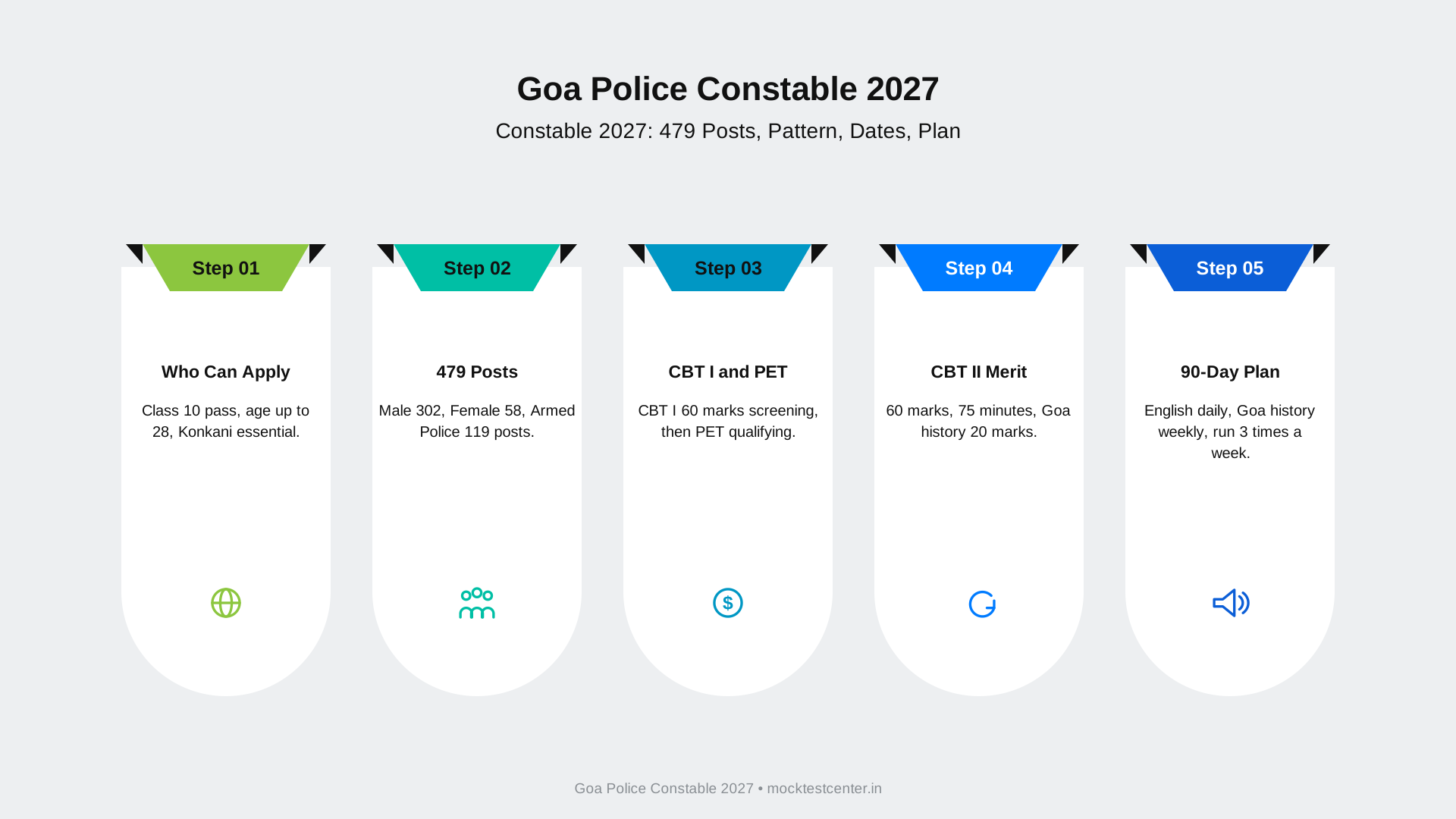
The Goa Police Constable 2027 cycle is already running, and it is the biggest constable drive Goa has seen in years. The Goa Staff Selection Commission advertised 479 Police Constable posts under Advertisement No. 2 of Year 2026, dated 20 February 2026. Applications closed on 13 March 2026. The first computer test ran in May 2026, physical tests ran through September to November 2026, and the final merit test, CBT II, is the stage still to come.
That order matters. This is a two tier exam with a physical test in the middle. CBT I only screens candidates for the physical test. The physical test only qualifies. CBT II decides the merit list. A candidate who tops CBT I and fails the 800 metre run goes home. A candidate who scrapes through CBT I and runs well still has to win CBT II.
The post needs only a Class 10 pass. The pay is Level 2, Rs 19,900 to Rs 63,200 a month. The age limit is 28 years. Knowledge of Konkani is essential, and the Konkani section of CBT I can end a candidacy on its own, because a candidate needs at least 4 marks out of 10 in it to stay in the race.
This guide works from the 2026 cycle, because that is the live document. The next notification will most likely follow the same scheme, and every figure here comes from the Goa Staff Selection Commission or from the result notices it has published since May 2026.
Goa Police Constable 2027 at a glance
| Detail | Goa Police Constable 2026, the live cycle |
|---|---|
| Conducting body | Goa Staff Selection Commission (GSSC) |
| Post | Police Constable (Male, Female, Armed Police) |
| Advertisement | No. 2 of Year 2026, dated 20 February 2026 |
| Total posts | 479 (Male 302, Female 58, Armed Police 119) |
| Application window | 20 February to 13 March 2026, online |
| Education | SSC, Class 10 pass, from a recognised board |
| Age limit | Maximum 28 years as on 13 March 2026 |
| Fee | UR Rs 200; OBC and EWS Rs 100; SC, ST, PwD Rs 50 |
| Pay | Level 2, Rs 19,900 to Rs 63,200 |
| CBT I | 60 marks, 75 minutes, screening only; held 16, 17, 24, 30 and 31 May 2026 |
| Physical tests | PST September to November 2026; PET November 2026 |
| CBT II | 60 marks, 75 minutes, merit; date not announced as of 21 November 2026 |
| Negative marking | None, in either CBT |
| Konkani | Minimum 4 marks out of 10, mandatory |
| Official websites | gssc.goa.gov.in and citizen.goapolice.gov.in |
The 2026 cycle so far
The notification came out on 20 February 2026. It covered 14 Group C posts across Goa government departments, and Police Constable was the largest of them, with 479 of the posts. The same advertisement also carried 4 Platoon Commander posts in the Home Guards and Civil Defence Organisation, a post that needs a Class 12 pass and pays Level 4.
Applications ran online for three weeks and closed on 13 March 2026. The fee was Rs 200 for unreserved candidates, Rs 100 for OBC and EWS candidates, and Rs 50 for SC, ST, PwD candidates, paid online only.
CBT I ran on five days in May 2026, the 16th, 17th, 24th, 30th and 31st, in batches. The commission published the CBT I result, then shortlisted 20 times the number of posts in each category for the physical tests. That is a wide funnel. For 479 posts, roughly 9,580 candidates went forward to the physical stage, category by category.
The Physical Standards Test ran in phases. Phase 1 ran from 1 to 12 September 2026. Phase 2 ran from 26 to 28 October 2026. A round for additional candidates ran on 12 November 2026 for men and 13 November 2026 for women. The commission published the PST results in phases through September to November, with corrigenda on 9 and 17 November 2026.
The Physical Efficiency Test followed at Goa University Ground, Taleigao Plateau. Male candidates from the Phase 1 list, serial numbers 1 to 3,756, took the PET from 2 to 11 November 2026, with no test on 8 November, and again on 18 and 19 November. Female candidates from the Phase 1 list, serial numbers 1 to 708, took it on 15 and 16 November 2026. Phase 2 lists and additional candidates took it on 17, 19, 20 November 2026. Reporting time was 7 AM.
CBT II has not been announced as of 21 November 2026. The commission publishes the CBT II eligibility list after the PET, and the gap between the PET and CBT II in the 2025 Sub Inspector cycle was about two months. Candidates who cleared the PET should watch gssc.goa.gov.in every day, because the commission gives short notice and the admit card window is brief.
One more small drive sits beside the main one. On 20 November 2026, the Office of the Director General of Police issued Notification No. 1 of 2026 for the absorption of 52 Home Guard volunteers into Police Constable posts. That drive is only for volunteers with at least 18 years of Home Guard service as on 23 November 2026, and the form had to be submitted offline at the Home Guard office in Altinho, Panaji, on 23 November 2026. It is a separate channel, and it does not change the 479 open posts.
479 posts, split three ways
The 479 posts split into three constable categories, and the split shapes the competition. Male constable has 302 posts. Female constable has 58. Armed Police constable has 119. A candidate applies for each post separately, and the commission considers the candidate in the category applied for.
| Post | Total | UR | ST | SC | OBC | EWS |
|---|---|---|---|---|---|---|
| Police Constable (Male) | 302 | 152 | 35 | 5 | 81 | 29 |
| Police Constable (Female) | 58 | 30 | 6 | 2 | 15 | 5 |
| Police Constable (Armed Police) | 119 | 72 | 15 | 1 | 21 | 10 |
| Total | 479 | 254 | 56 | 8 | 117 | 44 |
The male list is the big one, and the OBC share in it is large, at 81 posts. The female list is small, at 58 posts, so the female competition is tighter even though fewer women apply. The Armed Police list, at 119 posts, takes only the candidates who clear the same physical standards, and its CBT II shortlist ratio is wider, at 5 times the posts, against 3.5 times for the other two lists.
Candidates who were eligible for more than one post could apply for each of them, and they took CBT I only once. The commission used the first batch score if a candidate appeared in more than one batch. A candidate who cleared the PET once counted for every post applied for, and took the PET only once.
Some tracker sites quote 722 Group C posts for Goa in early 2026. That figure belongs to a different advertisement, Advertisement No. 1 of Year 2026, which covered posts such as Government Primary School Teacher and other departmental Group C posts. The police constable posts sit in Advertisement No. 2 of Year 2026, and the police number is 479. The two advertisements share a date, 20 February 2026, which is why the figures get mixed up on tracker pages.
Who can apply
The education bar is low, and that is exactly why the competition is heavy. A candidate needs a pass in the Secondary School Certificate examination, Class 10, from a recognised board. There is no minimum percentage. A candidate with a higher qualification can still apply, and many graduates do, because a government job at Level 2 with a pension structure beats most private options at the same education level.
Knowledge of Konkani is essential. The notification says so in plain words, and the exam tests it. Knowledge of Marathi is desirable, which means it helps but the notification does not require it. Candidates who studied in Goa usually clear the Konkani condition without thinking about it. Candidates from outside Goa need to plan for it, because the Konkani section is the first 10 questions of CBT I and it carries a pass mark of its own.
The age limit is 28 years as on the last date of application, 13 March 2026. Relaxation runs 5 years for SC and ST candidates, 3 years for OBC candidates, 10 years for PwD candidates, and up to 5 years for government servants. There is no minimum age stated separately in the advertisement beyond the usual rule that a candidate must have completed 18 years, and the Class 10 pass itself sets a practical floor.
Two documents decide domicile. A candidate needs a valid 15 year residence certificate of Goa, and registration with the Employment Exchange, Goa. Both were required at the application stage in the 2026 cycle. Candidates who live in Goa but never registered with the Employment Exchange found this out late, and the notification gave no grace for it. Anyone aiming at the next cycle should get both documents in order now, while there is no deadline pressure.
The Platoon Commander post in the same advertisement needs a Class 12 pass, and it prefers candidates with NCC training, Home Guards service or Physical Training Instructor training. Its age limit runs to 45 years. It is a different post with a different physical test, including shot put, and it is not part of the 479 constable posts.
The two tier test, and why CBT I is a filter
The Goa Police Constable exam pattern runs on two tiers, with the physical test sitting between them. CBT I screens. The PET qualifies. CBT II ranks. The marks of CBT I never enter the merit list. That single fact should shape all preparation, because time spent chasing a perfect CBT I score is time taken from the two things that actually decide selection: the physical test and CBT II.
| CBT I section | Marks |
|---|---|
| Test of English and Comprehension | 30 |
| Test of Numerical Ability | 10 |
| Test of Reasoning | 10 |
| Test of Konkani Language | 10 |
| Total | 60 |
| Time | 75 minutes |
English carries half the paper, at 30 marks out of 60. That is the first thing to notice. Numerical ability and reasoning carry 10 marks each, and Konkani carries 10. A candidate who is strong in English starts with a real edge, because the English section alone is worth as much as the other three sections put together.
The pass marks are 45 percent for unreserved candidates, 40 percent for OBC candidates, and 35 percent for SC and ST candidates. On a 60 mark paper, that means 27 marks for UR, 24 for OBC, and 21 for SC and ST. Those are the minimums to stay in the race, and the real shortlist cut off runs higher, because the commission takes only 20 times the posts per category to the PET.
There is no negative marking in either CBT. A candidate should attempt every question. A guess costs nothing, and a right guess adds a mark. The commission also gives PwD candidates 20 minutes of compensatory time in the CBT.
CBT I is common across the posts in the advertisement, from serial number 2 to 14. A candidate who applied for constable and for another post in the same group took CBT I once, and the same score counted for each post. The Konkani questions come first, as questions 1 to 10, and the commission evaluates the rest of the paper only for candidates who score at least 4 in Konkani.
Ties break by date of birth. If two candidates score equal marks, the older candidate ranks above the younger one. It is a small rule, and it matters only at the cut off line, but cut off lines are where selections are won and lost.
CBT II decides the merit list
After the PET, the commission shortlists candidates for CBT II. The ratio is 3.5 times the posts for Police Constable (Male and Female), and 5 times the posts for Police Constable (Armed Police) and Platoon Commander. On 479 posts, that means roughly 1,057 male constable candidates, 203 female constable candidates, and 595 Armed Police candidates reach CBT II, category by category, subject to enough candidates clearing the PET.
| CBT II section | Marks |
|---|---|
| Test of English Language and Comprehension | 20 |
| Test of Numerical Ability | 10 |
| Test of Reasoning | 10 |
| General History of Goa | 20 |
| Total | 60 |
| Time | 75 minutes |
General History of Goa is the new subject in CBT II, and it carries 20 marks, a third of the paper. Candidates who prepared only for CBT I will meet it unprepared. The official syllabus breaks Goa history into modules. Module I covers sources and early history, from archaeological records and literary sources to folklore, prehistoric settlements, river valley cultures, rock art sites and the Gaunkari or Comunidade system. Module II covers the dynastic phase. Module III covers the Portuguese period from 1510 to 1961. A candidate who reads Goa history as a story, dynasty by dynasty, will hold it better than a candidate who memorises lists of dates.
English drops from 30 marks in CBT I to 20 marks in CBT II, but it stays the joint largest section with Goa history. Reasoning and numerical ability stay at 10 marks each. The shape is deliberate. The commission tests language and Goa knowledge in the merit paper, and it tests speed and accuracy in the screening paper.
NCC certificate holders get bonus marks in CBT II for constable and Armed Police posts. A C certificate adds 3 marks, a B certificate adds 2, and an A certificate adds 1. Three marks on a 60 mark paper is 5 percent of the total, and it often covers the gap between selection and the waiting list. A candidate who holds an NCC certificate should make sure the commission has it on record before CBT II.
The CBT II for five posts, including Police Constable (Male and Female), runs separately. The CBT II for seven posts, including Armed Police, runs as a common paper in one batch, and candidates exercise their post preference after the final result, based on merit and eligibility. A candidate who applied for Armed Police and for other posts in that common group should read the preference rules in the notification before CBT II, because the option once exercised is final.
Physical standards and the PET
The physical stage has two parts. The Physical Standards Test checks height and chest for men, and height and weight for women. The Physical Efficiency Test measures running and jumping. Both are qualifying only. Neither carries marks. A candidate either meets the standard or goes home.
| Standard | Male | Female |
|---|---|---|
| Height | 168 cm (ex-servicemen 167 cm) | 157 cm |
| Chest | 80 cm unexpanded, 85 cm expanded | Not applicable |
| Weight | Not applicable | Not less than 42 kg |
The PET events are the same for constable and Armed Police, and the standards are the same ones Goa Police has used for years. The 100 metre run and the 800 metre run test speed and stamina on the same day, and the jumps test power in between.
| PET event | Male | Female |
|---|---|---|
| 100 metre run | 14 seconds | 18.5 seconds |
| Long jump (3 chances) | 4.2 metres | 3.1 metres |
| High jump (3 chances) | 1.3 metres | 0.9 metres |
| 800 metre run (male) / 400 metre run (female) | 2 minutes 50 seconds | 1 minute 40 seconds |
Ex-servicemen get relaxed standards. Men between 30 and 40 years run 100 metres in 15 seconds, jump 4.00 metres, clear 1.20 metres, and run 800 metres in 3 minutes. Men above 40 years get 17 seconds, 3.5 metres, 1.10 metres, and 3 minutes 15 seconds. Women ex-servicemen between 30 and 40 years get 19 seconds, 3.10 metres, 0.9 metres, and 1 minute 50 seconds for 400 metres. Women above 40 years get 19.5 seconds, 3.00 metres, 0.9 metres, and 2 minutes.
The PET ran at Goa University Ground on Taleigao Plateau. The Goa Police Department conducted it for GSSC. Candidates carried a hard copy of the PST result slip and a photo ID, reported at 7 AM in track pant or shorts and T-shirt, and left mobile phones and smart watches outside. Only transparent bottles with plain water were allowed. Those details sound small, and they are the details that get candidates sent back from the gate.
Training for the PET needs a different clock from training for the written test. The 100 metre run in 14 seconds needs sprint work, and the 800 metre run in 2 minutes 50 seconds needs endurance work, and the two do not build each other. A candidate who only runs long distances will miss the sprint cut. A candidate who only sprints will fade in the 800 metres. Both need separate sessions in the week.
The Konkani test inside CBT I
Konkani is the quiet filter in this exam. It carries only 10 marks out of 60 in CBT I, and it decides whether the other 50 marks get counted at all. A candidate needs at least 4 marks out of 10 in Konkani, and the Konkani questions are the first 10 questions of the paper. A candidate who scores 50 out of 60 but only 3 in Konkani fails CBT I.
The rule exists because the job needs Konkani every day. A constable takes complaints and records statements in Konkani, and speaks the language to the public every day. The commission tests the language before it tests anything else, and the syllabus treats Konkani grammar and comprehension, plus sentence formation, as the core.
Preparation for Konkani is short and direct. Read Konkani newspapers and government notices. Practise grammar and comprehension from Class 10 Konkani material. Learn the common vocabulary of administration and policing in Konkani, because the test draws on it. A candidate who speaks Konkani at home still needs to practise the written form, because spoken ease does not always survive a multiple choice grammar question.
Marathi is desirable, not essential. It adds nothing to the score, and no section tests it. Candidates should not spend preparation time on Marathi at the cost of Konkani or English.
Fee and pay
The application fee in the 2026 cycle was Rs 200 for unreserved candidates, Rs 100 for OBC and EWS candidates, and Rs 50 for SC, ST and PwD candidates. The fee was paid online only, through internet banking, debit card, credit card or UPI, and it was not refundable.
The pay is Level 2 of the CCS Revised Pay Rules 2016, which runs from Rs 19,900 to Rs 63,200 a month, plus allowances as per Government of Goa norms. A new constable starts at the bottom of the level, and the scale rises with service. The post is Group C, and the recruitment is direct, from the open market, under the recruitment rules framed under Article 309 of the Constitution.
That pay, with a Class 10 qualification, explains the size of the applicant pool. It also explains why the physical test matters so much. Thousands of candidates can pass a 60 mark screening test. Far fewer can run 800 metres in 2 minutes 50 seconds on the same morning they sprinted 100 metres in 14 seconds.
How to prepare in 90 days
Ninety days is enough for this exam, if the days split across the three things that decide selection: CBT I, the PET and CBT II, in that order. The mistake is to prepare for the three stages one after another. The physical test sits between the two written tests, and a candidate who starts running only after CBT I has about ten weeks, which is short for building both sprint speed and 800 metre stamina.
Days 1 to 30 belong to the base. English every day, because it carries 30 marks in CBT I and 20 in CBT II. Grammar and vocabulary, sentence usage, plus reading comprehension, in that order. Numerical ability and reasoning on alternate days, 10 marks each, from Class 10 arithmetic and standard reasoning topics such as series, coding, directions and blood relations, plus puzzles. Konkani daily, in short sessions, because a daily 20 minutes of reading and grammar beats a weekend of cramming. Running starts on day 1, with three sessions a week, one sprint session, one endurance session, and one mixed session with jumps.
Days 31 to 60 belong to mocks and Goa history. Take a full CBT I mock every week on the real clock, 60 marks in 75 minutes, and score it the same day. The mock shows where marks leak, and the leak is usually speed, not knowledge. Start General History of Goa in this block, one module a week, from early history and the Gaunkari system, through the dynasties, to the Portuguese period from 1510 to 1961. Read it as a connected story, and make a one page timeline for each module. The timeline is what survives in the exam hall.
Days 61 to 90 belong to CBT II shape and peak fitness. Shift the mocks to CBT II pattern, 60 marks in 75 minutes with Goa history in place of Konkani, and add the NCC bonus to the target score if it applies. Run the PET events as a full rehearsal twice in this block, on a ground, with a stopwatch, in the order the commission runs them. The rehearsal shows the real problem, which is rarely one event. It is the 800 metre run after the sprints and jumps, on tired legs.
A daily plan that works is simple. Two hours of written preparation in the morning, one hour of physical training in the evening, and 30 minutes of Konkani or Goa history at night. Sundays carry the weekly mock and a rest from running. Candidates who work during the day should protect the morning two hours first, because the evening hour is the one that gets eaten by everything else.
Mock tests should copy the real paper. The Goa Police Constable exam pattern gives 75 seconds a question, 60 questions in 75 minutes, and the English section, at 30 questions, sets the pace. A candidate who spends three minutes on one reasoning question has already lost two marks somewhere else. Practise with a timer from the first mock, not from the tenth.
What the tracker sites get wrong
Most pages that rank for this exam still print the old Goa Police pattern. They show a single written test of 100 marks, with General Knowledge, English, Mathematics, Reasoning at 25 marks each, in 2 hours. That pattern belonged to the 2021 direct recruitment by the Goa Police Department, and to the older cycles before GSSC took over Group C recruitment. It does not apply to the 2026 cycle. The live Goa Police Constable exam pattern is two CBTs of 60 marks each, with Konkani in CBT I and Goa history in CBT II.
The 100 mark pattern also appears on pages that call themselves 2026 guides, with exam dates marked as notified soon. The GSSC syllabus document for Advertisement No. 2 of Year 2026 is the document that counts, and it is public on gssc.goa.gov.in. Any guide that does not mention CBT I and CBT II, Konkani at 4 out of 10, and the 20 times shortlist for the PET is writing about a different exam.
The vacancy figure is the second error. Some pages quote 722 posts, and some quote 181, and some quote 261. The 722 figure belongs to Advertisement No. 1 of Year 2026. The 181 and 261 figures belong to older Goa Police drives from 2025 and earlier. The constable number in the live advertisement is 479, split 302 male, 58 female and 119 Armed Police.
The physical standards are the third error. Older pages print the 2021 PET, where men ran 100 metres in 15 seconds and jumped 3.80 metres, and women ran 100 metres in 19 seconds. The 2026 standards are faster and longer for men, at 14 seconds and 4.2 metres, and faster for women, at 18.5 seconds. A candidate who trains to the 2021 numbers will fail the 2026 test by a second and 40 centimetres.
The lesson is plain. Check the advertisement number before trusting any figure. Advertisement No. 2 of Year 2026 is the live cycle. Anything that does not cite it is either old or guessed.
Before the next notification
The next constable notification will most likely follow the 2026 scheme, because GSSC now runs Group C recruitment on a settled two tier pattern. Candidates aiming at it should treat the gap as preparation time, not waiting time.
Get the documents first. The 15 year residence certificate of Goa and the Employment Exchange registration were both required in 2026, and both take time to obtain. Keep the Class 10 certificate and birth certificate, plus caste certificate and disability certificate where they apply, in one folder, with scanned copies ready. The application window in 2026 lasted three weeks, and the commission gave no extension.
Start the physical training now. The PET standards are public, and they do not change much between cycles. A candidate who can already run 100 metres in 14 seconds and 800 metres in 2 minutes 50 seconds has removed the hardest filter in the whole process before the notification even appears.
Read Konkani every day, and read Goa history once a week. Those two subjects are the ones other states do not have, and they are the ones that separate Goa candidates from everyone else. English and reasoning, plus numerical ability, are common to every police exam in India. Konkani and Goa history belong to this exam alone, and they carry 30 of the 120 marks across the two CBTs.
Watch gssc.goa.gov.in for the CBT II date, and watch citizen.goapolice.gov.in for PET notices, because the police department publishes the physical test lists on its own recruitment page. The commission publishes results and eligibility lists, plus corrigenda, on its site, and the site updates several times a week during an active cycle.
Sources
Syllabus and Scheme of Examination from the Goa Staff Selection Commission, Advertisement No. 2 of Year 2026, on gssc.goa.gov.in. Goa Staff Selection Commission, What’s New notices on PET dates and PST results, plus CBT II eligibility lists, November 2026, on gssc.goa.gov.in. Sarkari Job, Goa Police Constable PET Date 2026, 14 November 2026, reporting Advertisement No. 2 of Year 2026, vacancy split, fee and PET standards, plus the CBT pattern. Adda247, Goa Police Constable Syllabus 2026, reporting the 479 vacancies and the CBT I and CBT II pattern. GovtRank, GSSC Exam Syllabus and Scheme 2026, reporting the two tier CBT and the Konkani rule, plus shortlist ratios. FreeJobAlert, Goa Police Constable Recruitment 2026, 20 November 2026, reporting Notification No. 1 of 2026 for absorption of 52 Home Guard volunteers. The Goan, GSSC allows police with 3 yrs service to apply for PSI’s post, May 2025. Times of India, Goa Police Recruitment 2021, reporting the 2021 pattern and physical standards used for comparison. Office of the Director General of Police, Goa, recruitment page, on citizen.goapolice.gov.in.