About Orissa High Court 2027 Exam Series
📖 Table of Contents
- Two advertisements, 64 posts, one form window
- Who can apply for each post
- Junior Stenographer: the English test filters, the skill test ranks
- Junior Grade Typist: three filters, then ten minutes that decide everything
- What the last three High Court cycles actually did
- The district court drives are a different recruitment
- How to apply and the rejections the Court warns about
- Your Orissa High Court 2027 preparation plan, post by post
- What the job pays and what the work looks like
- Sources
Orissa High Court 2027: Junior Stenographer and Typist Recruitment Guide
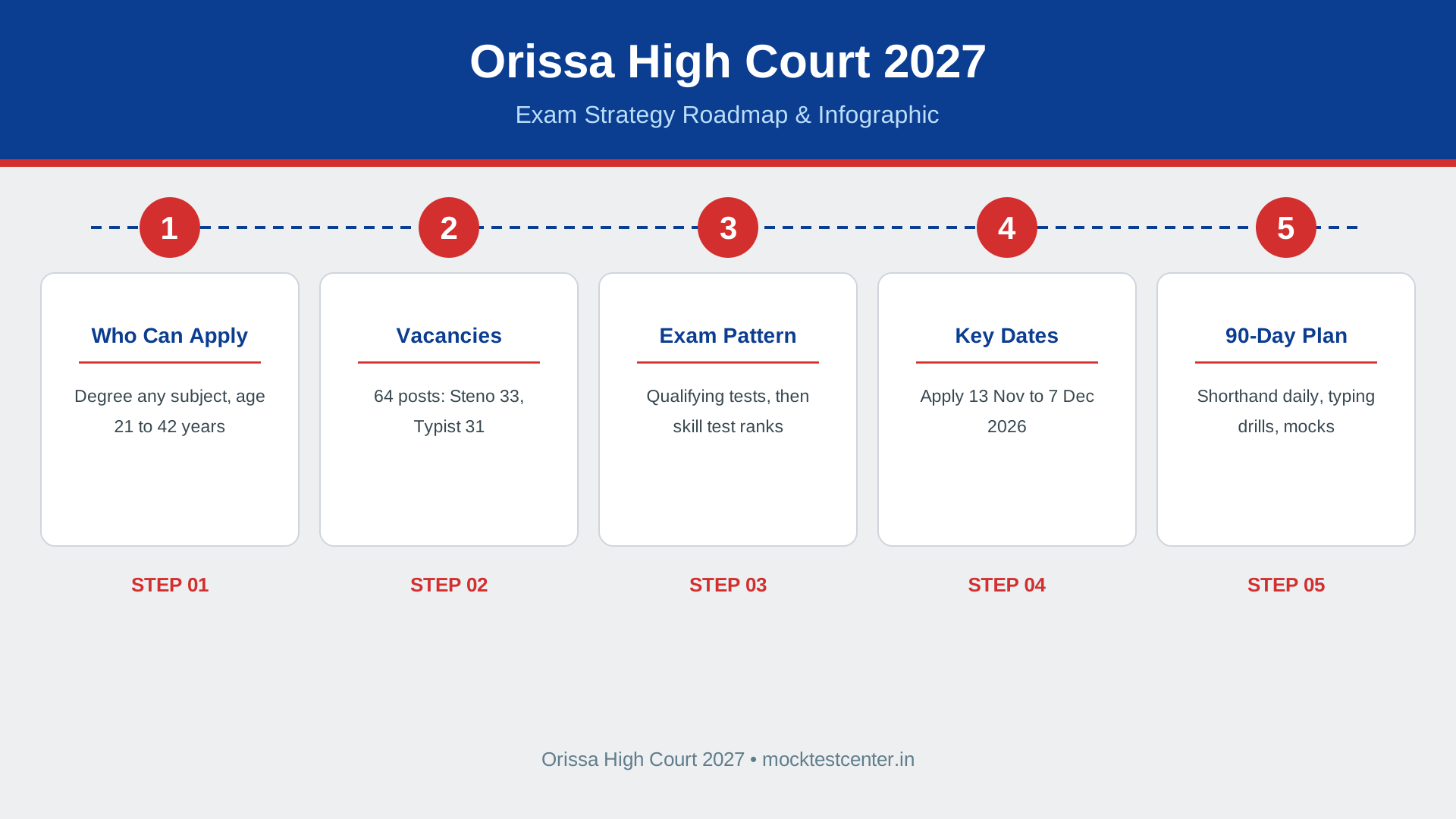
Orissa High Court 2027 brings 64 Group C posts in the Court's own establishment at Cuttack. Two advertisements came out together on 11 November 2026. Advertisement No. 06/2026 offers 33 Junior Stenographer posts. Advertisement No. 07/2026 offers 31 Junior Grade Typist and Data Entry Operator posts. Online forms open at 10:00 AM on 13 November 2026 and close at 11:59 PM on 7 December 2026. The fee is Rs 500 for most candidates. SC, ST and PwBD candidates pay nothing if they choose the exemption. Both posts need a bachelor's degree. The Stenographer post adds shorthand at 80 words per minute and typing at 40 words per minute. The Typist post adds typing at 40 words per minute on a computer and a PGDCA or an equivalent qualification. Age runs above 21 and not above 42 as on 12 November 2026 for both posts. That age band is the first thing to check, because the last Stenographer drive capped age below 32. This guide follows the two official advertisements word by word, and it keeps the two posts separate, because their tests share almost nothing except the form window.
The Court's official name is High Court of Orissa. You will still see Odisha High Court on many job sites. Both names point to the same Court at Cuttack, and the official site is orissahighcourt.nic.in. Every date and mark in this guide comes from Advertisement No. 06/2026 or Advertisement No. 07/2026, both dated 11 November 2026 and signed by the Registrar (Examination). Where a tracker page disagrees with the advertisement, this guide follows the advertisement and says so.
Two advertisements, 64 posts, one form window
The two advertisements share a form window, a fee, an age rule and a helpdesk. Almost everything else differs. Treat them as two recruitments that happen to open on the same day. A candidate can apply for either post if eligible, but each post has its own form on the Examination Portal, its own tests and its own merit list. That is the shape of Orissa High Court 2027 in one table.
| Detail | Junior Stenographer | Junior Grade Typist / Data Entry Operator |
|---|---|---|
| Advertisement | No. 06/2026, dated 11 November 2026 | No. 07/2026, dated 11 November 2026 |
| Posts | 33 | 31 |
| Group and pay | Group C, Level 7, Rs 25,500 to Rs 81,100 | Group C, Level 4, Rs 19,900 to Rs 63,200 |
| Form window | 13 November 2026, 10:00 AM to 7 December 2026, 11:59 PM | 13 November 2026, 10:00 AM to 7 December 2026, 11:59 PM |
| Age as on 12 November 2026 | Above 21 and not above 42 | Above 21 and not above 42 |
| Fee | Rs 500, online only | Rs 500, online only |
| Fee exemption | SC, ST and PwBD, at their option | SC, ST and PwBD, at their option |
| Degree | Bachelor's degree in any discipline | Bachelor's degree in any discipline |
| Extra qualification | Shorthand 80 wpm, typing 40 wpm, computer knowledge | Typing 40 wpm on computer, PGDCA or equivalent |
| Stages | English test, Computer Application Test, Skill Test, document verification | Preliminary Examination, Language Test, Computer Application Test, Main Written Examination, document verification |
| What decides merit | Skill Test marks alone | Main Written Examination (typing test) marks alone |
Both recruitments run under the High Court of Orissa (Appointment of Staff and Conditions of Service) Rules, 2019, as amended from time to time. The Court can change the number of posts or cancel the process at any stage without assigning a reason. That line sits in both advertisements, and it is worth reading plainly. The vacancy count is firm on the day the advertisement comes out. It is not a promise.
Exam dates are not in either advertisement. Centres for each stage will be conveyed through the Court's website and the e-Admit Card. No admit card will be sent by post. The Court also refuses requests to change a centre. Check orissahighcourt.nic.in regularly after you apply, because every notice about dates and admit cards goes up there and nowhere else.
Who can apply for each post
The degree rule is the same for both posts. You need a bachelor's degree in any discipline from a recognised university, or an equivalent qualification. There is no subject bar. A history graduate and an engineering graduate stand on the same footing at the application stage. What separates candidates is the skill paper, not the degree.
Age is counted as on 12 November 2026. You must be above 21 and not above 42. In date of birth terms, you must not have been born earlier than 12 November 1984 and not later than 11 November 2005. Only the date of birth in your High School Certificate or Class 10 board certificate counts. The Court accepts no other proof of age.
Relaxation in the upper age limit follows the same table in both advertisements. SC, ST, SEBC (Non-Creamy Layer) and women candidates get five years more. PwBD candidates with a permanent disability of 40 percent to 50 percent get ten years more. A PwBD candidate who also belongs to SC, ST or SEBC (Non-Creamy Layer) gets fifteen years in total, ten under the PwBD head and five under the community head. Ex-servicemen get relaxation under the relevant Acts, Rules, Orders or instructions of the State Government. If you fall under more than one head, you get only one relaxation, the one most beneficial to you. The advertisements state the limit plainly. Save as provided above, the age limit prescribed can in no case be relaxed.
The vacancy tables show how the 64 posts split. Women hold 11 of the 33 Stenographer posts and 10 of the 31 Typist posts as horizontal reservation. If women candidates are not available in a category, those seats go to male candidates of the same category. Exchange of reservation between SC and ST is not considered.
| Post | UR | SEBC | ST | SC | Total | Women | PwBD | Ex-Servicemen |
|---|---|---|---|---|---|---|---|---|
| Junior Stenographer | 11 (W 4) | 1 (W 0) | 12 (W 4) | 9 (W 3) | 33 | 11 | 2 | 2 |
| Junior Grade Typist / Data Entry Operator | 7 (W 2) | 6 (W 2) | 11 (W 4) | 7 (W 2) | 31 | 10 | 2 | 1 |
| Combined | 18 | 7 | 23 | 16 | 64 | 21 | 4 | 3 |
Two details in that table deserve a second look. ST holds the largest share in both posts, 12 Stenographer seats and 11 Typist seats. SEBC holds just one Stenographer seat against six Typist seats. So a SEBC candidate with shorthand training faces a very different contest from a SEBC candidate with a PGDCA. Pick the post that matches the skill you already hold, not the post with the bigger headline count.
The Stenographer post also demands proof of speed. You need a certificate from a recognised institute showing a minimum speed of 80 words per minute in shorthand and 40 words per minute in typewriting, plus adequate knowledge of Computer Application. The Typist post demands a certificate showing typewriting at 40 words per minute on the computer, and proof that you passed PGDCA or an equivalent qualification from recognised universities, AICTE recognised institutions, or any other institution recognised by the Government. Keep both certificates ready before the form opens. A form filed without them is a form that will fail verification later.
Other conditions apply to both posts. You must be a citizen of India, of good character, of sound health and mind, with good physique, free from any contagious or communicable disease, and without bodily infirmity of more than 50 percent. You must not have more than one spouse living if married. You must have no past criminal antecedent or record, no conviction by a criminal court for an offence involving moral turpitude, and no debarment by any Government, Court or Public Service Commission from appearing in any recruitment test. Government servants can apply if they meet the qualification and age rules, but they must inform their Head of Office in writing and produce a No Objection Certificate when directed.
Junior Stenographer: the English test filters, the skill test ranks
In Orissa High Court 2027, the Stenographer scheme has three tests. Only the third one decides your rank. The first two only remove candidates. That single fact should shape all your preparation. An excellent English score earns you nothing beyond a pass. A weak shorthand speed costs you everything.
Stage one is a Qualifying Test in English, worth 100 marks in 90 minutes. It has four parts. An essay in English carries 20 marks. Translation of a passage from Odia to English carries 20 marks. Re-translation of a passage from English to Odia carries 20 marks. Knowledge of English Grammar carries 40 marks. Grammar is the largest slice, and it is the part most candidates can improve fastest, because it rewards rules rather than speed. The two translation parts reward candidates who read and write Odia with ease. If Odia is not your strong language, the translation parts are where marks leak.
The pass line for the English test is 35 percent for general category candidates and 30 percent for SC and ST candidates. Fall below it and you do not reach the Computer Application Test. Note the wording. The advertisement names general category at 35 percent and SC and ST at 30 percent. It does not name a separate SEBC pass mark in this paragraph, so SEBC candidates should prepare to the 35 percent line and treat anything lower as unsafe.
Stage two is the Computer Application Test, also 100 marks and also qualifying only. Theory carries 50 marks in 30 minutes. The skill test carries 50 marks in 30 minutes. The syllabus names the MS Office programs and MS Access, plus internet work with file uploading and downloading. You need 50 percent to pass. Score below half and you do not reach the Skill Test. The test is practical in the second half, so reading about Excel will not carry you. Open the programs and do the tasks. Create a table, sort a column, build a short slide, save a file, upload it, download it again. That is the test.
Stage three is the Skill Test, and it is the whole contest. The Court dictates an English passage of 400 words at a speed of 80 words per minute for five minutes. You then transcribe it on a computer at a speed of 40 words per minute within ten minutes. Each correct word earns 0.25 marks, so a perfect script scores 100. Mistakes and omissions beyond 10 percent of total words mean disqualification. A mistake means a wrongly spelt word, a substituted word, an overlapping word, or a wrong punctuation mark. At 400 words, 10 percent is 40 words. Cross that line and the script is out, whatever your English and computer scores were.
Think about what that means in practice. Dictation at 80 words per minute for five minutes is a sprint, not a stroll. Most shorthand learners practise at 60 or 70 and hope to rise on the day. The advertisement gives no room for that hope. Your shorthand must already be at 80 before you apply, because the test measures the speed you bring in, not the speed you plan to reach. Transcription at 40 words per minute on a computer sounds gentle next to it, and it is, but only if your shorthand notes are clean. Messy notes slow the typing, and slow typing eats the ten minutes. Practise the pair together, dictation then transcription, under the clock, until the pair feels routine.
Merit for the Stenographer post rests on the Skill Test marks alone. The Court prepares one merit list of all candidates, then separate merit lists for general and reserved categories in descending order of total marks. Your English and computer scores only open the door. The merit list starts fresh from the Skill Test.
Junior Grade Typist: three filters, then ten minutes that decide everything
The Typist scheme in Orissa High Court 2027 has four stages, and the shape is the same as the Stenographer scheme with one extra filter at the front. The first three stages only remove candidates. The fourth stage alone decides merit. The extra stage is a Preliminary Examination, and it is the only stage in either advertisement with negative marking.
Stage one is the Preliminary Examination, 150 marks in two hours, with 150 objective questions carrying multiple choice answers. The paper follows the Graduation Course and covers General English, General Knowledge, Logical Reasoning and Quantitative Aptitude. Every wrong answer costs 0.5 marks. A blank answer costs nothing. That half mark matters more than it looks. Four wrong answers wipe out two full marks, which is the value of two correct answers. Guess only when you can remove at least two options with confidence. A wild guess on every doubtful question is how a passable paper turns into a failing one.
The pass line for the Preliminary Examination is 40 percent for most categories and 33 percent for SC and ST candidates. The Court also keeps the discretion to fix a cut off mark, taking into account the number of vacancies and the number of candidates who qualified. So the pass percentage is a floor, not a guarantee. If far more candidates clear 40 percent than the Court wants in the Language Test, the cut off can rise. Prepare for a score well above 40 percent, not for the line itself.
Stage two is the Language Test, 100 marks in two hours, qualifying only. It tests both English and Odia. An essay in English of 300 words carries 30 marks. Precis writing carries 20 marks. Translation from English to Odia carries 20 marks. Translation from Odia to English carries 20 marks. English Grammar carries 10 marks. The pass line is 45 percent for most categories and 33 percent for SC and ST candidates. That 45 percent line is steeper than the Stenographer English test line, and the essay alone is nearly a third of the paper. A candidate who writes little English prose will feel it here. Write one 300 word essay a day for a month and the paper stops looking large.
Stage three is the Computer Application Test, 100 marks, qualifying only. Theory runs 30 minutes and the skill test runs 30 minutes. The skill part covers the MS Office programs and MS Access, plus internet work with file uploading and downloading, the same ground as the Stenographer computer test. You need 50 percent or more to move on. Marks from the Language Test and the Computer Application Test are not taken into account while drawing up the final merit list. The advertisement says so twice, once for each test, so there is no doubt.
Stage four is the Main Written Examination, a Typewriting Test in English worth 100 marks in ten minutes. You type the contents from a printed matter of about 400 words. While assessing accuracy, 0.25 marks are deducted for each mistake in the typed script. Omission, substitution, addition and repetition of words count as mistakes. A script with more than 20 mistakes is eliminated as disqualified. Twenty mistakes in 400 words is a 5 percent error rate. That is a tight line, and it is the real test. Typing fast is easy. Typing fast without adding, dropping or repeating words is the skill.
The final list is arranged in order of merit on the basis of marks in the Main Written Examination alone. If two or more candidates secure equal marks, the older candidate ranks above the other. The Chief Justice may reduce the qualifying marks at his discretion to meet the exigency of non-availability of sufficient number of candidates. That discretion exists in the Typist advertisement and not in the Stenographer one, which is one more small difference between the two posts.
Document verification sits between the Computer Application Test and the Main Written Examination for Typist candidates. You must produce a self-attested copy of the application form, self-attested copies of the certificates uploaded during submission of the online application, and their originals. If you fail to attend any stage of the examination or document verification, your candidature will be rejected. For Stenographer candidates, the advertisement also requires production of self-attested copies with originals at the time of document verification, and absence from any stage including document verification means rejection.
One correction matters here, because several tracker pages get it wrong. Some pages list a Viva Voce of 20 marks as the last stage of the Typist recruitment. Advertisement No. 07/2026 has no viva. Its stages are the Preliminary Examination, the Language Test, the Computer Application Test and the Main Written Examination, followed by document verification before the Main Written Examination. The viva belonged to older Typist cycles, including Advertisement No. 08 of 2024, which held its viva on 7 December 2024. Do not prepare for a viva that this advertisement does not hold.
What the last three High Court cycles actually did
The Court recruits for its own establishment in small, frequent drives rather than one large annual event. That rhythm matters, because the last cycle of each post tells you more about the next one than any generic guide can. Three recent cycles deserve attention.
The Assistant Section Officer drive under Advertisement No. 02 of 2024 filled 147 Group B posts. The split was UR 70, SEBC 5, ST 57 and SC 15. Applications ran from 20 May to 18 June 2024. The age band was 21 to 32 years, far narrower than the 21 to 42 band in the 2026 Stenographer and Typist advertisements. The ASO scheme had four stages, a Preliminary Examination, a Main Written Examination, a Computer Application Test and a Viva Voce Test. The Main Written Examination was held on 7 December 2025. The Computer Application Test followed on 21 February 2026. Document verification and viva notices went out on 24 February 2026. The select list came on 9 March 2026, and appointment letters followed on 16 March 2026. Nearly two years passed between the advertisement and the appointment letters. That gap is normal for this Court, and candidates should plan for it. A High Court recruitment is a slow process with long silences between stages. Orissa High Court Recruitment 2027 follows the same slow rhythm.
The Junior Stenographer drive under Advertisement No. 05 of 2025 filled 25 posts with an upper age limit below 32 years. The English test was held on 2 November 2025. The Computer Application Test and the Stenography Skill Test were first set for 14 December 2025 and then held on 20 December 2025. The select list came on 4 February 2026. Compare that with Advertisement No. 06/2026. Posts rose from 25 to 33, and the upper age limit rose from below 32 to 42. That is the single biggest change in this cycle. Candidates between 33 and 42 who were shut out of the last Stenographer drive are eligible now. If you sat out the 2025 drive on age, check your date of birth against 12 November 2026 before you assume anything.
The Junior Grade Typist drive under Advertisement No. 01 of 2026 is the strangest of the three, and the most useful. It offered 28 posts, with applications from 15 January to 11 February 2026. The Preliminary Examination was held on 5 April 2026 at Cuttack. Seventy four candidates qualified for the Language Test. The Language Test was held on 29 July 2026 in the New Conference Hall of the High Court. The Computer Application Test followed on 19 August 2026. Then, on 31 August 2026, the Court issued a result notice for the drive. The notice states that none of the candidates could succeed in the recruitment process. The whole drive, 28 posts, five months of tests, ended with no selections. The Court then issued a fresh advertisement, No. 07/2026, for 31 Typist posts. The lesson is plain. The qualifying tests in this scheme are not formalities. Candidates cleared the Preliminary Examination and then fell away in the Language Test, the Computer Application Test or the typing test, until nobody remained. Treat every qualifying stage as a real filter, because the last cycle proves it is one.
Two more 2026 drives round out the picture. The Translator drive under Advertisement No. 02 of 2026 held its Preliminary Examination on the same day as the Typist drive, 5 April 2026. Eighty nine candidates qualified, the Main Written Examination was held on 28 July 2026, and the select list came on 31 August 2026. The older Typist drive under Advertisement No. 08 of 2024 ran its Main Written Examination on 9 November 2024, held a viva on 7 December 2024, and ended with appointment orders for 17 Typist and Data Entry Operator candidates. The 2024 cycle shows the older shape of the scheme, with a viva at the end. The 2026 scheme dropped it.
The district court drives are a different recruitment
Search results for Orissa High Court jobs will also show district court advertisements, and they look almost identical at first glance. They are not the same recruitment. The High Court establishment drives in this guide come from the High Court of Orissa at Cuttack under the 2019 Staff Rules. District court drives come from the Office of the District Judge of a judgeship under the Odisha District and Civil Courts Judicial Staff Services Rules, 2008.
Take the Jharsuguda drive as the example. Advertisement No. 02 of 2026 from the Office of the District Judge, Jharsuguda, dated 15 May 2026, offered 11 Group C posts in the Judgeship of Jharsuguda. Junior Clerk cum Copyist had 7 posts, Junior Typist had 1, and Stenographer Grade III had 3. Applications went offline in the prescribed format, with the last date 17 June 2026. No fee was charged. The age band was 18 to 42 years as on 17 June 2026. Candidates needed a degree, a Diploma in Computer Application, and the ability to speak, read and write Odia at M.E. standard. The scheme had a written test, a computer practical, a skill test and a viva voce. None of that matches the High Court establishment advertisements. The pay levels look the same, Level 4 for clerk and typist and Level 7 for stenographer, because both use the ORSP pay matrix, but the recruiting authority, the rules, the application route and the tests all differ. If you apply to a district judgeship thinking it is the High Court drive, you will file the wrong form in the wrong office.
How to apply and the rejections the Court warns about
Apply only online, through the Court's website. Orissa High Court Recruitment 2027 accepts online forms only, through the Examination Portal. Go to orissahighcourt.nic.in, open Recruitment Corner, then Examination Portal, then the link for your post, "Recruitment to the posts of Junior Stenographer (Advertisement No. 06 of 2026)" or "Recruitment to the posts of Junior Grade Typist / Data Entry Operator (Advertisement No. 07 of 2026)". Read the advertisement and the Instructions to Candidates on the Court's website before you fill anything. Submit well before the closing date. The advertisements advise this in plain words, to avoid the last minute rush, and the portal will be at its slowest in the final hours.
The fee is Rs 500, non-refundable and non-adjustable, paid online by debit card, credit card, UPI or net banking. SC, ST and PwBD candidates are exempt at their option. That phrase matters. The exemption is your choice to claim, not an automatic waiver. If you pay when you could have claimed the exemption, the money does not come back.
Upload scanned copies of the original documents. For both posts, that means your High School Certificate or Class 10 board certificate for proof of age, your bachelor's degree certificate, a certificate of good character from the institution last attended or two certificates from two persons of repute, one of whom must be a Gazetted Officer, a recent passport size photograph, your full signature, and your Aadhaar card. Stenographer candidates add a certificate from a recognised institute showing shorthand at 80 words per minute and typewriting at 40 words per minute, and a certificate showing adequate knowledge of Computer Application. Typist candidates add a certificate showing typewriting at 40 words per minute on the computer, and a certificate showing PGDCA or an equivalent qualification. Add your caste or tribe certificate if you claim reservation, a discharge certificate and affidavit if you claim ex-serviceman status, and a medical or disability certificate if you claim PwBD status. Take a printout of the submitted form. Keep at least two copies of the passport size photograph you uploaded.
Four rejection traps sit in the fine print, and each one has caught candidates before. First, the SEBC (Non-Creamy Layer) certificate. If it is more than three years old on the date you submit the form, it is liable for rejection. Check the issue date now, not after you file. Second, the OBC certificate. An OBC certificate in lieu of a SEBC certificate will not be accepted. The two are different documents, and the Court says so in capital letters. Third, caste certificates for women. Women candidates from SC, ST or SEBC categories must submit caste certificates by birth showing "Daughter of" the father. A certificate by virtue of marriage, showing "Wife of", is not acceptable and is liable for rejection. Fourth, character certificates. If you use two certificates from persons of repute instead of one from your last institution, both must have been issued within three months of the date you submit the form.
Two more rules catch people who change their names. A change of name or surname after the High School Certificate examination must be supported by a notification in the Odisha Gazette, and you must upload the gazette notification with the form. Even a small difference counts. Addition, omission, alteration, replacement of letters, or a discrepancy in spacing in the name or middle name or surname, as compared with the High School Certificate, is treated as a change of name. Community or caste status once mentioned in the form cannot be changed under any circumstances. Fill the form once and carefully. Do not file a second one to fix a mistake. If you do file more than one application, only the latest one, the one with the higher acknowledgement number, will be considered.
Admission to any stage is provisional. If verification at any stage shows that you do not fulfil the eligibility conditions, your candidature is liable for rejection. If you fail to attend any stage of the examination or document verification, your candidature will be rejected. No TA or DA is paid for appearing in the examination. For help with the form, the Recruitment Cell of the Court can be reached on mobile number 9437498780 or by email at ohcrecruitment1948@gmail.com, on working days between 10:30 AM and 5:00 PM, during the period from the opening to the closing of the form.
Your Orissa High Court 2027 preparation plan, post by post
No exam date has been announced, so the honest plan is a staged one. Build the skill first, then the qualifying subjects, then the speed. The skill is the part that takes months. The qualifying subjects take weeks. Candidates who reverse that order arrive at the skill test with good English and slow hands.
For the Stenographer post, shorthand is the plan. Practise dictation at 80 words per minute every day, five minutes at a time, exactly as the test runs it. Transcribe each passage on the computer immediately after, inside ten minutes, and count your mistakes the way the Court counts them. Wrong spelling, substitution, overlapping words and wrong punctuation all count. Keep a log of your error rate. You need it under 10 percent, and you need it under 10 percent when you are tired, because the test will not wait for a fresh day. Alongside that, give the English test one hour a day. Grammar carries 40 of its 100 marks, so work through error correction and voice first. Then take up narration. Prepositions and sentence improvement come last. Write one essay a week and translate one short Odia passage into English and one English passage into Odia every week. The computer test needs two or three practical sessions a week. Word, Excel and PowerPoint, Access and internet use, plus file upload and download. Do each task for real rather than reading about it. Save a file. Rename it. Upload it. Download it again.
For the Typist post, the Preliminary Examination comes first in time, so it comes first in the plan, but it must not swallow the plan. Give it six weeks of daily work. General English, General Knowledge, Logical Reasoning and Quantitative Aptitude, at graduation level, with 150 questions in two hours as your mock format. That is 48 seconds per question. Practise at that pace from the start, because a candidate who knows the answers but runs out of time scores the same as a candidate who does not know them. Remember the negative marking of 0.5 per wrong answer. In mocks, track your raw score and your score after removing guesses. If the second number is higher, stop guessing.
After the Preliminary Examination, the Language Test needs its own block. The 300 word English essay is 30 marks, so essay writing is not a side task here. Write timed essays on general topics, keep them near 300 words, and read them back for grammar rather than for ideas. Precis writing is a separate skill. It asks you to shrink a passage to a third of its length without losing its sense, and most candidates either copy sentences or drop the main point. Practise one precis a week. Translation both ways needs daily Odia reading. If you read Odia only in the test hall, the translation parts will cost you the 45 percent line.
The Computer Application Test is common to both posts, so prepare for it once and use it twice if you apply for both. Fifty marks of theory and fifty of skill, thirty minutes each. The theory part rewards short, factual study of MS Office menus, file types and shortcuts, plus internet basics. The skill part rewards doing. Build a spreadsheet with a sum and a sort. Make a five slide presentation. Save, rename, upload and download files until the steps feel automatic. Fifty percent is the pass line, and it is a low bar for a candidate who has actually used the programs.
The typing test is the last stage for Typist candidates and the only one that ranks them. Ten minutes, about 400 words from printed matter, and disqualification above 20 mistakes. Train for accuracy before speed. Type at 35 words per minute with zero errors for a week, then raise the pace to 40. Count every omission, substitution, addition and repetition as a mistake, because the Court does. Most candidates lose marks on repeated words and skipped lines, not on slow fingers. Read the printed matter once before you start typing, so your eyes stay ahead of your fingers and you do not lose your place.
One practical note covers both posts. The Court holds its tests in Cuttack, and the last Typist Preliminary Examination ran at Saraswati Group of Institutions, Belagachhia, Trisulia, Cuttack, with reporting at 7:00 AM for an 8:30 AM paper. Outstation candidates should plan travel the day before. A missed reporting time is a missed stage, and a missed stage ends the candidature.
What the job pays and what the work looks like
The Stenographer post sits in Level 7 of the pay matrix under the ORSP Rules, 2017, at Rs 25,500 to Rs 81,100, plus dearness allowance and other allowances sanctioned by the Government of Odisha from time to time. The Typist post sits in Level 4 at Rs 19,900 to Rs 63,200, with the same allowances. The starting basic is Rs 25,500 for a Stenographer and Rs 19,900 for a Typist. Gross pay is not stated in either advertisement, and this guide does not estimate it. Dearness allowance changes with government orders, and any gross figure printed today would be wrong within months.
Both posts are Group C posts in the Court's establishment at Cuttack. The work is court work. A Junior Stenographer takes dictation from judges and officers and transcribes it, then handles the computer work that follows. A Junior Grade Typist and Data Entry Operator types judgments and orders and enters data into the Court's systems. The shorthand and typing speeds in the advertisements are the daily tools of the job. That is why the tests measure them directly instead of asking about them in a written paper.
The gap between the two posts is real. Level 7 against Level 4 is a difference of Rs 5,600 a month in starting basic, and the gap widens as the pay matrix rises. That gap is the price of shorthand. If you already hold shorthand at 80 words per minute, the Stenographer post pays for a skill you own. If you do not, the Typist post is the honest choice, and the PGDCA is its entry ticket. Either way, Orissa High Court Recruitment 2027 closes on 7 December 2026 at 11:59 PM. Apply before then, and check the Court's website for the exam dates when they come.
If you are preparing for more than one government exam, these mock test guides can help alongside this one. Try the UPSC CSE Prelims 2027, SSC CGL 2027, SSC CHSL 2027, SSC GD 2027, IBPS Clerk 2027, SBI Clerk 2027, UPPSC RO ARO 2027, JKSSB Junior Stenographer 2027, JKSSB Junior Assistant 2027 and KPSC KAS 2027 mock tests to keep your practice going across exams.
Sources
Advertisement No. 06/2026 for recruitment to 33 posts of Junior Stenographer, High Court of Orissa, Cuttack, dated 11 November 2026, on orissahighcourt.nic.in. Advertisement No. 07/2026 for recruitment to 31 posts of Junior Grade Typist / Data Entry Operator, High Court of Orissa, Cuttack, dated 11 November 2026, on orissahighcourt.nic.in. Recruitment Corner and Notification Archive of the High Court of Orissa on orissahighcourt.nic.in, for the ASO Advertisement No. 02 of 2024 select list of 9 March 2026 and appointment letters of 16 March 2026, the Junior Stenographer Advertisement No. 05 of 2025 select list of 4 February 2026, the Junior Grade Typist Advertisement No. 01 of 2026 preliminary result of 15 July 2026, language test result of 3 August 2026 and result notice of 31 August 2026, the Translator Advertisement No. 02 of 2026 select list of 31 August 2026, and the Junior Grade Typist Advertisement No. 08 of 2024 viva notice of 7 December 2024 and appointment orders. Advertisement No. 02 of 2026, Office of the District Judge, Jharsuguda, dated 15 May 2026, for 11 posts of Junior Clerk cum Copyist, Junior Typist and Stenographer Grade III. Figures for the PwBD and ex-serviceman shares inside the two 2026 vacancy tables could not be read from the official PDF text extraction. The counts in this guide follow the task brief and tracker pages that read the advertisements page by page. Stenographer: 2 PwBD and 2 ex-servicemen. Typist: 2 PwBD and 1 ex-serviceman.