About SBI Clerk 2027 Exam Series
📖 Table of Contents
- SBI Clerk 2027: the latest cycle is still running
- 9,766 posts and what regular and backlog mean
- Who can apply: age, degree and the language rule
- Prelims: 100 questions in 60 minutes
- Mains: 190 questions that decide everything
- The language test after Mains
- Salary: the new pay scale
- State wise posting: why your circle choice matters
- Syllabus: what to study in each section
- Cut offs: how SBI draws the line
- A 90 day plan that fits around a job
- Five mistakes that cost good candidates their seat
- When the SBI Clerk 2027 notice arrives, check these five things first
SBI Clerk 2027: Junior Associate Vacancies, Pattern, Salary
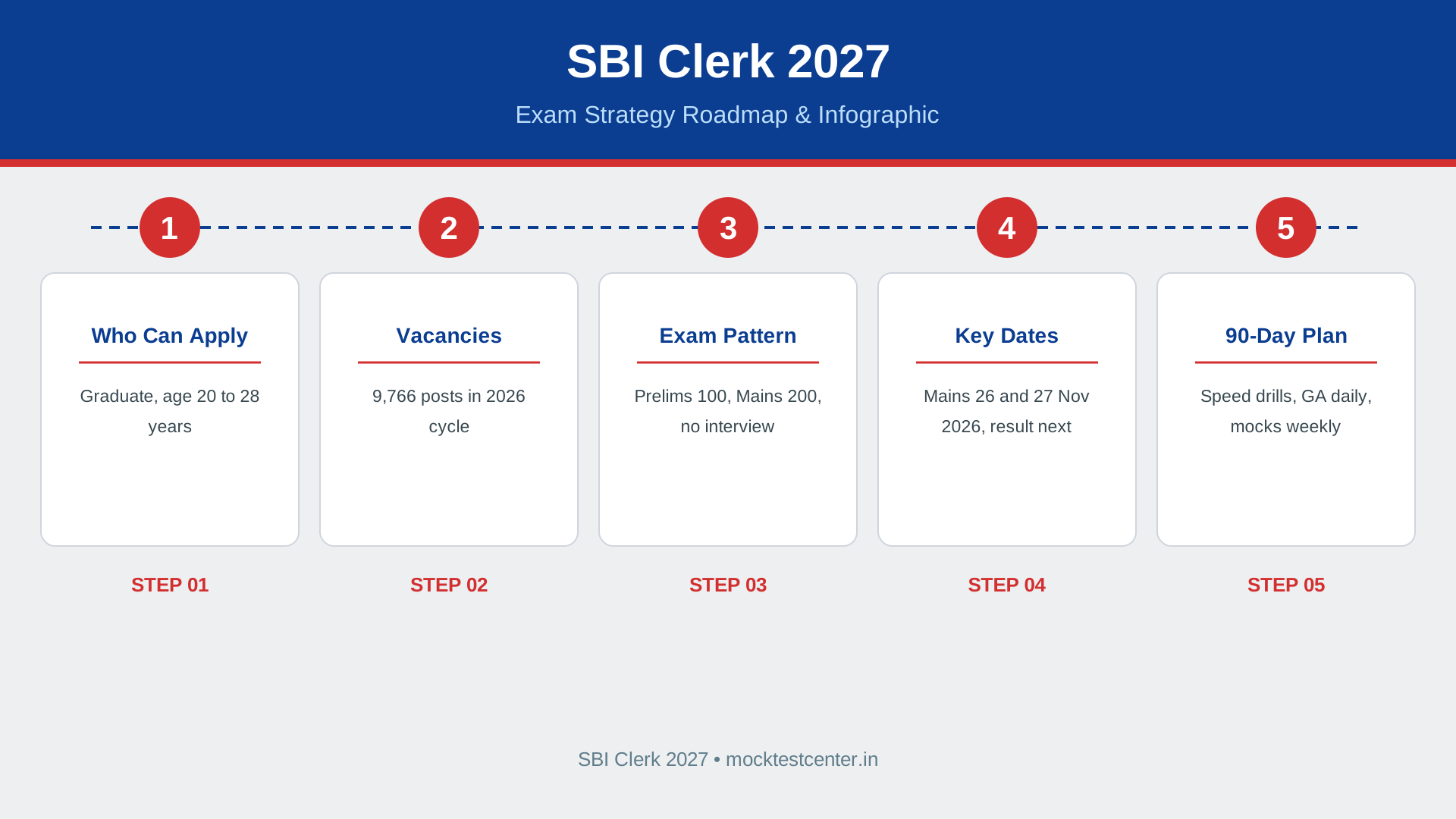
SBI Clerk 2027 has no notification yet. The latest cycle is still running as this page is written in November 2026, and that timing shapes everything on this page. The 2026-27 recruitment under advertisement CRPD/CR/2026-27/17 advertised 9,766 Junior Associate posts, the largest SBI Clerk intake in years.
Its Prelims ran on 26 and 27 September 2026, the result came on 18 November 2026, and the Mains is set for 26 and 27 November 2026. Until that cycle closes and SBI publishes the next advertisement, no one can quote 2027 dates or vacancies as fact. This page works from the two most recent cycles and says plainly where the facts end.
Clerk is the biggest doorway into SBI. It takes graduates from every stream, it asks for no interview, and it posts you in the state you apply for. The trade off is the work itself.
A Junior Associate handles customers at the counter, and the job rewards patience and accuracy more than ambition. If you want an officer chair, read the SBI PO 2027 page instead. If you want a stable bank job in your home state with a clear path upward, this is the exam for you.
SBI Clerk 2027: the latest cycle is still running
SBI released the 2026-27 Clerk notification on 11 August 2026 and took online applications from 11 to 31 August 2026. The advertisement number is CRPD/CR/2026-27/17. The Prelims for regular vacancies ran on 26 and 27 September 2026, and the result was declared on 18 November 2026.
The Mains for regular vacancies is scheduled for 26 and 27 November 2026, though a few sources list 23 November instead, so the admit card carries the final date. Candidates who cleared Prelims should download the call letter from the SBI careers page as soon as it appears, because SBI activates it only a week or so before the exam.
The 2026-27 cycle also ran a separate special drive for backlog vacancies under advertisement CRPD/CR/SPLDRIVE/2026-27/16. That drive had 1,538 posts, held its Prelims on 16 September 2026, declared its result on 17 October 2026 and held its Mains on 29 October 2026. The two tracks share one advertisement family but run on different dates, and candidates mix them up every year.
If you applied under the regular advertisement, your dates are the September and November ones. The backlog drive is a different list with different call letters.
The cycle before this one, 2025-26, ran under advertisement CRPD/CR/2025-26/06. SBI released it on 5 August 2025, took applications from 6 to 26 August 2025, held the Prelims on 20, 21 and 27 September 2025 and the Mains on 21 November 2025. That cycle advertised 6,589 posts in total, made up of 5,180 regular vacancies and 1,409 backlog vacancies.
A few reporting sites quote 5,583 posts for the same cycle instead, and the two figures cannot both be right. The 6,589 figure matches the notification split of 5,180 plus 1,409, so this page uses it and flags the 5,583 variant as unverified.
Look at the vacancy trend and the story is clear. The 2023 cycle had 8,773 posts, 2024 had 8,283, 2025 had 6,589 and 2026 jumped to 9,766. SBI Clerk is a high volume exam every year, and the intake stays in the thousands.
That volume is the reason the cut offs stay reachable. Thousands of seats means thousands of candidates clear Prelims, and a steady, well prepared candidate has a real chance. The SBI Clerk 2027 notification will most likely appear around August 2027 if the recent rhythm holds, since the last two came in early August, but that is a guess from a pattern.
The SBI careers page at sbi.co.in/web/careers is the only place the notice appears first.
9,766 posts and what regular and backlog mean
The 2026-27 notification lists 9,766 posts. Of these, 7,680 are regular vacancies and 2,086 are backlog vacancies. Backlog posts are unfilled reserved category posts from earlier cycles, and they are filled through the same exam but tracked separately.
The special drive for 1,538 of those backlog posts ran on its own schedule, which is why the dates look confusing from outside. The regular 7,680 posts are the ones most candidates compete for.
Unlike the PO exam, SBI Clerk vacancies are state wise. You apply for one state or union territory only, and you compete against candidates who applied for that same state. Your posting stays inside that state, and usually inside that circle.
That single rule shapes the whole exam. A candidate from Bihar applies for Bihar vacancies and competes with Bihar applicants. A candidate from Uttar Pradesh faces a different cut off, because the number of posts and the number of applicants differ by state.
There is no all India merit list, and there is no way to switch states after you apply. Pick your state with care. Apply where you hold the local language and where you can actually live and work.
The state wise split also explains why cut offs swing so much between states. A state with many posts and fewer applicants has a lower cut off. A state with few posts and a flood of applicants has a cut off that can sit 10 marks higher.
Previous year state cut offs circulate on coaching sites, and they are worth a look, but they are not a promise. The 2027 state split will come with the notification, and the only sensible move is to check your own state's posts against its past cut offs and decide whether your mock scores clear that bar.
One more number matters. The bank reserves posts for SC, ST, OBC, EWS and PwBD candidates as per government rules, and the reservation applies state by state. Your category cut off is the one that counts for you, and it is always lower than the unreserved cut off for the same state. Check the notification table for your state and category before you set your target score.
Who can apply: age, degree and the language rule
The rules are short. You need a graduation degree in any discipline from a recognised university. Final year students can apply provisionally, but they must produce proof of passing by the date SBI specifies in the notification.
There is no minimum percentage in graduation, which surprises candidates who come from exams that demand 55 or 60 percent. SBI asks only for a degree.
Age is counted as on 1 April of the recruitment year. For the 2026-27 cycle the window was 20 to 28 years as on 1 April 2026, which means candidates born not earlier than 2 April 1998 and not later than 1 April 2006. The upper limit relaxes by 5 years for SC and ST, 3 years for OBC non creamy layer, 10 years for persons with benchmark disabilities, and 5 years for ex servicemen and for candidates domiciled in Jammu and Kashmir during 1980 to 1989.
There is no attempt limit. You can sit the exam every year till your age runs out.
The language rule is the one candidates overlook. You apply for one state, and after Mains you face a Local Language Proficiency Test if you have not studied the local language of that state at Class 10 or 12 level. The test is qualifying only.
It checks whether you can read, write and speak the local language well enough to serve customers in that state. It sounds minor, and it ends candidatures every year, because candidates who applied for a state whose language they cannot read discover the problem too late. Apply for a state whose language you really know.
The IBPS Clerk 2027 exam has the same language test, so the advice holds there too.
The application fee in the last two cycles was 750 rupees for General, OBC and EWS candidates, and nil for SC, ST, PwBD, ex servicemen and disabled ex servicemen. The fee is non refundable and you pay it online while filling the form. Fill the form on a computer, upload a recent photograph and signature in the exact formats the notification specifies, and keep the registration number safe. SBI asks for it at every later stage.
Prelims: 100 questions in 60 minutes
Prelims is a speed test with a hard timer. You get 100 questions, 100 marks and 60 minutes, split into three sections of 20 minutes each. English Language carries 30 questions for 30 marks.
Numerical Ability carries 35 questions for 35 marks. Reasoning Ability carries 35 questions for 35 marks. The timer locks you into each section.
You cannot borrow minutes from English to finish Numerical Ability, so section wise speed is the skill that matters.
Prelims is qualifying only. Its marks do not count in the final merit list. The paper shortlists candidates for Mains, roughly ten times the state wise vacancies.
That takes some pressure off, but not much, because Mains is where the job is decided and you cannot reach Mains without clearing Prelims first. The practical effect is simple. Do not chase a huge Prelims score.
Chase a safe score with high accuracy, and save your deepest preparation for Mains.
Negative marking is one fourth of a mark per wrong answer, so a wrong answer costs 0.25 marks. With 35 questions in 20 minutes for Numerical Ability, you have about 34 seconds per question. English is faster, and a good candidate finishes it in 12 to 14 minutes.
Reasoning sits in the middle. Puzzles and seating arrangements eat time, and the candidates who clear Prelims comfortably are the ones who skip a stuck puzzle early instead of wrestling it for four minutes.
What should you study? English covers reading comprehension, cloze test, error spotting, para jumbles, fillers and vocabulary in context. Numerical Ability covers simplification, number series, data interpretation, quadratic equations and arithmetic word problems.
Reasoning covers puzzles, seating arrangement, syllogism, inequality, coding decoding, blood relations and direction sense. None of this is new, and the syllabus has stayed stable for years. Previous year papers are the most reliable guide to the level.
Work through the 2025 and 2026 Prelims papers question by question, and you will see the exact mix SBI favours.
One difference from the PO exam is worth noting. SBI removed the sectional cut off in the Clerk exam as well, so a weak section cannot fail you on its own. Your aggregate score decides whether you move on.
That changes how you plan your week. Put your hours where the marks are, and do not chase perfection in your weakest section at the cost of your strongest.
| Section | Questions | Marks | Time |
|---|---|---|---|
| English Language | 30 | 30 | 20 minutes |
| Numerical Ability | 35 | 35 | 20 minutes |
| Reasoning Ability | 35 | 35 | 20 minutes |
| Total | 100 | 100 | 60 minutes |
Mains: 190 questions that decide everything
Mains is the whole exam. There is no interview in SBI Clerk recruitment, so your Mains score is your final score, subject only to the language test. The paper carries 190 questions for 200 marks in 2 hours 40 minutes, split into four sections with fixed timings.
General and Financial Awareness carries 50 questions for 50 marks in 35 minutes. General English carries 40 questions for 40 marks in 35 minutes. Quantitative Aptitude carries 50 questions for 50 marks in 45 minutes.
Reasoning Ability and Computer Aptitude carries 50 questions for 60 marks in 45 minutes. That adds up to 190 questions and 200 marks.
General Awareness is the best return in the paper. Fifty questions for 50 marks in 35 minutes means more than a mark a minute, and the questions come from the last four to six months of banking, economy and current affairs. Candidates who read a financial newspaper daily and revise the last six months of banking news before the exam pick up marks that others leave on the table.
There is no shortcut for this section. Monthly compilations help, but they help only if you revise them twice.
Quantitative Aptitude in Mains is harder than in Prelims. Data interpretation dominates, with caselets, missing data sets and multi layered tables, and the arithmetic word problems go deeper. Reasoning in Mains adds computer aptitude, with basic questions on hardware, software, networking and the internet.
The 50 questions in this section carry 60 marks, so each question is worth more than one mark, and a wrong answer costs more here than anywhere else in the paper. Accuracy matters more than attempts in this section.
English in Mains is the section most candidates find easiest, and that is exactly why it decides so little. When most candidates score well in a section, it cannot separate them. The sections that separate candidates are General Awareness and Reasoning, where the spread of scores is widest. Give those two sections your best hours.
Negative marking is the same as Prelims, one fourth of a mark per wrong answer. There is no sectional cut off in Mains either, so your aggregate score decides your rank. SBI normalises scores across shifts, because Mains runs in multiple shifts with papers of slightly different difficulty.
Your raw score is not your final score, and comparing raw scores with friends who sat a different shift tells you nothing. Wait for the official scorecard.
Quantitative Aptitude in Mains deserves a closer look, because the DI sets are where candidates lose the most marks. A caselet gives you a paragraph of data instead of a table, and you must build the table yourself before you can answer a single question. That building step takes three to four minutes, and candidates who rush it get every question in the set wrong.
Practise caselets separately. Read the paragraph, draw the table on rough paper, fill every cell, and only then look at the questions. Missing data sets work the same way.
A table with blank cells looks hard, but the blanks follow from the totals, and one careful pass fills them all. Two caselets a day for a month makes this section feel routine instead of frightening.
General Awareness for Clerk leans more on banking than on general current affairs, and the sources should match that. Read the RBI website's press releases once a week, because policy changes, rate decisions and new banking rules appear there before they reach the newspapers. Follow the finance ministry's scheme announcements the same way.
A monthly banking awareness compilation from a coaching site is useful for revision, but it cannot replace the habit of reading the news as it happens. Candidates who read the business page daily for six months walk into Mains with the section already half won.
How should you attempt the paper? Start with General Awareness, because it is the fastest section and it settles your nerves. Fifty questions in 35 minutes means you should not spend more than 40 seconds on any one question, and you should mark the ones you are unsure of and move on.
Then take Quant, where the DI sets need long unbroken stretches of attention, and leave Reasoning for the end, because its puzzles can swallow time without warning. Keep five minutes spare at the end of each section to revisit the questions you skipped. Candidates who follow a fixed order in every mock walk into the exam with a plan instead of a hope, and a plan is worth 5 marks on its own.
| Section | Questions | Marks | Time |
|---|---|---|---|
| General and Financial Awareness | 50 | 50 | 35 minutes |
| General English | 40 | 40 | 35 minutes |
| Quantitative Aptitude | 50 | 50 | 45 minutes |
| Reasoning Ability and Computer Aptitude | 50 | 60 | 45 minutes |
| Total | 190 | 200 | 2 hours 40 minutes |
The language test after Mains
The Local Language Proficiency Test is the last gate, and it is the one candidates take least seriously. After Mains, candidates who have not studied the local language of their state at Class 10 or 12 level must appear for it. The test checks reading, writing and speaking in the local language. It carries no marks and it is qualifying only, but failing it ends your candidature even if you topped Mains.
The test is simple for a candidate who really knows the language. You read a passage, write a short piece and answer a few questions. It is hard only for the candidate who applied for a state whose language they cannot read.
That happens more often than you would think, because candidates chase states with lower cut offs and forget the language condition. The fix is easy. Apply for a state whose language you studied in school, or whose language you speak at home.
If you studied Hindi in Class 10 and you apply for a Hindi speaking state, you are usually exempt, because the Class 10 certificate proves the language. Check the exemption rule in the notification before you apply, because it saves you a test and a risk.
Provisional allotment follows the language test. SBI allots you to the state you applied for, and the posting comes inside that circle. There is no transfer to another state in the early years, so the state you pick is the state you will live in. Choose it like a life decision, because that is what it is.
Salary: the new pay scale
The pay scale for a Junior Associate changed with the latest wage settlement, and the old figures that still circulate online are out of date. The revised scale runs from 24,050 to 64,480 rupees a month. The starting basic pay for a graduate is 26,730 rupees, which is the 24,050 starting point plus two advance increments admissible to graduates. The scale rises by 1,340 rupees a year for three years, then 1,650 for three years, then 2,000 for four years, then 2,340 for seven years, then 4,400 for one year, then 2,680 for one year, reaching 64,480 at the top.
On top of basic pay, a Junior Associate gets dearness allowance, house rent allowance, transport allowance and other allowances as per the rules. The gross monthly salary in a metro city lands around 45,000 to 48,000 rupees, and the in hand figure after deductions is around 39,000 to 43,000 rupees, depending on the posting city. Older sources quote the pre revision scale of 17,900 to 47,920 rupees with a starting basic of 19,900 for graduates, and that was correct before the settlement. The 2026-27 notification uses the revised scale, so use the new figures when you plan.
The money is only half the story. A Junior Associate is the front line of the bank, handling cash, clearing, account opening and customer service at the counter. The work is steady and the hours are regular, which is why the post suits candidates who want a stable life in their home state.
Promotion runs through the internal channel. A clerk can rise to Trainee Officer and then to the officer cadre through the internal promotion exams, and many SBI officers today started at the counter. The IBPS PO 2027 exam is the direct officer route, but the clerk route reaches the same building by a slower staircase.
One honest comparison helps here. The Clerk starting basic of 26,730 rupees is lower than the PO starting basic of 48,480 rupees, and the gap stays wide through the career. But the Clerk exam has no interview, no group exercise and no descriptive paper, and it posts you in your home state.
Candidates who want the officer chair should aim for PO. Candidates who want a secure bank job close to home should aim for Clerk. Both are good jobs, and the right choice depends on your life, not on the pay slip alone.
State wise posting: why your circle choice matters
Your circle choice is the most consequential decision in the whole application, and it is the one candidates spend least time on. SBI divides the country into circles, and each circle covers one or more states. You apply for vacancies in one state or union territory, and your merit list is drawn for that state alone.
Your posting stays in that state. You cannot transfer to another state in your early years, and the bank expects you to serve where it posts you.
Three things should drive your choice. First, the local language. You must know it, or you face the language test and the risk that comes with it.
Second, the vacancy count. More posts in your state means a lower cut off and a better chance. Third, your life.
A posting in your home state means family support, low living costs and no language barrier. A posting in a far state means the opposite. Candidates who chase the state with the lowest cut off often forget the third point, and they regret it when the allotment letter arrives.
The cut off difference between states is real. In the 2025 cycle, some states saw Prelims cut offs far above others, because the applicant pool and the vacancy count differ so much. The exact state wise cut offs for the 2026 cycle will come with the result, and they are worth reading before you choose your state for 2027.
If your mock scores sit 5 marks above your home state's last cut off, you are in a good place. If they sit 5 marks below, either raise your score or reconsider the state, and remember the language rule before you switch.
Transfers do come later in the career, but they come on the bank's terms and after years of service in your allotted circle, not on request in the first year. A candidate who joins in a far state should expect to live there for a long stretch, build a life there, and learn the local language properly even if the test is already behind them. That is a manageable life if you chose it with open eyes.
It is a hard life if you chose it for a 3 mark cut off advantage and discovered the distance only after the allotment letter arrived. Your home state is usually the right answer, and the rare exception is a candidate with family or roots in another state.
The IBPS RRB Clerk 2027 exam works the same way, with state wise vacancies and a local language test, so the same thinking applies if you sit both exams. Apply where you belong, not where the cut off looks easy.
Syllabus: what to study in each section
The syllabus has stayed stable for years, and previous year papers are the most reliable guide to the level.
English Language covers reading comprehension, cloze test, error spotting, sentence improvement, para jumbles, fillers and vocabulary. Read every day. A candidate who reads a newspaper for 30 minutes daily builds the vocabulary and the reading speed that no crash course can give in a month.
The editorial page of a national daily is enough. Read it, note five new words a day, and use them in a sentence of your own.
Numerical Ability covers number series, simplification, approximation, quadratic equations, data interpretation, caselets and arithmetic word problems on ratio, percentage, profit and loss, time and work, speed and distance, interest and probability. Data interpretation dominates the marks. Tables, bar graphs and line graphs appear every year, along with pie charts and mixed sets.
Practise one DI set a day under a timer, and check every step of your working when you get it wrong. Most DI errors come from misreading the question, not from weak maths.
Reasoning Ability covers puzzles, seating arrangement, syllogism, inequality, coding decoding, blood relations, direction sense and order and ranking, with alphanumeric series alongside. Mains adds computer aptitude: basics of hardware and software, with networking, internet and MS Office alongside. Puzzles are the biggest block of marks in Reasoning, and they reward daily practice more than any other topic. Ten puzzles a day for three months changes your speed more than any book can.
General and Financial Awareness covers current affairs of the last four to six months, banking terms, RBI policy, government schemes, budgets, the economic survey, financial institutions, static GK and awards and appointments. This section rewards a routine. Spend 30 minutes each morning on current affairs and 30 minutes each evening revising the last month's notes. The RBI Assistant 2027 exam tests the same awareness topics, so the reading you do for SBI Clerk carries over directly if you sit both exams.
Cut offs: how SBI draws the line
SBI publishes cut offs after each stage, state by state and category by category, and the numbers move every year with the paper and the vacancies. This page gives no cut off figures for SBI Clerk 2027, because there are none yet, and it gives no figures from past years as targets, because past cut offs mislead more than they help. A paper that was easy produced high cut offs.
A paper that was hard produced low ones. The vacancy count pushes the line up or down by several marks.
What helps is understanding the mechanism. Prelims shortlists roughly ten times the state wise vacancies, on aggregate marks, with no sectional bar. Mains shortlists candidates for the language test and allotment on aggregate marks, again with no sectional bar.
Your target is not a number. Your target is a rank inside your state's vacancy count, and the way to get there is a Mains score comfortably above the middle of the pack. In practice that means scoring well in General Awareness and Reasoning, where most candidates are weak, rather than fighting for the last two marks in English, where most candidates are strong.
Coaching sites publish expected cut offs within hours of every exam, and those numbers are guesses built on small samples of candidate feedback. They are sometimes close and sometimes far off, and they create anxiety that hurts the next stage of preparation. Read them if you must, then forget them and prepare for the next stage. The official scorecard is the only number that matters, and it arrives on the SBI careers page.
A 90 day plan that fits around a job
Ninety days is enough if you already know the basics, and it is not enough if you are starting from zero. This plan assumes you know the syllabus and can solve easy questions in each section. If you are starting from zero, double the timeline and start with concept books before you touch mocks.
Days 1 to 30 build the base. Study Quant for two hours a day, Reasoning for two hours, English for one hour and current affairs for one hour. Finish one topic a day in each subject and solve 50 questions on that topic before you move on.
Take one full Prelims mock every Sunday and spend Monday morning analysing it. Analysis matters more than the mock. For every wrong answer, write down why you got it wrong in one line.
Wrong concept, silly mistake, time pressure, or misread question. After four mocks you will see your own pattern, and that pattern tells you what to fix.
Days 31 to 60 shift the weight to Mains. Keep one hour a day for Prelims speed, because Prelims comes first, but give two hours a day to Mains level DI and Reasoning puzzles, and one hour to General Awareness revision. Add one Mains mock a week, and analyse it the same way. This is also the stage to start reading about banking in depth, because Mains General Awareness asks about RBI policy, banking terms and financial news, not just headlines.
Days 61 to 90 are for mocks and revision. Take two Prelims mocks a week and one Mains mock a week. Stop learning new topics after day 75.
New topics in the last two weeks cost more than they give, because they steal revision time from topics you already know. Revise your error notebook, your current affairs notes and your formula sheets. Sleep properly in the last week.
A tired brain loses more marks in 60 minutes than a month of study gains.
Working candidates should cut this plan to three hours a day and stretch it to six months. Two hours before work and one hour after is a realistic split. The IBPS SO 2027 exam and the LIC ADO 2027 exam share much of this syllabus, so the same study hours serve more than one exam. One syllabus, several applications, and the exam that falls first sharpens you for the rest.
Five mistakes that cost good candidates their seat
The first mistake is preparing for Prelims and forgetting Mains. Prelims is qualifying, Mains is deciding, and candidates who spend five months on Prelims speed arrive at Mains underprepared. Start Mains level DI and puzzles from the second month, even before Prelims is done.
The second mistake is ignoring General Awareness till the last month. Fifty marks in 35 minutes is the best return in the paper, and it needs months of steady reading. A candidate who starts GA in the last month cannot cover six months of news, and the section becomes a guess.
The third mistake is taking mocks without analysing them. A mock you do not analyse is entertainment, not preparation. Every mock should produce a list of five fixes. If your mocks produce no fixes, you are not looking hard enough.
The fourth mistake is applying for the wrong state. Candidates chase the state with the lowest cut off and forget the language test, or they forget that the posting stays in that state for years. Pick your state for your life, not for the cut off.
The fifth mistake is applying without reading the notification. The age cut off date, the photo specifications, the state wise vacancy table and the fee rules change slightly between cycles, and the notification is the only source that counts. Read it end to end before you fill the form. Ten minutes of reading saves a rejected application.
When the SBI Clerk 2027 notice arrives, check these five things first
Check the state wise vacancy table for your state and category, because that sets your competition. Check the age cut off date, because it decides whether you are eligible this year. Check the application window and the fee, and apply in the first week rather than the last day, when the portal slows down.
Check the exam pattern section for any change in marks or timing, because SBI has changed section marks before. And check the language test rule for your state, because it decides whether you need to prove the local language.
Then start. The NICL AO 2027 exam, the IDBI Executive 2027 exam and the ECGC PO 2027 exam run on similar calendars, and the same preparation carries across all of them. Pick SBI Clerk as your main target if a home state posting is what you want, sit the others as well, and let the exam that falls first sharpen you for the one that matters most.
The 2027 notification will most likely come around August 2027 if the recent pattern holds. Your preparation should be well under way by then.