About JKSSB Junior Stenographer 2027 Exam Series
📖 Table of Contents
- The 2025 cycle in numbers
- Junior Stenographer and Junior Scale Stenographer
- The 2021 cycle and the 2022 exam
- Who can apply for JKSSB Junior Stenographer 2027
- The written test and the skill test
- What the written test covers
- Shorthand at 65 words per minute
- Fee and how to apply
- What to study first
- A 90 day plan that fits around a job
- Other exams worth preparing alongside
- Sources
JKSSB Junior Stenographer 2027: Complete Exam Guide
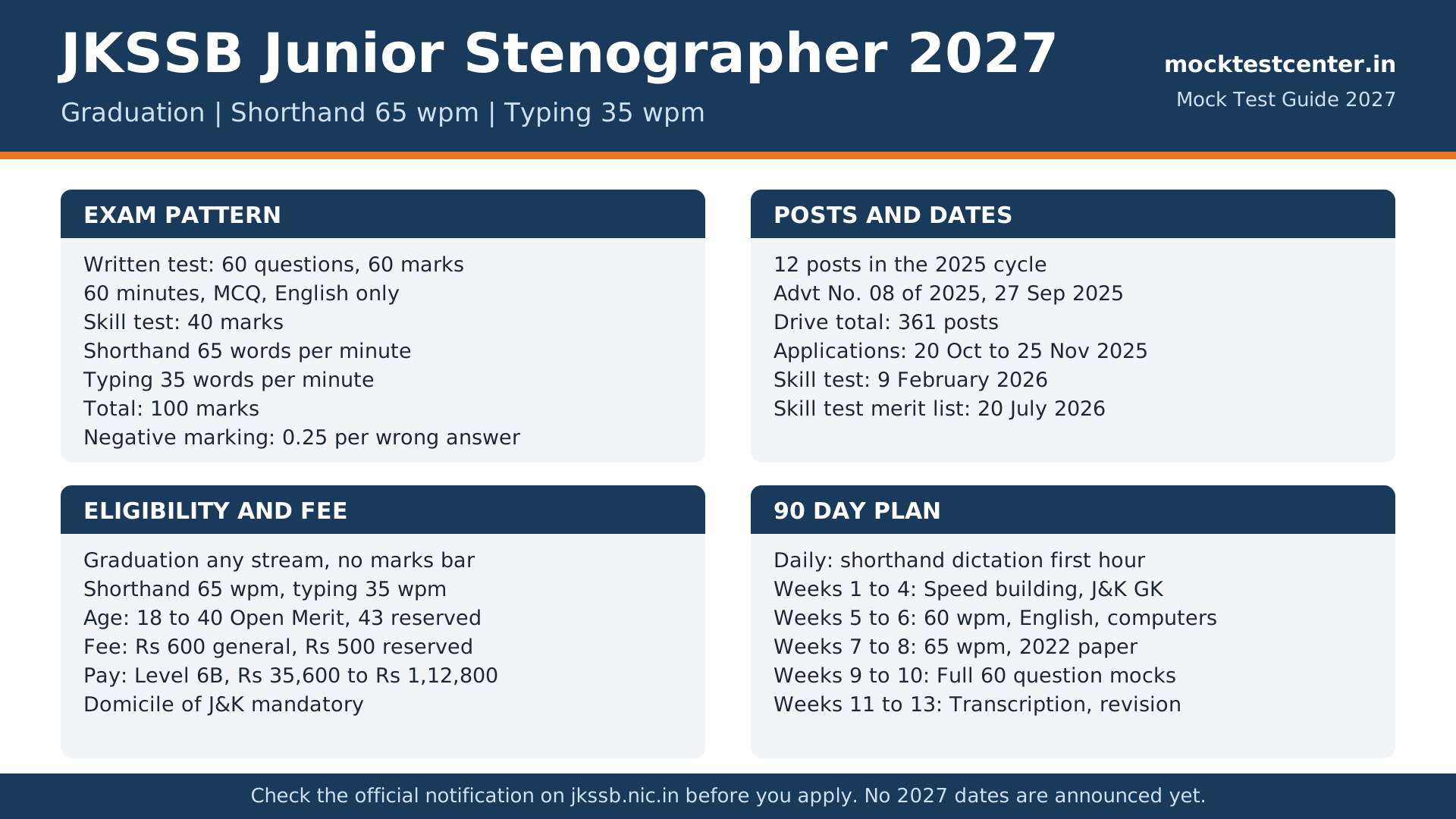
The latest Junior Stenographer recruitment is already deep into its selection process. The Jammu and Kashmir Services Selection Board advertised 12 Junior Stenographer posts under Advertisement No. 08 of 2025, dated 27 September 2025, as part of a 361 post drive that also covered Junior Assistants and Junior Scale Stenographers. Applications ran from 20 October to 25 November 2025, the skill test followed on 9 February 2026, and the skill test merit list came out on 20 July 2026. JKSSB Junior Stenographer 2027 has no notification yet, so every fact in this guide comes from that 2025 cycle and the 2021 cycle before it. If you plan to sit for the next cycle, those two cycles are the closest picture you have of the posts, the shorthand speeds, the pattern and the fees.
Junior Stenographer is a graduate level post where speed is the qualification. A degree alone does not get you in. You need shorthand at 65 words per minute and typing at 35 words per minute, and those speeds are tested, not claimed on a form. The selection has two parts: a written test worth 60 marks and a skill test worth 40 marks, for a total of 100. That split is what makes this exam different from the Junior Assistant exam advertised in the same notification. The Junior Assistant is judged mostly on the written paper. The Stenographer is judged almost as much on the hands as on the head, and a candidate who can write fast but cannot take dictation at speed will not clear it.
The 2025 cycle in numbers
| Item | Detail |
|---|---|
| Conducting body | Jammu and Kashmir Services Selection Board (JKSSB) |
| Post | Junior Stenographer |
| Advertisement | Notification No. 08 of 2025, dated 27 September 2025 |
| Posts | 12, within a 361 post drive |
| Other posts in the same drive | Junior Assistant 343, Junior Scale Stenographer 6 |
| Application window | 20 October to 18 November 2025, extended to 25 November 2025 |
| Skill test | 9 February 2026, as reported by trackers |
| Skill test merit list | 20 July 2026 |
| Pay | Level 6B, Rs 35,600 to Rs 1,12,800 |
| 2027 notification | Not issued as of 20 November 2026 |
Twelve posts is a small number, and it is worth saying plainly what that means. The 2025 drive offered 361 posts in total, but 343 of those were Junior Assistants. The Stenographer share was 12, and the Junior Scale Stenographer share was 6. The competition here is measured in the number of graduates in Jammu and Kashmir who can actually take shorthand at 65 words per minute, and that number is small. The post rewards a narrow skill that few people hold, and the vacancy count is small because the skill is rare.
The dates in the table need one note. The skill test date of 9 February 2026 and the merit list date of 20 July 2026 come from tracker pages, not from a notice read directly on jkssb.nic.in during preparation. The Board site could not be reached by direct fetch on 20 November 2026. The advertisement number, the vacancy split of 343, 12 and 6, the application window, and the extension to 25 November 2025 are reported consistently across several independent trackers, so this guide states them as the cycle facts. The written examination date for this cycle was not verified during preparation, and this guide states no written exam date for the 2025 cycle. Check jkssb.nic.in for the current stage of the selection before you act on any date in this guide.
Junior Stenographer and Junior Scale Stenographer
The two posts share a name and a skill, and they are easy to confuse. Junior Stenographer and Junior Scale Stenographer both ask for graduation with shorthand at 65 words per minute and typing at 35 words per minute. Both sit at Level 6B pay of Rs 35,600 to Rs 1,12,800, according to the trackers that report the 2025 notification. The difference is the grade and the department. Junior Scale Stenographer is the senior stenographer post, and in the 2025 drive it carried 6 posts against 12 for Junior Stenographer. In earlier notifications the Junior Scale Stenographer appeared in the same combined drives, including the 168 post notification of 2022 that covered Junior Scale Stenographer, Driver, Junior Assistant and Assistant Superintendent Jails.
The distinction matters when you fill the form. The 2025 advertisement lists the two posts separately, with separate vacancy counts and separate department wise breakups in Annexure A of the notification. A candidate applies for the post named in the item, not for stenography in general, and the choice of post decides the department you serve in. Read the item number in the notification before you apply, because the two posts sit side by side in the same advertisement and the names differ by one word.
There is also a third name that appears in older syllabus pages: Steno Typist. The JKSSB syllabus page for Junior Stenographer covers Junior Stenographer, Steno Typist and Junior Scale Stenographer together, and the syllabus topics are the same for all three. That shared syllabus is useful for preparation, because the written test topics do not change much between the three posts. The speeds do not change either. Shorthand at 65 words per minute and typing at 35 words per minute are the standard for all of them.
The 2021 cycle and the 2022 exam
The cycle before the 2025 drive was the 2021 cycle, with 43 Junior Stenographer vacancies. Its written examination was held on 29 November 2022, in the second shift, and the official paper from that day is the one previous year paper that trackers host for this post. The selection process in that cycle was the same shape as the 2025 cycle: a written examination, a skill test, and document verification. The mode was online, and the marking scheme was 1 mark for a correct answer and minus 0.25 for a wrong answer.
That 2022 paper is the best preparation material available for the next cycle. It is an official paper, set by the Board, and it shows the level and the spread of the written test in a way that no mock test can. Solve it under time, with the 0.25 negative marking applied, and log the errors by topic. A candidate who has solved the 2022 paper knows the standard of the General Awareness questions, the depth of the English questions, and the level of the numerical questions. A candidate who has only read the syllabus knows none of that.
The gap between the cycles is worth noting. The 2021 cycle exam ran in November 2022, and the next advertisement came in September 2025, almost three years later. Stenographer recruitment runs only when departments report vacancies, and the vacancy count is small each time. A candidate who misses a cycle may wait years for the next one, and that is a real cost. If you hold the shorthand speed now, apply when the notification comes, even if the vacancy count looks small. Twelve posts with few skilled applicants is a better chance than a large vacancy count in an exam where everyone can apply.
Who can apply for JKSSB Junior Stenographer 2027
Eligibility rests on three things: a degree, the two speeds, and an age inside the limit. Graduation from a recognised university, in any discipline, is the educational qualification. There is no marks percentage condition for this post, which sets it apart from the Accounts Assistant post in the same Board, where Open Merit candidates need 50 percent. The speeds are the real qualification. Shorthand at a minimum of 65 words per minute and typewriting at a minimum of 35 words per minute are required, and both are tested in the skill test. A candidate who holds the degree but not the speeds cannot clear the selection, however strong the written test score is.
| Category | Maximum age, as on 1 January 2025 |
|---|---|
| Open Merit | 40 years |
| SC, ST, RBA, ALC/IB, EWS, OBC | 43 years |
| Persons with Benchmark Disabilities | 42 years |
| Ex-servicemen | 48 years |
The minimum age is 18 years for every category, reckoned as on 1 January 2025 for the 2025 cycle. The age table above matches the standard JKSSB age table used across the 2025 notifications, and it is the same table that governs the Junior Assistant posts in the same advertisement. Domicile is mandatory. Only domiciles of the Union Territory of Jammu and Kashmir can apply, and the domicile certificate must have been issued before the cut off date in the notification. The 2025 notification required the certificate to be in hand before 20 October 2025, the opening date of the application window.
The pay sits at Level 6B, Rs 35,600 to Rs 1,12,800 per month, according to the trackers that report the 2025 notification, including Testbook and the notification summaries. One tracker page gives Level 5, Rs 29,200 to Rs 92,300, for the Junior Stenographer post, and that figure conflicts with the Level 6B figure carried by the majority of sources. This guide follows the Level 6B figure and flags the Level 5 figure as a conflict. The Junior Assistant in the same advertisement sits at Level 4, Rs 25,500 to Rs 81,100, so the Stenographer post pays two levels above the Junior Assistant, which is the premium the shorthand skill earns.
The written test and the skill test
| Stage | Marks | Detail |
|---|---|---|
| Written Examination, CBT | 60 | 60 objective questions, 1 mark each, 60 minutes |
| Skill Test | 40 | Shorthand 65 words per minute and typing 35 words per minute |
| Total | 100 | Written plus skill test |
The written test carries 60 objective questions for 60 marks, in 60 minutes, with 1 mark for a correct answer and a penalty of 0.25 marks for a wrong answer. The questions are multiple choice, set in English only. Sixty questions in 60 minutes gives 60 seconds per question, the same pace as the Junior Assistant paper, and the same rule applies: attempt the questions where you can remove at least one option, and leave the rest blank, because a blank answer costs nothing and a wrong answer costs 0.25.
The skill test carries 40 marks and it is the stage that decides the selection for most candidates. Shorthand dictation at 65 words per minute is the core of it, followed by transcription on a typewriter or computer at 35 words per minute. One tracker reports that candidates must achieve 90 percent accuracy in the typing test to qualify, and that figure is stated here as a tracker report, not as a notification figure, because it appears in only one source. The skill test is qualifying in the sense that a candidate who fails it cannot be selected, however high the written score, and it is scored in the sense that its 40 marks count in the total of 100.
A conflict in the pattern needs a plain statement. One tracker page gives a different written test: 40 questions for 40 marks in 120 minutes, split as General Awareness 10, Reasoning 10, Numerical Ability 10, Computer 5 and English 5. That split conflicts with the Testbook pattern of 60 questions for 60 marks in 60 minutes, and the two cannot both be right for the same cycle. This guide follows the 60 question pattern, because Testbook reports it against the 2022 official paper, which it hosts, and because the 60 plus 40 split adds to the 100 mark total that the notification carries. The 40 question split is flagged here as an unverified tracker figure. Do not build a study plan around a section split that rests on one conflicting page.
Document verification closes the selection. Candidates who clear the written test and the skill test must produce the originals of the degree certificate, the domicile certificate, the category certificate where applicable, and the date of birth proof, and the Board checks each one against the details given in the application form. A mismatch in the name, the date of birth, or the category can end a selection at this stage, after the exams are already cleared. Check every certificate against the application form before you submit it, and keep the originals ready from the day you apply. The skill test merit list of 20 July 2026 shows how the process moves: the Board publishes stage wise lists on jkssb.nic.in, and each list names the candidates who move to the next stage. Watch the site after every stage, because the notice for the next stage follows the list, and the gap between the list and the next stage can be short.
What the written test covers
The syllabus for the written test is published for Junior Stenographer, Steno Typist and Junior Scale Stenographer together, and it covers five areas. General Awareness with special reference to Jammu and Kashmir covers the physical and political divisions of India, Indian culture, the freedom struggle and heritage, current events of national and international importance, demography and the census, important lakes and rivers, climate, weather, crops and means of transport, and the economy, history, geography, culture and heritage of Jammu and Kashmir, with its important tourist destinations. General English and Comprehension covers narration, tenses, articles, modals, pronouns, homophones and homonyms, phrases, antonyms and synonyms, clauses, idioms and phrases, rearrangement of jumbled sentences, active and passive voice, prepositions, pairs of words, correction of sentences, correction of spellings, and error spotting.
General Intelligence and Reasoning covers letter series, number series, time, speed and distance, semantic series, statements and conclusions, mental reasoning, logical reasoning, word building, semantic analogy, numerical operations, figural analogy, number and symbolic analogy, semantic classification, number and symbolic classification, problem solving, figural classification, space visualisation, space orientation, symbolic operations, trends, Venn diagrams, and punched pattern and hole folding and unfolding. Numerical Ability covers the standard arithmetic set at Class 10 level. Computer covers the fundamentals: parts of a computer, operating systems in outline, the internet, email, and common applications.
That syllabus is wide, and the written test has only 60 questions to cover it. The paper cannot test every topic, so it picks a spread, and the spread changes between cycles. The right preparation is breadth with speed: cover every topic lightly, practise reasoning and numerical questions as timed drills, and keep the Jammu and Kashmir general awareness notebook current. The written test is 60 percent of the total, and a strong written score gives you room in the skill test. A weak written score leaves no room at all, because the skill test has a ceiling that every serious shorthand candidate can reach.
Shorthand at 65 words per minute
Shorthand is the skill this exam is about, and it is the skill that most graduates do not hold. Sixty five words per minute of dictation means the speaker reads about a word a second, and you must capture every word in shorthand and then transcribe it accurately at 35 words per minute. That speed takes months of daily practice to build and weeks of neglect to lose. A candidate who starts shorthand from zero needs six months of daily dictation practice to reach 65 words per minute with accuracy, and a candidate who already writes at 50 words per minute needs two months of daily practice to reach 65. There is no shortcut, and no book can substitute for the daily dictation.
The practice routine is simple and it works. Take dictation for 10 minutes a day at a speed slightly above your comfort level, transcribe it immediately, and count the errors. Raise the dictation speed by 5 words per minute each week that the error count stays low. Practise English dictation, because the test dictation is in English, and use passages from newspapers and government reports, because the test passages come from that kind of material. Keep a notebook of the shorthand outlines that trouble you, and revise them weekly. A candidate who practises dictation every day for three months will pass the skill test. A candidate who practises in bursts will not, because shorthand speed fades fast without daily use.
Typing at 35 words per minute is the easier half of the skill test, and it is the half that candidates neglect. Thirty five words per minute is a modest speed, yet it must be accurate, and accuracy under time pressure is a skill of its own. Practise typing for 15 minutes a day on a computer keyboard, with passages from the same material you use for dictation, and count the errors. The transcription in the skill test is typed from your own shorthand notes, so the typing speed and the shorthand accuracy work together. A clean shorthand note transcribes fast. A messy note transcribes slowly, and the clock does not wait.
Fee and how to apply
The application fee for the 2025 cycle is reported differently across trackers, and the difference is large enough to state plainly. One set of trackers, including the notification summary that quotes the advertisement text, gives Rs 600 for all candidates and Rs 500 for SC, ST 1, ST 2 and EWS candidates. A second set gives Rs 700 for General, RBA, ALC and EWS and Rs 600 for SC, ST and PwBD. A third gives Rs 500 for General, OBC and EWS and Rs 400 for SC, ST and PwD. The 600 and 500 figures match the fee in the Accounts Assistant 2025 notification and the Class IV 2026 notification, both from the same Board in the same period, and the notification summary that quotes the fee text directly carries the 600 and 500 figures. This guide follows the 600 and 500 figures and flags the 700 and 600 figures and the 500 and 400 figures as conflicts. Check the fee in the notification for the cycle you apply in, because the fee is the one figure that changes most often between cycles.
Applications go in online only, through jkssb.nic.in, in the window the notification fixes. The 2025 window ran from 20 October to 18 November 2025, and the Board extended it to 25 November 2025. The form asks for personal details, the domicile certificate, the graduation details, the category certificate where applicable, a photograph and a signature, and the fee payment. The speeds are not proved at the application stage. You declare the qualification, and the Board tests the speeds in the skill test. Do not apply without the speeds in hand, because the skill test follows the written test and there is no time to learn shorthand between the application and the test.
What to study first
Start with shorthand, because it takes the longest to build and it cannot be rushed. If your shorthand is below 65 words per minute, give it the first hour of every day, before anything else. The written test preparation fits around it. For the written test, start with General Awareness with special reference to Jammu and Kashmir, because it is the largest single area and the one where local knowledge pays. Then add reasoning and numerical ability as daily timed drills, English as a short daily drill on error spotting and synonyms, and computers as a weekend read of a fundamentals note set.
Books are simple to list. For shorthand, a standard Pitman shorthand textbook with dictation practice, and a daily newspaper for dictation passages. For typing, any typing tutor software with accuracy tracking. For general awareness, a Jammu and Kashmir yearbook and a standard general knowledge book, plus a notebook of local news from the last twelve months. For reasoning and numerical ability, a standard reasoning and quantitative aptitude book with timed drills. For English, a grammar and comprehension book with error spotting practice. For computers, a computer fundamentals note set. The 29 November 2022 official paper is the most useful single document after the books, and solving it under time is the best check of where you stand.
One habit matters more than the book list. Take dictation every day without a break, even on days when the written test preparation feels urgent. Shorthand speed is a daily skill, and a week without dictation costs more than a week without reading. Keep the dictation notebook beside the written test books, and do the dictation first, when the mind is fresh. A candidate who protects the daily dictation hour will reach the skill test ready. A candidate who lets the written test eat the dictation hour will reach the skill test with a good written score and no shorthand, and that is a failed selection.
A 90 day plan that fits around a job
| Weeks | Focus | Daily time |
|---|---|---|
| 1 to 2 | Shorthand dictation every day, plus Jammu and Kashmir history and geography | 2 hours |
| 3 to 4 | Shorthand speed building, plus reasoning and numerical drills | 2 hours |
| 5 to 6 | Shorthand at 60 words per minute, plus English and computers | 2 to 3 hours |
| 7 to 8 | Shorthand at 65 words per minute, plus the 2022 paper under time | 2 to 3 hours |
| 9 to 10 | Full written mocks, 60 questions in 60 minutes, plus daily dictation | 2 to 3 hours |
| 11 | Transcription practice under time, plus revision of the error log | 3 hours |
| 12 | Two full mocks, shorthand at exam speed, light revision | 3 hours |
| 13 | Final dictation at 65 words per minute, facts sheet revision, one rest day | 2 hours |
The plan gives shorthand the first hour of every day, and that is deliberate. The written test preparation fills the second hour in the early weeks and grows in the later weeks, when the shorthand speed is already built. The last two weeks are mocks and transcription practice, with the error log doing the teaching. Keep the log in a notebook, one line per mistake, with the topic and the correct rule for the written test, and one line per dictation error, with the shorthand outline that failed. A candidate who reviews the log every Sunday will not repeat the same mistake in the second mock, and that is the whole point of mock tests.
The plan assumes you already write shorthand at some speed. If you start from zero, the plan needs six months, not 90 days, and the honest advice is to take the six months. Shorthand at 65 words per minute is a skill that takes daily practice across months, and a 90 day crash course from zero will not reach it with accuracy. Start the shorthand now, apply in the next cycle if the speed is not ready, and use the waiting time to build the speed properly. A cycle missed is a delay. A skill test failed for want of speed is a wasted application.
Other exams worth preparing alongside
JKSSB Junior Stenographer aspirants often prepare for other state and national exams alongside this one. The SBI Clerk 2027, IBPS Clerk 2027, RBI Assistant 2027, IBPS RRB Clerk 2027, SSC GD 2027, FSSAI Assistant 2027, LIC ADO 2027, UP Police Constable 2027, SBI PO 2027 and UGC NET Paper 1 2027 pages on this site carry the same style of mock test guide, and the pattern habit you build here transfers directly to them.
Sources
The Jammu and Kashmir Services Selection Board site at jkssb.nic.in, the official source for the notification, the syllabus, the admit card and the merit lists, which could not be reached by direct fetch during preparation on 20 November 2026, so the facts below rest on the tracker pages listed here and should be checked against the official notification before you apply. Testbook, for the 2021 cycle with 43 vacancies, the written exam held on 29 November 2022 in the second shift, the online mode, the marking of 1 mark correct and minus 0.25 wrong, the written test of 60 marks and the skill test of 40 marks, the 60 minute duration, the pay of Level 6B Rs 35,600 to Rs 1,12,800, the 2025 notification for 12 posts, the application window to 25 November 2025, and the skill test merit list of 20 July 2026. Rojgar Warrior, Examlover, Sarkari Result Daily and JK Chrome, for Advertisement No. 08 of 2025 dated 27 September 2025, the 361 post total with Junior Assistant 343, Junior Stenographer 12 and Junior Scale Stenographer 6, the application window from 20 October to 18 November 2025, the shorthand speed of 65 words per minute and the typing speed of 35 words per minute, and the age limit of 40 years for Open Merit as on 1 January 2025. MySarkariNaukri, for the fee of Rs 600 for all candidates and Rs 500 for SC, ST 1, ST 2 and EWS candidates, and the selection on merit in the written and OMR examination. Toppersexam, for the conflicting 40 question and 40 mark pattern with the section split of 10, 10, 10, 5 and 5, flagged in this guide as unverified. Career News at TuteeHub, for the syllabus topics of General Awareness with special reference to Jammu and Kashmir, General English and Comprehension, General Intelligence and Reasoning, Numerical Ability and Computer, shared across Junior Stenographer, Steno Typist and Junior Scale Stenographer. NaukriPulse, for the 90 percent accuracy figure in the typing test, stated here as a tracker report.