About GPSC DySO 2027 Exam Series
📖 Table of Contents
- GPSC DySO 2027 at a glance
- The 102 posts, and where each one sits
- The prelims paper, and the 0.30 mark that punishes guessing
- The mains papers, where the whole merit is made
- The 2023 cycle, finished in March 2025
- Who can apply, what it costs, and the age rule
- A preparation plan that fits the numbers
- The mistakes that cost candidates a year
- Sources
GPSC DySO 2027: Complete Exam Guide
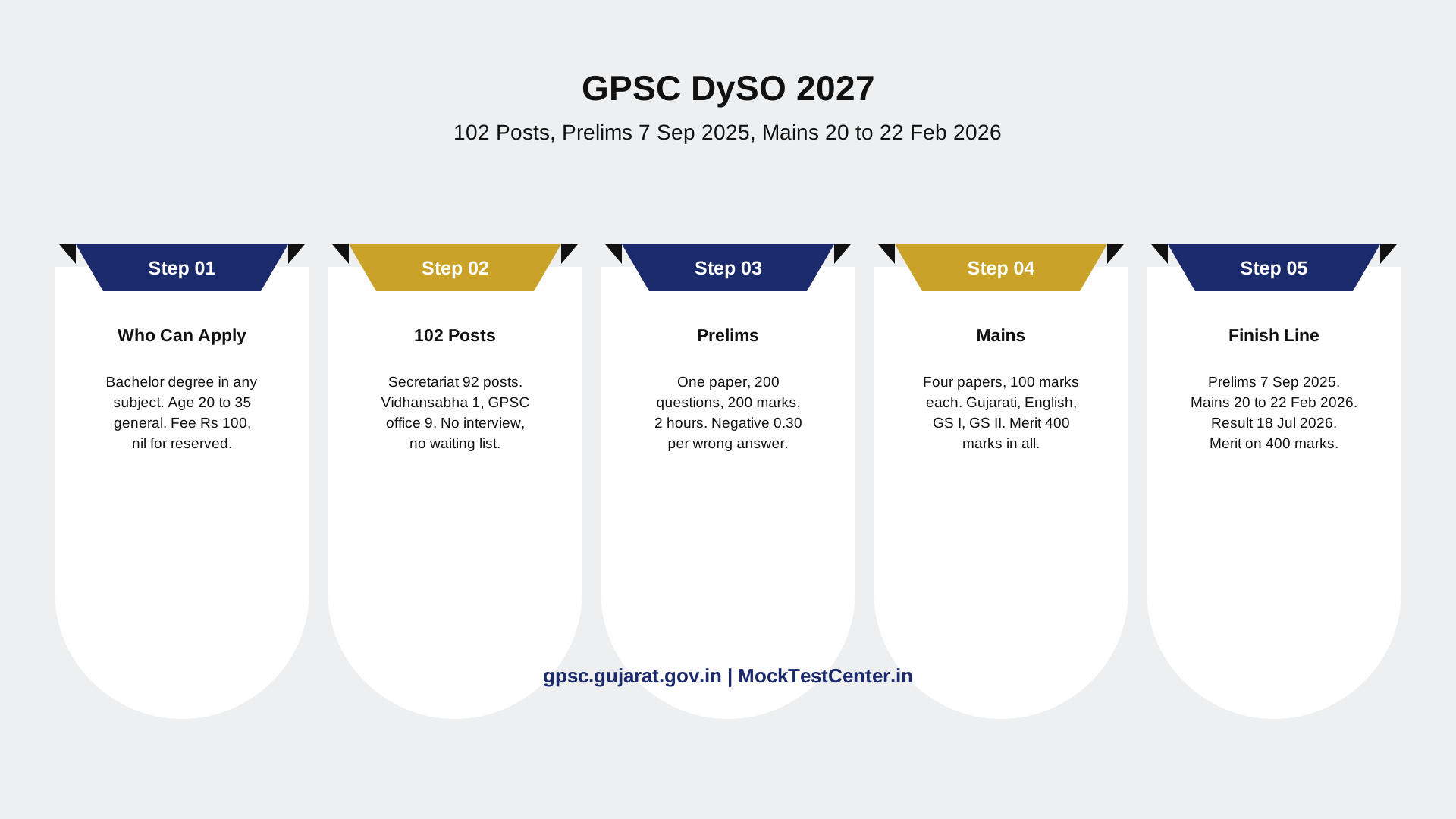
The GPSC DySO 2027 page on this site follows the live cycle of the Deputy Section Officer and Deputy Mamlatdar examination, and the live cycle is the 2025 examination. The Gujarat Public Service Commission, known as GPSC, published the notification for 102 posts on 25 June 2025 under Advertisement Number 08/2025-26. Applications ran from 25 June to 9 July 2025. GPSC held the Preliminary Examination on 7 September 2025, ran the mains from 20 to 22 February 2026, and declared the final result on 18 July 2026. No separate 2027 notification has been published as of 22 November 2026, so this guide anchors on the 2025 cycle and says so wherever a 2027 figure would otherwise be guessed.
That anchoring matters because GPSC runs its examinations on a calendar that slips across years, and because the DySO examination has run three separate cycles in three years with three different post counts. The 2023 cycle carried 127 posts. The 2024 cycle carried 40 posts. The 2025 cycle carries 102 posts. A candidate who mixes the three cycles will prepare from the wrong post count and the wrong dates. This guide keeps the 2025 cycle as the anchor, uses the 2023 and 2024 cycles as history, and labels each figure with the cycle it belongs to.
The examination has two stages and no interview. An objective prelims screens candidates. A descriptive mains of four papers decides the whole merit. Final merit comes from the mains written examination of 400 marks alone. Prelims marks count for nothing beyond the shortlist, and there is no waiting list. That single fact shapes every sensible preparation plan, and this guide returns to it more than once.
GPSC DySO 2027 at a glance
| Detail | GPSC DySO 2027, as run in the 2025 cycle |
|---|---|
| Conducting body | Gujarat Public Service Commission (GPSC), Gandhinagar |
| Exam | Deputy Section Officer, Class 3 and Deputy Mamlatdar, Class 3, Combined Competitive Examination, commonly called GPSC DySO |
| Live cycle | 2025, notification dated 25 June 2025, Advertisement Number 08/2025-26 |
| Posts in live cycle | 102 in all, Secretariat 92, Vidhansabha 1, GPSC office 9 |
| Applications | 25 June to 9 July 2025, closed |
| Fee | Rs 100 for general category, nil for reserved categories, ex servicemen and PwD candidates |
| Prelims | 7 September 2025, one paper, 200 questions, 200 marks, 2 hours |
| Prelims merit list | 5 November 2025 |
| Mains | 20 to 22 February 2026, four descriptive papers, 400 marks |
| Final result | 18 July 2026, Notification Number APE-08/2025-26-Main-CNF, merit on 400 mains marks, no waiting list |
| Interview | None |
| Final merit | Mains written examination, 400 marks |
| Education | Bachelor degree from a recognised university |
| Age limit | 20 to 35 years for general category, relaxation for reserved categories, women and PwD |
| 2027 notification | Not published as of 22 November 2026 |
The 102 posts, and where each one sits
The notification of 25 June 2025 opened with 102 posts, and the split across offices is the first thing a candidate should read. Deputy Section Officer in the Secretariat carries 92 posts. Deputy Section Officer in the Vidhansabha carries 1 post. Deputy Section Officer in the GPSC office carries 9 posts. Those three numbers add to 102. The Secretariat posts are the bulk of the recruitment, and the Secretariat is where most selected candidates will work, in the departments at the New Sachivalaya in Gandhinagar. The Vidhansabha post is a single vacancy, and the GPSC office posts are nine.
One tracker page complicates the split and should be flagged rather than smoothed over. OJAS Gujarat lists the same 102 total but adds 38 Deputy Mamlatdar posts under Advertisement Number 127/2024-25, describing it as a special recruitment for PwD candidates. The 38 figure does not belong to Advertisement Number 08/2025-26, and adding it to the 102 would give 140 posts for a cycle that notified 102. This guide uses the Testbook post wise split of 92 plus 1 plus 9, which adds to 102 exactly, and records the 38 Deputy Mamlatdar figure as a separate special recruitment that should not be added to this cycle.
The two posts in the title do different work. A Deputy Section Officer works on files in the Secretariat, in a department of the Gujarat government, drafting notes, putting up cases, and tracking decisions through the levels above. A Deputy Mamlatdar works in the field in a taluka, in revenue administration, handling land records, revenue recovery, election duty and taluka level administration under the Mamlatdar. The examination is combined, so one merit list serves both kinds of post, and the posting depends on the rank and on the vacancies in each stream. A candidate who wants desk work in Gandhinagar and a candidate who wants field work in a taluka sit the same papers and land on the same list.
The earlier cycles show how sharply the post count moves. The 2023 cycle under Advertisement Number 42/2023-24 carried 127 posts, with 120 Deputy Section Officer posts in the Secretariat and 7 in the GPSC office. The 2024 cycle under Advertisement Number 67/2024-25 carried 40 posts. The 2025 cycle carries 102 posts. Three cycles, three totals, and no steady trend. A candidate who assumes the next cycle will carry about 100 posts is guessing. The notified number is the only number that counts, and it arrives with the advertisement.
Testbook reports pay for the post as about Rs 38,090 per month for the first five years after recruitment, on a fixed pay basis under Gujarat government rules for Class 3 posts. That is the only pay figure retrieved for this guide. The sources read for this guide state no regular pay scale after the fixed pay period, so this guide does not quote one. A candidate should read the pay terms in the advertisement PDF before applying, because the fixed pay period and the regular scale are the two facts that decide the first five years of earnings.
The prelims paper, and the 0.30 mark that punishes guessing
The GPSC DySO exam pattern starts with a single objective paper, and that single paper design is the first thing that separates this examination from the Class 1-2 examination above it. The prelims is one paper of 200 questions for 200 marks, held in 2 hours. The paper covers General Studies, and tracker pages list eight core topics: History, Cultural Heritage, Constitution and Polity, Geography, Indian Economy, Science and Technology, Current Events, and General Mental Ability, with weight to Gujarat in each. The standard is graduation level. The medium is Gujarati and English.
The marking rule is negative marking of 0.30 marks for each wrong answer. Each question carries 1 mark, so a wrong answer costs 0.30 marks, and three wrong answers cost nearly a full correct answer. Questions left unattempted carry no penalty. ExamCare reports the 0.30 figure from the official scheme, and the prelims is described as an objective test of 200 marks on the same page. One tracker page calls the prelims computer based, and another calls it OMR based. The sources read for this guide leave the mode unsettled, so this guide records the paper as objective, 200 questions, 200 marks, 2 hours, with 0.30 negative marking, and flags the CBT versus OMR question as unresolved.
The 2025 prelims was held on 7 September 2025. The merit list for the prelims was released on 5 November 2025, about two months after the examination. The sources read for this guide state no number of candidates who qualified for the mains, and this guide does not guess it. The Commission shortlists mains candidates in a ratio to the posts, and candidates should read that ratio from the result notification itself. The annual schedule published by Gujarat Samachar set the mains for February 2026, and GPSC held it from 20 to 22 February 2026.
Speed matters as much as knowledge in a paper of 200 questions in 120 minutes. That allows 36 seconds per question on average. A candidate who spends two minutes on a single hard question has already borrowed time from three other questions. The mock test habit that pays off fastest is the habit of marking an answer and moving on, then returning only if time remains. Blind guessing across the whole paper is a losing strategy because of the 0.30 deduction. Informed guessing, where two options can be eliminated, is a different matter and usually pays.
The prelims syllabus rewards Gujarat specific preparation more than national material alone. History with weight to Gujarat, the geography of Gujarat, the polity of the state, the economy of Gujarat and current events from the state all recur in past papers. The cooperative movement, the dairy cooperatives, the ports, the tribal districts of the east, the desert districts of Kutch and the industrial corridors of the state are the topics where a well prepared candidate pulls away from the rest, because national level material is common to every state examination and every serious candidate covers it. The Gujarat portion is where local preparation pays.
The mains papers, where the whole merit is made
The mains is a descriptive examination of four papers, each of 100 marks and each of 3 hours, for a total of 400 marks. There is no interview after it. These four papers decide the whole selection. That is the single most important fact about this examination, and it changes the preparation plan completely. A candidate who treats the mains as a second prelims will fail it, because the mains tests written expression in two languages and two General Studies papers, not the ability to pick one option out of four.
| Paper | Subject | Marks | Time | Type |
|---|---|---|---|---|
| I | Gujarati Language | 100 | 3 hours | Descriptive |
| II | English Language | 100 | 3 hours | Descriptive |
| III | General Studies I | 100 | 3 hours | Descriptive |
| IV | General Studies II | 100 | 3 hours | Descriptive |
| Total | Written examination | 400 | 12 hours | Descriptive |
The language papers carry half the merit, and that is the part of the examination that most candidates underestimate. Gujarati Language for 100 marks and English Language for 100 marks together carry 200 of the 400 merit marks. The language papers test essay writing, letter writing, precis, comprehension, grammar and translation, under the syllabus headings tracker pages report. A candidate who can answer General Studies questions well but writes weak Gujarati will lose half the examination in the language papers. The language papers deserve a weekly slot in the timetable from the first month, not a last minute revision.
General Studies I and General Studies II carry the other half of the merit. General Studies I covers History, Cultural Heritage and Geography, with weight to Gujarat. General Studies II covers Indian Polity and Constitution, Public Administration and Governance, Ethics in Public Service, Science and Technology, Indian Economy and Current Events. The two papers together carry 200 marks. GPSC held the mains from 20 to 22 February 2026, across three days, with the four papers spread over that period. GPSC declared the final result on 18 July 2026, about five months after the mains.
The final result notification is the most authoritative document in the record for this cycle, and it states the rules plainly. Notification Number APE-08/2025-26-Main-CNF declared the result of the Combined Competitive Examination, Main, for the posts of Deputy Section Officer in the State Secretariat and Deputy Section Officer in the GPSC, Class 3, under Advertisement Number 08/2025-26, held from 20 to 22 February 2026. The Commission determined merit on the aggregate marks of the main examination, 400 marks of written examination, under Rule 14(1) of the Deputy Section Officer, Class 3 and Deputy Mamlatdar, Class 3, Combined Competitive Examination Rules, 2018. The Commission prepares no waiting list, under Rule 14(4). Rule 16 bars a candidate who misses the main examination or any of its papers from selection. Those three rules decide the end of the cycle, and a candidate should read them before the mains, not after it.
One detail in the result notification deserves attention. The result lists 56 reserved category candidates whom the Commission recommended for appointment on unreserved posts, with 17 EWS candidates, 11 EWS female candidates, 14 SEBC candidates, 7 SEBC female candidates and 3 Scheduled Caste candidates among them. That is the meritorious reserved candidate rule in operation, and it shows that a reserved category candidate who scores at the general standard is appointed against an unreserved post. A candidate from a reserved category should not assume that the category cut off is the only standard that matters. Scoring at the general standard changes the post that is allotted.
The 2023 cycle, finished in March 2025
The 2023 cycle is the finished cycle that shows the full arc of this examination, from notification to final result, and it is worth reading in full because the 2025 cycle follows the same rules. Advertisement Number 42/2023-24 opened applications from 15 July to 31 July 2023 for 127 posts, with 120 Deputy Section Officer posts in the Secretariat and 7 in the GPSC office. GPSC held the prelims on 15 October 2023. GPSC held the mains from 8 to 11 September 2024 and declared the final result on 10 March 2025 under Notification Number APE-42/2023-24-Main-CNF.
The gap between the prelims and the mains in that cycle was almost eleven months, from October 2023 to September 2024. The gap between the mains and the final result was six months, from September 2024 to March 2025. The whole cycle took about twenty months from notification to final result. A candidate who waits for the result before starting the next stage loses the whole gap. The sensible habit is to start mains answer writing the week after the prelims, while the result is still months away.
One conflict in the record for the 2023 cycle should be flagged. Testbook lists the prelims of the 2023 cycle as 15 October 2024 in its exam dates table, while GPSC Guru lists the prelims exam date as 15 October 2023. The 2024 date cannot be right, because the mains was held in September 2024 and the final result was declared in March 2025, so a prelims in October 2024 would fall after the mains. This guide uses 15 October 2023, and records the Testbook table date as an error. The 2024 cycle under Advertisement Number 67/2024-25 carried 40 posts, with applications from 15 to 30 October 2024, and the sources read for this guide state no prelims or mains dates for it.
Who can apply, what it costs, and the age rule
The education rule is a bachelor degree from a recognised university in any discipline. The rules demand no specific subject and no experience. The post is open to fresh graduates. Final year students could apply in earlier cycles subject to producing proof of passing before the mains examination, and the advertisement for the cycle in question is the only reliable source for that condition. One tracker page claims the education needed is a bachelor degree in law, and that claim is wrong. It contradicts the same page's own statement that a bachelor degree from any recognised university is needed, and it contradicts every other tracker page for this examination. This guide uses a bachelor degree in any discipline, and records the law degree claim as a tracker error.
The age rule is 20 to 35 years for the general category, counted as on the last date of application. For the 2025 cycle the last date was 9 July 2025, so the age was counted as on that date. Reserved categories get relaxation under Gujarat government rules. The figures reported for this examination are 5 years for SC, ST and SEBC male candidates, 10 years for SC, ST and SEBC female candidates, 5 years for general female candidates, and 10 years for persons with disabilities, with a maximum age of 45 years in all cases. One tracker page reports the upper age as 36 years instead of 35, and that figure conflicts with the 20 to 35 range reported by the other tracker pages for the 2025 cycle. This guide uses 20 to 35 years.
The fee in the 2025 cycle is Rs 100 for general category candidates, and nil for reserved categories, ex servicemen and persons with disabilities. Candidates pay the fee online through the GPSC OJAS portal or by post office challan, and the last date to pay the fee was 10 July 2025, one day after the last date to apply. The application window ran from 25 June 2025 at 1 pm to 9 July 2025 at 11.59 pm, a window of 15 days. The Commission rejects an application filed without the fee, and it does not reopen the window. Testbook reports that GPSC refunds the fee to candidates who appear for the examination, which is an unusual rule and a reason to appear even if preparation feels incomplete.
There is no rule that bars candidates from outside Gujarat from applying, but Gujarat domicile decides who gets the state reservations. A candidate from another state can apply and compete, but the Commission assesses such a candidate as general category for reservation purposes. Knowledge of Gujarati is required in practice. The examination is bilingual, Gujarati and English, and the mains Paper I tests Gujarati for 100 marks as a full merit paper, not a qualifying paper. A candidate who cannot write Gujarati at all will lose a quarter of the merit in Paper I alone, which is a practical barrier even though no Gujarati certificate is demanded at the application stage.
There is no fixed number of attempts for this examination. The age limit restricts attempts in practice of 20 to 35 years for the general category, with relaxation for reserved categories. A candidate can appear as many times as the age limit allows, subject to clearing the prelims each time. Testbook reports that position for this examination, and it matches the age based structure of the recruitment.
A preparation plan that fits the numbers
The plan starts from the marks. The prelims carries 200 marks and decides nothing beyond the shortlist. The mains carries 400 marks and decides everything. There is no interview to rescue a weak mains score and no second chance inside the cycle. A candidate who spends 70 percent of the year on prelims and 30 percent on mains has the ratio backwards. The working split that fits the numbers is about 40 percent of study time on prelims material in the first months, moving to 80 percent on mains writing once the prelims syllabus is covered. The prelims material and the mains material overlap heavily in General Studies, so the split is about the form of practice, not the subject. Prelims practice is multiple choice questions under time. Mains practice is written answers under time.
Answer writing should start early and stay small. One answer a day, 150 words, in 11 minutes, is enough in the first month. The point is the habit, not the volume. By the third month the candidate should be writing two answers a day and one essay a fortnight. By the sixth month the candidate should be writing a full three hour paper every week, with the language papers getting a weekly slot of their own. The language papers carry half the merit, so the weekly slot is not a luxury. A candidate who writes Gujarati and English every week from the start will arrive at the mains with the two papers already practised, while a candidate who starts the language papers in the last month will arrive with half the examination unpractised.
The Gujarati paper deserves a special note because it is the paper that most non Gujarati medium candidates fear and most Gujarati medium candidates ignore. The paper tests essay, letter, precis, comprehension, grammar and translation. A Gujarati medium candidate who writes Gujarati every day in ordinary life still needs to practise writing it under time pressure, in the formal register the paper demands. A non Gujarati medium candidate needs to build the vocabulary of administration in Gujarati, the words for files, notes, orders and revenue, because those are the words the paper uses. Both kinds of candidate should write one Gujarati answer a week from the first month.
Mock tests have a specific job in this examination, and it is not to predict the rank. Their job is to expose the habits that cost marks. In the prelims, the habits are blind guessing, slow reading, and spending two minutes on a question worth 1 mark. In the mains, the habits are writing too much on the first answer and too little on the last, skipping the language papers in practice, and never finishing a paper in 3 hours. A candidate should take a mock test, spend an hour on the mistakes, and change one habit before the next test. A candidate who takes twenty mock tests and changes nothing has bought twenty confirmations of the same errors.
Current affairs need a Gujarat filter. National and international events matter, but the prelims paper and the mains General Studies papers both give weight to Gujarat, its history, its social reform movements, its geography, its economy and its administration. A candidate who reads only national current affairs will score well on half the paper and poorly on the other half. The habit that pays is a daily note of one Gujarat fact, one national fact and one international fact, kept in a single notebook and revised weekly. After six months that notebook holds more than 500 facts, and the revision of it takes an hour.
The mistakes that cost candidates a year
The first mistake is preparing for the prelims as if it were the examination. The prelims is a gate. Candidates who clear it by a wide margin and then discover they have never written a mains answer lose the months between the prelims and the mains to learning a skill they should have built a year earlier. The mains is the examination. The prelims is the ticket to sit it. In this examination the gap is sharper than in most, because the mains carries the whole merit and there is no interview after it.
The second mistake is ignoring the language papers. Gujarati and English together carry 200 of the 400 merit marks. A candidate who prepares only General Studies prepares for half the examination. The language papers are the cheapest marks in the examination to protect and the most expensive to lose, because they test skills that improve slowly and cannot be crammed in a final month.
The third mistake is missing a mains paper. Rule 16 of the 2018 rules states that a candidate who fails to attend the main examination or fails to attend any of the main examination papers is not eligible for selection. Missing one paper out of four ends the whole attempt, even if the other three papers were strong. A candidate should plan travel and stay for all three days of the mains, and should not schedule anything else in that week.
The fourth mistake is trusting a single tracker site for dates and post counts. The 2025 cycle alone produced a confusing 38 Deputy Mamlatdar figure that does not belong to Advertisement Number 08/2025-26, a law degree claim that contradicts the same page, and an upper age of 36 years that conflicts with the 35 year figure on other pages. The 2023 cycle produced a prelims date of 15 October 2024 on one page that cannot be right. A candidate who plans from one site will plan from one error. The official site, gpsc.gujarat.gov.in, is the only source for dates, and the advertisement PDF is the only source for post counts. Tracker sites are useful for explanation, and they are not a source for facts that decide an attempt.
The fifth mistake is waiting for the result before starting the next stage. The 2023 cycle took eleven months from prelims to mains and six months from mains to final result. The 2025 cycle took two months from prelims to merit list and five months from mains to final result. The candidates who keep moving during those gaps are the ones who arrive at the next stage ready. The candidates who wait arrive at the next stage and start from zero. The examination rewards the candidate who treats waiting time as study time, because in this examination waiting time is most of the calendar.
Check gpsc.gujarat.gov.in for the next advertisement before you change anything in this plan, and read the advertisement PDF line by line when it appears. The pattern, the post count and the dates in the next cycle will be the ones that decide your attempt, not the figures in any guide.
Mock tests for other examinations on this site include UPPSC RO ARO 2027, MPSC Group B 2027, MPSC Group C 2027, Punjab Patwari 2027, JKSSB Junior Assistant 2027, SSC CHSL 2027, IBPS Clerk 2027, RRB NTPC 2027, UPSC CSE Prelims 2027, Goa PSC 2027.
Sources
Testbook, GPSC DYSO Recruitment 2025, merit list released 5 November 2025 for Advertisement Number 08/2025-26, prelims 7 September 2025, 102 vacancies, Deputy Section Officer and Deputy Mamlatdar Grade 3, selection by prelims and mains, vacancy split Secretariat 92, Vidhansabha 1, GPSC 9, total 102, 2023 cycle Advertisement Number 42/2023-24 with 127 posts, 2024 cycle Advertisement Number 67/2024-25 with 40 posts, applications 15 July to 31 July 2023 for the 2023 cycle, prelims 15 October 2024 in the exam dates table, mains February 2026 for the 2025 cycle, fee Rs 100 general, nil others, refunded to candidates who appear, prelims 200 marks objective, salary about Rs 38,090 per month for the first five years. Testbook, GPSC DYSO Final Result 2026, final result 18 July 2026, Notification Number APE-08/2025-26-Main-CNF, mains 20 to 22 February 2026, merit on 400 marks of main written examination, no waiting list, 102 notified vacancies. Testbook, GPSC DYSO Eligibility Criteria 2025, age 20 to 36 years in one table, relaxation 5 years for reserved male candidates, 10 years for reserved female candidates, 10 years for PwD, maximum 45 years, bachelor degree in law in one table and bachelor degree from any recognised university in the text, no fixed number of attempts. Scribd, GPSC Deputy Section Officer Exam Results, Notification Number APE-42/2023-24-Main-CNF dated 10 March 2025, mains held 8 to 11 September 2024, merit on 400 marks of main written examination under Rule 14(1), no waiting list under Rule 14(4), candidate failing to attend mains or any paper not eligible under Rule 16, 56 reserved category candidates recommended on unreserved posts. GPSC Guru, DYSO and Deputy Mamlatdar Class 3 question papers, Advertisement Number 42/2023-24, prelims exam date 15 October 2023. ExamCare, GPSC Deputy Section Officer and Deputy Mamlatdar 2026, prelims single paper 200 questions, 200 marks, 2 hours, 0.30 negative marking, mains four papers of 100 marks each, Gujarati, English, General Studies I and II, 3 hours each, 400 marks, no interview, final ranking on 400 mains marks. OJAS Gujarat, GPSC DYSO Recruitment 2025, notification 25 June 2025, applications 25 June to 9 July 2025, fee payment to 10 July 2025, prelims 7 September 2025, mains February 2026, age 20 to 35 years, fee Rs 100 general, nil reserved, 38 Deputy Mamlatdar posts under Advertisement Number 127/2024-25 noted as special PwD recruitment. ExamConnect, GPSC DYSO Recruitment 2025, applications 25 June to 9 July 2025, fee Rs 100, prelims 7 September 2025, mains February 2026, age 20 to 35 years as on 9 July 2025, category split general 61, EWS 11, SEBC 16, SC 6, ST 8, total 102. Gujarat Samachar, GPSC exam schedule 2025 released, Deputy Section Officer and Deputy Mamlatdar prelims 7 September 2025, mains February 2026, Class 1 and 2 prelims 20 April 2025. StudyClap, GPSC Deputy Section Officer 2026, application dates 15 July to 31 July 2023, mains 23 to 25 July 2024 in one table, figures not used in this guide as conflicting with the result notification.