
About MPSC Group B 2027 Exam Series
📖 Table of Contents
- MPSC Group B 2027 at a glance
- The 552 posts, and why the mix matters more than the total
- The 2025 cycle, the one tracker sites get wrong
- The 2024 cycle, told as history
- Who can apply, and the age rule that decides PSI first
- The prelims paper, one hour that only screens
- The mains papers, where the merit is made
- The PSI physical test and interview, the stage only one post faces
- Fee, application and the calendar that keeps moving
- Cut offs, and what they actually tell a candidate
- How to prepare, in the order that matters
- Mistakes that end attempts
- Pay, posting and the job itself
- Where to check, and what this guide does not claim
- Sources
MPSC Group B 2027: Complete Exam Guide
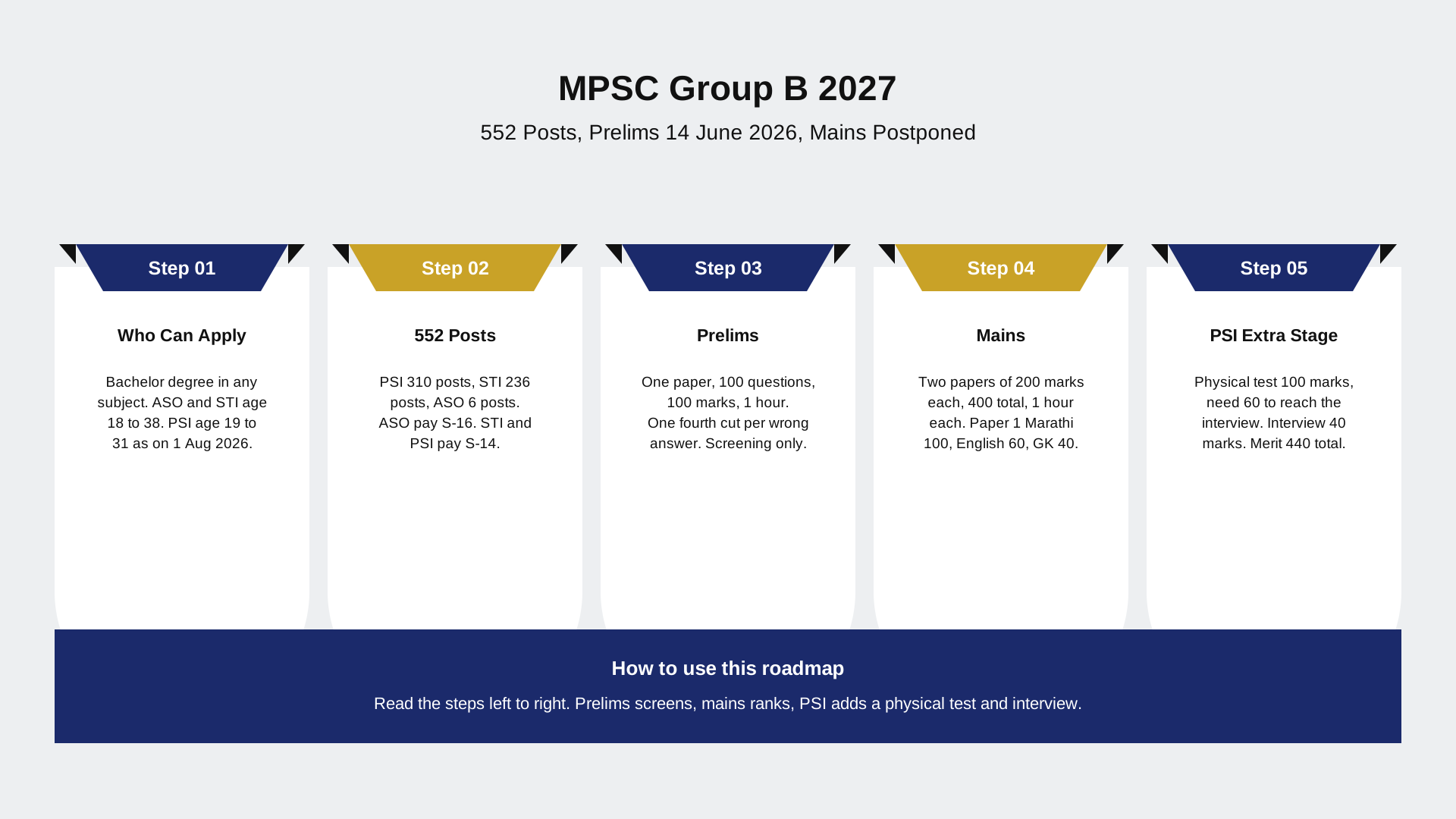
The MPSC Group B 2027 page on this site follows the live cycle of the Maharashtra Group B (Non-Gazetted) Services Combined Examination, and the live cycle is the 2026 examination. The Maharashtra Public Service Commission, known as MPSC, published Advertisement Number 011/2026 on 9 April 2026 for 552 posts. The posts are Police Sub Inspector with 310 posts, State Tax Inspector with 236 posts, and Assistant Section Officer with 6 posts. Applications ran from 10 April to 14 May 2026 after an extension from 30 April. The Preliminary Examination was held on 14 June 2026 and its result came on 1 July 2026, with 9,253 candidates qualifying for the mains. The mains examination was postponed by a notice dated 28 September 2026, and no new mains date had been announced as of 22 November 2026. No separate 2027 notification has been published, so this guide anchors on the 2026 cycle and says so wherever a 2027 figure would otherwise be guessed.
That matters because Group B is the one Maharashtra examination where a wrong cycle can cost a candidate a post, not just marks. Three cycles have run in quick succession, and tracker sites mix them up freely. The 2024 cycle carried 480 posts. The 2025 cycle began with 282 posts and grew to 758 posts through corrigenda. The 2026 cycle carries 552 posts. The post mix changes every time, the prelims cut off moves with it, and the PSI age limit is far tighter than the STI and ASO limits. A candidate who prepares from the 2024 numbers will expect 216 PSI posts and a cut off near 62.5 marks. The 2026 cycle has 310 PSI posts and an open category cut off of 53.25 marks. This guide uses the 2026 figures throughout and keeps the earlier cycles as history, clearly labelled as history.
The examination has two written stages for every post. A single objective prelims paper of 100 marks screens candidates. Two objective mains papers of 200 marks each decide the merit for STI and ASO. PSI candidates face two more stages after the mains: a physical test of 100 marks and an interview of 40 marks. Prelims marks count for nothing beyond the shortlist. That single fact shapes every sensible preparation plan, and this guide returns to it more than once.
MPSC Group B 2027 at a glance
| Detail | MPSC Group B 2027, as run in the 2026 cycle |
|---|---|
| Conducting body | Maharashtra Public Service Commission (MPSC) |
| Exam | Maharashtra Group B (Non-Gazetted) Services Combined Examination |
| Live cycle | 2026, Advertisement Number 011/2026 dated 9 April 2026 |
| Posts in live cycle | 552: Police Sub Inspector 310, State Tax Inspector 236, Assistant Section Officer 6 |
| Applications | 10 April to 14 May 2026, extended from 30 April 2026 |
| Prelims | 14 June 2026, one paper, 100 questions, 100 marks, 1 hour |
| Prelims result | 1 July 2026, 9,253 candidates qualified for the mains |
| Mains | Two papers of 200 marks each, 400 total, postponed by notice dated 28 September 2026, new date not announced as of 22 November 2026 |
| PSI only | Physical test 100 marks, need 60 marks to reach the interview, interview 40 marks |
| Education | Bachelor degree in any discipline from a recognised university |
| Age limit | ASO and STI 18 to 38 years open category as on 1 August 2026; PSI 19 to 31 years open category |
| Fee in live cycle | Prelims Rs 394 for open category, Rs 294 for reserved categories, Rs 44 for ex-servicemen |
| 2027 notification | Not published as of 22 November 2026 |
The 552 posts, and why the mix matters more than the total
The headline number is 552, but the mix is what decides a candidate's chances. Police Sub Inspector carries 310 posts, more than half the total. State Tax Inspector carries 236 posts. Assistant Section Officer carries 6 posts, and all 6 sit in the MPSC office itself. A candidate who wants ASO is chasing 6 posts against the whole state. A candidate who wants PSI is chasing 310 posts. The preparation is largely shared, since the prelims and the mains papers are common, but the odds are not shared at all, and the PSI candidate must also pass a physical test that the STI and ASO candidates never face.
The pay levels are set out in the 2026 advertisement. ASO sits at pay level S-16, with a scale of Rs 44,900 to Rs 1,42,400. STI and PSI sit at pay level S-14, with a scale of Rs 38,600 to Rs 1,22,800. Those are basic pay scales before allowances such as dearness allowance, house rent allowance and transport allowance, which vary by posting. The ASO scale is higher because the post sits in the secretariat and commission office structure, while STI and PSI are field posts with their own allowances and duties. A candidate choosing between STI and PSI on pay alone will find little difference in the scale. The difference sits in the work, the hours and the physical test.
The mix has swung widely from cycle to cycle, and that swing is the first thing a candidate should check in any new advertisement. In the 2024 cycle the split was PSI 216, STI 209 and ASO 55, a total of 480. In the 2025 cycle the split at notification was STI 279 and ASO 3, a total of 282, with no PSI post at all in the first advertisement. Corrigenda then added PSI 392 posts and Sub-Registrar and Stamp Inspector 84 posts, taking that cycle to 758 posts. In the 2026 cycle the split is PSI 310, STI 236 and ASO 6, a total of 552, with no Sub-Registrar post. The Sub-Registrar post appears in some cycles and not in others, and this guide does not treat it as a permanent part of Group B. Candidates should read the post table in the advertisement itself before deciding which post to aim for.
The mains application is where the post choice becomes binding. When a candidate who cleared the prelims applies for the mains, the candidate chooses one or more posts, and MPSC declares a separate result for each post. Those choices cannot be changed later. A candidate who applies for PSI alone cannot later claim an STI post from the same mains score, and a candidate who skips PSI in the mains application cannot later sit the physical test. The sensible move is to apply for every post the candidate is eligible for and interested in, subject to the PSI age and physical standards, because the mains papers are the same for all three posts and only the second paper has post specific sections.
The 2025 cycle, the one tracker sites get wrong
Most tracker pages about MPSC Group B 2027 describe the 2025 cycle as if it were a small STI and ASO recruitment of 282 posts. That description is wrong, and it is wrong in a way that misleads PSI candidates most of all. The 2025 cycle began as Advertisement Number 117/2025, dated 29 July 2025, and the first advertisement did carry only 282 posts: STI 279 and ASO 3. Corrigenda dated 14 August 2025 and 6 March 2026 then added posts, and the final count for the cycle was 758 posts: ASO 3, STI 279, PSI 392 and Sub-Registrar and Stamp Inspector 84. The PSI posts arrived after the first advertisement, which is why pages that copied only the first advertisement still show no PSI post for the cycle.
The dates of the 2025 cycle are also mangled on tracker sites, because the prelims moved. The prelims was first scheduled for 9 November 2025. It was postponed because district collectors and revenue staff were deployed on election and vote counting duties, and it was finally held on 4 January 2026. The prelims result came on 23 March 2026. The mains examination was held on 17 May 2026, with mains applications running from 8 to 22 April 2026 under Advertisement Number 010/2026. The PSI result of that mains cycle was published on 7 September 2026. A candidate who reads a page that still shows 9 November 2025 as the prelims date is reading a page that was never updated after the postponement.
One more error deserves a direct flag. PW Live gives the 2025 Group B advertisement number as 124/2025. That number belongs to the Group C examination of the same year, and the Group C prelims result pages confirm Advertisement Number 124/2025 for Group C. The Group B 2025 advertisement is 117/2025, as recorded by the CIAS Academy tracker from MPSC documents. The two examinations share a year and a commission, and a copied number is easy to miss, but a candidate who searches for 124/2025 expecting Group B documents will open the wrong advertisement. This guide uses 117/2025 for the Group B 2025 cycle throughout.
The 2025 cycle also shows how fast MPSC moves once the prelims is over. The gap from prelims on 4 January 2026 to result on 23 March 2026 was under three months, and the mains followed less than two months after the result. Candidates who waited for the prelims result before starting mains preparation had under eight weeks. The 2026 cycle has broken that rhythm, because the mains was postponed on 28 September 2026, but the lesson stands: mains preparation should run alongside prelims preparation, not after it.
The 2024 cycle, told as history
The 2024 cycle is the freshest completed map of how Group B actually runs from notification to mains, and its numbers are worth reading in full. The notification came as Advertisement Number 048/2024, with applications from 14 October to 4 November 2024. The cycle carried 480 posts: ASO 55, STI 209 and PSI 216. The prelims was scheduled for 5 January 2025 and was held on 2 February 2025. The prelims result came on 19 May 2025, and 8,179 candidates qualified for the mains. The mains examination was held on 29 June 2025.
The prelims cut off for the 2024 cycle was 62.5 marks for the open general category, as reported by PW Live and CareerPower from the official cut off list. The female open cut off was 59.25 marks, the Scheduled Caste cut off was 61.5 marks, and the Scheduled Tribe cut off was 56.5 marks. Those numbers look high against the 2026 cycle, where the open cut off fell to 53.25 marks. The difference is not a mystery. The 2026 cycle has more posts, 552 against 480, and more candidates qualified, 9,253 against 8,179, and the paper itself differs every year. A cut off is a result, not a target, and a candidate who aims for 62.5 marks because that was the 2024 cut off is aiming at the wrong year.
The fee structure of the 2024 cycle is the clearest record of how MPSC charges across the two written stages. The prelims fee was Rs 394 for the open category and Rs 294 for backward classes, Economically Weaker Sections, orphans and disabled candidates. The mains fee was Rs 544 for the open category and Rs 344 for the reserved categories. Those mains figures are the ones this guide cites for the mains stage, because the 2026 mains notice has not been published yet and its fee is not verified. Candidates should expect a separate mains fee at the mains application stage, and should not assume the prelims fee covers both stages.
Who can apply, and the age rule that decides PSI first
The education rule is simple and it is the same for all three posts. A bachelor degree in any discipline from a recognised university qualifies a candidate. There is no restriction on the subject of the degree. Final year students could apply in earlier cycles subject to passing the degree by the date MPSC fixes, and the 2026 advertisement keeps the same structure of eligibility. The degree rule is the reason Group B draws candidates from engineering, commerce, arts and science in the same hall, and the reason the prelims paper is set at degree standard rather than at the standard of any one subject.
The age rule is where the three posts split apart, and PSI is the post that splits hardest. Age is counted as on 1 August 2026 for the 2026 cycle. For ASO and STI, the minimum age is 18 years and the maximum is 38 years for open category candidates, 43 years for backward class, Economically Weaker Section and orphan candidates, and up to 45 years for disabled candidates. For PSI, the minimum age is 19 years and the maximum is 31 years for open category candidates, 34 years for backward class, Economically Weaker Section and orphan candidates, and 36 years for sportspersons and ex-servicemen. Disabled candidates are not eligible for PSI, under a Home Department resolution dated 4 August 2021 that the 2026 advertisement cites. A candidate who is 35 years old can apply for STI and ASO but cannot apply for PSI, and no amount of preparation changes that.
Knowledge of Marathi is required. MPSC states the requirement in the advertisement, and the mains Paper 1 tests Marathi directly at Class 12 standard for 100 marks. A candidate who studied in English medium through school and college can still qualify, but that candidate must treat Marathi as a scoring subject to be learned, not as a formality. The prelims paper is bilingual, Marathi and English, and a candidate may answer in either language, but the Marathi questions in the mains do not offer that choice.
There is no Maharashtra domicile condition that bars other Indians from applying for the examination itself, but reservation benefits are available only to candidates who hold Maharashtra domicile. Candidates from other states apply in the open category and pay the open category fee. The application runs through the MPSC online portal at mpsconline.gov.in, and the advertisement and notices appear on mpsc.gov.in. Candidates should keep their degree certificate, caste and category certificates where applicable, domicile proof and identity proof ready before the application window opens, because the window in the 2026 cycle ran for just over a month and the last date was extended only once.
The prelims paper, one hour that only screens
The MPSC Group B exam pattern starts with a single prelims paper. It is a General Ability Test, objective in type, with 100 multiple choice questions for 100 marks in 1 hour. The standard is that of a bachelor degree. The paper is a screening test only. Its marks do not count in the final merit list. The scheme of examination dated 9 October 2024, which governs the recent cycles, says about 12 times the number of posts are called to the mains, though the 2026 result called 9,253 candidates for 552 posts, which is closer to 17 times. The exact multiple varies by cycle and by category, and the cut off in each category decides the final count.
The marking rule is where careless candidates lose marks they never expected to lose. One fourth of a question's marks is deducted for each wrong answer. Since each question carries 1 mark in the prelims, a wrong answer costs 0.25 marks. A question left blank costs nothing. A question with more than one answer marked is treated as wrong and penalised the same way. That rule rewards disciplined guessing and punishes blind guessing. A candidate who can eliminate two options has a fair chance of gaining from an attempt. A candidate who guesses at random across twenty questions will lose about 5 marks net and will usually fall below the cut off.
Speed is the real test in this paper. One hundred questions in 60 minutes allows 36 seconds per question on average. That is far tighter than most state prelims papers, and it is the reason Group B prelims scores cluster in the fifties and sixties rather than in the eighties. A candidate who spends three minutes on a single hard question has already borrowed time from five other questions. The mock test habit that pays off fastest is the habit of marking an answer or moving on within forty seconds, then returning only if time remains. Accuracy matters more than attempts because of the one fourth deduction, so the candidate who attempts 85 questions with 75 correct will usually beat the candidate who attempts all 100 with 65 correct.
The syllabus for the prelims paper covers current affairs, history of India and Maharashtra, geography of India and Maharashtra, polity and governance, economy and planning, general science, and intelligence and arithmetic. Maharashtra specific questions carry a large share, and the history of Maharashtra, its social and economic awakening, its reformers and its freedom movement recur every year. The paper is set in Marathi and English, and the candidate should practise in the language the candidate will actually use on the day, because translating a question in the head costs seconds that this paper does not spare.
The mains papers, where the merit is made
The mains examination has two papers of 200 marks each, and every paper lasts 1 hour. Paper 1 is common to all posts. It carries Marathi for 100 marks with 50 questions at Class 12 standard, English for 60 marks with 30 questions, and General Knowledge for 40 marks with 20 questions. Paper 2 is the General Ability Test and subject specific paper. It carries 100 questions for 200 marks at degree standard, and its post specific part differs for PSI, STI and ASO. The total is 400 marks, and both papers count in the final merit for every post. All questions are objective multiple choice, not descriptive, which surprises candidates who know the Rajyaseva mains, where the papers are descriptive. Group B mains is a speed test in objective questions, twice over.
One discrepancy in tracker pages deserves a clear flag. CIAS Academy describes mains Paper 1 as Marathi 50 questions for 100 marks and English 50 questions for 100 marks, which would leave no room for the General Knowledge part. PW Live, Testbook, Exam Syllabus Hub and Police Job News all give the split as Marathi 50 questions for 100 marks, English 30 questions for 60 marks and General Knowledge 20 questions for 40 marks, a total of 100 questions and 200 marks. This guide follows the second version, because four independent sources agree on it and it matches the scheme of examination. Candidates should confirm the split from the mains notification itself when it appears, because the mains notification is the document that settles the paper.
Paper 1 carries a trap that graduates from science and engineering streams often overlook. Marathi alone is 100 of the 400 mains marks, a full quarter of the merit total. English adds 60 marks and General Knowledge adds 40 marks. A candidate who is strong in general studies but weak in Marathi grammar, vocabulary and comprehension starts the mains 30 or 40 marks behind a candidate who reads Marathi fluently. Two sessions a week on Marathi from the start of preparation closes that gap, while a fortnight of Marathi before the mains does not.
Paper 2 shares four blocks across all three posts: reasoning, history of Maharashtra, geography of Maharashtra, and the Indian Constitution. Each post then adds its own areas. The PSI version adds human rights and protective laws, including civil rights law, atrocities law and the evidence law that a police officer uses daily. The STI version adds tax law and bookkeeping. The ASO version adds secretariat procedure and administrative law. A candidate who applies for more than one post writes the Paper 2 version for each post applied for, and the post specific sections are the reason the mains application asks the candidate to choose posts carefully.
The negative marking in the mains is the same as in the prelims: one fourth of the question's marks for each wrong answer. In the mains each question carries 2 marks, so a wrong answer costs 0.5 marks. A blank answer costs nothing. The arithmetic of guessing is therefore the same as in the prelims, but the stakes are higher, because every mains mark counts in the merit list while prelims marks count for nothing. A candidate who guesses wildly in the mains is not gambling with a screening score. The candidate is gambling with the final rank.
The PSI physical test and interview, the stage only one post faces
PSI is the only Group B post with a physical stage, and it is the stage that ends the most PSI attempts after the mains. The physical standards are checked first. For men the minimum height is 165 cm barefoot, with a chest of 79 cm unexpanded and at least 5 cm expansion. For women the minimum height is 157 cm barefoot. The standards are relaxed for Scheduled Tribe candidates and for some reserved categories, and the advertisement lists the relaxed figures post by post, so a candidate near the limit should read the advertisement table rather than rely on a summary. Measurements are checked again before appointment.
The physical test itself carries 100 marks. About four times the number of PSI posts in each category are called for it after the mains. A candidate needs at least 60 marks in the physical test to be called for the interview, but the physical test marks are not counted in the final merit. The events for men are the 800 metre run for 50 marks, pull ups for 20 marks, shot put with a 7.260 kg shot for 15 marks, and long jump for 15 marks. The events for women are the 400 metre run for 50 marks, long jump for 30 marks, and shot put with a 4 kg shot for 20 marks. The run alone is half the test, which is why PSI candidates who cannot run 800 metres in the qualifying time fail the stage even when they clear every written paper.
Some tracker pages describe the physical test as qualifying in nature with pass or fail events and no marks. That description does not match the scheme of examination dated 9 October 2024, which gives the test 100 marks and a 60 mark threshold for the interview call. The marks do not enter the merit list, and in that sense the test is qualifying, but a candidate must score 60 of 100, not merely finish each event. A candidate who treats the run as a formality and trains only after the mains result will usually find the physical test window too short. The sensible plan is to run from the first month of preparation, because the mains result to physical test gap is often only a few weeks.
The interview carries 40 marks. Only PSI candidates face it. The board tests suitability for police service: clarity of thought, communication, confidence, awareness of Maharashtra and India, and the ability to take a view and defend it calmly. The PSI final merit list is made on mains marks plus interview marks, a total of 440 marks. The physical test contributes nothing to that total beyond the gate it opens. For STI and ASO, the final merit is the mains total of 400 marks alone, with no interview and no physical test. That difference is worth remembering when comparing cut offs across posts: a PSI cut off and an STI cut off are cut offs on different totals.
Fee, application and the calendar that keeps moving
The prelims fee in the 2026 cycle is Rs 394 for open category candidates, Rs 294 for backward class, Economically Weaker Section, orphan and disabled candidates, and Rs 44 for ex-servicemen. The fee is non refundable and does not include bank charges and taxes. Payment runs online by card or net banking, or by SBI challan within the window MPSC fixes. In the 2026 cycle the application window ran from 10 April to 14 May 2026, extended from 30 April, and the challan fee deadline ran a few days past the application deadline. Candidates should treat the challan deadline as a separate date, because an application paid late by challan is still a late application.
The mains stage carries its own application and its own fee. In the 2025 cycle the mains applications ran from 8 to 22 April 2026 under Advertisement Number 010/2026. In the 2024 cycle the mains fee was Rs 544 for the open category and Rs 344 for the reserved categories. The 2026 mains notice has not been published yet, because the mains was postponed on 28 September 2026, so the 2026 mains fee is not verified as of 22 November 2026. Candidates should budget for a mains fee in the same range and should watch mpsc.gov.in for the mains notice rather than assume the prelims fee covers both stages.
The calendar is the part of this examination that most often defeats careful candidates. The 2025 prelims moved from 9 November 2025 to 4 January 2026. The 2026 prelims was scheduled for 14 June 2026 and was held on that date, but the mains was postponed on 28 September 2026 with no new date. The Group C prelims of the same year moved three times. MPSC publishes its tentative schedule of competitive examinations each year, and the latest schedule available when this guide was written is for 2026, dated 17 October 2025. The 2027 schedule has not been seen yet. A candidate who books travel or leave on a tracker site date, without checking the MPSC notice, risks arriving on the wrong day.
Cut offs, and what they actually tell a candidate
The prelims cut off is the only public score that tells a candidate how hard the paper was, and the two recent cycles tell different stories. In the 2024 cycle the open general cut off was 62.5 marks out of 100. In the 2026 cycle the open cut off was 53.25 marks out of 100, with the same figure for Scheduled Caste, Other Backward Class, Socially and Educationally Backward Class, Vimukta Jati A, Nomadic Tribe C, Nomadic Tribe D and Special Backward Class categories. The Nomadic Tribe B cut off was 52.75 marks, the Economically Weaker Section cut off was 47.50 marks, and the Scheduled Tribe cut off was 43.75 marks. For women the open cut off was 50.25 marks, and the Economically Weaker Section female cut off was 44.00 marks. Those figures come from the prelims result published on 1 July 2026.
A nine mark fall in the open cut off does not mean the 2026 paper was nine marks harder. It means the paper, the post count and the candidate pool moved together. The 2026 cycle has 72 more posts than the 2024 cycle, and it called 1,074 more candidates to the mains. A larger shortlist pulls the cut off down even when the paper is the same difficulty. The female cut offs sit below the general cut offs in both cycles, which reflects the separate shortlist for women rather than a difference in the paper. Candidates should use the cut off as a floor for mock test scores, not as a prediction. A candidate who scores 55 marks in mocks is above the 2026 open cut off and below the 2024 open cut off, and both facts are true at once.
Mains cut offs are published with the mains result, post by post, and they are the numbers that decide selection. The PSI mains cut off sits on a total of 440 marks including the interview, while the STI and ASO cut offs sit on 400 marks. Comparing a PSI cut off with an STI cut off without noting the different totals misleads. The physical test also filters PSI candidates after the mains, so the PSI mains cut off alone does not tell a candidate whether the candidate will reach the interview. Sixty marks in the physical test is a separate gate, and it has ended attempts of candidates who ranked high in the mains.
How to prepare, in the order that matters
Preparation should follow the weight of the marks, not the order of the stages. The mains carries 400 of the 400 merit marks for STI and ASO, and 400 of the 440 merit marks for PSI, so mains preparation deserves the largest share of study time from the start. The prelims deserves enough time to clear the cut off safely, and no more. Candidates who spend a full year on prelims facts and then discover Marathi Paper 1 in the last month usually fail the mains on language marks, not on knowledge.
For the prelims, Maharashtra is the highest value subject. The history, geography and economy of the state appear in a large share of the 100 questions, and most candidates score their lowest marks here. A candidate should read one solid book on Maharashtra history and one on Maharashtra geography and economy, then revise them three times rather than reading three books once. Current affairs should cover the twelve months before the examination, with a focus on Maharashtra government schemes, appointments and state budget figures. Arithmetic and reasoning should be practised daily in short sets, because those questions are the fastest marks in the paper for a candidate who has drilled them.
For the mains, the single most useful habit is writing Paper 1 answers under time. Marathi grammar and comprehension improve slowly, and English at degree standard rewards a candidate who reads English daily. Paper 2 needs a different habit: the candidate should study the post specific part for the post the candidate actually wants, because the PSI, STI and ASO versions of Paper 2 diverge. A candidate who applies for all three posts should prepare the shared blocks first, then the post specific blocks for each post, in that order.
Mock tests for MPSC Group B 2027 should copy the real conditions. Prelims mocks should run 100 questions in 60 minutes with the one fourth negative marking enforced, including the rule that a question with more than one answer marked counts as wrong. A candidate who has never practised at 36 seconds per question will run out of time in the real paper, and the last ten questions will be guessed in a rush. Mains mocks should run two papers of one hour each, back to back, so that the candidate learns to switch from language to general ability without a break. PSI candidates should add a weekly run to the mock schedule, because the physical test is a gate that written mocks never test.
Revision should be planned backwards from the mains, not from the prelims. The gap between the prelims and the mains in the 2025 cycle was about four months, from 4 January to 17 May 2026, and the gap in the 2024 cycle was about five months, from 2 February to 29 June 2025. The 2026 mains has been postponed, which gives the 9,253 candidates who qualified on 1 July 2026 a longer window than either of those cycles. That window is the real mains preparation period, and candidates who wait for the new mains date before starting mains study waste most of it. The last thirty days before any written paper should carry no new book and no new topic. They should carry revision of notes, previous year papers, and full length mocks with error analysis.
Mistakes that end attempts
The first mistake in MPSC Group B 2027 is preparing from the wrong cycle. The 2024 cycle had 480 posts with ASO 55, the 2025 cycle grew from 282 to 758 posts through corrigenda, and the 2026 cycle has 552 posts with ASO 6. Books and guides printed for the 2024 cycle still circulate, and their vacancy and cut off figures are wrong for the 2026 cycle. Check the advertisement number on the cover of any guide: the live cycle is Advertisement Number 011/2026 dated 9 April 2026.
The second mistake is the post choice in the mains application. The choices made at the mains application stage cannot be changed later, and MPSC declares a separate result for each post. A candidate who applies for STI alone and then decides the candidate wants PSI has no route back. A candidate who applies for PSI without meeting the height and chest standards will clear the written papers and fail at measurement. Read the post table and the physical standards in the advertisement before choosing, not after the mains result.
The third mistake is ignoring Marathi. Paper 1 carries Marathi for 100 marks, a quarter of the mains total, and the prelims paper is bilingual. Candidates from English medium backgrounds who treat Marathi as a subject to be picked up in the last month lose 30 or 40 marks that no amount of general studies can recover. Two sessions a week from the start prevents that outcome.
The fourth mistake is trusting a single tracker site for dates and advertisement numbers. The prelims date for the 2025 cycle moved from 9 November 2025 to 4 January 2026, the 2026 mains was postponed on 28 September 2026, and PW Live gives the wrong advertisement number for the 2025 cycle. The official MPSC notices on mpsc.gov.in are the only sources that settle a date or a number. This guide lists the notice dates wherever a date moved.
The fifth mistake belongs to PSI candidates alone, and it is the most avoidable of all. The physical test needs 60 of 100 marks, and the run alone is 50 marks. Candidates who start running only after the mains result usually find the physical test window too short to build the needed fitness. Running should start in the first month of preparation, alongside the written study, because the physical test is a gate that no written score can open.
Pay, posting and the job itself
The three posts lead to very different working lives. A Police Sub Inspector joins the Maharashtra Police at the station level, supervises investigation and law and order work, and works shifts that include nights, festivals and election duty. The post carries authority and public contact from the first day, and it carries the physical demands that the physical test screens for. Promotion runs through the police hierarchy, and the precise timelines depend on vacancies and seniority, which this guide does not publish because the Commission does not publish them in the advertisement.
A State Tax Inspector joins the state tax department, works on assessment, audit and enforcement of state taxes, and spends the working day on records, returns and field verification. The post suits candidates who are comfortable with numbers and with tax law, and the Paper 2 tax and bookkeeping sections are the first taste of that work. An Assistant Section Officer joins the secretariat or the commission office, works on files, noting and drafting, and supports the senior officers of the department. The post suits candidates who write clearly and who want office work rather than field work.
All three posts are transferable state services. Postings move across districts, and the first posting is rarely the home district. Candidates who join for a posting near home should understand that the service does not work that way. The work in each post covers the whole state, and the interview board for PSI looks for candidates who understand that breadth and still want the job.
Where to check, and what this guide does not claim
Every date, post count and fee in this guide comes from the sources listed below. The official website is mpsc.gov.in, and the online application portal is mpsconline.gov.in. The advertisement, corrigenda, press notes, answer keys and results appear on the MPSC website first, and every other site copies them. A candidate who checks the MPSC website once a week from application to result will never miss a notice.
This guide does not publish a 2027 notification, because none exists as of 22 November 2026. It does not publish a 2027 vacancy count, a 2027 application window, or a 2027 fee. When the next notification appears, the figures in this guide will need updating, and the first place to check is the advertisement number on the MPSC website. The mock tests on this page follow the pattern of the live cycle: 100 questions and 100 marks for the prelims in 1 hour, two mains papers of 200 marks each, and the PSI physical test and interview after the mains.
One more caution belongs here. Several tracker sites label the 2024 cycle as the 2025 examination, because the prelims and mains of that cycle fell in 2025 while the notification is dated 2024. The notification is Advertisement Number 048/2024, the prelims was held on 2 February 2025, and the mains was held on 29 June 2025. The correct label for that cycle is the 2024 cycle, and this guide uses that label throughout. The page title carries 2027 because that is the year in which the 2026 cycle concludes and because this site groups its examination pages by that year. The next step for a candidate in the live cycle is to watch for the mains notice on mpsc.gov.in, because the postponed mains is the one date that decides the rest of this cycle.
Sources
Maharashtra Public Service Commission, Advertisement Number 011/2026 dated 9 April 2026, 552 posts, PSI 310, STI 236, ASO 6, applications 10 April to 14 May 2026, on mpsc.gov.in. MPSC notice dated 28 September 2026, Group B mains postponed. MPSC Group B (Non-Gazetted) Scheme of Examination dated 9 October 2024, prelims 100 questions and 100 marks in 1 hour, mains two papers of 200 marks each, negative marking one fourth, PSI physical test 100 marks and interview 40 marks. CIAS Academy, MPSC Results and Notifications 2026-27 tracker, updated 3 November 2026, Group B 2025 cycle Advertisement Number 117/2025 dated 29 July 2025, corrigenda 14 August 2025 and 6 March 2026, 758 posts, prelims result 23 March 2026, mains 17 May 2026, Group B 2026 cycle Advertisement Number 011/2026, 552 posts. CIAS Academy, MPSC Combined Syllabus 2026, PSI STI ASO paper wise, Group B scheme dated 9 October 2024 and Advertisement Number 011/2026, PSI height 165 cm men and 157 cm women, chest 79 cm with 5 cm expansion, physical test 100 marks with 60 needed for interview, interview 40 marks, pay ASO S-16 Rs 44,900 to Rs 1,42,400, STI and PSI S-14 Rs 38,600 to Rs 1,22,800, age ASO and STI 18 to 38 years, PSI 19 to 31 years as on 1 August 2026. Sarkari Job, MPSC Group B Prelims Result 2026, Advertisement Number 011/2026, prelims 14 June 2026, result 1 July 2026, 9,253 candidates qualified, cut off open 53.25, fee Rs 394 open and Rs 294 reserved. PW Live, MPSC Group B Combined Notification 2025, notification 29 July 2025, 282 posts at notification, STI 279 and ASO 3, applications 1 to 21 August 2025, prelims first 9 November 2025 then 4 January 2026, fee Rs 719 open and Rs 449 reserved as a tentative figure. Testbook, MPSC STI Recruitment 2025, 282 vacancies, STI 279 and ASO 3, applications 1 to 21 August 2025, prelims 9 November 2025. PW Live, MPSC Group B Mains Exam Date 2025, prelims 2 February 2025, mains 29 June 2025, 480 vacancies. PW Live, MPSC Group B Cut Off 2025, prelims 2 February 2025, result 19 May 2025, open cut off 62.5 marks. GovtJobGuru, MPSC Group B Recruitment 2024, Advertisement Number 048/2024, 480 vacancies, ASO 55, STI 209, PSI 216, applications 14 October to 4 November 2024, prelims fee Rs 394 and mains fee Rs 544. Apni Pathshala, MPSC Group B Result 2025 Declared, prelims 2 February 2025, result 19 May 2025, 8,179 candidates qualified for mains. Exam Syllabus Hub, MPSC Combine Syllabus, prelims 100 questions and 100 marks in 1 hour, mains Paper 1 Marathi 50 questions 100 marks, English 30 questions 60 marks, General Knowledge 20 questions 40 marks, Paper 2 100 questions 200 marks, negative marking one fourth. Police Job News, Maharashtra Police SI Recruitment 2026, mains 5 December 2026 as per the MPSC calendar released in October 2025, Paper 1 Marathi 100, English 60, General Knowledge 40, physical test 100 marks with 60 needed, interview 40 marks.







