
About MPSC Group C 2027 Exam Series
📖 Table of Contents
- MPSC Group C 2027 at a glance
- How 2,619 posts became 16,717
- The big cadres in the 16,717 posts
- The 2025 cycle, the completed map
- The 2024 cycle, told as history
- Who can apply, and the age rule that varies by cadre
- The prelims paper, one hour that only screens
- The mains papers, where the merit is made
- The typing certificate, and the test that does not exist
- Fee, application and the window that is open now
- Cut offs, and what they actually tell a candidate
- How to prepare, in the order that matters
- Mistakes that end attempts
- Pay, posting and the job itself
- Where to check, and what this guide does not claim
- Sources
MPSC Group C 2027: Complete Exam Guide
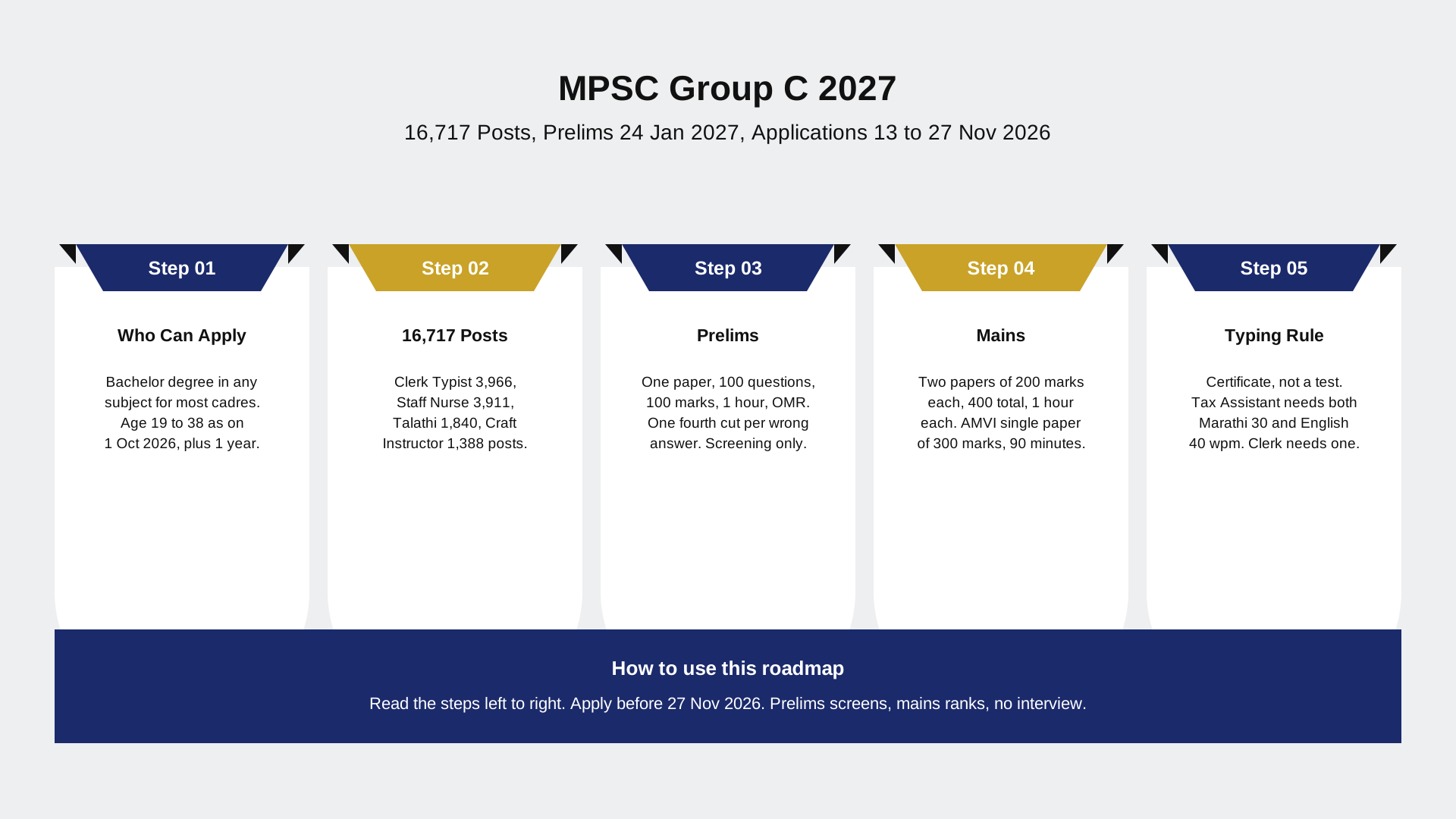
The MPSC Group C 2027 page on this site follows the live cycle of the Maharashtra Group C Services Combined Examination, and the live cycle is the 2026 examination. The Maharashtra Public Service Commission, known as MPSC, published Advertisement Number 017/2026 on 25 June 2026 for 2,619 posts. Corrigenda then raised the total twice: to 5,707 posts on 22 July 2026, and to 16,717 posts on 6 November 2026. The Preliminary Examination is scheduled for 24 January 2027 in offline OMR mode. Applications reopened from 13 November to 27 November 2026 so that new candidates could apply and earlier applicants could opt for the new cadres, with a one year relaxation in the upper age limit. No separate 2027 notification has been published as of 22 November 2026, so this guide anchors on the 2026 cycle and says so wherever a 2027 figure would otherwise be guessed.
That matters because Group C is the one Maharashtra examination where the post count in most published material is already out of date. Pages written in July 2026 show 2,619 posts. Pages written in September 2026 show 5,707 posts. Both figures are wrong now. The 6 November 2026 corrigendum added 11,010 posts and moved the prelims from 3 January to 24 January 2027. A candidate who prepares from the July figure will think this is a clerk typist examination of under 2,000 posts. The live cycle is a 16,717 post recruitment that includes staff nurses, village revenue officers, craft instructors, Krushi Sevaks and civil engineering assistants alongside the clerk typists. This guide uses the 16,717 figure throughout and keeps the earlier figures as history, clearly labelled as history.
The examination has two written stages and no interview. A single objective prelims paper of 100 marks screens candidates. Two objective mains papers of 200 marks each decide the merit for the clerical and inspectorate posts. The Assistant Motor Vehicle Inspector sits a separate single mains paper of 300 marks. Typing is a certificate qualification, not a test, for the clerk typist and tax assistant posts. Prelims marks count for nothing beyond the shortlist. That single fact shapes every sensible preparation plan, and this guide returns to it more than once.
MPSC Group C 2027 at a glance
| Detail | MPSC Group C 2027, as run in the 2026 cycle |
|---|---|
| Conducting body | Maharashtra Public Service Commission (MPSC) |
| Exam | Maharashtra Group C Services Combined Preliminary Examination 2026 |
| Live cycle | 2026, Advertisement Number 017/2026 dated 25 June 2026 |
| Posts in live cycle | 16,717 after the corrigendum dated 6 November 2026, up from 2,619 at notification and 5,707 on 22 July 2026 |
| Applications | 27 June to 10 August 2026, then reopened 13 to 27 November 2026 for new cadres, with a one year age relaxation |
| Prelims | 24 January 2027, one paper, 100 questions, 100 marks, 1 hour, offline OMR |
| Mains | Two papers of 200 marks each, 400 total, for clerical and inspectorate posts; single 300 mark paper for Assistant Motor Vehicle Inspector; date to be announced |
| Interview | None |
| Typing | Certificate qualification, not a test: Tax Assistant needs Marathi 30 words per minute and English 40 words per minute, Clerk Typist needs either one |
| Education | Bachelor degree in any discipline from a recognised university for most cadres; diploma or degree for technical cadres |
| Age limit | 19 to 38 years unreserved as on 1 October 2026 for most cadres, 18 minimum for Tax Assistant, with relaxations to 43 and 45 years |
| Fee in live cycle | Prelims Rs 394 for open category, Rs 294 for reserved categories, Rs 44 for ex-servicemen; mains Rs 544 open, Rs 344 reserved |
| 2027 notification | Not published as of 22 November 2026 |
How 2,619 posts became 16,717
The post count of this cycle moved three times, and each move changed who should apply. The advertisement of 25 June 2026 listed 2,619 posts: Clerk Typist 1,864, Assistant Motor Vehicle Inspector 461, Tax Assistant 282, Industry Inspector 9 and Technical Assistant 3. Applications opened on 27 June 2026 with a first deadline of 17 July 2026. The prelims was first set for 27 September 2026 as a computer based test. That was the examination as first advertised, and it is the examination most tracker pages still describe.
The first change came on 16 July 2026. MPSC deferred computer based testing to July 2027, moved the prelims to offline OMR mode on 25 October 2026, set the mains for 27 December 2026, and extended the application deadline to 31 July 2026. The second change came on 22 July 2026, when a corrigendum added 3,088 posts across several cadres, taking the total to 5,707. The additions were 1,539 village revenue officers, the post Maharashtra knows as Talathi, 254 assistant fisheries development officers, 11 senior record keepers and 11 assistant superintendents for the consumer commission, and 1,273 more clerk typists across revenue and forest, registration and stamps, rationing, food and civil supplies and tribal development departments. The application deadline moved to 5 August 2026 and the fee deadline to 8 August 2026. A further corrigendum on 5 August 2026 dealt with village revenue officer posts in scheduled areas and the children of disabled and deceased ex-servicemen.
The third change came on 9 September 2026, when a press note moved the prelims from 25 October 2026 to 3 January 2027, citing centre availability in the districts, the State Services mains of October, the festival season, other agencies timetables and the winter session. The mains date of 27 December 2026 announced in July could not stand once the prelims moved, and MPSC said the mains date would be re-announced. That was the position as of early November 2026, and it is the position that the CIAS Academy tracker and the Brolly guide both record.
The fourth change came on 6 November 2026, and it is the largest of all. MPSC issued a corrigendum raising the posts from 5,707 to 16,717, an addition of 11,010 posts, and moved the prelims from 3 January to 24 January 2027. Applications reopened from 2 pm on 13 November to 11.59 pm on 27 November 2026, so that new candidates could apply and earlier applicants could opt for the new cadres. A one year relaxation in the upper age limit was announced with the same corrigendum. The commission announced the corrigendum on its official account on 6 November 2026, and Jagran Josh and the Daily Jagran reported the same figures on 9 November 2026. As of 22 November 2026 the application window is still open, and it closes on 27 November 2026.
The lesson of this sequence is not that MPSC is careless. The lesson is that a Group C corrigendum overrides the original advertisement on dates, post counts and rules, and a candidate who reads only the advertisement will miss the examination that is actually being held. The newest notice should always be read first. In this cycle the newest notice is the corrigendum dated 6 November 2026, and it changes the post count, the prelims date, the application window and the age limit all at once.
The big cadres in the 16,717 posts
The largest cadres in the expanded list show how far this cycle has grown beyond a clerk typist recruitment. Clerk Typist carries 3,966 posts, Staff Nurse carries 3,911 posts, Village Revenue Officer or Talathi carries 1,840 posts, Craft Instructor carries 1,388 posts, Krushi Sevak, formerly Assistant Agriculture Officer, carries 1,203 posts, and Civil Engineering Assistant carries 949 posts. The original five cadres still sit inside the total: Assistant Motor Vehicle Inspector 461, Tax Assistant 282, Industry Inspector 9 and Technical Assistant 3, with Clerk Typist now at 3,966 rather than the 1,864 first advertised. The full cadre wise list runs across many departments, and the reservation wise break up sits in the corrigendum appendices, so a candidate should read the corrigendum itself for the exact count of the cadre the candidate wants.
The Staff Nurse cadre deserves a note, because it surprises candidates who think of Group C as a clerical examination. The 3,911 staff nurse posts sit in the Medical Education and Drugs department, and they carry their own qualification rules. The Krushi Sevak cadre was renamed from Assistant Agriculture Officer by a corrigendum on 20 November 2026, and the rename changed nothing else about the post. The Talathi cadre carries 1,840 posts in this cycle, up from the 1,539 added in July, and the village revenue officer is examined on the same prelims and mains as the other cadres. The 2023 Talathi recruitment was run by the revenue department through an outsourced online test with normalisation, and it has nothing to do with this examination. Candidates who prepare from 2023 Talathi material are preparing for a different test.
The pay levels for the original cadres are set out in the advertisement. Clerk Typist sits at pay level S-6, with a scale of Rs 19,900 to Rs 63,200. Tax Assistant sits at pay level S-8, with a scale of Rs 25,500 to Rs 81,100. Technical Assistant sits at pay level S-10, with a scale of Rs 29,200 to Rs 92,300. Industry Inspector sits at pay level S-13, with a scale of Rs 35,400 to Rs 1,12,400. Those are basic pay scales before allowances such as dearness allowance and house rent allowance. The pay levels for the cadres added by the July and November corrigenda are fixed cadre by cadre in the corrigendum appendices, and this guide does not publish a single pay figure for them because no single figure exists. A candidate should check the pay level of the chosen cadre in the corrigendum before applying.
The reservation structure follows the Maharashtra pattern, with the Socially and Educationally Backward Class reservation applied subject to the Bombay High Court final decision. The Tax Assistant reservation in the 25 June advertisement split 282 posts into 180 reserved and 102 unreserved, and the Assistant Motor Vehicle Inspector reservation split 461 posts into 295 reserved and 166 unreserved. The clerk typist posts are split office by office across the later pages of the advertisement. Candidates should check the reservation table for their own category and cadre rather than rely on the headline totals.
The 2025 cycle, the completed map
The 2025 cycle is the freshest completed map of how Group C actually runs, and its numbers are worth reading in full. The notification came as Advertisement Number 124/2025, with applications from 7 October to 27 October 2025. The cycle began with 938 posts: Clerk Typist 852, Tax Assistant 73, Industry Inspector 9 and Technical Assistant 4. A corrigendum dated 25 March 2026 raised the total to 1,741 posts: Clerk Typist 1,527, Sub-Inspector in the State Excise Department 125, Tax Assistant 73, Industry Inspector 9, Technical Assistant 4, and Bailiff and Clerk in the Office of the Sheriff, Mumbai 3. The Sub-Inspector post appears only in the revised list, which is why pages that copied only the first advertisement show no Sub-Inspector post for the cycle.
The prelims of the 2025 cycle was first scheduled for 4 January 2026 and was held on 11 January 2026. The result came on 4 May 2026, and 31,236 candidates qualified for the mains. The open general cut off was 50.25 marks out of 100, the female open cut off was 47.50 marks, the Scheduled Caste general cut off was 40.25 marks, and the Scheduled Tribe general cut off was 42 marks. The mains examination was held on 12 July 2026 under Advertisement Number 014/2026, with mains applications closing on 4 June 2026. The industry inspector recommendation list and the technical assistant merit list were published on 25 August 2026, and the clerk typist general merit list, with appointing authority preferences, followed in September 2026.
Two figures from the 2025 cycle need a flag. PW Live gives the mains dates as 29 March to 26 April 2026, but the mains was actually held on 12 July 2026, as reported by FreeJobAlert and Brolly from the mains notification. The March to April dates were the expected window published before the mains notification appeared, and they did not stand. FreeJobAlert also reports the mains notification as covering 1,884 posts, against the revised prelims total of 1,741 posts. That difference is not explained in the sources this guide could read, and the mains notification itself was not read in full by Brolly either. This guide uses 1,741 as the prelims total and flags the 1,884 figure as reported but unverified.
The 2025 cycle also shows the scale of the competition. More than 31,000 candidates qualified the prelims for 1,741 posts, which is about 18 candidates per post at the mains stage. The prelims cut off of 50.25 marks for the open category is the floor that cleared that field. A candidate who scores 50 marks in mocks is below that floor, and a candidate who scores 60 marks is above it, but the floor moves every cycle with the post count and the paper. The 2026 cycle has far more posts, 16,717 against 1,741, and the floor will move with that change.
The 2024 cycle, told as history
The 2024 cycle ran alongside the Group B 2024 cycle and shared its application window. The notification came as Advertisement Number 049/2024, dated 9 October 2024, with applications from 14 October to 4 November 2024. The cycle carried 1,333 posts: Clerk Typist 786, Tax Assistant 482, Industry Inspector 39, Technical Assistant 9, and Bailiff and Clerk 17. The prelims was held on 2 February 2025. The prelims fee was Rs 394 for the open category and Rs 294 for the reserved categories, and the mains fee was Rs 544 for the open category and Rs 344 for the reserved categories.
One figure in the 2024 cycle is often copied wrong, and it deserves a direct flag. PlacementStore gives the Tax Assistant count as 428 posts, but the advertisement total is 1,333 posts, and 39 plus 428 plus 9 plus 17 plus 786 comes to 1,279, not 1,333. The correct Tax Assistant figure is 482 posts, as reported by MH Job Alert and RRB Ranchi, because 39 plus 482 plus 9 plus 17 plus 786 comes to 1,333 exactly. A candidate who uses the 428 figure will undercount the largest tax cadre of that cycle by 54 posts.
The 2024 cycle also shows how long a Group C cycle can take to close. The final clerk typist list of 8 June 2026 recommended 975 candidates and withheld one Economically Weaker Section sportsperson post for a judicial matter. The list came more than sixteen months after the prelims. Candidates in the 2026 cycle should expect a similar length of process, with the prelims in January 2027, the mains to follow, and the final lists months after that. The examination rewards candidates who keep their documents ready across that whole period, because certificate verification comes at the end, not at the start.
Who can apply, and the age rule that varies by cadre
The education rule depends on the cadre, and the advertisement lists the qualification cadre by cadre. For most cadres, including Clerk Typist and Tax Assistant, a bachelor degree in any discipline from a recognised university qualifies a candidate. There is no restriction on the subject of the degree. Industry Inspector needs an engineering degree or a diploma in technology, or a science degree other than a vocational degree. Technical Assistant needs a bachelor degree. Assistant Motor Vehicle Inspector needs SSC with a three year diploma or a degree in automobile or mechanical engineering, a year of experience, driving licences and no colour blindness. The qualification for each cadre sits in Appendix 3 of the corrigendum for the added cadres, and a candidate should read that appendix for the cadre the candidate wants rather than assume a degree covers every post.
The age rule varies by cadre too, and that variation is the part of this examination that most often defeats careful candidates. Age is reckoned on 1 October 2026 for most cadres, except the village revenue officer, where it is reckoned on 5 August 2026. The minimum age is 19 years for most cadres and 18 years for Tax Assistant. The maximum age is 38 years for unreserved candidates, 43 years for backward classes, orphans, Economically Weaker Sections and sportspersons, and 45 years for disabled candidates. Project affected and earthquake affected candidates have a maximum of 45 years, and part time graduates in the clerk typist cadre have a maximum of 55 years. Ex-servicemen have 38 or 43 years plus service plus three years. The one year relaxation announced with the 6 November 2026 corrigendum sits on top of those limits for the 2026 cycle. A candidate whose age is close to the limit should check the age reckoning date for the chosen cadre, because the village revenue officer date differs from the rest by nearly two months.
Knowledge of Marathi is required. MPSC states the requirement in the advertisement, and the mains Paper 1 tests Marathi directly for 100 marks. A candidate who studied in English medium through school and college can still qualify, but that candidate must treat Marathi as a scoring subject to be learned, not as a formality. The prelims paper is bilingual, Marathi and English, and a candidate may answer in either language, but the Marathi questions in the mains do not offer that choice.
There is no Maharashtra domicile condition that bars other Indians from applying for the examination itself, but reservation benefits are available only to candidates who hold Maharashtra domicile. Candidates from other states apply in the open category and pay the open category fee. The application runs through the MPSC online portal at mpsconline.gov.in, and the advertisement and notices appear on mpsc.gov.in. Candidates should keep their degree certificate, caste and category certificates where applicable, domicile proof and identity proof ready before the application window opens, because the reopened window in this cycle runs only from 13 to 27 November 2026.
The prelims paper, one hour that only screens
The MPSC Group C exam pattern starts with a single prelims paper. It is a General Ability Test, objective in type, with 100 multiple choice questions for 100 marks in 1 hour. The standard is that of a bachelor degree. The paper is a screening test only. Its marks do not count in the final merit list. The paper is held in Marathi and English, and the candidate should practise in the language the candidate will actually use on the day, because translating a question in the head costs seconds that this paper does not spare.
The marking rule is where careless candidates lose marks they never expected to lose. One fourth of a question's marks is deducted for each wrong answer. Since each question carries 1 mark in the prelims, a wrong answer costs 0.25 marks. A question left blank costs nothing. A question with more than one answer marked is treated as wrong and penalised the same way. That rule rewards disciplined guessing and punishes blind guessing. A candidate who can eliminate two options has a fair chance of gaining from an attempt. A candidate who guesses at random across twenty questions will lose about 5 marks net and will usually fall below the cut off.
Speed is the real test in this paper. One hundred questions in 60 minutes allows 36 seconds per question on average. That is far tighter than most state prelims papers, and it is the reason Group C prelims scores cluster in the fifties rather than in the eighties. A candidate who spends three minutes on a single hard question has already borrowed time from five other questions. The mock test habit that pays off fastest is the habit of marking an answer or moving on within forty seconds, then returning only if time remains. Accuracy matters more than attempts because of the one fourth deduction, so the candidate who attempts 85 questions with 75 correct will usually beat the candidate who attempts all 100 with 65 correct.
The syllabus for the prelims paper covers current affairs, history of India and Maharashtra, geography of India and Maharashtra, polity and governance, economy and planning, general science, and arithmetic and reasoning. Maharashtra specific questions carry a large share, and the history of Maharashtra, its social and economic awakening, its reformers and its freedom movement recur every year. The prelims of the 2026 cycle will be held on OMR sheets, not on computer, after the corrigendum of 16 July 2026 deferred computer based testing to July 2027. Candidates should practise on OMR sheets, because bubbling answers costs time that a computer based mock does not charge.
The mains papers, where the merit is made
The mains examination for the clerical and inspectorate posts has two papers of 200 marks each, and every paper lasts 1 hour. Paper 1 is common to all those posts. It carries Marathi with 50 questions and English with 50 questions, a total of 100 questions and 200 marks, with Marathi set at Class 12 standard and English set at degree standard. Paper 2 is the General Studies and Intelligence Test. It carries 100 questions for 200 marks at degree standard. The total is 400 marks, and both papers count in the final merit. All questions are objective multiple choice, not descriptive. The mains date for the 2026 cycle has not been announced, because the prelims moved to 24 January 2027 and the earlier mains date of 27 December 2026 could not stand.
One discrepancy in tracker pages deserves a clear flag. Jagran Josh and Testkart give the Paper 1 split as Marathi 60 questions for 120 marks and English 40 questions for 80 marks. Brolly, which read the advertisement and the pattern announcement of 1 August 2026, gives the split as Marathi 50 questions and English 50 questions, a total of 100 questions and 200 marks. This guide follows the second version, because Brolly cites the advertisement directly and the 50 and 50 split matches the Group C scheme documents. Candidates should confirm the split from the mains notification itself when it appears, because the mains notification is the document that settles the paper.
Paper 1 carries a trap that graduates from science and engineering streams often overlook. Marathi alone is 100 of the 400 mains marks, a full quarter of the merit total. English adds 100 marks. A candidate who is strong in general studies but weak in Marathi grammar, vocabulary and comprehension starts the mains 30 or 40 marks behind a candidate who reads Marathi fluently. Two sessions a week on Marathi from the start of preparation closes that gap, while a fortnight of Marathi before the mains does not.
The Assistant Motor Vehicle Inspector sits a different mains. That post takes a single mains paper of 150 questions and 300 marks on mechanical and automobile engineering, in English, at diploma standard, in 90 minutes, with the same one fourth negative marking. The AMVI candidate then faces verification of the physical standards: men 163 cm height and 79 cm chest with 5 cm expansion, women 155 cm height and 45 kg weight. The AMVI mains is the only mains in Group C that tests a technical subject, and it is the reason AMVI candidates should prepare from engineering material rather than from the general mains books.
The negative marking in the mains is the same as in the prelims: one fourth of the question's marks for each wrong answer. In the mains each question carries 2 marks, so a wrong answer costs 0.5 marks. A blank answer costs nothing. The arithmetic of guessing is therefore the same as in the prelims, but the stakes are higher, because every mains mark counts in the merit list while prelims marks count for nothing. A candidate who guesses wildly in the mains is not gambling with a screening score. The candidate is gambling with the final rank.
The mains also carries percentile floors that candidates rarely notice until the result. The floors are the 35th percentile for unreserved candidates, the 30th percentile for backward classes and orphans, and the 20th percentile for disabled candidates and sportspersons, on the written marks. A candidate who clears the category cut off but falls below the percentile floor does not qualify. The mains cut off for Industry Inspector in the 2025 cycle was 310 marks out of 400, which shows how high the merit can run for a small cadre with few posts.
The typing certificate, and the test that does not exist
The typing rule is the most misunderstood part of Group C, and the misunderstanding runs in both directions. The rule is a certificate qualification, not a test. A Tax Assistant needs a Government Commercial Certificate in Marathi typing at 30 words per minute and in English typing at 40 words per minute, both. A Clerk Typist needs Marathi at 30 words per minute or English at 40 words per minute, either one. An MS-CIT type certificate under the resolution of 31 October 2013 is accepted. The certificate must be held by the closing date of the mains application, with a two year post appointment window for disabled candidates, ex-servicemen and orphans. The commission conducts no typing test for these cadres and awards no marks for typing.
Several tracker pages describe a typing skill test after the mains, with three times the vacancies shortlisted and a ten minute test at 30 and 40 words per minute. That description does not match the advertisement. Clause 8.1 of the advertisement lists the stages as prelims and mains only, and the recommendation follows the mains merit and certificate verification. A candidate who spends months preparing for a typing test that MPSC does not conduct is preparing for the wrong stage, and a candidate who has no typing certificate at the mains application date is disqualified even with a high mains score. The certificate should be obtained before the mains application, not after the mains result.
The Bailiff and Clerk post in the 2025 cycle followed the same certificate rule, with Marathi or English typing at the same speeds. The typing speeds are given in words per minute, and the certificate examination also records key depressions per hour: 1,000 for Marathi and 1,200 for English in ten minutes. Those figures appear on the certificate itself, and the candidate need only hold the certificate. No typing marks enter the merit list, and no typing speed is tested again by the commission.
Fee, application and the window that is open now
The prelims fee in the 2026 cycle is Rs 394 for open category candidates, Rs 294 for backward class, Economically Weaker Section, orphan and disabled candidates, and Rs 44 for ex-servicemen. The mains fee is Rs 544 for the open category, Rs 344 for the reserved categories, and Rs 44 for ex-servicemen. The fee is non refundable and does not include bank charges and taxes. Payment runs online by card or net banking, or by SBI challan within the window MPSC fixes. In the original window the fee deadline ran a few days past the application deadline, and candidates should treat the challan deadline as a separate date, because an application paid late by challan is still a late application.
The application window is the most urgent fact in this guide. The original window ran from 27 June to 10 August 2026, after extensions from 17 July and 31 July and 5 August. The window then reopened from 2 pm on 13 November to 11.59 pm on 27 November 2026, so that new candidates could apply and earlier applicants could opt for the new cadres added by the 6 November 2026 corrigendum. As of 22 November 2026 that window is still open, and it closes on 27 November 2026. A candidate who reads this guide after that date has missed the window, and no extension has been announced. The application runs through the MPSC online portal at mpsconline.gov.in, and the candidate should use the Check Eligibility option against Advertisement Number 017/2026.
The calendar is the part of this examination that most often defeats careful candidates. The prelims moved from 27 September 2026 to 25 October 2026, then to 3 January 2027, then to 24 January 2027. The mains moved with it, from 27 December 2026 to a date to be announced. MPSC publishes its tentative schedule of competitive examinations each year, and the latest schedule available when this guide was written is for 2026, dated 17 October 2025. The 2027 schedule has not been seen yet. A candidate who books travel or leave on a tracker site date, without checking the MPSC notice, risks arriving on the wrong day. The admit card and exam timing for the prelims will be published on mpsc.gov.in closer to 24 January 2027.
Cut offs, and what they actually tell a candidate
The prelims cut off is the only public score that tells a candidate how hard the paper was, and the 2025 cycle gives the freshest reading. The open general cut off was 50.25 marks out of 100, the female open cut off was 47.50 marks, the Scheduled Caste general cut off was 40.25 marks, and the Scheduled Tribe general cut off was 42 marks. Those figures come from the prelims result published on 4 May 2026, when 31,236 candidates qualified for the mains. The cut off is a result, not a target, and a candidate who aims for 50.25 marks because that was the 2025 cut off is aiming at the wrong year. The 2026 cycle has 16,717 posts against 1,741 in the 2025 cycle, and the floor will move with that change.
Mains cut offs are published with the mains result, cadre by cadre, and they are the numbers that decide selection. The Industry Inspector mains cut off in the 2025 cycle was 310 marks out of 400, which is 77.5 percent of the total, and it shows how high the merit can run for a small cadre. The clerk typist merit list is published with appointing authority preferences, because the clerk typist posts sit in many departments and the candidate's preference decides the posting office. Candidates should use the mains cut off of their own cadre as the floor for mock test scores, not the cut off of a different cadre.
The percentile floors sit underneath the cut offs and catch candidates who miss them. The floors are the 35th percentile for unreserved candidates, the 30th percentile for backward classes and orphans, and the 20th percentile for disabled candidates and sportspersons, on the written marks. A candidate who clears the category cut off but falls below the percentile floor does not qualify. The floors are published in the scheme, not in the advertisement, which is why tracker pages rarely mention them, and why candidates first learn of them from the result.
How to prepare, in the order that matters
Preparation should follow the weight of the marks, not the order of the stages. The mains carries 400 of the 400 merit marks for the clerical and inspectorate posts, so mains preparation deserves the largest share of study time from the start. The prelims deserves enough time to clear the cut off safely, and no more. Candidates who spend a full year on prelims facts and then discover Marathi Paper 1 in the last month usually fail the mains on language marks, not on knowledge.
For the prelims, Maharashtra is the highest value subject. The history, geography and economy of the state appear in a large share of the 100 questions, and most candidates score their lowest marks here. A candidate should read one solid book on Maharashtra history and one on Maharashtra geography and economy, then revise them three times rather than reading three books once. Current affairs should cover the twelve months before the examination, with a focus on Maharashtra government schemes, appointments and state budget figures. Arithmetic and reasoning should be practised daily in short sets, because those questions are the fastest marks in the paper for a candidate who has drilled them.
For the mains, the single most useful habit is writing Paper 1 answers under time. Marathi grammar and comprehension improve slowly, and English at degree standard rewards a candidate who reads English daily. Paper 2 needs a different habit: the candidate should study the shared blocks first, then the post specific knowledge for the cadre the candidate wants, because the Paper 2 questions differ by cadre. AMVI candidates should prepare from mechanical and automobile engineering material at diploma standard, in English, because their mains is a technical paper of 150 questions in 90 minutes.
Mock tests for MPSC Group C 2027 should copy the real conditions. Prelims mocks should run 100 questions in 60 minutes on an OMR sheet, with the one fourth negative marking enforced, including the rule that a question with more than one answer marked counts as wrong. A candidate who has never practised at 36 seconds per question will run out of time in the real paper, and the last ten questions will be guessed in a rush. Mains mocks should run two papers of one hour each, back to back, so that the candidate learns to switch from language to general ability without a break.
Revision should be planned backwards from the prelims date of 24 January 2027. The last thirty days before the prelims should carry no new book and no new topic. They should carry revision of notes, previous year papers, and full length mocks with error analysis. The gap between the prelims and the mains is the real mains preparation window for candidates who clear the prelims, and candidates who wait for the prelims result before starting mains study waste most of that window. The typing certificate, where needed, should already be in hand before the mains application, because the certificate must be held by the closing date of that application.
Mistakes that end attempts
The first mistake in MPSC Group C 2027 is preparing from the wrong post count. The cycle began with 2,619 posts, grew to 5,707 posts in July 2026, and now carries 16,717 posts after the corrigendum of 6 November 2026. Books and guides printed for the July figure still circulate, and their vacancy figures are wrong for the live cycle. Check the corrigendum date on any guide: the live figure is 16,717 posts after 6 November 2026.
The second mistake is missing the reopened window. Applications reopened from 13 to 27 November 2026 for new candidates and for earlier applicants who want to opt for the new cadres. A candidate who applied in July and wants a Staff Nurse or Talathi post must add the option in that window. A candidate who never applied must apply in that window. The window closes on 27 November 2026, and no extension has been announced.
The third mistake is treating typing as a test. There is no typing test in this examination. The typing certificate is a qualification that must be held by the closing date of the mains application. A Tax Assistant needs both Marathi at 30 words per minute and English at 40 words per minute. A Clerk Typist needs either one. A candidate with a high mains score and no certificate at the mains application date is disqualified, and a candidate who spends months preparing for a typing test that does not exist has wasted the mains preparation window.
The fourth mistake is trusting a stale prelims date. The prelims moved from 27 September 2026 to 25 October 2026, then to 3 January 2027, then to 24 January 2027. Pages that still show 3 January 2027 were written before the 6 November 2026 corrigendum and were never updated. The official MPSC notices on mpsc.gov.in are the only sources that settle a date. This guide lists the notice dates wherever a date moved.
The fifth mistake is confusing this examination with the 2023 Talathi recruitment. The 2023 Talathi test was run by the revenue department through an outsourced online test with normalisation. The village revenue officer posts of this cycle are examined on the MPSC Group C prelims and mains, on OMR sheets, with the same negative marking as the other cadres. Preparing from 2023 Talathi material is preparing for a different test.
Pay, posting and the job itself
The cadres lead to very different working lives. A Clerk Typist joins a government office, works on files, typing, records and correspondence, and supports the officers of the department. The post suits candidates who type accurately and who want steady office work. A Tax Assistant joins the finance department, works on tax records and returns, and needs both Marathi and English typing because the work runs in both languages. An Industry Inspector joins the industries, energy and labour department, works on industrial registration and inspection, and needs the engineering or science background the post demands.
A Village Revenue Officer, the Talathi, joins the revenue department, works at the village level on land records, revenue collection and certificates, and is the most public facing post in this cycle. A Staff Nurse joins the medical education and drugs department, works in hospitals and medical colleges, and carries the clinical duties the post demands. A Craft Instructor joins the skills, employment, entrepreneurship and innovation department, and trains students in a trade. An Assistant Motor Vehicle Inspector joins the home department, inspects vehicles, and needs the driving licences and the physical standards the post demands.
All cadres are transferable state services. Postings move across districts, and the first posting is rarely the home district. The clerk typist posts are split office by office, and the appointing authority preference the candidate gives after the mains decides the posting office. Candidates who join for a posting near home should understand that the service does not work that way. The work in each cadre covers the whole state, and the merit list decides which preference is granted.
Where to check, and what this guide does not claim
Every date, post count and fee in this guide comes from the sources listed below. The official website is mpsc.gov.in, and the online application portal is mpsconline.gov.in. The advertisement, corrigenda, press notes, answer keys and results appear on the MPSC website first, and every other site copies them. A candidate who checks the MPSC website once a week from application to result will never miss a notice.
This guide does not publish a 2027 notification, because none exists as of 22 November 2026. It does not publish a 2027 vacancy count, a 2027 application window, or a 2027 fee. When the next notification appears, the figures in this guide will need updating, and the first place to check is the advertisement number on the MPSC website. The mock tests on this page follow the pattern of the live cycle: 100 questions and 100 marks for the prelims in 1 hour on OMR sheets, two mains papers of 200 marks each, and the typing certificate rule for the clerk typist and tax assistant posts.
One more caution belongs here. Several tracker sites label the 2025 cycle as the 2026 examination, because the prelims and mains of that cycle fell in 2026 while the notification is dated 2025. The notification is Advertisement Number 124/2025, the prelims was held on 11 January 2026, and the mains was held on 12 July 2026. The correct label for that cycle is the 2025 cycle, and this guide uses that label throughout. The page title carries 2027 because that is the year in which the 2026 cycle prelims falls and because this site groups its examination pages by that year. The next step for a candidate is to apply before 27 November 2026, because the reopened window is the one date in this cycle that will not move again.
Sources
Maharashtra Public Service Commission, Advertisement Number 017/2026 dated 25 June 2026, 2,619 posts, Clerk Typist 1,864, Assistant Motor Vehicle Inspector 461, Tax Assistant 282, Industry Inspector 9, Technical Assistant 3, applications 27 June to 17 July 2026, on mpsc.gov.in. MPSC corrigendum dated 16 July 2026, computer based test deferred to July 2027, prelims by OMR on 25 October 2026, mains 27 December 2026, applications to 31 July 2026. MPSC corrigendum dated 22 July 2026, 3,088 posts added, 5,707 posts in all, applications to 5 August 2026, fee to 8 August 2026. MPSC corrigendum dated 5 August 2026, village revenue officer posts in scheduled areas, extension. MPSC press note dated 9 September 2026, prelims moved from 25 October 2026 to 3 January 2027. MPSC corrigendum dated 6 November 2026, posts raised from 5,707 to 16,717, prelims moved from 3 January to 24 January 2027, applications reopened 13 to 27 November 2026, one year age relaxation, announced by the commission on 6 November 2026. Jagran Josh, MPSC Increases Group C Vacancies to 16,717, Prelims Rescheduled to a New Date, 9 November 2026, 16,717 posts, prelims 24 January 2027, applications 13 to 27 November 2026. Daily Jagran, MPSC Group C Recruitment 2026, Vacancies Increased to 16,717, Prelims on January 24, Apply from November 13, 16,717 posts, one year age relaxation. My Maharashtra, MPSC Group C 2026, 16,717 posts, apply 13 to 27 November, exam 24 January, updated 21 November 2026, Clerk Typist 3,966, Staff Nurse 3,911, Talathi 1,840, Craft Instructor 1,388, Krushi Sevak 1,203, Civil Engineering Assistant 949, Krushi Sevak renamed from Assistant Agriculture Officer by corrigendum dated 20 November 2026. CIAS Academy, MPSC Results and Notifications 2026-27 tracker, updated 3 November 2026, Advertisement Number 017/2026, 2,619 posts at notification, 5,707 posts after 22 July 2026, prelims 3 January 2027. Brolly Exam Prep, MPSC Group C, checked 11 November 2026, Advertisement Number 017/2026, 5,707 posts, prelims 3 January 2027, mains Paper 1 Marathi 50 questions and English 50 questions, Paper 2 100 questions, AMVI mains 150 questions and 300 marks in 90 minutes, typing certificate is a qualification not a test, age reckoned 1 October 2026 except village revenue officer 5 August 2026, fee prelims Rs 394 and Rs 294, mains Rs 544 and Rs 344, percentile floors 35th unreserved, 30th backward classes and orphans, 20th disabled and sportspersons, mains Industry Inspector cut off 310 of 400, 2024 final clerk typist list 8 June 2026. PW Live, MPSC Group C Notification 2025, Advertisement Number 124/2025, 938 posts at notification, corrigendum 25 March 2026 raised to 1,741 posts, Clerk Typist 1,527, Sub-Inspector 125, Tax Assistant 73, Industry Inspector 9, Technical Assistant 4, Bailiff and Clerk 3, applications 7 to 27 October 2025, prelims 11 January 2026, mains 29 March to 26 April 2026 as expected dates, fee Rs 394 and Rs 294, pay Clerk Typist S-6 Rs 19,900 to Rs 63,200, Tax Assistant S-8 Rs 25,500 to Rs 81,100, Industry Inspector S-13 Rs 35,400 to Rs 1,12,400, Technical Assistant S-10 Rs 29,200 to Rs 92,300. Karmasandhan, MPSC Group C Result 2026, Advertisement Number 124/2025, prelims 11 January 2026, result 4 May 2026, 31,236 candidates qualified, cut off open general 50.25. CareerPower, MPSC Group C Result 2026, Advertisement Number 124/2025, prelims 11 January 2026, result 4 May 2026, 31,236 candidates qualified, mains 7 June 2026 as expected date, cut off open general 50.25, female 47.50. FreeJobAlert, MPSC Group C Services Main Exam Notification, Advertisement Number 014/2026, mains 12 July 2026, 1,884 posts as reported. Jagran Josh, MPSC Group C Syllabus 2025, mains Paper 1 Marathi 60 questions 120 marks and English 40 questions 80 marks, Paper 2 100 questions 200 marks, typing test for Tax Assistant and Clerk Typist. PlacementStore, MPSC Group B and C Recruitment 2024, Advertisement Number 049/2024, 1,333 posts, Industry Inspector 39, Tax Assistant 428 as printed, Technical Assistant 9, Bailiff and Clerk 17, Clerk Typist 786, applications 14 October to 4 November 2024, prelims 2 February 2025. MH Job Alert, MPSC Group C Notification 2024, 1,333 posts, Tax Assistant 482, Industry Inspector 39, Technical Assistant 9, Bailiff and Clerk 17, Clerk Typist 786, fee prelims Rs 394 and Rs 294, mains Rs 544 and Rs 344. Testkart, MPSC Group C Exam Pattern 2026, Advertisement Number 017/2026, prelims 3 January 2027, Paper 1 Marathi 60 questions and English 40 questions, Paper 2 100 questions, AMVI mains 300 marks.







