
About Punjab Patwari 2027 Exam Series
📖 Table of Contents
- Punjab Patwari 2027 at a glance
- What a Patwari actually does
- The 2023 cycle, date by date
- The next round: what is known and what is not
- Who can apply
- Punjab Patwari exam pattern: Part A decides everything
- Punjab Patwari exam pattern: Part B, the merit paper
- The syllabus, section by section
- Fee and how to apply
- Pay, posting and promotion
- The 2021 common test and why it matters
- A 90 day plan that fits the real paper
- Mistakes that cost candidates marks
- Where to check next
- Sources
Punjab Patwari 2027: Complete Exam Guide
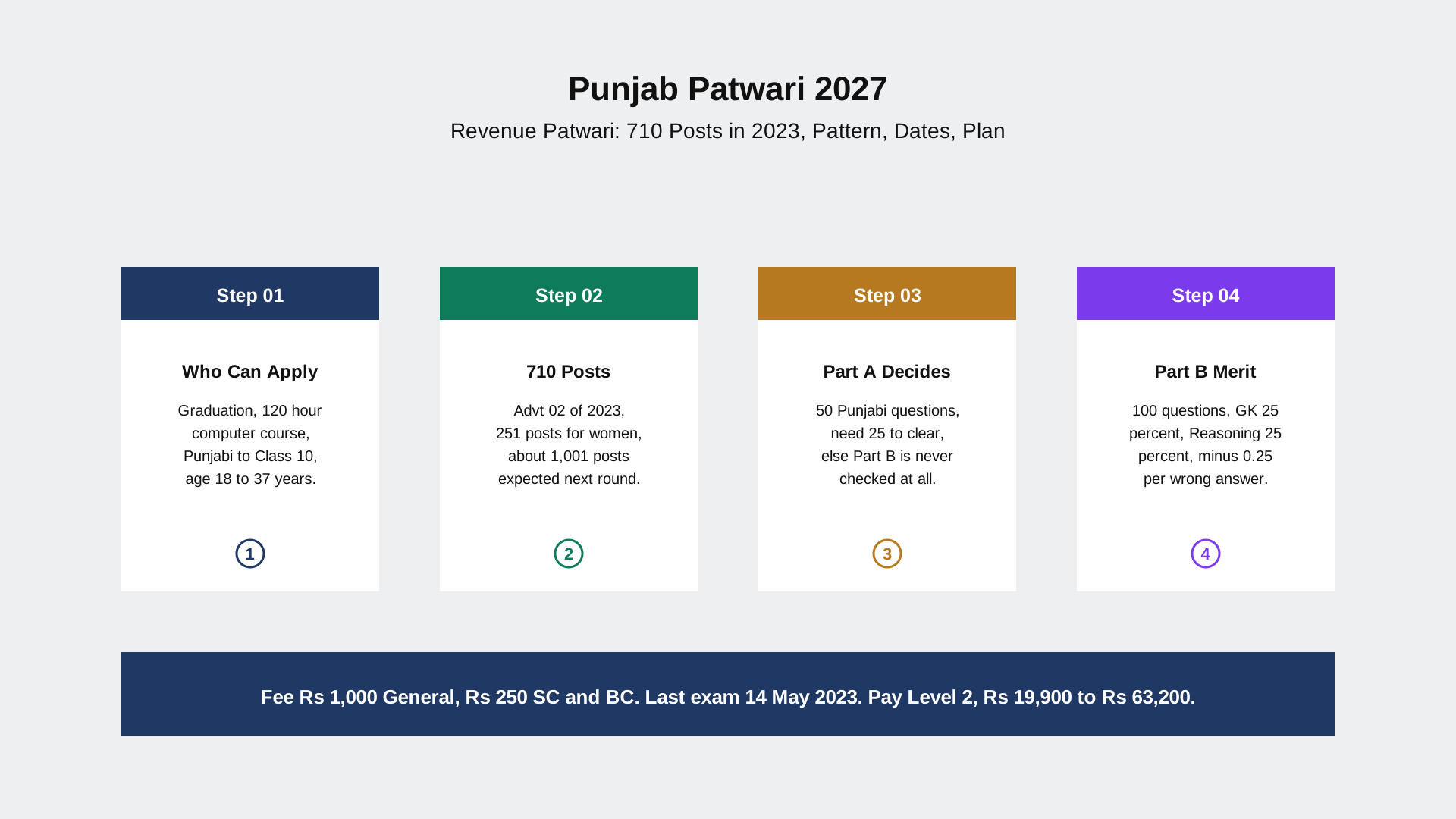
Punjab Patwari 2027 is the next round of recruitment for the post of Revenue Patwari in Punjab, run by the Punjab Subordinate Services Selection Board, known as PSSSB. PSSSB has not published the 2027 notification as of 21 November 2026, so this guide anchors on the last full cycle, Advertisement Number 02 of 2023. That cycle offered 710 Revenue Patwari posts, took applications from 23 February to 2 April 2023, and held its written test on 14 May 2023. Every date, fee and pattern in this guide comes from that cycle, and this guide treats the reports of about 1,001 posts in the next round as reports, not as facts, until the new advertisement appears on sssb.punjab.gov.in.
The Patwari is the lowest rung of the revenue ladder and the one that touches ordinary people most. A Patwari keeps the land records of a circle of villages, measures fields, records crops, enters mutations when land changes hands, and prepares the papers that a Tehsildar signs. Farmers know the Patwari by name in a way they never know an officer in Chandigarh. That closeness is the reason the post draws lakhs of applications for a few hundred seats, and it is also the reason the job needs a candidate who can read land records, write in Punjabi, and work with numbers. The exam tests exactly those three things, and nothing else.
The selection is a single written test followed by document verification. There is no interview. The written test has two parts in one sitting. Part A is a 50 question Punjabi language test at matriculation standard, and it counts as qualifying only: a candidate must score 25 out of 50, and the board checks Part B only if the candidate clears Part A. Part B is the 100 question merit paper, and the merit list is made from Part B alone. The whole paper runs 2 hours 30 minutes on an OMR sheet, with 1 mark per question and a deduction of one fourth of a mark for each wrong answer in Part B.
Punjab Patwari 2027 at a glance
| Detail | Punjab Patwari 2027, as last run in the 2023 cycle |
|---|---|
| Full post name | Revenue Patwari, Revenue and Rehabilitation Department, Punjab |
| Conducting body | Punjab Subordinate Services Selection Board (PSSSB) |
| Last advertisement | Advertisement Number 02 of 2023, detailed notification 23 February 2023 |
| Posts in last cycle | 710 Revenue Patwari posts, 251 reserved for women |
| Expected next round | About 1,001 posts reported by trackers, not confirmed in any advertisement as of 21 November 2026 |
| Education | Graduation in any discipline, plus 120 hour computer course or NIELIT O Level, plus Punjabi up to Matriculation |
| Age limit | 18 to 37 years as on 1 January 2023 in the last cycle |
| Fee in last cycle | Rs 1,000 General, Rs 250 SC and BC, Rs 200 ex servicemen and dependents, Rs 500 PwD |
| Exam | Single OMR paper, 150 questions, 150 marks, 2 hours 30 minutes |
| Part A | Punjabi qualifying, 50 questions, 50 marks, need 25 to clear |
| Part B | Merit paper, 100 questions, 100 marks, minus 0.25 per wrong answer |
| Pay | Level 2, Rs 19,900 to Rs 63,200, initial pay Rs 19,900 |
| Selection | Written test, then document verification |
| Official website | sssb.punjab.gov.in |
What a Patwari actually does
A Patwari holds charge of a patwar circle, a group of villages, and keeps the record of every field in it. The core record is the jamabandi, the record of rights, which lists who owns which field, how much land it covers, and what revenue it pays. Alongside it runs the girdawari, the crop inspection record, made twice a year, in which the Patwari walks the fields and records what crop stands on each plot. When land is sold, inherited or divided, the Patwari records the mutation, the change of ownership, and sends it up for the Kanungo and the Tehsildar to approve. When a boundary is disputed, the Patwari measures the field and draws the map that settles it.
The work is outdoors as much as it is at a desk. A Patwari measures land with a chain and a tape, and today with electronic instruments as well, walks village boundaries, visits fields after rain and after harvest, and sits in the village to hear complaints about records. The computer course that the recruitment demands is part of the job now. Punjab has digitised its land records, Patwaris enter mutations online, and the Patwari who cannot work a computer cannot do the job. The 120 hour computer course is not a formality in the notification. It is a description of the daily work.
The post sits at the base of a promotion ladder that runs upward through the revenue department. A Patwari can rise to Kanungo, then to Naib Tehsildar, and then to Tehsildar, through departmental examinations and seniority. That ladder is one reason the post attracts graduates who could aim higher. The starting pay is modest, Level 2 with an initial pay of Rs 19,900 a month, but the post is permanent, the work is in the home district in many cases, and the promotion line is real. Candidates who join for the salary alone will be disappointed. Candidates who join for a permanent Punjab government post with a clear line upward will find what they came for.
The 2023 cycle, date by date
The last full cycle began with a short advertisement on 13 December 2022 and a detailed notification on 23 February 2023, Advertisement Number 02 of 2023. Online applications opened the same day, 23 February 2023. The first last date was 20 March 2023. The board then reopened the window on 24 March 2023 and extended the last date to 2 April 2023. The fee last date was 5 April 2023. The written test was held on 14 May 2023. That is the full timetable as reported by the Times of India, Scroll and the PSSSB trackers, and it shows a pattern that candidates should expect again: a short first window, an extension, and an exam about six weeks after applications close.
One detail in that timetable is disputed between sources. MockSutra states that the fee window closed on 22 March 2023, two days after the first application last date, while the Times of India and Scroll state that the fee could be paid until 5 April 2023, after the extended application date. Both cannot be right, and the weight of evidence favours 5 April, because the extension to 2 April for applications would make little sense without a fee window that ran past it. This guide records 5 April 2023 as the fee last date and flags the 22 March figure as the conflicting report. The practical lesson is the same either way. Pay the fee on the day you apply. A candidate who files the form and waits to pay is betting the whole application on a date that may move.
The cycle before that, Advertisement Number 01 of 2021, was a larger combined drive. It recruited Patwaris, Zilladars and Irrigation Booking Clerks together through a common written test, with 1,152 posts reported in total. That common test used a different plan of examination from the 2023 Patwari only paper, with 120 marks and a heavier weight for quantitative ability, including mensuration of land and conversion of land units. Candidates who study from 2021 material should know that the 2023 paper replaced that plan. The 2023 plan is the one this guide describes, and it is the plan the next advertisement is most likely to repeat.
The next round: what is known and what is not
As of 21 November 2026, PSSSB has not published a new Patwari advertisement. Press reports and tracker sites through September 2026 have repeatedly put the coming recruitment at about 1,001 posts, and Testbook expected the notification in August 2026. August 2026 has passed without a notification on sssb.punjab.gov.in, and this guide will not present the 1,001 figure as a fact. Treat it as a reported expectation. Only the advertisement will confirm the vacancy count, the dates and the fee.
One tracker detail should be read with care. Testbook prints a category wise vacancy table for the 2026 round that totals 710 posts, with General 266 and the same figures as the 2023 advertisement. That table is the 2023 breakup copied into a 2026 page, and it sits next to a headline that promises around 1,001 posts. The two numbers cannot both describe the next round. This guide uses 710 as the 2023 figure and 1,001 as the reported expectation for the next round, and treats any category breakup for the next round as unknown until the advertisement publishes it.
The waiting period is the right time to prepare, because the 2023 timetable shows how little time the notice leaves. Applications ran for about five weeks including the extension, and the exam followed about six weeks after the window closed. A candidate who starts on the day the notice appears has about eleven weeks from notice to exam. A candidate who starts now has months. The pattern, the syllabus and the eligibility rules in this guide come from the official 2023 documents, and they will change only if the new advertisement changes them. Prepare on the 2023 pattern, and read the new advertisement the day it appears to catch any change.
Who can apply
The education rule has three parts, and all three must be met. First, a graduation degree in any discipline from a recognised university. The subject of the degree does not matter. A BA, a BSc, a BCom and a BTech all qualify, because the post asks for a graduate, not for a specialist. Second, a 120 hour computer course, or the NIELIT or DOEACC O Level certificate, which the board accepts in place of the 120 hour course. The computer course must be from a recognised institute, and the certificate must be in hand at document verification. Third, Punjabi as a subject up to Matriculation, that is Class 10. A candidate who never studied Punjabi in school cannot apply, whatever the degree says.
The Punjabi rule is the one that removes the most candidates, and it removes them late, at document verification, after they have cleared the written test. The board checks the Class 10 certificate for Punjabi as a subject. A candidate who studied Punjabi at home but never took it as a school subject does not meet the rule. A candidate from another state who graduated in Punjab but took a different language in Class 10 does not meet the rule either. Check the Class 10 mark sheet before you apply. If Punjabi is not on it, the application will fail at the last step, and no score in the written test can save it.
The age rule in the 2023 cycle was 18 to 37 years as on 1 January 2023. Age relaxation followed Punjab government rules for reserved categories, with the usual extra years for SC and BC candidates, for ex servicemen and for disabled candidates. One tracker page states the age limit as 21 to 37 years, and that figure conflicts with the Times of India and Scroll reports, which both state 18 to 37 years as on 1 January 2023. This guide uses 18 to 37, because two independent news reports agree on it and it matches the board practice for graduate level posts, and flags the 21 year figure as the conflicting report. The new advertisement will set its own cut off date, and that date will decide eligibility. A candidate who turns 38 a week before the cut off is out, and a candidate who turns 38 a week after it is in.
Candidates must hold Indian citizenship, and Punjab domicile matters for reservation benefits. Candidates from other states may apply, but reservation benefits in Punjab government posts go to Punjab domicile candidates. An out of state candidate competes in the general category. Keep the domicile certificate ready, because the board will ask for it at document verification, along with the graduation degree, the computer course certificate, the Class 10 certificate showing Punjabi, and a valid photo identity proof.
Punjab Patwari exam pattern: Part A decides everything
The paper is a single OMR test of 150 questions in 2 hours 30 minutes, with 1 mark per question. Part A is Punjabi language at matriculation standard, 50 questions for 50 marks. Part B is the merit paper, 100 questions for 100 marks. Candidates answer the two parts in the same sitting, on the same OMR sheet, but the board treats the two parts very differently. Part A is qualifying only. A candidate must score at least 25 out of 50 in Part A, which is 50 percent. If the candidate scores 24 or less, Part B is never checked, whatever the Part B score would have been. If the candidate scores 25 or more, the board checks Part B and builds the merit list from Part B alone. Part A marks do not add to the merit score. They only open the door.
That rule makes Part A the most dangerous part of the paper, and the most ignored. Candidates spend months on general knowledge and reasoning and treat Punjabi as a language they already know, because they speak it at home. Speaking Punjabi and passing a matriculation standard Punjabi language test are two different skills. Part A tests the life and works of the Sikh Gurus, antonyms and synonyms, idioms and proverbs, parts of speech, prefixes and suffixes, changing number and gender, punctuation, correcting words and sentences, the correct Punjabi forms of English words and of numerals, months and days, and questions on the Punjabi language and on Punjab history and culture. Board notification GSR 72 of 28 October 2022 fixes the standard, and it set the matriculation standard for the Punjabi test. A candidate who scores 24 in Part A fails the whole exam, even with a Part B score that would have topped the merit list.
The marking rule for Part A is disputed between sources, and this guide states the dispute. The main PrepSahi syllabus page, which transcribes the board Final Plan of Written Examination, states that there is no negative marking in Part A. A second PrepSahi page states that the board deducts one third of a mark per wrong answer in Part A. The board plan itself, as quoted by the first page, supports no negative marking in Part A, and this guide follows that reading. The difference matters for strategy. With no negative marking, a candidate should attempt all 50 Part A questions. With a deduction, a candidate should attempt only the questions the candidate is sure about. Until the new advertisement settles it, prepare for Part A as if every question must be attempted, and read the marking rule in the new advertisement before the exam.
Punjab Patwari exam pattern: Part B, the merit paper
Part B is the paper that decides selection, and its 100 questions are spread across six sections with indicative weightages set by the board. General Knowledge and Current Affairs carries about 25 percent. Logical Reasoning and Mental Ability carries about 25 percent. Punjab History and Culture carries about 16 percent. Punjabi carries about 13 percent. English carries about 12 percent. Information and Communication Technology, known as ICT, carries about 9 percent. The board calls this distribution indicative, which means it may vary slightly from year to year, but the order of size is stable. General knowledge and reasoning together are half the paper. Punjab history and culture is the next largest block. Punjabi and English together are a quarter. ICT is the smallest block and the cheapest marks in the paper.
Each question in Part B carries 1 mark, and each wrong answer deducts one fourth of a mark. A blank answer costs nothing. That rule shapes the whole strategy of Part B. A candidate should attempt a question when the candidate can eliminate two options, because the expected gain is positive. A candidate should leave a question blank when the candidate can eliminate no option, because a blind guess loses a quarter mark three times out of four. Across the paper, the difference between a candidate who guesses blindly on 20 questions and a candidate who leaves them blank is about 5 marks in the wrong direction. Fractions of a mark decide the merit list in a 710 post recruitment, and 5 marks is a large gap.
The two largest sections deserve the most time, and for different reasons. General Knowledge and Current Affairs covers political, environmental and economic issues, current affairs, science and technology, Punjab history from the 14th century, Indian history with special attention to the freedom struggle, sports, cinema and literature. It is broad, and it rewards daily reading over months, not a week of cramming. Logical Reasoning and Mental Ability covers verbal reasoning such as coding and decoding, analogy, classification, series, direction sense, relations, mathematical operations, time tests and the odd one out, non verbal series, analogy and classification, and basic numeracy such as percentage, number system, LCM and HCF, ratio and proportion, average, ages, profit and loss, partnership and mixture, interest, work and time, time and distance, mensuration and data interpretation. It is the section where practice converts most directly into marks, because the question types repeat and speed is a skill that improves with timed sets.
The syllabus, section by section
General Knowledge and Current Affairs in Part B is the widest section, and it is the one that punishes candidates who study only from a single book. The board syllabus lists current affairs, Indian history and geography, physical features, climate, demography, economic and social development, poverty alleviation and economic planning, politics, science, sport, cinema and literature, freedom and social movements in India and Punjab and their leaders, constitutional and administrative law, the central and state executive, the judicial system, centre state relations, citizenship, and fundamental rights and duties. The Punjab part of the section runs from the 14th century onward, which means the Sikh Gurus, the Mughal period, the Sikh rulers, the British period and the freedom movement in Punjab all appear. A candidate should read a daily news summary and keep a notebook of Punjab specific facts, because the Punjab questions are the ones that separate Punjab candidates from candidates who prepared for a general exam.
Logical Reasoning and Mental Ability is the section where the exam is most predictable. The verbal reasoning types are coding and decoding, analogy, classification, series, direction sense, relations, mathematical operations, time tests and odd one out problems. The non verbal types are series, analogy and classification with figures. The numeracy types are percentage, number system, LCM and HCF, ratio and proportion, number series, average, problems on ages, profit and loss, partnership and mixture, simple and compound interest, work and time, time and distance, mensuration and data interpretation. The numeracy part overlaps with the old 2021 common test, which gave quantitative ability a weight of 30 out of 120 and included mensuration of rectangles, squares, triangles, trapeziums, rhombuses, pentagons and circles, and units of land measurement and their conversion. Land measurement units are worth special attention for a Patwari candidate, because the job itself is measured in those units. A candidate who knows the kanal, marla, bigha and acre conversions will answer questions that other candidates skip, and will also use that knowledge on the first day of the job.
Punjab History and Culture carries about 16 percent of Part B, and it is the section where a Punjab candidate should outscore everyone else. The syllabus covers the physical features of Punjab and its ancient history, social, religious and economic life in Punjab, the development of language, literature and arts, society and culture during Afghan and Mughal rule, the Bhakti movement and Sufism, the teachings and history of the Sikh Gurus and saints, the Adi Granth, the Sikh rulers, and the freedom movements of Punjab. The same material appears in Part A in Punjabi, so preparation here counts twice. A candidate who reads Punjab history once, in Punjabi, will carry it into both parts of the paper. A candidate who reads it in English only will know the facts and miss the Punjabi vocabulary that Part A asks for.
Punjabi in Part B, about 13 percent, covers correct forms and spelling, prefixes and suffixes, synonyms and antonyms, nouns, pronouns and verbs, gender and number, proverbs and idioms, English to Punjabi translation, and one word substitution. It overlaps heavily with Part A, so the Punjabi preparation counts twice here as well. Together, Part A and the Punjabi part of Part B make 63 of the 150 questions in the paper, which is more than two fifths of the whole test. No other subject comes close. A candidate who is strong in Punjabi starts the paper with a large advantage. A candidate who is weak in Punjabi is fighting the paper from the first question.
English in Part B, about 12 percent, covers grammar, subject verb agreement, adjectives, adverbs, articles, prepositions, synonyms, antonyms, one word substitution, fill in the blanks, spelling, idioms, direct and indirect speech, active and passive voice, and sentence correction. There is no comprehension passage in the English section, which is a mercy for candidates who read slowly. The questions are short and rule based, and they reward a candidate who has worked through a grammar book once, properly, rather than a candidate who has read many books quickly. ICT, about 9 percent, covers the basics of computers, networks and the internet, and the use of office tools such as Word, PowerPoint, spreadsheets and databases. It is the smallest section and the easiest to finish, because the syllabus is short and the questions are direct. Nine marks for a week of study is the best return in the paper, and candidates who skip ICT leave those marks for others.
Fee and how to apply
The 2023 fee was Rs 1,000 for General and Sports category candidates, Rs 250 for SC and BC candidates, Rs 200 for ex servicemen and their dependents, and Rs 500 for persons with disabilities. The fee was paid online through the SBI payment gateway, by net banking, card or UPI, and it was non refundable. Some tracker pages list EWS candidates at Rs 250 as well, alongside SC and BC, while the official advertisement summary lists SC and BC at Rs 250 without naming EWS separately. This guide records the four figures that all sources agree on, and notes that candidates should check the EWS grouping in the new advertisement. PSSSB has not announced the fee for the next round, and the 2023 figures are the best guide to what it will look like.
Applying is online only, on sssb.punjab.gov.in. The candidate creates a fresh registration with a working mobile number and email address, and the registration number and date of birth become the login for every later step. The form asks for personal details, educational qualifications, the computer course certificate details, and the category. The candidate uploads a scanned photograph and signature in the format the portal specifies. The candidate pays the fee online and downloads and prints the confirmation page. Keep the registration number safe. It is needed for the admit card, the answer key objections, the result, and document verification. A candidate who loses the registration number loses access to every later step.
Three application mistakes recur in PSSSB recruitments. The first is registering with a mobile number or email that the candidate does not check, because the board sends the admit card alert and the result alert to those contacts. The second is entering the computer course details wrongly, or uploading a certificate that is not the 120 hour course or the O Level, which fails at document verification after the candidate has cleared the test. The third is waiting until the last day, when the portal slows under the load of thousands of last minute applications. The board extended the 2023 cycle once, and candidates who applied early had no trouble, while candidates who waited for the extension gambled on a window that might not have reopened.
Pay, posting and promotion
The Patwari post is in Level 2 of the pay matrix, with a scale of Rs 19,900 to Rs 63,200 a month and an initial pay of Rs 19,900. One tracker page prints the initial pay as Rs 19,990, which looks like a typing error for Rs 19,900, and this guide uses Rs 19,900, because the board pay scale and the Testbook and Adda247 pages agree on it. On top of the basic pay come the usual allowances under Punjab government rules, including dearness allowance, house rent allowance and travel allowance, which lift the monthly salary well above the basic figure. The exact take home pay depends on the allowance rates in force at the time of joining, and the advertisement will not state a take home figure. Candidates should read the scale, not a tracker headline, when they judge the salary.
Posting is anywhere in Punjab, and the Patwari serves in a patwar circle in a tehsil. The department tries to post candidates near their home district where vacancies allow, but there is no guarantee, and a candidate should expect a posting in any district. The work is field based, and the department expects the Patwari to live in or near the circle, to be available to villagers, and to keep the records up to date. A candidate who wants a desk job in Chandigarh will be disappointed. A candidate who wants a government post in the home state, with a village level posting and a clear promotion ladder, will find the job fits.
Promotion runs from Patwari to Kanungo, then to Naib Tehsildar, and then to Tehsildar, through departmental examinations and seniority. The departmental examinations test revenue law, land records, and the procedures of mutation, partition and settlement, which are the same subjects the Patwari handles every day. A Patwari who learns the work properly is preparing for the promotion examination at the same time. That is the quiet advantage of the post. The daily work is the syllabus for the next promotion, and the experience that looks like routine record keeping is also the preparation for the next rank.
The 2021 common test and why it matters
The 2021 cycle matters because authors wrote many of the books and websites that candidates buy today for it, and its pattern was different from the 2023 paper. The 2021 common test for Revenue Patwari, Irrigation Booking Clerk and Zilladar carried 120 marks, with General Knowledge and Awareness at about 20, Mental Ability at about 15, Quantitative Ability at about 30, Languages English and Punjabi at about 20, Information Technology at about 15, Agriculture at about 10, and Punjab History and Culture at about 10. Agriculture was a full section in that plan, with crop science and farm practice, and quantitative ability was the largest section, with mensuration of land and conversion of land units at its centre.
The 2023 Patwari only plan dropped Agriculture as a separate section and dropped the 120 mark scheme. It replaced them with the Part A and Part B structure, 150 questions, and the six section weightages described above. A candidate who studies Agriculture as a full section for the next round is studying for a paper that no longer exists. A candidate who ignores quantitative ability entirely is making the opposite error, because the numeracy topics live on inside the Logical Reasoning and Mental Ability section of Part B. The right approach is to study the 2023 plan as the base, and to keep the land measurement units and the agriculture facts that relate to girdawari and crop inspection, because those facts are part of the Patwari job and may appear in the general knowledge and Punjab history sections.
A 90 day plan that fits the real paper
Ninety days is enough for the Patwari paper if the days follow the weight of the paper. The paper is two fifths Punjabi, one quarter general knowledge and reasoning combined in Part B alone, and the rest spread across history, English and ICT. The first thirty days build the base. Give Punjabi one hour a day, split between Part A topics such as idioms, proverbs, grammar and the Gurus, and Part B topics such as synonyms, antonyms and one word substitution. Give general knowledge one hour a day, with a daily news summary and a Punjab history chapter on alternate days. Give reasoning and numeracy one hour a day, working through one question type at a time with timed sets. English and ICT share thirty minutes a day. One full mock test every Sunday, 150 questions in 2 hours 30 minutes on an OMR sheet, with Part A and Part B scored separately.
Days 31 to 60 turn the base into exam skill. Give Punjabi a second pass, this time through mock questions rather than reading, because the Part A pass mark of 25 out of 50 is a threshold that candidates must clear with margin, not scrape. A candidate who scores 30 in Part A mocks is safe. A candidate who scores 25 or 26 is one bad day from failing the whole exam. Give reasoning daily timed sets, and write the numeracy formulas out by hand in a formula book once a week. General knowledge gets a revision notebook of Punjab facts, and the news notes start to form a file. Mock tests move to twice a week, and the review after each test records three numbers: the Part A score, the Part B score, and the marks lost to wrong guesses in Part B. The third number is the one that tells you whether to guess more or less.
Days 61 to 90 are for revision and speed. No new topic starts after day 65. The Punjabi notes get read end to end twice, with the idioms and proverbs read aloud, because hearing them helps memory. Write the reasoning formula book out from memory once a week until it comes out clean. The Punjab history notes get a daily half hour. Mock tests run every other day in the last two weeks, always in one sitting, always timed, always with the Part A rule applied strictly: if Part A falls below 25, the mock is a failure whatever Part B says. The last three days are light. Short revision, early sleep, no new material. A tired candidate misreads Punjabi idioms, and a misread idiom in Part A can cost the whole exam.
Two habits run through all ninety days. First, practise on OMR sheets. The paper is offline, and candidates who have only ever clicked answers on a screen lose time and make marking errors on paper. Print OMR sheets, darken circles by hand, and time yourself. Second, keep a mistakes book. One page per mock test, one line per error, with the right answer and the reason you missed it. By day 90 that book holds every trap you have already fallen into once, and the traps are the same ones the real paper will set.
Mistakes that cost candidates marks
The most expensive mistake is ignoring Part A. Candidates who score well in Part B and fail Part A do not appear in the merit list at all, and their Part B score is never published as a merit score. Treat Part A as a separate exam with its own pass mark, and do not consider yourself ready until your Part A mock scores sit at 30 or above, with margin. Punjabi is the largest subject in the whole paper when Part A and Part B are added together, and it deserves the largest share of preparation time.
The second mistake is guessing blindly in Part B. The one fourth mark deduction looks small, and it is small for a single question, but it adds up across the paper. Twenty blind guesses cost about 15 marks in deductions against about 5 marks gained, a net loss of about 10 marks. Ten marks in a 710 post recruitment is the difference between selection and the waiting list. Guess only when you can eliminate two options. Leave the rest blank, and let the blank questions cost nothing.
The third mistake is preparing from 2021 material without knowing the pattern changed. The 2021 common test had Agriculture as a section and a 120 mark scheme. The 2023 paper has neither. Books that still print the 2021 plan will waste weeks of preparation on a section that does not exist and will leave the Part A Punjabi test underprepared. Check the plan of examination on the cover of any book you buy. If it says 120 marks and lists Agriculture, it is a 2021 book, and it should be used only for the topics that survive into the 2023 plan.
The fourth mistake is applying without checking the Punjabi and computer course rules. The board checks the Class 10 certificate for Punjabi as a subject and the computer course certificate at document verification, after the written test. A candidate who clears the test and fails document verification loses the post to the next candidate on the list. Check both certificates before you pay the fee. If the computer course certificate is missing, enrol for the 120 hour course now, because the certificate must be in hand before verification, and a course takes weeks to complete.
The fifth mistake is trusting tracker dates. Trackers have reported the next notification as expected since mid 2026, and the August 2026 expectation passed without a notification. The advertisement will appear on sssb.punjab.gov.in, and nowhere else counts. Check the board website every week, and treat every other date as a rumour until the notice confirms it. The same caution applies to the vacancy number. Treat about 1,001 posts as a reported expectation, not a fact. Only the advertisement will publish the category breakup for the next round.
Where to check next
The one place that matters is the PSSSB website at sssb.punjab.gov.in. The advertisement, the application link, the admit card, the answer key and the result will all appear there first. Everything else is a copy. When the notice lands, read five things before you pay: the post name and advertisement number, the cut off date for age, the fee for your category, the Part A marking rule, and the exam pattern. If the pattern differs from the one in this guide, the team behind this page will update it and rebuild the mock tests to match.
Until then, the work is the same. Punjabi every day, with Part A as a separate pass mark to clear with margin. General knowledge and reasoning alongside, Punjab history in a daily slot, English and ICT in a short daily slot, and a mock test every week in the real pattern of 150 questions in 2 hours 30 minutes, with Part A scored on its own. The post is permanent, the ladder runs to Tehsildar, and the exam rewards the candidate who treated the waiting months as preparation time, not as waiting time.
Sources
MockSutra, PSSSB Patwari Notification, Vacancy, Dates, Fee and Apply Online, with Advertisement Number 02 of 2023 dated 23 February 2023, 710 Revenue Patwari posts, 251 reserved for women, applications 23 February to 20 March 2023, written test 14 May 2023, fee Rs 1,000 General, Rs 250 SC and BC, Rs 200 ex servicemen, Rs 500 PwD, last verified 26 September 2026. Times of India, PSSSB Patwari 2023 registration ends today, apply for 710 posts on sssb.punjab.gov.in, with registration from 23 February 2023, last date 2 April 2023, fee last date 5 April 2023, age 18 to 37 years, fee Rs 1,000 General and Rs 250 SC, ST, OBC and EWS. Scroll, PSSSB Patwari recruitment 2023 registration reopened, apply till April 2, with Advertisement Number 02 of 2023, 710 posts, fee till 5 April 2023, age 18 to 37 years as on 1 January 2023, fee Rs 1,000 General, Rs 500 PwD, Rs 250 SC and BC, Rs 200 ex servicemen and dependents. PrepSahi, Punjab Patwari Syllabus 2026, Subject wise, PSSSB Official, with Final Plan of Written Examination for Advertisement Number 02 of 2023, 150 questions in 2 hours 30 minutes, Part A Punjabi qualifying 50 questions with 25 needed, Part B merit 100 questions with one fourth negative marking, weightages GK 25 percent, Reasoning 25 percent, Punjab History and Culture 16 percent, Punjabi 13 percent, English 12 percent, ICT 9 percent, GSR 72 of 28 October 2022. RankRacer, Punjab Patwari Exam, Eligibility, Pattern, Syllabus and FAQs, with Advertisement Number 02 of 2023, graduation plus 120 hour computer course, and the 2021 common test with 120 marks. Testbook, Punjab Patwari Recruitment Notification 2026, with about 1,001 vacancies expected, notification expected August 2026, age 18 to 37 years, pay Rs 19,900 to Rs 63,200. Adda247, Punjab Patwari Recruitment 2026 Notification Out Soon for 1001 Posts, with 1,001 posts expected, graduation plus O Level certificate, age 18 to 37 years, fee Rs 1,000 General, Rs 250 EWS and SC, ST and BC, Rs 200 ex serviceman, Rs 500 PwBD. CareerPower, PSSSB Patwari Recruitment 2026 Notification, Eligibility, 1000 plus Vacancies, with 1,001 posts expected, Level 2 pay with initial pay Rs 19,900, official website sssb.punjab.gov.in. Abhipedia, Detailed Syllabus of Punjab Patwari Exam 2023, with the 2021 common test syllabus, 120 marks, negative marking one fourth per wrong answer. Punjab Subordinate Services Selection Board, official website sssb.punjab.gov.in.







