About UGC NET Home Science 2027 Exam Series
📖 Table of Contents
- What NET gives you after you qualify
- Where the June 2027 cycle stands right now
- The exam pattern in plain words
- Paper 1 in brief: the common paper everyone faces
- Who can apply: the eligibility rules
- Age limit and relaxations
- How the qualifying mark and the cut off work
- Paper 2 syllabus: units one to five
- Unit 1: Food Science and Food Service Management
- Unit 2: Nutrition and Dietetics
- Unit 3: Textiles
- Unit 4: Apparel Designing
- Unit 5: Resource Management and Consumer Issues
- Paper 2 syllabus: units six to ten
- Unit 6: Housing and Interior Design
- Unit 7: Human Development
- Unit 8: Family Studies
- Unit 9: Communication for Development
- Unit 10: Extension Management and Community Development
- June 2026 cycle: what actually happened
- December 2026 cycle: the dates that changed
- Best books for UGC NET Home Science 2027
- NCERT, Human Ecology and Family Sciences, Class 11 Parts 1 and 2, and Class 12 Parts 1 and 2
- B. Srilakshmi, Food Science
- B. Srilakshmi, Nutrition Science
- Bernard P. Corbman, Textiles: Fibre to Fabric
- C. R. Kothari, Research Methodology
- A previous year papers book
- A 90 day plan that fits real life
- Mock test strategy: how to use mocks without wasting them
- Common mistakes that cost good candidates marks
- What to check the day the June 2027 notice arrives
UGC NET Home Science 2027: Syllabus, Pattern, Eligibility and Cut Off
UGC NET Home Science 2027 opens the door to college teaching and funded research for home science graduates across India. The exam tests two papers in one sitting, a common Paper 1 and a subject Paper 2 with code 12. Pass it and a college can appoint you as an Assistant Professor.
Score higher and you also win a Junior Research Fellowship, a monthly fellowship that pays for your PhD.
This guide covers the full picture of UGC NET 2027 in plain words. You will find the pattern, the eligibility rules, the age limits, the qualifying marks, the cut off method, the complete Paper 2 syllabus unit by unit, the June 2026 and December 2026 cycles, the best books, a 90 day plan, a mock test strategy and the mistakes that cost good candidates marks. The June 2027 notification has not come out yet, as of 19 November 2026, so this guide rests on the last two cycles and says clearly where the facts end and the waiting begins.
What NET gives you after you qualify
NET gives eligibility, and eligibility is what colleges ask for before they appoint a teacher. The result comes in three categories. Category 1 means JRF and Assistant Professor plus PhD admission.
Category 2 means Assistant Professor and PhD admission. Category 3 means PhD admission only. Every candidate who qualifies lands in one of the three, and the category decides what doors open next.
Pass UGC NET Home Science 2027 and a college can appoint you as an Assistant Professor. Score higher and you also win a Junior Research Fellowship, a monthly fellowship that pays for your PhD.
A JRF pays 37,000 rupees a month for the first two years, then 42,000 rupees a month as a Senior Research Fellow after that, plus house rent allowance as per UGC rules. The fellowship supports full time research, and a JRF holder joins a university department to work on research in university home science departments, on nutrition, food science, textiles, human development and extension. The money matters, but the real value is the research position itself, because a PhD with a fellowship carries weight in every later application.
For Categories 2 and 3, universities give the NET score 70 percent weight and their own interview 30 percent weight for PhD admission. The NET score stays valid for PhD admission for one year from the result. Home Science graduates teach in colleges and universities, and they also find work in nutrition and dietetics, the food industry, textiles and apparel, community development, and public health nutrition programmes like ICDS.
A NET qualification opens the college gate, and a JRF opens the research gate.
One warning belongs here, early. NET gives eligibility for a teaching post, and it gives a fellowship for research, but it gives no job by itself. A candidate still faces interviews, college selection processes and university rules.
Treat NET as the key, and keep the key separate in your mind from the door it opens.
Where the June 2027 cycle stands right now
The June 2027 notification has not come out yet. NTA releases the notification on the official portal, ugcnet.nta.ac.in, and the UGC NET 2027 notice will appear there first. As of 19 November 2026, no date, no fee and no exam window for June 2027 exists in any official notice, so any website that gives you a fixed June 2027 exam date today is guessing.
That leaves you with a clear choice. You can wait for the notice, or you can start now with the syllabus and the pattern from the last two cycles. The syllabus has stayed unchanged since June 2019, and the pattern has stayed the same across cycles, so preparation that starts now will still count when the notice arrives.
The only things that change with each cycle are the dates, the fee and the cut off, and those three come from the notice itself.
The December 2026 cycle runs first, with exams on 14, 15, 16, 17, 18 and 21 December 2026. Candidates who sit in December will see their result before the June 2027 notice arrives, and their experience will set the tone for June. If you plan to sit in June 2027, use the December cycle as a live rehearsal in your mind, watch its dates, its admit card timing and its result date, and you will know the rhythm of the exam before your own cycle starts.
The common paper guide at UGC NET Paper 1 2027 follows the same cycle, so read it beside this page.
The exam pattern in plain words
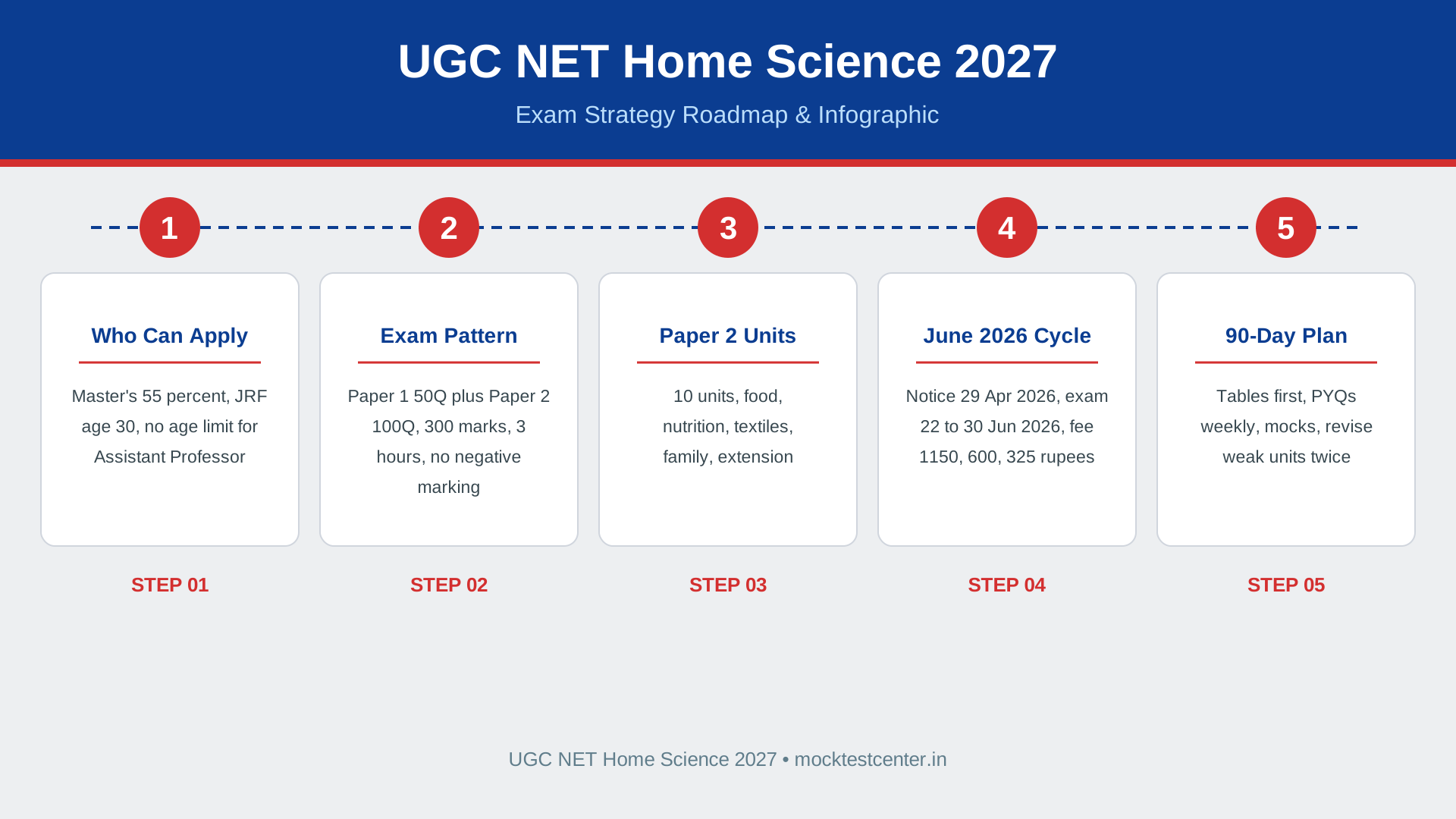
NTA holds UGC NET as a computer based test, both papers together in a single session of three hours, with no break between the papers. Paper 1 carries 50 questions for 100 marks, two marks each. Paper 2 carries 100 questions for 200 marks, two marks each.
The total comes to 150 questions for 300 marks. All questions are compulsory, and each question carries four options with one correct answer.
The rule that shapes every strategy in this guide is simple. There is no negative marking in either paper. A wrong answer costs nothing, and a skipped question also costs nothing, so an attempt never hurts your score.
That changes how you should use the last minutes of the paper, and the mock test section of this guide explains how.
Paper 1 is the general paper on teaching and research aptitude, common for every subject, with code 00. Paper 2 is your subject, Home Science, with code 12, and it carries twice the marks of Paper 1. A candidate who treats Paper 2 as the main paper and Paper 1 as the support paper reads the pattern correctly, because 200 of the 300 marks come from your own subject.
Candidates from other subjects face the same split, and the UGC NET Psychology 2027 page shows how the common paper looks from another subject's side.
The exam runs in shifts across several days, because lakhs of candidates sit for 85 subjects. Your shift, your centre and your reporting time come from the admit card, which NTA releases a few days before the exam. Keep your application number and your password safe from the day you apply, because the admit card, the answer key and the result all need the same login.
Paper 1 in brief: the common paper everyone faces
Paper 1 has ten units, and each unit gives about five questions worth ten marks. The units are Teaching Aptitude, Research Aptitude, Comprehension, Communication, Mathematical Reasoning and Aptitude, Logical Reasoning, Data Interpretation, Information and Communication Technology, and People, Development and Environment, plus the Higher Education System. The syllabus has stayed unchanged since June 2019, so the previous year papers tell you the real shape of this paper better than any new book can.
Teaching Aptitude and Research Aptitude together give about ten questions, and they reward short notes and repeated revision. Comprehension gives one passage with five questions, and it rewards a candidate who reads the passage twice before touching the options. Communication, Mathematical Reasoning, Logical Reasoning and Data Interpretation reward practice, and a daily set of ten questions in each area builds speed faster than a weekend of theory.
ICT and People, Development and Environment reward current knowledge. The Higher Education System unit rewards a candidate who knows the bodies that run Indian higher education, UGC, AICTE, NCTE and the national policies, by name and by function. Give Paper 1 one hour of study a day, every day, and treat it as a subject of its own, because a strong Paper 1 lifts a borderline Paper 2 score over the cut off line.
Who can apply: the eligibility rules
You need a Master's degree or an equivalent qualification, with at least 55 percent marks for General and General EWS candidates, or 50 percent for OBC Non Creamy Layer, SC, ST, PwD and third gender candidates, without rounding off, from a UGC recognised university. Final year Master's students may apply provisionally, and they must complete the degree within the window the bulletin sets.
Holders of a four year bachelor's degree with eight semesters need 75 percent aggregate, or 70 percent for reserved categories, and they qualify for JRF and PhD admission only, and not for Assistant Professor. The Master's degree must be complete within two years of the result date for Categories 1 and 2, and within one year for Category 3, though that Category 3 window comes from a single source and needs a check against the official bulletin.
Your Paper 2 subject should match your Master's subject, or a closely related subject, and the bulletin lists the permitted combinations. A home science Master's degree fits Paper 2 Home Science directly. Candidates with a degree in a related field should read the subject list in the bulletin before they apply, because a wrong subject choice can waste a whole cycle.
The UGC NET Geography 2027 page shows how another subject handles the same eligibility rule.
There is no limit on the number of attempts, as long as you stay within the age limit for JRF. A candidate who misses the cut off in one cycle can sit again in the next cycle, and many successful candidates qualify on their second or third attempt.
Age limit and relaxations
The age limit applies to JRF only. The maximum age for JRF is 30 years as on the first day of the exam month. For the June 2026 cycle that date was 1 June 2026, and for the December 2026 cycle it is 1 December 2026.
The June 2027 cycle will use the first day of its own exam month, and the notice will state the date.
Relaxation goes up to five years for OBC Non Creamy Layer, SC, ST, PwD, third gender candidates and women. Research experience, an LLM degree and armed forces service also earn relaxation, and the total relaxation stays capped at five years. A candidate who claims relaxation must hold the certificate that proves it, because the certificate check happens at the time of admission or appointment.
Assistant Professor posts and PhD admission carry no upper age limit. A candidate of any age can qualify for Category 2 or Category 3, and a candidate over 30 can still sit for the exam and qualify as an Assistant Professor. That rule makes NET a second chance exam for working teachers, for candidates who finished their Master's late, and for anyone who returns to study after a break.
Age never blocks the teaching path, and only the fellowship path carries a clock.
How the qualifying mark and the cut off work
Two numbers decide your result, and they work in sequence. First comes the qualifying mark, the minimum aggregate across both papers. General and General EWS candidates need 40 percent, which means 120 marks out of 300.
SC, ST, OBC Non Creamy Layer, PwD and third gender candidates need 35 percent, which means 105 marks out of 300. You must appear in both papers to count, and the qualifying mark only lets you enter the race.
Then comes the cut off, and the cut off decides who actually qualifies. NTA caps the number of candidates who qualify for Assistant Professor at 6 percent of the candidates who appeared in both papers. That 6 percent pool splits by reservation category and then by subject, and the split produces the subject wise and category wise cut off.
A subject with many candidates gets a larger share of the pool, and a subject with few candidates gets a smaller share.
That method explains why the cut off moves every cycle. More candidates, a harder paper, or a different category split can all push the line up or down. It also explains why no one can predict the June 2027 cut off today.
The honest way to use the cut off is to study the last cycle's cut off for your own subject and category, and to aim ten marks above it in your mocks. This guide gives no cut off numbers for Home Science, because the exact subject cut off figures were not verified against the NTA cut off PDF of 28 August 2026 in this pass, and a wrong number here would mislead you. Read the mechanism, aim above the last line, and check the official cut off list when NTA releases it.
The UGC NET English 2027 page explains the same method from another subject's side.
The three result categories follow from the same merit list. The highest scorers take Category 1, JRF plus Assistant Professor plus PhD admission. The next band takes Category 2, Assistant Professor plus PhD admission.
The next band takes Category 3, PhD admission only. A candidate who misses Category 1 by a few marks still holds a useful result, so never treat a Category 2 or 3 result as a failure.
Paper 2 syllabus: units one to five
Paper 2 for Home Science has ten units, and each unit gives about ten questions. The syllabus comes from the official UGC syllabus for subject code 12, and the unit titles below follow that official document. The brief for this package listed different unit names, and the package note at the end of this file records the change and the reason.
Learn the units in order, because the order itself teaches you how the subject fits together.
Unit 1: Food Science and Food Service Management
Food science starts with food itself, its composition, its physical and chemical properties, and the way cooking and processing change its nutrients. Learn the food groups and the nutrients in each group, then quality evaluation, objective and subjective methods, food standards, microbiological safety, HACCP and packaging. Food pigments and additives, preservation methods and their applications, and new product development including nanotechnology appear in recent papers.
The second half of the unit covers food service management, menu planning, food cost analysis and institutional food service management. Keep a table of preservation methods with one example each, because questions here often ask for the method that fits a given food.
Unit 2: Nutrition and Dietetics
Nutrition and dietetics carries the largest weight in this paper, so treat it as the centre of your preparation. Start with food groups, the balanced diet and the food pyramid, then macro and micro nutrition, nutrient functions, deficiency diseases and the recommended dietary allowances from ICMR. Public health nutrition follows, with nutrition across the life span from conception to old age, community nutrition, sports nutrition and disaster nutrition.
Learn the national policies and programmes by name and purpose, ICDS, POSHAN Abhiyaan and the mid day meal scheme among them. Clinical and therapeutic nutrition closes the unit, diet therapy for diabetes, obesity, cardiovascular disease, renal and liver disorders, and enteral and parenteral nutrition, plus diet counselling and management. Learn the RDA table by age and sex until you can write it without looking.
Unit 3: Textiles
Textiles covers fibres, yarns, fabrics and finishes. Learn the classification of fibres, natural and man made, and the properties of each fibre, cotton, wool, silk, jute, polyester, nylon and rayon. Yarn manufacture, fabric construction, weaving, knitting and non woven fabrics follow.
Finishes change how a fabric looks and behaves, so learn the common finishes and their purpose. Traditional Indian textiles need separate notes, their names, their regions and their techniques. Testing of textiles, care and eco friendly developments close the unit.
Keep samples in mind, a piece of khadi, a Banarasi sari, a block printed cloth, because questions often describe a fabric and ask you to name it.
Unit 4: Apparel Designing
Apparel designing turns cloth into clothing. Learn body measurements and how to take them, pattern making, drafting, draping and flat pattern methods. Fit matters more than fashion in this unit, so study the common fitting problems and their corrections.
Selection of apparel for different age groups, occupations and occasions appears in questions, as do the principles of design, line, colour, texture and balance. The unit also touches the apparel industry, its structure and its employment. Sketch the basic bodice block and the common pattern adjustments, because drawing them once teaches more than reading about them three times.
Unit 5: Resource Management and Consumer Issues
Resource management studies how a family uses its time, money, energy and space. Learn the management process, planning, organising, controlling and evaluating, and the resources a family manages, human and non human. Time and energy management, work simplification and ergonomics sit at the centre of this unit.
The consumer half covers consumer rights and responsibilities, consumer protection laws, standardisation marks like ISI, Agmark and ISO, and the problems consumers face in the market. Decision making, both in the family and in the market, ties the unit together. This unit rewards examples from daily life, a household budget, a purchase decision, a complaint to a consumer forum.
Five units done, and five to go. The first half of the syllabus covers the base of the subject, and the second half covers its applications. Candidates who finish the first five units well find the second five easier, because the second half keeps using the ideas of the first.
The UGC NET Sociology 2027 page follows the same ten unit shape in its own subject, so a look at it shows how the pattern repeats.
Paper 2 syllabus: units six to ten
The second half of the Home Science syllabus moves from the base to the wider world. These five units ask you to apply what the first five taught, and the paper rewards candidates who can make that jump. Read each unit with the first half in mind, and look for the links between them.
Unit 6: Housing and Interior Design
Housing and interior design covers the home as a space to live in. Learn housing needs, site selection, house planning, and the principles of design applied to interiors. Space planning for each room, kitchen, living room, bedroom and bathroom, needs its own notes, with the work triangle in the kitchen and the storage rules in the bedroom.
Furniture selection and arrangement, lighting, ventilation, colour schemes and furnishing follow. The unit also covers housing schemes and the problems of housing in India. Draw a simple house plan and label the rooms, because questions often test the placement of rooms and the direction of light and air.
Unit 7: Human Development
Human development covers growth and change from conception to old age. Learn the principles of development, the stages, prenatal, infancy, childhood, adolescence, adulthood and old age, and the physical, motor, cognitive, language, social and emotional changes in each stage. Theories of development need names and core ideas, Piaget, Vygotsky, Erikson, Kohlberg and Freud among them.
Heredity and environment, and their interaction, run through the whole unit. Special needs, children with disabilities, and the care they need, appear in questions. Make a stage by stage chart with one key change and one key theorist in each row, and revise it weekly.
Unit 8: Family Studies
Family studies looks at the family as the first institution a child meets. Learn the functions of the family, its types, joint, nuclear, extended and single parent, and the changes the Indian family has seen. Marriage, its forms and its functions, mate selection, and the adjustments of early married life follow.
Parenting styles and their effects on children need care, as do family crises, conflict, divorce, separation and the care of the elderly. The unit also covers family welfare programmes. Read this unit beside Unit 7, because the family shapes every stage of development that Unit 7 describes.
Unit 9: Communication for Development
Communication for development studies how messages reach people and change behaviour. Learn the communication process, its elements, its barriers and its types, and the traditional and modern media used in development work. The unit covers communication for health, nutrition, education and family welfare, and the role of media in social change.
Message design, audience analysis and the use of folk media, radio, television and digital media all appear. Keep examples ready, a health campaign, a nutrition message, a literacy drive, because questions often ask which medium fits which audience and why.
Unit 10: Extension Management and Community Development
Extension management closes the syllabus with the work of taking knowledge to the community. Learn the concept and philosophy of extension, its objectives and its principles, and the extension teaching methods, individual, group and mass methods, with one example each. Programme planning, its steps, monitoring and evaluation follow.
Community development, its history in India, its programmes and its agencies, Panchayati Raj institutions among them, forms the second half. The role of the extension worker, leadership and participation, ties it together. This unit rewards field sense, so connect every method to a real village situation you can picture.
Ten units done. The syllabus now sits complete in front of you, and the next step is a plan for covering it. The UGC NET History 2027 page covers its own ten units the same way, and a comparison of the two pages shows how much of the exam method stays the same across subjects.
June 2026 cycle: what actually happened
The June 2026 notification came on 29 April 2026, though one source records 28 April, and this guide uses 29 April as the majority date while flagging the other claim. Applications ran from 29 April to 20 May 2026, and NTA extended the window to 23 May 2026, with fee payment open till 23 May at 11:50 PM. One source says the window closed on 24 May, and that claim stays flagged here.
NTA held the exam on 22 to 30 June 2026, on 22, 23, 24, 25, 29 and 30 June, as a computer based test. The fee was 1,150 rupees for General and Unreserved candidates, 600 rupees for General EWS and OBC Non Creamy Layer candidates, and 325 rupees for SC, ST, PwD and Third Gender candidates, paid online only and non refundable. The number of subjects is reported as 85 by most trackers, while one source says 87 including two newly added subjects, Statistics and Forestry, and that difference stays flagged until the official bulletin settles it.
NTA released the cut off lists on 28 August 2026, and a re exam cut off list for English and Commerce on 17 September 2026, with the final answer key for the re exam on the same date. Certificates came on 24 September 2026. Candidates who sat in June 2026 should check their certificate and their category on the official portal, ugcnet.nta.nic.in, because the certificate is the document a college asks for.
The UGC NET Economics 2027 page records the same June 2026 cycle from its own subject side.
December 2026 cycle: the dates that changed
The December 2026 notification came on 8 October 2026, with a revised bulletin and corrigendum on 16 October 2026. Applications ran from 8 October to 31 October 2026, with fee payment extended to 1 November 2026, and the correction window opened from 2 November 2026. Candidates who applied in this cycle should keep the correction window in mind, because a wrong photo, a wrong signature or a wrong category entry can cost a whole attempt.
The exam dates changed once. NTA first announced 14 to 19 December 2026, then revised the schedule to 14, 15, 16, 17, 18 and 21 December 2026. That revision shows why candidates should check the official site, nta.ac.in, after every notice, because a date in an old article can mislead a candidate who never checks again.
The December cycle will set the pattern for June 2027, so watch its admit card date, its answer key date and its result date, and note each one down.
Best books for UGC NET Home Science 2027
Home Science covers five fields in one paper, so pick one strong book per field and learn it well. Six books cover the syllabus, and each one earns its place for a different reason.
NCERT, Human Ecology and Family Sciences, Class 11 Parts 1 and 2, and Class 12 Parts 1 and 2
Read this set first. It covers food, nutrition, textiles, human development, family and resource management in simple language, and it matches the syllabus unit by unit.
B. Srilakshmi, Food Science
The standard Indian textbook for Unit 1. Learn the chapters on food composition, preservation and quality with the tables, because the paper asks table level detail.
B. Srilakshmi, Nutrition Science
The companion book for Unit 2. Work through the nutrient chapters and the RDA tables slowly, and keep a separate notebook for deficiency diseases with one cause, one symptom and one food source each.
Bernard P. Corbman, Textiles: Fibre to Fabric
The classic book for Unit 3. Learn the fibre properties and the fabric construction chapters, and match each fibre to its use.
C. R. Kothari, Research Methodology
Use this book for the research methods that appear inside Units 1 and 2 and across Paper 1. Learn sampling, hypothesis and data analysis from one source, and practise the numerical examples.
A previous year papers book
Finish with a UGC NET Home Science previous year papers book from Arihant or Trueman's, solved year by year, and check every answer against the syllabus unit it belongs to.
Buy the latest edition of each book, and check the edition year before you pay. A book from 2019 still teaches the syllabus, because the syllabus has stayed unchanged since June 2019, but a newer edition carries better questions and cleaner answers. Keep one book per unit open at a time, and finish one book before you buy the next.
A shelf full of unread books helps no one, and a single book read twice beats three books read once.
The UGC NET Law 2027 page lists its own subject books the same way, and a candidate preparing for two subjects can compare the two lists before buying anything.
A 90 day plan that fits real life
Ninety days divide into three parts, and each part has one job. Days 1 to 30 build the base. Read the syllabus unit by unit, two units a week, and make short notes as you read.
Give Paper 1 one hour a day in this phase, and give your subject three hours a day. End each week with a previous year paper, solved without a time limit, and mark the questions you got wrong.
Days 31 to 60 build speed. Start timed practice, one full Paper 2 set every third day, and one Paper 1 set every week. Revise your notes every Sunday, and rewrite the notes that feel thin.
This is the phase where weak units show themselves, and the honest move is to give the weakest unit the most hours, even when the strongest unit feels better to study. A plan that only feeds your strengths leaves the weak unit to cost you marks on exam day.
Days 61 to 90 build exam fitness. Sit for a full mock every second day, 150 questions in three hours, in one sitting, with no break and no phone. Analyse each mock the same evening, and write down three things, the units that cost marks, the question types that ate time, and the silly errors.
Revise only from your notes and your error list in the last ten days, and stop learning new material five days before the exam. Sleep well in the last week, because a tired mind drops more marks than a thin syllabus does.
Working candidates can follow the same plan with smaller daily hours. Two hours a day for ninety days beats six hours a day for thirty days, because the syllabus needs repetition more than it needs long sittings. Keep a simple daily log, date, hours, units covered, questions solved, and the log itself will keep you honest when motivation dips.
The UPSC CSE Prelims 2027 page uses the same 90 day shape, so one log can serve both subjects.
Mock test strategy: how to use mocks without wasting them
A mock test measures, and the analysis after it teaches. Sit for the mock in exam conditions, three hours, one sitting, no break, no phone, no notes. Home Science mocks test tables and numbers, RDA values, fibre properties, nutrient functions, so practise recall of tables in every mock.
A question that asks for a number rewards the candidate who has written that table from memory.
Analyse the mock the same day, while the questions still feel fresh. Sort every wrong answer into three piles, concept gap, silly error, and time pressure. Concept gaps need a return to the book.
Silly errors need a slower reading habit. Time pressure needs more timed sets. A mock without this sorting wastes three hours, because the score alone teaches nothing.
Use the no negative marking rule in the last fifteen minutes of every paper. With no penalty for a wrong answer, every unanswered question is a lost chance, so mark an answer for every question before time ends. Guess with sense, remove the options you know are wrong, and pick from what remains.
A mock is the place to practise this, so that the habit feels natural on exam day.
Take mocks from the full syllabus, and mix subjects only for Paper 1. Your Paper 2 mocks should stay inside UGC NET Home Science 2027, because a mixed mock hides your weak units. Keep a running table of your UGC NET 2027 mock scores, Paper 1 and Paper 2 separately, and watch the trend across weeks, because a rising trend tells you the plan works and a flat trend tells you to change the plan.
Common mistakes that cost good candidates marks
The first mistake is starting without the syllabus. Candidates read random books for months and then find the paper asking about units they never opened. Print the syllabus, pin it on the wall, and tick each unit as you finish it.
The syllabus is the exam, and everything else is commentary on it.
The second mistake is reading Paper 1 last. Paper 1 carries 100 marks, a third of the total, and candidates who leave it to the final month score far below their subject level. One hour a day from day one keeps Paper 1 level with Paper 2, and a level Paper 1 saves many borderline results.
The third mistake is collecting books instead of finishing them. Many home science candidates read only nutrition and skip textiles, apparel and extension. The paper covers all ten units, so a candidate who skips three units gives away a third of the paper.
The fourth mistake is taking mocks and skipping the analysis. A mock score without analysis is a number without a lesson, and a candidate who repeats the same errors in ten mocks learns nothing from any of them. Analyse every mock, write the error list, and fix one error type before the next mock.
The fifth mistake is trusting unofficial dates. Websites guess the June 2027 dates every year, and candidates who plan around a guessed date lose weeks. Trust only the official portal, and plan around the syllabus until the notice arrives.
What to check the day the June 2027 notice arrives
Read the notice on the official portal, ugcnet.nta.ac.in, and check six things in order. First, the application window and the last date for fee payment. Second, the exam window and the exam month, because the JRF age limit counts from the first day of that month.
Third, the fee for your category. Fourth, the subject list, to confirm UGC NET Home Science 2027 with code 12 and the permitted degree combinations. Fifth, the syllabus link, to confirm the units have stayed the same.
Sixth, the correction window dates.
Apply early in the window, and keep a copy of the filled form, the fee receipt and the application number. Check your photo, your signature, your category and your subject before you submit, because the correction window fixes small errors and never fixes a wrong subject. Then return to your plan, and let the notice change your dates, not your study.
The RRB Group D Level 1 2027 page follows the same notice check, and a candidate preparing for two exams can use one checklist for both.
Your preparation starts before the notice, and the notice only sets the dates. A candidate who has covered the syllabus, solved the previous year papers and taken the mocks will meet the notice with calm, and a candidate who waits for the notice will meet it with panic. Start now, and let UGC NET 2027 find you ready.