
About UGC NET Psychology 2027 Exam Series
📖 Table of Contents
- What this exam opens for you
- Where the June 2027 cycle stands today
- Who runs UGC NET and where to check
- The pattern both papers share
- Paper 1 in brief
- Who can apply
- Age limits for JRF and Assistant Professor
- How qualifying works
- Paper 2 units one to five
- Paper 2 units six to ten
- What the June 2026 cycle showed
- What the December 2026 cycle showed
- How NTA sets the cut off
- Books that help in Psychology
- A 90-day plan that fits real life
- How to use mock tests well
- Mistakes that cost marks
- What to check when the June 2027 notice arrives
UGC NET Psychology 2027
What this exam opens for you
UGC NET Psychology 2027 gives graduates a single doorway into three futures. A pass can lead to a Junior Research Fellowship, an Assistant Professor post, or admission to a PhD program. Many candidates chase all three at once, and the exam lets them do that with one paper.
Psychology draws a steady crowd every cycle. Students of psychology, counselling, social work, education and human resource management all find a home in this subject. The syllabus rewards readers who know the classic experiments, the key theories and the numbers behind research methods.
This page covers the full picture for the June 2027 cycle. You will find the pattern, the eligibility rules, the age limits, the qualifying marks, the full Paper 2 syllabus unit by unit, the June and December 2026 cycles, the cut off method, books, a 90-day plan and a mock test method. Read it once from start to finish, then use the last section as a checklist when the new notice arrives.
Start with one fact. The June 2027 notice still waits.
Where the June 2027 cycle stands today
The National Testing Agency has released no notification for the June 2027 cycle as of 19 November 2026. No form dates, no exam dates, no fee and no cut off exist for June 2027 yet. Any website that prints fixed June 2027 dates today prints a guess, and you should treat it as a guess. UGC NET 2027 will follow the same two cycle rhythm as 2026.
That gap leaves you with a clear job. Prepare from the last two cycles and keep your documents ready. The June 2026 and December 2026 cycles give you the pattern, the fee, the eligibility rules and the syllabus, and none of those change in a hurry. The syllabus for Psychology has stayed the same since June 2019, so your reading today will count in June 2027.
Two cycles a year give you two chances. The December 2026 exam runs on 14, 15, 16, 17, 18 and 21 December 2026, and the June 2027 cycle will follow the same shape a few months later. Use the December cycle as a live rehearsal if you feel ready, and use June 2027 as your main target if you need more time.
Watch the official site for the notice. The only source that counts is the NTA site, and this page links to it in the next section.
Who runs UGC NET and where to check
The National Testing Agency, or NTA, runs UGC NET for the University Grants Commission. NTA handles the form, the admit card, the computer based test, the answer key, the result and the cut off lists. UGC sets the eligibility rules for the fellowship and the teaching posts. UGC NET 2027 keeps the same single session format as the 2026 cycles.
Check every fact on the official sites. The main site is ugcnet.nta.ac.in, and NTA also runs nta.ac.in. The UGC site ugc.gov.in carries the fellowship rules. Treat any other site as a helper, and treat the NTA bulletin as final.
The bulletin matters more than any coaching note. It gives the exact dates, the exact fee, the exact eligibility words and the exact syllabus. Download it the day NTA releases it and read the eligibility part twice before you pay the fee.
The pattern both papers share
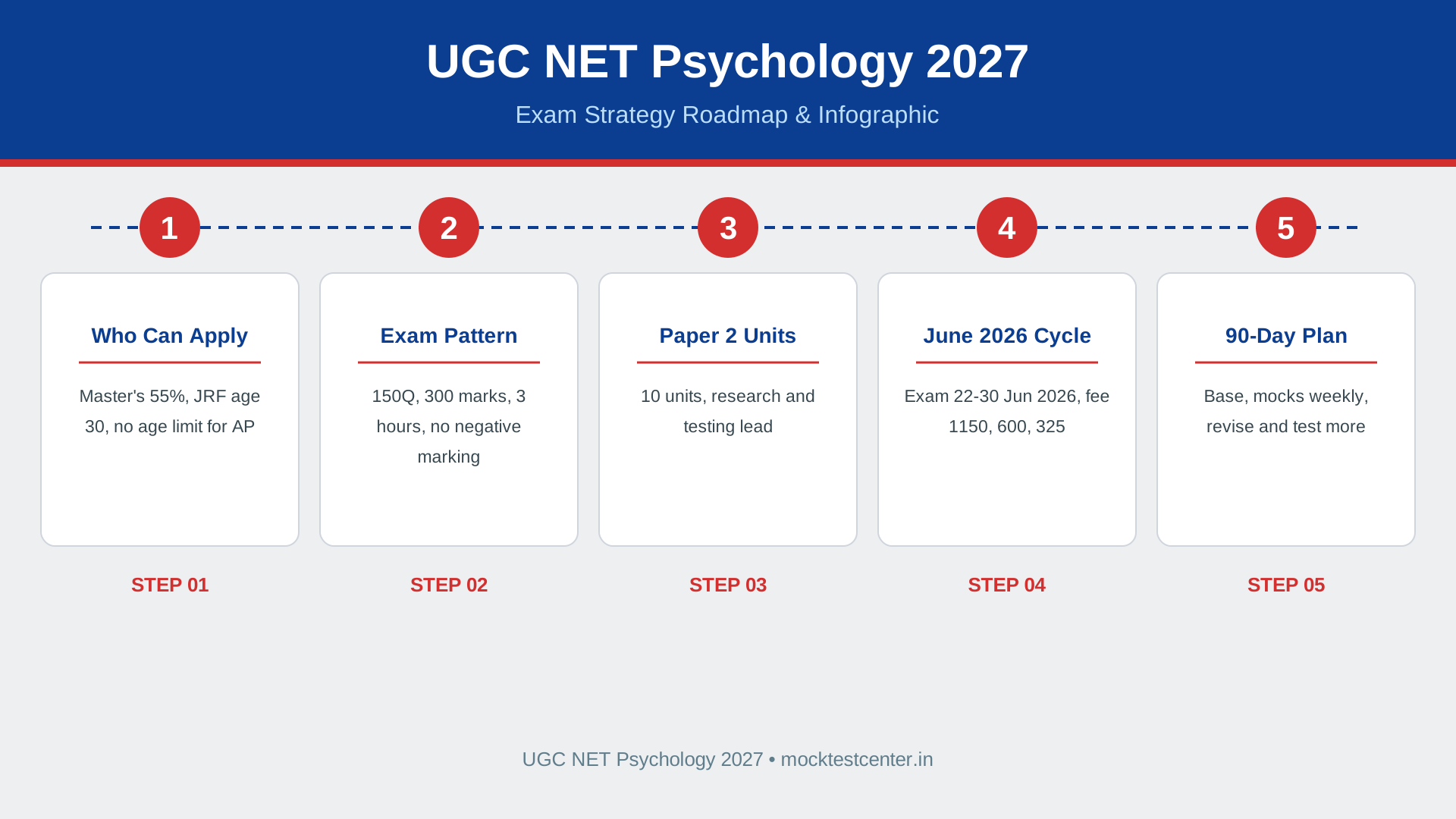
UGC NET runs as one computer based test with two papers in a single session. You sit for three hours with no break between the papers, and you answer 150 questions for 300 marks. Every question carries two marks, and every question needs an answer, because the paper has no choice and no negative marking.
Paper 1 carries 50 questions for 100 marks. Paper 2 carries 100 questions for 200 marks. A wrong answer costs zero marks, so you should answer every question, even the ones where you feel unsure. A guess can add two marks, and it can never take marks away. UGC NET 2027 keeps this no negative marking rule for both papers.
| Paper | Questions | Marks |
|---|---|---|
| Paper 1, Teaching and Research Aptitude | 50 | 100 |
| Paper 2, Psychology | 100 | 200 |
| Total, single session of 3 hours | 150 | 300 |
The single session changes how you plan your time. You get 180 minutes for 150 questions, which works out to 72 seconds per question on average. Fast readers finish Paper 1 in about 50 minutes and keep the rest for Paper 2, where the subject questions need more thought. Practise the full three hour stretch in mocks, because a three hour paper tests stamina as much as knowledge.
Paper 1 in brief
Paper 1 tests teaching and research aptitude, and it stays the same for every subject. It carries 10 units, and each unit sends about five questions worth 10 marks. The units cover Teaching Aptitude, Research Aptitude, Comprehension, Communication, Mathematical Reasoning and Aptitude, Logical Reasoning, Data Interpretation, Information and Communication Technology, People Development and Environment, and the Higher Education System.
Paper 1 decides more results than candidates expect. It carries one third of the total marks, and a strong Paper 1 score lifts your total past the cut off even when Paper 2 feels tough. Many subject experts lose the fellowship by five or ten marks, and Paper 1 often holds those marks.
Give Paper 1 a fixed slot every day. Thirty minutes a day covers one unit in about a week, and the full ten units fit into ten weeks at that pace. Solve past Paper 1 questions from the last five cycles, because the question style repeats even when the facts change. For a full Paper 1 guide, see UGC NET Paper 1 2027 on this site.
Who can apply
A Master degree opens the door. You need at least 55 percent marks in your Master degree if you belong to the General or General EWS group, and at least 50 percent if you belong to OBC NCL, SC, ST, PwD or the third gender group. NTA counts the percentage without rounding off, so 54.9 percent will fall short of 55 percent.
Final year Master students can apply too. You can sit for the exam while your final result still waits, but you must finish the degree with the required percentage within two years of the result date for the first two result categories, and within one year for the third category. That one year rule for the third category comes from a single source, so check the bulletin when it arrives.
Four year Bachelor degree holders get a narrower door. With 75 percent aggregate, or 70 percent for reserved groups, you can qualify for the fellowship and for PhD admission, but this route gives you no eligibility for Assistant Professor posts. Read that rule twice if you plan to use it.
Your Master subject should match your Paper 2 subject in most cases. NTA lets candidates pick a subject close to their Master degree, and the bulletin lists the allowed combinations. Pick the subject you studied in depth, because Paper 2 tests postgraduate level knowledge across ten units.
Age limits for JRF and Assistant Professor
The fellowship carries an age limit, and the teaching post carries none. For the Junior Research Fellowship, you must stay under 30 years of age as on the first day of the exam month. The June 2026 cycle counted age as on 1 June 2026, and the December 2026 cycle counts age as on 1 December 2026. June 2027 will count age as on the date the new bulletin names, so check that notice with care before you apply.
Relaxation stretches the limit by up to five years for OBC NCL, SC, ST, PwD, third gender and women candidates. Research experience, an LL.M. degree and armed forces service can also earn relaxation, and the total relaxation stays capped at five years. Add your relaxation once, and check the bulletin for the exact words before you apply.
Assistant Professor posts carry no upper age limit at all. You can sit for the exam at 35, 45 or 55 and still qualify for teaching posts if your score clears the cut off. PhD admission also carries no upper age limit. That split shapes many plans, because candidates past 30 can still build a teaching career through this exam.
Age counts from the first of the exam month, and a single day can change your category. If your birthday falls in the exam month itself, read the bulletin rule with care and keep your birth proof ready at the form stage.
How qualifying works
Two hurdles stand between you and a pass. First, you must appear in both papers, because a candidate who skips either paper gets no result. Second, your combined score across both papers must reach the minimum, which is 40 percent for General and General EWS candidates and 35 percent for SC, ST, OBC NCL, PwD and third gender candidates. In marks, that means 120 out of 300 for the General group and 105 out of 300 for the reserved groups.
Those minimum marks only let NTA consider you. The real cut off sits far higher, because NTA caps the number of qualifiers. Only 6 percent of the candidates who appear in both papers can qualify for Assistant Professor posts, and NTA splits that 6 percent by reservation category and then by subject. That split produces the subject wise and category wise cut off for Psychology.
NTA declares results in three categories. Category 1 covers the Junior Research Fellowship plus Assistant Professor plus PhD admission. Category 2 covers Assistant Professor plus PhD admission. Category 3 covers PhD admission only. A Category 1 result opens every door, while a Category 3 result still opens the PhD door.
For Categories 2 and 3, universities give the NET score 70 percent weight and their own interview 30 percent weight for PhD admission. The NET score stays valid for PhD admission for one year from the result date. Plan your PhD applications inside that year, because the score loses its value after that.
The fellowship pays well by student standards. A Junior Research Fellow gets 37,000 rupees a month for the first two years, and the amount rises to 42,000 rupees a month as a Senior Research Fellow after that, plus house rent allowance as per UGC rules. That money lets many scholars study full time without a side job.
Paper 2 units one to five
Paper 2 for Psychology carries subject code 04 and ten units, and the syllabus has stayed the same since June 2019. Read the unit list below as your map. The first five units build the base that the rest of the paper keeps using, and the research unit alone can decide your result.
Unit 1, Emergence of Psychology, traces how the subject grew. Eastern systems such as the Bhagavad Gita, Buddhism, Sufism and Integral Yoga open the unit, and the Western story runs from Greek thought through Wundt, Freud, James and the modern schools. Structuralism, functionalism, behaviourism, Gestalt, psychoanalysis, humanism and the cognitive school all appear, and the questions test what each school actually claimed.
Unit 2, Research Methodology and Statistics, carries the heaviest weight in practice. Research types, variables, hypothesis testing, sampling, experimental designs, ANOVA, MANOVA, ANCOVA, correlation, regression, factor analysis, parametric and non-parametric tests, and research ethics all sit here. Learn the formulas by writing them, and solve numerical questions daily, because this unit punishes readers who only read theory.
Unit 3, Psychological Testing, covers how psychologists measure the mind. Test construction, item writing and analysis, standardisation, reliability, validity, norms, intelligence tests, aptitude tests, personality tests, attitude scales such as Likert scales, and neuropsychological testing all appear. Learn the difference between reliability and validity first, because the paper asks it in many forms.
Unit 4, Biological Basis of Behaviour, covers the body behind the mind. Neurons, the central and peripheral nervous systems, the endocrine system, neurotransmitters, brain structure and functions, genetics, sleep and biofeedback all sit in this unit. Draw the brain areas on one page and the endocrine glands on another, because diagrams fix this unit in memory faster than text.
Unit 5, Attention, Perception, Learning, Memory and Forgetting, covers how the mind takes in and keeps information. Theories of attention, perceptual organisation, classical and operant conditioning, observational learning, models of memory, forgetting curves and methods to improve memory all appear. Link each theory to its classic experiment, because the paper often names the experiment and asks for the theory.
Paper 2 units six to ten
Unit 6, Thinking, Intelligence and Creativity, covers how the mind solves problems. Concepts, reasoning, problem solving, decision making, theories of intelligence, IQ testing, emotional intelligence and the nature of creativity all sit here. Candidates often skip this unit, and that is a mistake, because its questions come straight from the standard texts.
Unit 7, Personality, Motivation, Emotion, Stress and Coping, covers why people act as they do. Theories of personality, assessment of personality, theories of motivation, the nature of emotion, stress models and coping strategies all appear. Keep a table with one row per theory and one line for its key idea, because the paper tests the differences between theories more than the theories alone.
Unit 8, Social Psychology, covers people in groups. Attitudes, prejudice, conformity, obedience, group dynamics, leadership, aggression, prosocial behaviour and social cognition all sit in this unit. The classic studies of Milgram, Asch and Zimbardo return again and again, so learn the method and the finding of each study, not just the name.
Unit 9, Human Development and Interventions, covers growth across the lifespan. Prenatal development, childhood, adolescence, adulthood, ageing, developmental theories and intervention methods all appear. Pair the theories with their stages, because the paper asks which stage a given behaviour belongs to.
Unit 10, Emerging Areas, closes the syllabus with the newest fields. Educational psychology, clinical and counselling psychology, health psychology, environmental psychology, forensic psychology, community psychology and organisational applications all sit here. This unit rewards readers who follow new work, so read one recent application per week and note where psychology meets real life.
One flag belongs here. One popular guide lists 15 units for Psychology, and it adds Psychological Disorders, Therapeutic Approaches and Applications of Psychology as separate units. The official syllabus for subject code 04 has 10 units, and the disorder, therapy and application topics sit inside Units 7, 9 and 10. This page uses the official 10-unit split, and you should check the official syllabus PDF if a guide shows a different list.
What the June 2026 cycle showed
The June 2026 cycle gives you the clearest picture of how a UGC NET cycle runs. NTA released the notification on 29 April 2026. One source gives 28 April 2026 instead, and the majority of trackers say 29 April, so this page uses 29 April and flags the 28 April claim.
Applications ran from 29 April 2026 to 20 May 2026 at first, and NTA extended the window to 23 May 2026, with fee payment open till 11.50 PM on 23 May. One source says the window closed on 24 May 2026 instead, and this page flags that claim too. The lesson for you is simple. Apply early and never trust an extension until NTA posts it.
The exam ran on 22, 23, 24, 25, 29 and 30 June 2026 in computer based mode. The fee for the cycle was 1,150 rupees for General candidates, 600 rupees for General EWS and OBC NCL candidates, and 325 rupees for SC, ST, PwD and third gender candidates. The fee went online only, and NTA gave no refund.
The result and cut off lists came on 28 August 2026. English and Commerce needed a re-exam, and their fresh cut off list came on 17 September 2026 with the final answer key for the re-exam on the same day. Certificates came on 24 September 2026. From notification to certificate, the cycle took about five months.
The number of subjects carries a small conflict. Most trackers say 85 subjects, while one tracker says 87, with Statistics and Forestry as two newly added subjects. This page flags the conflict, because the official bulletin will settle it.
What the December 2026 cycle showed
The December 2026 cycle moved fast. NTA released the notification on 8 October 2026 and issued a revised bulletin with a corrigendum on 16 October 2026. Applications ran from 8 October to 31 October 2026, fee payment stretched to 1 November 2026, and the correction window opened on 2 November 2026.
NTA first announced the exam for 14 to 19 December 2026, then revised the dates. The final exam dates are 14, 15, 16, 17, 18 and 21 December 2026. That change shows why you should check the NTA site after you apply, because a date can move even after the first notice.
The December cycle also shows the pace you should expect. Notification to exam took about ten weeks, and the June cycle will likely follow a similar gap. If NTA releases the June 2027 notice in late April 2027, as it did in 2026, the exam would fall in late June, but that is a guess from the past pattern, and the bulletin will give the real dates.
How NTA sets the cut off
The cut off has no fixed number. NTA builds it after the exam from the scores of the candidates who appeared in both papers. The 6 percent cap fixes how many candidates can qualify for Assistant Professor posts, and the split by category and by subject fixes the cut off for each group. A tough paper pulls the cut off down, and an easy paper pushes it up, so last year cut off never predicts this year cut off exactly.
Psychology usually needs a high score for the fellowship. The fellowship cut off sits above the Assistant Professor cut off, which sits above the PhD only cut off, and the General category cut off sits above the reserved category cut offs in most cycles. Aim for the fellowship line even if you only need the teaching post, because a higher target pulls your whole score up. UGC NET 2027 cut offs will follow the same method as 2026.
This page gives no exact cut off numbers for Psychology from June 2026. The NTA cut off PDF of 28 August 2026 carries the subject wise numbers, and this pass did not verify the Psychology figures from that PDF. Read the mechanism above, and check the PDF itself if you want the exact numbers for your category.
One number matters more than the cut off itself. Your Paper 1 score can rescue a weak Paper 2, because the cut off uses the combined total of 300 marks. Candidates who treat Paper 1 as a side task throw away the easiest marks in the whole exam.
Books that help in Psychology
One good book per unit beats ten books read in part. Start with Psychology by Robert A. Baron, which covers the core of the subject in clear language and gives you the vocabulary for the whole paper. Pair it with Introduction to Psychology by Morgan, King, Weisz and Schopler for the classic experiments and theories.
For the research unit, use a dedicated book on research methods and statistics, and solve numerical questions every day. A. K. Singh has a widely used Indian text on tests, measurements and research methods, and it suits Unit 2 and Unit 3 together. Keep a formula sheet with one line per test, and revise it weekly.
For biology and cognition, Psychology by Saundra Ciccarelli and J. Noland White gives clear diagrams and examples. For the basics, the NCERT Class 11 and Class 12 Psychology books give short, clean definitions that help in the first revision round.
Past papers matter as much as books. Solve the last five years of Psychology papers unit by unit, and mark every question you miss. The questions repeat their themes even when the facts change, and a question you miss twice is a topic you must revise twice.
Buy books only after you check the syllabus. A book that covers the old syllabus will waste your weeks, and a book that skips Unit 6 or Unit 10 will leave gaps that the paper will find.
A 90-day plan that fits real life
Days 1 to 30 build your base. Give two hours a day to Paper 2 and thirty minutes to Paper 1. Finish Units 1, 4 and 5 of Paper 2 in the first month, because they carry the history, the biology and the cognition that the rest needs. Start Unit 2 in the same month, and solve five statistics questions a day from the start.
Days 31 to 60 go deep and test. Finish Units 2, 3, 6, 7, 8, 9 and 10 of Paper 2, and take one full mock test every week. Check every wrong answer and note the correct idea in one line. Revise your weak units twice, and start a short note file for theories, experiments and formulas.
Days 61 to 90 revise and test more. Take a full mock test every three days, and in the last two weeks take one every two days. Revise your short notes daily, and solve past papers in the last week. Sleep well in the last three days, because a tired mind drops easy marks.
The plan works only if you protect the hours. Two focused hours beat five distracted hours, so put the phone away, set a timer, and count solved questions at the end of each day. If you miss a day, cover the missed unit the next morning instead of pushing the whole plan forward.
How to use mock tests well
A mock test works only if you take it like the real exam. Sit for three hours in one stretch with no pauses, answer all 150 questions, and keep the same order you plan for exam day. Most toppers attempt Paper 1 first and Paper 2 next, because Paper 1 needs less deep thought and a quick start builds confidence.
After each test, spend one hour on analysis. Note the questions you got wrong, and note the questions you guessed right, because a lucky guess hides a gap. Track your score unit by unit, and give the next week to the two weakest units.
Two or three good tests a week with full analysis beat ten tests taken in a rush. A test without analysis only tells you a number, while analysis tells you what to study next. Keep an error book with one line per mistake, and read it the night before the next test.
Other subjects on this site can sharpen your Paper 1 and your general method. See UGC NET Political Science 2027, UGC NET Sociology 2027, UGC NET Economics 2027, UGC NET Commerce 2027, UGC NET Management 2027, UGC NET History 2027, UGC NET English 2027, RRB Group D Level 1 2027 and SSC MTS and Havaldar 2027 on this site.
Mistakes that cost marks
The first mistake is to ignore Paper 1. Candidates spend months on Psychology and treat Paper 1 as a last week job, then lose the fellowship by a few marks that Paper 1 would have given. Paper 1 carries 100 marks, and those marks come easier than the last 20 marks of Paper 2.
The second mistake is to read statistics without solving. Unit 2 has numbers, and numbers need practice, not reading. Solve five numerical questions a day from the first week, and keep a formula sheet that you rewrite from memory every Sunday.
The third mistake is to guess the exam date. Candidates who wait for the notice to start reading lose the months that toppers use. The syllabus stays fixed, the pattern stays fixed, and the books stay the same, so start now and let the notice catch up with you.
The fourth mistake is to trust cut offs from random sites. A fake cut off can make you aim too low or panic for no reason. Use the NTA cut off PDF, use the 6 percent rule, and aim for the fellowship line.
The fifth mistake is to skip the admit card and exam day rules. Read the admit card the day it arrives, reach the center early, and carry the exact documents NTA asks for. A missed document can end a year of study in one morning.
What to check when the June 2027 notice arrives
Check the notification date and the last date to apply first, then the fee for your category, then the exam dates. Save the bulletin as a PDF and mark the eligibility part, the age rule and the subject code. Psychology carries code 04, and the form will ask you to pick it. UGC NET 2027 forms will open on the NTA site first, so check there before you trust any other page.
Check the syllabus line in the bulletin. The syllabus has stayed the same since June 2019, but a new bulletin can still change a unit, so compare the unit list with the ten units on this page. If a unit changes, change your plan the same day.
Check the correction window dates and use them if you spot a mistake in your form. A wrong photo, a wrong signature or a wrong category can cost you the exam, and the correction window is your only chance to fix it.
Check the admit card date, the exam city and the shift timing when NTA releases them. Plan your travel a day early if your center sits far from home, and keep your documents in one folder the night before.
UGC NET Psychology 2027 rewards steady readers who start early and revise often. The notice will arrive, the exam will follow, and the candidates who used the waiting months well will walk in ready.







