
About UGC NET History 2027 Exam Series
📖 Table of Contents
- What this exam gives you
- Who can apply
- Age limits and relaxations
- The exam pattern in one sitting
- Paper 1 in brief
- Paper 2 syllabus unit by unit
- Unit 1: Negotiating the Sources
- Unit 2: From State to Empire
- Unit 3: Emergence of Regional Kingdoms
- Unit 4: Sources and Political Developments in Medieval India
- Unit 5: Administration and Economy
- Unit 6: Society and Culture
- Unit 7: Sources of Modern Indian History
- Unit 8: Colonial Economy and Society
- Unit 9: National Movement and Post-Independence India
- Unit 10: Historical Method, Research Methodology and Historiography
- June 2026 cycle: what actually happened
- December 2026 cycle
- How the cut off works
- Best books for UGC NET History 2027
- A 90 day plan that fits a working student
- How to use mock tests
- Mistakes that cost marks
- What to check when the June 2027 notice arrives
UGC NET History 2027
UGC NET History 2027 has no notification yet. NTA has published no dates for the June 2027 cycle as of 19 November 2026. That single fact shapes this whole page. You can still prepare with confidence because the pattern and the syllabus stay the same from cycle to cycle, and the June 2026 cycle gives you firm dates and fees to plan around.
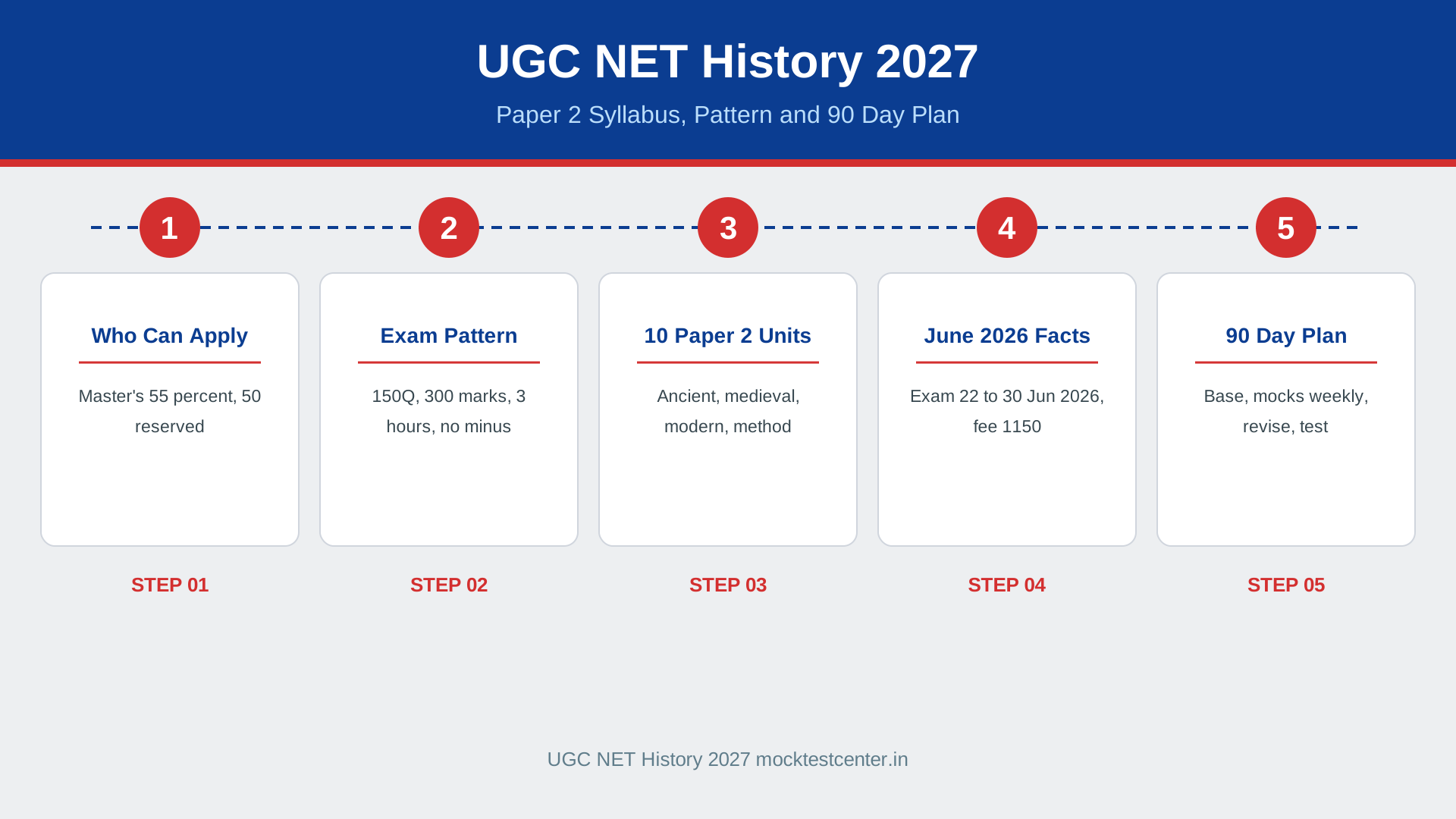
Here is the direct answer. UGC NET History 2027 will test you in one sitting of 3 hours. Paper 1 carries 50 questions for 100 marks. Paper 2 carries 100 questions for 200 marks. Every question carries 2 marks. NTA gives no negative marking, so attempt every question. The paper comes in English and Hindi. Check the official site ugcnet.nta.ac.in for every notice, because only the official notice counts as final.
History draws graduates who love the past, yet the paper tests method as much as memory. The ten units run from the Harappan civilisation to post independence India, with historiography and research method closing the paper, so the exam rewards candidates who know how history gets written as well as what happened. This page walks through the pattern, the eligibility, the full syllabus unit by unit, the June and December 2026 cycles, the cut off method, the books, and a 90 day plan you can start today.
What this exam gives you
UGC NET opens three doors, and the result puts you in one of three categories. Category 1 covers Junior Research Fellowship and Assistant Professor, with PhD admission. Category 2 covers Assistant Professor and PhD admission. Category 3 covers PhD admission only. The category you land in depends on your score and the cut off for your subject and category, so read the cut off section below with care.
A Junior Research Fellowship pays 37000 rupees a month for the first two years, then 42000 rupees a month as Senior Research Fellow, plus house rent allowance as per UGC rules. That money lets you research full time in a university, and the fellowship carries weight when you apply for teaching posts later. An Assistant Professor post needs the NET qualification in most universities and colleges, so the exam works as a career licence for teaching.
For PhD admission, universities give the NET score 70 percent weight and their own interview 30 percent weight for candidates in Categories 2 and 3. The NET score stays valid for PhD admission for 1 year from the result date. So even a Category 3 result has real value if you plan a PhD within that year. Start your PhD applications in the same season as your result, because the 1 year window passes fast.
Who can apply
You need a Master degree or an equivalent degree with at least 55 percent marks if you belong to the General or General EWS category. Candidates from OBC Non Creamy Layer, SC, ST, PwD and third gender categories need at least 50 percent marks. NTA counts the percentage without rounding off, so 54.9 percent counts as below 55 percent. Your degree must come from a UGC recognised university.
Final year Master students can apply provisionally, but you must complete the degree within the window the bulletin sets. The bulletin sets 2 years from the result date for Categories 1 and 2, and 1 year for Category 3. Treat that Category 3 window with care, because it rests on a single source in our research and you must check it against the official bulletin when the June 2027 notice arrives.
Holders of a four year bachelor degree with 75 percent aggregate marks can also apply, with 70 percent for reserved categories. They qualify for Junior Research Fellowship and PhD admission only, and the Assistant Professor door stays closed for them. Check your own degree against these rules before you pay the fee, because the fee is non refundable and a wrong application wastes both money and a cycle.
Age limits and relaxations
The Junior Research Fellowship has a maximum age of 30 years as on the 1st of the exam month. For the June 2026 cycle that date was 1 June 2026, and for the December 2026 cycle it was 1 December 2026. The June 2027 cycle will use the 1st of the exam month as its reference date, but confirm that date in the new notice before you apply.
Relaxation goes up to 5 years for OBC Non Creamy Layer, SC, ST, PwD, third gender and women candidates. Research experience, an LL.M. degree and armed forces service also earn relaxation, with the total capped at 5 years. Add your relaxations together and check the cap, because the cap, rather than the sum, decides your final limit.
Assistant Professor posts and PhD admission carry no upper age limit. So a candidate of 45 can still sit for the exam and qualify for teaching, even when the fellowship age has passed. That rule keeps the exam open to working teachers and late starters, and it shapes the competition in every subject.
The exam pattern in one sitting
NTA holds both papers together in a single Computer Based Test session of 3 hours, with no break between papers. You manage the 180 minutes yourself, because the exam sets no sectional time limit. That freedom helps candidates who finish Paper 1 fast and want more time for Paper 2, and it punishes candidates who spend too long on the first paper. Practise with a timer from the first mock onward.
- Paper 1: 50 questions, 100 marks, 2 marks each
- Paper 2: 100 questions, 200 marks, 2 marks each
- Total: 150 questions, 300 marks, 3 hours
- Negative marking: none, attempt every question
- Mode: Computer Based Test, all questions compulsory
- Medium: English and Hindi
Paper 1 tests teaching and research aptitude, and Paper 2 tests your subject alone. The two papers together decide your aggregate, and the aggregate decides whether you clear the qualifying floor. Read the next two sections for the syllabus of each paper, then the cut off section for how NTA turns scores into results.
Paper 1 in brief
Paper 1 carries the code 00 and stays common for every subject. It has 10 units, with about 5 questions and 10 marks from each unit. The syllabus has stayed unchanged since June 2019, so old papers and old notes still work for this paper. The units cover teaching aptitude; research aptitude; comprehension; communication; mathematical reasoning and aptitude; logical reasoning; data interpretation; information and communication technology; people, development and environment; and the higher education system.
Many subject specialists treat Paper 1 as a side task and lose 20 to 30 marks there, which often decides the result. Give Paper 1 one hour a day in your plan, with data interpretation and logical reasoning as daily practice. Solve the last five years of Paper 1 questions before you touch a new guide, because the question styles repeat and the old papers show you the exact level NTA expects.
Paper 2 syllabus unit by unit
Paper 2 for UGC NET History 2027 carries subject code 06 and has 10 units. The 100 questions spread across these units, with about 10 questions from each unit on average, though the exact split shifts from shift to shift. NTA publishes no official per unit weight, so treat any weight table on the web as a rough guide built from past papers. The unit list below follows the official NTA syllabus, and the package notes flag any order difference we found while checking it.
Unit 1: Negotiating the Sources
This unit teaches you how historians know what they claim to know. Archaeological sources cover exploration, excavation, epigraphy and numismatics, with dating methods for sites. Literary sources cover indigenous literature in primary and secondary form, with the problem of dating religious and secular texts, myths and legends. Foreign accounts cover Greek, Chinese and Arabic writers, with what each traveller saw and what each missed. The unit then walks through Neolithic and Chalcolithic cultures, the Indus Valley Civilisation, the Vedic and Later Vedic Age, the Mahajanapadas and the second urbanisation, plus Jainism, Buddhism and the Ajivikas. Learn each source with its limits, because NTA asks what a source can prove and what it hides, and that question separates the top scorers from the rest. Keep a timeline on one page for this unit and revise it weekly.
Unit 2: From State to Empire
This unit follows the rise of states into empires across ancient India. It starts with the rise of Magadha and the Greek invasion under Alexander, with its effects on Indian polity. The Mauryan expansion follows, with Mauryan polity, society and economy, Ashoka Dhamma and its nature, and the decline and disintegration of the Mauryan Empire. Mauryan art and architecture appear, with Ashokan edicts and their language and script as source material. The post Mauryan period covers Indo Greeks, Shakas, Kushanas and the Satavahanas, with trade and cultural exchange. The Sangam Age covers south Indian polity and literature. The Gupta Vakataka Age covers polity, economy, society and culture, with Harsha and the regional kingdoms closing the unit. Learn each dynasty with its dates, its capital, its administration and its art, because the paper tests the same facts in matching and chronology formats.
Unit 3: Emergence of Regional Kingdoms
This unit covers early medieval India, the period that many candidates find hardest because the kingdoms multiply fast. Regional kingdoms across north, south, Deccan and eastern India form the core, with the Gurjara Pratiharas, the Palas, the Rashtrakutas, the Cholas and the Rajput states. Early medieval administration covers the king, the court and the officers who ran the state. The agrarian economy covers land grants, the brahmana and temple grants, and the growth of the landholding class. Trade, ports and guilds cover the movement of goods and the towns that grew around it. Temple architecture covers the Nagara, Dravida and Vesara styles with examples. The Bhakti movement appears here in its early form, with society, education and the debates among historians about feudalism closing the unit. Make a map based chart for this unit, because places anchor the kingdoms in memory.
Unit 4: Sources and Political Developments in Medieval India
This unit covers the political story of medieval India from the Sultanate to the Marathas. Sources of medieval Indian history cover Persian chronicles, inscriptions, coins, foreign travellers and archaeological remains, with the strengths and limits of each. The Delhi Sultanate covers the five dynasties from the Slave dynasty to the Lodis, with administration, economy and decline. The Mughal Empire covers Babur to Aurangzeb, with expansion, administration and the causes of decline. The Vijayanagara and Bahmani kingdoms cover the Deccan story, with their rivalry and their cultural life. The Maratha Empire covers Shivaji, the Maratha administration and the expansion under the Peshwas. Learn each dynasty with its founder, its key rulers, its battles and its administrative marks, because the paper returns to the same rulers in new question frames every cycle.
Unit 5: Administration and Economy
This unit looks past the kings to the machinery that ran medieval India. Sultanate administration covers the central government, the iqta system and the revenue system. Mughal administration covers the central government, the mansabdari system, the jagirdari system and the zabt system of revenue. Vijayanagara and Maratha administration cover their own systems, with the Maratha ashtapradhan as a regular question. Agriculture and irrigation cover crops, land revenue and water systems. Industries and handicrafts cover textiles, metal work and crafts. Trade, commerce and currency cover inland and overseas trade, the coinage of each period and the merchant communities. Famines and peasant revolts close the unit, with the causes and the responses of the state. This unit rewards table based notes, so put each administration side by side on one page and compare them directly.
Unit 6: Society and Culture
This unit covers the people of medieval India rather than its courts. Social organisation covers castes, communities and the position of each group. Sufism covers the orders, the saints and their role in society. The Bhakti movement covers its saints, its ideas and its spread across regions. The Sikh movement covers Guru Nanak and the later Gurus, with the rise of the Khalsa. The position of women covers their status in different communities and periods. Education covers madrasas, pathshalas and centres of learning. Art, architecture, painting and music cover the monuments, the schools of painting and the musical traditions of the period. Learn each movement with its founder, its core idea and its regional base, because the paper tests these three facts together in matching questions.
Unit 7: Sources of Modern Indian History
This unit opens modern India with its sources and the coming of British power. Historical sources cover archives, official records, newspapers, private papers and oral sources. The rise of British power covers the Carnatic wars, the battle of Plassey, the battle of Buxar and the grant of Diwani. British expansion covers the subsidiary alliance, the doctrine of lapse and the wars with Mysore, the Marathas and the Sikhs. The Revolt of 1857 covers its causes, its course, its centres and its effects. Company and Crown administration covers the shift after 1858, with the Government of India Act 1858. Constitutional developments cover the Acts from 1909 to 1935, with the Morley Minto reforms, the Montagu Chelmsford reforms and the Government of India Act 1935. Keep the Acts in a single timeline chart, because the paper tests their years and their provisions together.
Unit 8: Colonial Economy and Society
This unit covers what British rule did to the Indian economy and society. The colonial economy covers the drain of wealth debate, the commercialisation of agriculture and the decline of handicrafts. Agriculture and land settlements cover the Permanent Settlement, the Ryotwari system and the Mahalwari system, with their effects on peasants. Industrial policy covers the slow growth of modern industry, the railways and the debate on deindustrialisation. Banking and transport cover the growth of banks, the railways and their effects. Urbanisation covers the growth of towns and the new urban classes. Tribal and peasant movements cover the Santhal rebellion, the Munda revolt, the Indigo revolt and the Deccan riots. Social and educational reforms cover the reformers, the movements and the laws that followed. This unit gives many analytical questions, so learn the causes and the effects of each policy rather than its date alone.
Unit 9: National Movement and Post-Independence India
This unit carries the largest share of questions in many shifts, so give it the most revision rounds. The rise of Indian nationalism covers its social, economic and political roots. The Indian National Congress covers its formation, its moderates and extremists, and its mass phases. The Gandhian movements cover Non Cooperation, Civil Disobedience and Quit India, with their programmes and their limits. The INA and Subhas Chandra Bose cover the armed struggle outside India. Partition and independence cover the causes, the plan and the aftermath. The Constitution of India covers its making, its features and its early working. Economic planning covers the five year plans and their record. Foreign policy covers non alignment and the early years of Indian diplomacy. Learn this unit in strict chronological order, because the paper tests sequence and cause and effect more than isolated facts here.
Unit 10: Historical Method, Research Methodology and Historiography
This unit tests how history gets written, and it gives easy marks to candidates who learn its terms well. The historical method covers heuristics, criticism, synthesis and presentation. Objectivity and bias cover the debate on whether a historian can stay neutral. Research methodology covers the selection of a research area, hypothesis, data collection, primary and secondary sources, original and derivative sources, note taking, references, footnotes, bibliography, and thesis and assignment writing. Plagiarism and intellectual dishonesty cover the ethics of research. Schools of historiography cover Greek and Roman writing, church historiography, Renaissance writing, Ranke, the Marxist philosophy of history, Spengler, Toynbee and post modernism. Learn each school with its chief thinker and its core claim, because the paper asks you to match thinkers to claims in almost every shift.
June 2026 cycle: what actually happened
The June 2026 notification came on 29 April 2026. One source in our research says 28 April 2026, and we flag that claim here because we could not settle it against the official bulletin. Applications ran from 29 April 2026 to 20 May 2026 originally, then NTA extended the window to 23 May 2026, with fee payment till 23 May 2026 at 11.50 PM. One source says the window closed on 24 May 2026, and we flag that claim too. Use the extended date of 23 May 2026 as your planning fact.
NTA held the exam from 22 to 30 June 2026, on 22, 23, 24, 25, 29 and 30 June, in Computer Based Test mode. The fee was 1150 rupees for General and Unreserved candidates, 600 rupees for General EWS and OBC Non Creamy Layer candidates, and 325 rupees for SC, ST, PwD and Third Gender candidates. The fee stayed online only and non refundable. Check the official NTA site nta.ac.in for the bulletin of that cycle if you want the primary source.
Trackers report 85 subjects for the June 2026 cycle, while one source reports 87 subjects including two newly added subjects, Statistics and Forestry. We flag that conflict here and use 85 as the working figure. NTA released the cut off lists on 28 August 2026. For English and Commerce, a re exam cut off list came on 17 September 2026, with the final answer key for the re exam on the same date. Certificates came on 24 September 2026.
December 2026 cycle
How the cut off works
You must appear in both papers, and your aggregate across both papers must cross the qualifying floor. The floor sits at 40 percent, or 120 of 300 marks, for General and General EWS candidates. It sits at 35 percent, or 105 of 300 marks, for SC, ST, OBC Non Creamy Layer, PwD and third gender candidates. Those floors only admit you for consideration. The real cut off sits far higher in most subjects.
NTA caps the number of candidates who qualify for Assistant Professor at 6 percent of the candidates who appeared in both papers. NTA splits that 6 percent by reservation category first, then by subject, and that split produces the subject wise and category wise cut off. A subject with more candidates gets a larger share of the 6 percent, and a subject with fewer candidates gets a smaller share, so the cut off moves with the crowd size in your subject.
This page gives no exact cut off numbers for UGC NET History 2027, because we did not verify the figures against the NTA cut off PDF of 28 August 2026. The June 2026 cut off list came on 28 August 2026, and the re exam list for English and Commerce came on 17 September 2026, but a number copied from a coaching site can differ by a mark or two from the official list. Read the official PDF on the NTA site before you set a target score, and set your target 15 to 20 marks above the last official cut off for your category, because the cut off rises when the paper turns easy.
Best books for UGC NET History 2027
Start with the NCERT base, then move to the standard university books. Read India Ancient Past by R. S. Sharma for ancient India, History of Medieval India by Satish Chandra for the medieval period, and History of Modern India by Bipan Chandra for the modern period. Add India Struggle for Independence by Bipan Chandra for the national movement, because that single book covers a large share of the most asked unit. For ancient India, add A History of Ancient and Early Medieval India by Upinder Singh for depth on polity and society.
For historiography, read What is History by E. H. Carr for the method debate, and keep a short notes book on the schools of historiography with each thinker and his core claim on one page. For culture and art, read The Wonder That Was India by A. L. Basham, with focus on society, religion and art. IGNOU BA History and MA History study material also helps, because its unit structure matches the NET syllabus closely and its language stays simple. Close every unit with previous year papers from the NTA site, because the paper repeats its question styles even when the facts change.
Buy books after you read the syllabus once, because a book that skips a unit wastes your money. Check the edition year on the cover, because tax rates, budget facts and current data change every year. Use the library for the expensive reference books and buy only the base guide and the previous year paper book, because the notes you write yourself matter more than the shelf you fill.
A 90 day plan that fits a working student
Days 1 to 30 build your base. Give two hours a day to Paper 2 and one hour a day to Paper 1. Finish two Paper 2 units in this phase with notes and 50 questions each, and cover teaching aptitude and research aptitude in Paper 1. Read one newspaper page a day for the people, development and environment unit. Solve 30 questions a day from the units you finish, and keep an error notebook from day one.
Days 31 to 60 go deep and test. Finish the remaining Paper 2 units, with the hardest unit first in this phase while your energy stays high. Take one full mock test every week, in a single 3 hour sitting, and spend two hours on analysis after each test. Revise your weak units twice in this phase, and practise the numerical units daily, because formulas fade fast without use. Add previous year papers here, one paper a week, with the same analysis routine.
Days 61 to 90 revise and test more. Take a full mock test every three days, and in the last two weeks take one every two days. Revise your short notes daily, with the error notebook as your main revision source. In the last week of your UGC NET 2027 plan, solve only past papers and your error notes, and stop new books completely. Sleep well in the last three days, because a tired mind loses more marks than a missed chapter. Keep your admit card, photo and identity proof ready in this phase, so the exam week stays calm.
How to use mock tests
A mock test works only when you treat it like the real exam. Take each UGC NET 2027 mock in one 3 hour stretch, with no pauses and no phone, and mark your answers with the same care you will use on exam day. Spend one hour on analysis after each test, and note every wrong answer with the correct method beside it. Track your score in Paper 1 and Paper 2 separately, because a strong subject paper can hide a weak Paper 1 score that costs you the result.
Two or three good tests a week, with full analysis, beat ten tests taken in a rush. Start with one mock a week, then raise the pace in the last month as the plan above sets out. Use the error notebook to pick your revision topics each week, because the notebook shows your real weak units rather than the units you fear most. Time yourself per section too, because the 180 minutes vanish fast when a hard unit eats your clock.
Other pages on this site help you compare your preparation across exams.
- UGC NET Political Science 2027
- UGC NET Sociology 2027
- UGC NET Paper 1 2027
- UGC NET English 2027
- UGC NET Geography 2027
Mistakes that cost marks
The first mistake is to skip Paper 1. Candidates who score 140 in Paper 2 and 50 in Paper 1 lose to candidates who score 120 in Paper 2 and 75 in Paper 1, because the aggregate decides the result. Give Paper 1 its hour a day and its mock analysis every week.
The second mistake is to read ten books for one unit. One base guide, one subject book for the weak units and the previous year papers cover the syllabus. Extra books add pages without adding marks, and they steal revision time in the last month.
The third mistake is to leave the numerical units for the end. Statistics, finance and maths based units need daily practice, and a last week rush cannot build that skill. Start the numerical units in week one, even if they feel hard, and the comfort grows with each set you solve.
The fourth mistake is to trust a cut off number from a random site. Cut offs change with the paper and the crowd, and a wrong target makes you either complacent or panicked. Use only the official NTA cut off PDF, and set your target above the last official figure for your category.
The fifth mistake is to wait for the notification before you start. The syllabus stays stable across cycles, and the June 2026 dates show you the shape of the cycle. Start now, and use the notice only to confirm dates, fees and the subject code.
What to check when the June 2027 notice arrives
Read the notice the day it comes, and check ten things before you apply. First, the exam dates and the application window, with the last date and the fee payment deadline. Second, the fee for your category, because the June 2026 fee was 1150 rupees for General, 600 rupees for General EWS and OBC Non Creamy Layer, and 325 rupees for SC, ST, PwD and Third Gender, and the new fee may differ. Third, your subject code, which is 06 for UGC NET History 2027. Fourth, the syllabus PDF, to catch any unit change. Fifth, the eligibility and age rules, with the reference date for the fellowship age.
Sixth, the exam cities and the city choice rules. Seventh, the correction window dates, because a wrong photo or signature can cost you the admit card. Eighth, the photo and signature specifications, with the file size and format. Ninth, the category certificate rules, with the format and the issuing authority. Tenth, the result categories and the PhD score validity, because the rules can change between cycles. Save the bulletin PDF on your phone and read it twice, once before you apply and once before the exam.
More pages on this site cover the exams that many NET candidates also prepare for.
- UPSSSC PET 2027
- UPSC CAPF 2027
- RRB NTPC 2027
- UPSSSC Junior Assistant 2027
- UPSSSC Revenue Lekhpal 2027
Start your UGC NET 2027 preparation today, with the syllabus in front of you and the June 2026 cycle as your guide. The notice will arrive when it arrives, and the candidates who started early will read it with calm minds. Check ugcnet.nta.ac.in every week from now on, keep your documents ready, and take your first full mock test this week. That first mock tells you the truth about where you stand, and the next 90 days tell you how far you can go.







