About OICL AO 2027 Exam Series
📖 Table of Contents
- What OICL AO 2027 is
- The 2025-26 cycle: 300 posts, and the return of the Generalist
- The 2024 cycle: 100 specialist posts, and why it confused everyone
- Who can apply: Generalist and Hindi Officer
- Age and fee
- Prelims: one paper for both streams
- Mains for Generalists: 200 marks plus a descriptive test
- Mains for Hindi Officers: a different paper
- Interview and the 80 to 20 merit
- Pay: what an Administrative Officer actually takes home
- OICL AO next to the other officer and assistant exams
- What to study for each section
- A 90 day plan that fits around a job
- Mistakes that cost candidates this exam
- What to check first when the next notice comes
- Sources
OICL AO 2027: Pattern, Salary, Dates and How to Prepare
What OICL AO 2027 is
OICL AO 2027 is the expected recruitment of Administrative Officers in Scale I by the Oriental Insurance Company Limited. An Administrative Officer in OICL does office based officer work in branch and regional offices: underwriting, claims, accounts, legal work, human resources and branch administration. It is the officer entry into one of the four public sector general insurers, and it is the post most graduates in this field aim for first, because it asks for a plain graduation degree and pays an officer salary from day one.
One fact must come first. The newest OICL AO cycle started on 1 December 2025, when the company notified 300 Administrative Officer posts, and it is still running. Applications closed on 18 December 2025, the preliminary exam took place on 10 January 2026, the preliminary result came out on 6 February 2026, and the main exam took place on 28 February 2026. The main exam result has been released, and the interview stage follows. No 2027 notice exists yet, and none can exist until this cycle closes. This page builds the whole guide from the December 2025 notice and the cycle before it, and it says plainly wherever a figure belongs to a past cycle. Check the official site at orientalinsurance.org.in before you act on any date or vacancy number, because only the next notice is final.
OICL is a public sector general insurance company wholly owned by the Government of India. The AO post is its Scale I officer entry, and it comes in two streams in the current cycle: Generalist, for graduates in any discipline, and Hindi Officer, for postgraduates in Hindi. The two streams share the preliminary exam and then split for the mains, with different papers and different marks. The selection has three stages: a preliminary online test, a main online test with a descriptive test, and an interview. The preliminary test is qualifying only. The final merit combines the mains objective marks and the interview marks in the ratio of 80 to 20.
The 2025-26 cycle: 300 posts, and the return of the Generalist
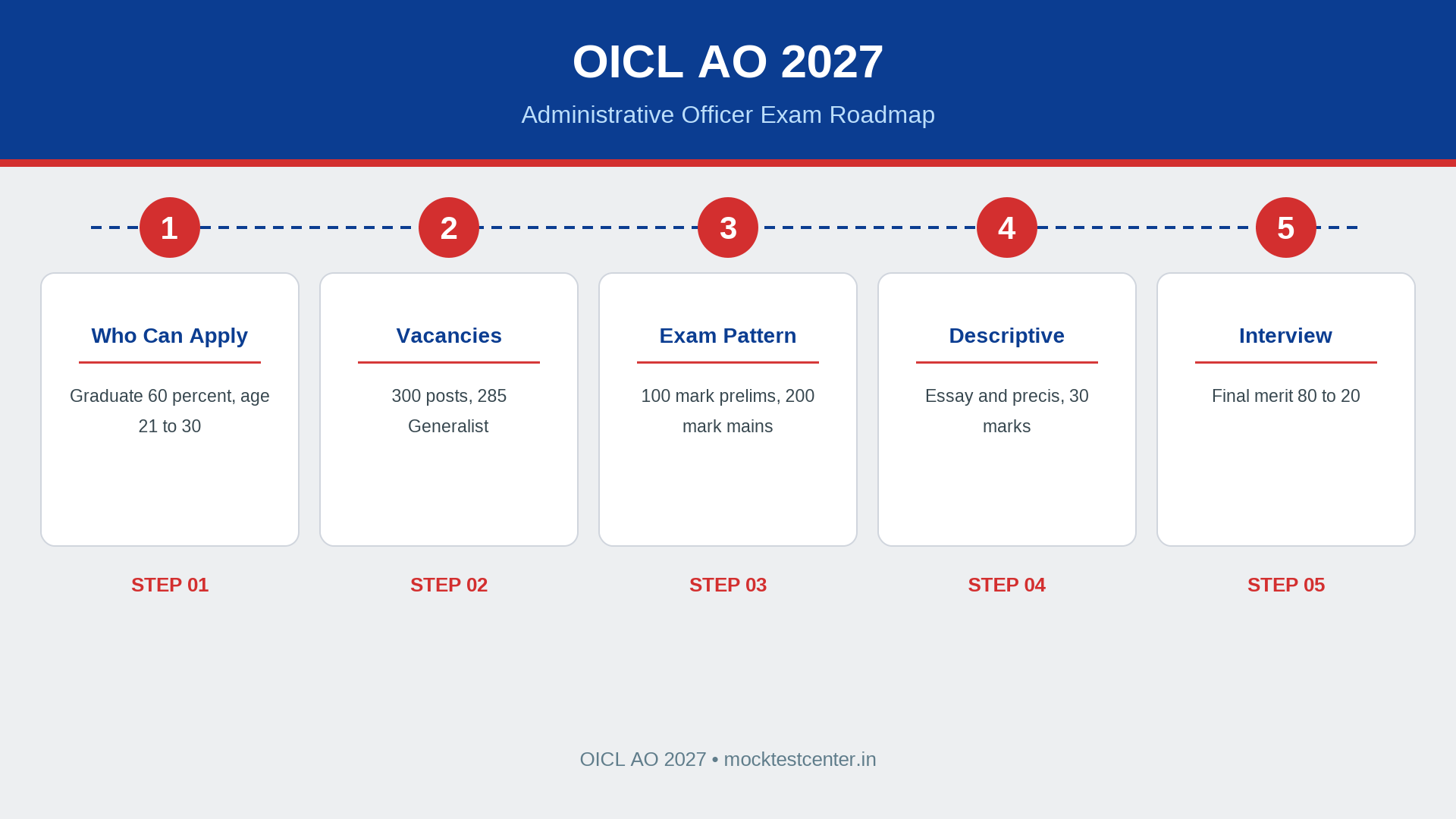
The December 2025 notification is the most important OICL AO notice in years, because it brought back the Generalist stream. The company notified 300 Administrative Officer posts: 285 Generalists and 15 Hindi Officers. The notification came out on 1 December 2025. Online applications ran from 3 December to 18 December 2025. The Tier I preliminary exam took place on 10 January 2026. The Tier II main exam took place on 28 February 2026. The preliminary result was declared on 6 February 2026, and the mains result followed after the February exam.
The category split for the 285 Generalist posts was UR 123, OBC 68, SC 42, ST 24 and EWS 28. The 15 Hindi Officer posts split as UR 7, OBC 4, SC 2, ST 1 and EWS 1. The totals across both streams were UR 130, OBC 72, SC 44, ST 25 and EWS 29, adding to 300. These are the figures to remember, because several tracker pages print the notification date as 25 November 2025 instead of 1 December, and one page prints the last date to apply as 15 December instead of 18 December. The advertisement reproduced from the official notice gives 1 December as the release date and 18 December as the last date, so this guide uses those figures and flags the variants.
The return of the Generalist matters because the cycle before this one had no Generalist posts at all. A graduate in any discipline could not apply to OICL AO in 2024. In the 2025-26 cycle, that same graduate can apply for 285 posts. If you are a general graduate with 60 percent marks, this is your cycle, and the next one will most likely look like it. If you are a Hindi postgraduate, the 15 Hindi Officer posts are a small but real door, and the mains paper for that stream is a different exam, covered in its own section below.
The 2024 cycle: 100 specialist posts, and why it confused everyone
The cycle before the current one is the reason so many pages about this exam are wrong. In March 2024, OICL notified 100 Administrative Officer posts, and every one of them was a specialist post. There was no Generalist stream. The split was Accounts 20, Actuaries 5, Engineers 15, Legal 20, Medical 20 and Engineering IT 20. The notification came out on 8 March 2024. Applications ran from 21 March to 12 April 2024. The preliminary exam took place on 7 July 2024. The main exam took place in late September 2024. The mains result came out on 20 November 2024. Interviews ran from 23 to 27 December 2024 in New Delhi, except 25 December, and from 30 December 2024 to 2 January 2025 in Mumbai.
That specialist only cycle is still quoted on many pages as if it were the OICL AO exam itself, with lists of engineering and medical eligibility rules presented as the general rule. A general graduate reading those pages would conclude that OICL AO needs an engineering degree or an MBBS, which is false for the current cycle. The 2024 cycle also shows how the company alternates: a specialist cycle, then a generalist cycle. The cycle before 2024, in 2017, was a generalist heavy cycle with 300 posts, including 223 Generalists, with applications from 18 August to 15 September 2017 and Phase I on 22 October 2017. The pattern across a decade is clear. OICL runs an AO cycle every few years, and the stream mix changes each time. Read the stream table in the new notice before you decide whether you are eligible.
One date in the 2024 cycle needs a flag. Most sources put the main exam on 28 September 2024, while one tracker page puts it on 27 September. This guide uses 28 September, the date in the result table, and flags the 27 September variant. The preliminary exam date of 7 July 2024 is agreed across sources, as is the fee: 1,000 rupees for most candidates and 250 rupees for SC, ST and persons with disabilities, the same fee as the current cycle.
Who can apply: Generalist and Hindi Officer
The Generalist stream asks for a graduation or post graduation degree in any stream from a recognised university, with a minimum of 60 percent marks. SC and ST candidates need 55 percent. There is no subject restriction and no work experience requirement. A graduate in history, commerce, science or engineering can apply, as long as the percentage rule is met. The percentage rule is the gate here, and it is strict: it is 60 percent for General, OBC and EWS candidates, and 55 percent for SC and ST candidates. Check your final year mark sheet, not your best semester, because the notice counts the qualifying examination as a whole.
The Hindi Officer stream asks for a Master's degree in Hindi, with English as a compulsory or elective subject at the graduation level, and a minimum of 60 percent marks. This is a specialist language post, and it suits a small group: postgraduates in Hindi who also studied English at graduation. Fifteen posts is a small number, but the applicant pool is small too, and a candidate who fits this stream exactly faces far less competition than a Generalist. If you hold a Master's in Hindi, do not ignore this stream. Read its mains pattern below before you decide, because the professional knowledge paper is worth 100 marks out of 200.
One stream per candidate. You cannot apply for both streams in the same cycle. The choice is made at the form stage, and it decides which mains paper you sit. A Hindi postgraduate who applies as a Generalist gives up the small pool advantage. A general graduate cannot apply as a Hindi Officer at all. Choose the stream that fits your degree, not the stream with more posts.
Age and fee
The December 2025 notice set the age at 21 to 30 years as on 30 November 2025. That means born not earlier than 1 December 1995 and not later than 30 November 2004. The next notice will print a new cut off date, and the window will move with it. Relaxation follows government rules: five years for SC and ST, three years for OBC in the non creamy layer, and ten years for persons with benchmark disabilities, with further relaxation for ex servicemen and for existing employees of the company. Read the relaxation table in the next notice line by line, because the slabs are long and a wrong claim can end the run at the document check.
The fee in the December 2025 cycle is 1,000 rupees including GST for all candidates other than SC, ST and persons with benchmark disabilities, and 250 rupees including GST for SC, ST and PwBD candidates. The 250 rupees covers intimation charges only. The fee is paid online only, with the registration, and it is not refunded. The 2024 cycle charged the same figures, 1,000 and 250, so the fee has been stable across the last two cycles. Do not confuse it with the Assistant fee in the same company, which is 850 rupees for most candidates and 100 for reserved categories. Officer and Assistant are different posts with different fees.
Prelims: one paper for both streams
The preliminary exam is the same for Generalists and Hindi Officers. It is a one hour online test with 100 questions for 100 marks. Three sections share the hour, each with its own timer of 20 minutes. English Language gives 30 questions for 30 marks. Reasoning Ability gives 35 questions for 35 marks. Quantitative Aptitude gives 35 questions for 35 marks. Each section is separately timed, which means you cannot borrow minutes from English to finish Reasoning. When the 20 minutes end, that section closes.
The preliminary test is qualifying only. Its marks do not enter the final merit. The notice says the top 20 times the number of vacancies will be shortlisted for the mains, which means about 6,000 candidates out of the preliminary field went on to the mains for 300 posts. Each section has its own passing marks, decided by the company, and the notice does not print them. The penalty for a wrong answer is one fourth of the marks assigned to the question, which is 0.25 marks, since each question carries one mark. Unanswered questions carry no penalty.
That changes how you should treat the hour. A candidate who scores very high in the preliminary test gains nothing extra in the final list. The job of the preliminary test is to get you into the mains with the least effort, so that your energy stays fresh for the main exam seven weeks later. In the 2025-26 cycle the gap between the two exams was about seven weeks, from 10 January to 28 February. Use the preliminary weeks to build speed, and keep the deep study for the mains.
Speed is the whole game in the preliminary test. Twenty minutes for 35 reasoning questions leaves about 34 seconds per question. Twenty minutes for 35 quantitative aptitude questions leaves the same. There is no room for a long puzzle. Practise in sets of 35 with a timer, and learn to skip a question in five seconds when it does not open up. A skipped question costs nothing. A stuck question costs the next three.
Mains for Generalists: 200 marks plus a descriptive test
The mains for Generalists is a two and a half hour objective test with 200 questions for 200 marks, followed by a descriptive test of 30 marks in 30 minutes. Five sections share the objective paper, each with its own timer. English Language gives 40 questions for 40 marks in 30 minutes. Reasoning gives 45 questions for 45 marks in 45 minutes. Quantitative Aptitude gives 40 questions for 40 marks in 40 minutes. Computer Knowledge gives 35 questions for 35 marks in 15 minutes. General Awareness gives 40 questions for 40 marks in 20 minutes.
| Section, Mains Generalist | Questions | Marks | Minutes |
|---|---|---|---|
| English Language | 40 | 40 | 30 |
| Reasoning | 45 | 45 | 45 |
| Quantitative Aptitude | 40 | 40 | 40 |
| Computer Knowledge | 35 | 35 | 15 |
| General Awareness | 40 | 40 | 20 |
| Total objective | 200 | 200 | 150 |
Each question carries one mark, and the penalty for a wrong answer is one fourth of a mark. Unanswered questions carry no penalty. Reasoning is the longest section, with 45 questions in 45 minutes, which is one minute per question. Computer Knowledge is the tightest, with 35 questions in 15 minutes, which is about 26 seconds per question. General Awareness gives 40 questions in 20 minutes, which is 30 seconds per question. These are recall sections, and they reward short daily revision, not long reading sessions.
The descriptive test is a test of English Language, worth 30 marks in 30 minutes, conducted online. It has two parts: an essay worth 20 marks and a precis worth 10 marks. It is qualifying in nature. The descriptive answer sheets are evaluated only if the candidate qualifies in the objective test, and the descriptive marks stay out of the final merit. Skipping it in preparation is still a mistake: a fail there ends the run, whatever the objective score. Practise one essay and one precis a week, timed at 30 minutes for the pair, so the format feels familiar on the day.
Mains for Hindi Officers: a different paper
The mains for Hindi Officers is a two hour objective test with 150 questions for 200 marks. Five sections share the paper, each with its own timer. English Language gives 25 questions for 25 marks in 20 minutes. Reasoning gives 25 questions for 25 marks in 30 minutes. Computer Knowledge gives 25 questions for 25 marks in 10 minutes. General Awareness gives 25 questions for 25 marks in 10 minutes. Professional Knowledge gives 50 questions for 100 marks in 50 minutes.
| Section, Mains Hindi Officer | Questions | Marks | Minutes |
|---|---|---|---|
| English Language | 25 | 25 | 20 |
| Reasoning | 25 | 25 | 30 |
| Computer Knowledge | 25 | 25 | 10 |
| General Awareness | 25 | 25 | 10 |
| Professional Knowledge | 50 | 100 | 50 |
| Total objective | 150 | 200 | 120 |
Professional Knowledge is half the paper. Fifty questions carry 100 marks, which means each question is worth two marks. The section covers Hindi language and literature, official language policy, translation, and the Rajbhasha rules that govern Hindi use in government offices. A Hindi postgraduate who knows this material well can build a lead that the other sections cannot undo. A candidate who treats the Hindi Officer mains as a general paper with a Hindi label will lose the exam in this one section.
The Hindi Officer mains also includes a descriptive test, in Hindi and English, which is qualifying in nature. The marks for that descriptive test were not verified in this pass: one source reports 50 marks, while the notice summary reproduced from the advertisement leaves the figure out. This guide states the conflict plainly and leaves the 50 mark figure out of the facts. Check the notice before you plan around it. The interview follows the mains for shortlisted candidates in both streams.
Interview and the 80 to 20 merit
The interview follows the mains for shortlisted candidates. The final selection combines the mains objective marks and the interview marks in the ratio of 80 to 20. The preliminary marks play no part in the final merit, and the descriptive test is qualifying only. That ratio decides where your effort belongs. Eighty percent of the final merit comes from the 200 mark objective paper. Twenty percent comes from the interview. A candidate who leads the mains by 20 marks can afford an average interview. A candidate who trails the mains by 20 marks needs an exceptional interview to catch up.
The interview panel asks about your degree subject, your home state, the insurance business, current affairs and why you want to join OICL. A general graduate should be ready to explain the degree in plain words, and a Hindi Officer should be ready to discuss official language policy in depth. Prepare with your own stories: one project you did, one subject you know well, one reason this company and not another. Those answers carry more weight than any rehearsed definition. Document verification runs alongside the interview, so keep your degree certificate, your percentage proof, your caste or category certificate and your age proof ready before the mains result, not after it.
One conflict needs a flag. A coaching page that reproduces the 2025-26 notice lists the selection as three phases: preliminary exam, mains exam and a local language proficiency test, with no interview mentioned. Every other source, including the notice summaries on Oliveboard, Guidely and Testbook, lists the interview as the third stage, with the 80 to 20 merit. This guide follows the majority: prelims, mains, interview. If the next notice prints a language test, read it carefully, because that would be a change from the current cycle.
Pay: what an Administrative Officer actually takes home
An Administrative Officer starts at a basic pay of 50,925 rupees a month, in the scale 50,925, then 2,500 fourteen times to 85,925, then 2,710 four times to 96,765. The gross emoluments run to about 85,000 rupees a month in metropolitan centres. On top of the basic pay come dearness allowance, house rent allowance, city compensatory allowance, medical benefits, leave travel concession and the contributory pension scheme. The scale is the same across the public sector general insurers, because it comes from the industry wide settlement for Scale I officers.
Put that pay beside the Assistant post in the same company and the trade off is clear. An OICL Assistant starts at a basic pay of 22,405 rupees, less than half the AO starting basic, with total emoluments of about 40,000 rupees a month in a metro city. The AO post pays more than twice as much at the start and asks for more: a 60 percent degree, a mains paper with a descriptive test, and an interview. For a graduate with 60 percent marks, the AO post pays for the extra effort. For a graduate below 60 percent, the AO door is closed, and the Assistant post is the way in.
Put the pay beside the other insurers and the picture is fair. NIACL and NICL pay their Administrative Officers the same starting basic of 50,925 rupees in their last cycles, with the same scale. The money is the same across the four companies. The difference is the stream mix, the vacancy count and the date of the next notice. OICL notified 300 AO posts in December 2025. NIACL notified 550 in August 2025. NICL notified 266 in June 2025 and opened a new cycle for 321 posts in October 2026. Apply for every AO exam you are eligible for, and decide when the offers come.
OICL AO next to the other officer and assistant exams
The OICL AO exam sits in a family of insurance officer exams with the same preliminary pattern and nearly the same mains, and the smart move is to prepare once and apply everywhere you are eligible. The closest cousin is the NIACL AO 2027 exam, run by New India Assurance, which hired 550 Administrative Officers in 2025 at the same starting basic of 50,925 rupees, with a 200 mark mains and a 50 mark interview. The other close cousin is the NICL AO 2027 exam, run by National Insurance, which hired 266 officers in 2025 and opened a new cycle for 321 posts in October 2026. The other big insurance officer entry is the LIC AAO 2027 exam, the officer entry into life insurance.
The other officer exams in the family are the LIC AAO exam, which is the officer entry into life insurance, and the IBPS PO 2027 exam, which is the officer entry into public sector banks and uses a similar preliminary pattern. The IBPS SO 2027 exam is a specialist officer post in banks, for graduates with a specialist degree in IT, law, agriculture, HR or marketing. The RBI Grade B 2027 exam is the hardest officer post in the financial sector, with a much tougher paper and a much higher pay. The SBI PO 2027 exam is the largest bank officer exam in the country. The assistant exams in the same family are the NIACL Assistant 2027 exam and the NICL Assistant 2027 exam, both of which hire 500 Assistants state wise with a preliminary test, a main test and a regional language test.
The way to choose is the stream table and the date. OICL AO is the only AO exam in the current round with a Hindi Officer stream, and it is the only one whose last cycle was generalist heavy after a specialist only cycle. If you are a general graduate with 60 percent marks, apply to all three general insurers and to IBPS PO. If you are a Hindi postgraduate, OICL AO is your best door, and the professional knowledge paper is where you win it. One preparation serves them all, because the preliminary pattern is the same 100 mark paper in every one of them.
What to study for each section
English appears in both the preliminary and the mains, and it is in English only, so it deserves a fixed daily slot. Reading comprehension, cloze tests, error spotting, sentence improvement, vocabulary and para jumbles carry the section. Read one editorial a day and mark the sentence structures you would have written differently. That habit alone lifts the score, because comprehension questions reward readers, not memorisers. Keep a notebook of new words with one example sentence each, and revise it every Sunday. English is also the descriptive test, so the same reading habit feeds the essay and the precis. A candidate who reads every day writes better essays without extra effort.
Reasoning is the section where speed is built. Puzzles, seating arrangements, inequality, syllogism, coding decoding, blood relations, direction sense and order ranking make up most of it. Learn the standard types first, then practise them in timed sets of 35. A puzzle that takes four minutes is a puzzle you should have skipped. The rule is simple: if a question does not open up in five seconds, move on and come back if time is left. Time is never left, which is the point. In the mains, reasoning is the longest section, with 45 questions in 45 minutes, so the same discipline pays the most there.
Quantitative Aptitude rewards the same discipline. Simplification, approximation, number series, quadratic equations and arithmetic word problems carry the section, with data interpretation in the mains. Learn tables, squares and cubes up to 30, and practise simplification until it is automatic. Arithmetic word problems take the longest, so do them last inside the section. A candidate who finishes the quick questions first and then takes the word problems with the remaining minutes scores more than a candidate who starts with the longest question on the page.
General Awareness splits into two halves. Half is current affairs from the last six months: government schemes, the Union Budget, RBI monetary policy, major appointments and sports events. The other half is static awareness, and for an insurer that means insurance awareness first. Read the business page every morning and keep a notebook of one line per story. Six months of one line a day is about 180 lines, and that notebook covers most of the section. Add insurance basics: what general insurance covers, the difference between life and general insurance, the role of the Insurance Regulatory and Development Authority of India, and the main government insurance schemes. Those topics appear because the company hiring you is an insurer, and it wants officers who know what it sells.
Computer Knowledge is the smallest section by time and the easiest to prepare badly. Thirty five questions in 15 minutes means you must answer from memory. Hardware, software, operating systems, internet basics, MS Office, keyboard shortcuts and cyber security terms carry it. Make flashcards and drill them in five minute bursts. Do not spend a week on computers. Two weeks of short daily drills is enough, and the time you save belongs to English and reasoning. Hindi Officer candidates should give the same short drills to computers and give their main effort to professional knowledge, which is half their mains paper.
A 90 day plan that fits around a job
Ninety days is enough for this exam if you study every day, and most candidates for this post are graduates with a job or a family to look after, so the plan below assumes two hours a day, not eight. The first thirty days build the base. One hour on reasoning and quantitative aptitude, thirty minutes on English, thirty minutes on general awareness and computers. Learn the standard question types, build the vocabulary notebook, and start the current affairs notebook. Hindi Officer candidates should spend the second hour on professional knowledge instead of computers. Take one preliminary mock a week, timed, and mark every wrong answer to see whether it was a knowledge gap or a speed gap.
The next thirty days switch to mocks. Two full preliminary mocks a week and one full mains mock a week, all timed, all reviewed the same day. Review matters more than the mock itself. For every wrong answer, write one line: what the right method was. For every skipped question, write one line: why you skipped it. Patterns appear fast. Most candidates find one section eating their time, and fixing that one section lifts the total more than studying everything a little harder. Add one essay and one precis a week in this phase, timed at 30 minutes for the pair.
The last thirty days are revision and speed. Cut new study to one hour a day and spend the other hour on mocks and revision of your notebooks. Take a mains mock every three days in the last two weeks, at the same time of day as the real exam. Revise the current affairs notebook every morning, because the general awareness section rewards fresh memory. In the last week, revise the computer flashcards, the vocabulary notebook and the formula sheet, and stop learning new topics. A new topic in the last week costs revision time and adds nothing on exam day. Keep the essay practice going to the end, because the descriptive test is qualifying and a fail there ends the run.
One more rule for the whole ninety days: practise on a computer. The exam is online, with a timer on the screen and separately timed sections. A candidate who practises on paper is surprised by the interface on the day. Use the free mocks on this site in the same format, with the same section timers, so the real exam feels like the tenth mock, not the first.
Mistakes that cost candidates this exam
The first mistake is applying for the wrong stream. A Hindi postgraduate who applies as a Generalist gives up the small pool advantage of 15 posts with few applicants. A general graduate who tries the Hindi Officer stream is not eligible at all. Read the stream table and the percentage rule before you apply, because the choice is made at the form stage and it cannot be fixed later.
The second mistake is treating the preliminary test as the real exam. Preliminary marks do not count in the final merit. Candidates who spend three months on preliminary speed and start mains preparation after the preliminary result get seven weeks for a 200 mark paper with a descriptive test. Prepare both stages together from the first day.
The third mistake is ignoring the descriptive test. It is qualifying, so its marks do not count, and candidates skip it in preparation. Then they fail it after clearing the objective paper, and the run ends. One essay and one precis a week is enough to pass it, and it costs thirty minutes a week. The fourth mistake is ignoring the interview. Twenty percent of the final merit is a large share, and a candidate who leads the mains by a few marks can lose the list to a candidate who interviewed well. Prepare your degree subject, your home state and the insurance business before the mains result, not after it.
The fifth mistake is believing a tracker page that prints a 2027 date or vacancy number. No 2027 notice exists. Any site that prints one today is guessing, and a plan built on a guessed date falls apart when the real notice prints different numbers. The last mistake is reading the 2024 specialist cycle as the OICL AO exam. That cycle had no Generalist posts. The current cycle has 285. Read the stream table in the new notice, not a three year old page.
What to check first when the next notice comes
When OICL releases the next AO advertisement, read it in this order. First, the stream table, because the mix of Generalist, Hindi Officer and specialist posts decides whether you are eligible at all. Second, the percentage rule, because 60 percent for Generalists is the gate. Third, the age cut off date, because the 21 to 30 window moves with it. Fourth, the mains pattern table, because the section split and the descriptive test may change. Fifth, the fee and the pay scale, because both have been stable across the last two cycles and a change would be news.
Everything else in this guide stays useful, because the shape of the exam has been stable across the last two cycles. The numbers change. The shape does not, until a notice says otherwise. Start preparing now, with the December 2025 pattern as your base. The notice, when it comes, will give you about two weeks to apply and about five weeks to the first exam. That leaves too little time to start from zero. It is enough time to sharpen what you already built. Two hours a day, ninety days, one mock a week at first and one every three days at the end, and a stream choice made on your degree, not on the vacancy count. That is the whole plan, and it is enough.
Sources
Oriental Insurance Company Limited, Recruitment of 300 Administrative Officers Scale I, notification 1 December 2025, applications 3 to 18 December 2025, Tier I 10 January 2026, Tier II 28 February 2026, on orientalinsurance.org.in. OICL AO Recruitment 2024, 100 specialist posts, notification 8 March 2024, applications 21 March to 12 April 2024, prelims 7 July 2024, mains 28 September 2024, interviews December 2024 to January 2025, as published on orientalinsurance.org.in. OICL AO 2025-26 pattern, fee, age and merit ratio as reported from the official notice by Oliveboard, Guidely, Testbook and PW, cross checked against each other in this pass. OICL AO 2017 cycle, 300 posts including 223 Generalists, applications 18 August to 15 September 2017, Phase I 22 October 2017, as reported from the official notice.