
About IB ACIO 2027 Exam Series
📖 Table of Contents
- What this exam is
- The 2025 cycle in one look
- Who can apply
- 3,717 posts and what they pay
- Three tiers, 250 marks
- Tier I: 100 questions in 60 minutes
- Tier II: the descriptive paper most people ignore
- Tier III: the 100 mark interview
- What to study for Tier I
- How to write Tier II answers that score
- The 2025 dates, start to finish
- What the fee really costs
- How many people get through each tier
- A 120 day plan that fits a working student
- Books and papers that are enough
- Mistakes that cost marks in Tier I
- How to use mock tests for this exam
- A last word
IB ACIO 2027
What this exam is
IB ACIO 2027 is the next round of recruitment for Assistant Central Intelligence Officer Grade II, Executive, in the Intelligence Bureau. The Bureau works under the Ministry of Home Affairs, and the Ministry runs the whole recruitment from its own site, mha.gov.in. The post is a Group C, non-gazetted, non-ministerial post in the General Central Service, and it sits in Pay Level 7. Graduates from any subject can apply.
Read this line first. No 2027 notice exists yet. As of 23 November 2026, the Ministry has published no fresh ACIO notification for 2027, and no 2027 vacancy number, date, or fee has been announced. Any site that gives you 2027 dates or a 2027 vacancy total is guessing.
This page builds on the last full cycle, ACIO II Executive 2025, because that notice is the best guide to what the next one will look like.
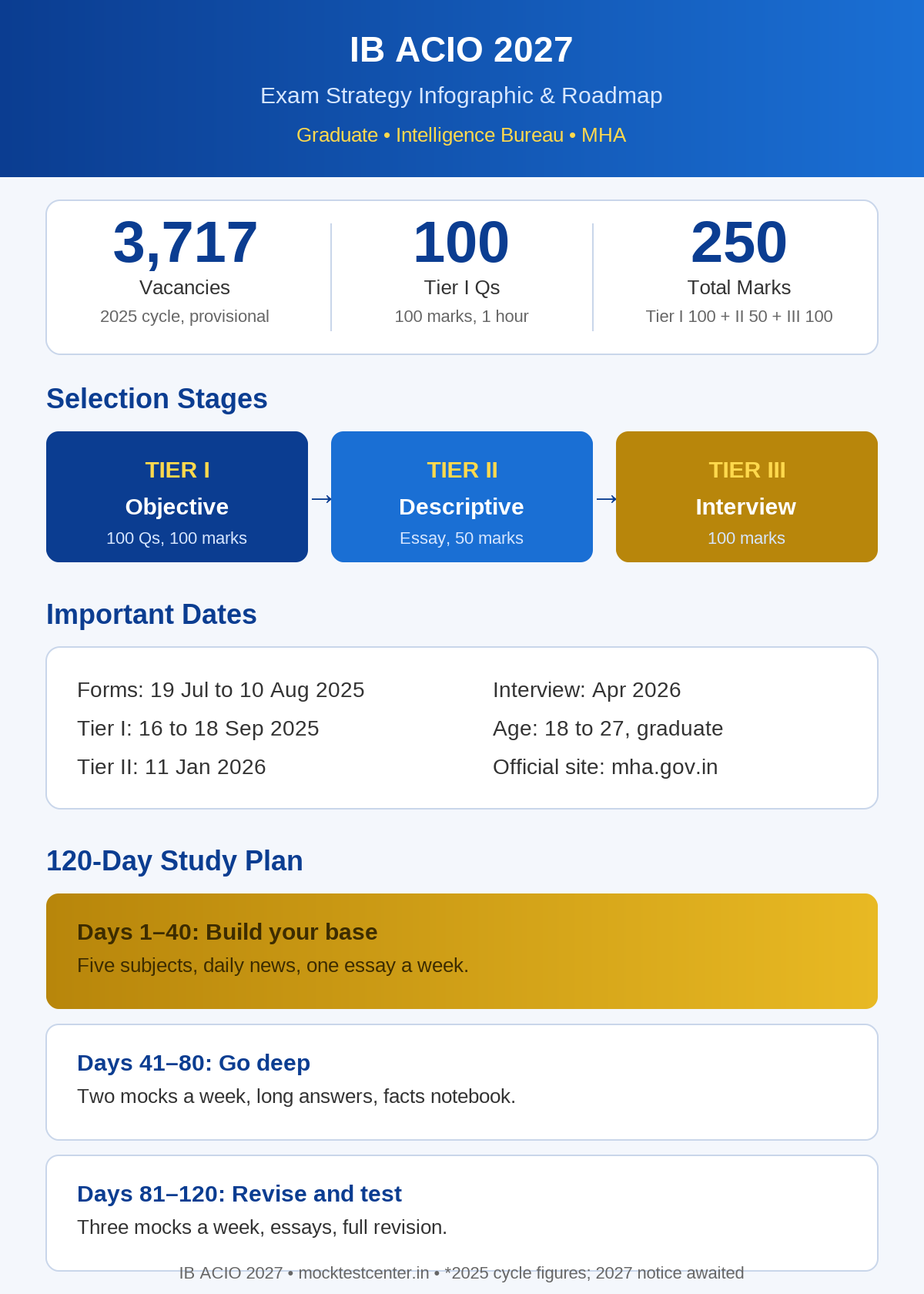
The 2025 cycle was large. It advertised 3,717 posts, and it ran from July 2025 to June 2026. Forms opened on 19 July 2025 and closed on 10 August 2025. Tier I ran on 16 to 18 September 2025.
Tier II ran on 11 January 2026. Interviews ran from 1 to 30 April 2026, and the final result came on 3 June 2026. The whole cycle took about eleven months from the first form to the final list.
ACIO is an intelligence job, and that shapes everything about it. Officers collect and study information that bears on the internal security of the country. They write reports, check facts on the ground, and brief senior officers. The work is quiet.
You will not see it on television. The post carries all India transfer liability, so the Ministry can post you anywhere in the country. That single fact scares some candidates away, and it suits others perfectly.
Three things make this exam different from the SSC graduate exams that most candidates also prepare for. First, Tier II is a descriptive paper. You write an essay and long answers by hand, in one hour, for 50 marks. Second, the interview carries 100 marks, which is 40 percent of the total 250.
Third, the fee has two parts, an exam fee and a processing charge, and the total for a general male candidate is Rs 650, not Rs 100. Each of these three facts changes how you should prepare, and this page takes them one by one.
The 2025 cycle in one look
Keep this table beside you while you read the rest of the page. Every figure in it comes from the 2025 notification and the result notices that followed it. Nothing here is a guess about 2027.
| Item | 2025 cycle fact |
|---|---|
| Post | Assistant Central Intelligence Officer Grade II, Executive |
| Organisation | Intelligence Bureau, Ministry of Home Affairs |
| Vacancies | 3,717 |
| Pay | Level 7, Rs 44,900 to Rs 1,42,400, plus allowances |
| Age | 18 to 27 years as on 10 August 2025 |
| Education | Graduation from a recognised university |
| Forms | 19 July to 10 August 2025 |
| Tier I | 16 to 18 September 2025, 100 questions, 100 marks, 1 hour |
| Tier II | 11 January 2026, descriptive, 50 marks, 1 hour |
| Interview | 1 to 30 April 2026, 100 marks |
| Final result | 3 June 2026 |
| 2027 notice | Not announced as of 23 November 2026 |
One more stream ran beside this one in 2025. The Ministry also recruited ACIO II Technical, 258 posts, through GATE scores in Computer Science and IT and in Electronics and Communication. That stream is separate. This page covers only the Executive stream, the one with the written exam and the interview.
Who can apply
Eligibility means who is fit to apply. The rules below come from the 2025 notice. The next notice can change them, so read the new notice line by line when it comes.
First, education. You must hold a graduation degree or an equal qualification from a recognised university, and you must hold it by the closing date of the form. Final year students who expect their result after the closing date cannot apply. Knowledge of computers is a desired qualification in the notice, which means it helps but the notice does not make it a must.
Learn the basics of computers anyway. The job needs them every day.
Second, age. You must be 18 to 27 years old as on the closing date, which was 10 August 2025 in the last cycle. The notice gives age relaxation to reserved groups under government rules. SC and ST candidates get 5 extra years.
OBC candidates get 3 extra years. Ex-servicemen, meritorious sportspersons, and departmental candidates also get relaxation under the rules. The exact relaxation for each of those groups sits in the notice, and you should read it there rather than trust a coaching site.
Third, citizenship. Only Indian citizens can apply. Both men and women can apply. There is no limit on the number of attempts.
You can apply again in the next cycle as long as you still meet the age limit and the education rule.
Fourth, the form asks you to pick five exam cities, in order of choice, from a long list that covers every state and union territory. Pick cities you can actually reach. The exam city you pick does not change later. Tier II and the interview may not run in every Tier I city, and the Ministry can club nearby centres together for those stages.
- Education: graduation or equal degree from a recognised university, held by the closing date
- Age: 18 to 27 years as on the closing date, with relaxation for reserved groups under government rules
- Computer knowledge: desired, not a must, in the 2025 notice
- Citizenship: Indian citizens only, men and women both
- Attempts: no fixed limit, age and education decide
- Exam cities: pick five choices at the form stage, no change later
A word on certificates. After the Tier I result, the Ministry asks shortlisted candidates to keep documents ready in original, with attested copies. That list includes your Class 10 certificate for date of birth, your Class 12 certificate if you hold one, your graduation degree and mark sheets, your caste or EWS certificate if you claim one, a no objection certificate from your employer if you work in government, and your ex-serviceman or sportsperson certificate if you claim that relaxation. Get these papers in order now.
A missing certificate at the document stage has ended many good runs.
3,717 posts and what they pay
Vacancy means the number of empty posts. The 2025 notice gave 3,717 posts for ACIO II Executive. The split by category was UR 1,537, EWS 442, OBC 946, SC 566, and ST 226. Add those five numbers and you get 3,717.
The notice called the total provisional, which means the Ministry can change it as departments report their needs. The 2027 total is unknown, and any number you see for 2027 before the notice is a guess.
One fake number needs a warning. A few low quality sites have started to carry a 2027 claim of 2,000 ACIO posts. No official source backs it. The Ministry has published nothing of that kind.
Ignore it until mha.gov.in says otherwise.
Pay sits in Level 7 of the pay matrix, from Rs 44,900 to Rs 1,42,400 per month, plus admissible central government allowances. On top of that, the post carries a Special Security Allowance of 20 percent of basic pay. The notice also gives cash compensation for duty on holidays, up to 30 days in a year. Add the allowances together and the monthly take home is well above the basic pay alone.
The exact figure depends on the city of posting, because house rent allowance changes with the city class.
Compare this with the graduate exams most candidates know. SSC CGL posts sit mostly in Level 6 and Level 7 too, but ACIO adds the 20 percent security allowance that those posts lack. That allowance is the reason many candidates rank ACIO above a desk post with the same basic pay. The trade is the transfer liability and the nature of the work.
You do not choose your city, and you do not talk about your work outside the office.
Three tiers, 250 marks
The IB ACIO exam pattern runs in three tiers, then verification and a medical test. Tier I is an online objective test of 100 marks. Tier II is a descriptive paper of 50 marks. Tier III is an interview of 100 marks.
The three tiers add to 250 marks, and the final merit list adds all three together. No single tier decides the result on its own. A strong Tier I can be lost by a weak interview, and a middling Tier I can be saved by a strong Tier II and interview.
After the interview, the Ministry checks character and antecedents and runs a medical test. These are pass or fail checks. They carry no marks, but a fail here ends the selection. Keep your record clean and your health in order through the whole cycle, not just at the end.
| Tier | What happens | Marks | Time |
|---|---|---|---|
| Tier I | Online objective test, 100 questions | 100 | 1 hour |
| Tier II | Descriptive paper, essay and long answers | 50 | 1 hour |
| Tier III | Interview | 100 | As fixed |
| Total | Final merit on all three tiers | 250 |
The shortlist rules matter as much as the marks. About ten times the number of vacancies go from Tier I to Tier II, provided they clear the Tier I minimum marks. About five times the vacancies go from Tier II to the interview, provided they score at least 17 out of 50 in Tier II. With 3,717 vacancies in 2025, that meant roughly 37,000 candidates sat Tier II and roughly 18,500 faced the interview.
The exact shortlist numbers for the next cycle will depend on the vacancy total in the new notice.
Tier I: 100 questions in 60 minutes
Tier I is the gate. It is an online test of 100 objective questions for 100 marks, in 60 minutes. Each question carries 1 mark. Each wrong answer costs 0.25 mark.
Unattempted questions cost nothing. The paper splits into five parts of 20 questions each: Current Affairs, General Studies, Numerical Aptitude, Reasoning and Logical Aptitude, and English. Every part carries 20 marks, so no single subject dominates Tier I. That balance is a gift.
A candidate who is weak in one part can still clear Tier I on the strength of the other four.
Sixty minutes for 100 questions means 36 seconds per question on average. That is the real test. The questions are not very hard. The clock is hard.
Candidates who read slowly or who stop to think on one question lose the paper in the last ten minutes. Practice with a timer from the first week, not from the last month. Your mock score without a timer means nothing.
Negative marking shapes the whole approach. A wrong answer costs a quarter mark, so a blind guess loses marks over a full paper. The working rule is simple. Answer a question when you can remove at least two of the four options.
Skip it when you cannot remove even one. A skipped question costs zero. A wild guess costs a quarter mark and, worse, it eats time you could spend on a question you know.
The notice also fixes minimum qualifying marks in Tier I, and these are not the same as the cut off. UR and EWS candidates need 35 marks out of 100. OBC candidates need 34. SC and ST candidates need 33.
Ex-servicemen are treated in their own category. These are the floor. The actual cut off, the score of the last candidate called for Tier II, sits above the floor and changes with the paper and the number of candidates. The Ministry normalises Tier I marks across shifts, because the exam runs on more than one day and the papers differ.
Your raw score and your normalised score can differ by a few marks.
| Tier I part | Questions | Marks |
|---|---|---|
| Current Affairs | 20 | 20 |
| General Studies | 20 | 20 |
| Numerical Aptitude | 20 | 20 |
| Reasoning and Logical Aptitude | 20 | 20 |
| English | 20 | 20 |
| Total | 100 | 100 |
Minimum qualifying marks in Tier I: UR 35, EWS 35, OBC 34, SC 33, ST 33, out of 100. Treat 35 as the floor and aim far above it. In a cycle with 3,717 posts and lakhs of applicants, the real Tier I cut off sits well above the minimum, and only the top slice moves to Tier II.
Current Affairs deserves a special note. Twenty of the hundred questions test current events, and the IB ACIO exam pattern gives that part the same weight as Quant or English. Most graduate exams give current affairs a smaller share. Here it is a full fifth of the paper.
Read the news every day from the start of your preparation, and keep a notebook of one line per event: what happened, when, and why it matters. A notebook beats a monthly magazine in the last week, because your own notes are the ones you remember.
Tier II: the descriptive paper most people ignore
Tier II is the part of this exam that most candidates prepare for last, and it is the part that separates the final list from the rest. It is a descriptive paper of 50 marks in 60 minutes. You write by hand. There are no options to tick.
The 2025 paper had three parts: an essay for 20 marks, English comprehension for 10 marks, and two long answer questions of 10 marks each on current affairs, economics, and socio-political issues, for 20 marks. Add them and you get 50.
An essay in 20 marks means the examiner reads how you think, not only what you know. A good essay has a clear stand in the first lines, three or four points in the middle, and a short close. It uses facts and numbers where they fit, and it avoids slogans. A weak essay wanders.
It repeats one point in five ways. It fills the page without saying anything new. The difference is practice. Write one essay a week, by hand, in 25 minutes, and read it back the next day.
You will see your own faults faster than any teacher can point them out.
The comprehension part gives a passage and asks questions on it. It tests whether you can read a page of English and pull out its meaning. Ten marks is a small share, but it is the easiest ten marks in the paper for a candidate who reads English daily. Read one long English article a day, from a newspaper, and write its main point in two lines.
That single habit lifts both comprehension and the essay.
The two long answers test your grip on current affairs, economics, and socio-political issues. Each carries 10 marks. The examiner expects a structured answer: a short opening, the facts, the two sides of the issue, and a close that says what should happen next. A one-sided answer scores less.
A balanced answer with facts scores more. These questions reward the same daily news habit that Tier I rewards, so the two tiers feed each other.
You need at least 17 out of 50 in Tier II, which is 33 percent, to reach the interview. That is the floor. The final merit adds Tier II marks to Tier I and interview marks, so every mark here counts twice: once to cross the floor, and once in the final total. A candidate who scores 35 in Tier II instead of 20 gains 15 marks in the final list, and 15 marks in a 250 mark total can move a rank by hundreds of places.
A warning about old patterns. Some guides still describe Tier II as an essay plus precis writing. That was the pattern in older cycles. The 2025 notice, as quoted by several sources that reproduce it, gives essay, comprehension, and two long answers, with no separate precis task.
If the next notice changes the pattern again, the notice is final. Read it before you start Tier II practice.
Tier III: the 100 mark interview
The interview carries 100 marks, which is 40 percent of the total. No other graduate exam in this family gives the interview so much weight. It is the stage where the panel tests whether you can think on your feet and speak clearly, even under pressure. The panel asks about your education, your home state and current events.
It also asks why you want this job. Short, honest answers beat long, rehearsed ones. A panel can hear a memorised answer in the first ten seconds.
The interview in this cycle also includes a psychometric and aptitude test, according to the trackers that follow the process. The Ministry has not published a separate syllabus for that test, so treat it as a check of how you think and react, not as a subject to memorise. Sleep well the night before. Reach the centre early.
Carry your original documents and their copies in one folder, and keep a spare set at home.
Prepare the interview the way you prepare the essay: by thinking, not by memorising. Know the big events of the last six months and hold a view on each of them. Know your own subject well enough to explain it to a stranger in two minutes. Know why you want an intelligence job, and say it in your own words.
If you do not know an answer, say so in one line and move on. A guess in the interview costs more than a silence.
What to study for Tier I
The syllabus is short on paper and wide in practice. Five parts, twenty questions each, and each part pulls from a large field. The plan below gives each part its share of time.
Current Affairs covers national and international events. It also covers government schemes and awards, sports and appointments. The questions come mostly from the last six to twelve months before the exam. Read one newspaper daily and note the facts that a question setter would use: names, dates, numbers, and places.
Monthly current affairs notes help in revision, but they cannot replace daily reading. The daily habit is what keeps the facts in your head on exam day.
General Studies covers history, geography, polity, economy, and science. The questions are mostly static, which means the facts do not change. The Constitution, the freedom movement, rivers and mountains, and basic science stay the same every year. A standard general studies book and the NCERT books for Classes 6 to 10 cover most of this part.
Do not chase rare facts. The paper rewards the candidate who knows the common facts cold.
Numerical Aptitude covers number systems, percentage, ratio and proportion, average, profit and loss, simple and compound interest, time and work, time and distance, and data interpretation. The level is Class 10, and the test is speed, not depth. Learn short methods for the common types, and practise 20 questions a day with a timer. A question that takes more than a minute is a question to skip in the real paper.
Reasoning and Logical Aptitude covers analogies, series, coding and decoding, blood relations, direction sense, puzzles, and non-verbal reasoning. This part rewards daily practice more than any other. Twenty questions a day, for three months, will lift your score by more than any book can. Time yourself.
Reasoning questions are easy to get right and easy to spend too long on.
English covers error spotting, synonyms and antonyms, idioms, one word substitution, voice, narration, and comprehension passages. The level is moderate, and the questions test whether you use English or only study it. Read English every day. A candidate who reads a newspaper in English for twenty minutes a day will score more in this part than a candidate who only solves grammar exercises.
How to write Tier II answers that score
Descriptive writing is a skill, and skills grow by doing. Reading about essay writing does not teach essay writing. Writing one essay a week does. The method below is plain, and it works if you follow it for three months.
Pick a topic from the news. Give yourself five minutes to plan. Write three points on a rough sheet, in short lines. Then write the essay in 25 minutes, by hand, without stopping to check a fact.
A rough plan stops the essay from wandering. A time limit stops it from growing too long. After you finish, read it once and mark the lines that say nothing new. Cut them in the next essay.
Learn the shape of a good long answer. Open with one line that states the issue. Give the facts in two or three lines. Give both sides in short lines.
Close with one line on what should happen next. That shape fits almost every Tier II question, whether the topic is the economy, a new law, or a foreign policy event. Examiners read hundreds of answers. A clear shape makes yours easy to mark.
Keep a facts notebook for Tier II. One page per topic, with five facts: what happened, when, the numbers, the law or scheme behind it, and the two views on it. Ten topics in the notebook is enough to start. Twenty is strong.
The notebook feeds the essay, the long answers, and the interview, all at once. One hour of work serves three tiers.
Write by hand. Tier II is a pen and paper test, and your hand must keep up with your mind for a full hour. Candidates who type all their notes find their handwriting slows them down in the exam hall. Write at least one answer by hand every day in the last two months.
Speed matters here as much as content, because an unfinished answer scores zero for the part you did not write.
The 2025 dates, start to finish
The 2025 cycle shows how long this exam takes. From the short notice to the final result, it ran about eleven months. Plan your year around that length. A candidate who starts after Tier I is too late for Tier II.
| Event | Date |
|---|---|
| Short notice | 14 July 2025 |
| Forms open | 19 July 2025 |
| Forms close and fee last date | 10 August 2025 |
| Fee by SBI challan last date | 12 August 2025 |
| Tier I admit card | 13 September 2025 |
| Tier I exam | 16 to 18 September 2025 |
| Tier I result | 21 November 2025 |
| Tier II exam | 11 January 2026 |
| Tier II result, interview shortlist | 5 March 2026 |
| Interviews | 1 to 30 April 2026 |
| Final result | 3 June 2026 |
| 2027 notice | Not announced as of 23 November 2026 |
Two gaps in that table deserve attention. The gap between Tier I and its result was about two months. The gap between the Tier I result and Tier II was about seven weeks. Both gaps are short for descriptive preparation.
A candidate who waits for the Tier I result before starting Tier II practice gets seven weeks to learn a skill that needs three months. Start Tier II practice in the first month, while Tier I preparation is still running.
What the fee really costs
The fee has two parts, and many sites report only one of them. That is why you will see two different numbers online. Both numbers are real. They describe different parts of the same payment.
Every candidate pays a recruitment processing charge of Rs 550. On top of that, male candidates in the UR, EWS, and OBC groups pay an exam fee of Rs 100. Their total is Rs 650. SC and ST candidates, women candidates, and ex-servicemen who are eligible for reservation pay no exam fee, so their total is Rs 550.
Ex-servicemen who already hold a civil Group C post on a regular basis after using reservation pay the exam fee as well, so their total is also Rs 650. Pay the fee online through SBI EPAY LITE, by debit card, credit card, internet banking, UPI, or SBI challan. The challan last date ran two days after the form last date in 2025.
| Group | Exam fee | Processing charge | Total |
|---|---|---|---|
| UR, EWS, OBC male | Rs 100 | Rs 550 | Rs 650 |
| SC, ST, women, eligible ex-servicemen | Nil | Rs 550 | Rs 550 |
Keep the payment receipt and a printout of the form. The form needs a valid email ID and mobile number, a scanned photo of 100 to 200 KB, and a scanned signature of 80 to 150 KB, in JPG or JPEG format. Fill the form in two steps: register your personal and contact details first, then log in again with the ID and password that reach your email, and fill the rest. Do not send any hard copy by post.
The Ministry sends all later information to your registered email and to its own site.
How many people get through each tier
The shortlist ratios turn a big vacancy number into a small chance, and it helps to see the numbers plainly. With 3,717 vacancies, about ten times that number, near 37,000 candidates, moved to Tier II. About five times the vacancies, near 18,500 candidates, moved to the interview. The final list held 3,717 names.
Each tier cut the field by about half, and the interview cut it by about four fifths.
Those ratios also explain why Tier II matters so much. Only about 37,000 of the lakhs who sat Tier I reached Tier II, and the candidates in that group are already strong. The difference between rank 3,000 and rank 5,000 in that group is a handful of marks in Tier II and the interview. A candidate who treats Tier II as an afterthought gives away the very marks that decide the final list.
A 120 day plan that fits a working student
Most ACIO candidates study beside a job or a college course. The plan below assumes five hours a day, split into two sittings. If you have more time, add mocks. If you have less, cut the reading, never the practice.
Days 1 to 40: Build your base. Study the five Tier I subjects in rotation, one hour each for Quant, Reasoning, and English, and one hour for General Studies plus current affairs. Read the newspaper for 30 minutes a day and keep the one line per event notebook. Write one essay a week by hand, in 25 minutes, on a topic from the news. Take one Tier I mock every Sunday, in 60 minutes, with the timer on.
After each mock, spend one hour on the questions you got wrong. That hour is where the learning happens.
Days 41 to 80: Go deep. Move to two mocks a week. Add one long answer a week, by hand, in 15 minutes, on a current issue. Build the facts notebook to twenty topics. Start revising General Studies from your notes instead of reading the book again.
Spend the last 15 minutes of every day on English reading, a newspaper article or a long passage, and write its main point in two lines. This is also the time to fix your weak subject. If Quant is slow, give it an extra 30 minutes a day for two weeks. If English is weak, read more and solve less grammar.
Days 81 to 120: Revise and test. Take three mocks a week now, and take at least two of them at the same hour as the real exam. Write two essays a week and two long answers a week. Revise the facts notebook daily, one topic at a time. Do not start a new book in this phase.
Do not learn a new topic in the last ten days. In the last week, revise your mistake notebook, your current affairs notes, and your facts notebook, and keep your admit card, photo ID, and certificates ready. Reach the centre early on exam day, and carry a watch if the rules allow one.
Books and papers that are enough
You do not need a shelf of books. One good book per subject, plus previous year papers and mock tests, is enough. For Quant, use a Class 10 level book and practise short methods. For Reasoning, use a standard reasoning book and practise 20 questions daily.
For General Studies, use the NCERT books for Classes 6 to 10 and one yearly current affairs book. For English, use a grammar book and a vocabulary book, and read one English passage daily. For current affairs, use the newspaper first and a monthly note set second.
Previous year papers matter more than new books. Solve the Tier I papers of the last two cycles with a timer, and solve the Tier II questions of the last cycle by hand. Old papers show you the level of the questions, the topics that repeat, and the speed you need. Keep a notebook of your mistakes, and read it every Sunday.
A mistake you write down once is a mistake you rarely repeat.
Mistakes that cost marks in Tier I
The first mistake is guessing. A quarter mark per wrong answer adds up across a hundred questions. Ten wild guesses cost two and a half marks, and two and a half marks can be the difference between Tier II and home. Skip what you do not know.
The second mistake is spending too long on one question. A Quant question that takes three minutes has already cost you five easy questions. Mark it, move on, and return to it only if time is left at the end. The paper rewards the candidate who answers the easy questions first.
The third mistake is ignoring current affairs until the last month. Twenty questions is a fifth of the paper, and a month of cramming cannot build a year of news. Read daily from the first week.
The fourth mistake is preparing for Tier I alone and starting Tier II after the result. Seven weeks is not enough to learn descriptive writing from zero. Write one essay a week from the start. It costs two hours a month and it can decide your final rank.
The fifth mistake is trusting a 2027 date or vacancy number from a site that does not link to the Ministry. The notice on mha.gov.in is the only source that counts. Check it every week. Do not pay any agent or any website for this exam.
The form runs only on the official site.
How to use mock tests for this exam
Mock tests are practice tests that look like the real exam. For this IB ACIO exam pattern, mock tests matter more than for most exams, because the paper is a race against the clock and Tier II needs a different skill from Tier I. Take Tier I mocks in 60 minutes, with all five parts in one sitting. Take Tier II practice in 60 minutes, by hand, with the essay and the long answers together.
A mock without a timer teaches you the subjects. A mock with a timer teaches you the exam.
Take at least 20 Tier I mocks before the exam, and write at least 12 essays and 12 long answers by hand. After each mock, check which part was slowest and which part lost the most marks to wrong answers. If English is weak, take English sectional tests daily. If Quant is slow, practise 20 questions a day with a timer until the speed comes.
If current affairs is weak, read the news for 30 minutes a day and keep the one line notebook.
If you want to look at other graduate exams on this site, you can see SSC CGL 2027, SSC CHSL 2027, SSC MTS and Havaldar 2027, SSC GD Constable 2027, SSC CPO Sub-Inspector 2027, SSC Stenographer Grade C and D 2027, SSC Junior Engineer 2027, SSC JHT 2027, SSC Selection Post 2027 and SSC Delhi Police Constable 2027 on this site. The official site for this exam is mha.gov.in.
A last word
IB ACIO 2027 has no notice yet, and that is good news for a candidate who starts now. The last cycle gave 3,717 posts to graduates aged 18 to 27, with a Tier I of 100 questions in one hour, a descriptive Tier II of 50 marks, and an interview of 100 marks. The pattern is stable, the syllabus is short, and the preparation is the same work every graduate exam needs: daily news, timed practice, and honest writing by hand.
Start today. Read the news for 30 minutes, solve 20 Quant and 20 Reasoning questions with a timer, and write one short essay this week. Check mha.gov.in every week for the 2027 notice, and keep your degree, certificates, photo, and signature ready. The candidates who reach the final list are rarely the ones who knew the most on day one.
They are the ones who kept going, week after week, until the notice came.







