About IB Junior Intelligence Officer 2027 Exam Series
📖 Table of Contents
- What this exam is
- Who can apply
- Vacancies and pay
- How selection works
- IB JIO 2027 Tier I, the 100 mark online test
- Tier II, the skill test
- Tier III, the interview
- Syllabus
- Important dates
- Fee and how to apply
- Cut off: what 35 marks really mean
- How JIO differs from ACIO and the other IB posts
- Mistakes that cost candidates the exam
- Books and study material
- A 120 day plan
- How to use mock tests
- A last word
IB Junior Intelligence Officer 2027
What this exam is
The Intelligence Bureau, or IB, is the domestic intelligence agency of India. It works under the Ministry of Home Affairs. Its technical recruitment is listed on this site as IB JIO 2027. Its job is to collect information that protects the country from threats inside its borders. Most of its work stays out of public view. That is the nature of the job, and it is also the reason the job draws so many young technical minds.
The Junior Intelligence Officer Grade II Technical, or JIO II Tech, is the technical entry post of the IB. A JIO works with electronics and computers. The work covers wireless surveillance and electronic intelligence. It also covers cyber analysis and communication intercepts. A JIO may set up and run technical equipment, test a communication link, track a signal, or help a senior officer turn raw technical data into a clear report. The post is Group C. It is Non Gazetted and Non Ministerial. It is a central government post with All India transfer liability, which means you must be ready to serve anywhere in India.
This page is filed here as IB JIO 2027, and it is about the 2027 cycle. Read this line with care: no 2027 notification exists as of 23 November 2026. The Ministry of Home Affairs has not announced fresh dates, vacancies or a fee for a 2027 cycle. Every fact on this page comes from the live cycle, the JIO II Tech Examination 2025, which offered 394 posts. The 2027 cycle, when it comes, will most likely follow the same shape, because the 2025 notification sets the pattern. But no 2027 figure on any website is real until MHA publishes it. Check mha.gov.in before you trust any 2027 date or vacancy number.
The 2025 cycle moved fast. MHA released the notification on 22 August 2025. Applications ran from 23 August to 14 September 2025, a window of about three weeks. The Tier I online test took place on 15 October 2025. That speed is a lesson in itself. When the next notification drops, you will not get months to prepare. You will get about three weeks to apply, and the exam can follow within a month. The students who clear this exam are the ones who start preparing before the notification comes out.
One more thing to fix early: JIO is a technical post. It is not a general graduate post. A plain BA or BCom degree does not make you eligible, and a 10 plus 2 certificate on its own does not either. You need a diploma in engineering in a listed field, or a BSc with a listed subject, or a BCA degree. The full list sits in the eligibility section below. If your qualification is not on that list, no amount of preparation will help, because the form itself will reject you. Check your eligibility first, then plan your study.
Who can apply
Eligibility for JIO II Tech runs through three routes. You need only one of them. Route one is a Diploma in Engineering in one of these fields: Electronics; Electronics and Telecommunication; Electronics and Communication; Electrical and Electronics; Information Technology; Computer Science; Computer Engineering; Computer Applications, from a government recognised university or institute. Route two is a Bachelor of Science degree with Electronics, Computer Science, Physics or Mathematics. Route three is a Bachelor of Computer Applications degree, or BCA. The result of your diploma or degree must be out on or before the closing date of applications, and you must have been declared successful by that date. Students still waiting for results on the closing date cannot apply.
Age matters as much as education. You must be between 18 and 27 years old on the closing date. In the 2025 cycle the closing date was 14 September 2025, so the age was counted on that day. The 2027 cycle will count age on its own closing date, which is not known yet. Age relaxation follows government rules. SC and ST candidates get five extra years. OBC candidates get three extra years. Departmental candidates, meaning central government civilian employees with three years of regular and continuous service, get relaxation up to 40 years of age. Widows get relaxation too, as do divorced women and women judicially separated from their husbands and not remarried, up to 35 years for UR, 38 years for OBC and 40 years for SC and ST. Ex servicemen get relaxation as per government instructions. Meritorious sportspersons get up to five extra years.
Two points in the notification catch many readers by surprise. First, the post is not identified as suitable for any category of Persons with Benchmark Disabilities, so PwBD candidates need not apply. Second, you must be an Indian citizen, and your date of birth and name come from your matriculation certificate alone. No other proof of date of birth is accepted. Keep your Class 10 certificate safe, because it decides your age in this exam.
Now the part that causes the most confusion: the ITI question. An ITI certificate does not appear in the eligibility list of the 2025 notification. The list names only diploma, BSc or BCA. Some coaching websites list ITI as an accepted qualification, and some even list BTech and BE degrees. The notification text does not list either of them. A BTech holder may hold a diploma too, and that diploma would qualify, but a BTech degree on its own is not named in the notification. Treat tracker lists with care here. The safe rule is simple: if your qualification is a diploma in a listed field, a BSc with a listed subject, or a BCA, you are eligible. Anything else needs a fresh check against the new notification when it comes.
Government employees who already work in a PSU or an autonomous body should note one more rule. They can apply, but they do not get the departmental age relaxation, and they need a No Objection Certificate from their employer at the time of the interview. Candidates in government service should inform their employer before they apply.
- Education: Diploma in Engineering in a listed field, or BSc with Electronics, Computer Science, Physics or Mathematics, or BCA
- Age: 18 to 27 years on the closing date, with relaxation for SC, ST, OBC, departmental candidates, ex servicemen plus other groups under government rules
- Citizenship: Indian citizen only
- Date of birth proof: matriculation certificate only
- Result must be declared on or before the closing date
- ITI certificate alone does not appear in the notification list
- PwBD candidates: post not identified as suitable
Vacancies and pay
The 2025 cycle offered 394 posts of Junior Intelligence Officer Grade II Technical. The category split was 157 for UR, 32 for EWS, 117 for OBC, 60 for SC plus 28 for ST. The notification calls the number provisional, which means it can change as the department firms up its needs. The 2027 total is not known. The last full cycle before 2025, the 2023 cycle, offered 797 posts, so the number can swing a lot from one cycle to the next. A small vacancy number does not mean the exam is out of reach. The Tier I cut off will sit high instead, and every mark will count.
The pay sits in Level 4 of the pay matrix, from Rs 25,500 to Rs 81,100 per month, plus admissible central government allowances. On top of that, the post carries a Special Security Allowance of 20 percent of basic pay. That allowance is a real part of the package, and it is one reason the in hand salary looks better than the basic pay suggests. The notification also promises cash compensation in lieu of duty performed on holidays, subject to a ceiling of 30 days. House rent allowance and dearness allowance apply, with medical benefits as per central government rules.
The post is temporary at first. The notification says appointment will be temporary, and permanent appointment depends on the rules in force at that time. That is normal for this kind of post. Your selection also depends on character and antecedent verification followed by a medical examination. The IB checks your background with care, as you would expect from an intelligence agency. A candidate who clears all three tiers can still lose the post if the verification or the medical exam fails.
| Category | Vacancies 2025 |
|---|---|
| UR | 157 |
| EWS | 32 |
| OBC | 117 |
| SC | 60 |
| ST | 28 |
| Total | 394 |
Do not compare this vacancy table with the ACIO exam. The Assistant Central Intelligence Officer Grade II Executive is a different post, a graduate level Group B post in Level 7 with its own notification and its own pattern. The JIO is a technical Group C post in Level 4. The two exams share a parent body, the IB. Little else is common. A separate section later on this page sets out the difference in full, because mixing up the two posts is the most common error among new candidates.
How selection works
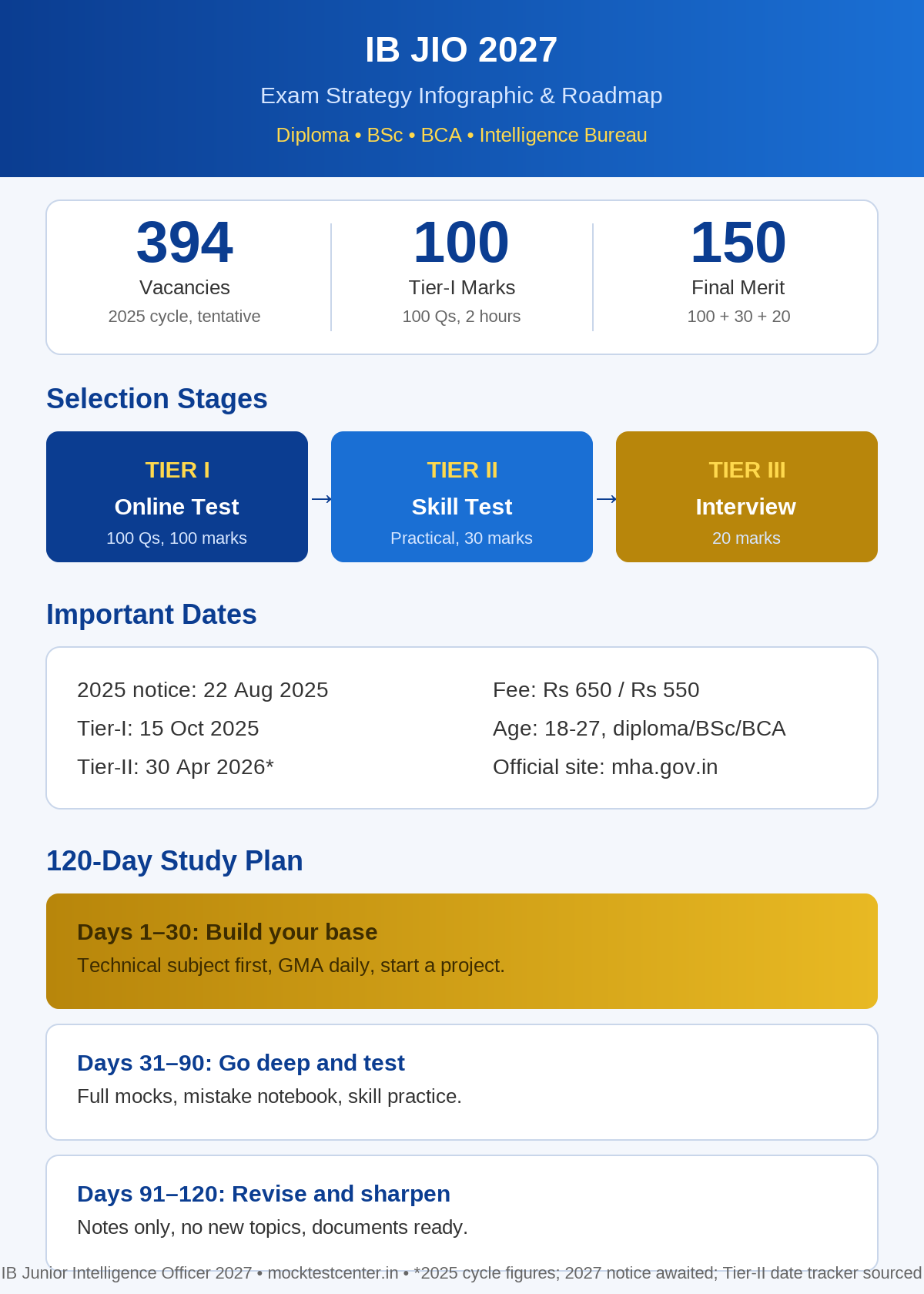
Selection runs in three tiers. Tier I is an online objective test of 100 marks. Tier II is a skill test of 30 marks. Tier III is an interview, or personality test, of 20 marks. The final merit list comes from combined performance in all three tiers, out of 150 marks in all. A waiting list is also prepared, so that replacements can be made if a selected candidate drops out.
The three tiers test three different things. Tier I tests what you know, with 100 multiple choice questions in two hours. Tier II tests what you can do with your hands and your tools, with a practical test in your trade. Tier III tests who you are under pressure, with a face to face interview that checks technical aptitude, mental alertness and communication. A candidate who is strong in books but weak in practical work can lose the post at Tier II. A candidate who is strong in both but cannot explain his work in the interview can lose marks at Tier III. You need all three.
Tier I has a minimum qualifying mark. In the 2025 cycle it was 35 out of 100 for UR and EWS, 34 for OBC, and 33 for SC and ST. Ex servicemen were treated in their own category. Scoring the minimum does not mean selection. You only stay in the race. After Tier I, IB shortlists candidates for the skill test and the interview at five times the number of vacancies, based on Tier I marks after normalisation, and only among those who clear the minimum. The notification adds that the cut off may go higher depending on marks and vacancies, and the five times rule may shrink for the same reason. With 394 vacancies, five times means about 1,970 candidates reach Tier II and Tier III. That is a small group, and the interview room will know your Tier I score is only part of the story.
Ties in the combined score are resolved in a fixed order. First, marks in Tier I. Then marks in Tier II. Then marks in Tier III. Then date of birth, with older candidates placed higher. Then alphabetical order of names, starting with the first name. The tie rules reward the written test first, so a strong Tier I score protects you twice: once in the shortlist, and again in a tie.
One point needs a clear correction, because two popular coaching sites get it wrong. Some pages say Tier II is qualifying only and the final merit uses Tier I plus interview. Others say the interview carries 50 marks. Both are wrong. The notification says the final merit list is prepared on combined performance in Tier I plus Tier II plus Tier III, and it fixes Tier II at 30 marks and Tier III at 20 marks. Trust the notification over any coaching page when the two disagree.
IB JIO 2027 Tier I, the 100 mark online test
Tier I is the gate. It is an online test of objective type multiple choice questions, 100 questions for 100 marks, in two hours. Each question carries one mark. Each wrong answer costs a quarter mark, or 0.25. An unattempted question costs nothing. Questions marked for review are not considered for evaluation, so do not mark a question for review and hope it gets counted. A marked question earns no marks.
The paper splits into two parts. General Mental Ability carries 25 percent, which means 25 questions and 25 marks. The combination of subjects as per essential qualifications carries 75 percent, which means 75 questions and 75 marks. That split is the whole strategy of the exam in one line. Three quarters of your score comes from your own technical stream. A diploma holder in electronics answers electronics questions. A computer science student answers computer questions. The General Mental Ability part is common to all, and it is the part where a technical student can gain or lose the most ground, because it tests speed and accuracy rather than subject depth.
General Mental Ability means reasoning and quantitative aptitude at graduation level. The reasoning side covers series; analogy; coding and decoding; blood relations; direction and distance; order and ranking; syllogism; data sufficiency; cubes and dice; clock and calendar reasoning; classification. The quantitative side covers number systems; HCF and LCM; averages; percentages; profit and loss; simple and compound interest; time and work; time speed and distance; mixtures and alligation; simplification. None of this needs advanced mathematics. It needs fast and clean working, plus a habit of checking your answer before you move on. With negative marking of a quarter mark, a guess costs you more than a skip. Four wrong guesses wipe out one right answer.
Normalisation applies to Tier I. The exam runs in more than one shift, and normalisation adjusts scores so that a hard shift does not punish its candidates and an easy shift does not reward its candidates beyond reason. You cannot control normalisation, so do not waste thought on it. What you can control is your raw score, and a raw score near 70 or above puts you in a strong place in most cycles. The minimum qualifying marks of 33 to 35 are only the floor. The real cut off, the score of the last candidate shortlisted at five times the vacancies, sits far above the floor in every cycle with few vacancies. Some coaching sites publish expected cut off ranges like 68 to 72 for UR. Treat those numbers as guesses. They are not official, and no official Tier I cut off for the 2025 cycle was available when this page was written.
The exam city list in the 2025 notification ran to 147 cities across India. You had to pick five choices while filling the form, and the city once chosen could not be changed. Tier I may run in one or more shifts at a centre if the number of candidates is large. Tier II and Tier III may not run at all the cities listed for Tier I. IB can club candidates from nearby centres and hold the later tiers at fewer places. That detail matters for travel planning, because a candidate from a small town may need to travel to a bigger city for the skill test and the interview.
The admit card for Tier I in the 2025 cycle came about three days before the exam, on 12 October 2025, as reported by trackers, and the answer key followed on 17 October 2025, also as reported by trackers. Both dates come from secondary sources, not from the notification, so treat them as a guide to the usual gap rather than a fixed rule. The Tier I result was reported around the turn of the year, with one tracker giving 31 December 2025 and another giving 1 January 2026. The two dates conflict, so this page does not state a single result date as fact. What is clear is that the result took about two and a half months from the exam date, which is slow by SSC standards and normal for the IB.
| Tier I part | Questions | Marks |
|---|---|---|
| General Mental Ability | 25 | 25 |
| Technical subjects as per qualification | 75 | 75 |
| Total | 100 | 100 |
| Time | 2 hours | Negative 0.25 per wrong answer |
Tier II, the skill test
Tier II is a skill test of 30 marks. It is practical based and technical in nature, commensurate with the job profile. Those are the words of the notification, and they tell you most of what you need to know. There is no fixed question paper for Tier II, no fixed time limit in the notification, and no published syllabus for it. The test changes with your trade. An electronics candidate may be asked to work with circuits and measurements, using real instruments. A computer science candidate may be asked to write code and debug it, or to work with networks and data. An information technology candidate may face tasks in systems, software or communication. The exact tasks are set by the examiners on the day, and they test whether you can do the work, not whether you can describe it.
That practical character is what makes Tier II dangerous for book strong candidates. A student can score 80 in Tier I from memory and still fail to wire a circuit, read a measurement, or trace a fault in a network. The skill test rewards hands on practice. If you are a diploma student, your lab hours are your preparation. If you are a BSc student, your practical classes and your own small projects are your preparation. If you are a BCA student, your programming practice and your work with databases and networks are your preparation. Build something real before the exam, and you will walk into Tier II with a calm mind.
One more fact about Tier II deserves emphasis, because it changes how you prepare. Tier II carries 30 marks out of the final 150, which is 20 percent of the merit. A difference of 10 marks in Tier II equals a difference of 10 marks in Tier I, and few candidates think of it that way. Most preparation energy goes into Tier I, and Tier II gets a few days of thought at the end. That is backwards. The candidates who treat Tier II as a full stage, with its own practice time, gain marks that their rivals leave on the table. The Tier II date for the 2025 cycle was reported by trackers as 30 April 2026, about six months after Tier I. That date is tracker sourced and not confirmed from the notification, so check it against the MHA site before you quote it.
Tier III, the interview
Tier III is an interview, or personality test, of 20 marks. It is a face to face round. The notification does not publish an interview syllabus, and the interview does not follow a fixed question list. What the interview checks, as described by trackers who follow the exam, is technical aptitude and mental alertness. It also checks problem solving and communication, and your suitability for intelligence work. Expect questions that connect your technical subject to real work. An electronics candidate may be asked how a communication system fails and how to find the fault. A computer candidate may be asked how a network can be secured and where it stays weak. Expect also questions about why you want to join the IB, what you know about its work, and whether you are ready for transfer to any part of India.
Twenty marks looks small next to 100 marks in Tier I. It is not small in effect. The final merit runs out of 150, so the interview is more than 13 percent of the total. Two candidates with the same Tier I and Tier II scores can sit several ranks apart on interview marks alone. The interview also covers a check of your documents and your background, and the notification says a No Objection Certificate from your employer is needed at the interview stage if you work in government service. Carry your original certificates, your caste or category certificate if you claim one, and your photo identity proof. A candidate who forgets a document at this stage creates a problem that no amount of marks can fix.
Speak plainly in the interview. The panel has seen many candidates who dress up simple answers in heavy words. A clear answer in simple words, with one real example from your own study or project, beats a long answer that says nothing. If you do not know an answer, say so in one line and move on. A wrong answer given with confidence costs more than an honest gap. The interview tests judgment as much as knowledge, and judgment shows in how you handle a question you cannot answer.
Syllabus
Here is a fact that surprises many candidates: the 2025 notification carries no detailed syllabus appendix. It fixes the Tier I split, 25 percent General Mental Ability and 75 percent technical subjects as per essential qualifications, and it leaves the topic list to the exam itself. The syllabus below is therefore built from tracker pages that analyse past papers and from the subject lists in the eligibility rules. It is a guide, not a quote from the notification, and you should read it that way.
General Mental Ability splits into reasoning and quantitative aptitude, with the same topics set out in the Tier I section above. That list is long, but the questions are short. Each one tests a single idea, and speed comes from practice rather than from new theory.
The technical part follows your qualification stream, and the stream decides your paper. Electronics and telecommunication covers electronic devices and circuits; analog electronics; digital electronics; network theory; control systems; communication engineering; data communication and networks; electronic measurements; microprocessors and microcontrollers; basic electrical engineering. Computer science and information technology covers computer programming; Python programming; data structures and algorithms; computer networks and the internet; web technologies; databases; operating systems; artificial intelligence and algorithms. Electrical and electronics adds power electronics; electrical machines; measurements. The weight of each topic shifts from year to year. One tracker analysis of past papers put communication systems at 14 questions, computer networks at 13, digital electronics at 9, network theory at 7 and measurements at 7 in a single paper. That breakup is tracker analysis of a past paper, not a rule for the next paper, so use it to order your revision, not to skip topics.
Your revision order should follow the marks. The technical part is 75 marks, so it gets 75 percent of your study time. Inside the technical part, start with the topics that carry the most questions in past papers, then cover the rest. Inside General Mental Ability, give equal time to reasoning and quant, because both feed the same 25 marks. A candidate who masters the technical part and ignores General Mental Ability loses the 25 marks that separate the selected list from the waiting list.
Do not look for a General Awareness section in this exam. Some coaching pages print a Tier I pattern with general awareness, English and quant as separate sections. That pattern belongs to other exams, and one tracker page even describes a Tier II with translation passages, which belongs to a language post and not to JIO. The JIO Tier I has two parts only: General Mental Ability and technical subjects. If a source shows you a four section pattern for JIO, it has mixed this exam up with another one.
Important dates
The 2025 cycle ran on a tight clock, and the dates show it. The notification came on 22 August 2025. Online registration opened on 23 August 2025 and closed on 14 September 2025 at 11:59 at night. The last date for fee payment through SBI challan was 16 September 2025, during banking hours. The Tier I exam took place on 15 October 2025, just one month after the forms closed. The answer key was reported on 17 October 2025. The Tier I result was reported around 31 December 2025 or 1 January 2026, with the exact date in dispute between trackers. The Tier II skill test was reported for 30 April 2026. All dates after the exam are tracker reported, so this page marks them as such, and the notification itself gives only the application dates.
The IB JIO 2027 cycle has no dates at all. No notification date, no form dates, no exam date. The IB does not follow a fixed annual calendar the way SSC does, so you cannot assume the 2027 notification will come in August. It may come earlier, or later, or the cycle may skip a year if vacancies do not arise. The right move is to watch mha.gov.in and the National Career Service portal at ncs.gov.in, which were the two application routes in 2025, and to keep your documents ready so that a three week form window never catches you short.
| Event | Date |
|---|---|
| 2025 notification | 22 August 2025 |
| 2025 forms open | 23 August 2025 |
| 2025 forms close | 14 September 2025 |
| 2025 challan fee last date | 16 September 2025 |
| 2025 Tier I exam | 15 October 2025 |
| 2025 Tier I result | Reported around 31 Dec 2025 or 1 Jan 2026, date not settled |
| 2025 Tier II skill test | Reported 30 April 2026, tracker sourced |
| 2027 notification | Date awaited |
Fee and how to apply
The fee has two parts, and the split confuses many candidates, so read it slowly. There is an Examination Fee of Rs 100, and there are Recruitment Processing Charges of Rs 550. Every candidate pays the processing charges of Rs 550. Male candidates from UR, EWS or OBC categories pay the examination fee of Rs 100 as well, so their total is Rs 650. SC and ST candidates, female candidates of all categories, and ex servicemen eligible for reservation are exempt from the examination fee of Rs 100, so they pay Rs 550 only. Ex servicemen who have already secured a Group C civil post after availing reservation benefits must pay the full Rs 650. Bank charges, if any, fall on the candidate, and the fee once paid is not refunded under any circumstances.
One tracker summary page prints the fee as Rs 500 for general male candidates and Rs 450 for others. That table is wrong. The notification text fixes the two components at Rs 100 and Rs 550, and the total at Rs 650 and Rs 550, and several other trackers agree with the notification. If a site quotes Rs 500, it is using an old or mistaken figure. Do not plan your payment on it.
Applications go only through the MHA website or the NCS portal, online only. No other mode is accepted, and no hard copy of the form is needed. You register, you get an Application Sequence Number on your mobile and email, and you use it for later logins. You upload a photo and a signature, and the sizes are strict: the photo must be 100 to 200 KB in JPG or JPEG, with your face covering 70 to 80 percent of the frame, and the signature must be 80 to 150 KB in JPG or JPEG, signed in black ink on white paper. After you submit, the SBI payment gateway opens for the fee, by debit card, credit card, net banking, UPI or challan. An e challan stays valid for four days from generation, but the challan must reach the bank before the last date for challan payment.
Submit only one application. The notification warns that multiple applications may lead to cancellation of all of them. Preview the form before you submit, and check your email ID with extra care, because admit cards and call letters for all three tiers go to that email ID only. The helpdesk number in the 2025 notification was 022 61087525, open 10 in the morning to 6 in the evening, Monday to Saturday, for technical queries about filling the form. Mobile phones and other electronic gadgets are banned inside the exam centre, and the centre cannot assure safe keeping of valuables, so leave them at home.
Cut off: what 35 marks really mean
The minimum qualifying marks in Tier I were 35 for UR and EWS, 34 for OBC, and 33 for SC and ST, out of 100. Those numbers are the floor, not the cut off. The floor decides who stays in the race. The cut off decides who gets shortlisted. With 394 vacancies and a shortlist of five times the vacancies, about 1,970 candidates move to Tier II and Tier III. The score of the 1,970th candidate is the real cut off, and it moves with the difficulty of the paper and the strength of the field. In a cycle with few vacancies, the real cut off can sit 30 marks above the floor. A candidate who aims at 35 is aiming at survival, not selection.
Think of the final merit in the same way. The merit runs out of 150 marks, and every tier feeds it. A Tier I score of 75, a Tier II score of 22 and an interview score of 14 gives 111 out of 150. A rival with a Tier I score of 70, a Tier II score of 26 and an interview score of 16 gives 112, and takes the higher rank. The written test opens the door, but the skill test and the interview decide the order inside the room. That is why the preparation plan on this page gives real time to all three tiers instead of betting everything on Tier I.
No official final cut off for the 2025 cycle was available when this page was written. Do not trust any site that prints a final cut off with decimal points and calls it official. If you see one, ask for the MHA result notice behind it. Without that notice, the number is a guess dressed as a fact.
How JIO differs from ACIO and the other IB posts
The IB recruits for several posts, and new candidates mix them up. Here is the short map. The Assistant Central Intelligence Officer Grade II Executive, or ACIO II Executive, is the graduate level officer post, Group B, in Level 7. It needs a bachelor degree in any subject and an age of 18 to 27 years, and its exam has a written test with general and subject papers, a descriptive test and an interview. The Security Assistant Executive is a Class 10 pass post, Group C, in Level 3, with a written test and a local language test. The Multi Tasking Staff post is also a Class 10 pass post, Group C, in Level 1. The Junior Intelligence Officer Grade II Technical is the technical post of the group, Group C, in Level 4, open only to holders of a diploma, a BSc or a BCA in listed fields, with a technical Tier I, a practical skill test and an interview.
The mix up matters because the preparation is different. An ACIO candidate studies general awareness and English, with quant and reasoning beside them. A JIO candidate studies General Mental Ability for 25 marks and a technical subject for 75 marks. A candidate who prepares for ACIO and sits for JIO will find three quarters of the paper outside his study. A candidate who prepares for JIO and sits for ACIO will find the descriptive paper and the general paper outside his study. Pick your post first, then pick your books. The notifications come out separately for each post, with separate dates and separate forms, so you can apply for more than one if you are eligible for both, but you must prepare for each on its own terms.
There is also a Junior Intelligence Officer Grade I post in the IB structure, senior to Grade II. This page does not cover it, because its recruitment, if any, runs on a separate notice with its own rules. Do not carry Grade II facts over to Grade I, and do not assume a Grade I notification is a Grade II notification.
Mistakes that cost candidates the exam
The first mistake is applying with the wrong qualification. A candidate with a plain BSc in chemistry, or a BA, or an ITI certificate, fills the form and pays the fee, and the form is rejected at document verification, months after the exam. The fee is not refunded. Check the three routes against your own certificate before you pay.
The second mistake is trusting a tracker date. A site prints a 2027 notification date, a candidate plans leave and travel around it, and the date passes with no notification. The only dates that count are the ones on mha.gov.in. Everything else is a forecast, and forecasts in this exam have a poor record.
The third mistake is the Mark for Review trap. In Tier I, questions marked for review are not evaluated. A candidate who marks a question for review and moves on, meaning to come back, loses that question even if he knew the answer. Use the review mark only if you are sure you will return to it, and clear it before you submit.
The fourth mistake is ignoring the skill test until the Tier I result comes out. The gap between the Tier I result and Tier II can be short, and practical skill cannot be built in a week. A diploma student who keeps lab practice alive through the whole preparation walks into Tier II ready. A student who starts practical work after the result walks in hoping.
The fifth mistake is the photo and signature. The notification fixes the file sizes and the face coverage, and a hazy photo or a wrong size can stall the form at the last hour. Prepare the photo and signature files before the form opens, in the right size and format, and keep identical passport photos ready for the exam centre and the later stages.
The sixth mistake is the email ID. Admit cards and call letters go to the email given in the form, with result links sent there too. A candidate who gives a dead inbox, or an inbox he never checks, can miss the Tier II call letter entirely. Give an email you check daily, and check the spam folder too, because the notification itself warns that mails can land in spam.
Books and study material
You do not need a shelf of books for this exam. You need one good source per area, plus past papers and mock tests. For General Mental Ability, use a standard reasoning book and a standard quantitative aptitude book at graduation level, and practise 25 questions a day under a timer. For the technical part, use your own diploma or degree books first. They match the syllabus better than any guide, because the exam tests the subjects you already studied. An electronics student should revise from his diploma notes on devices; circuits; digital electronics; networks; communication. A computer student should revise from his degree notes on programming; data structures; networks or databases. A BCA student should revise from his course books on programming; web technology or computer applications.
Add two things to the books. First, the past papers of the JIO exam and of similar technical exams, solved with a timer. Past papers show you the real weight of each topic, which no guide can guess. Second, a notebook of mistakes. After every mock, write down each wrong answer, the reason it went wrong, and the rule that fixes it. That notebook becomes your revision material in the last two weeks, and it is worth more than a new book bought late.
Do not buy a guide that promises the whole JIO syllabus in one book. No single guide covers electronics, computer science or information technology at the depth this paper needs. A guide can help with General Mental Ability. The technical part belongs to your own subject books and to practice.
A 120 day plan
This plan for IB JIO 2027 assumes four months and about five hours a day. It gives the technical part the largest share, because the technical part carries 75 marks. It keeps General Mental Ability alive every day, because 25 marks decide close ranks. And it gives the skill test real time from the start, because practical skill grows slowly.
Days 1 to 30: build your base. Study five hours a day. Spend three hours on your technical subject, starting with the topics that carry the most questions in past papers. Spend one hour on reasoning and one hour on quant. Solve 25 General Mental Ability questions daily. Start a small practical project in your trade, even a simple one, and work on it for an hour each weekend. A circuit you build, a program you write, or a network you set up teaches more than a chapter you read.
Days 31 to 60: go deep. Study six hours a day. Finish the technical syllabus once, topic by topic, and make short notes for each topic. Take one full Tier I mock every three days, in two hours, with negative marking counted in full. After each mock, spend one hour on your mistakes and add them to your notebook. Keep the practical project going, and add a second one if the first is done. Read the MHA site once a week for any new notice.
Days 61 to 90: test and fix. Take two full Tier I mocks every week. Spend the days between mocks on weak topics only. Do not start a new book now. Practise skill test tasks twice a week, with real tools and real equipment where you can. If you are a computer student, write code and debug it under time pressure. If you are an electronics student, build circuits and test them, and take measurements. Start speaking your answers aloud, because the interview rewards a candidate who can explain his work in plain words.
Days 91 to 120: revise and sharpen. Take one full mock every week and no more. The rest of the time goes to your mistake notebook, your short notes, and your practical work. Do not learn new topics in the last two weeks. Revise the formulas, the circuit rules, the programming syntax and the reasoning shortcuts you already know. In the last week, keep your admit card and photo identity proof ready, with photos and certificates beside them, and rest well. A tired mind loses marks that a fresh mind keeps.
How to use mock tests
Mock tests are practice tests that look like the real exam. For IB JIO 2027, they matter more than usual, because Tier I is the only written stage and it decides the shortlist. Take Tier I mocks in two hours, with 100 questions, and count negative marking at 0.25 per wrong answer. A mock without negative marking teaches you nothing about the real paper, because it rewards guessing. A mock with negative marking teaches you the most valuable skill in this exam: when to skip.
Take at least 20 Tier I mocks before the exam. After each mock, check three things. First, which part was slowest, General Mental Ability or technical. Second, which topic lost the most marks. Third, how many marks you lost to guesses. If guesses cost you more than 5 marks in a mock, change your rule: attempt only the questions you can solve or narrow to two options. Speed without accuracy is a loss in this paper, because every four wrong answers erase one right answer.
Use sectional tests too. A 25 question General Mental Ability test in 30 minutes builds the speed that the full mock cannot. A 75 question technical test in 90 minutes builds the depth that the full mock spreads thin. Alternate full mocks and sectional tests through the week, and keep one day free for revision of mistakes.
If you want to look at other exams on this site, you can see SSC CGL 2027, SSC CHSL 2027, SSC CPO Sub Inspector 2027, SSC Junior Engineer 2027, SSC Stenographer 2027, SSC GD Constable 2027, SSC MTS Havaldar 2027, SSC Selection Post 2027, SSC JHT 2027 and SSC Delhi Police Constable 2027 on this site. The official sites are mha.gov.in for the exam and ncs.gov.in for the application portal.
A last word
IB JIO 2027 is a small exam with a large reward. The seats are few, 394 in the last cycle, and the work is quiet and technical, and people trust it. The pay is Level 4 with a 20 percent Special Security Allowance, and the post carries the respect that comes with serving in the Intelligence Bureau. But the exam does not forgive a careless candidate. Your qualification gets checked at the door, your knowledge in Tier I, your hands in Tier II, and your judgment in the interview.
Start today. Check your eligibility against the three routes. Fix your technical base first, keep General Mental Ability sharp every day, and practise your trade with your hands, not only with your eyes. Keep your documents ready, watch mha.gov.in every week for the 2027 notice, and do not pay any agent or any website for this exam. The form lives only on the official MHA site and the NCS portal.