About Supreme Court Junior Court Assistant 2027 Exam Series
📖 Table of Contents
- Read this first, because the year in the title can mislead you
- What a Junior Court Assistant does every day
- Who can apply
- Posts, pay and place of work
- The four stages, and how each one cuts the field
- The objective test, question by question
- The typing test, where most dreams end
- The descriptive test, two hours of writing in English
- The interview, 25 marks that still need respect
- Important dates, 2026 and 2025 side by side
- Fee, form and documents
- What changed between 2025 and 2026, and why it matters
- Cut offs and scores from 2025, and what they teach you
- Syllabus, section by section
- Books and free sources that cover this paper
- A 90 day plan that fits the real calendar
- How to use mock tests for this exam
- Mistakes that cost candidates a place
- A last word
Supreme Court Junior Court Assistant 2027
Read this first, because the year in the title can mislead you
Supreme Court JCA, short for Supreme Court Junior Court Assistant 2027, is the name of this page. The name follows the year of the test that students will prepare for next. The live recruitment cycle behind this page is the 2026 cycle. The Supreme Court of India issued Advertisement No. F.6/2026-SC (RC) on 30 September 2026 for 250 tentative Junior Court Assistant posts. Forms ran from 7 October to 28 October 2026. The Objective Type Test had a tentative date of 20 November 2026. No 2027 notification exists as of 23 November 2026. Any site that prints a 2027 vacancy number or a 2027 exam date today invents it. This page gives you the 2026 facts in full, the 2025 cycle for comparison, and a plan you can use for the next cycle, whenever the Court announces it.
That warning matters more for this exam than for most others. The Supreme Court runs this recruitment in gaps of years, and each cycle changes the pattern. The 2025 cycle had 241 posts and a two hour objective paper with 50 English questions, 25 aptitude questions and 25 general knowledge questions, plus a separate 25 question computer knowledge test, and it carried no negative marking. The 2026 cycle has 250 posts and a 90 minute objective paper of 100 questions with a new shape, and it carries negative marking of 0.25 mark per wrong answer. A student who prepares from a 2025 guide walks into the 2026 paper with the wrong plan. A student who prepares from a 2026 guide and then sits the next cycle without checking the new notice risks the same error in reverse. Read the notice first, every single cycle. The official site for every fact on this page is sci.gov.in, and the Court posts each notice under Recruitments on that site.
Three other mix ups trap students every year. First, Junior Court Assistant is a Group B Non-Gazetted post in the Supreme Court Registry, in Level 6 of the Pay Matrix, with an initial basic pay of Rs 35,400 a month plus allowances. Junior Court Attendant is a different post, Group C, in Level 3, with 10th pass as the education bar and 130 posts in its own 2026 notice. The two names sound alike, the two notices came out weeks apart, and many job sites mix them up. Second, Junior Court Assistant-cum-Junior Programmer is also a different post, a technical post with its own syllabus, and it is not this exam. Third, the Supreme Court also recruits Law Clerks, Court Masters, Senior Personal Assistants and other posts through separate notices. If a notice does not carry the words Junior Court Assistant and the advertisement number F.6/2026-SC (RC), it is a different recruitment. Check the advertisement number before you trust any date or fee in a job post.
This exam suits a particular kind of graduate. You need a degree, you need steady English typing at 35 words a minute on a computer, you need working computer knowledge, and you need patience with long legal texts. The job sits at the centre of the Indian judiciary. You will handle case files, court records, and the daily paperwork that keeps the highest court in the country moving. The pay is Level 6, the posting is in New Delhi, and the work carries real responsibility from the first month. The selection has four stages, and the typing test removes more candidates than any other stage. That single fact should shape your whole preparation, and this page spends a lot of words on it.
What a Junior Court Assistant does every day
A Junior Court Assistant works in the Registry of the Supreme Court of India in New Delhi. The Registry is the office that runs the Court behind the scenes. Judges hear cases in court halls, and the Registry makes those hearings possible. It receives petitions, checks them, numbers them, lists them before the right bench, keeps the case files in order, and records what happens each day. A Junior Court Assistant sits inside that chain. The work is office work, but it is office work where a small error can delay a case or misplace a record, so the Court tests accuracy as hard as it tests knowledge.
Your daily tasks will include diary work and filing, which means you take in new papers, enter them in the system, and place them in the right case file. You will draft routine letters and notes in English, prepare lists of cases for the next day, and check that every paper in a file carries the right number and date. You will handle correspondence with lawyers, litigants and other offices. You will use the Court computer system for most of this work, which is why the notice asks for knowledge of computer operation and a typing speed of 35 words a minute before you even sit the exam. The Court expects you to type from day one, so it tests typing before you join.
The post also carries a public face. Lawyers and litigants visit the Registry counters with questions about their cases. You answer, you guide them to the right counter or the right form, and you do it in clear English and in a polite tone. Some days bring heavy filing work before a big hearing. Other days bring quiet record work. The pace changes with the Court calendar, and the Court calendar runs through most of the year. You will work in New Delhi, at the Supreme Court, and the job gives you a close view of how the highest court in India functions. Students who like law, order, and careful paperwork tend to stay happy in this post for years. Students who want field work or outdoor duty should look at police and defence exams instead, because this post keeps you at a desk in the Registry.
Promotion runs through the Registry ladder. A Junior Court Assistant can rise to Senior Court Assistant and beyond, through departmental processes over years of service. The notice itself does not print a promotion chart, and this page will not invent one. What the notice does print is the entry point, and the entry point is strong: Group B, Non-Gazetted, Level 6, basic pay Rs 35,400. The 2025 notice printed an approximate gross salary of Rs 72,040 a month at the rates then in force, including house rent allowance. The 2026 notice prints only the basic pay of Rs 35,400 plus allowances, and it does not print a gross figure. Some job sites quote a gross figure near Rs 73,000 for 2026 by adding dearness allowance at current rates, but that figure comes from the sites, and the notice does not carry it. Treat the basic pay as the firm number and the gross as a rough guide that moves with allowance rates.
Who can apply
Eligibility for the 2026 cycle rests on three things, and you need all three on the date the notice fixes. First, education: a Bachelor degree from a recognised university in India, in any subject. The notice does not ask for law, or for any particular subject. A graduate in history, commerce, science, arts or any other stream can apply, as long as the university holds recognition in India. Second, computer skill: knowledge of computer operation with a typing speed of 35 words a minute in English on a computer. The notice prints this as one qualification, and the typing test later checks it in practice. Third, age: not below 18 years and not above 30 years as on 1 September 2026. That date is the eligibility date for the whole 2026 cycle. Your degree, your typing ability, and your age all count as on that date.
Age relaxation follows the usual Government of India rules, and the notice names the groups. Scheduled Caste, Scheduled Tribe, Other Backward Class Non-Creamy Layer, physically challenged candidates, and ex-servicemen receive relaxation as per the rules in force. Dependants of freedom fighters receive relaxation up to 5 extra years over the limit of 30 years. Departmental candidates of the Supreme Court Registry have no upper age limit at all. Candidates who work in other government departments, public sector undertakings or nationalised banks receive no age relaxation for this post. The notice does not print the exact extra years for each category, and this page will not print them as if the notice did. The usual central pattern gives 5 years to SC and ST candidates and 3 years to OBC candidates, and many trackers print those figures, but the figures come from the general rules, and your form will show what the portal allows when you apply. Check the portal and the notice together if your age sits near the limit.
Indian citizenship is a must. The notice invites applications from Indian citizens who meet the qualifications and the other eligibility conditions as on 1 September 2026. You apply online only, through the link on sci.gov.in. The Court accepts no paper form. You need a valid email address and a mobile number that you keep active, because the Court sends alerts by SMS and email, and you need your application number safe for later, since the admit card download asks for it. Keep a print of the form and the fee receipt after you submit, and keep the same photo and signature files ready for the next stage, because document checks come later in the process.
One practical point about the degree deserves attention. The notice asks for a Bachelor degree, and it does not ask for a typing certificate from any institute. Your typing speed is tested by the Court itself in the typing test, and that test decides the point. Do not spend money on a typing certificate course in the hope that a certificate will replace the test. It will not. Spend that time on the keyboard instead. The same logic applies to computer knowledge. The notice asks for knowledge of computer operation, and the objective paper tests computer knowledge with 15 questions. A certificate will not replace those 15 marks. Practice on a real computer will.
- Education: Bachelor degree from a recognised university in India, any subject
- Typing: minimum 35 words a minute in English on a computer, with knowledge of computer operation
- Age: 18 to 30 years as on 1 September 2026, with relaxation as per Government of India rules
- Dependants of freedom fighters: up to 5 extra years over the age limit
- Departmental candidates of the Supreme Court Registry: no upper age limit
- Citizenship: Indian citizen, and the form is online only through sci.gov.in
Posts, pay and place of work
The 2026 cycle offers 250 tentative vacancies of Junior Court Assistant. The word tentative carries weight. The notice says the number of posts may change due to administrative needs and the needs of the Registry. The Court prepares a panel from this recruitment, and the panel fills the vacancies as they arise. A place on the panel does not by itself give a right to claim appointment, and the notice says so in plain words. The 2025 cycle offered 241 tentative vacancies under Advertisement No. F.6/2025-SC(RC) dated 4 February 2025, and the final result of 10 October 2025 empanelled 241 candidates. The two cycles sit close together in size, 241 then 250, and that closeness tells you the Court recruits for this post in steady numbers rather than in sudden jumps.
The notice gives no category wise break up of the 250 posts. Reservation follows Rule 4A of the Supreme Court Officers and Servants (Conditions of Service and Conduct) Rules, 1961, and the notice points to that rule instead of printing a table. Job sites that print a neat table of UR, OBC, SC and ST seats for 2026 invent the table. Do not plan your chances around a split that the Court never published. The final result of the 2025 cycle did show a split, with 187 unreserved, 36 SC and 18 ST candidates empanelled, as reported by trackers that read the result notice. That split belongs to 2025, and it tells you nothing firm about 2026, because the 2026 notice prints no split at all.
Pay sits in Level 6 of the Pay Matrix, with an initial basic pay of Rs 35,400 a month plus allowances. The Level 6 range runs from Rs 35,400 to Rs 1,12,400. Dearness allowance, house rent allowance, transport allowance and other allowances add on top of the basic pay, as per central government rules. The posting is in the Supreme Court of India in New Delhi. You should plan your life around Delhi, not around a transfer to your home state, because this is a Delhi post in the Supreme Court Registry. The work, the files, the court halls and the counters all sit in the same campus, and your daily routine will centre on that campus.
The four stages, and how each one cuts the field
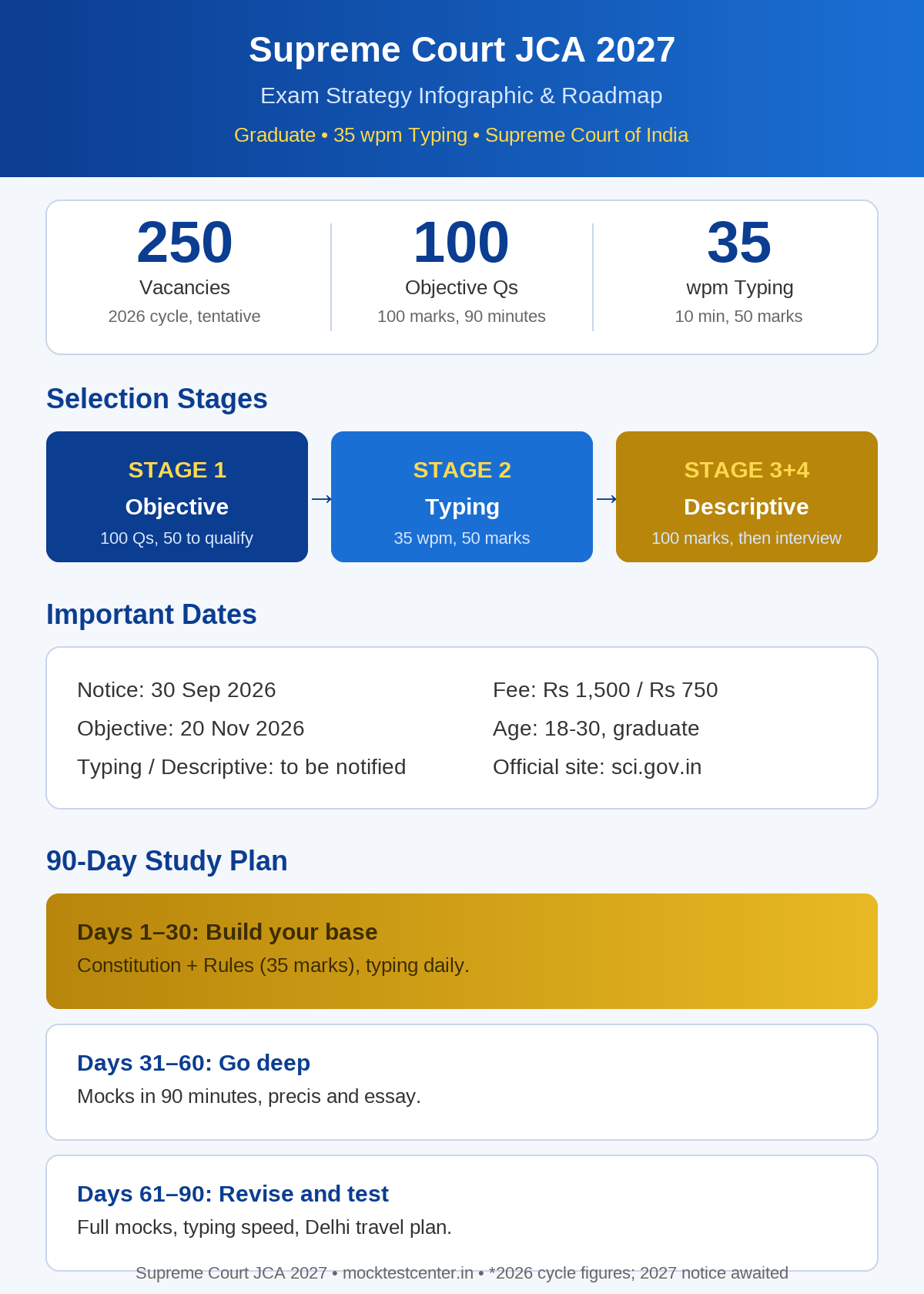
Selection runs in four stages, and you must qualify in each stage before the next one opens for you. Stage one is the Objective Type Test, 100 questions for 100 marks in 90 minutes, with a minimum qualifying mark of 50. Stage two is the Typing Speed Test on a computer in English, 10 minutes for 50 marks, with a minimum qualifying mark of 25 and a minimum speed of 35 words a minute. Stage three is the Descriptive Written Test in English, 2 hours for 100 marks, with a minimum qualifying mark of 50. Stage four is the Interview, for 25 marks, with a minimum qualifying mark of 13. The Court calls candidates for the interview in a ratio of 1 to 3 against the vacancies, and only those who qualify in all three tests before it can face the interview board. The total of the four stages is 275 marks, but the total alone does not tell the story. The qualifying line at each stage tells it, because a candidate who scores 90 in the objective test and 24 in typing goes home, while a candidate who scores 51 in the objective test and 40 in typing moves on.
The shortlist rule after stage one deserves a careful read. If a large number of candidates score the minimum 50 marks or more in the Objective Type Test, the Registry will shortlist on merit in the ratio of 1 to 10 against the tentative vacancies. With 250 vacancies, that ratio gives 2,500 candidates for stage two. The rule means a score above 50 only puts you in a pool for the typing test, and the Registry then takes the top 2,500 from that pool on merit. In a popular exam like this one, thousands can cross 50, so your real target is a rank inside the top 2,500, and that target sits well above 50 in practice. The 2025 cycle shows how sharp the cut can get. The typing test of 4 June 2025 called 10,281 candidates, and only a fraction of them moved on to the descriptive test. The numbers change each cycle, but the shape stays the same: the objective test filters, the typing test filters harder, and the descriptive test filters again.
Each stage also has its own place and mode. The Objective Type Test runs in 131 cities across India, as listed in Annexure A of the advertisement. You choose your city preferences in the form, and the Registry may shift centres if it needs to. The typing test and the descriptive test run only in Delhi and the National Capital Region. The interview runs online or in physical mode in Delhi. That split matters for your budget and your travel. A student from Patna or Lucknow can sit the objective test near home, but the same student must travel to Delhi for the typing and descriptive tests, and must plan stay and travel for those days. The notice gives no travel allowance for these stages, and trackers note the same point. Keep money aside for Delhi travel from the day you apply, so a call for the typing test never catches you short.
| Stage | Test | Marks | Time | Minimum to qualify |
|---|---|---|---|---|
| Stage 1 | Objective Type Test, 100 questions | 100 | 1 hour 30 minutes | 50 |
| Stage 2 | Typing Speed Test on computer, English, 35 words a minute | 50 | 10 minutes | 25 |
| Stage 3 | Descriptive Written Test in English | 100 | 2 hours | 50 |
| Stage 4 | Interview | 25 | Not fixed in the notice | 13 |
The objective test, question by question
The Supreme Court JCA Objective Type Test of 2026 is a 100 question multiple choice paper for 100 marks in 90 minutes. Each question carries 1 mark. Each wrong answer costs 0.25 mark. An unanswered question costs nothing. The minimum qualifying mark is 50. The paper runs on a computer, and the Court calls it an Objective Type Test with multiple choice answers. The answer key goes up on 22 November 2026, as per the notice read by trackers, and objections run on 22 and 23 November 2026 till 11.55 pm, at Rs 100 per objection, with a refund if the objection proves valid. That last detail comes from trackers that read the notice, and you should confirm it on sci.gov.in before you pay for any objection, because the fee and the window are easy to get wrong from second hand posts.
The section split is the most important fact in the whole 2026 pattern, because 35 of the 100 questions test law, and most general exam guides give law no space at all. General English, including comprehension, carries 20 questions. General Aptitude carries 15 questions. General Knowledge carries 15 questions. Provisions relating to the Judiciary in the Constitution of India carry 15 questions. The Supreme Court Rules, 2013 carry 10 questions. The Supreme Court Officers and Servants (Conditions of Service and Conduct) Rules, 1961 carry 10 questions. Computer Knowledge carries 15 questions. Add them up and you get 100. The two sets of Rules together carry 20 marks, and the Constitution judiciary section carries 15 more. A candidate who ignores the Rules gives away a fifth of the paper before the test begins. A candidate who reads the bare text of the Rules and the judiciary chapters of the Constitution walks in with 35 marks already in reach.
The 2026 split also changes the balance of English. In 2025, English carried 50 of the 100 objective questions, and the paper gave it half the weight. In 2026, English carries 20 of the 100 questions, and the descriptive test carries the English writing load instead. That shift tells you where to put your hours. English still matters, because 20 questions in 90 minutes can lift or sink your rank, and because the descriptive test is entirely in English. But English no longer dominates the objective paper. The new paper spreads its weight across seven sections, and no single section decides the result on its own. Your mock test scores should show a flat profile across sections, with no section below half marks, rather than a tall English score and a blank law score.
Negative marking changes how you should attempt the paper. Each wrong answer costs 0.25 mark, so four wrong answers erase one correct answer. Blind guessing hurts you. The safe rule is simple: answer a question only when you can rule out at least two of the four options, or when your first instinct rests on a fact you actually know. Leave the rest blank. A blank answer costs nothing, and in a paper with a qualifying line of 50, the marks you save by skipping can matter as much as the marks you earn by answering. Trackers that read the notice confirm the 0.25 deduction, and they also confirm that the 2025 paper had no negative marking at all. Students who prepared from 2025 papers and guessed freely in 2026 paid for every guess. Do not repeat that error. Practise your mocks with the 0.25 deduction switched on, and count your net score after the deduction, never your raw count of correct answers.
Time is tight, and you should plan it before the exam hall. Ninety minutes for 100 questions gives you 54 seconds per question on average, and the paper mixes quick questions with slow ones. General knowledge and computer knowledge questions often take seconds when you know the fact, and they take forever when you do not, so you should answer the known ones fast and move on. Comprehension takes longer, and aptitude questions take longer still, so you should keep a rough clock in your head: about 20 minutes for English, 15 minutes for aptitude, 12 minutes for general knowledge, 15 minutes for the Constitution section, 12 minutes for the two Rules sections together, and 12 minutes for computer knowledge, with a few minutes left to review the questions you marked for a second look. Those splits are a practice guide, and your own mock tests will tell you where you run slow. Do not let one hard question eat five minutes. Mark it, move on, and come back only if time remains.
The typing test, where most dreams end
The Typing Speed Test runs on a computer in English, for 10 minutes, for 50 marks, with a minimum qualifying mark of 25. You must type at a minimum speed of 35 words a minute. Mistakes are allowed up to 3 percent of the total words you type. The test is mandatory to qualify, and the descriptive test is evaluated only for candidates who qualify in typing. Read that last line again, because it carries the whole strategy of this exam. Your descriptive paper is checked only if your typing passes. A brilliant essay counts for nothing if your typing speed falls short, and the Court will not read a single line of it.
The 2025 cycle shows how hard this stage bites. The typing test of 4 June 2025 called 10,281 candidates. The result notice set the cut at 43.18 marks or more out of 50 for the descriptive test call, along with 10 exempted candidates with disability. Out of the 10,281 listed, 6,540 were marked as not qualified, as per a tracker that read the result notice name by name. That means roughly two in three candidates who reached the typing test failed it, even though every one of them had cleared the objective test first. The qualifying mark in the notice was only 25 out of 50, but the real cut for the next stage ran far higher, at 43.18, because the Registry called only a limited number forward. The lesson is plain: aim for 45 or more out of 50 in typing, and aim for a clean speed well above 35 words a minute with errors under 3 percent. A bare pass will not carry you forward when the field is this large.
Typing at 35 words a minute sounds easy until you try it under test conditions. You must type a passage the Court gives you, on a computer keyboard you did not choose, in a hall full of other candidates, with the clock running, and every error counts against your 3 percent allowance. Three percent of 350 words is about 10 errors. A candidate who types fast and careless can cross the error limit in the first two minutes. A candidate who types slow and careful can miss the speed line. The skill you need is accurate speed, and it comes only from daily practice on a real keyboard. Practise for 30 minutes a day, every day, on a desktop keyboard, not on a phone. Use English passages from newspapers and books, and count your words and your errors after each session. When you can hold 40 words a minute with under 2 percent errors for ten minutes at a stretch, you are ready. When you can only reach 35 on a good day, you are not ready, because the test hall will take a few words a minute off your home speed.
Your keyboard habits matter as much as your speed. Learn touch typing if you have not already, so your eyes stay on the screen and your fingers find the keys without looking down. Sit straight, keep your wrists level, and type with all ten fingers. Avoid the habit of looking at the keyboard after every word, because it breaks your rhythm and costs you seconds you cannot recover. Practise with the same kind of passage the test will give you, which is plain English prose, not code and not numbers. Practise in ten minute blocks, because that is the length of the test, and your speed in minute one means little if it collapses by minute eight. End each practice block by counting your net words per minute after errors, and write the number in a notebook. The notebook will show you whether you are improving or only repeating the same errors.
The descriptive test, two hours of writing in English
The Descriptive Written Test runs in English, for 2 hours, for 100 marks, with a minimum qualifying mark of 50. It has three parts: a comprehension passage, precis writing, essay writing. The notice does not print a mark split for the three parts, and this page will not invent one. Trackers agree on the three parts and on the total, and they agree that the test runs in Delhi and the National Capital Region, like the typing test. The test checks whether you can read a passage and answer on it, shrink a long text into a short one without losing its point, and build an essay with a clear beginning, middle and end. All three skills matter in Registry work, where you will read long papers, summarise them for others, and draft letters and notes in plain English.
Comprehension is the most scoring part for most students, because the answers sit in the passage itself. Read the passage twice before you touch the questions. Read it once for the main idea, and read it again with the questions in mind. Answer in your own words, and keep each answer short and direct. Do not copy whole lines from the passage, because the examiner wants to see that you understood the text, and copying shows nothing of the kind. Watch the time, because comprehension can eat an hour if you let it, and the essay still needs its share.
Precis writing is the part students fear most, and it is the part where practice pays fastest. A precis is a short version of a longer text, usually about a third of the length, and it must keep every main point and drop every example, repetition and decoration. Read the passage, mark the main points, write them in your own words in the same order, and give the precis a short title. Count your words as you write, because a precis that runs too long loses marks, and a precis that drops a main point loses more. Practise with newspaper editorials, which run about 500 words and carry a clear argument, and shrink each one to about 160 words. After a month of that practice, the precis in the test will feel like one more editorial, and your hand will know the pace.
Essay writing rewards structure more than big words. Pick the topic you know best, and plan it in five minutes before you write a word. Write a short opening that states your point, then three or four paragraphs that build the argument step by step, then a short close that sums up what you said. Use simple sentences, plain words, and correct grammar. Avoid long sentences that lose their way, and avoid words you cannot spell with confidence. The examiner reads hundreds of essays, and a clear essay with correct English beats a fancy essay with errors on every line. Keep your handwriting legible, because an examiner cannot give marks to words he cannot read. If the test runs on paper, your handwriting is part of your score in practice, even if the notice never says so. If it runs on a computer, the same rule holds for your typing, because a typed essay with errors reads just as badly.
The interview, 25 marks that still need respect
The Interview carries 25 marks, with a minimum qualifying mark of 13. The Court calls candidates for the interview in a ratio of 1 to 3 against the vacancies, and only candidates who qualify in the objective test, the typing test and the descriptive test can receive a call. With 250 vacancies, that ratio gives up to 750 interview calls. The interview runs online or in physical mode in Delhi, as per the notice. In the 2025 cycle, interviews ran through video conferencing on 10 to 12 September 2025, as per trackers that read the cycle, and the final result followed on 10 October 2025. The mode can change each cycle, so you should prepare for both a video call and a room, and you should keep your documents ready either way.
An interview of 25 marks cannot rescue a weak written score, and it cannot destroy a strong one on its own, but it can still move your rank at the edge. The board will ask about you, your degree, your home state, and why you want to work in the Supreme Court. It will ask about the Court itself, about the Constitution, and about current legal news. It will watch how you speak, how you listen, and whether you stay calm under pressure. Prepare a short, honest account of your education and your preparation, and practise saying it aloud until it sounds natural. Read the news about the Supreme Court for a month before the interview, and know the names of the Chief Justice and a few recent judgments in simple terms. Dress neatly, reach the venue or the video link early, and answer in clear English. If you do not know an answer, say so in plain words and move on. A board respects a candidate who admits a gap far more than a candidate who invents an answer.
The final panel follows the interview. The Court prepares a panel of suitable candidates for the 250 tentative vacancies, and the panel fills the posts as the Registry needs them. The 2025 final result empanelled 241 candidates for 241 posts, and the selected candidates then went through document verification and a medical examination before joining. The 2026 notice follows the same shape, and the same steps will follow the final result. Keep your degree certificate, your mark sheets, your identity proof, your caste or category certificate if you claimed one, and your disability certificate if you claimed one, in original and in copy, from the day you apply. A missing paper at verification can cost a place that four stages of testing had already won.
Important dates, 2026 and 2025 side by side
Dates are where this exam punishes careless reading, because the two cycles sit close together and their dates look alike. Keep them apart. The 2026 advertisement came on 30 September 2026. Forms opened on 7 October 2026 at 10.00 am and closed on 28 October 2026 at 11.55 pm. The Objective Type Test had a tentative date of 20 November 2026. The answer key was planned for 22 November 2026, with objections on 22 and 23 November 2026. The admit card link opened on 14 November 2026 through a notice of that date, as reported by trackers, and the exam city slip was reported as released on 9 November 2026, though one tracker noted on 13 November 2026 that the Court site then showed no city slip notice for this cycle. That conflict is worth a line in the flags, because the two reports cannot both be right about the same date, and the Court site is the only source that settles it. Dates for the typing test, the descriptive test and the interview were not fixed in the 2026 advertisement, and the notice says they will come later on sci.gov.in.
The 2025 cycle ran on a longer clock, and it shows what the gap between stages can look like. The advertisement came on 4 February 2025 under No. F.6/2025-SC(RC). Forms ran from 5 February to 8 March 2025. The objective test was held on 13 April 2025 across 128 centres in 28 states and union territories. The result came on 9 May 2025. The typing test was held on 4 June 2025. The descriptive test was held on 1 August 2025 in Delhi and the National Capital Region, and its result came on 4 September 2025. Interviews ran on 10 to 12 September 2025 through video conferencing. The final result came on 10 October 2025. The whole cycle took about eight months from the notice to the final result. A 2027 aspirant should expect a similar stretch, and should keep the months after the objective test free for Delhi travel, because the typing and descriptive dates can arrive with short notice.
| Event | 2026 cycle | 2025 cycle |
|---|---|---|
| Advertisement | 30 September 2026, No. F.6/2026-SC (RC) | 4 February 2025, No. F.6/2025-SC(RC) |
| Vacancies | 250 tentative | 241 tentative |
| Forms open | 7 October 2026 | 5 February 2025 |
| Forms close | 28 October 2026, 11.55 pm | 8 March 2025, 11.55 pm |
| Fee | Rs 1,500 General, Rs 750 reserved | Rs 1,000 General and OBC, Rs 250 reserved |
| Objective test | 20 November 2026, tentative | 13 April 2025 |
| Typing test | Date to be notified | 4 June 2025 |
| Descriptive test | Date to be notified | 1 August 2025 |
| Interview | Date to be notified | 10 to 12 September 2025 |
| Final result | Date to be notified | 10 October 2025 |
| 2027 notice | No 2027 notification exists as of 23 November 2026 | |
Fee, form and documents
The application fee for 2026 is Rs 1,500 for General and Unreserved candidates, and Rs 750 for Scheduled Caste, Scheduled Tribe, Other Backward Class Non-Creamy Layer, ex-servicemen and physically challenged candidates, plus bank charges. The fee is non refundable, and you pay it online only, through the payment gateway the Court provides, which the notice names as the UCO Bank gateway. The fee rose sharply from 2025, when General and OBC candidates paid Rs 1,000 and SC, ST, ex-servicemen, differently abled and freedom fighter candidates paid Rs 250. Do not carry the 2025 fee into a 2026 form, and do not carry the 2026 fee into the next cycle without checking the new notice, because the Court has changed the fee between cycles and may change it again.
The form itself is online only, and it runs through the link on sci.gov.in. You register, fill your details, upload your photo and signature in the size the portal asks for, choose your test city preferences from the Annexure A list, pay the fee, and submit before the closing time. The portal for 2026 ran on the TCS iON platform, as per trackers, and the admit card link also ran through that platform. Keep your application number safe, because the admit card download needs it. Check every entry before you submit, because a wrong date of birth or a wrong category can create trouble at verification that no later correction can fix. The notice gives no correction window in the parts that trackers quote, and this page will not claim that one exists.
Prepare your documents before the form opens, not after. You need a Bachelor degree certificate or provisional certificate from a recognised university in India, your mark sheets, a government identity proof, a recent passport size photo, and your signature on white paper. If you claim a category, you need the category certificate in the format the notice asks for. If you claim disability, you need the disability certificate, and the notice carries Annexure formats for a medical certificate for candidates who need a scribe. If you work in a government office, you may need a no objection certificate from your employer, and the notice carries instructions on that point. Read the full advertisement once, slowly, before you fill the form, and read the general instructions at the end of it, because they carry the rules on scribes, on rejection of forms, and on the Delhi jurisdiction for disputes, and students skip them every year.
What changed between 2025 and 2026, and why it matters
The change between the two cycles is the single most useful fact on this page, because it decides what you study and how you attempt the paper. The 2025 objective paper ran for 2 hours. It had 100 questions: 50 on General English including comprehension, 25 on General Aptitude, and 25 on General Knowledge. A separate Objective Type Computer Knowledge Test carried 25 questions. The notice set no negative marking for the written exam, as per trackers that read the cycle, and the objective paper carried no qualifying mark printed in the same way as 2026. The 2026 objective paper runs for 90 minutes. It has 100 questions in seven sections, with English down to 20, aptitude at 15, general knowledge at 15, the Constitution judiciary section at 15, the Supreme Court Rules at 10, the 1961 service rules at 10, and computer knowledge at 15. It carries negative marking of 0.25 per wrong answer, and it sets a minimum qualifying mark of 50. The two papers share a name and a post, and little else.
The later stages changed in shape as well, though the names stayed the same. In 2025, the typing test ran for 10 minutes with a minimum speed of 35 words a minute and mistakes allowed up to 3 percent, and it carried 50 marks with a minimum of 25, much like 2026. The descriptive test ran for 2 hours with comprehension, precis, essay, and it carried 100 marks with a minimum of 50, much like 2026. The interview carried 25 marks, and the ratio for the interview call was 1 to 3, much like 2026. The structure of the later stages held steady while the objective paper changed around them. That steadiness is good news for a 2027 aspirant, because typing and descriptive practice from either cycle still transfers to the next one. The objective paper is the part you must rebuild from the latest notice each time, because the Court has shown it will change the sections, the time, and the marking without warning.
One more change sits in the fee and in the calendar. The fee rose from Rs 1,000 for General candidates in 2025 to Rs 1,500 in 2026, and the reserved fee rose from Rs 250 to Rs 750. The calendar also moved. The 2025 notice came in February and the objective test ran in April, with the final result in October. The 2026 notice came in late September and the objective test was set for late November, only seven weeks after the notice. A student who waited for the notice before starting preparation had seven weeks in 2026, against nine weeks in 2025. The lesson is to prepare before the notice, not after it. Typing practice, English writing practice, and reading of the Constitution and the Rules all take months, and none of them can start on the day the notice appears. Keep a base level of preparation through the year, so a short notice window never catches you cold.
| Item | 2025 cycle | 2026 cycle |
|---|---|---|
| Objective paper time | 2 hours | 1 hour 30 minutes |
| Objective paper sections | English 50, Aptitude 25, GK 25, plus separate Computer Knowledge 25 | English 20, Aptitude 15, GK 15, Judiciary in Constitution 15, SC Rules 2013 10, Service Rules 1961 10, Computer Knowledge 15 |
| Negative marking | None in the objective paper | 0.25 mark per wrong answer |
| Objective qualifying mark | Not printed as a fixed 50 | 50 out of 100 |
| Typing test | 35 words a minute, 10 minutes, 50 marks, 25 to qualify | Same shape, 35 words a minute, 10 minutes, 50 marks, 25 to qualify |
| Descriptive test | 100 marks, 2 hours, 50 to qualify | Same shape, 100 marks, 2 hours, 50 to qualify |
| Interview | 25 marks, 1 to 3 ratio | 25 marks, 13 to qualify, 1 to 3 ratio |
| Fee | Rs 1,000 General, Rs 250 reserved | Rs 1,500 General, Rs 750 reserved |
Cut offs and scores from 2025, and what they teach you
The advertisement carries no cut off table. Stage wise result lists carry the cut instead, and the cut emerges from those lists. That is why this section reads differently from a cut off table in other exams. The 2025 cycle gives us three firm numbers, and each one teaches a different lesson. First, the objective test of 13 April 2025 gave score cards to candidates, and the result list came on 9 May 2025, but the notice and the trackers carry no single published cut off score for that stage. Do not trust a site that prints a neat category wise objective cut off for 2025, because the Court published a list of roll numbers, and the score cards went to individual candidates. Second, the typing test of 4 June 2025 called 10,281 candidates, and the result set the cut at 43.18 marks or more out of 50 for the descriptive test call. Third, the descriptive test of 1 August 2025 called 2,547 candidates for the interview in a 1 to 3 ratio, and the cut for that call was 55 marks or more out of 100. The final result of 10 October 2025 empanelled 241 candidates, and the Court did not publish category wise final marks, as per trackers that read the result notices.
The typing cut of 43.18 is the number to stare at. The notice set the minimum at 25 out of 50, and the real cut for the next stage ran at 43.18, which is more than 86 percent of the marks. That gap tells you the typing test works as a ranking test in practice, and the Registry takes only the top slice forward. A candidate who scores 30 in typing clears the notice minimum and still goes home, because thousands of others scored above 40. The same logic holds for the descriptive test. The notice sets the minimum at 50 out of 100, and the real cut for the interview call ran at 55 in 2025. The gap there is smaller, but the direction is the same. Your target in every stage should sit well above the printed minimum, and your mock test scores should aim for 70 in the objective test, 45 in typing, and 65 in descriptive practice, because those are the levels that survive a real cut in a field of this size.
The 2026 qualifying marks give you the floor, and the 2025 cuts give you the ceiling you should aim for. The floor is 50 in the objective test, 25 in typing, 50 in descriptive, and 13 in the interview. The ceiling, from 2025, is a typing score above 43 and a descriptive score above 55 just to reach the next stage. Between the floor and the ceiling lies the whole competition, and the candidates who win it are the ones who treat the printed minimum as a warning line, not as a target. Set your mock test targets at least 15 marks above each minimum, and keep them there for a month before the exam. If your mock scores wobble around the minimum, you are not ready. If they hold steady above it, you can trust your preparation.
Syllabus, section by section
The Supreme Court JCA 2026 advertisement gives section heads and question counts, and it gives no detailed topic list. That gap is normal for this exam, and it means you must build your own topic list from the section heads, from the bare text of the Constitution and the Rules, and from standard books. This section does that job for you, section by section, and it marks clearly where the notice ends and where a study suggestion begins, so you never mistake a suggestion for an official topic.
General English, 20 questions including comprehension, tests grammar, vocabulary, and reading. Expect error spotting, sentence improvement, synonyms and antonyms, one word substitution, idioms and phrases, and a comprehension passage with questions on it. The standard of English is graduation level, and the paper rewards a candidate who reads English every day. Read one English newspaper daily, and read the editorial page with a pencil in hand. Learn 10 new words a day, and use each one in a sentence of your own. Practise error spotting from a standard grammar book, and practise comprehension with a timer, because the passage questions in this paper sit inside a 90 minute paper, and slow reading will cost you marks in other sections.
General Aptitude, 15 questions, tests number work and reasoning at a level a graduate can handle without special maths. Expect percentage, ratio and proportion, average, profit and loss, simple and compound interest, time and work, time and distance, number series, coding and decoding, blood relations, direction sense, and simple data tables. The questions are short, and they reward speed and accuracy rather than deep maths. Practise 15 questions a day from a standard aptitude book, and time yourself. Learn short cuts for percentage and ratio, because those two topics return in many forms. Do not spend weeks on advanced maths, because this paper does not ask for it.
General Knowledge, 15 questions, tests current events and static facts. Expect questions on national news, government schemes, sports, awards, books, history, geography, polity, economy, and science. The current affairs window for a 2026 paper runs roughly over the six months before the exam, so a 2027 aspirant should read the news from the start of the year and keep notes month by month. Use a monthly current affairs booklet and a static general knowledge book together, and revise both in the last month. Do not try to read everything. Read the news, note the facts that repeat across sources, and revise those notes twice.
Provisions relating to the Judiciary in the Constitution of India, 15 questions, is the section most students have never studied, and it is the section that can lift your rank fastest. The Constitution sets out the Union Judiciary in Part V, Chapter IV, in Articles 124 to 147, and it sets out the High Courts in Part VI, Chapter V, in Articles 214 to 231, and the subordinate courts in Chapter VI, in Articles 233 to 237. Read those articles in the bare text of the Constitution, which is free on legislative.gov.in. Learn how the Supreme Court is set up, how judges are appointed, how long they serve, what jurisdiction the Court holds, and how the High Courts relate to it. Learn the key articles by number: the establishment of the Supreme Court, the appointment of judges, the original and appellate jurisdiction, and the power of judicial review in simple terms. Use a standard polity book for concept clarity, and use the bare text for the exact words, because the questions often turn on the exact words of an article.
Supreme Court Rules, 2013, 10 questions, and Supreme Court Officers and Servants (Conditions of Service and Conduct) Rules, 1961, 10 questions, are the two sections that separate this exam from every other graduate exam. Together they carry 20 marks, and together they test whether you bothered to read the two documents that govern the Court and its staff. Read the bare text of both sets of Rules, and make short notes as you read. For the 2013 Rules, learn the structure of the Rules, the parts that deal with filing, listing, and procedure, and the language the Rules use for petitions and orders. For the 1961 Rules, learn the parts that deal with service conditions, conduct, and reservation, because the notice itself points to Rule 4A of the 1961 Rules for reservation. Do not try to memorise every rule number. Learn the shape of each document, the main chapters, and the rules that touch the daily work of the Registry. That level of reading will carry most of the 20 marks, and no coaching book can replace it.
Computer Knowledge, 15 questions, tests the basics of computers at a level any graduate who uses a computer daily can reach. Expect questions on computer hardware and software, operating systems, MS Office and word processing, the internet and email, computer networks, memory and storage, and basic security. Use a standard computer awareness book, and practise on a real computer as you read, because a fact you have tried with your own hands stays longer than a fact you only read. Learn the full forms of common terms, the shortcut keys of a word processor, and the difference between hardware and software in simple words. This section rewards steady revision, and 15 questions in 90 minutes can give you quick marks if you keep your notes short.
Books and free sources that cover this paper
You do not need a shelf of books for the Supreme Court JCA exam. You need one good book per section, the bare text of the Constitution and the two sets of Rules, and a daily typing habit. For General English, use a standard objective English book and a grammar book, and read one English newspaper daily. For General Aptitude, use a standard quantitative aptitude and reasoning book, and practise 15 questions a day with a timer. For General Knowledge, use a standard general knowledge book and a monthly current affairs booklet, and revise your own notes twice. For the Constitution, use a standard polity book for concepts and the bare text on legislative.gov.in for the exact articles. For the two sets of Rules, use the official bare text as your main source, because no guide book can replace it. For Computer Knowledge, use a standard computer awareness book and practise on a real computer. The Court prescribes none of these books, and the list above is a study suggestion, not an official list. Buy the books, then stop buying books, and start solving papers.
Previous year papers deserve a special note, because this exam has few of them. The 2025 objective paper is the only recent paper in the old pattern, and the 2026 paper is the first in the new pattern. Solve the 2025 paper for aptitude, general knowledge and English practice, and ignore its section weights, because the 2026 paper changed them. Solve it with a timer, and count your net score after a 0.25 deduction per wrong answer, even though the 2025 paper had no deduction, because that habit will serve you in the new pattern. When the 2026 answer key and paper reach the public domain, solve that paper first, because it is the only paper in the current pattern. Do not pay for a paper that claims to be the 2026 paper before the Court has published it, and do not trust a paper that mixes 2025 questions with 2026 section heads.
A 90 day plan that fits the real calendar
This plan assumes you start 90 days before the objective test, and it assumes you already type at 25 words a minute. If you type slower than that, add 30 minutes of typing to every day of the plan, and start the plan earlier. Days 1 to 30 build your base. Study 5 hours a day. Learn the Constitution judiciary chapters and the two sets of Rules first, because they carry 35 marks and most students leave them to the end. Practise typing for 30 minutes every morning, and read English for 30 minutes every evening. Learn 10 new English words a day, and solve 15 aptitude questions a day. Days 31 to 60 go deep. Study 6 hours a day. Take one full objective mock every three days in 90 minutes, with the 0.25 deduction, and spend an hour after each mock on your mistakes. Practise precis and essay writing twice a week, one precis and one essay per session, in 2 hours. Keep typing daily, and push your speed past 38 words a minute with errors under 3 percent. Days 61 to 90 revise and test. Take two full mocks a week, and revise your mistake notebook, your Constitution notes, and your Rules notes daily. Do not learn new topics now. In the last week, rest well, keep your admit card and photo identity proof ready, and check sci.gov.in for any update on the test. After the objective test, shift your whole routine to typing and descriptive writing, because the next stages come fast and the typing test decides whether your descriptive paper is even read.
How to use mock tests for this exam
Mock tests are practice tests that look like the real exam, and for this exam they matter more than usual, because the 2026 pattern is new and the time is short. Take your mocks in 90 minutes, with 100 questions, with the 0.25 deduction, and with the 2026 section split. A mock that uses the 2025 split will teach you the wrong balance, and a mock that ignores negative marking will teach you to guess. Take at least 20 full mocks before the objective test, and take them on a computer, not on paper, because the real test runs on a computer and your eyes and your hands need the practice. After each mock, spend an hour on your mistakes. Note which section cost you the most marks, and study that section the next day. If the Rules sections cost you marks, read the bare text again. If aptitude cost you marks, practise that topic for a week. If guessing cost you marks, change your attempt rule and stick to it.
Typing mocks deserve the same discipline. Take a ten minute typing test every day in the last month, on a desktop keyboard, with a passage you have not seen before, and count your net speed after errors. A typing mock that uses a passage you already know will flatter you, and a typing mock on a phone keyboard will teach you nothing. Descriptive mocks deserve a weekly slot. Write one precis and one essay a week under a two hour clock, and get a teacher or a good English speaker to mark them for grammar, structure and clarity. A descriptive mock you never get marked is only half a mock, because you cannot see your own errors.
If you want to practise with other graduate exams on this site, you can see SSC CGL 2027, SSC CHSL 2027, SSC Stenographer 2027, SSC Junior Engineer 2027, SSC Delhi Police Constable 2027, SSC Selection Post 2027, SSC JHT 2027, SSC Limited Departmental Examinations 2027, Indian Army NDA 2027 and BPSC Assistant Section Officer 2027 on this site. The typing heavy SSC Stenographer paper is a useful cousin for this exam, because it also rewards daily keyboard practice, and the graduate papers above will keep your aptitude and general knowledge sharp while you work on the law sections that only this exam tests.
Mistakes that cost candidates a place
The first mistake is preparing from the 2025 pattern. The 2025 paper gave English 50 questions and no negative marking. The 2026 paper gives English 20 questions, adds 35 law questions, and deducts 0.25 per wrong answer. A student who studies 2025 weights will overstudy English, ignore the Rules, and guess freely. The second mistake is ignoring the typing test until after the objective test. The typing test removes two in three candidates who reach it, and typing speed takes months to build. Start typing on day one of your preparation, not on the day the objective result comes out. The third mistake is confusing Junior Court Assistant with Junior Court Attendant, or with the Programmer post, and then applying for the wrong post or preparing for the wrong pattern. Check the advertisement number on every notice you read. The fourth mistake is trusting a category wise vacancy table or a 2027 date from a job site. The 2026 notice gives no category split, and no 2027 notice exists. The fifth mistake is paying an agent for the form. The form is online only on sci.gov.in, and no agent can improve your chances. Pay only the fee the notice prints, through the gateway the notice names, and keep the receipt.
A last word
Supreme Court JCA 2027 is a strong post for a graduate who can type, write clear English, and read legal texts with patience. The pay is Level 6, the posting is in the Supreme Court in New Delhi, and the work puts you at the centre of the Indian judiciary. The competition is real, and the typing test is the hardest gate in the whole process. Start typing today, read the Constitution and the two sets of Rules this week, and take your first full mock in the 2026 pattern within the next seven days. Keep your documents ready, check sci.gov.in every week for the 2027 notice, and do not pay any agent or any website for this exam. The form is only on the official site, and the notice is the only source that counts.