About IB Security Assistant Executive 2027 Exam Series
📖 Table of Contents
- What this exam gives a 10th pass candidate
- Choose your SIB first, because it decides everything else
- Who can apply
- Posts and vacancies in the 2025 cycle
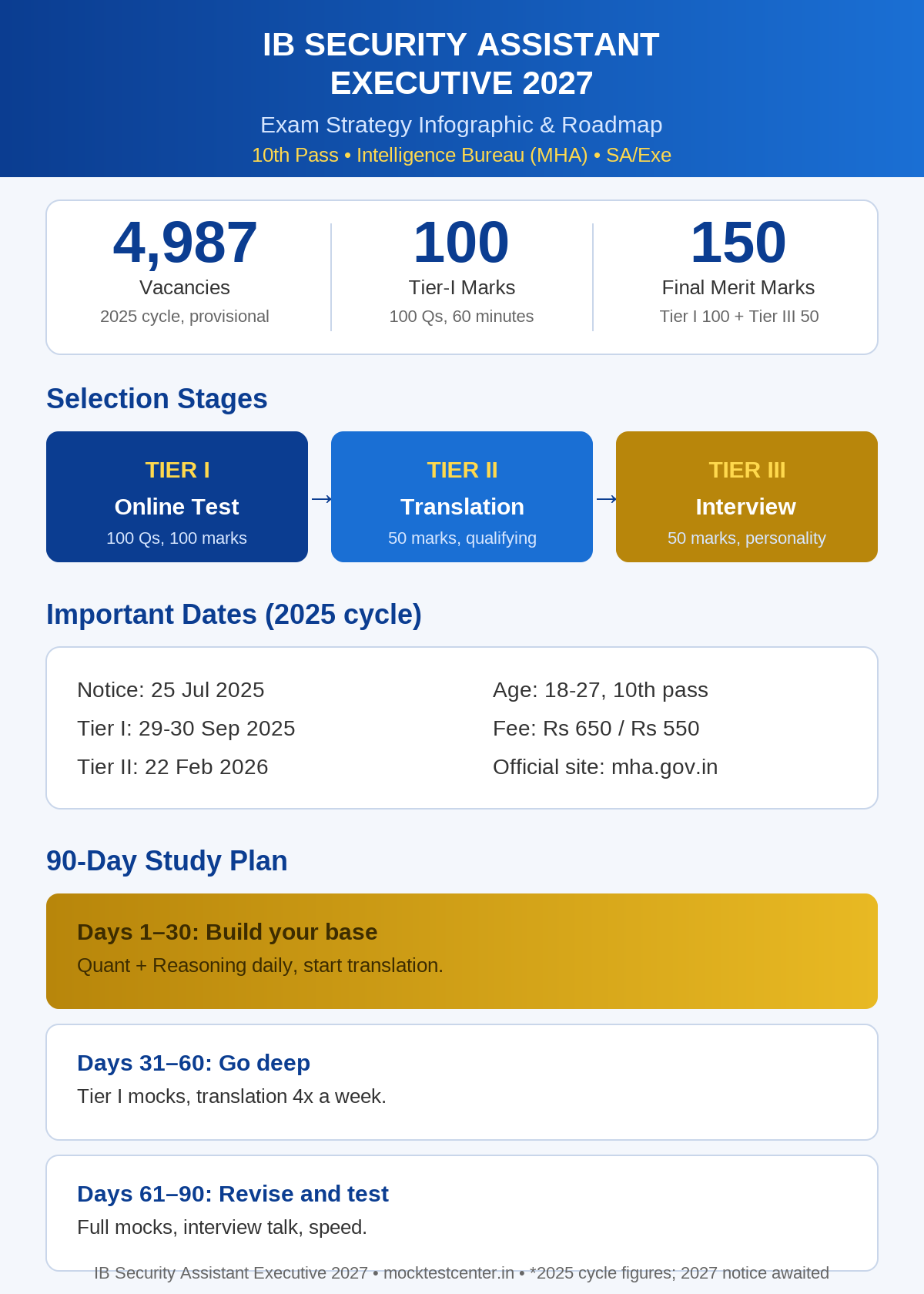
- How selection works across three tiers
- Tier I, the 100 mark online test
- Tier II, the translation test that ends many runs
- Tier III, the interview, and how the final list is made
- Dates of the 2025 cycle, and what they teach about the 2027 cycle
- Fee, and the Rs 550 charge that surprises first time candidates
- Pay, allowances, and what the work really looks like
- Syllabus, subject by subject
- Cut-off marks, and the 35, 34, 33 confusion
- Books and sources that are enough
- A 90 day plan that fits around a job or study
- Mistakes that cost candidates a year
- How to use mock tests for this exam
- A last word before you apply
IB Security Assistant Executive 2027
What this exam gives a 10th pass candidate
IB Security Assistant Executive 2027 is the page for the Intelligence Bureau exam that lets a 10th pass candidate join the Intelligence Bureau as a Security Assistant or Executive, called SA/Exe. The Intelligence Bureau works under the Ministry of Home Affairs, and this post sits in Pay Level 3, from Rs 21,700 to Rs 69,100 a month, plus allowances. No graduation is needed. No physical test is part of the scheme. The whole selection runs in three tiers, and the last tier is an interview of 50 marks.
Read one line before anything else. No 2027 notification exists as of 23 November 2026. Every fact on this page comes from the live 2025 cycle, because that is the cycle MHA has actually run. The 2025 notice came on 25 July 2025, forms ran from 26 July to 17 August 2025, and 4,987 posts were on offer. Any site that prints a 2027 vacancy number or a 2027 exam date today is guessing. The 2027 notice will appear on mha.gov.in when MHA is ready, and this page will need a fresh read of that notice before anyone applies.
The 2025 cycle also corrects a figure that many pages still print wrong. The task brief for this page first said 498 posts. The real number is 4,987, ten times that figure. One tracker even prints 4,937, which is a typing slip. The category split adds up to 4,987, and the SIB wise table adds up to 4,987, so the number holds from two directions. Keep that in mind when you see a small number quoted for this exam. It is almost always a dropped digit.
This exam suits a candidate who finished school and wants a central government job without waiting for a degree. It also suits a candidate who knows one local language well, because the local language decides where you can apply and how Tier II goes. The rest of this page walks through that choice first, then eligibility, vacancies, the three tiers, the fee, the pay, the syllabus, plus a 90 day plan.
Choose your SIB first, because it decides everything else
Many pages open with the exam pattern. That order misleads candidates for this exam. The pattern is the same for everyone, but the SIB you pick changes your chance of selection more than any chapter you study. SIB means Subsidiary Intelligence Bureau. MHA runs this recruitment SIB by SIB, and each SIB covers one region and lists the languages of that region.
You apply to only one SIB. You must hold a domicile certificate of the state of that SIB. You must know one language or dialect listed against that SIB, and you must know it well enough to read it, write it, and speak it. Tier II tests exactly that skill, by making you translate a 500 word passage from the local language to English and back. Pick a SIB whose language you know well, and the translation paper feels like a normal task. Pick a SIB for its vacancy count alone, and Tier II can end your run even after a good Tier I score.
Delhi had the most posts in 2025, with 1,124, and its languages are Hindi, Punjabi, Urdu. Ahmedabad had 307, with Gujarati, Kutchchi. Chennai had 285, with Tamil only. Kolkata had 280, with Bengali, Sylheti, Nepali, Bhutanese, Urdu, Santhali, Rohingya. Bengaluru had 204, with Kannada, Tulu, Beary, Konkani, Nawayathi. Itanagar had 180, with Nyishi, Adi, Galo, Apatani, Idu Mishmi, Monpa, Nocte, Tangsa, Sherdukpen, Memba. Jaipur had 130, with Hindi, Marwari, Dhatti/Thari, Wagdi. Guwahati had 124, with a long list that runs from Assamese and Bengali to Bodo, Mishing, Dimasa, Rabha, Tiwa, Kuki, Hmar, Paite, Garo, Santhali, Koch-Rajbanshi, Manipuri, Khasi. Hyderabad had 117, with Telugu. Amritsar had 74, with Punjabi only. Bhopal had 87, with Hindi only. Bhubaneswar had 76, with Odia, Kutia, Dongria, Bhunjia. Chandigarh had 86, with Hindi, Punjabi. Agartala had 67, with Bangla, Kokborok, Chakma, Kawbru, Halam. Aizawl had 53, with Mizo, Lai, Mara, Pang, Bru, Burmese, Falam-Chin, Bawm. Imphal had 39, with Manipuri, Tangkhul, Mao, Anal, Maring, Thadou, Paite, Zou, Rongmei, Mizo. Dehradun had 37, with Hindi only. Gangtok had 33, with Nepali, Bhutia, Lepcha. Leh had 37, with Ladakhi/Bhoti, Purgi, Balti, Shena/Brokskat, Changskat, Zangskari, Tibetan.
Two traps sit inside that list. First, a big vacancy number does not mean an easy seat. Delhi had 1,124 posts, and it also drew the largest crowd in the country, because every Hindi speaking candidate in north India looked at it first. A small SIB with 37 posts and a rare language can give a better chance to the candidate who speaks that language at home. Second, your domicile must match the state of the SIB, not the language. A candidate can speak Tamil well and still fail the domicile rule for Chennai if the domicile certificate belongs to another state. Check the certificate first, then the language, then the vacancy number. That order saves a wasted form fee.
One more point about the SIB choice. MHA fills each SIB separately, and the shortlists run SIB by SIB. Your Tier I score competes only with candidates who picked the same SIB and the same category. That is why the cut-off for one SIB can sit far above the cut-off for another SIB in the same year. The notice minimum marks stay the same everywhere, but the real shortlist line moves with the crowd in your SIB.
Who can apply
The 2025 notice sets three tests for eligibility, and all three must hold on the date the notice fixes. Miss one, and the form fails at document checking even if you clear every tier.
First, education. You must have passed Matriculation, which means Class 10, or an equal qualification from a recognised Board of Education. A candidate with a higher qualification can still apply, because the notice asks for Matriculation as the minimum, and a degree does not disqualify you. A candidate who is still waiting for a Class 10 result cannot rely on hope. The pass must be complete by the date the notice fixes.
Second, domicile. You must hold a domicile certificate of the state against which you apply. This rule has no workaround. A candidate who grew up in one state and now lives in another must apply against the state that issued the domicile certificate. Keep the certificate ready before the form opens, because a late certificate can miss the form window, and MHA gives no extra time for papers that were already in your hands to arrange.
Third, language. You must know one of the languages or dialects listed against your chosen SIB, and the notice means all three skills: read, write, speak. Many candidates speak a language at home and still struggle to write it, and Tier II exposes exactly that gap. If you cannot write a clean paragraph in the language, practise writing before you pick that SIB. Spoken ability also comes back in Tier III, where the interview panel can test how you speak the local language.
Age runs from 18 to 27 years as on 17 August 2025, which was the last date of the 2025 form window. The notice gives relaxation on top of that. SC and ST candidates get 5 extra years. OBC candidates get 3 extra years. Departmental candidates with three years of central government service can go up to 40 years. Widows, divorced women, and women judicially separated and not remarried can go up to 35 years for UR, 38 years for OBC, and 40 years for SC and ST. Ex-servicemen get relaxation as per government rules. Meritorious sportspersons can get up to 5 extra years as per the DoP&T order the notice cites.
You must be a citizen of India. The notice also lists field experience in intelligence work as a desirable qualification, which means it can help but it is not a must. Do not read it as a bar. A fresh 10th pass candidate with the right domicile and language can apply, and most selected candidates in this exam are fresh candidates.
One eligibility point needs a flag. A news report that quotes the notice says the SA/Exe post is not identified suitable for any category of Persons with Benchmark Disabilities. That line comes from a tracker report of the notice, and this page could not read the official PDF directly, so treat it as a point to check in the 2027 notice before applying. If it holds, it matters a lot, and it is better to learn it from the notice than from a rejection letter.
- Education: Matriculation (Class 10 pass) or equal, from a recognised board
- Age: 18 to 27 years as on 17 August 2025 (2025 cycle)
- Domicile: certificate of the state of the SIB you apply for
- Language: read, write, speak one language or dialect listed for that SIB
- Relaxation: SC/ST plus 5 years, OBC plus 3 years, departmental up to 40 years
- Citizenship: Indian citizen
- Desirable: field experience in intelligence work (not a must)
Posts and vacancies in the 2025 cycle
The post is Security Assistant/Executive, Group C, Non-Gazetted, Non-Ministerial, in the Intelligence Bureau. The 2025 notice offered 4,987 posts across the SIBs. The category split was UR 2,471, OBC 1,015, EWS 501, SC 574, ST 426. Those five numbers add to 4,987, and the SIB table adds to the same total. Vacancies stay provisional, and MHA can change them as needs change.
Delhi alone held 1,124 posts, which is close to a quarter of the whole drive. That weight makes Delhi the centre of this recruitment, and it also makes Delhi the hardest SIB to clear. Ahmedabad, Chennai, Kolkata, Bengaluru, and Itanagar follow, each above 170 posts. At the other end, Gangtok had 33, Dehradun 37, Leh 37, Imphal 39, Aizawl 53, Agartala 67. Small SIBs look thin on paper, and they are, but the crowd there is also thin, and the language bar keeps the field small.
Compare this drive with the 2023 cycle to see the scale. The 2023 SA/Exe drive offered 1,675 posts, and the 2025 drive offered 4,987, which is close to three times that number. That jump is one reason the 2025 forms drew a very large crowd, and it is also why so many coaching pages rushed out guides with wrong numbers in the first week. A guide that still quotes 1,675 or 498 for this exam is reading an old cycle, or a dropped digit, and you should close it.
| SIB | Languages | Posts |
|---|---|---|
| Delhi | Hindi, Punjabi, Urdu | 1,124 |
| Ahmedabad | Gujarati, Kutchchi | 307 |
| Chennai | Tamil | 285 |
| Kolkata | Bengali, Sylheti, Nepali, Bhutanese, Urdu, Santhali, Rohingya | 280 |
| Bengaluru | Kannada, Tulu, Beary, Konkani, Nawayathi | 204 |
| Itanagar | Nyishi, Adi, Galo, Apatani, Idu Mishmi, Monpa, Nocte, Tangsa, Sherdukpen, Memba | 180 |
| Jaipur | Hindi, Marwari, Dhatti/Thari, Wagdi | 130 |
| Guwahati | Assamese, Sylheti, Bengali, Nepali, Bodo, Mishing, Dimasa, Rabha, Tiwa, Kuki, Hmar, Paite, Garo, Santhali, Koch-Rajbanshi, Manipuri, Khasi | 124 |
| Hyderabad | Telugu | 117 |
| All other SIBs | As per the notice table | 1,236 |
| Total | All SIBs | 4,987 |
The table above lists the nine largest SIBs. The remaining posts sit across the other SIBs, and the full table runs to more than 30 SIBs. The 2027 notice will carry its own table, and the numbers will move. Use the 2025 table to learn how MHA spreads posts, and do not use it to predict your 2027 SIB. A SIB that had 300 posts in 2025 can have 60 in the next cycle, and a SIB that had 37 can jump.
How selection works across three tiers
Selection runs in three tiers, and each tier has a different job. Tier I is an online objective test of 100 marks. Tier II is an offline descriptive test of 50 marks that checks translation between English and the local language. Tier III is an interview, called a personality test, of 50 marks. Tier II only checks that you qualify, and the final merit adds Tier I and Tier III. That last line shapes your whole plan, because a candidate who treats Tier II as a side task can pass Tier I and still fall at the translation paper.
MHA shortlists in steps. After Tier I, MHA calls about ten candidates per vacancy for Tier II, based on Tier I normalised scores and the minimum qualifying marks. After Tier II, MHA calls about five candidates per vacancy for Tier III, based on Tier I scores and a pass in Tier II. The final list then ranks candidates on Tier I plus Tier III, SIB by SIB and category by category. Tier II marks stay out of the final total. A fail in Tier II still ends the run before Tier III.
| Tier | What it is | Marks | Time | Role in merit |
|---|---|---|---|---|
| Tier I | Online objective test, 100 questions | 100 | 60 minutes | Counts in final merit |
| Tier II | Offline descriptive translation test | 50 | 60 minutes | Qualifying only, need 20 |
| Tier III | Interview, personality test | 50 | As fixed by MHA | Counts in final merit |
| Final merit | Tier I plus Tier III | 150 | After Tier II pass | SIB wise and category wise |
Note what is missing from that table. No physical test appears in the SA/Exe scheme. No running, no height check, no chest measurement. Candidates who mix this exam with police constable exams often start running drills for a test that does not exist here. Save that time for translation practice and English. The one exception to watch is the separate Security Assistant (Motor Transport) drive, which ran 455 posts in 2025 with its own driving test and a different Tier II. That is a different post, and its pattern does not apply to SA/Exe.
Tier I, the 100 mark online test
Tier I of the IB SA Executive exam is the gate. It is an online objective test with 100 questions for 100 marks, and you get 60 minutes. Five sections share the paper, with 20 questions and 20 marks each. General Awareness, Quantitative Aptitude, Numerical and Analytical and Logical Ability and Reasoning, English Language, and General Studies. Each right answer gives 1 mark, and each wrong answer takes away 0.25 mark. A blank answer costs nothing. That last rule matters more than it looks, because a blind guess on a question you cannot solve has a one in four chance of a gain and a three in four chance of a loss, and the loss repeats across 100 questions.
Sixty minutes for 100 questions gives 36 seconds per question on average. That pace leaves no room for a long fight with one hard sum. The candidates who clear Tier I treat it as a speed paper with a hard stop per question. They mark a hard question, move on, and come back only if time is left. They also learn the shape of each section so that no section eats the clock. English has 20 questions, and a candidate who reads slowly can lose five minutes there without noticing. Quant has 20 questions, and two long sums can eat the same five minutes. A mock test with a strict 60 minute timer teaches this pace better than any book.
The five sections look equal on paper, and they are not equal in how candidates score. General Awareness and General Studies together make 40 marks, and they reward daily reading more than last week revision. A candidate who reads the news for 20 minutes a day for three months walks in with a base that no crash course can build in a week. Reasoning gives 20 marks for pure practice, and it is the most trainable section in the paper. English gives 20 marks, and it also feeds Tier II and Tier III, so it pays three times. Quant gives 20 marks at Class 10 level, and a candidate who left maths after school can still rebuild it with short daily drills.
The minimum qualifying marks in Tier I come from the 2025 notice. UR needs 30, EWS needs 30, OBC needs 28, SC and ST need 25, out of 100. Those are the floor, and the floor is not the shortlist line. MHA calls about ten candidates per vacancy for Tier II, and the shortlist line in a crowded SIB can sit well above the floor. A candidate who aims for 30 marks is aiming for the floor, and the floor only keeps you in the game if your SIB has a thin crowd. Aim for 65 or more in mocks, and treat 70 as a safe zone for a big SIB. That target also leaves room for a bad section on the real day.
One more Tier I fact. MHA normalises scores when the exam runs in more than one shift, and the 2025 Tier I ran on 29 and 30 September 2025 in more than one shift. Normalisation adjusts for a shift that had a harder paper, so a raw score in a hard shift can count for more than the same raw score in an easy shift. You cannot control the shift you get, and you cannot plan for it. The only sound response is to score as high as you can in your own shift and let the formula do its work.
Tier II, the translation test that ends many runs
Tier II is a descriptive test, offline, for 50 marks in 60 minutes. The task is one translation job: a passage of 500 words from the local language or dialect to English and vice versa. The notice splits the work into two parts. Part 1 is common for all candidates, and it is the written translation, worth 40 marks in the split that trackers report. Part 2 checks spoken ability, and MHA tests it during the Tier III interview, not in the written paper. The pass mark for Tier II is 20 out of 50. Tier II is qualifying in nature, so its marks stay out of the final merit. A score below 20 still ends the run.
Translation sounds simple until you try it under a clock. A 500 word passage in 60 minutes gives about 7 seconds per word, and that includes reading, thinking, writing, and checking. A candidate who translates word by word will run out of time halfway through the passage. A candidate who reads the whole passage first, grasps the sense, and then writes it in natural sentences will finish with time to check. The skill rests on more than vocabulary. It is the habit of writing full sentences in both languages without stopping to hunt for one perfect word.
The best way to train for Tier II is to translate real text, not to read about translation. Take a short news report in your local language, translate it to English in 30 minutes, and then translate it back the next day and compare. Do that three times a week for two months, and the paper stops feeling strange. Also read one editorial a day in English and one news page a day in the local language, because translation needs live language, not a word list. Candidates who only practise Tier I mocks and open a translation book in the last week are the ones who fail Tier II after clearing Tier I.
A practical point about the language choice. The translation paper uses the language of your SIB, so the SIB you picked in the form decides the paper you write. A candidate who picked Delhi writes Hindi, Punjabi, or Urdu as the local language side. A candidate who picked Chennai writes Tamil. There is no switch after the form closes. If your written Tamil is weak but your spoken Tamil is strong, Chennai will punish the weak half. Pick the SIB where both halves are strong.
Tier III, the interview, and how the final list is made
Tier III is an interview, called a personality test, for 50 marks. MHA calls about five candidates per vacancy for this stage, based on Tier I scores and a pass in Tier II. The panel checks mental alertness, integrity, and fit for a role in national intelligence. That is a wide brief, and it means the panel can ask about current events, your home state, your language, your reasons for joining, and simple questions that test how you think under pressure.
The final merit adds Tier I and Tier III, for a total of 150 marks. Tier II must be passed, and then its marks drop out of the total. This shape rewards a candidate who scores high in Tier I and speaks well in the interview. It also means a Tier I lead can shrink fast. A candidate with 75 in Tier I and 25 in the interview ends at 100, while a candidate with 65 in Tier I and 40 in the interview ends at 105. The interview is half the final weight in effect, because Tier I is 100 and Tier III is 50, so the interview carries a third of the total, and small gaps there swing ranks.
Spoken ability in the local language also comes into Tier III. The notice says Part 2 of the Tier II skill, which is spoken ability, is tested during Tier III. A candidate who writes the language well but cannot speak it with ease can lose marks here. Talk in the language every day. Describe the news in the language to a friend. Answer simple questions aloud in the language. That daily habit is the only real preparation for a spoken test, and no book can replace it.
Do not confuse this Tier III with the ACIO Tier III. The ACIO Grade II/Executive exam, which is the graduate level IB exam, also has three tiers, but its Tier III is a 100 mark interview, and its Tier II is an essay and comprehension paper of 50 marks. ACIO had 3,717 posts in 2025, and it needs a degree. SA/Exe needs only Class 10, its Tier III is 50 marks, and its Tier II is translation. The two exams share a name and a department, and they are different exams. Check the post name on the form before you pay the fee.
Dates of the 2025 cycle, and what they teach about the 2027 cycle
The 2025 cycle ran on a tight clock, and the dates show how fast MHA moves once the notice is out. The notice came on 25 July 2025, and some trackers date the short notice to 26 July 2025, which is when the form link went live. Forms ran from 26 July to 17 August 2025, till 23:59 hours. The online fee closed on 17 August 2025, and the SBI challan fee could be paid till 19 August 2025 in banking hours. Tier I ran on 29 and 30 September 2025. The answer key came on 4 October 2025. The Tier I result came on 17 December 2025. Tier II ran on 22 February 2026. The Tier II result came on 8 May 2026. The final result came on 14 August 2026.
Two things stand out in that list. First, the gap from form close to Tier I was about six weeks. A candidate who starts study after the notice will have about six weeks to Tier I, which is not enough to build a base from zero. Start before the notice. Second, the whole cycle from notice to final result took more than a year, and Tier II came five months after Tier I. That long gap is useful. It gives a Tier I qualified candidate five months to train translation and interview skills, and a candidate who uses those months well can turn a borderline Tier I score into a final selection.
The date conflict to note is the notice date itself. News18 and PW date the notification to 25 July 2025. Some trackers date it to 26 July 2025, which matches the day the form opened. This page uses 25 July 2025 as the notification date and 26 July 2025 as the form start, and it flags the small gap because a candidate who checks the official PDF will see one of the two dates. The 2027 notice will fix its own dates, and nothing in this page predicts them.
| Event (2025 cycle) | Date |
|---|---|
| Notification | 25 July 2025 |
| Forms open | 26 July 2025 |
| Forms close, online fee last date | 17 August 2025, 23:59 hours |
| SBI challan fee last date | 19 August 2025, banking hours |
| Tier I exam | 29 and 30 September 2025 |
| Tier I answer key | 4 October 2025 |
| Tier I result | 17 December 2025 |
| Tier II exam | 22 February 2026 |
| Tier II result | 8 May 2026 |
| Final result | 14 August 2026 |
| 2027 notification | Date awaited |
All dates after the notification line come from tracker reports that quote MHA notices and results, because this page could not read the official PDF directly. The pattern of dates is agreed across many trackers, and the result dates line up with the MHA result PDFs that trackers link. Even so, a candidate who plans travel or leave around these dates should check mha.gov.in and ncs.gov.in for the live notice, because a tracker can carry a date forward from an old cycle without saying so.
Fee, and the Rs 550 charge that surprises first time candidates
The fee has two parts, and many candidates miss the second part. Every candidate pays Recruitment Processing Charges of Rs 550. Male candidates of UR, EWS, and OBC also pay an Examination Fee of Rs 100, which takes their total to Rs 650. SC and ST candidates, all female candidates, and eligible ex-servicemen pay only the Rs 550 processing charge, because the notice exempts them from the Rs 100 examination fee. The fee is non-refundable, and it is paid online through SBI EPAY LITE by net banking, UPI, debit card, or credit card, or offline by SBI challan.
That split explains why some guides quote Rs 100 and others quote Rs 650 for the same exam. Both numbers are half right. Rs 100 is only the examination fee, and Rs 550 is the processing charge that every candidate pays. A male UR candidate who budgets Rs 100 will find the form asking for Rs 650 at the payment step. A female candidate who budgets Rs 650 will pay Rs 550. One report even printed Rs 450 as the fee, which matches no part of the notice and looks like a slip. Use Rs 650 for male UR, EWS, and OBC, and Rs 550 for everyone else, and check the 2027 notice for any change before you pay.
Pay the fee early in the form window. The last day brings heavy traffic on the payment gateway, and a failed payment can leave a form half done. Keep the payment receipt and the registration number safe, because the admit card, the answer key challenge, and the scorecard all need the registration number. MHA does not send these by post.
Pay, allowances, and what the work really looks like
The post sits in Pay Level 3, from Rs 21,700 to Rs 69,100 a month in the pay matrix, plus allowances that the central government allows. Trackers list DA, HRA, and a Special Security Allowance on top of basic pay, and the allowance part is what takes the in-hand pay above the basic figure. The exact allowance rates move with government orders, so this page does not print a fixed in-hand number. A candidate who sees a fixed in-hand figure on a coaching page should ask which order it comes from, because most such figures are old or guessed.
The work itself is field work, and it is not a desk job in the usual sense. A Security Assistant in the Intelligence Bureau works in the field, gathers information, watches, reports, and supports operations run by senior officers. The job needs discretion, patience, and a good memory for faces, places, and small facts. It also needs the local language, because much of the work runs through people who speak that language. That is why the recruitment tests the language twice, once in writing and once in speech.
Two facts about the work matter before you apply. First, the Bureau keeps its work quiet, and a candidate who likes to talk about the job in public will find the culture hard. Second, transfers can move you across SIBs and regions over a career, and the first posting will sit in the SIB you applied for. Pick a SIB where you can live and work for years, not only where the vacancy number looks big. The Intelligence Bureau began in 1887, and it is the oldest intelligence agency in India. That age gives the job a weight that the pay scale alone does not show, and it also means the work runs on trust and record keeping that goes back a long way.
Syllabus, subject by subject
Tier I has five sections, and each one needs a different kind of study. This part of the page takes them one by one, in the order that decides most ranks.
General Awareness covers current events of national and international importance, and it rewards a candidate who follows the news every day. Read one good newspaper daily, and keep a notebook for the facts that repeat: new schemes, new appointments, awards, sports results, and major court and parliament news. Twenty marks sit here, and a daily habit of 20 minutes beats a weekend rush. Do not try to memorise a year of news in a week. The paper will ask about the news you followed, not the news you crammed.
General Studies covers history, geography, polity, the Constitution, economy, and science, and it rewards a candidate who knows the Class 10 base well. Indian history, the freedom movement, physical geography of India, the Constitution and its key parts, basic economics, and everyday science form the core. Twenty marks sit here too, and they are the most stable marks in the paper, because the syllabus changes little from year to year. A Class 10 NCERT set and a standard general studies book cover most of it, and previous year papers show which topics repeat.
Quantitative Aptitude covers number systems, percentage, ratio and proportion, average, interest, profit and loss, time and distance, time and work, algebra at a basic level, geometry, and data tables. The level is Class 10, and the paper tests speed more than depth. Learn one short method per topic, and then drill it till it runs without thought. A candidate who writes every step for every sum will run out of time. A candidate who practises 20 sums a day for two months will finish the section with minutes to spare.
Numerical and Analytical and Logical Ability and Reasoning covers analogies, series, classification, coding and decoding, blood relations, direction sense, seating, puzzles, and non-verbal reasoning. This section is the most trainable in the paper. The question types repeat, and a candidate who solves 30 reasoning questions a day for a month will see the same patterns again and again on the real day. Keep a note of the types that slow you down, and drill those types alone till they speed up.
English Language covers error spotting, synonyms and antonyms, idioms and phrases, one word substitution, voice, speech, sentence improvement, and comprehension passages. Twenty marks sit here in Tier I, and English also feeds Tier II translation and the Tier III interview, so it pays three times over. Read one English passage a day, learn ten new words a day with their use in a sentence, and practise error spotting from previous year papers. A candidate who reads English daily will find the comprehension passage easy, and a candidate who only learns word lists will find it hard.
Tier II has no separate book list. Its syllabus is the skill of translation itself, plus the local language. The best preparation is live practice in both languages, as the Tier II part of this page explains. Tier III has no book either. Its preparation is current events, your home state, your language, and honest answers about why you want the job.
Cut-off marks, and the 35, 34, 33 confusion
The cut-off question draws more wrong answers than any other part of this exam, so this page takes it slowly. The 2025 notice fixes minimum qualifying marks for Tier I at 30 for UR, 30 for EWS, 28 for OBC, and 25 for SC and ST, out of 100. Those numbers are the floor. A candidate below the floor cannot move to Tier II, whatever the SIB. A candidate above the floor can still miss the shortlist, because MHA calls about ten candidates per vacancy for Tier II, and the shortlist line in each SIB and category sits where the tenth candidate per vacancy stands.
Now the confusion. Many pages print 35 for UR, 34 for OBC, and 33 for SC and ST as the Tier I cut-off for 2025. Those figures are the 2019 cut-offs, and they have travelled from guide to guide for years. One tracker even prints them as the minimum qualifying marks for the 2025 result, next to the notice figures, without saying which set is which. The notice figures of 30, 28, and 25 are the ones that match the 2025 notification, and the 35, 34, 33 set matches the 2019 result that another tracker prints with its year attached. Use the notice figures, and treat any page that prints 35, 34, 33 without a year as a page that copied an old cycle.
The Tier II pass mark is 20 out of 50, and that figure is agreed across trackers. The final merit has no fixed cut-off in advance, because it depends on the Tier I and Tier III scores of the candidates in each SIB and category. A safe way to think about the target is to aim for 70 or more in Tier I mocks and 35 or more in Tier III practice, which gives a combined 105 out of 150. That is a target, not a promise, and a small SIB can select below it while a big SIB can demand above it.
Books and sources that are enough
You do not need a shelf of books. One good book per subject, plus previous year papers and a daily newspaper, is enough for Tier I. For reasoning, use a standard reasoning book and solve 30 questions a day. For quant, use a Class 10 level book and drill short methods for percentage, ratio, time and work, and profit and loss. For general studies, use a standard general studies book with the Class 10 NCERT set beside it. For English, use a grammar book and a vocabulary book, and read one passage a day. For current events, use a monthly current affairs book and the daily newspaper, and keep your own notes.
Previous year papers matter more than new books. Buy or download the IB SA Executive papers from recent cycles and solve them with a 60 minute timer. They show the real level of the questions, which is lower than many coaching books, and they show which topics repeat. After each paper, spend an hour on the questions you missed, and write the reason for each miss in a notebook. That notebook becomes your revision book in the last week.
For Tier II, the source is the language itself. Read the local language newspaper daily, and translate one short report to English three times a week. Read one English editorial daily, and translate one paragraph to the local language. Keep a list of words that have no direct equal in the other language, and learn the closest natural phrase for each one. A dictionary helps, but a phrase list helps more, because translation is about sense, not single words.
A 90 day plan that fits around a job or study
Days 1 to 30: Build your base. Study 4 hours a day if you can, and 2 hours a day if you work. Learn the quant and reasoning syllabus first, because those two sections reward practice the fastest. Read the newspaper for 20 minutes a day, and learn 10 new English words a day. Start translation practice in the second week, with one short passage three times a week. Take one Tier I mock at the end of the month, with a strict 60 minute timer, and note your weakest section.
Days 31 to 60: Go deep. Study 5 hours a day if you can. Take one full Tier I mock every three days, and spend an hour after each mock on your mistakes. Push translation practice to four passages a week, and add spoken practice in the local language for 15 minutes a day. Revise general studies from your notes, and add current events from the last three months. If English is weak, give it 45 minutes a day, because it pays in all three tiers.
Days 61 to 90: Revise and test. Take two Tier I mocks a week, and one translation paper a week under a 60 minute clock. Do not start a new book now. Revise your mistake notebook, your general studies notes, and your vocabulary list daily. Practise interview answers aloud, in English and in the local language, for 15 minutes a day. In the last week, rest well, keep your admit card and photo ID ready, and check the exam centre a day early if you can.
Mistakes that cost candidates a year
The first mistake is picking the wrong SIB. A candidate picks Delhi for the 1,124 posts, even though the domicile certificate belongs to another state, or even though the written language is weak. The form goes through, the fee is paid, and the rejection comes at document checking, after the exam. Check domicile and written language before you pay.
The second mistake is ignoring Tier II till Tier I is done. Tier I ends, the result takes weeks, and the candidate starts translation practice only after the result. Five months sit between Tier I and Tier II in the 2025 cycle, and that is enough time, but only for a candidate who starts at once. A candidate who waits for the result and then starts will still pass if the base is strong, and will fail if the base is thin.
The third mistake is guessing too much in Tier I. Each wrong answer costs 0.25 mark, and a candidate who guesses on 20 questions can lose 5 marks on wrong answers while gaining only a few. Skip the questions you cannot solve, and guess only when you can rule out two options. That rule alone can add 4 or 5 marks to a Tier I score.
The fourth mistake is studying only from coaching notes and never solving a real paper. Coaching notes smooth out the hard parts, and the real paper does not. Solve previous year papers with a timer, and let the timer teach you the pace. The fifth mistake is trusting a 2027 date or vacancy number from a coaching page. No 2027 notice exists as of 23 November 2026, and any 2027 figure you see today is a guess dressed as news.
How to use mock tests for this exam
Mock tests are practice tests that look like the real exam, and they matter here because Tier I is a speed paper with a strict 60 minute limit. Take Tier I mocks in 60 minutes, with all five sections in one sitting, and no pause. Take at least 20 Tier I mocks before the exam. After each mock, check which section was slowest and which section lost the most marks to wrong answers. If reasoning was slow, drill reasoning alone for a week. If English lost marks, read more and learn words in sentences, not in lists.
Take Tier II mocks too, and treat them as seriously as Tier I mocks. Translate a 500 word passage in 60 minutes, once a week, from the second month onward. Score yourself on sense, grammar, and completion, and note where time ran out. A translation mock that ends half done teaches more than a Tier I mock with a high score, because it shows the exact point where your speed breaks.
Take Tier III practice as talk, not as reading. Answer five questions aloud every day, in English and in the local language, and record yourself once a week. Listen for filler words, long pauses, and answers that run too long. A short, direct answer beats a long, winding one in an interview, and the panel notices the difference in the first minute.
If you want to look at other exams on this site, you can see SSC CGL 2027, SSC CHSL 2027, SSC MTS and Havaldar 2027, SSC GD Constable 2027, SSC CPO Sub-Inspector 2027, SSC Stenographer Grade C and D 2027, SSC Junior Engineer 2027, SSC Delhi Police Constable 2027, SSC Selection Post 2027 and SSC JHT 2027 on this site. The official sites for this exam are mha.gov.in for the notice and results and ncs.gov.in for the application portal.
A last word before you apply
IB Security Assistant Executive 2027 is a rare chance for a 10th pass candidate to enter central intelligence work, and the 2025 cycle shows the scale: 4,987 posts, a 100 mark speed test, a translation paper, and an interview. The post pays Level 3 with allowances, and the work is field work that needs the local language every day. None of that is hidden. What stays hidden from most candidates is the SIB choice, and that choice is the one you must make first.
Start today, before the 2027 notice. Check your domicile certificate, pick the SIB whose language you can read, write, and speak, and build Tier I speed with daily mocks. Add translation practice from the second week, and talk in the local language every day. Check mha.gov.in every week for the 2027 notice, and do not pay any agent or any website for this exam. The form is only on the official MHA and NCS portals, and the fee is Rs 650 for male UR, EWS, and OBC candidates and Rs 550 for everyone else.