
About LIC AAO 2027 Exam Series
📖 Table of Contents
- What the LIC AAO 2027 exam is
- LIC AAO 2027: where the cycle stands now
- Vacancies: 841 posts and the streams
- Who can apply for LIC AAO 2027: the Generalist post
- Who can apply: the Specialist streams
- LIC AAO 2027 exam pattern: prelims first
- Mains: 300 marks decide the result
- Interview and the medical test
- Fee, salary and the job after selection
- Syllabus: what to study, section by section
- Cut offs from the 2025 cycle
- A 90 day plan that fits the real pattern
- Mistakes that cost candidates a year
- What to do this week
LIC AAO 2027: Assistant Administrative Officer Exam, Pattern and Eligibility
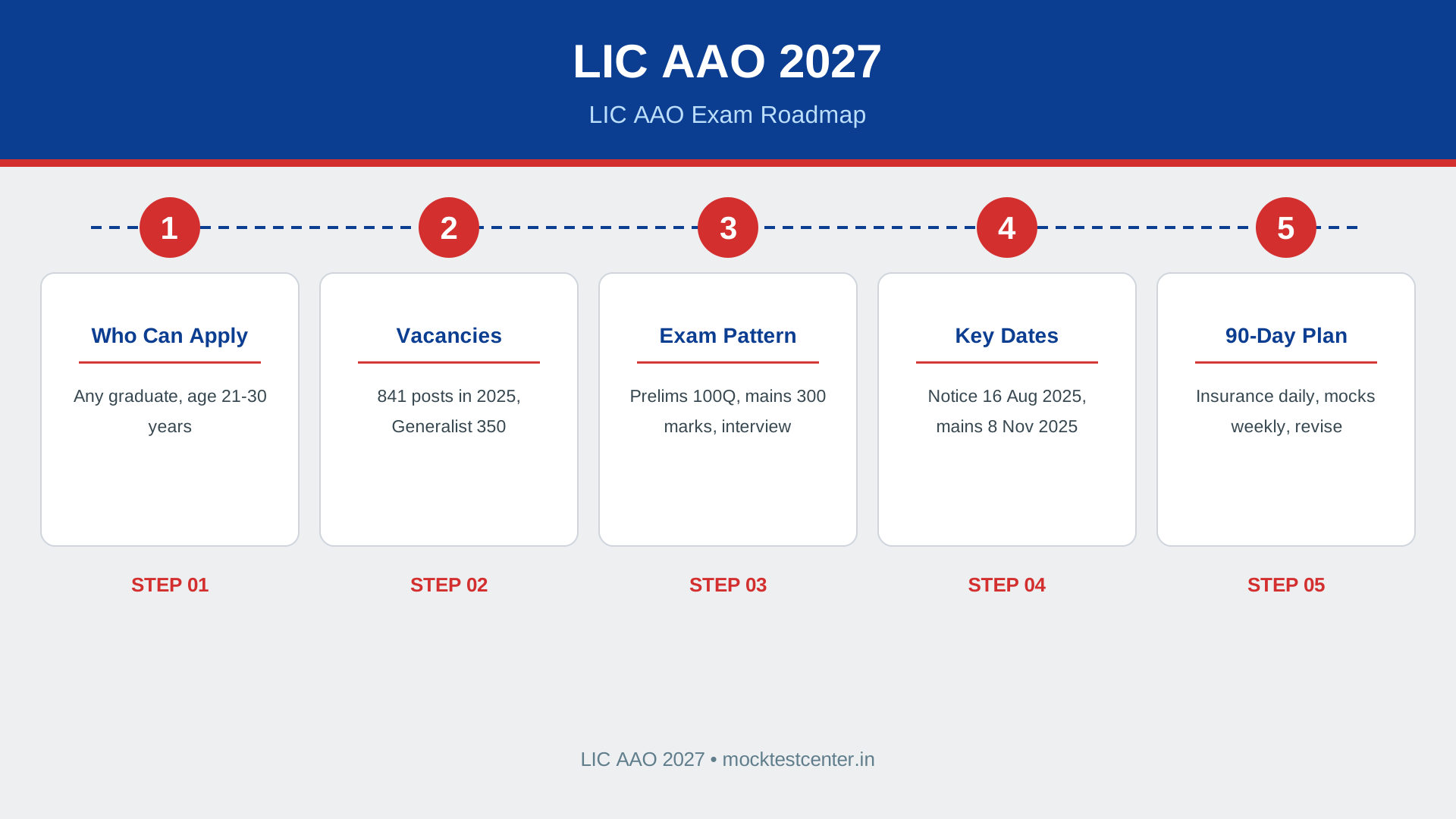
LIC AAO 2027 is the next recruitment for Assistant Administrative Officer posts in the Life Insurance Corporation of India. No notification for the next cycle has come out yet. The latest completed cycle is the 32nd batch from 2025, which offered 841 posts: 350 Generalist, 410 Specialist and 81 Assistant Engineer.
That cycle ran from a notification on 16 August 2025 to prelims on 3 October 2025, mains on 8 November 2025 and a final list on 14 May 2026. This page uses that cycle as the guide for 2027, because the pattern, the eligibility and the pay have stayed the same across batches. Four stages decide the result: prelims, mains, interview and a medical test.
Two facts make this exam different from every bank exam. First, the Generalist papers carry no negative marking at all. A wrong answer costs nothing, so the strategy for the paper is different from any IBPS or SBI paper. Second, the starting basic pay is 88,635 rupees a month, which is higher than the basic pay of most bank officer posts.
Those two facts pull lakhs of graduates toward 350 Generalist posts, and the cut offs show it. The 2025 final cut off for the Generalist post was 294 out of 360 for the general category. That is a high bar, and this page shows what it takes to clear it.
What the LIC AAO 2027 exam is
The Life Insurance Corporation of India, or LIC, is the largest life insurer in the country. It started in 1956, and its offices sit in every district. The Assistant Administrative Officer, or AAO, is a Class I officer post in LIC.
An AAO handles administration, underwriting support, claims work, accounts, marketing support and office management in a branch or a divisional office. It is an officer post from day one, with officer pay, officer work and a clear promotion path.
LIC recruits AAOs in two broad groups. The Generalist post takes any graduate, and it has the most posts. The Specialist posts take professionals: Chartered Accountants, Company Secretaries, Actuaries, Insurance Specialists and Legal professionals. The Assistant Engineer posts take civil and electrical engineers.
LIC notified the Generalist post in one notification and the Specialist and Assistant Engineer posts in a companion notification on the same date, and a candidate could apply for only one post across the two. That rule matters. You must pick one post before you apply, and you cannot hedge across two.
The selection has four stages. First comes an online prelims exam. It only shortlists candidates for the mains exam. Then comes an online mains exam, with an objective paper and a descriptive English paper.
Then comes an interview of 60 marks. Then comes a pre-recruitment medical examination. The final merit list uses the mains objective marks and the interview marks. Check every date and rule on the LIC website careers page before you apply, because the notification is the only final source.
LIC AAO 2027: where the cycle stands now
No notification for the next cycle has come out yet. As of late 2026, the LIC careers page still shows only the 2025 recruitment, the 32nd batch. LIC has announced no date for the next notification, and the 2026 cycle, if it comes, has no published schedule.
Anyone who gives you 2027 dates today is guessing. The honest position is simple. The last cycle is the best guide, and the next notification will most likely follow the same shape, because LIC has used the same four stage pattern for years.
Here is the 2025 cycle timeline, so you can see the pace of a real cycle. LIC released the notification on 16 August 2025. Applications ran from 16 August to 8 September 2025. The prelims exam took place on 3 October 2025, with papers also held on 7 October 2025 as reported by some sources.
The mains exam took place on 8 November 2025. The final list after the medical examination came on 14 May 2026. The whole cycle took nine months from notification to final list, which is slower than most bank exams. Plan for a long cycle, and do not expect a quick result.
Compare that with the previous batch to see the gap. The 31st batch came in 2023, with 300 Generalist posts including 23 backlog posts. The 32nd batch came in 2025, with 350 Generalist posts. LIC holds the AAO exam when it needs officers, not on a fixed yearly calendar.
The gap between batches can stretch to two years. A candidate who waits for the notification before starting preparation loses the months that matter. The syllabus is stable, the pattern is stable, and the books are the same. Start now, and the notification will only fix your exam date.
Vacancies: 841 posts and the streams
The 2025 drive offered 841 posts in all. The Generalist post had 350 posts: 142 for UR, 91 for OBC, 51 for SC, 28 for ST and 38 for EWS, including 9 backlog posts. The Specialist posts had 410 posts: Insurance Specialist 310, Chartered Accountant 30, Actuarial 30, Legal 30 and Company Secretary 10.
The Assistant Engineer posts had 81 posts: Civil 50 and Electrical 31. LIC calls the numbers provisional, and the notification states that the numbers can change with the actual requirement.
Three quarters of the AAO posts sit in two places. The Generalist post has 350 posts, and the Insurance Specialist post has 310 posts. Together they account for 660 of the 760 AAO posts. The other specialist posts are small: 30, 30, 30 and 10.
A Chartered Accountant who applies for the CA post competes for 30 seats across the country. A graduate who applies for the Generalist post competes for 350 seats. The odds differ sharply, and the choice of post decides them.
| Post in the 2025 drive | Vacancies |
|---|---|
| AAO Generalist | 350 |
| AAO Insurance Specialist | 310 |
| AAO Chartered Accountant | 30 |
| AAO Actuarial | 30 |
| AAO Legal | 30 |
| AAO Company Secretary | 10 |
| Assistant Engineer Civil | 50 |
| Assistant Engineer Electrical | 31 |
| Total | 841 |
The Insurance Specialist post deserves a line of its own, because it is the largest specialist post and the least understood. It needs a Bachelor degree plus the Fellowship of the Insurance Institute of India in Life, plus at least five years of experience in life insurance companies. That is a narrow gate, and it keeps the applicant pool small. A candidate with five years in life insurance and the Fellowship should look here first, because 310 seats with a small pool is the friendliest ratio in the whole drive.
How many candidates reach the mains exam? LIC shortlists about twenty candidates per vacancy for the mains stage in the Generalist post, as reported. That means roughly 7,000 candidates from lakhs of applicants move past prelims.
The exact shortlist comes out with the prelims result. Your job is to land inside it, and the prelims paper is the only gate.
Who can apply for LIC AAO 2027: the Generalist post
The Generalist post takes any graduate. You need a Bachelor degree in any discipline from a recognised Indian university, and the result must be declared on or before the reference date, which was 1 August 2025 in the last cycle. LIC states that no equivalent qualification will be accepted.
Final year students whose result comes after the reference date cannot apply. That rule is strict, and it has ended the run of candidates who applied on the hope that their result would come in time.
The age limit for the Generalist post is 21 to 30 years as on 1 August 2025 in the last cycle. A candidate must have been born on or after 2 August 1995 and on or before 1 August 2004 to meet the limit, before relaxation. Relaxation follows government rules: 5 years for SC and ST, 3 years for OBC, 10 to 15 years for PwBD, 5 to 10 years for ex-servicemen, and a further 5 years for confirmed LIC employees. Read the relaxation table in the notification itself, because the exact years differ by group.
There is no minimum percentage in graduation for the Generalist post. A pass degree is enough. That is different from RBI Assistant, which needs 50 percent, and it opens the exam to every graduate.
The RBI Assistant 2027 page gives the full picture of that exam, including its 50 percent rule. If your graduation marks are low, LIC AAO Generalist is the friendlier option.
- Education: Bachelor degree in any discipline, result declared on or before the reference date
- Age: 21 to 30 years as on 1 August of the notification year
- Minimum marks: none for the Generalist post
- Choice: apply for one post only across both notifications
- Attempts: no fixed limit within the age limit
There is no limit on attempts beyond the age limit. A candidate can apply in every batch while the age fits. That sounds generous, and it is, but it also means the competition includes candidates on their second and third attempts who know the paper well. Your first attempt needs the same depth they built over years.
Who can apply: the Specialist streams
The Specialist posts need professional qualifications on top of a degree, and each stream has its own list. Read the list for your stream with care, because a missing paper or a missing year of experience will fail the eligibility check at the document stage, after you have cleared the written papers.
- AAO Chartered Accountant: Bachelor degree, CA Final passed, and Associate membership of ICAI. Age 21 to 32 years.
- AAO Company Secretary: Bachelor degree and membership of ICSI. Age 21 to 30 years.
- AAO Actuarial: Bachelor degree and at least 6 papers of the Institute of Actuaries of India or the Institute and Faculty of Actuaries, UK. Age 21 to 30 years.
- AAO Insurance Specialist: Bachelor degree, Fellowship of the Insurance Institute of India in Life, and at least 5 years of experience in life insurance companies. Age 21 to 30 years.
- AAO Legal: Law degree with 50 percent marks, 45 percent for SC, ST and PwBD, enrolled as an Advocate, with 2 years of experience. Age 21 to 32 years.
- Assistant Engineer Civil and Electrical: BTech in Civil or Electrical engineering. Age 21 to 30 years.
The age limit is 21 to 32 years for the CA and Legal posts, and 21 to 30 years for the other specialist posts, as on 1 August 2025 in the last cycle. The two year extension for CA and Legal reflects the extra years those qualifications take. A law graduate who finished the degree at 24 and practiced for two years can still apply at 30, 31 or 32. That window matters, and it is the reason the Legal post draws experienced candidates.
The Specialist and Assistant Engineer posts have a different mains paper from the Generalist post, and a different marking rule. The Generalist papers carry no negative marking. The Specialist, Assistant Engineer and Legal prelims papers carry a negative marking of one fourth of a mark per wrong answer. That single difference changes the attempt strategy completely, and candidates who prepare for the Generalist paper and then sit a Specialist paper on the same syllabus will guess their way into lost marks.
LIC AAO 2027 exam pattern: prelims first
The LIC AAO exam pattern has two written stages, an interview and a medical test. The prelims exam is online and objective. For the Generalist post it has 100 questions for 70 marks, and the time is 60 minutes. Each section has its own time of 20 minutes, and you cannot carry unused time from one section to another.
The Generalist prelims paper carries no negative marking. The prelims exam only shortlists candidates for the mains exam. Its marks stay out of the final merit list. That single fact should shape your whole approach to prelims: you need enough marks to clear the cut off, and every extra hour after that belongs to mains preparation. The LIC AAO exam pattern below follows the 2025 cycle paper by paper, so what you read here is the real shape.
The Generalist prelims paper has three sections. Reasoning Ability has 35 questions for 35 marks in 20 minutes. Quantitative Aptitude has 35 questions for 35 marks in 20 minutes. English Language has 30 questions in 20 minutes, and it is qualifying only, so its marks do not add to the 70 ranked marks.
The total is 100 questions in 60 minutes, with 70 marks that count for ranking. Each section has its own minimum marks: 18 for Reasoning, 18 for Quantitative Aptitude and 10 for English, with lower minima of 16, 16 and 9 for SC, ST and PwBD candidates. A candidate must clear the sectional minima and the overall cut off.
| Generalist prelims section | Questions | Marks | Time |
|---|---|---|---|
| Reasoning Ability | 35 | 35 | 20 minutes |
| Quantitative Aptitude | 35 | 35 | 20 minutes |
| English Language, qualifying | 30 | 0 for ranking | 20 minutes |
| Total | 100 | 70 ranked | 60 minutes |
English is qualifying in prelims, but it still has a sectional minimum, and candidates fail it every year. Thirty questions in 20 minutes means 40 seconds per question, and the reading comprehension passage eats half the time. Practice English under the clock from the first week, not in the last month. A failed English section ends the run even with high scores in Reasoning and Quant.
Reasoning and Quant carry 35 marks each, so they decide most of the prelims score. Reasoning has puzzles, seating, syllogisms, coding, blood relations and data sufficiency. Quant has arithmetic, data interpretation, number series, quadratic equations and simplification.
Data interpretation sets carry the most marks per minute when you know the calculation shortcuts, and they punish a candidate who calculates every figure by hand. Learn the shortcuts first, then the theory.
The Specialist, Assistant Engineer and Legal prelims papers differ. They have 100 questions in 1 hour with a negative marking of one fourth of a mark per wrong answer. The Legal prelims paper swaps Quantitative Aptitude for General Awareness, so it has Reasoning, English and General Awareness. The exact mark split for the Legal paper was not confirmed from two sources, so check the notification for the section marks before you plan around them.
How many candidates move from prelims to mains? LIC shortlists about twenty candidates per vacancy for the mains stage in the Generalist post, as reported. That means roughly 7,000 candidates from lakhs of applicants move past prelims.
The exact shortlist comes out with the prelims result. Your job is to land inside it, not to top it.
Mains: 300 marks decide the result
The mains exam is where the LIC AAO 2027 selection is won. For the Generalist post, the mains exam has an objective paper and a descriptive English paper. The objective paper has 120 questions for 300 marks in 120 minutes.
The descriptive English paper has 25 marks and 30 minutes, and it is qualifying only, so its marks do not add to the 300. The Generalist mains paper carries no negative marking. That is the whole mains exam for the Generalist post, and those 300 marks carry most of the final result. The LIC AAO exam pattern puts the whole weight on this objective paper.
The objective paper has four sections. Reasoning Ability has 30 questions for 90 marks in 40 minutes. General Knowledge and Current Affairs has 30 questions for 60 marks in 20 minutes. Data Analysis and Interpretation has 30 questions for 90 marks in 40 minutes.
Insurance and Financial Market Awareness has 30 questions for 60 marks in 20 minutes. The total is 120 questions for 300 marks in 120 minutes. Reasoning and Data Analysis carry 90 marks each, so they decide most of the mains score.
| Generalist mains section | Questions | Marks | Time |
|---|---|---|---|
| Reasoning Ability | 30 | 90 | 40 minutes |
| General Knowledge and Current Affairs | 30 | 60 | 20 minutes |
| Data Analysis and Interpretation | 30 | 90 | 40 minutes |
| Insurance and Financial Market Awareness | 30 | 60 | 20 minutes |
| Total objective | 120 | 300 | 120 minutes |
| English Descriptive, qualifying | Typed | 25 | 30 minutes |
Two sections make this mains paper different from every bank mains paper. Data Analysis and Interpretation carries 90 marks, with questions on data tables, charts, caselets and sufficiency. Insurance and Financial Market Awareness carries 60 marks, with questions on insurance terms, LIC products, IRDAI, financial markets and government schemes.
Together they carry 150 marks out of 300, and most bank exam candidates have never studied either subject. That is the gap to exploit. Give Insurance Awareness a fixed slot every day from the start, and it will add marks that others leave on the table.
The Specialist and Assistant Engineer mains papers differ. Their objective paper has 150 marks: Reasoning 30, General Awareness 20 and Professional Knowledge 100. Then comes a Professional Knowledge descriptive paper of 150 marks, and an English descriptive paper of 25 marks, qualifying.
The Specialist mains paper carries a negative marking of one fourth of a mark per wrong answer in the objective part. The descriptive professional knowledge paper tests depth in your field, and no amount of objective practice can replace it.
The descriptive English paper is qualifying in both cases, but it still has a minimum, and candidates fail it every year. It is typed, not handwritten, and it tests essay and letter writing in 30 minutes. Practice typing essays under the clock from the first month. A candidate who types slowly will run out of time, and a failed qualifying paper ends the run even with a high objective score.
The no negative marking rule in the Generalist papers deserves a line of its own. A wrong answer costs nothing, so you should attempt every question. Guess on the questions you do not know, because a guess has a one in four or one in five chance of adding marks, and a blank adds nothing. That rule is the opposite of the IBPS rule, where guessing costs marks.
The IBPS PO 2027 paper punishes guessing with a 0.25 cut per wrong answer. The LIC Generalist paper rewards it. Know which paper you are sitting, and play by its rule.
Interview and the medical test
Candidates who clear the mains exam are called for an interview. The interview carries 60 marks. The minimum qualifying marks are 30 for UR, OBC and EWS candidates, and 27 for SC, ST and PwBD candidates.
About three times the number of vacancies are called for the interview, as reported. A candidate who scores below the minimum cannot be selected, whatever the mains score.
The interview panel tests your knowledge of insurance, your awareness of LIC and current affairs, and your fitness for an officer role. Expect questions on why you picked LIC, on insurance terms, on LIC products, on current financial news, and on the work of an AAO. A Generalist candidate should expect questions on insurance basics.
A Specialist candidate should expect questions on the professional subject. The panel can tell in two minutes whether you studied the subject or only the exam.
The final merit list uses the mains objective marks and the interview marks: 300 plus 60, for a total of 360 marks. Prelims marks play no part, and the qualifying English descriptive marks play no part. A candidate with 240 out of 300 in mains and 45 out of 60 in the interview will rank above a candidate with 230 in mains and 55 in the interview, because the mains marks carry five times the weight of the interview. That is why the mains paper deserves your best months.
After the interview comes the pre-recruitment medical examination. LIC checks medical fitness before the appointment, and the final list comes after the medical test. Keep your degree certificates, caste certificate, age proof and identity proof ready from the start, because a document problem at the last stage can undo a year of work.
Fee, salary and the job after selection
The application fee for LIC AAO is 700 rupees for general, OBC and EWS candidates, and 85 rupees for SC, ST and PwBD candidates. You pay online only. The fee does not come back once paid. Check your post, your category and your eligibility before you pay, because a wrong post choice cannot be fixed after the form is submitted.
The salary is the part candidates ask about first, so here it is in plain figures. An LIC AAO starts on a basic pay of 88,635 rupees per month, as per the 2025 notification. Dearness allowance, house rent allowance, transport allowance and other allowances sit on top of the basic pay. The gross salary is higher than the basic pay by a wide margin, and it moves with the city of posting.
LIC also gives benefits like gratuity, provident fund, pension as per rules, medical benefits and leave travel concession. The basic pay of 88,635 rupees is the fixed fact. Treat any gross figure you read online as a guide, not a promise.
Compare that with the bank officer posts before you decide. An IBPS Specialist Officer starts on a basic pay of 48,480 rupees, and the IBPS SO 2027 page gives the full picture of that exam. A LIC AAO starts at nearly double that basic pay. The gap is real, and it is the reason the AAO cut offs run high.
Pay is one factor. The work, the posting and the growth path are the others. Insurance work differs from bank work, and a candidate should like the field, not only the pay.
After selection, an AAO joins as a Class I officer in a branch or divisional office. LIC gives training first, then a posting. Promotion follows through seniority and internal exams, and AAOs move into senior officer roles over time.
The post is a starting point, not a ceiling. Candidates who join young and clear the internal exams grow fast inside the corporation.
Syllabus: what to study, section by section
The LIC AAO 2027 syllabus has two parts: the common prelims subjects and the mains subjects that only LIC tests. The prelims subjects are the same as other bank exams, so standard books and mock tests cover them well. The mains subjects need a plan of their own, and Insurance Awareness is the one that needs daily work.
Reasoning covers puzzles, seating arrangement, syllogism, coding decoding, blood relations, direction sense, inequalities and data sufficiency. Puzzles and seating carry the most questions, and they need speed. Solve one puzzle set a day under a timer. Time yourself from the first week, because untimed practice builds knowledge without speed, and this exam pays for speed.
Quantitative Aptitude covers simplification, number series, quadratic equations, arithmetic, data interpretation and data sufficiency. Arithmetic covers percentage, ratio, profit and loss, time and work, time speed and distance, simple and compound interest, averages and mixtures. Data interpretation sets carry the most marks, and they reward fast calculation. Learn squares, cubes and percentage conversions by heart, because the paper gives you 20 minutes for 35 questions in prelims, with no calculator.
English Language covers reading comprehension, cloze test, error spotting, sentence improvement, para jumbles, fill in the blanks and vocabulary. The passages are long and the questions test inference more than memory. Read one English editorial every day and solve ten questions a day from a standard book.
That daily habit beats a weekend crash course. English is qualifying in prelims and in the descriptive paper, but it still has minima, so give it daily time.
General Knowledge and Current Affairs covers banking, insurance, finance, government schemes, static facts and current affairs of the last six months. Read a monthly capsule and revise it twice. The section is wide, and revision matters more than first reading.
A candidate who reads six months of news in the last month cannot retain it. A candidate who reads a little every day can.
Data Analysis and Interpretation covers data tables, bar charts, line graphs, pie charts, caselets, data sufficiency and quantity comparison. It carries 90 marks in mains, so it deserves the same time as Reasoning. Solve one data set a day under a timer, and learn the calculation shortcuts first. The section rewards a candidate who calculates fast, not one who calculates perfectly.
Insurance and Financial Market Awareness covers insurance terms, types of policies, LIC products and schemes, IRDAI and its functions, financial markets, SEBI, RBI functions, government insurance schemes and recent insurance news. It carries 60 marks in mains, and most bank exam candidates have never studied it. Start with a standard insurance awareness book, then read LIC product pages and IRDAI releases. The section is narrow, and a month of daily reading covers it well.
Candidates often ask whether the IBPS RRB PO 2027 preparation covers the LIC AAO prelims. It covers the common subjects, and the RRB PO paper is close in level. Use RRB mocks for speed and LIC mocks for the real shape.
The IBPS RRB Clerk 2027 paper is a useful early mock, though it is easier than the AAO paper. Move to AAO level mocks at least two months before the exam.
Cut offs from the 2025 cycle
LIC publishes cut offs with the results, and the 2025 cycle cut offs are on record. This section gives the verified figures for the Generalist post, because they show the bar you must clear. The prelims cut off for the Generalist post was 58 out of 70 for the UR category.
The mains cut off was 232 out of 300 for the UR category. The final cut off, on mains plus interview out of 360, was 294 for UR, 288 for EWS, 285 for OBC, 271 for SC and 260 for ST.
| Category | Prelims out of 70 | Mains out of 300 | Final out of 360 |
|---|---|---|---|
| UR | 58 | 232 | 294 |
| EWS | Not stated here | Not stated here | 288 |
| OBC | Not stated here | Not stated here | 285 |
| SC | Not stated here | Not stated here | 271 |
| ST | Not stated here | Not stated here | 260 |
Read those numbers with care. A prelims score of 58 out of 70 means 83 percent, and a mains score of 232 out of 300 means 77 percent. The final cut off of 294 out of 360 means 82 percent.
Those are high bars, and they come from two facts: the Generalist papers carry no negative marking, so scores run high, and 350 posts draw lakhs of applicants. A candidate who aims for the cut off will miss it. Aim ten marks above it in mocks, and the real exam will have room for a bad day.
The LIC AAO 2027 cut offs will follow the same shape. Use the cut offs of your own category only. A UR cut off says nothing about the ST cut off, because the applicant pools differ. Compare your mock scores with the cut off of your own category and your own post.
That is the comparison that tells you whether you are ready. The Specialist cut offs differ by stream, and they were not available in verified form at the time of writing, so this page does not print them.
A 90 day plan that fits the real pattern
Ninety days is enough to prepare for LIC AAO 2027 if you use the days in the right ratio. The ratio is the plan. Spend about a third of your study time on Reasoning and Quant, a quarter on Data Analysis and Insurance Awareness, a quarter on English and General Knowledge, and the rest on mocks and revision. Insurance Awareness and Data Analysis together carry 150 marks in mains, so they deserve a real slot every day, not a weekend slot. The LIC AAO exam pattern rewards daily Insurance Awareness work more than last minute reading.
Days 1 to 30 build the base. Finish the standard books for Reasoning, Quant and English once, chapter by chapter, and make short notes. Start an insurance awareness book and finish half of it. Start a notebook for current affairs and add five lines a day.
Take one mock test at the end of the month to find your weak sections. Do not take a mock every day in the first month. You need knowledge first, and mocks measure knowledge you do not have yet.
Days 31 to 60 build speed. Solve previous year papers for LIC AAO and for IBPS Clerk 2027. Take one full mock every week and review every wrong answer the same day. Finish the insurance awareness book.
Revise your current affairs notebook twice. Start typing one essay a week for the descriptive paper. The SBI Clerk 2027 paper is a useful extra mock for speed, because its prelims pattern is close to the AAO paper.
Days 61 to 90 are for mocks and revision. Take two mocks a week. Revise your notes a third time. Solve only your weak topics in Quant and Reasoning, and stop learning new theory.
In the last ten days, revise your notes, your error log, your insurance capsules and your current affairs notebook. Sleep well the night before the exam. A tired candidate loses more marks to slow reading than to hard questions.
Specialist candidates should add one more habit to this plan. Solve professional knowledge questions for your stream every day from day one, and write one descriptive answer a week. The descriptive professional knowledge paper cannot be prepared by reading alone, and a candidate who writes for the first time in the exam hall will run out of time.
Mistakes that cost candidates a year
The first mistake is applying for the wrong post. A candidate with a CA qualification who applies for the Generalist post wastes a professional edge, and a graduate with no professional qualification who applies for a Specialist post fails the eligibility check. Your qualification decides your post. Check the list before you apply, and apply only where your qualification fits.
The second mistake is treating prelims as the main exam. Candidates spend three months on Reasoning and Quant and two weeks on mains subjects, then wonder why a 300 mark paper decided their fate. Flip the ratio.
Mains is the main exam. Prelims is a gate. Insurance Awareness and Data Analysis deserve daily time from the first week.
The third mistake is ignoring English. English is qualifying in prelims and in the descriptive paper, but it still has minima, and candidates fail it every year. Thirty minutes of English a day from the start is enough. Zero minutes is not.
The fourth mistake is skipping mock tests, or taking mocks without review. A mock you do not review is entertainment. Review every wrong answer, write the reason in an error log, and revise the log every week. The log is where your score actually grows.
The fifth mistake is applying for only one exam. The banking and insurance calendar has many exams with overlapping syllabi, and a candidate who prepares for LIC AAO 2027 can also sit the SBI PO 2027 exam and the NIACL AO 2027 exam with little extra study. The LIC ADO 2027 exam also shares large parts of the syllabus. More exams mean more chances in the same year, and the same preparation serves all of them.
What to do this week
Start with three actions. First, open the 2025 notification on the LIC careers page and read the eligibility list for your post word by word. Note the reference date, the age limit and the qualification list. Second, buy or borrow the standard books for Reasoning, Quant, English, Data Analysis and Insurance Awareness, and read the first chapter of each.
Third, take one timed prelims mock to see where you stand in Reasoning, Quant and English. Write the three section scores in a notebook. That notebook is your baseline, and every later mock should beat it.
Then set a fixed daily routine and keep it for ninety days. One hour for Reasoning and Quant, thirty minutes for English, thirty minutes for Insurance Awareness and Data Analysis, and fifteen minutes for current affairs. That is under three hours a day, and it is enough if you keep it every day.
The LIC AAO 2027 notification will come when it comes. Your preparation should be half done by then.







