
About NICL AO 2027 Exam Series
📖 Table of Contents
- What an AO does at National Insurance
- NICL AO 2027 notification status
- 266 posts, stream by stream
- Who can apply: degree and marks
- Age rules
- Fee and how to apply
- Prelims: 100 questions in 60 minutes
- Mains: the 250 mark paper
- Descriptive test and interview
- What you earn and what you sign
- Syllabus, subject by subject
- A 90 day plan that fits around a job
- How NICL AO compares with the other insurance exams
- Five checks before you fill the form
NICL AO 2027
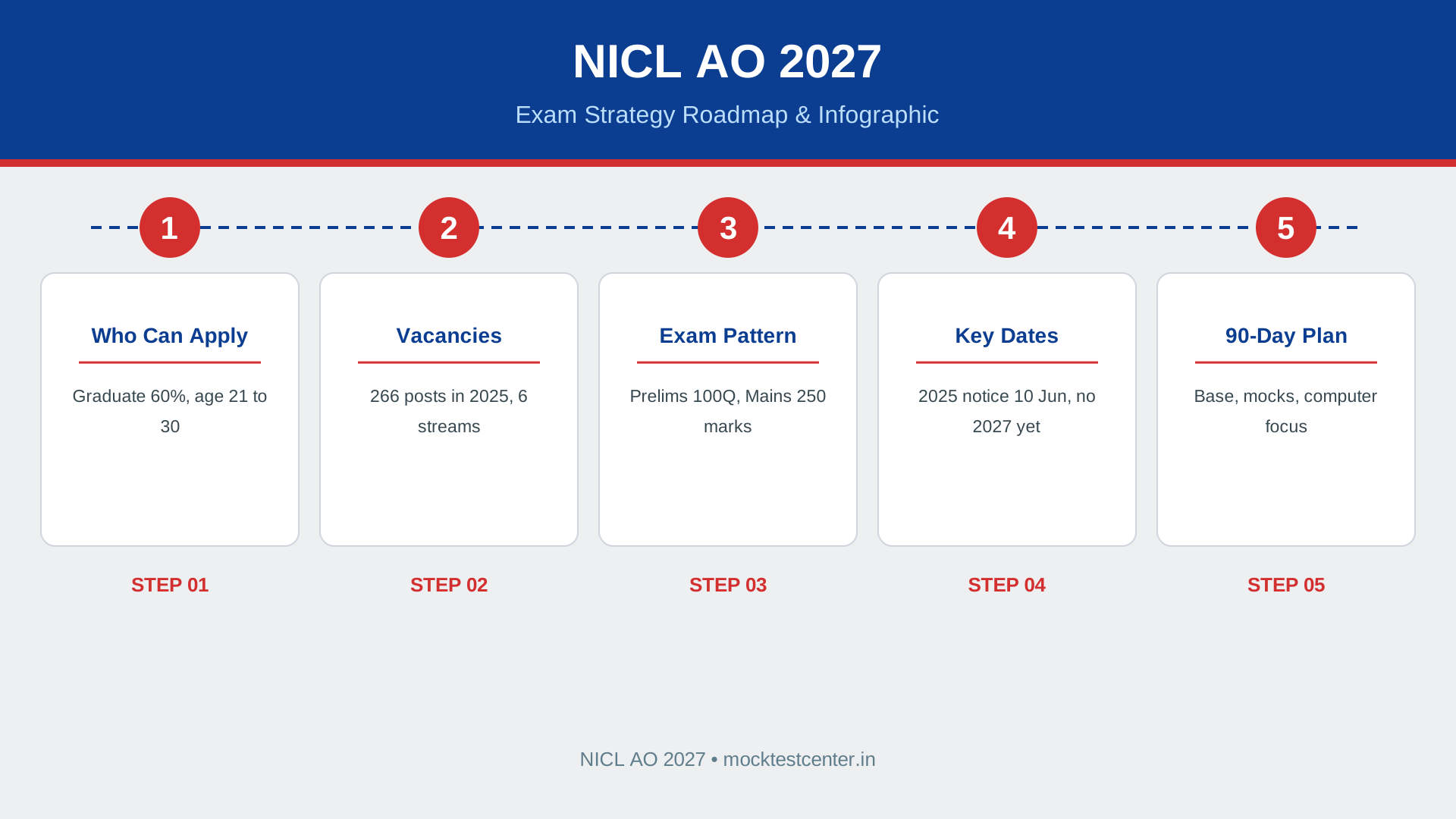
NICL AO 2027 has no notification yet. The National Insurance Company Limited has not announced dates, vacancies or an application link for the next Administrative Officer cycle. The last cycle ran in 2025, and this guide uses that notification as the base.
Every number below comes from the 2025 cycle, and the guide marks each place where the next notice can change it. If you plan to apply, learn the 2025 pattern now and watch the official site for the new notice.
An Administrative Officer at National Insurance is a Scale I officer in a general insurance company. You underwrite policies, settle claims, manage a branch team and handle the office work that keeps policies running. It is a desk job with field visits, not a sales job.
The pay starts at a basic of 50,925 rupees a month, and the company carries the line Trusted Since 1906. That mix of a desk, a good salary and a public sector tag is why this exam draws lakhs of graduates when it opens.
What an AO does at National Insurance
National Insurance sells motor and health policies. It also sells fire and marine policies, along with other general insurance lines. An AO sits in the middle of that business.
You read a proposal, judge the risk, fix the premium and issue the policy. That is underwriting. When a claim comes in, you check the papers, verify the loss and approve the payment.
That is claims. Both jobs need judgement, and both leave a paper trail that auditors read later.
Generalist AOs do all of it. They rotate between underwriting and claims, plus branch administration. Specialist AOs do one thing in depth.
A legal officer handles cases in court and reads policy wordings for legal risk. An IT officer keeps the systems running. A finance officer handles the money side.
An automobile engineer inspects vehicles and assesses motor claims. A doctor handles health claims and medical opinions.
The job grows with time. A Scale I officer can rise to Scale II and beyond through internal promotion exams and interviews. National Insurance has offices across India, so transfers are part of the career.
The work stays office based through most of it, with site visits for specialists. If you want a stable office career in insurance, this is the post to aim for.
National Insurance is a public sector general insurer under the Ministry of Finance, owned by the Government of India. It was incorporated in 1906, nationalised in 1972, and spun off as a distinct company in 2002. Its head office sits in New Town, Kolkata.
That long history matters for your career. An old company has more branches, more promotion posts and more specialist roles to move into.
It also has a large workforce, so seniority moves slowly. Both facts are true at once, and both shape the career.
NICL AO 2027 notification status
As of November 2026, National Insurance has issued no AO notification for 2026 or 2027. The official site at nationalinsurance.nic.co.in carries the 2025 AO cycle, which ran its mains exam on 31 August 2025. No fresh AO advertisement has appeared since. Anyone who gives you a 2027 date today is guessing.
NICL does not run AO recruitment every year. The 2025 cycle came after a gap, and the company notifies only when it has vacancies. That means no one can give you a 2027 date today. The honest position is simple: the exam will come, the pattern will look like 2025, and the date will appear on the official site first.
Check that site once a week. In 2025 the application window ran from 12 June to 3 July, only 22 days. A short window punishes latecomers.
Keep your documents ready now. Keep your degree certificate with marks and your caste certificate if it applies.
Keep a photo and a signature scan ready too. The notice will fix the exact sizes, but a candidate who has them ready files on day one and spends the window preparing, not scanning papers.
Use the wait well. The prelims pattern has stayed the same across cycles. You get 100 questions in 60 minutes, split across English and Reasoning and Quant.
The mains has kept its 250 mark objective paper and its 30 mark descriptive test. Learn those papers now. When the notice lands, you will need only the dates and the vacancy count, not a new syllabus.
266 posts, stream by stream
The 2025 notification offered 266 Administrative Officer Scale I posts. Generalists took the largest share at 170. Specialists took 96.
The specialist split was Finance 21 and Automobile Engineers 21. Legal took 20. IT took 20.
Doctors (MBBS) took 14. Add those five numbers and you get 96. Add 96 to 170 and you get 266.
Each stream has its own degree rule, and you can apply to only one stream. A generalist needs a graduation or post graduation degree in any discipline with 60 percent marks, or 55 percent for SC and ST candidates. A finance officer needs B.Com or M.Com, or CA or ICWA.
A legal officer needs a graduation or post graduation in law. An IT officer needs BE or BTech or MCA in computer science or IT.
An automobile engineer needs BE or BTech in automobile or mechanical engineering, with a diploma in automobile engineering in one reading of the notice. A doctor needs MBBS or MD or MS with valid registration from the National Medical Commission.
Read your stream rule twice before you apply. National Insurance checks the degree at document verification, and a wrong stream choice ends the selection even if you top the exam. If your degree fits two streams, pick the one with more posts and less competition.
Generalist had 170 posts in 2025 and drew the most applicants, but it also had the most seats. A small stream like Doctors with 14 posts draws few applicants, yet one wrong answer can push you out of the list.
Vacancies in NICL are provisional. The notice says so in plain words. The company can raise or lower the number before the final result, and it can keep some posts unfilled if enough candidates do not clear the interview.
So use the 2025 number to judge the scale of the exam, not to predict your rank. A 266 post cycle is a mid sized cycle, smaller than the 550 post NIACL cycle of the same year, and that difference shows in the cut offs, because fewer seats with a similar number of applicants pushes the cut off higher than most first timers expect.
Who can apply: degree and marks
The degree rule for generalists is plain. You need a graduation or post graduation degree in any discipline from a recognised university, with at least 60 percent marks. SC and ST candidates need 55 percent.
The marks are counted on the date fixed in the notice, and in 2025 that date was 1 May 2025. Your final year result must be declared by that date. Awaiting results do not count.
The 60 percent line matters more than it looks. Many graduates with a degree but 58 percent cannot apply for the generalist stream at all. If your marks fall short, check the specialist streams.
Most of them carry the same 60 percent rule, so they will not help. Know your percentage before you plan, because the percentage decides eligibility before the exam starts.
Specialist degrees need care too. A finance officer needs CA or ICWA, or MBA Finance, or B.Com or M.Com, with 60 percent marks. A legal officer needs LLB or LLM.
An IT officer needs BE or BTech in IT or computer science, or MCA. An automobile engineer needs BE or BTech in automobile or mechanical engineering.
A doctor needs MBBS with valid NMC registration. Read the exact wording in the notice, because one missing word in your degree title can change your eligibility.
Age rules
The age band for NICL AO in 2025 was 21 to 30 years as on 1 May 2025. The new notice will fix its own reference date, and your age will be counted on that date. Compute it before you pay the fee, because the fee does not come back.
Relaxations follow government rules. SC and ST candidates get five extra years, so their ceiling is 35. OBC candidates get three extra years, so their ceiling is 33.
PwBD candidates get ten extra years. Ex-servicemen get their service years added to the base. The notice carries the full table, and the table is final.
Age is the most common reason applications fail at verification. Candidates count their age on the wrong date, or they claim a relaxation that does not apply to their category. Check your birth date on your Class 10 certificate, not on your memory. That certificate is the proof National Insurance accepts.
Fee and how to apply
The 2025 fee was 1,000 rupees for General, OBC or EWS candidates, and 250 rupees for SC, ST or PwBD candidates. Both figures include GST. The fee covers the application and the intimation charges, and it is paid online only.
Keep the payment receipt until the final result. Keep it safe.
Applications run through the online portal linked from the official site. You register, fill the form, upload the photo and signature, pay the fee and submit. The form asks for your stream first, so decide the stream before you start.
You cannot change the stream after submission. The notice also fixes the photo and signature sizes, and the portal rejects uploads that do not match.
Apply early in the window. Portals slow down on the last day, and a failed payment on the last evening leaves no time to retry. In 2025 the window closed on 3 July, and the fee payment closed with it.
A form without a paid fee counts for nothing. National Insurance ignores drafts.
Prelims: 100 questions in 60 minutes
Phase I is the prelims, an objective online paper of 100 questions for 100 marks in 60 minutes. English Language carries 30 questions for 30 marks in 20 minutes. Reasoning Ability carries 35 questions for 35 marks in 20 minutes.
Quantitative Aptitude carries 35 questions for 35 marks in 20 minutes. Each section has its own timer, so you cannot move time between sections.
The prelims is qualifying only. Its marks play no part in the final merit list. It only decides who sits for the mains.
That changes how you should treat it. You need to clear the sectional cut offs and the overall cut off, and then you need to rank high enough to make the shortlist. After that, the prelims score is forgotten.
Do not chase a top prelims score. Chase a safe margin above the cut off, and save your best work for the mains.
Each wrong answer costs 0.25 marks in the prelims. That penalty shapes your attempt strategy. A guess with no basis loses marks across a full paper, while a question you can narrow to two options is worth the risk.
Practice with the penalty on, so your mock scores match the real paper. A mock without negative marking flatters you, and flattery fails in the exam hall.
Speed is the real test here. One hundred questions in 60 minutes gives you 36 seconds per question, and the sectional timers make it tighter. Reasoning puzzles eat time, and Quant data sets eat more.
Learn to skip fast. A question you cannot crack in 45 seconds is a question that steals marks from two easier questions later in the section.
Mark it and move on. Return only if time is left.
Mains: the 250 mark paper
Phase II is the mains, and it has two parts. The objective test carries 250 marks in 180 minutes. The descriptive test carries 30 marks in 30 minutes. Only candidates who clear the prelims sit for the mains, and only the mains and the interview decide the final list.
For generalists, the objective paper has five sections of 50 marks each. Reasoning carries 50 marks in 40 minutes. English Language carries 50 marks.
Quantitative Aptitude carries 50 marks. General Awareness carries 50 marks. Computer Knowledge carries 50 marks.
The five sections add to 250 marks and 180 minutes. The notice gives the Reasoning timing as 40 minutes, and the other section timings follow the same pattern in the full notification.
For specialists, the paper adds a sixth section, Professional Knowledge. The total stays at 250 marks in 180 minutes. Professional Knowledge tests your stream subject: law for legal officers, finance for finance officers, computers for IT officers, engineering for automobile engineers, medicine for doctors. This section is where specialists win or lose, because generalist practice does not cover it at all.
General Awareness is the section that rewards daily reading. It covers current affairs of the last six months. Insurance news and government schemes carry weight, as do RBI decisions and the budget.
It also covers static facts about India and the world. Fifty questions in a short time gives you little room to think, so you must answer from memory, not from working. A candidate who reads the news daily finishes this section fast and banks the time for Quant.
Computer Knowledge is the section that surprises generalists. It covers computer basics and hardware and software. It covers operating systems and MS Office.
It covers internet and networking and basic security. Fifty marks is a large block, and candidates who skip it give away a fifth of the paper. Study it like a subject.
Keep notes and revise them. The questions are direct, and direct questions reward a candidate who has read the chapter once.
Quant in the mains runs deeper than in the prelims. Data interpretation sets grow longer, and the arithmetic questions need more steps. Reasoning in the mains adds complex puzzles and caselets.
English in the mains adds comprehension passages and error detection at a higher level. The step up from prelims to mains is real, and candidates who prepare only for the prelims feel it in the first ten minutes of the mains paper.
Descriptive test and interview
The descriptive test runs just after the objective paper in the same sitting. It carries 30 marks in 30 minutes. You write an essay and a precis and a comprehension passage.
The topics come from current affairs and insurance, plus everyday office subjects. An essay on digital insurance or financial inclusion is a typical topic.
Thirty minutes for three tasks is tight. Practice writing by hand on paper, timed, at least twice a week in the last month. The real test is typed on a computer, so practise typing too.
The examiners read for structure and clarity, not for fancy words. A precis that keeps the main points in plain sentences scores more than a precis with fine words and a broken structure.
The interview follows the mains for shortlisted candidates. The panel asks about your degree and your stream. They ask about your hometown and why you want to join National Insurance.
Specialists get subject questions. A legal officer may be asked about a recent court ruling on insurance. A doctor may be asked about a claim dispute.
A generalist may be asked about the difference between life and general insurance. Prepare your own subject well, because the panel will test it with questions that grow harder with each answer, and a candidate who knows the subject can turn the interview into the strongest part of the selection.
The final merit combines the mains marks and the interview marks. One widely cited reading of the notification puts the weight at 80 percent for the mains exam and 20 percent for the interview, while another source reports 75 to 25. The two figures conflict, so read the new notification for the exact ratio before you rely on either one. The prelims marks play no part, and the descriptive test is qualifying only.
What you earn and what you sign
The pay scale for an Administrative Officer Scale I starts at a basic pay of 50,925 rupees a month. The scale runs as 50,925, then fourteen increments of 2,500 to reach 85,925, then four increments of 2,710 to reach 96,765. That is a fourteen year climb to the top of the scale, and promotions move you to a higher scale before that.
Gross emoluments come to about 90,000 rupees a month in metropolitan centres, as most sources that read the 2025 notification put it. One source reports 80,000 to 85,000 rupees instead, so treat the figure as approximate. Doctors get an extra 25 percent non practising allowance on top of the basic pay. The exact take home depends on the city of posting, because house rent allowance changes with the city class.
Selected officers serve one year of probation. During probation, officers must pass the Licentiate examination of the Insurance Institute of India. That exam tests non life insurance basics, and the company gives study time for it. A candidate who clears the mains and the interview but ignores the Licentiate will feel the pressure in the probation year.
There is also a four year service bond. The bond exists to stop officers from taking the training and leaving at once. If you plan to stay, it costs you nothing. If you plan to use NICL as a stepping stone to another exam, count the bond in your plan and read its terms in the notice.
Syllabus, subject by subject
Reasoning covers puzzles and seating arrangement. It also tests syllogisms and blood relations. Coding and decoding and direction sense come next.
Series and inequalities close the list. The prelims gives you 35 questions in 20 minutes, so the easy questions pay first.
Learn to spot a question you can solve in 30 seconds and skip one that will eat two minutes. In the mains, reasoning grows into complex puzzles and caselets, and the questions need more steps.
Quant covers simplification and number series. Percentage and ratio come first. Average and profit and loss follow.
Time and work and time speed and distance test your speed with numbers. Simple and compound interest and mensuration close the list. Data interpretation carries the most weight in both stages.
Do one data interpretation set every day. Keep it timed. Track your accuracy apart from your speed.
English covers reading comprehension and cloze test. Error spotting and sentence improvement test your grammar. Fillers and vocabulary test your word knowledge.
The prelims English section is qualifying in effect, since the prelims itself is qualifying, but the mains English section carries 50 marks. Read one newspaper editorial a day. It builds vocabulary and reading speed at once, and it feeds your current affairs notes too.
General Awareness needs a split plan. Static GK covers Indian history and geography. Polity and economy come next.
Current affairs covers the last six months. Insurance news and government schemes carry weight, as do RBI decisions and the budget.
Keep a one page note per week of current affairs. At revision time you will read 24 pages, not 24 newspapers.
Computer Knowledge needs its own notebook. Study computer basics and hardware and software. Study operating systems and MS Office.
Study internet and networking and basic security. The questions are direct, so a single careful reading of a good book covers most of the section. Do not leave it to the last week, because fifty marks is too large to cram.
Professional Knowledge is the specialist section, and it needs its own books. A legal officer should revise the Indian Contract Act and the Insurance Act. A finance officer should revise accounting standards and financial management.
An IT officer should revise data structures and DBMS. Networking comes next. A doctor should revise common diseases and claim procedures.
An automobile engineer should revise vehicle systems and motor claim assessment. Start this section early, because no amount of general practice covers it.
A 90 day plan that fits around a job
Most NICL AO 2027 aspirants are graduates who already work or study, so the plan below assumes two to three hours a day, not eight. Days 1 to 30 build the base. Learn the reasoning types and the numerical formulas, and start the current affairs notebook. Do one prelims style mock each week, untimed at first, so you learn the question types without panic.
Days 31 to 60 add speed and mains depth. Move to timed mocks twice a week: one prelims paper and one mains paper. Start the descriptive practice now.
Write one essay and one precis a week, timed at 30 minutes for the pair. The professional knowledge section should be half done by day 60 for specialists.
Computer Knowledge should be half done by day 60 for generalists. If either is not, cut time from English practice and give it to the weak section, because those sections carry marks that no one else can score for you.
Days 61 to 90 are mock tests and revision only. Take a full mock every second day and spend the next day analysing it. For each wrong answer, write down why you got it wrong: concept gap, silly mistake, or time pressure.
Concept gaps need a chapter revisit. Silly mistakes need a checklist you read before each mock. Time pressure needs more timed sets, not more theory.
Keep Sundays for revision and rest. Rest counts. A tired brain learns nothing, and this exam rewards steady work over bursts.
Candidates who prepare for bank exams alongside NICL AO should note the overlap: Reasoning and quant are common to both, and so is English, so a SBI PO 2027 mock test or an IBPS PO 2027 mock test can double as prelims practice, while computer knowledge and professional knowledge stay NICL only. The SBI Clerk 2027 mock test page and the IBPS RRB PO 2027 mock test page are useful for the same reason.
How NICL AO compares with the other insurance exams
NICL AO is a general insurance officer job. That puts it next to NIACL AO, which is the same job in a different company, and next to LIC AAO and LIC ADO, which are life insurance jobs. The NIACL AO 2027 mock test page describes the closest cousin: same Scale I post, same basic pay of 50,925 rupees, but a 200 mark mains paper instead of 250, and a descriptive test of letter and essay instead of essay and precis and comprehension. If you apply to both, prepare for the heavier NICL mains and the NIACL mains will feel lighter.
LIC AAO is the life insurance cousin. The LIC AAO 2027 mock test page covers an office job with a different mains pattern and no descriptive test. LIC ADO is the odd one out: a field sales job with an apprentice stipend and incentive pay, described on the LIC ADO 2027 mock test page.
If you want a desk, pick NICL AO, NIACL AO or LIC AAO. If you want field work and incentive pay, pick ADO.
The exam shapes differ in small ways that matter. NICL AO has a computer knowledge section of 50 marks that NIACL AO does not have. NIACL AO has a general awareness section of 50 marks in the mains that NICL AO also has, but the weight differs.
ECGC PO, covered on the ECGC PO 2027 mock test page, is an export credit officer job with its own pattern. The IBPS SO 2027 mock test page and the RBI Assistant 2027 mock test page cover two more office based options. Apply to the ones whose job you would actually accept, not to every form you see.
Five checks before you fill the form
First, check your degree percentage against the 60 percent line, or 55 percent for SC and ST candidates. That line decides eligibility before the exam starts. Second, check your stream.
You apply to one stream only, and the degree rule for that stream is checked at verification. A wrong stream ends the selection.
Third, check the age reference date in the notice and compute your age on that date. Fourth, read the mains pattern for your stream: generalists take five sections of 50 marks, specialists add professional knowledge and the total stays at 250 marks. Your preparation changes with that one line.
Fifth, keep the official site as your only source for dates. The site is at nationalinsurance.nic.co.in, and National Insurance posts every AO notice there. Coaching sites will publish dates before the company does, and those dates will be guesses dressed as news.
When the NICL AO 2027 notice appears, download the PDF, read it end to end, and then fill the form. The PDF is the exam. Everything else, including this guide, is preparation for it.
Sources: NICL AO Recruitment 2025 notification, Advt 06/2025, via the National Insurance Company site at nationalinsurance.nic.co.in.







