About IB MTS 2027 Exam Series
📖 Table of Contents
- Read this first, because most websites mix up two exams
- What the job actually is
- Who can apply
- The 362 posts, SIB by SIB
- How selection works, stage by stage
- Tier I in full detail
- Tier II, the paper most websites get wrong
- Important dates of the 2025 cycle
- The fee, and why it is not Rs 100
- Pay and allowances
- Syllabus, subject by subject
- Cut offs, and what no one has published yet
- How to apply, step by step
- Mistakes that cost candidates a year
- A 90 day plan that fits a Class 10 student
- How mock tests fit this paper
- Sources
- A last word
IB MTS 2027
Read this first, because most websites mix up two exams
IB MTS 2027 is the Multi-Tasking Staff (General) exam of the Intelligence Bureau, under the Ministry of Home Affairs. IB means Intelligence Bureau. MTS means Multi-Tasking Staff. The post is a Group C, Non-Gazetted, Non-Ministerial post in the General Central Service, at Pay Level 1. You need only a Class 10 pass to apply. That single fact makes this exam one of the most searched 10th pass exams in India.
Now the warning that this whole page rests on. IB MTS and SSC MTS are two different exams. SSC MTS comes from the Staff Selection Commission. IB MTS comes from the Intelligence Bureau through the Ministry of Home Affairs. They share three letters, MTS, and almost nothing else. SSC MTS has its own notice, its own pattern with two sessions, and its own fee of Rs 100. IB MTS has a different notice, a different pattern with Tier I and Tier II, and a different fee. If you prepare for one while reading the pattern of the other, you will prepare for the wrong paper. This page covers IB MTS only. Where SSC MTS differs, this page says so in plain words.
The second fact you must hold on to is the date. No IB MTS 2027 notification exists as of 23 November 2026. The Ministry of Home Affairs has published no 2027 vacancy total, no 2027 form dates, and no 2027 exam date. Any website that gives you 2027 dates or a 2027 vacancy number today is guessing. This page builds on the live cycle, IB MTS Exam 2025, because that cycle has finished in full. Its short advertisement came on 18 November 2025. Its detailed notification came on 21 November 2025. Its Tier I ran on 27 January 2026. Its Tier II ran on 12 July 2026. Its final result came on 5 October 2026. Every number on this page comes from that cycle, and the page marks each one as a 2025 figure. When the 2027 notice comes, check it on mha.gov.in and read the new numbers there.
The 2025 cycle matters for one more reason. IB had not run a separate MTS (General) recruitment for about seven years before this cycle. That gap explains why so many old pages on the internet show old patterns. Some show five subjects in Tier I. Some show a translation test in Tier II. Some show a 2019 cut off. The 2025 notification changed parts of that picture, and the trackers that copied old pages never caught up. This page follows the 2025 notification text itself, and it flags every place where popular websites still show the old version.
What the job actually is
Multi-Tasking Staff (General) is a support post. You keep an Intelligence Bureau office running. The work covers routine office tasks, record keeping, movement of files and papers, help at the reception and in sections, and other general duties that the office assigns. You do not carry out intelligence operations. You do not hold an officer rank. You work inside the Bureau, and your work lets the officers do theirs.
The Bureau runs the recruitment through its Subsidiary Intelligence Bureaux, called SIBs. India has 37 SIBs in the 2025 list, from Agartala to Vijayawada. You apply against one SIB only. You also need a domicile certificate of the state of that SIB, and you must hold it on the closing date of the form. Your candidature counts against the vacancies of the SIB you picked. The notification says the SIB you pick cannot change in any circumstances, so pick it with care and pick it once.
The post carries all India transfer liability. That means the Bureau can post you anywhere in India. The 2025 notification says it in one line and leaves no room for doubt: only candidates willing to serve anywhere in India need apply. If you want a posting in your home town for life, this post will disappoint you. Delhi had the largest share of posts in 2025, with 108, but Delhi is a posting, not a promise. Your SIB is where you start. Your service can take you elsewhere.
Appointment starts as temporary. The notification says permanent appointment depends on the rules in force at that time. That is normal for Group C posts. It does not mean the job is a contract job. It means confirmation follows the service rules after you join.
One more line from the notification deserves your attention before you apply. Final selection needs character and antecedent verification, followed by a medical examination. The Bureau checks your background before it appoints you. The notification also warns candidates against people who claim to be former IB officers and promise help in the exam or a fake appointment letter. IB shares no question paper input with anyone. Do not pay any agent. Apply only through mha.gov.in or the NCS portal at ncs.gov.in.
Who can apply
Eligibility for IB MTS has two parts, and both must hold on the closing date of the form. First, education. You must have passed Matriculation, Class 10, or an equivalent exam from a recognised board. Your final result must be out on or before the closing date, and you must have passed by then. The notification says candidates whose Class 10 result had not come out by the closing date cannot apply. A higher qualification does not hurt you. You can hold a Class 12 certificate, a diploma, or a degree, and still apply, because the essential qualification is Class 10. But the higher qualification does not replace the Class 10 pass. You need the Class 10 pass itself.
Second, domicile. You must hold a domicile certificate of the state against which you apply, and you must hold it on the closing date. This is the rule that trips up many candidates. You may live in one state and hold a domicile of another. The Bureau counts the certificate, not your current address. Get the certificate before you fill the form, and check that the state on it matches the SIB you pick.
Third, age. You must be 18 to 25 years old as on the closing date. In the 2025 cycle the closing date was 14 December 2025, so the age limit ran as on that date. The date of birth on your Matriculation certificate decides your age. The notification says no other proof of date of birth counts. Check your Class 10 certificate now, because a wrong date there can end your form later.
Age relaxation follows government rules. SC and ST candidates get 5 extra years. OBC (Non-Creamy Layer) candidates get 3 extra years. Departmental candidates, meaning central government civilian employees with 3 years of regular and continuous service, get relaxation up to 40 years of age. Widows, divorced women, and women judicially separated from their husbands and not remarried get relaxation up to 35 years for UR, 38 years for OBC, and 40 years for SC and ST. Ex-servicemen get relaxation as per government instructions. Meritorious sportspersons get up to 5 extra years. Persons with Benchmark Disabilities get 10 extra years for UR, 13 years for OBC, and 15 years for SC and ST. If you claim relaxation under two heads, the notification gives you the one that helps you more, not both added together.
Only Indian nationals can apply. The notification invites online applications from Indian nationals, and it says so at the top. Keep your Class 10 certificate, your domicile certificate, and your caste or category certificate ready in the format the government prescribes. The OBC certificate must be in the central government format, not the state format, and you must not belong to the creamy layer. A state format OBC certificate will not pass document verification, and the notification warns that the candidature will face summary rejection if the certificate is not in the prescribed proforma.
- Education: Class 10 pass from a recognised board, result out on or before the closing date
- Domicile: domicile certificate of the state of the SIB you apply against, held on the closing date
- Age: 18 to 25 years as on the closing date, with relaxation as per government rules
- Nationality: Indian national only
- Date of birth: taken only from the Matriculation certificate
- OBC certificate: central government format, Non-Creamy Layer only
The 362 posts, SIB by SIB
The 2025 notification gave 362 vacancies for MTS (General). The category split was UR 160, OBC (Non-Creamy Layer) 72, SC 42, ST 54, and EWS 34. Add those five numbers and you get 362. The notification calls the number provisional and liable to change, which is the standard line in every IB notice. PwBD and ex-servicemen vacancies sit inside this total on a centralised basis, without allocation to one SIB. That means a PwBD or ex-serviceman candidate competes on merit across SIBs, and the vacancy goes to the SIB of the selected candidate.
Delhi, listed as Delhi and IB Headquarters, had the largest share by far, with 108 posts. That is almost 30 in every 100 posts in the whole country. Itanagar came next with 25, Mumbai with 22, Srinagar with 14, and Trivandrum with 13. Lucknow had 12. Aizawl and Bhopal had 11 each. Chennai had 10, and Leh had 10. Guwahati had 10 as well. At the other end, two SIBs had zero posts in 2025: Imphal and Jaipur. Kolkata had only 1 post. Panaji had 2, Nagpur had 2, and Ranchi had 2. A small SIB means a small number of seats, and a small number of seats means a high cut off for that SIB, because merit runs SIB wise.
That SIB wise merit is the most important thing about the vacancy table. You do not compete against the whole country for 362 posts. You compete against the candidates who picked your SIB, for the posts of that SIB. A score that wins a seat in a SIB with 25 posts may fail in Delhi, where more candidates apply, or may win easily in a SIB with 2 posts if few candidates apply there. But you cannot game this by picking a SIB with few posts, because you need the domicile of that state. Your domicile decides your SIB list in practice, and most candidates have only one real choice.
Some centres have no reserved vacancies for a category, as per rules and roster. At those centres, OBC, SC, ST, and EWS candidates count as UR candidates, and the UR age rule applies to them. Read the vacancy table of the new notice with this rule in mind when the 2027 notice comes.
| SIB | Posts | SIB | Posts |
|---|---|---|---|
| Delhi / IB Hqrs | 108 | Itanagar | 25 |
| Mumbai | 22 | Srinagar | 14 |
| Trivandrum | 13 | Lucknow | 12 |
| Aizawl | 11 | Bhopal | 11 |
| Chennai | 10 | Guwahati | 10 |
| Leh | 10 | Vijayawada | 3 |
| Kolkata | 1 | Imphal | 0 |
| Jaipur | 0 | Total | 362 |
The table above shows only the largest and the smallest SIBs. The full 2025 table lists all 37 SIBs, and the category split for each one. When the 2027 notice comes, read its full table before you pick your SIB, and check the category split for your SIB, because a SIB with posts but no posts in your category will treat you as UR.
How selection works, stage by stage
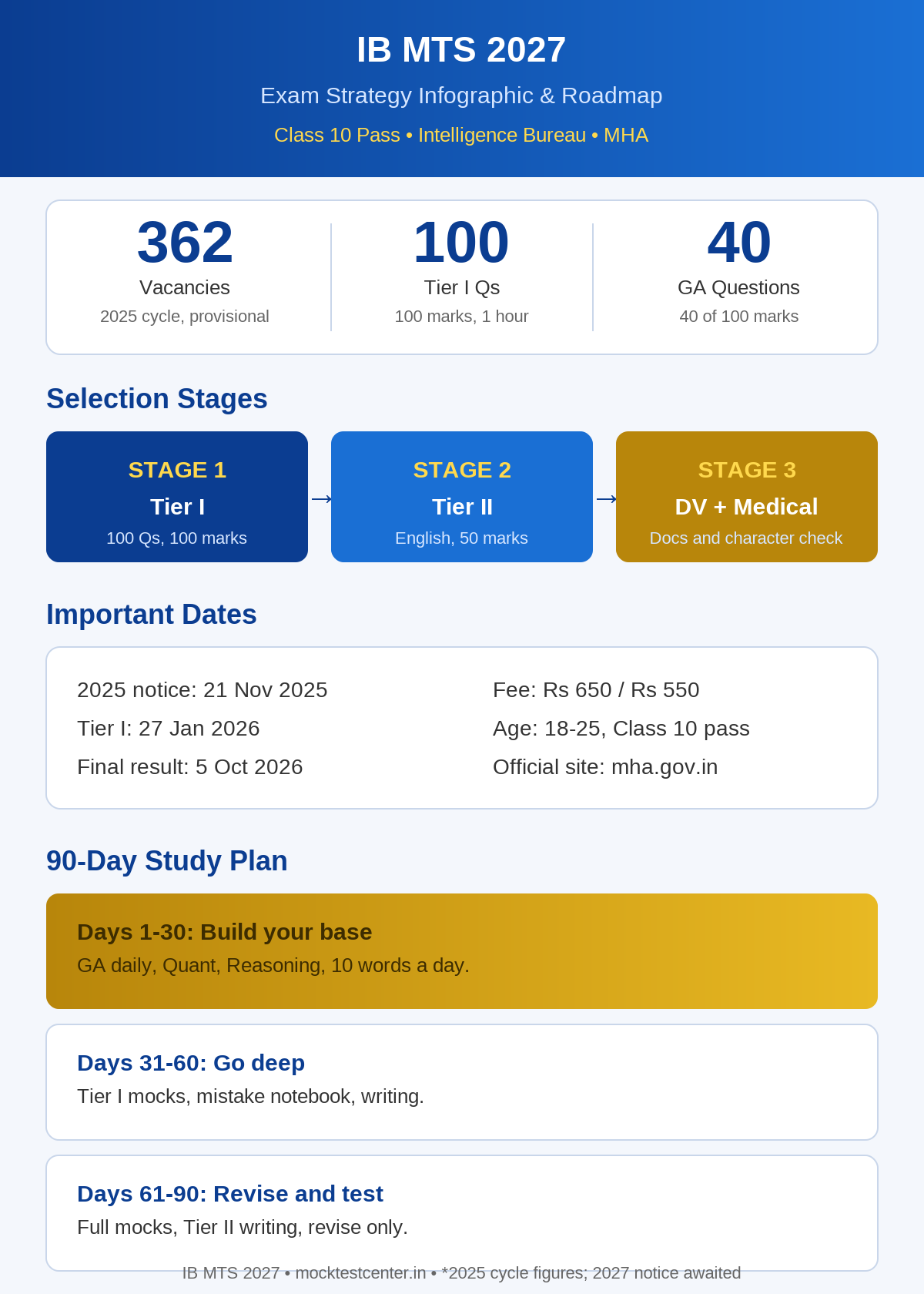
Selection for IB MTS runs in two tiers, then document verification and a medical examination. Tier I is an online objective test of 100 questions for 100 marks in 1 hour. Tier II is a descriptive test of 50 marks in 1 hour. Tier II is qualifying only. The final merit list comes from Tier I marks alone, provided you clear Tier II. That one line decides your whole preparation plan. Tier I is the exam that ranks you. Tier II is the gate you must pass. A high Tier II score adds nothing to your rank, but a fail in Tier II ends your selection even if your Tier I score was high.
There is no interview in IB MTS. There is no physical test in IB MTS. There is no skill test in IB MTS. If a website tells you about an IB MTS interview or a PET, it has mixed this exam with IB Security Assistant or with SSC MTS. IB Security Assistant has an interview and a different Tier II. SSC MTS has a physical test for Havaldar posts. IB MTS has neither. The 2025 notification lists Tier I, Tier II, document verification, medical examination, and character verification. That is the full list.
The Bureau shortlists candidates for Tier II at 10 times the number of vacancies, based on Tier I performance and normalisation of marks, subject to the minimum cut off in Tier I. With 362 vacancies, that means about 3,620 candidates reach Tier II, if enough candidates clear the minimum cut off. The notification adds that the shortlist can shrink if the cut off leaves fewer candidates. Normalisation matters here because Tier I runs in more than one shift when the number of candidates is large. Your raw score may go through normalisation before the Bureau compares it with scores from other shifts.
After Tier II, the Bureau prepares a final merit list from Tier I marks, for candidates who cleared Tier II. It also prepares a waiting list, which stays live under the rules of the Department of Personnel and Training, to give replacements in future. A waiting list means your chance does not end with the first list if a selected candidate drops out or fails verification.
Ties in Tier I at the final selection stage resolve in two steps. First, the older candidate ranks higher. Second, if the date of birth also matches, names resolve in alphabetical order, starting with the first name. You cannot control a tie, but you should know the rule exists, because it shows how close the competition gets at the last seat of a SIB.
| Stage | What happens | Marks and result |
|---|---|---|
| Stage 1: Tier I | Online objective test, 100 questions, 1 hour | 100 marks, decides final merit |
| Stage 2: Tier II | Descriptive English test, pen and paper, 1 hour | 50 marks, qualifying, need 20 to pass |
| Stage 3: Document verification | Original certificates checked | Pass or fail |
| Stage 4: Medical and character check | Medical exam and background verification | Pass or fail, then appointment |
Tier I in full detail
Tier I is the paper that decides your rank, so learn its shape by heart. It is an online exam of objective type multiple choice questions. It has 100 questions, each of 1 mark, for a total of 100 marks, in 1 hour. There is one composite hour for the whole paper. You can move between parts as you like inside that hour. No part has its own timer. That matters, because you can give more time to the part that pays you more and less time to the part that pays you less.
The four parts are General Awareness with 40 questions, Quantitative Aptitude with 20 questions, Numerical, Analytical and Logical Ability and Reasoning with 20 questions, and English Language with 20 questions. General Awareness alone carries 40 of the 100 marks. That is the single most important fact about this paper. A candidate who scores well in General Awareness starts 40 marks ahead of a candidate who ignores it. Quant and Reasoning give 20 each. English gives 20. The paper is at Class 10 level, because the post asks only for Matriculation.
Each correct answer gives 1 mark. Each wrong answer costs 0.25 mark. The notification states the negative marking as one fourth of a mark for each wrong answer. An unattempted question gives no mark and costs nothing. Questions you mark for review do not count in evaluation. Four wrong answers wipe out the gain of one right answer, so blind guessing hurts you. A guess you can narrow to two options is a different matter, but a pure guess on a question you know nothing about loses marks over a full paper.
The minimum cut off in Tier I, out of 100, is UR 30, OBC 28, SC and ST 25, and EWS 30. Ex-servicemen and PwBD candidates count in their own category for this cut off. These numbers are floors, not the final cut off. The notification says the cut off for Tier I in different categories may go higher, depending on the marks candidates score and the number of vacancies. The final cut off for a SIB depends on how many candidates applied for that SIB and how they scored. A floor of 30 for UR tells you the lowest score that can ever qualify. It does not tell you the score that will win a seat. Treat 30 as the line you must cross, and treat a much higher score as the line you must aim for.
One more correction belongs here, because many websites still print it wrong. Some pages show Tier I with five parts, adding General Studies with 20 questions to the four parts above. That five part pattern belongs to the old combined IB pattern for Security Assistant and ACIO, not to the 2025 MTS notification. The 2025 MTS notification lists four parts only: General Awareness 40, Quantitative Aptitude 20, Numerical and Logical Ability and Reasoning 20, and English Language 20. The total is 100. If a mock test gives you a fifth part called General Studies, it follows the wrong pattern, and your practice will not match the real paper.
The paper runs in Hindi and English, except for the English Language part, which runs in English only. That is the standard bilingual rule for IB papers. Use it in practice. If you take mocks only in English, you will read slower on the real day if you switch to Hindi, and the reverse holds too. Pick your medium now and practise in it.
Tier II, the paper most websites get wrong
Tier II is where most websites go wrong about IB MTS, so read this part twice. The 2025 notification describes Tier II as a descriptive test on English Language and Comprehension. It tests the basics of English Language, its vocabulary, correct grammar, sentence structure, synonyms, antonyms, and correct usage, to test comprehension and paragraph writing in 150 words. It carries 50 marks and runs for 1 hour. It is qualifying in nature, with qualifying marks of 20 out of 50.
Now compare that with what many trackers print. They describe Tier II as a translation test: a passage of 500 words from the local language to English and back, for 50 marks, with 20 to pass. That description is real, but it belongs to a different post. It belongs to IB Security Assistant (Executive), whose Tier II tests translation between the local language and English. It does not belong to IB MTS (General). The 2025 MTS notification has no translation task, no 500 word passage, and no local language test. Its Tier II is an English descriptive paper, and the task it names is paragraph writing in 150 words.
Why did so many sites copy the wrong task? IB runs several recruitments with a shared Tier I, and the trackers copied the Security Assistant Tier II into the MTS page without reading the MTS notification. The mistake then spread from site to site. The 2025 cycle itself settled the question. Tier II ran on 12 July 2026 as a descriptive test on English Language and Comprehension, and the result lists that followed came from that paper. If you spend your preparation on translation between your local language and English, you will prepare for a paper you will never sit.
What should you practise for Tier II instead? Write short paragraphs in English, about 150 words, on simple topics. Practise comprehension, where you read a passage and answer questions on it. Revise vocabulary, synonyms and antonyms, and the correct use of words. Revise grammar, sentence structure, and common errors. Write by hand, because Tier II is a pen and paper descriptive test, not a computer test. Your handwriting must stay readable for a full hour, and your spelling must hold up without a spell checker. Twenty marks out of 50 is the pass line, which is 40 per cent. That sounds easy until you sit with a blank page and an hour on the clock. Candidates who never write in English fail this gate more often than anyone expects, and a fail here ends a selection that Tier I had already won.
Tier II may run at fewer centres than Tier I. The notification says Tier II may not run at all the Tier I cities, and the Bureau may club candidates from nearby centres. It also says the date, time, and centre of Tier II will reach shortlisted candidates through the email they gave in the form. Keep that email active and check it, including the spam folder, after the Tier I result.
Important dates of the 2025 cycle
The 2025 cycle ran from November 2025 to October 2026, almost a full year from notice to final result. That length is normal for IB recruitment, and you should plan for it. The short advertisement came on 18 November 2025. The detailed notification came on 21 November 2025. Forms opened on 22 November 2025 and closed on 14 December 2025 at 23:59. The fee through SBI challan at a bank branch stayed open till 16 December 2025, during banking hours. Tier I ran on 27 January 2026. The Tier I result came on 13 April 2026. Tier II ran on 12 July 2026. The final result came on 5 October 2026.
Two date conflicts circulate online, and both are worth naming. First, some pages say the detailed notification came on 22 November 2025. The notification text and the most careful trackers give 21 November 2025 for the detailed notification, with the short advertisement on 18 November 2025. The 22 November date is the day forms opened, not the day the detailed notice came. Second, one tracker lists the last date to apply as 4 December 2025. That date is wrong. The notification gives 14 December 2025 as the closing date, and the fee and challan dates follow from it. A candidate who trusted the 4 December date would have stopped ten days early for no reason.
A third conflict concerns the Tier II date. One tracker lists 27 July 2026. The final result reports and the result trackers that followed the cycle give 12 July 2026. This page uses 12 July 2026, because it matches the reports published with the final result on 5 October 2026.
| Event | Date, 2025 cycle |
|---|---|
| Short advertisement | 18 November 2025 |
| Detailed notification | 21 November 2025 |
| Forms open | 22 November 2025 |
| Forms close | 14 December 2025, 23:59 |
| SBI challan fee last date | 16 December 2025, banking hours |
| Tier I exam | 27 January 2026 |
| Tier I result | 13 April 2026 |
| Tier II exam | 12 July 2026 |
| Final result | 5 October 2026 |
| 2027 notice | Date awaited |
No 2027 dates exist as of 23 November 2026. The 2027 notice will set its own closing date, and the age limit will run as on that closing date. Do not carry the 14 December 2025 date into the 2027 cycle. When the notice comes, note the closing date first, because your age, your qualification, and your domicile all count as on that date.
The fee, and why it is not Rs 100
Most government exam fees are a single number. IB MTS has two parts, and that is why so many pages get it wrong. The 2025 notification splits the fee into two components. The Examination Fee is Rs 100. The Recruitment Processing Charges are Rs 550. Every candidate pays the processing charges of Rs 550, whatever the category. Male candidates of UR, EWS, and OBC categories pay the examination fee of Rs 100 as well, so their total is Rs 650. All SC and ST candidates, all female candidates, all Persons with Benchmark Disabilities, and ex-servicemen eligible for reservation pay only the processing charges of Rs 550. They pay no examination fee.
One exception sits inside that rule. An ex-serviceman who already holds a Group C civil post on a regular basis after using ex-serviceman reservation must pay the examination fee of Rs 100 as well, so the total for that candidate is Rs 650. Banking charges, if any, fall on the candidate. The fee, once paid, gets no refund in any circumstances. The notification says that in plain words, and the application instructions repeat it.
Payment runs through the SBI EPAY LITE gateway, by debit card, credit card, net banking, UPI, or SBI challan. Online payment stays open till the last date of the form. A challan generated on the last day stays valid for 4 days from generation, but the candidate must still submit it at the bank before the challan last date, which was 16 December 2025 in the 2025 cycle. The notification warns candidates not to press back or refresh after submitting payment online, because that can cause a double charge. Wait for the server message, then print the form with the fee details.
Compare this with SSC MTS, and the difference jumps out. SSC MTS charges Rs 100, with exemption for women, SC, ST, PwBD, and ex-servicemen. IB MTS charges Rs 650 or Rs 550, because the Rs 550 processing charge applies to everyone. A candidate who reads the SSC fee on an IB page will underpay and may find the form incomplete. Read the fee table of the notice you apply under, and pay the total the table shows for your category.
| Category | Exam fee | Processing charges | Total to pay |
|---|---|---|---|
| Male, UR / EWS / OBC | Rs 100 | Rs 550 | Rs 650 |
| Female, all categories | Nil | Rs 550 | Rs 550 |
| SC / ST, all | Nil | Rs 550 | Rs 550 |
| PwBD, all | Nil | Rs 550 | Rs 550 |
| Ex-serviceman, eligible for reservation | Nil | Rs 550 | Rs 550 |
Pay and allowances
MTS (General) sits at Pay Level 1 in the pay matrix, from Rs 18,000 to Rs 56,900 per month, plus admissible central government allowances. Level 1 is the entry level of the central government pay matrix, and it fits a Class 10 post. The starting basic pay is Rs 18,000. That number alone understates the monthly income, because allowances add a large share on top of it.
The allowance that sets IB apart from most Level 1 posts is the Special Security Allowance, at 20 per cent of basic pay. On a basic pay of Rs 18,000, that allowance alone adds Rs 3,600 per month. The notification lists it as a note under the pay scale, and the news reports of the 2025 cycle repeat it. On top of that, the post carries cash compensation in lieu of duty performed on holidays, subject to a ceiling of 30 days. That means work on a holiday can earn cash compensation instead of a day off, up to 30 days in a year. Dearness allowance, house rent allowance, and transport allowance follow central government rules and depend on the city of posting. A posting in Delhi pays a different house rent allowance from a posting in a small town.
Some trackers quote an in hand salary of about Rs 38,000 in the first month. That figure is a tracker estimate, not a number from the notification, and it depends on the city, the allowances in force, and the deductions. This page does not repeat it as a fact. What the notification does give is solid enough: basic pay Rs 18,000 at entry, Special Security Allowance at 20 per cent of basic pay, holiday cash compensation up to 30 days, and the standard central government allowances. For a 10th pass candidate, that package is strong, and the job security of a central government post adds value that no monthly figure captures.
Promotion from MTS follows the rules of the Bureau and the central government. The notification does not promise a promotion timeline, and this page invents none. What it does promise is a permanent central government service after confirmation, with all India transfer liability. If you want a post where a degree is not needed and the work is steady, the pay at Level 1 with the Special Security Allowance is the honest reason to apply.
Syllabus, subject by subject
The 2025 notification gives the scheme of the exam, not a long topic list. The syllabus below follows that scheme and the standard Class 10 level of the paper. It stays at the level the post demands. You do not need graduation level books for this exam. You need Class 10 level clarity, speed, and accuracy.
General Awareness carries 40 questions, so it deserves 40 per cent of your preparation time. It covers current events, history, culture, geography, polity and the Constitution, economy, and general science. Current events mean the news of the last 12 months, with a focus on government schemes, awards, sports, appointments, and major national events. Static general knowledge means the facts that do not change: capitals, rivers, mountains, constitutional articles, and the structure of government. Read a newspaper daily, and keep a notebook of one line facts. General Awareness rewards the candidate who reads a little every day far more than the candidate who reads a lot in the last week.
Quantitative Aptitude carries 20 questions. It covers number systems, percentage, ratio and proportion, average, simple and compound interest, profit and loss, discount, time and work, time speed and distance, mensuration, algebra at a basic level, and data interpretation from tables and charts. The level is Class 10. The trap is not difficulty. The trap is time. Twenty questions in a 60 minute paper leave you about 36 seconds per question across the whole paper, and Quant questions eat time if you solve them the long way. Learn short methods for percentage, ratio, and time and work, and practise them till they feel automatic.
Numerical, Analytical and Logical Ability and Reasoning carries 20 questions. It covers analogies, series, coding and decoding, classification, blood relations, direction sense, Venn diagrams, puzzles at a basic level, and non verbal reasoning such as figures and patterns. Reasoning rewards practice more than theory. Solve 20 questions a day, time yourself, and write down the types you miss. Most candidates miss the same two or three types again and again, and fixing those types is the fastest way to add marks.
English Language carries 20 questions in Tier I. It covers error spotting, synonyms and antonyms, idioms and one word substitution, spelling, fill in the blanks, sentence improvement, sentence rearrangement, voice, speech, and short comprehension passages. English also decides Tier II, so every hour you give to English pays twice. Learn 10 new words a day with their meanings and one sentence each. Read one English passage a day and write its main point in two lines. That habit builds both Tier I vocabulary and Tier II paragraph writing at the same time.
Cut offs, and what no one has published yet
Cut off means the lowest score that wins a seat, and candidates ask about it more than any other number. For IB MTS 2025, you must separate three different numbers, because websites mix them up. First, the minimum qualifying marks in Tier I, which the notification fixes. Second, the expected cut off, which trackers guess before the result. Third, the final closing cut off, which the Bureau publishes with the result, if it publishes one at all.
The minimum qualifying marks in Tier I, out of 100, are UR 30, EWS 30, OBC 28, and SC and ST 25. Tier II needs 20 out of 50 to pass. Those are the only cut off numbers that the notification fixes. They are floors. A candidate below the floor cannot qualify, whatever the vacancies. A candidate above the floor may still fail, because the final cut off can rise above the floor.
The expected cut offs that trackers printed before the Tier I exam ran from about 65 to 70 for UR, 60 to 65 for OBC, 62 to 67 for EWS, 55 to 60 for SC, and 50 to 55 for ST, out of 100. Those are guesses, not facts. This page records them only to show what the guessing looked like, and it does not present them as the real cut off. The real cut off depends on the difficulty of the paper, the number of candidates, and the SIB wise vacancies, and it changes every cycle.
The final cut off for the 2025 cycle has not appeared as an official table of category wise or SIB wise closing marks. The Tier I result of 13 April 2026 and the final result of 5 October 2026 came as lists of roll numbers, arranged by city and category. No official closing marks table was found on the MHA website during the checks for this page. That means this page gives no closing cut off figure for 2025, because none was verified. If a website shows you a 2025 closing cut off, ask it for the MHA link. If it has no link, treat the number as a guess.
One older cut off does exist in the record. The 2019 cycle, the previous MTS recruitment before the seven year gap, had minimum qualifying marks of UR 35, OBC 34, and SC and ST 33, out of 100. Those numbers belong to 2019, not to 2025, and the 2025 notification lowered the floors to 30, 28, and 25. Do not use the 2019 numbers to set your target for the next cycle. Set your target from the 2025 floors and from the competition in your SIB. A safe target for a UR candidate in a large SIB is a score well above 70 in Tier I, because the paper is at Class 10 level and many candidates score high. In a small SIB, the target moves with the number of candidates, and no single number fits all SIBs.
How to apply, step by step
Forms go only through the MHA website at mha.gov.in or the NCS portal at ncs.gov.in. No other website takes the form. No offline form exists. The 2025 cycle ran the form in two steps, and the next cycle will likely follow the same shape, but read the new notice when it comes, because the steps can change.
Step one is registration. You agree to the instructions, fill your personal details and contact details, and submit. The portal sends your login ID, called the Application Sequence Number, and a password to your registered email. Step two is the form itself. You log in again, fill your personal details, qualification details, and declaration, upload your photo and signature, and pay the fee through the SBI gateway. The form lets you edit information before submission of step one and step two. Once you submit, you cannot edit. Preview the form before you submit, and check your email ID and your photo and signature with care, because a hazy photo or a wrong email can cancel the form.
The photo must be a recent passport size colour photograph, 35 mm by 45 mm, not older than 12 weeks, with a light background, and the face must cover 70 to 80 per cent of the photo. The scanned photo must be 100 to 200 KB in jpg or jpeg format. The signature must be on white paper with a black ink pen, scanned at 80 to 150 KB in jpg or jpeg format. Black and white photos do not pass. A photo with a pattern behind it does not pass. Keep the same photograph for the whole recruitment, because the notification says the same photograph must stay in use through the process.
You must give five choices of exam centre cities for Tier I, from the list of 132 cities in the notification. The list runs from Port Blair to Siliguri, and it covers every state. The Bureau can place you in any one of your five choices, or shift you to another city if your city is over or under subscribed. Your candidature still counts against the vacancies of the SIB you picked, whatever city you sit in. Pick five cities you can actually reach, because the Bureau will not pay your travel, except for unemployed SC and ST candidates, who get fare reimbursement as per the rules.
Submit only one application. The notification says multiple applications may lead to cancellation of all of them. Fill the category once, because the category you fill cannot change later, and no benefit of another category will apply. Keep a printout of the form after payment, and keep your Application Sequence Number safe. The helpdesk for technical queries runs on phone number 022-61087526, from 10 in the morning to 6 in the evening, Monday to Saturday, and through the helpdesk tab on the portal after login.
Mistakes that cost candidates a year
The first mistake is picking the wrong SIB. Candidates pick Delhi because it has 108 posts, then learn at document verification that they hold no Delhi domicile. The form is gone, the fee is gone, and the year is gone. Pick the SIB of the state whose domicile certificate you actually hold. The second mistake is the domicile itself. Candidates apply with a domicile applied for but not yet issued. The notification counts the certificate you hold on the closing date, not the one you hope to get. Get the certificate first, then fill the form.
The third mistake is the fee. Candidates pay Rs 100 and think they have paid, because every other exam charges Rs 100. IB MTS charges Rs 650 for a male UR, EWS, or OBC candidate, and Rs 550 for everyone else. An incomplete fee means an incomplete form. The fourth mistake is the photo. A black and white photo, an old photo, or a photo with a dark background can reject the form. The rules give exact sizes, 100 to 200 KB for the photo and 80 to 150 KB for the signature, and the portal checks them. Follow the numbers, not your guess.
The fifth mistake is the Tier II trap. Candidates score well in Tier I and then fail Tier II, because they never wrote a paragraph in English. Twenty marks out of 50 is the pass line, and it needs practice, not luck. Write one paragraph a week from today, and the gate will not surprise you. The sixth mistake is trusting agents. The notification warns in plain words that fraudsters invite applications, promise help in the exam, and issue fake appointment letters. IB shares no paper input with anyone. If someone asks for money to get you selected, walk away.
The seventh mistake is social media. The notification tells candidates not to disclose their progress to the next stage on personal or family social media, and to stop family members from publicising it. The Bureau takes this seriously. Keep your selection off social media till the process ends.
A 90 day plan that fits a Class 10 student
Days 1 to 30 build your base. Study 4 hours a day. Give General Awareness 90 minutes, Quant 60 minutes, Reasoning 60 minutes, and English 30 minutes. Read the newspaper daily and note 10 facts. Learn 10 new English words daily. Solve 20 Reasoning questions a day. Write one English paragraph a week, about 150 words, on a simple topic like your village, your school, or a festival.
Days 31 to 60 go deep. Study 5 hours a day. Take one full Tier I mock every three days, in 60 minutes, with negative marking on. After each mock, spend one hour on your mistakes, and write each mistake in a notebook with the correct method. Keep the newspaper habit. Write one English paragraph every three days now, and read it aloud to catch grammar errors.
Days 61 to 90 revise and test. Take two full Tier I mocks every week, and one Tier II style writing practice every week, timed at 60 minutes. Do not learn new topics now. Revise your mistake notebook, your General Awareness notes, and your English words daily. In the last week, revise only, sleep well, and keep your admit card, photo ID, and certificates ready. A calm last week adds more marks than a new book.
How mock tests fit this paper
Mock tests matter for IB MTS for one reason: the paper is 100 questions in 60 minutes. That is 36 seconds per question, and no one learns that pace from books alone. Take mocks in 60 minutes, on a computer, with negative marking of 0.25 on. Score yourself the way the Bureau scores you, with normalisation aside. After each mock, check three numbers: your General Awareness score out of 40, your accuracy, and the questions you skipped. General Awareness decides your rank, accuracy decides whether negative marking eats your score, and skipped questions show where your syllabus has gaps.
Take at least 20 full Tier I mocks before the exam, and at least 10 Tier II writing practices. Mix in sectional tests for General Awareness, because 40 questions in one part need their own practice. If you want to look at other exams on this site while you prepare, you can see SSC MTS Havaldar 2027, which is the Staff Selection Commission exam with the same three letters and a different pattern, SSC GD Constable 2027, SSC CHSL 2027, SSC CGL 2027, SSC Stenographer 2027, SSC Junior Engineer 2027, SSC Delhi Police Constable 2027, SSC Selection Post 2027, SSC JHT 2027 and SSC Limited Departmental Examinations 2027 on this site. The official sites for this exam are mha.gov.in and ncs.gov.in.
Sources
The facts on this page come from the detailed notification for the Multi-Tasking Staff (General) Exam 2025, published by the Intelligence Bureau under the Ministry of Home Affairs, and from the result reports that followed the cycle. The notification text was read from the official document hosted for the 2025 cycle, with the vacancy table, the scheme of exam, the fee table, and the age and domicile rules taken from its pages. The Tier I date of 27 January 2026, the Tier I result of 13 April 2026, the Tier II date of 12 July 2026, and the final result of 5 October 2026 were checked against the reports published with the final result. The official portals are mha.gov.in and ncs.gov.in. Check both when the 2027 notice comes.
A last word
IB MTS 2027 is a rare exam: a central government post, in the Intelligence Bureau, for Class 10 pass candidates, with a clear two tier selection and no interview. The 2025 cycle gave 362 posts, and Delhi alone gave 108 of them. The paper is short, 100 questions in 60 minutes, and General Awareness carries 40 of those marks. Tier II asks only for 20 marks out of 50, but it asks for them in written English, and candidates who ignore it lose a selection they had already won.
Start today. Read the newspaper, learn 10 words a day, and write one paragraph a week. Pick your SIB from your domicile, not from a vacancy table. Pay the full fee, Rs 650 or Rs 550 as your category demands. Check mha.gov.in every week for the 2027 notice, and do not pay any agent or any website for this exam. The form lives only on the official MHA site and the NCS portal, and the notice is the only paper that counts.