
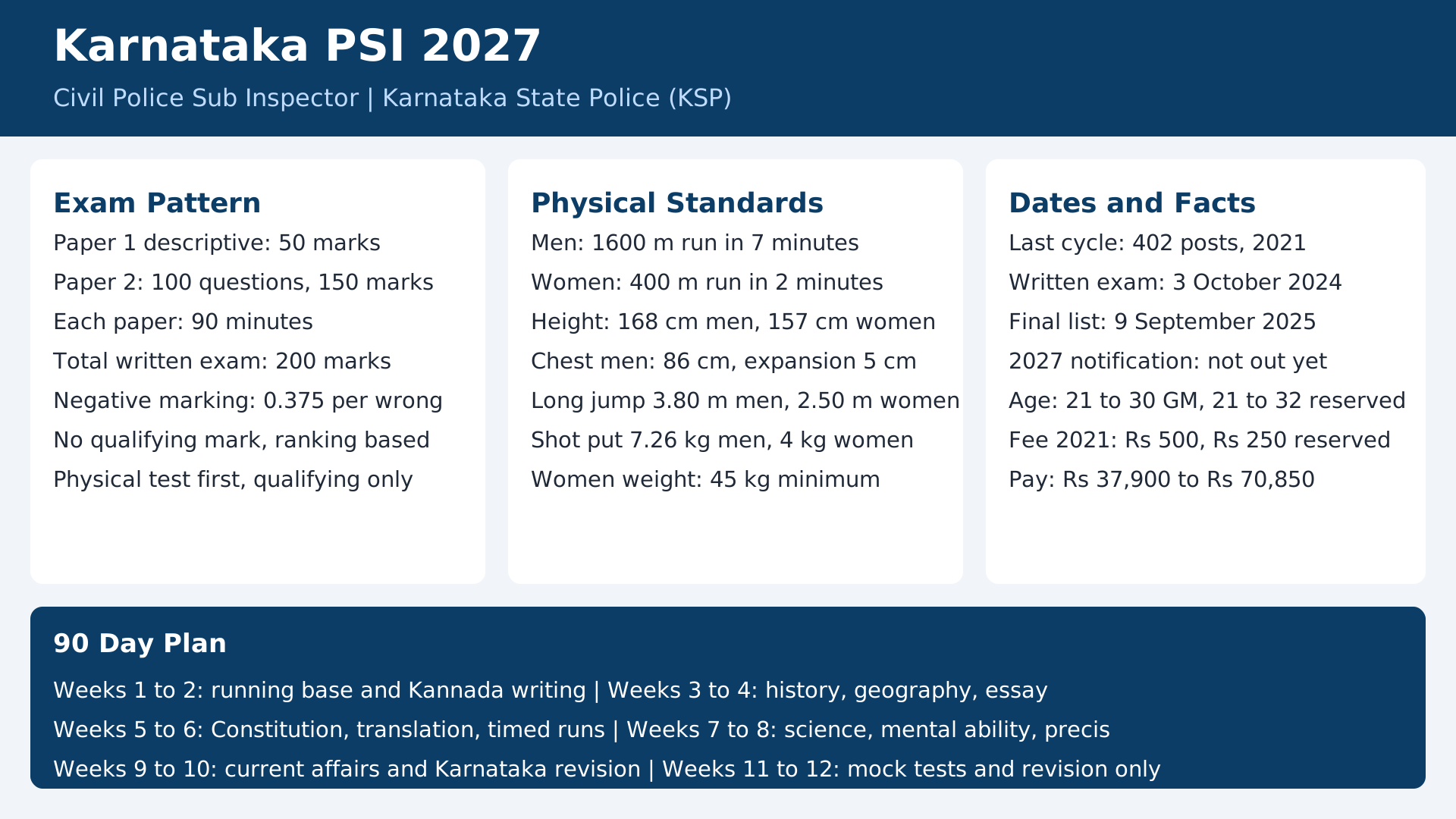
About Karnataka PSI 2027 Exam Series
📖 Table of Contents
- The post in numbers
- What a Civil PSI actually does
- Civil PSI, RSI and the other Sub Inspector posts
- Who can apply
- How selection works, stage by stage
- The physical test, event by event
- Karnataka PSI 2027 written exam: Paper 1 and Paper 2
- Paper 2 syllabus, topic by topic
- Paper 1: the paper that decides rank
- Salary, allowances and the job after selection
- Competition and cut off: what is known and what is not
- How to prepare, in the order that works
- A 90 day plan that covers both halves
- Mistakes that cost marks
- Sources
Karnataka PSI 2027: Civil Police Sub Inspector Guide
Karnataka PSI 2027 has no notification yet. The Karnataka State Police has not published the 2027 notice for Civil Police Sub Inspector posts as of 19 November 2026, so no 2027 post count, no 2027 dates and no 2027 fee exist anywhere in this guide. What exists is a clear record of the last full cycle and a draft set of rules that points to the next one. The last Civil PSI cycle offered 402 posts. Its notice came out on 3 March 2021, its written exam was held on 3 October 2024, and its final selection list was published on 9 September 2025. That long gap between notice and final list tells you the first truth about this exam. It rewards candidates who start early and keep going, because the process itself moves slowly.
This guide covers the Civil PSI post only. It is the station level officer post in the Karnataka State Police, the officer who runs a police station shift, records first information reports, investigates cases and supervises constables and head constables. The same recruitment family includes other Sub Inspector posts with different duties and different physical tests, and this guide marks those differences wherever they change your preparation. Every number in this guide comes from a source retrieved for this package, and the sources sit at the end. Where sources disagree, this guide says so instead of picking the neater figure.
The post in numbers
| Item | Detail |
|---|---|
| Conducting body | Karnataka State Police, known as KSP |
| Post | Police Sub Inspector, Civil, men and women |
| Last full cycle posts | 402, notified 3 March 2021 |
| Written exam, last cycle | 3 October 2024, held by the Karnataka Examinations Authority |
| Final selection list, last cycle | 9 September 2025 |
| 2027 notification | Not out as of 19 November 2026 |
| Written exam total | 200 marks, Paper 1 of 50 and Paper 2 of 150 |
| Age limit, Civil PSI direct | 21 to 30 years for General Merit, 21 to 32 for reserved categories |
| Education | Bachelor degree in any discipline from a recognised university |
| Language | Knowledge of Kannada, read, write and speak |
| Fee, 2021 cycle | Rs 500 for General Merit and OBC, Rs 250 for SC, ST and Category 1 |
| Pay scale, 2021 cycle | Rs 37,900 to Rs 70,850 per month |
| Official sites | ksp.karnataka.gov.in and ksp.gov.in, applications at recruitment.ksp.gov.in |
The Karnataka State Police is the law enforcement agency for the state of Karnataka. It was established in 1965 and works under the Department of Home Affairs of the Government of Karnataka, with its headquarters in Bengaluru. Its motto is Satyameva Jayate. As on 1 February 2026 the state had 1,103 police stations. A Civil PSI joins that structure at the station level, which is where most policing in Karnataka actually happens. The force also runs armed reserve battalions, a state reserve police, an industrial security force and a wireless wing, and each of those wings has its own Sub Inspector cadre. Know which cadre you are applying for before you apply, because the run time and the age limit change with it.
One more number needs a plain warning. The Karnataka government approved 8,176 police vacancies in 2025 across the department. That figure covers constables, armed constables, KSRP staff, KSISF staff and Detective Sub Inspectors, and only 20 of those approved posts were Detective Sub Inspectors. That figure is a department wide approval that covers many posts besides PSI, so do not quote 8,176 as the PSI vacancy figure. The only PSI specific figure in the draft rules is 92 Special Reserve Sub Inspector posts in the India Reserve Battalion, described below, and the only completed Civil PSI figure is the 402 posts of the 2021 cycle.
What a Civil PSI actually does
A Civil PSI is the first supervisory officer a citizen meets at a police station. The PSI takes complaints, records first information reports, visits the scene, collects evidence, questions witnesses, arrests accused persons where the law allows it, and prepares the case file that goes to court. The PSI also supervises the constables and head constables on shift, manages the station diary and the beat system, and answers to the Inspector who holds charge of the station as Station House Officer. In smaller stations the PSI may hold independent charge of routine work. The work is a mix of field duty and desk duty, and it runs in shifts, including nights, weekends and festival bandobast.
The post suits a graduate who can write clearly, speak to people firmly and calmly, and keep records straight. The written exam tests exactly those skills in its own way. Paper 1 tests essay writing, translation and precis writing. Paper 2 tests general studies, current affairs and mental ability. The physical test comes first and it only qualifies you. It adds no marks. The written exam decides the merit list. A candidate who is strong in the run and weak in Paper 1 will clear the ground and then lose on paper. A candidate who is strong on paper and slow on the ground will never reach the paper at all. Both halves need work, and the plan near the end of this guide gives each half its own slot.
The rank sits above Assistant Sub Inspector and below Inspector in the state police hierarchy. A PSI wears two stars with a red and blue ribbon. Promotion runs upward through Inspector and Deputy Superintendent of Police, but the climb is slow in the Civil cadre. Court records on the Karnataka police service note that a Civil Sub Inspector may take close to 30 years to reach Deputy Superintendent of Police, while a Sub Inspector in the Reserve Police reaches Assistant Commandant in about 10 to 11 years. That difference is real, and it is one reason some candidates prefer the reserve cadres. The Civil cadre gives you investigation work and station command. The reserve cadres give you faster rank movement and armed duty. Pick with your eyes open.
Civil PSI, RSI and the other Sub Inspector posts
Karnataka runs several Sub Inspector posts under one recruitment family, and mixing them up is the most common error in PSI preparation. Civil PSI works in police stations on law and order and investigation. Reserve Sub Inspector, called RSI, works in the City Armed Reserve and District Armed Reserve on crowd control, riot control, VVIP bandobast and disaster response. Special Reserve Sub Inspector, called SRSI, works in the Karnataka State Reserve Police battalions on the same kind of armed duty at state level. KSISF PSI guards industrial sites and strategic assets. Excise PSI enforces excise law. Wireless PSI works on police communications. Each post needs a degree, each has its own age limit, and the physical tests differ.
The differences that change your preparation are small and sharp. The Civil PSI run is 1600 metres in 7 minutes for men. The RSI run is the same distance in 6 minutes 30 seconds. The age limit for Civil PSI direct recruitment is 30 years for General Merit and 32 for other categories. For RSI, SRSI, KSISF PSI and Wireless PSI it is 26 years for General Merit and 28 for other categories. For PSI Intelligence it is 28 and 30. Paper 1 has no precis writing for KSRP and KSISF Sub Inspector posts, and the essay there carries 30 marks instead of 20. If you prepare for Civil PSI, train for the 7 minute run and the full Paper 1. If you also apply for RSI, train for the 6 minute 30 second run, because the Civil standard will not save you there.
The draft recruitment rules of 2025 add one more post to watch. They cover 92 Special Reserve Sub Inspector posts in the India Reserve Battalion, filled 60 percent by direct recruitment, 30 percent by promotion and 10 percent by direct recruitment from in service candidates drawn from Assistant Sub Inspectors, Head Constables, Police Constables or equivalent cadres of the Karnataka State Police. Application dates for those 92 posts were still to be announced when Testbook last updated its page on 1 November 2026. Those 92 posts are not Civil PSI posts. Do not count them in a Civil PSI vacancy estimate, and do not prepare for them as if they were the same post.
Who can apply
The education rule is simple. You need a bachelor degree from a recognised university, in any discipline. BA, BCom, BSc, BBA and BCA all count. A diploma does not count. Final year students cannot apply. Trackers that follow the KSP notices state this plainly: only candidates who have completed the degree and hold the marks card can apply. If your final semester result is still awaited when the notice closes, you wait for the next cycle. That is a hard rule, and no amount of preparation changes it.
Kannada is a real eligibility condition that the notice enforces. The 2021 Civil PSI notice required knowledge of Kannada, the ability to read, write and speak the language. Paper 1 itself tests it, with translation both ways and a precis of a Kannada passage that must be written in Kannada. Candidates who studied in Kannada medium or studied Kannada as a first or second language up to SSLC will find this natural. Candidates who did not study Kannada at school need to build the skill from scratch, and they should start before anything else. A graduate who is strong in general studies and cannot write a Kannada precis will lose 10 marks in Paper 1 and will struggle with the translation section as well. That is 30 of the 50 marks in Paper 1 at risk.
The age limits come from the 2021 Civil PSI notice and the consolidated tracker pages, and they differ by category and by entry route. The table below gives the Civil PSI figures. In service candidates get a higher upper limit, and reserved categories get relaxation on top of the direct limit. Check the new notice when it comes out, because age limits have moved between cycles and the draft rules for the 92 Special Reserve posts quote a different limit of 21 to 28 years for that cadre.
| Entry route | General Merit | Reserved categories |
|---|---|---|
| Direct, Civil PSI | 21 to 30 years | 21 to 32 years |
| In service, Civil PSI | 21 to 35 years | 21 to 40 years |
| Direct, RSI and SRSI and KSISF and Wireless | 21 to 26 years | 21 to 28 years |
| Direct, PSI Intelligence | 21 to 28 years | 21 to 30 years |
In service candidates need at least 5 years of service as Police Constable, Head Constable or Assistant Sub Inspector in any wing of the Karnataka State Police, according to the eligibility pages for the 2021 cycle. The in service route also feeds the 10 percent quota in the 2025 draft rules for the Special Reserve posts. If you are already in the force, read the notice for your cadre, because the in service rules are written separately and the age limits are higher.
There is no limit on the number of attempts. Trackers that follow the PSI exam state this clearly: attempts are unlimited within the age limit. That fact cuts both ways. It means a candidate who misses one cycle can return for the next. It also means the competition includes experienced repeaters who know the paper well. Your first attempt should still be your serious attempt, because the cycle gap can run to years. The 2021 cycle took more than four years from notice to final list. Waiting for the next cycle is not a plan.
How selection works, stage by stage
Selection for Karnataka PSI 2027 will run in the same fixed order as the last cycle, and the order matters. The physical test comes first. Only candidates who clear it sit for the written exam. The written exam decides merit. Document verification and the medical exam follow for shortlisted candidates. The final selection list is then published. There is no qualifying mark in the written exam. Trackers state this directly: selection is ranking based only. Your score is compared with every other candidate who cleared the physical test, and the list is drawn in merit order against the post count and the reservation roster.
The physical test has two parts. The Endurance Test checks running, jumping and shot put. The Physical Standard Test measures height, chest and weight. Both parts are qualifying only. They add no marks to the merit list. Failing any single event ends the attempt. That is why the physical section of this guide gives every event its own standard instead of a summary. You need to pass each one, not most of them.
The written exam is held by the Karnataka Examinations Authority for the Civil PSI cycle. The 2021 cycle written exam was held on 3 October 2024. The provisional list followed on 26 December 2024, and the final selection list on 9 September 2025. The long gap is worth noting for a practical reason. Candidates who clear the written exam should keep their documents ready and keep their fitness up, because document verification and medical checks can be called at short notice months after the exam.
One stage needs an honest note, because sources disagree about it. Older sources describe a viva voce at the end of the process. A 2003 Karnataka High Court judgment on the 2002 PSI recruitment records an interview and personality test carrying 7.5 marks after the written exam. A 2025 eligibility tracker also says shortlisted candidates will be called for viva voce. But the current trackers for the recent cycles say there is no interview. Shikarat states it in one line, no interview. Filo states the same, that selection rests on the written exam with the physical test, document verification and medical exam as qualifying stages. This guide follows the current trackers and states that the recent Civil PSI cycle had no interview stage, while flagging that older rules did include a viva voce. If the 2027 notice restores an interview, the notice itself will say so, and that notice is the only source that counts.
Document verification checks every claim in your application. Degree certificate and marks cards, age proof, caste and category certificates where claimed, Kannada study proof where needed, and in service records where the route applies. A wrong certificate or a missing document at verification ends the attempt even after a good written score. Keep originals and attested copies in one folder from the day you apply. The medical exam checks sound physical and mental health, vision including colour vision, hearing, and freedom from any defect likely to interfere with police duty. Colour blindness is generally a disqualifying factor in police medical standards. If you wear glasses, carry your prescription. If you have a medical condition, get it checked privately before the medical exam so you know where you stand.
The physical test, event by event
The physical test is the gate. It comes before the written exam, and it is pass or fail. Train for it from week one of your preparation for Karnataka PSI 2027, not from the week the admit card arrives. Running fitness takes months to build, and a candidate who starts running two weeks before the test will not make the time. The standards below are the consolidated figures from the Shikarat syllabus page of June 2026, the Jagran Josh report on the 2021 ET and PST admit card, and the Jobsandhan eligibility page. Where two sources give different figures for the same event, this guide notes the difference.
| Event, men, Civil PSI | Standard |
|---|---|
| 1600 metres run | 7 minutes |
| Long jump or high jump | 3.80 metres long jump or 1.20 metres high jump, 3 chances |
| Shot put, 7.26 kg | 5.60 metres, 3 chances |
| Height | 168 cm minimum |
| Chest | 86 cm when fully expanded, minimum expansion 5 cm |
| Event, women, Civil PSI | Standard |
|---|---|
| 400 metres run | 2 minutes |
| Long jump or high jump | 2.50 metres long jump or 0.90 metres high jump, 3 chances |
| Shot put, 4 kg | 3.75 metres, 3 chances |
| Height | 157 cm minimum |
| Weight | 45 kg minimum |
Three points about these tables deserve attention. First, the men run time differs by cadre. Civil PSI men run 1600 metres in 7 minutes. RSI men run the same distance in 6 minutes 30 seconds. The Jagran Josh report on the 2021 admit card confirms the Civil figure of 7 minutes, and Shikarat confirms both figures side by side. Second, the jump gives you a choice. You may clear either the long jump or the high jump, in 3 chances. Pick the one you clear reliably in practice and train that one only. Third, the shot put weight differs by sex. Men throw a 7.26 kg shot to 5.60 metres. Women throw a 4 kg shot to 3.75 metres. Technique matters as much as strength in the shot put, so practise the glide or the standing throw with a coach rather than muscling the shot in the test ground.
One conflict sits in the physical figures and it is worth naming. Some older pages quote a 1600 metre run in 6 minutes 30 seconds for all men, and a 2 kilometre run in 10 minutes for an older constable pattern. Those figures belong to other posts and older cycles. The Civil PSI figure in the 2021 admit card report and the June 2026 consolidated syllabus page is 7 minutes. This guide uses 7 minutes for Civil PSI men and flags the 6 minute 30 second figure as the RSI standard. In service and ex servicemen candidates have their own standards in the same pages. In service men keep the 168 cm height and 86 cm chest standard. Ex servicemen have no height standard in the PSI tables. Women in service keep the 157 cm height figure. Check the notice for your own category, because the table changes with it.
Height and chest are measured in the Physical Standard Test after the Endurance Test, and candidates who fail the measurement are eliminated even if they ran well. There is no appeal on a tape measure. If your height is close to 168 cm for men or 157 cm for women, measure yourself on a proper stadiometer before you apply, in the morning, standing straight, without shoes. If your chest expansion is close to 5 cm, practise deep breathing and chest expansion exercises daily. These are small margins, and small margins decide who goes forward.
Karnataka PSI 2027 written exam: Paper 1 and Paper 2
The written exam has two papers, each of 90 minutes, and both are compulsory. Paper 1 is descriptive. Paper 2 is objective. Together they carry 200 marks. There is no separate qualifying mark in either paper. Merit is drawn on the total of the two papers, after the physical test has already filtered the field. The table below gives the pattern as reported across the consolidated syllabus pages for the recent cycles.
| Paper | Type | Marks | Duration |
|---|---|---|---|
| Paper 1 | Descriptive, essay and translation and precis | 50 | 90 minutes |
| Paper 2 | Objective, multiple choice | 150 | 90 minutes |
| Total | Written exam | 200 | 180 minutes |
Paper 1 breaks into three parts. The essay carries 20 marks and runs to about 600 words. Translation carries 20 marks, split as 10 marks for Kannada to English and 10 marks for English to Kannada. Precis writing carries 10 marks. The precis is a summary of a Kannada passage, reduced to one third of its size, with a suitable title, and it must be written in Kannada. English is allowed in the rest of Paper 1. The precis is the exception. Candidates who write the precis in English lose those marks. KSRP and KSISF Sub Inspector papers have no precis, and their essay carries 30 marks instead of 20. That difference matters only if you apply for those posts as well.
Paper 2 carries 100 questions of 1.5 marks each, which makes 150 marks. Negative marking applies at 25 percent of the marks of a question, which is 0.375 marks for each wrong answer. That is the figure in the consolidated syllabus pages and in the Recruitment Guru pattern page. Two conflicts need a note here. Some pages say Paper 2 has 150 questions, which would mean 1 mark each, and some pages say the negative marking is 0.25 marks per wrong answer. The detailed pattern pages that break Paper 2 into its parts say 100 questions at 1.5 marks each with 0.375 negative marking, and the arithmetic fits: 100 times 1.5 is 150, and 25 percent of 1.5 is 0.375. This guide follows the 100 question figure with the 0.375 deduction and flags the other figures as conflicting tracker versions. The 2027 notice will settle it, and the notice is the final word.
The negative marking changes how you should attempt Paper 2. A wrong answer costs 0.375 marks on top of the 1.5 you miss. Blind guessing across the paper will pull a good score down fast. The working rule is simple. Attempt a question if you can rule out two options. Skip it if you are choosing at random among four. With 100 questions in 90 minutes you have 54 seconds per question on average, so the paper rewards quick recall and punishes long deliberation. Mark the hard ones and return to them only after the rest of the paper is done.
Paper 2 syllabus, topic by topic
Paper 2 covers ten topics in the consolidated syllabus. The list below follows the Shikarat syllabus page and the Testbook syllabus page for the recent cycles. The weight of each topic is not published, so this guide does not invent a weight for any topic. It does say where the marks usually hide, based on the nature of each topic and the shape of the paper.
| Topic | What it covers |
|---|---|
| Current affairs | National and international events, awards, books and authors, important days, financial and economic news |
| Indian freedom fight | The struggle for independence, its leaders, movements and dates |
| Indian Constitution | Fundamental rights, duties, the structure of government, key articles and amendments |
| History | Ancient, medieval and modern India, with Karnataka history inside it |
| Geography | Physical and human geography of India and Karnataka, rivers, soils, climate and resources |
| Arts | Indian art forms, culture and heritage |
| Literature | Indian and Karnataka literature, authors and works |
| Mental ability | Reasoning, analogies, series, coding and decoding, arithmetic reasoning |
| Moral education | Values, ethics and conduct expected of a public servant |
| Science | General science at school level, everyday science and technology |
Current affairs and Karnataka general knowledge carry the most weight in practice, because they are the topics that change with every cycle and the topics a repeater cannot bank from last time. Read a Karnataka newspaper daily, in Kannada or English, and keep a notebook of state news: cabinet decisions, new schemes, appointments, court orders, and major events in the districts. The freedom fight, Constitution, history and geography topics reward a standard state level preparation, the same books that serve other Karnataka exams. Mental ability rewards daily practice rather than reading. Twenty minutes a day on reasoning questions will move your score more than a weekend of theory.
Moral education is the topic candidates most often ignore, and it is the topic that fits a police exam best. It covers the values a police officer needs on duty: honesty, impartiality, service to the public, and respect for the law. Read it as a set of situations, not as a set of definitions. A question may give you a situation at a police station and ask what the right response is. The answer is usually the option that protects the citizen and follows the law, not the option that protects the officer. Prepare for it by reading the Karnataka Police Act and the code of conduct material in standard police exam books, and by thinking through real situations rather than memorising lines.
Paper 1: the paper that decides rank
Paper 1 carries only 50 marks, a quarter of the written total, but it decides rank more than its share. Paper 2 is multiple choice, and a large number of candidates score in a narrow band there. Paper 1 is written by hand, and the gap between a good answer and a weak answer is wide. Two candidates can score the same in Paper 2 and sit twenty ranks apart because of Paper 1. Treat it as the paper that separates you from the crowd, not as a formality before the real exam.
The essay needs a structure you can repeat under time pressure. Write about 600 words. Open with the issue in two sentences. Give three points of substance, each in its own paragraph, with a fact or an example in each. Close with one paragraph that states what should be done, not a repeat of the opening. Pick essay topics from current affairs, national and state issues, social issues and policing ethics, because those are the areas the syllabus names. Practise one essay a week, in 30 minutes, by hand, and get it checked by someone who writes well. An essay written on a keyboard does not prepare your hand for 600 words in the hall.
Translation needs daily practice in both directions. Kannada to English translation tests whether you can carry the meaning across without losing it. English to Kannada translation tests the same skill in reverse, and it is the harder direction for candidates who read English well but write Kannada rarely. Practise with newspaper editorials. Take one paragraph a day, translate it, and compare your version with the original meaning sentence by sentence. The errors that cost marks are small ones: a wrong tense, a dropped qualifier, a word translated by its nearest equivalent instead of its exact sense. A translation that keeps the meaning and reads naturally will score. A translation that is word for word and stiff will not.
Precis writing is a skill of its own. You must reduce a Kannada passage to one third of its size and give it a suitable title, in Kannada. The skill is selection. Read the passage twice. Mark the sentences that carry the argument. Drop the examples, the repetitions and the ornament. Write the summary in your own Kannada, in the same order as the original, and count the words as you go. A precis that runs to half the passage misses the point of the exercise. A precis that is one third and keeps every point of the argument is a full score answer. Practise two precis passages a week from Kannada newspapers and magazines.
Salary, allowances and the job after selection
The 2021 Civil PSI notice fixed the pay scale at Rs 37,900 to Rs 70,850 per month. That is the scale in the notice, and it is the figure this guide uses. A tracker page that summarises the post quotes about Rs 40,000 a month as the starting figure, which fits the bottom of that scale with allowances added. Pay scales are revised by the state government from time to time, so the 2027 notice may show a revised scale. Do not treat the 2021 scale as the 2027 scale. Treat it as the last published scale, and check the new notice.
On top of basic pay, a PSI gets the usual state government allowances: dearness allowance, house rent allowance and travel allowance. Oliveboard notes these allowances in its PSI salary page, with the pay starting at Rs 37,900 under the 7th Pay Commission structure. The exact allowance rates move with government orders, so this guide does not quote them as fixed figures. The total monthly earning at the start of service sits above the basic pay, and it rises with increments and with promotion.
The job after selection starts with training. Directly recruited Deputy Superintendents of Police in Karnataka train for two years at the Karnataka Police Academy in Mysore, according to court records on the state police service. Sub Inspector training runs at the same academy system, and the training covers law, procedure, investigation, physical training, weapons handling, and field attachment at a police station. Training is residential and disciplined, and it is where a graduate becomes an officer. Candidates who clear the final list should expect a call for training at short notice, and should keep their fitness up through the waiting period rather than stopping all exercise after the exam.
A posting follows training, usually to a police station in a district or a city commissionerate. The PSI works in shifts, handles law and order duty, investigation, bandobast, and court work. The hours are long and the work is public facing. A candidate who wants fixed hours and a desk should think twice before applying. A candidate who wants responsibility early, direct contact with people, and a uniformed service will find the post fits. The state had 1,103 police stations as on 1 February 2026, so the posting map is wide, and a new PSI can be posted anywhere in the state.
Competition and cut off: what is known and what is not
No official cut off figure for the 2021 Civil PSI cycle was found in the sources retrieved for this package. Trackers note that the cut off varies by year and depends on the post count, the difficulty of the paper and the number of candidates, and that it is released a few days after the exam. This guide does not invent a cut off. Any page that quotes a precise PSI cut off for a cycle without naming the KSP or KEA list it came from is guessing, and this guide will not repeat the guess.
What is known is the shape of the competition. There is no qualifying mark. Selection is ranking based. The physical test removes a large share of applicants before the written exam, because a single failed event ends the attempt. The written exam then ranks the survivors on 200 marks. In that structure, the candidates who lose are usually the ones who prepared for only one half of the exam. The runner who never wrote an essay, and the scholar who never ran, both fall at different gates. The safe position is to be good enough at both. Good enough at the physical test means clearing every event with a margin, not scraping through the run on the last second. Good enough at the written exam means a Paper 2 score built on daily practice and a Paper 1 score built on weekly writing.
One more fact about the last cycle helps you judge the timeline. The notice came out in March 2021 and the final list came out in September 2025. That is more than four years. The written exam itself was held in October 2024, three and a half years after the notice. No candidate can plan a career on a single PSI cycle with that kind of gap. Prepare for PSI as your main target, but keep a second exam in preparation alongside it, one with a shorter cycle. The general studies and mental ability you build for PSI transfer directly to other state police and state service exams, and the Kannada writing you build for Paper 1 transfers to every Karnataka exam that tests the language.
How to prepare, in the order that works
Start with the physical test, because it has the longest lead time. Run four days a week. Build to 1600 metres in 7 minutes for men, with a target of 6 minutes 30 seconds in practice so the test day has a margin. Women should build to 400 metres in 2 minutes with the same kind of margin, and add sprint work for the short distance. Add long jump or high jump practice twice a week, and shot put practice once a week with proper technique. Measure your height, chest and weight early, and fix what can be fixed. Running fitness takes twelve weeks to build from a standing start. Writing fitness takes less time. That is the whole reason the physical test comes first in the plan.
Kannada writing comes second, because it is the skill most graduates outside Karnataka medium schools lack. Write in Kannada every day. Keep a diary in Kannada. Translate one editorial paragraph a day in each direction. Write one precis a week. Read one Kannada newspaper daily, and read it for language as well as news: note the words used for official actions, court orders and government schemes, because those are the words your translation and essay will need. A candidate who reads Kannada daily for three months will write it far better than a candidate who starts a month before the exam.
General studies comes third, and it needs a fixed daily slot rather than weekend bursts. Cover the ten Paper 2 topics in rotation, one topic a day, with current affairs every day. Use standard books for history, geography, Constitution and science, and use a Karnataka specific book for state history, state geography, art, literature and culture. The Karnataka parts of the paper are where a candidate from the state has an edge, and where a candidate who studied only national material loses marks. Keep short notes, one page per topic, and revise them weekly. Notes you never revise are notes you never learn.
Mental ability needs practice, not reading. Solve reasoning questions daily, twenty minutes a day, from a standard reasoning book or a mock test. Time yourself. The skill is speed with accuracy, and it only comes from timed practice. Current affairs needs a daily habit too. Read the news, note the facts in a notebook, and revise the notebook every Sunday. A fact you read once and never revise will not be there in the hall.
A 90 day plan that covers both halves
| Weeks | Focus | Daily time |
|---|---|---|
| 1 to 2 | Running base, Kannada writing daily, Paper 2 topics survey | 2 hours study plus 45 minutes running |
| 3 to 4 | History and geography, essay practice, jump and shot put technique | 2 hours study plus 45 minutes physical |
| 5 to 6 | Constitution and freedom fight, translation daily, timed run tests | 2 to 3 hours study plus 45 minutes physical |
| 7 to 8 | Science and mental ability, precis practice, mock Paper 2 | 2 to 3 hours study plus 45 minutes physical |
| 9 to 10 | Current affairs revision, Karnataka art and literature, full physical rehearsal | 2 to 3 hours study plus 45 minutes physical |
| 11 to 12 | Mock tests, revision of notes, no new topics | 2 hours study plus 30 minutes physical |
| Last 3 days | Notes revision, one light mock, rest before the test | 1 hour study plus light walk |
This 90 day plan is built for a Karnataka PSI 2027 attempt, and it assumes two to three hours of study a day plus 45 minutes of physical training, which is realistic for a graduate who is working or studying alongside preparation. It puts the physical test first in the day, early in the morning, because running in the heat of the afternoon will exhaust you for study. It puts Kannada writing in the first study slot, because it is the skill that fades fastest if you skip it. It puts current affairs last in the day, because it is the lightest work and it fits the evening.
Mock tests deserve a fixed slot, not leftover time. Take one full Paper 2 mock every Sunday from week 7 onward, in 90 minutes, without pausing, and review every wrong answer the same evening. Track your score by topic, not just in total, because a total of 110 that hides a mental ability score near zero is a warning. Take one full Paper 1 mock every second Sunday from week 5 onward, in 90 minutes, by hand, and get the essay and precis checked. The last three days are for notes revision only. New topics in the last three days cost more marks than they gain, because they displace revision of material you already know.
One habit ties the plan together. Keep a single notebook for current affairs and a single notebook for Kannada words and phrases. Rewrite both from memory once a week. That rewrite is the revision. Reading the same page five times only builds recognition, and recognition fails in the hall when the options look alike. Writing from memory shows you what you actually know, and it shows you the gaps while there is still time to fix them.
Mistakes that cost marks
The first mistake is training for the run and ignoring the jump and the shot put. The Endurance Test has three events, and failing any one of them ends the attempt. Candidates who run well and never practise the long jump discover on test day that their take off is wrong. Practise all three events from week one, and test yourself on all three once a fortnight under test conditions, with the 3 chances rule applied strictly.
The second mistake is writing Paper 1 for the first time in the hall. An essay of 600 words, a precis in Kannada and two translations in 90 minutes is a lot of writing, and a hand that has not written at speed will slow down and cramp. Write by hand every week from the start of preparation. Your handwriting needs to be legible under time pressure, and only practice makes it so.
The third mistake is guessing blindly in Paper 2. A wrong answer costs 0.375 marks, and a paper full of guesses will drag a decent score down. Attempt the questions you know, attempt the ones you can narrow to two options, and leave the rest. The candidates who top the list usually attempt around 85 questions and get about 75 right.
The fourth mistake is studying national material and skipping Karnataka material. The paper tests Karnataka history, geography, art, literature and current affairs alongside national topics, and the state topics are where the paper is won. A candidate who knows the national freedom struggle and nothing about Karnataka's part in it will lose marks that a state focused candidate will gain. Give Karnataka its own slot in the plan, every week, from the start.
The fifth mistake is trusting a single tracker page for the pattern. This guide has already shown you the conflicts: 100 questions against 150, 0.375 against 0.25, interview against no interview, a 7 minute run against 6 minutes 30 seconds. Every one of those conflicts has a real source behind it, and the wrong choice can cost you the attempt. Read the official notice when it comes out, and treat the notice as the final word. Until then, prepare for the pattern this guide states, and keep the conflicts in mind.
The sixth mistake is stopping all preparation after the written exam. The physical test is over, the written exam is over, and the wait for the list can run to months. Candidates who stop running and stop reading during that wait arrive at document verification and medical checks out of shape and out of touch. Keep a light routine going. It costs little, and it keeps you ready for whatever the next stage asks.
Candidates who prepare for Karnataka PSI often prepare for other uniformed and graduate level exams alongside it. The UP Police Sub Inspector 2027, UP Police Constable 2027, Bihar Police Constable 2027, SSC GD 2027, AFCAT 2027, Agniveer Vayu 2027, IBPS PO 2027, SBI PO 2027, UPPSC PCS 2027 and UGC NET Paper 1 2027 pages on this site carry the same style of mock test guide, and the running habit, the general studies base and the disciplined daily routine you build here transfer directly to them.
Sources
Karnataka State Police recruitment pages at ksp.karnataka.gov.in and ksp.gov.in, for the conducting body, the official sites and the recruitment portal at recruitment.ksp.gov.in. Testbook Karnataka SI page, for the 2025 draft recruitment rules covering 92 Special Reserve Sub Inspector posts in the India Reserve Battalion, the 60 percent direct and 30 percent promotion and 10 percent in service split, the selection stages of Endurance Test and Physical Standard Test, written examination and medical examination, and the fee figures of Rs 500 and Rs 250. Karemp KSP PSI 402 final selection list page, for the 2021 cycle dates: notice 3 March 2021, written exam 3 October 2024, provisional list 26 December 2024, final selection list 9 September 2025. CareerIndia KSP recruitment 2021 page, for the 402 Civil PSI posts, the age limits of 21 to 30 years for General Merit and 21 to 32 for reserved categories, the in service limits of 21 to 35 and 21 to 40, the fee of Rs 500 and Rs 250, the pay scale of Rs 37,900 to Rs 70,850, and the Kannada read, write and speak requirement. Oliveboard Karnataka PSI pages, for the 402 posts, the 21 to 30 age limit, the fee, the salary scale, the 5 year in service requirement, and the basic Kannada knowledge requirement.
Shikarat Karnataka PSI syllabus and exam pattern page of 28 June 2026, for the Paper 1 and Paper 2 pattern, the essay and translation and precis marks, the 100 question Paper 2 at 1.5 marks each with 0.375 negative marking, the physical standards for men and women, the age limits by cadre, the degree requirement, the no interview statement, the no qualifying marks statement, and the unlimited attempts statement. Recruitment Guru KSP syllabus pages, for the Paper 1 and Paper 2 pattern, the 90 minute duration of each paper, and the 200 mark total. Jagran Josh KSP PSI admit card 2021 report, for the Civil PSI run of 1600 metres in 7 minutes, the women run of 400 metres in 2 minutes, and the height standards of 168 cm for men and 157 cm for women. Jobsandhan Karnataka Police eligibility page, for the physical standards, the selection stages, and the viva voce note from older rules. Filo KSP SI 2026 guides, for the selection stages, the no interview statement, and the medical standards note on vision and colour blindness.
Needs of Kannada KSP recruitment 2025 page, for the government approval of 8,176 police vacancies across the department, including 20 Detective Sub Inspector posts. Karnataka State Police page on Wikipedia, for the establishment of the force in 1965, the headquarters in Bengaluru, the Home Department control, the motto Satyameva Jayate, and the figure of 1,103 police stations as on 1 February 2026. Indian Kanoon records of the Karnataka High Court judgment of 25 April 2013 and the Central Administrative Tribunal records, for the 2002 interview carrying 7.5 marks, the Civil and Reserve cadre distinction, and the promotion timelines in the two cadres.







