
About Karnataka Police Constable 2027 Exam Series
📖 Table of Contents
- The 2026 cycle in numbers
- Civil and Armed are two different recruitments
- Who can apply
- The written paper, the only stage that counts for merit
- The Kannada language test, and who must sit it
- Physical standards and the endurance test
- What the job pays and what the work looks like
- How to study the General Studies paper
- The armed paper is not the civil paper
- A 90 day plan for Karnataka Police Constable 2027
- Mistakes that cost marks
- Sources
Karnataka Police Constable 2027: Civil and Armed Guide
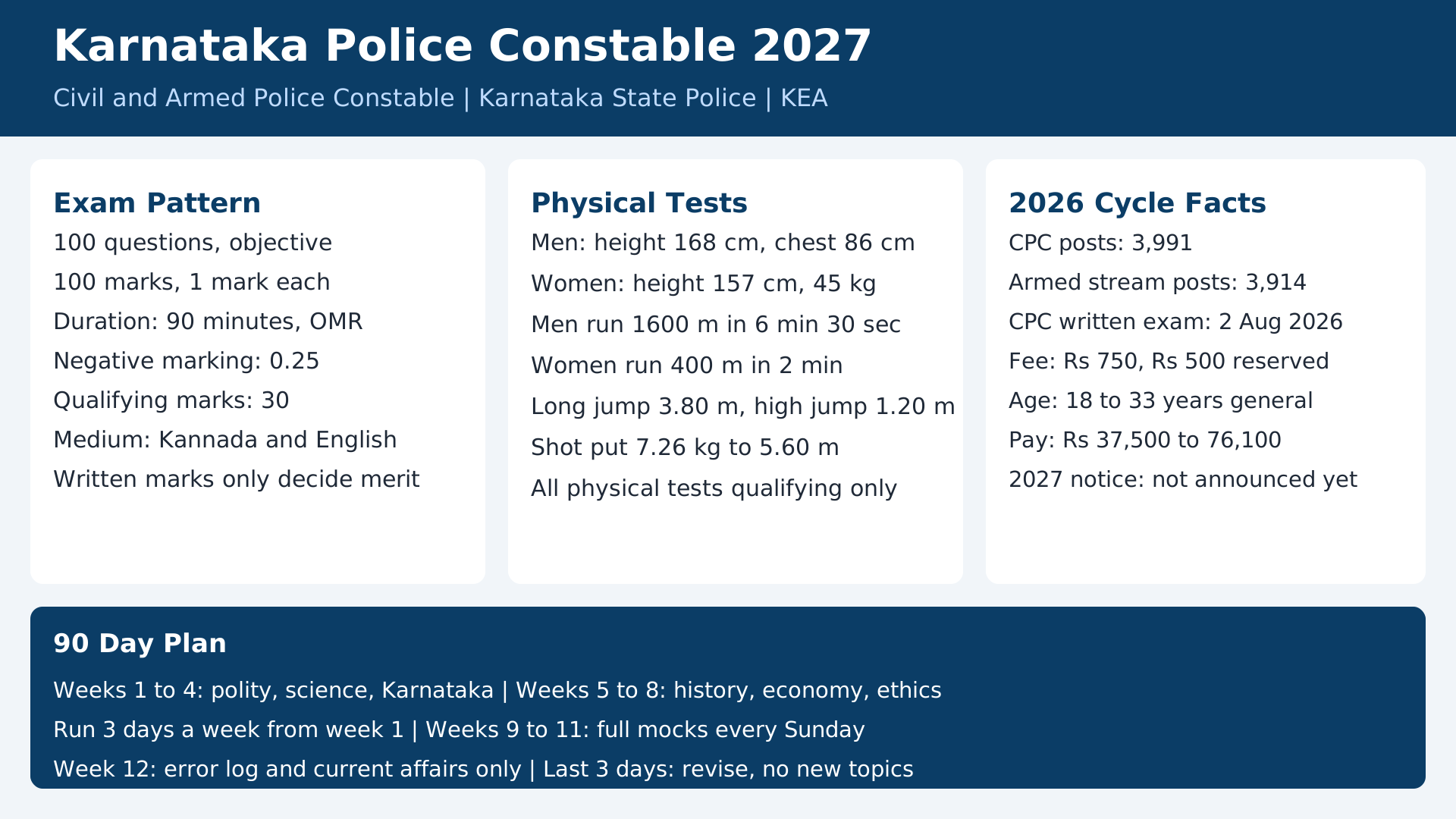
Karnataka Police Constable 2027 has no notification yet as of 19 November 2026. The last real cycle ran in 2026, and it is the only safe base for your preparation. In that cycle the Civil Police Constable stream advertised 3,991 posts and the armed stream advertised 3,914 posts across four notifications. Both streams used one written paper of 100 questions for 100 marks in 90 minutes, and that paper alone decides merit. The physical tests that follow carry no marks at all. If you understand that single fact, you know where your hours should go.
This guide covers both streams, Civil Police Constable and Armed Police Constable, because most candidates search them as one exam and they are not one exam. They have separate notifications, separate dates, separate papers and separate applicant pools. It also covers the Karnataka State Reserve Police stream, because its notification looks similar and its paper shares the same design, yet it is a third recruitment with its own dates. Read the stream that matches your application, and treat every 2027 date in this guide as unannounced until the Karnataka State Police publishes it on ksp.karnataka.gov.in.
The 2026 cycle in numbers
The 2026 Civil Police Constable cycle gives you the clearest picture of what this exam looks like in practice. Two notifications dated 5 June 2026 advertised 3,991 posts. Of these, 3,395 sat in the residual cadre, called the Mikkili or Okkalida cadre in tracker reports, and 596 sat in the Kalyana Karnataka cadre under Article 371J of the Constitution. Applications ran from 8 June to 3 July 2026, with fee payment open to 4 July 2026. The written exam took place on 2 August 2026.
The applicant count tells you how crowded the gate is. A total of 3,90,715 candidates applied for those 3,991 posts, and 3,68,858 paid the fee. That works out to roughly 98 applicants per post. The number looks worse than it is. A large share of those applicants never studied the paper that was actually set, because they prepared from section tables that do not exist. The rest of this guide shows you the paper that was actually set.
| Item | Civil Police Constable 2026 |
|---|---|
| Conducting body | Karnataka State Police, DGP Recruitment wing |
| Written exam conducted by | Karnataka Examinations Authority (KEA) |
| Notification date | 5 June 2026 |
| Posts | 3,991 (3,395 residual, 596 Kalyana Karnataka) |
| Applications | 3,90,715 applied, 3,68,858 paid |
| Application window | 8 June to 3 July 2026 |
| Written exam | 2 August 2026 |
| Pay scale | Rs 37,500 to Rs 76,100 per month |
| Training | 9 months at Police Training Schools |
| 2027 notification | Not announced as of 19 November 2026 |
From 2026 the written exam is conducted and evaluated by KEA, the Karnataka Examinations Authority, while the recruitment itself stays with the Karnataka State Police. Applications also run through the KEA portal at cetonline.karnataka.gov.in/kea. That split matters when you look for notices. The notification and the result lists appear on the KSP recruitment portal, and the application form and admit card sit on the KEA portal. Check both, and trust neither a coaching site nor a forwarded message over them.
Civil and Armed are two different recruitments
A Civil Police Constable works in a police station. The job covers law and order, complaints, investigation support, traffic and beat duty across the districts. An Armed Police Constable works in the City Armed Reserve or the District Armed Reserve, known as CAR and DAR. The job covers riot control, VIP security and armed guard duty. The two streams recruit separately, examine separately and post separately. A candidate who prepares for one and applies for the other will find the paper familiar but not identical, and the dates will not match.
The armed stream in 2026 to 27 advertised 3,914 posts across four notifications that share one written scheme. The CAR and DAR notifications came out on 19 June 2026 and advertised 1,600 posts, 1,421 in the residual cadre and 179 in the Kalyana Karnataka cadre. The KSRP notifications came out on 10 July 2026 and advertised 2,314 posts. CAR and DAR posts are for men only. KSRP and KSISF posts are open to men and women, while IRB posts are for men only.
| Stream | Notification | Posts | Written exam |
|---|---|---|---|
| Civil Police Constable | 5 June 2026 | 3,991 | 2 August 2026 |
| Armed Police Constable, CAR and DAR, men | 19 June 2026 | 1,600 | 6 September 2026 |
| Special Reserve Police Constable, KSRP, men and women | 10 July 2026 | 1,455 | 20 September 2026 |
| KSRP, KSISF and IRB, Kalyana Karnataka | 10 July 2026 | 859 | 20 September 2026 |
The KSRP stream deserves a clear note because its name confuses candidates every year. KSRP stands for Karnataka State Reserve Police. It is a reserve force used for riot control, disaster management and high risk operations. KSISF is the Karnataka State Industrial Security Force. IRB is the India Reserve Battalion. These three sit in one recruitment window with their own notifications and their own exam date, 20 September 2026, and they are not part of the Civil Police Constable drive of 3,991 posts. The 859 Kalyana Karnataka posts in the last row split into KSRP 334, KSISF 364 and IRB 161.
Applications for CAR and DAR ran from 22 June to 22 July 2026, with fee payment open to 24 July 2026. Applications for KSRP ran from 13 July to 10 August 2026, with fee payment open to 11 August 2026. The two groups apply through different KEA portals and sit on different dates. Treat them as two recruitments that share one paper design, because that is what they are.
Who can apply
Every constable post in the 2026 cycle asked for the same minimum qualification. You must have passed Second PUC, Class 12, or an equivalent examination from a recognised board. Candidates whose results were still awaited on the last date of application were not eligible. The marks card had to be in hand before the last date. No minimum percentage was specified. A pass was enough.
Several equivalent qualifications were accepted. These included HSC through NIOS, a three year diploma from a recognised institution, a two year ITI course, and a two year Career Education Diploma, the JOC, JODC and JLDC courses. Class 12 from CBSE, ICSE or any recognised state board counted. A candidate with a diploma, an ITI certificate or a degree was eligible as long as the PUC or Class 12 equivalent condition was met. Only Indian citizens could apply. Candidates from other Indian states could apply but were placed under the General category and could not claim Karnataka state reservation benefits.
The age limits changed in 2026, and the change is the single most important eligibility fact in this guide. Before this cycle the General category upper age was 25 years. A Government Order dated 29 January 2026, GO number 262 of 2025, added a one time relaxation of 5 years for all categories. The General upper age rose to 33 years. SC, ST and Category 1, 2A, 2B, 3A and 3B candidates got an upper age of 35 years. Candidates from notified tribal and forest areas got 38 years. The minimum age stayed at 18 years. Ex servicemen got their service period plus 3 years. The reference date for age calculation was the last date of application, 3 July 2026 for Civil Police Constable.
| Category | Minimum age | Maximum age in 2026 |
|---|---|---|
| General | 18 years | 33 years |
| SC, ST, Category 1, 2A, 2B, 3A, 3B | 18 years | 35 years |
| Tribal and forest area candidates | 18 years | 38 years |
| Ex servicemen | 18 years | Service period plus 3 years |
Do not assume the 5 year relaxation will return in 2027. The order states it is a one time relaxation for the current cycle. Whether it extends to a future cycle depends on a fresh government order. If you are 29 or older, check the age limit in the 2027 notification the day it comes out, before you spend a week on preparation. There is no limit on the number of attempts. You can apply every cycle as long as you meet the age and other conditions.
Two more eligibility conditions catch candidates out. A male candidate who has more than one spouse, or a female candidate married to a person already married, is not eligible unless the Karnataka Government has given an exemption. Candidates with pending criminal cases or criminal records are not eligible. Only one application per notification is allowed, and multiple applications can lead to cancellation.
The written paper, the only stage that counts for merit
The written exam is one undivided paper. It has 100 objective questions for 100 marks, one mark per question, to be answered in 90 minutes on an offline OMR sheet. Each question has four options. A wrong answer costs 0.25 marks. You need 30 marks to qualify. The paper is printed in Kannada and English side by side, and the English version is treated as final in a dispute. That is the whole pattern, and it fits in one paragraph, which is why so many coaching sites pad it out with invented section tables.
| Item | Detail |
|---|---|
| Questions | 100 objective questions |
| Marks | 100 marks, 1 mark per question |
| Duration | 90 minutes |
| Mode | Offline OMR |
| Options | 4 per question |
| Negative marking | 0.25 per wrong answer |
| Qualifying marks | 30 |
| Medium | Kannada and English side by side |
| Merit | Written marks only |
One hundred questions in 90 minutes gives you 54 seconds per question. A two minute question is not this exam's question, however correct your method is. Overwriting an answer or shading two circles counts as wrong. The paper has no sections, and that fact changes how you should study. The notification names one subject only, General Studies, made up of general knowledge, science, geography, history, the Constitution of India, the national freedom movement, mental ability and moral education. No per section counts exist, no sub totals exist, and no section headers appear in any real paper.
Two blueprints circulate widely and both are wrong. One claims General Knowledge 50, Mental Ability 25 and Language 25. The other claims General Knowledge 30, Kannada 20, English 20, Numerical 15 and Reasoning 15. They contradict the official wording and each other. A reading of 1,100 real questions across 11 past papers found not one Kannada grammar question, not one English grammar question, not one vocabulary item and not one comprehension passage. Buying a language book for this paper wastes weeks you do not have.
What the papers do show is same topic blocks of 10 to 20 questions in an order that changes every cycle. The 2026 Kalyana Karnataka paper put mental ability at questions 31 to 45. The residual paper put it at questions 1 to 15. You cannot plan around the order, so do not try. Measured across seven Civil Police Constable papers, weighted toward the two 2026 papers, the split came out at about 85 general awareness, 10 reasoning and 5 arithmetic. The head by head weightage below comes from that same count, and it is a guide to what to study, not a claim that the booklet is divided.
| Head | Questions per 100, about |
|---|---|
| Constitution and polity | 16 |
| General science | 15 |
| Karnataka, all heads together | 12 |
| Geography of India | 7 |
| History of India | 7 |
| Current affairs | 6 |
| Economy | 4 |
| Freedom movement | 3 |
| Science and technology | 3 |
| Ethics and moral education | 3 |
| Sports, culture, awards, days, environment, computer | 9 |
| Mental ability, reasoning half | 8 |
| Mental ability, arithmetic half | 6 |
Polity and general science alone carry about 31 of 100 marks. Short of time, these two return the most marks per hour. Mental ability is about 14, not 25. Candidates who arrive from the Maharashtra Police Constable pattern build a quarter paper reasoning bank, and this paper does not reward it. Karnataka content is about 12 of 100 and falling, from 23 questions in 2019 to 9 and 7 in the two 2026 papers. Ethics is now a real head. It scored zero in every paper before December 2023 and 3 to 6 in every paper since. Two thirds of it is doctrine recall, naming frameworks, committees and codes of conduct. One third is scenario judgement.
The 2026 cycle added one trap that costs marks to candidates who do not know about it. The OMR sheet carries five circles per row. The first four are the answer options. The fifth means not attempted, and you get five extra minutes after the final bell purely to shade it for questions you left alone. The 2024 booklet said an unanswered question gets zero. The 2026 notification says the opposite. If no circle at all is shaded in a row, 0.25 marks are deducted. A blank row now scores exactly like a wrong answer. A blind guess among four options wins 1 mark once in four tries and loses 0.25 on the other three, averaging a gain of about 0.06 marks. The fifth circle scores a clean zero. So answer, even on a hunch, before you shade the fifth circle, and never leave a row blank. Spend those five minutes sweeping for empty rows rather than second guessing answers.
The Kannada language test, and who must sit it
A separate qualifying paper of 150 marks with 50 to qualify sits outside the main paper. It is set at SSLC first language Kannada standard, conducted by KEA, and its marks are not added to merit. You sit it only if you did not study Kannada as a first or second language up to SSLC or higher, did not study in Kannada medium, and have not already passed a recruiting authority's Kannada test. For most Karnataka candidates it does not apply.
In 2026 the Civil Police Constable Kannada test ran in July, before the written exam, with results on 23 July ahead of the 2 August paper. For those who need it, it gates the right to sit the main paper. Its scope covers grammar, vocabulary, synonyms and antonyms, sentence construction, proverbs and idioms, and comprehension at SSLC level. The armed stream held its Kannada test on 22 August 2026 from 3 pm to 5 pm, again for candidates who did not already qualify for exemption. If you studied Kannada at SSLC, ignore this section. If you did not, treat this test as your first exam, because failing it ends the cycle before the main paper begins.
Physical standards and the endurance test
Candidates who qualify in the written exam are called for the Physical Standard Test and the Endurance Test at five per post in the civil stream, and for medical examination at two per post on written marks. The Physical Standard Test measures height, chest and weight on an electronic measuring machine, video and CCTV recorded, and it is pass or fail. The Endurance Test carries no marks at all, which the notification states in plain words. Train seriously, because these stages eliminate, but no amount of running improves your rank.
The physical standards below are the figures reported for the 2026 cycle by Testbook, Meritpulse and Sahisarkarijobs. One source, Prepp, reports the general male height as 170 cm instead of 168 cm. The majority of trackers and the detailed notification summaries report 168 cm, so this guide uses 168 cm and flags the conflict. Confirm the figure in your own cycle's notification before you train to a cutoff.
| Category | Height | Chest or weight |
|---|---|---|
| General male and ex military | 168 cm | Chest 86 cm, with 5 cm expansion |
| Female and transgender candidates | 157 cm | Weight 45 kg |
| Male from tribal and forest areas | 155 cm | Chest 75 cm, with 5 cm expansion |
| Female from tribal and forest areas | 150 cm | As per notification |
The endurance test has three events, and you must pass all three. Failing any single event means elimination. The events differ by group. Men run 1,600 metres within 6 minutes 30 seconds. Women and ex servicemen run 400 metres within 2 minutes. For the jump, men need a long jump of 3.80 metres or a high jump of 1.20 metres, and women need a long jump of 2.50 metres or a high jump of 0.90 metres, with three attempts allowed. You may try either jump or both, but you must qualify in at least one of them. For shot put, men throw a 7.26 kg shot to 5.60 metres or more, and women throw a 4 kg shot to 3.75 metres or more, again with three attempts.
| Event | Men | Women and ex servicemen |
|---|---|---|
| Run | 1,600 m within 6 min 30 sec | 400 m within 2 min |
| Long jump or high jump | 3.80 m or 1.20 m, 3 attempts | 2.50 m or 0.90 m, 3 attempts |
| Shot put | 7.26 kg to 5.60 m, 3 attempts | 4 kg to 3.75 m, 3 attempts |
The armed stream shortlisted candidates for its physical tests at a ratio of 1 to 10 on written marks, wider than the civil stream's 1 to 5. Its eligibility lists came out on 10 October 2026 for one notification group and on 18 October 2026 for the other. As of 23 October 2026 the physical test schedule for the armed stream had not been announced. That gap is normal for this recruitment. The notice period when it arrives will be short, so train now and do not wait for a date to start running.
After the physical stages comes document verification, then a medical examination by a Medical Board. The medical checks vision, hearing and musculoskeletal fitness. The shortlisting ratio for document verification is 1 to 2 per vacancy. No interview is part of the process anywhere in this recruitment. Your rank comes from the written paper alone, and everything after it only decides whether you keep that rank.
What the job pays and what the work looks like
The pay scale for a Karnataka Police Constable in the 2026 cycle was Rs 37,500 to Rs 76,100 per month. Tracker reports put the starting in hand salary at roughly Rs 42,000 to Rs 52,000 per month after standard deductions, depending on city classification and allowances. Treat that in hand figure as indicative, because the actual amount depends on posting location, tax slab and deductions. The package includes basic pay, dearness allowance, house rent allowance and other admissible allowances, plus National Pension System contribution, medical facilities for self and family, leave travel concession, uniform allowance and risk allowance.
Selected candidates undergo 9 months of foundational training at Police Training Schools before posting. The Karnataka State Police is the primary law enforcement agency of the Government of Karnataka, headquartered in Bengaluru, and it was established in 1965. As of 1 February 2026 it had 1,103 police stations across the state. The force handles crime prevention, investigation, traffic management and internal security across 31 districts.
The work is field work. It involves shift duty, outdoor postings, rural postings early in service, and transfers as per administrative needs. Career growth runs through departmental exams and promotions to Head Constable, Assistant Sub Inspector and higher ranks. The job suits candidates who are comfortable with outdoor work, strict physical standards and irregular hours. It does not suit a candidate who wants only desk work, or a candidate with a medical condition that may fail the strict vision, hearing or musculoskeletal standards. Decide that before you apply, because the medical board will decide it for you later.
How to study the General Studies paper
Polity carries about 16 marks, and it is the steadiest head in the paper. Items tie an Article to its subject, ask how a body is composed or appointed, match a writ to its purpose, or give three to five statements and ask which subset is correct. Drill statement based practice, not one line facts. Learn the Constitution as a set of working parts: fundamental rights, directive principles, the President, the Parliament, the judiciary, the states, local government, and the constitutional bodies. A candidate who knows Articles by subject and can pick the correct subset from a list of statements will take most of these marks.
General science carries about 15 marks, and it stays at Class 8 to Class 10 level throughout, never higher. Learn causes in a sentence, everyday phenomena with the mechanism asked, instruments and alloys matched to their use, and deficiency diseases matched to their vitamin. Physics of everyday life, chemistry of common compounds, and human physiology cover most of the head. Do not buy a degree level science book. The paper asks what happens and why, in plain school science, and it asks it fast.
Karnataka content carries about 12 marks in the civil paper and more in the armed paper. Learn dynasties and rulers, temples and capitals, the Mysore Dewans, the unification movement, rivers by length, soils, sanctuaries by district, folk forms by region, and Jnanpith winners from the state. State textbooks printed before 2018 still carry old district names, so check administrative facts against a current source. The share is falling, from 23 questions in 2019 to 9 and 7 in the two 2026 civil papers, so give it its hours but do not let it eat the polity and science hours.
History, geography, economy and current affairs together carry about 24 marks. Chronological ordering and matching dominate. Current affairs favours expanded acronyms of new schemes, newly commissioned ships and satellites, agreements, and the themes of named international days, with a Karnataka strand alongside the national one. For economy, learn basic concepts, budget and tax vocabulary, banking and RBI functions, the main indices, and the Karnataka Economic Survey headline figures. For geography, learn rivers, soils, crops, minerals and the physical map of India and Karnataka. Roughly ten questions per paper are match the list grids, and a comparable number are multi statement selection items. A bank of one fact one answer questions will not read like this exam, so practise figures too. The 2026 papers carried outline maps of India and Karnataka, about six figure items per paper.
Ethics and moral education now carry 3 to 6 marks, and they are the newest head in the paper. Two thirds is doctrine recall, naming frameworks, committees and codes of conduct. One third is scenario judgement. Learn the named frameworks and public service codes and what each says. In scenarios, pick the action that follows law, standing procedure or published duty, not the kindest sounding one. Police situational judgement adds about 1 mark, and the same rule applies: follow procedure, not sentiment.
Mental ability carries about 14 marks in the civil paper, split into roughly 8 reasoning and 6 arithmetic. Number series, letter and alphabet order, coding, direction sense, blood relations, calendar and one figure item cover the reasoning half. For arithmetic, mensuration and time, speed and distance come first, then number system, simplification, percentage, ratio, average and a small data chart. Algebra, trigonometry, interest and partnership appear in zero civil papers. Do not import a banking or SSC reasoning book wholesale. The arithmetic here is short and practical, and a question that needs two minutes of working is a question to skip and return to.
The armed paper is not the civil paper
Measured across six armed papers against the civil stream's eleven, the armed paper carries more general awareness and less reasoning, a higher Karnataka share and a far more volatile science block. General awareness runs about 88 per 100 in the armed stream against 86 in the civil stream. Reasoning runs about 5 against 8. Arithmetic runs about 7 against 6. Karnataka questions average 16.2 in the armed stream against 12.3 in the civil stream. Those gaps are small. The science gap is not.
One armed paper, dated 28 January 2024, ran 32 general science questions. The civil paper of 25 February 2024, five weeks later and built on the same template, ran 15. A candidate who had prepared the civil paper's science and walked into that armed paper found roughly a third of the booklet in a subject treated as a minor head. The science column across the six armed papers reads 9, 7, 19, 32, 13 and 15. Economy runs the same trap in reverse: zero questions in two of the six papers, and then 17 in the 22 November 2020 KSRP paper. The two 2026 papers set by KEA are the most mutually consistent pair in the set, landing on 87 general awareness in both, which makes them the better single guide to the next paper.
The lesson for an armed stream candidate is plain. Cover the floor of every block rather than optimising for an average that no single paper has ever produced. Prepare science to the top of its range and expect the mean. Prepare Karnataka to 23 and expect 16. Prepare economy thin but do not skip it, because a single paper can end a cycle on a head you ignored. Reasoning has never exceeded 7 questions in an armed paper and arithmetic has never exceeded 9. There is no armed paper in which a quarter paper reasoning bank would have paid for itself. Computer awareness ran 6, 3, 2, 1, 0 and 0 in date order, a clean decline to nothing in both KEA papers, so a token revision is enough there. Moral education runs the other way, zero in every paper up to September 2023, then 1, 3 and 4 in the three papers since, the same dated change the civil stream shows.
The armed stream also differs in who can apply. CAR and DAR posts are for men only, and IRB posts are for men only, while KSRP and KSISF posts are open to men and women. The written scheme is identical for CAR, DAR, KSRP, KSISF and IRB posts, which is why one preparation plan serves all four notifications. One honest gap remains. The civil stream's 2026 rule that a wholly blank row is itself penalised does not appear in any armed document the guides we used have read, so it is not claimed to apply here and not claimed to be absent. The safe play costs nothing either way: shade the fifth circle for every question you leave alone.
A 90 day plan for Karnataka Police Constable 2027
| Weeks | Focus | Daily time |
|---|---|---|
| 1 to 2 | Polity basics and general science, plus running 3 days a week | 2 hours study, 30 min run |
| 3 to 4 | Karnataka history, geography and culture, plus current affairs daily | 2 hours study, 30 min run |
| 5 to 6 | Indian history, freedom movement and economy, plus jump and shot put practice | 2 to 3 hours study, 45 min physical |
| 7 to 8 | Ethics and moral education, plus mental ability in 20 minute blocks | 2 hours study, 45 min physical |
| 9 to 10 | Full mock tests every Sunday in 90 minutes on paper with an OMR sheet | 2 hours study, 45 min physical |
| 11 | Two mocks a week, each followed by analysis longer than the mock | 2 to 3 hours study, 45 min physical |
| 12 | Revision of error log, Karnataka notes and six months of current affairs | 2 hours study, light physical only |
| Last 3 days | Polity articles, science facts, Karnataka notes, one light mock test | 1 hour study, rest only |
The plan assumes two hours of study a day and gives polity and science the longest stretch because they carry about 31 of 100 marks between them. Run from week 1, not from the week the physical test notice arrives. The 1,600 metre run in 6 minutes 30 seconds needs weeks of training, and the notice period after the written result is short. Three running days a week in the early weeks, with jump and shot put practice added from week 5, is enough for a candidate who starts from average fitness. If you cannot yet run 1,600 metres without stopping, add two extra running days and cut one hour of current affairs until you can.
Mock tests deserve a fixed slot, not leftover time. Take one full 100 question mock test every Sunday from week 9 onward, in 90 minutes, without pausing, and review every wrong answer the same evening. Track your score by head, not just in total, because a total of 52 that hides a polity score of 6 out of 16 is a warning. Practise on the paper's own shapes: match the list grids, multi statement selection items and figure items. The last three days are for polity articles, science facts and Karnataka notes only. New topics in the last three days cost more marks than they gain, because they displace revision of material you already know.
Keep a single error log, one line per mistake, with the head it belongs to. Rewrite it from memory once a week. That rewrite is the revision. Reading the same page five times only builds recognition, and recognition fails in the exam hall when the options look alike. Separate what you did not know from what you knew and misread, because the fix for each is different. What you did not know needs a note. What you misread needs slower reading and a second look at the question stem, not more notes.
Mistakes that cost marks
The first mistake is studying to a section table that does not exist. No language section, no 25 question reasoning section, no fixed per subject counts. The paper is one General Studies booklet, and the candidates who accept that fact stop buying language books and start drilling polity and science. The second mistake is leaving rows blank. Since 2026 a blank row costs 0.25 in the civil stream, exactly like a wrong answer. Shade the fifth circle for every question you leave alone, and use the five extra minutes after the bell to sweep for empty rows.
The third mistake is treating the physical tests as merit. They are qualifying only. A fast run never adds a mark to your written score, and a slow run never subtracts one. It only decides whether you stay in the race. Train for them, pass them, and keep your study hours on the paper. The fourth mistake is over weighting Karnataka content. It is about 12 of 100 in the civil paper and trending down. Give it its hours, then move on to polity and science, which pay more per hour.
The fifth mistake is using SSC material unfiltered. Algebra and trigonometry are staples there and absent here. The sixth mistake is practising only single fact questions. The modern paper runs on match grids, multi statement items and figures, and a bank of one fact one answer questions will never feel like this exam. The seventh mistake is assuming the sibling constable exams share this paper. Armed Police Constable and the KSRP streams have their own notifications, dates and mixes. One armed paper ran 33 science questions against a civil paper's 15. Prepare for the stream you applied to.
The eighth mistake is applying for the wrong cadre or the wrong stream by accident. The civil drive has two cadres, Kalyana Karnataka and the residual cadre, and separate applications are required for each. The armed drive has separate notifications for CAR and DAR and for KSRP, KSISF and IRB, with different portals and different dates. Read the notification number on your application before you pay, because the fee is non refundable and a second application means a second fee.
Candidates who clear Karnataka Police Constable 2027 often prepare for other uniformed exams alongside it. The UP Police Constable 2027, Bihar Police Constable 2027, SSC GD 2027, AFCAT 2027, Agniveer Vayu 2027, UP Police Sub Inspector 2027, IBPS Clerk 2027, SBI Clerk 2027, RBI Assistant 2027 and UPPSC PCS 2027 pages on this site carry the same style of mock test guide, and the running habit and the General Studies base you build here transfer directly to them.
Start this week with three concrete steps. First, check your age against the 2026 limits and your PUC marks card against the last date rule, because those two checks decide whether you can apply at all. Second, start running three days a week and time your 1,600 metres, because the physical test notice will arrive with little warning. Third, open the KSP recruitment portal and the KEA portal and bookmark both, then set a weekly check for the 2027 notification, because the 2027 dates will appear there first and nowhere else.
Sources
Quiz4Exam KSP Civil Police Constable 2027 strategy guide, built from the official 2026 notifications, official booklets and answer keys, and a reading of 1,100 real questions across 11 past papers, for the 3,991 posts, the 3,90,715 applicants and 3,68,858 paid, the 100 question 90 minute paper with 0.25 negative marking and 30 to qualify, the fifth circle rule, the single General Studies subject, the measured weightage, the Kannada test of 150 marks with 50 to qualify, the 1 to 5 and 1 to 2 shortlisting ratios, the pay scale of Rs 37,500 to Rs 76,100, and the 9 months of training. Quiz4Exam KSP Armed Police Constable 2027 strategy guide, built from the official notifications on ksp-recruitment.in and six real armed papers, for the 3,914 armed stream posts, the CAR and DAR dates of 19 June, 22 June to 22 July and 6 September 2026, the KSRP dates of 10 July, 13 July to 10 August and 20 September 2026, the 1 to 10 physical shortlisting ratio, the armed paper weightage and the science volatility. Prepp Karnataka Police Constable eligibility page, for the age limits of 18 to 33, 35 and 38 years, the Government Order of 29 January 2026, the PUC qualification and its equivalents, the Kannada test date of 19 July 2026, and the physical standards, with the male height reported as 170 cm against the 168 cm used here. Testbook KSP constable physical test and eligibility pages, for the male height of 168 cm, chest 86 cm with 5 cm expansion, female height 157 cm and weight 45 kg, tribal standards of 155 cm and 150 cm, and the endurance standards for running, jumps and shot put. Sahisarkarijobs KSP Civil Police Constable Recruitment 2026 page, for the application window of 8 June to 3 July 2026, the fee of Rs 750 for General and Rs 500 for reserved categories, the cadre split of 3,395 and 596, the exam timings, and the indicative in hand salary of Rs 42,000 to Rs 52,000.
Meritpulse KSP syllabus page and FreeJobAlert Kannada test page, for the physical standards and the armed Kannada test date of 22 August 2026. Wikipedia Karnataka State Police page, for the force established in 1965, headquartered in Bengaluru, with 1,103 police stations as of 1 February 2026. Karnataka State Police official site at ksp.karnataka.gov.in and the Karnataka Examinations Authority portal at cetonline.karnataka.gov.in/kea, for the conducting bodies and the application route.







