
About JK Police SI 2027 Exam Series
📖 Table of Contents
- JK Police SI 2027 and the live cycle in numbers
- The written exam pattern changed, and the old pattern will mislead you
- Who can apply for JK Police SI 2027
- Physical standards and the endurance test
- What each section of the syllabus actually asks
- Fee, salary and what the job pays
- Do not confuse this exam with Sub Inspector Telecom
- The 2021 cycle and why it still matters
- How the selection runs from form to final list
- A 90 day plan that fits this paper
- Mistakes that cost candidates this exam
- Sources
JK Police SI 2027: Sub Inspector Exam Guide
The Jammu and Kashmir Services Selection Board, JKSSB, is running the current Sub Inspector cycle for 669 posts, and the written exam is set for 29 November 2026. JK Police SI 2027 has no notification yet as of 20 November 2026, so every fact in this guide comes from the live cycle, Advertisement Number 02 of 2024, and the 2021 cycle that came before it. If you plan to sit for the 2027 cycle, those two cycles are the closest picture you have of the posts, the pattern, the age limits, the physical tests and the fees. The Jammu and Kashmir Services Selection Board conducts the exam for the Home Department, and the Jammu and Kashmir Police is the department you join.
Sub Inspector is the first officer rank in the Jammu and Kashmir Police. An SI leads a police station team, investigates cases, supervises constables, and handles law and order duty in a police station or an armed unit. The post carries Level 6C pay, Rs 35,700 to Rs 1,13,100 a month, and it is a uniformed job with real authority from the first posting. That is why the competition is sharp. The 2021 cycle drew more than 97,000 candidates for 1,200 posts, and the current cycle is heading the same way. A degree in any subject makes you eligible, the age window is 18 to 28 years, and the written exam decides the merit. The physical tests only qualify you, they add no marks.
JK Police SI 2027 and the live cycle in numbers
| Item | Detail |
|---|---|
| Conducting body | Jammu and Kashmir Services Selection Board (JKSSB) |
| Department | Home Department, Jammu and Kashmir Police |
| Latest notification | Advertisement Number 02 of 2024, dated 22 November 2024 |
| Posts in the live cycle | 669 Sub Inspector posts |
| Application window | 3 December 2024 to 2 January 2025, online only |
| Written exam date | 29 November 2026, as per Testbook |
| Age limit | 18 to 28 years as on 1 January 2024, in service police personnel up to 30 years |
| Qualification | Bachelor degree in any discipline from a recognised university |
| Pay | Level 6C, Rs 35,700 to Rs 1,13,100 per month |
| Application fee | Rs 700 for most categories, Rs 600 for SC, ST 1, ST 2 and EWS |
| 2027 notification | Not issued as of 20 November 2026 |
The 669 posts split across categories as follows. Open Merit gets 267, SC gets 53, ST 1 gets 67, ST 2 gets 67, OBC gets 54, RBA gets 67, ALC and IB get 27, and EWS gets 67. Add those up and you get 669. The notification says the number of posts can rise or fall before the selection ends, and JKSSB is not bound to the advertised figure, so treat 669 as the working number and check the final list when it comes.
One warning belongs right at the top. The 2021 SI cycle ended in a paper leak scandal. JKSSB held the written exam on 27 March 2022, declared the result on 4 June 2022, and the Lieutenant Governor cancelled the whole selection list on 8 July 2022 after an inquiry found paper leaks and fraud. The CBI took the case and filed a chargesheet against 33 people on 12 November 2022. The current cycle, Advertisement 02 of 2024, is the fresh recruitment that followed. If you read old guides that quote the 2021 dates as live, they are three years out of date.
The written exam pattern changed, and the old pattern will mislead you
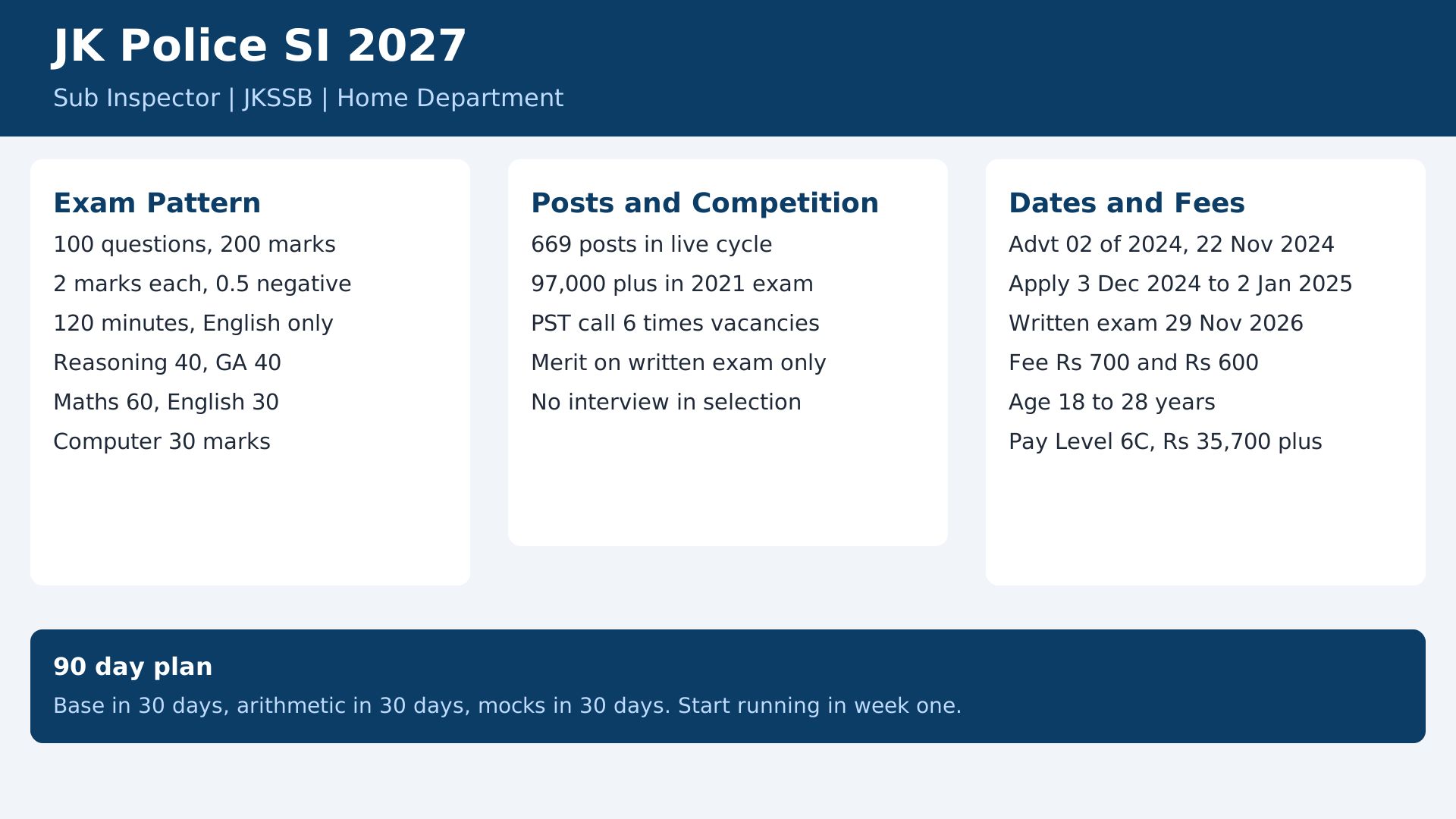
JKSSB issued a new syllabus notice on 26 December 2024 for this cycle, and it changed the paper. The written exam now has 100 objective questions for 200 marks, with each question carrying 2 marks and a negative marking of 0.5 marks for each wrong answer. You get 120 minutes. The six sections are Reasoning with 20 questions for 40 marks, General Awareness with 20 questions for 40 marks, Quantitative Aptitude with 15 questions for 30 marks, English with 15 questions for 30 marks, Mathematical Abilities with 15 questions for 30 marks, and Computer Proficiency with 15 questions for 30 marks. Reasoning, General Awareness and English are set at graduation level. Quantitative Aptitude, Mathematical Abilities and Computer Proficiency are set at Class 10 level. That split matters for your preparation, because the Class 10 sections reward speed and accuracy while the graduation sections reward reading and reasoning.
| Section | Questions | Marks | Level |
|---|---|---|---|
| General Intelligence and Reasoning | 20 | 40 | Graduation |
| General Awareness | 20 | 40 | Graduation |
| Quantitative Aptitude | 15 | 30 | Class 10 |
| English | 15 | 30 | Graduation |
| Mathematical Abilities | 15 | 30 | Class 10 |
| Computer Proficiency | 15 | 30 | Class 10 |
| Total | 100 | 200 | 120 minutes |
The old pattern is still all over the internet, and it will waste your time if you follow it. The 2021 cycle had 120 questions for 150 marks, with each question carrying 1.25 marks and a negative marking of 0.25 marks per wrong answer as stated in the notification. Its sections were Current Events and General Awareness, History of India and the National Movement, Indian and World Geography, Indian Polity and Governance, the Jammu and Kashmir Reorganisation Act 2019 with special reference to Jammu and Kashmir, Economic and Social Development, General Science and Environment, and General Mental Ability with Reasoning and Computers. That paper is gone. A few tracker pages still show a third version, six subjects of 20 marks each for a total of 120 marks, and no official source supports that version. Use the 100 question, 200 mark pattern above. It comes from the JKSSB notice of 26 December 2024 as reported by two independent tracker pages.
Merit works in a simple way, and you should plan around it. The written exam alone decides the final merit. The Physical Standard Test and the Physical Endurance Test are qualifying only. JKSSB calls candidates for the physical tests at six times the number of vacancies in each category, so about 4,014 candidates from the live cycle reach the physical stage. Pass the physical tests and your written score is what ranks you. A candidate who scores 10 marks more in the written exam beats a candidate who runs faster, because the run carries no marks at all. Train for the physical tests so they cannot knock you out, then put your hours into the written paper.
Who can apply for JK Police SI 2027
You need a bachelor degree from a recognised university, in any discipline. There is no subject condition for the general SI post. You must hold a domicile certificate of the Union Territory of Jammu and Kashmir, issued on or before the last date for applications. Only domiciles of Jammu and Kashmir can apply. The age is counted as on 1 January 2024 for the live cycle. Open Merit candidates must be between 18 and 28 years, born between 1 January 1996 and 1 January 2006. In service police personnel can apply up to 30 years. Ex servicemen can deduct their period of military service from their actual age. Reserved categories get relaxation under the Jammu and Kashmir rules, and the notification gives the exact born before and born after dates for each category, so check your category row before you apply.
The age question has a history that still affects candidates. In November 2021 the government announced a one time age relaxation for SI aspirants, because the recruitment had not been held for years. In December 2024 the Central Administrative Tribunal directed JKSSB to allow 241 overage aspirants to take part in the fresh selection process, with their results kept in a sealed cover pending further orders. Those 241 candidates had crossed 28 years while waiting for the advertisement. If you are close to the age limit, do not assume a relaxation will come. Apply in the cycle where you are eligible, and keep your domicile and category certificates ready before the window opens, because JKSSB does not accept certificates issued after the last date.
Physical standards and the endurance test
The physical standards are fixed by the Jammu and Kashmir Police Subordinate Service rules, and they are the same for the SI and the constable recruitments. Male candidates need a minimum height of 5 feet 6 inches, with a chest girth of 32 inches unexpanded and 33.5 inches expanded. Female candidates need a minimum height of 5 feet 2 inches, with no chest measurement. There is no weight condition in the notification. Measure yourself with a tape before you apply, because the Physical Standard Test is the first gate and there is no appeal against a height reading.
| Standard | Male | Female |
|---|---|---|
| Height | 5 feet 6 inches minimum | 5 feet 2 inches minimum |
| Chest unexpanded | 32 inches | Not applicable |
| Chest expanded | 33.5 inches | Not applicable |
The Physical Endurance Test has two events for each sex, and you must pass both. Male candidates run 1,600 metres in 6 minutes 30 seconds and do 20 pushups, with one cycle of up and down counted as one. Female candidates run 1,000 metres in 6 minutes 30 seconds and throw a 4 kg shot put 14.5 feet in three attempts. Ex servicemen face relaxed endurance standards under the rules. The endurance test is qualifying, so a pass is a pass, but do not train to the bare minimum. A 6 minute 30 second 1,600 metre run on a test day, after the height and chest check, with nerves and a crowd, feels very different from the same run on your home ground. Train to finish the distance in 6 minutes in practice, and the test day margin will carry you.
What each section of the syllabus actually asks
General Awareness carries 40 marks and it is the section where Jammu and Kashmir knowledge pays. The syllabus covers current events of national and international importance, the history of India and the National Movement, Indian and world geography, Indian polity and governance, economic and social development, and general science with environment. On top of that, the Jammu and Kashmir Reorganisation Act 2019 and Jammu and Kashmir with special reference carry their own weight in the older syllabus, and the new pattern keeps General Awareness as a single 40 mark block. Read the Jammu and Kashmir Reorganisation Act in plain language, learn the structure of the Union Territory administration, the districts and divisions, the major rivers and passes, the handicrafts and the horticulture economy, and the big central schemes as they apply in Jammu and Kashmir. Candidates who treat General Awareness as generic current affairs leave easy marks behind, because the Jammu and Kashmir questions repeat year after year.
Reasoning, also 40 marks, is the section that separates serious candidates from casual ones. It covers logical deductions, analytical reasoning, series, analogies, syllogisms, coding and decoding, blood relations, direction sense, ranking, and data interpretation. This is a practice section. You cannot read your way to 35 marks in Reasoning, you have to solve your way there. Do 20 questions a day from the second week of preparation, time yourself, and keep an error log. The same five or six question types repeat, and once you recognise them you answer in seconds instead of minutes.
English, 30 marks, tests grammar, vocabulary, comprehension, synonyms and antonyms, error detection, sentence correction, and one word substitution. The passage is usually the easiest 5 or 6 marks in the paper if you read it properly, so do not skip it under time pressure. Quantitative Aptitude and Mathematical Abilities together carry 60 marks at Class 10 level, which is the largest block in the paper. Number system, percentage, ratio and proportion, profit and loss, time and work, speed and distance, simple and compound interest, averages, mensuration, and data interpretation cover most of it. The level is Class 10, but the questions are set for speed. If your arithmetic is slow, these 60 marks will eat your time and drag your score down. Computer Proficiency, 30 marks, covers computer hardware, software basics, the internet, cyber crime basics, and the IT Act. It is the most scoring section for candidates who have used a computer daily, and the most neglected section for everyone else. Give it one week of focused reading and you can pick up 20 marks that most candidates leave on the table.
Negative marking shapes how you attempt the paper. Every wrong answer costs 0.5 marks in the current pattern, which is a quarter of the 2 marks a question carries. With 100 questions and 120 minutes, you have 72 seconds per question on average. The right approach is two passes. In the first pass, answer everything you know and mark the questions you can solve with a little more time. In the second pass, work the marked questions and leave the pure guesses alone. A blind guess has a one in four chance of gaining 2 marks and a three in four chance of losing 0.5, so random guessing hurts over a full paper. An educated guess between two options is a different matter, and it is worth taking.
Fee, salary and what the job pays
The application fee in the live cycle is Rs 700 for Open Merit, RBA, ALC and IB, OBC and other unreserved categories, and Rs 600 for SC, ST 1, ST 2 and EWS. Pay online only, through net banking, credit card or debit card, on the JKSSB portal. The fee is non refundable, and an application without the fee is rejected without consideration. That sounds obvious, but every cycle a few hundred applications fail on payment, usually because the candidate closed the window before the payment confirmation loaded. Wait for the confirmation page and save the receipt.
The pay is Level 6C in the pay matrix, Rs 35,700 to Rs 1,13,100 per month, plus the allowances that apply to Jammu and Kashmir Police personnel. During the probation period the Jammu and Kashmir Probationer Rules 2020 apply to pay and allowances, so your first two years will not look like the full pay band. The SI post also carries the usual police allowances and the career path runs upward to Inspector and beyond through promotion and departmental examination. Do not pick this exam for the starting salary alone. Pick it because you want police work, because the job involves night duty, disturbed area postings, public dealing under pressure, and long hours that no pay chart can soften.
Do not confuse this exam with Sub Inspector Telecom
JKSSB advertised a separate post, Sub Inspector Telecommunication, under Advertisement Number 11 of 2025, dated 26 November 2025, for 83 posts. That post needs a four year BE or BTech degree in Electronics and Communication, Computer Science, Information Technology or a related stream, and it carries the same Level 6C pay. Its written exam is a different paper, 100 questions for 200 marks with Part A of 60 marks on general awareness, aptitude and communication and Part B of 140 marks on technical subjects, with negative marking of 0.5 per wrong answer. Applications ran from 15 December 2025 to 13 January 2026, and Testbook lists its exam date as 23 December 2026. General graduates cannot apply for the Telecom post, and engineering graduates should not prepare for the general SI paper when their exam is the Telecom one. The two recruitments share the JKSSB portal and the SI title, and that is where the similarity ends.
There is also a tracker claim that the Jammu and Kashmir Police Headquarters issued its own SI notification in December 2025 for 658 posts, 482 Executive and 176 Armed, with applications through jkpolice.gov.in. That claim could not be verified against an official source during preparation, and it conflicts with the JKSSB cycle of 669 posts that is documented in the actual notification. This guide follows the JKSSB cycle. If a Police Headquarters notification exists, it would be a separate recruitment, and the upload check should confirm it on jkpolice.gov.in before anyone acts on it.
The 2021 cycle and why it still matters
The 2021 cycle deserves a full section, because it explains the caution in this guide and the rules that changed after it. JKSSB advertised 1,200 SI posts on 10 November 2021, under Advertisement Number 06 of 2021, and the application window ran to 10 December 2021, later extended to 26 December 2021. The written exam was held on 27 March 2022, and more than 97,000 candidates appeared. JKSSB declared the result on 4 June 2022, and the selection list of 1,200 candidates followed. Within weeks, allegations of paper leaks and favouritism surfaced, protests broke out in Jammu, and the government formed a probe committee headed by the Financial Commissioner of the Home Department. On 8 July 2022 the Lieutenant Governor cancelled the recruitment process from the start and recommended a CBI probe. The CBI filed a chargesheet against 33 people on 12 November 2022, and the alleged mastermind was arrested by the Enforcement Directorate in June 2024.
Three lessons from that cycle apply to your preparation. First, the 2021 paper is still useful for practice, because its syllabus topics overlap with the current one, but its pattern is dead, so do not use its question count or marks as your model. Second, the fresh cycle took more than two years to arrive, which is why the age relaxation question keeps coming up in court, and why you should never sit out a cycle hoping for a better one. Third, the Home Department placed draft Jammu and Kashmir Police Subordinate Service Recruitment Rules 2025 in the public domain in December 2025, to replace the old 1960 rules, which shows the recruitment framework itself is being rewritten. Read the rules when they are finalised, because they will govern the 2027 cycle.
How the selection runs from form to final list
The selection has four stages, and they run in a fixed order. First comes the online application on the JKSSB portal, with the fee paid online and the documents uploaded in the prescribed format. JKSSB then issues admit cards for the written examination, which is the only stage that carries marks. Candidates who clear the written exam are called for the Physical Standard Test at six times the number of vacancies in each category. Those who pass the height and chest check move to the Physical Endurance Test, the run and the pushups or the shot put. The last stage is document verification, where JKSSB checks your degree, your domicile certificate, your date of birth, and your category certificate against the cut off dates in the notification. A candidate who fails document verification loses the post even with a top written score, which is why the certificates deserve the same attention as the syllabus.
Medical examination follows selection under the police rules, and the appointment is subject to character verification by the police. The final selection list is drawn from the written merit of candidates who pass every later stage. There is no interview in this recruitment. That is good news for candidates who write well but speak nervously, and it puts the whole weight on the two hours of the written paper. Treat the physical tests as gates you must walk through, and the written paper as the race itself.
A 90 day plan that fits this paper
Days 1 to 30 are for the base. Cover the full syllabus once, section by section, with two hours a day on General Awareness and Jammu and Kashmir topics, one hour on Reasoning, and one hour split between English and Computer Proficiency. Start running in the first week, not the last month. Three runs a week, building from 800 metres to 1,600 metres, plus pushups every other day. The physical test has ended more SI dreams than the written paper, and it is the easiest stage to secure if you start early.
Days 31 to 60 are for the arithmetic block. Give Quantitative Aptitude and Mathematical Abilities two hours a day, because together they carry 60 marks at Class 10 level and they are the most trainable part of the paper. Keep one hour for General Awareness revision and one hour for Reasoning practice. Take your first full mock test at the end of week six, under exam conditions, 100 questions in 120 minutes, with negative marking applied. Score it and count every mark lost to a guess, then find your weak section before the last month.
Days 61 to 90 are for mocks and revision. Take two mocks a week, and spend the day after each mock only on the questions you got wrong. Revise Jammu and Kashmir facts, the Reorganisation Act, current affairs of the last six months, and the computer section in the final two weeks. In the last three days, stop learning new topics. Sleep properly, keep the running light, and revise your error log. The candidates who fail this exam usually fail on time management or on the physical test, not on knowledge, and both are fixed in the 90 days before the exam, not in the exam hall.
Mistakes that cost candidates this exam
The first mistake is preparing for the wrong pattern. Most free material online still shows the 120 question, 150 mark paper from 2021. If your mock tests use that pattern, your timing and your score mean nothing. Check that every mock you take has 100 questions, 200 marks, and 0.5 negative marking. The second mistake is ignoring the physical test until the written result comes. JKSSB calls six times the vacancies for the physical tests, which sounds generous, but the run and the pushups knock out candidates every cycle. The third mistake is treating General Awareness as a last week revision subject. It carries 40 marks, the same as Reasoning, and the Jammu and Kashmir portion of it is the most predictable part of the whole paper. The fourth mistake is applying without a domicile certificate in hand, or with a category certificate issued after the last date. JKSSB is strict on cut off dates, and no representation after the fact has ever helped.
JK Police SI aspirants often prepare for other uniformed exams alongside this one. The UP Police Sub-Inspector 2027, UP Police Constable 2027, Bihar Police Constable 2027, SSC GD 2027, SSC Delhi Police Constable 2027, AFCAT 2027, Agniveer Vayu 2027, IBPS PO 2027, SBI PO 2027 and UPPSC PCS 2027 pages on this site carry the same style of mock test guide, and the pattern habit you build here transfers directly to them.
Sources
JKSSB Advertisement Notification Number 02 of 2024 dated 22 November 2024, for the 669 posts, the category split of 267 Open Merit, 53 SC, 67 ST 1, 67 ST 2, 54 OBC, 67 RBA, 27 ALC and IB, and 67 EWS, the application window of 3 December 2024 to 2 January 2025, the Level 6C pay of Rs 35,700 to Rs 1,13,100, the fee of Rs 700 and Rs 600, and the age limits of 18 to 28 years with in service personnel up to 30 years, as reported by Career Power, Adda247, Government Daily Jobs and the notification copy on Scribd. The JKSSB syllabus notice of 26 December 2024, for the new 100 question and 200 mark pattern with 0.5 negative marking and the six sections, as reported by Ignite JK and JK Scholar. The 2021 cycle facts, Advertisement Number 06 of 2021, the 1,200 posts, the exam date of 27 March 2022, the result of 4 June 2022, the physical standards and the endurance test, from Oliveboard and the notification summary on JKSSB Posts. The cancellation of the 2021 selection list on 8 July 2022, the CBI probe and the chargesheet against 33 people on 12 November 2022, from The Print, The Indian Express of 17 November 2026, and the Central Administrative Tribunal order of 28 December 2024 allowing 241 overage aspirants, from News Drum and State Times. JKSSB Advertisement Number 11 of 2025 dated 26 November 2025, for the 83 Sub Inspector Telecommunication posts, the BE and BTech eligibility, the application window of 15 December 2025 to 13 January 2026, and the exam date of 23 December 2026, from Testbook, JKSSB Edge and JK Exams. The draft Jammu and Kashmir Police Subordinate Service Recruitment Rules 2025 placed in the public domain in December 2025, from the Daily Excelsior of 25 December 2025. The official JKSSB site at jkssb.nic.in and the Jammu and Kashmir Police site at jkpolice.gov.in, which could not be reached directly during preparation on 20 November 2026, so the facts above rest on the notification copies and tracker pages listed here and should be checked against the official notification before you apply.







