
About Kerala High Court 2027 Exam Series
📖 Table of Contents
- Kerala High Court 2027 at a glance
- The last Assistant cycle, start to finish
- 45 posts across two recruitment numbers
- Who can apply
- Kerala High Court exam pattern: 100 plus 60 plus 10
- The objective test, section by section
- The descriptive test is only marked for some candidates
- The interview, and the 35 percent rule
- Pay, and what an Assistant actually does
- Cut offs: a 40 percent floor, and 48.5 in practice
- A preparation plan that follows the marks
- Mistakes that cost candidates the post
- What to watch next
- Mock tests for Kerala High Court Assistant 2027: Full Tests, PYQ, Chapter Tests, Sectional Tests, NCERT based Tests, Current Affairs and PYQ PDF Downloads
- Sources
Kerala High Court 2027: Complete Exam Guide
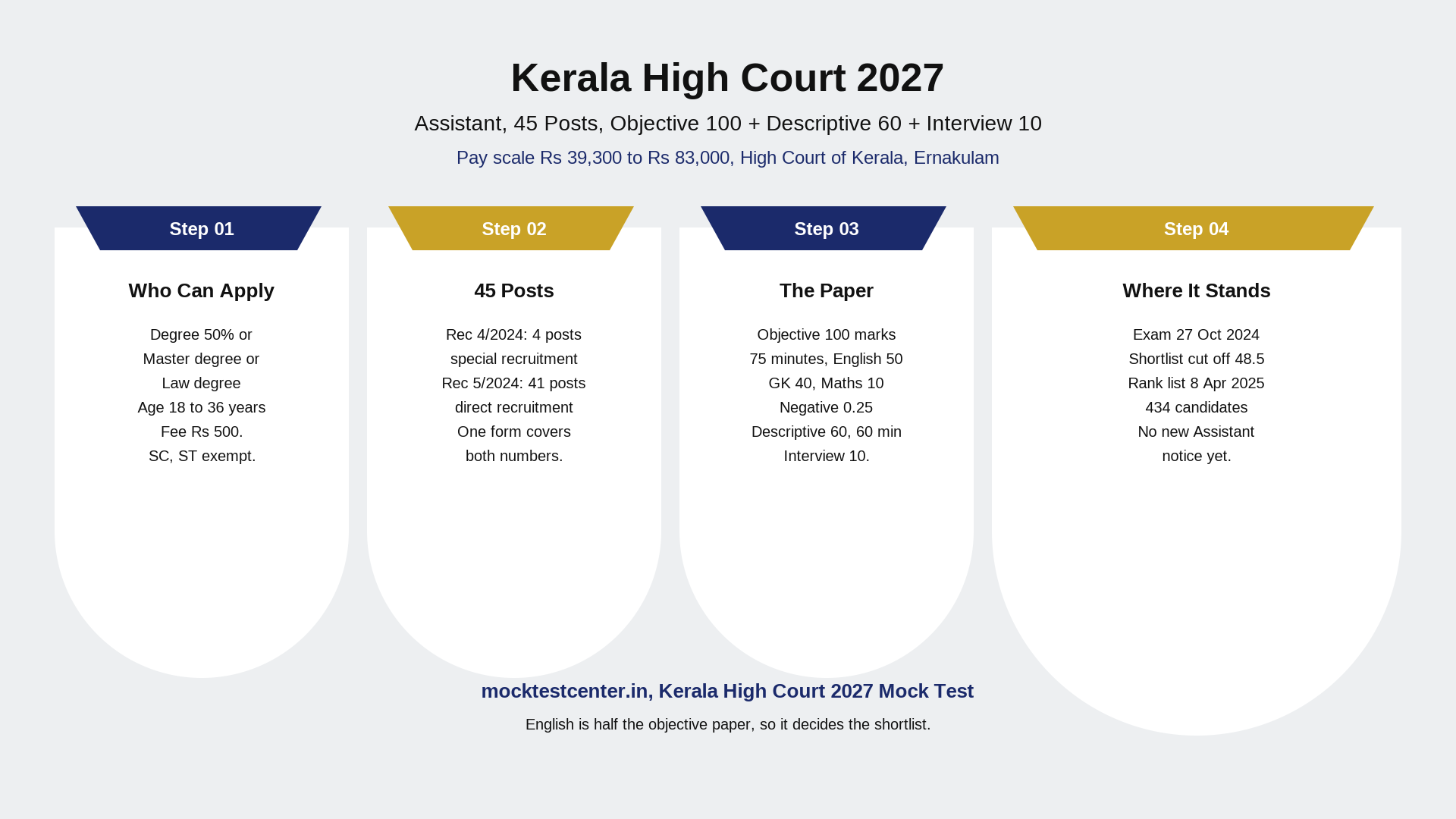
Kerala High Court 2027 is the page for the Assistant post in the High Court of Kerala, and the recruitment it follows is Recruitment Numbers 4/2024 and 5/2024, the last complete Assistant cycle. The High Court published that notification on 27 March 2024, held the written test on 27 October 2024, and published the final rank list on 8 April 2025. No new Assistant notification has appeared as of 23 November 2026, so this guide anchors on the 2024 cycle and says so plainly wherever a 2027 figure would otherwise be guessed. The post is Assistant in the High Court itself, at Ernakulam, recruited directly by the High Court through its own portal, not through the Kerala Public Service Commission.
The single number that should shape every preparation plan is 50. General English carries 50 of the 100 marks in the objective test, which is half the paper. General Knowledge carries 40, and Basic Mathematics and Reasoning carries 10. A candidate who treats English as one subject among three has misread the paper. English decides the shortlist, because the objective test needs 40 percent to reach the shortlist and the actual shortlist cut off in the last cycle stood at 48.5, and a candidate who scores 30 in English needs 19 of the remaining 50 marks just to reach that line. The descriptive test adds 60 marks and the interview adds 10, for a total of 170, but neither of those stages matters to a candidate who falls short in the objective test.
The Kerala High Court exam pattern rewards a particular kind of candidate. The objective test runs 75 minutes for 100 questions, which gives 45 seconds per question, and every wrong answer costs a quarter mark. The descriptive test follows immediately after the objective test, on the same day, for 60 marks in 60 minutes, and the High Court evaluates the descriptive papers only of candidates who reach the interview shortlist. The interview carries 10 marks, and a candidate needs 35 percent in the interview to find a place in the ranked list. Three stages, one day for the written papers, and a rank list built from all three scores together.
A warning belongs at the top of this guide, because tracker pages currently carry a 55 post Assistant notification with application dates in July and August 2025. That page is a recycled 2021 notification. Its web address contains the words recruitment-2021, its birth window runs from 2 January 1985 to 1 January 2003, which fits a 2021 cycle, and its fee of Rs 450 does not match the Rs 500 fee of the 2024 notification. Testbook, which tracks the exam separately, says the 2026 notification will release soon and puts the vacancy as to be announced. No new Assistant notification exists as of 23 November 2026, and any page that prints 2025 application dates for the Assistant post is repeating the old cycle.
Kerala High Court 2027 at a glance
| Detail | Kerala High Court 2027, as run in the 2024 Assistant cycle |
|---|---|
| Conducting body | High Court of Kerala, Ernakulam, through hckrecruitment.keralacourts.in |
| Post | Assistant |
| Live cycle | Recruitment Numbers 4/2024 and 5/2024, reference REC1-81360/2023, dated 27 March 2024 |
| Posts | 45, 4 under 4/2024 and 41 anticipated under 5/2024 |
| Applications | 3 April to 2 May 2024, closed |
| Fee | Rs 500, SC and ST and unemployed differently abled candidates exempt |
| Written test | 27 October 2024, objective test 100 marks in 75 minutes plus descriptive test 60 marks in 60 minutes |
| Interview | 4 to 22 February 2025 |
| Final rank list | 8 April 2025, 434 candidates |
| Pay scale | Rs 39,300 to Rs 83,000 |
| 2027 notification | Not published as of 23 November 2026 |
The last Assistant cycle, start to finish
The High Court published the notification on 27 March 2024 under reference REC1-81360/2023, covering two recruitment numbers in a single advertisement. Applications ran from 3 April to 2 May 2024, a window of thirty days, and one application form covered both recruitment numbers. The admit card came out on 9 October 2024, eighteen days before the exam. The written test took place on 27 October 2024, a Sunday, across the state, with the objective test and the descriptive test held back to back on the same day.
The shortlist followed in December 2024. Competitive Cracker puts the shortlist date at 17 December 2024, with a cut off mark of 48.5, while Adda247 puts the result at 18 December 2024 and a job tracker puts it at 19 December 2024. The three dates disagree by two days, and this guide uses 17 December 2024 with the conflict recorded, because Competitive Cracker ties the date to the cut off figure in the same paragraph. The shortlist carried the roll numbers of candidates provisionally shortlisted for the interview, and the High Court evaluated the descriptive papers only of those candidates.
Interviews ran from 4 to 22 February 2025, about three weeks, and the final rank list came out on 8 April 2025, about seven weeks after the last interview. The rank list carried 434 candidates in total, with a main list of 258 and supplementary lists for the reserved communities, and it covered both recruitment numbers, with the Recruitment Number 4 list carrying 22 candidates from the differently abled category. The whole cycle, from notification to final rank list, took just over a year, and the largest gap inside it was the five and a half months between the written test and the interviews.
That timeline sets the expectation for the next cycle. A candidate who applies when the next notification appears should expect a month to apply, about five months to the written test, and another five months to the final rank list. The written test date in the last cycle came about six months after the notification, and the admit card came eighteen days before the test. None of those gaps is a promise for the next cycle, but they are the only real timings available, and they beat any guess.
45 posts across two recruitment numbers
The 45 posts split into two recruitment numbers with different characters. Recruitment Number 4/2024 carried 4 posts under special recruitment for differently abled candidates, to fill backlog vacancies for the period from 29 June 2021 to 21 July 2023. Recruitment Number 5/2024 carried 41 anticipated posts under direct recruitment. The word anticipated matters. The 41 posts were the vacancies the High Court expected, not a fixed number, and the final rank list carried far more names than 41, because a rank list is a panel from which appointments happen as vacancies arise, not a list of 41 appointments.
One application form covered both numbers, and the selection process ran as one process for both. A differently abled candidate had to select both numbers on the single form. Applying twice lost the common candidature, according to the notification summary, and separate ranked lists came out for each number. A candidate who applied under only one number when eligible under both narrowed their own chances for no reason, and that is the kind of form error that no amount of preparation can fix afterwards.
The 45 post figure is small beside the number of applicants, though no applicant total for the 2024 cycle appeared in the sources read. This guide prints no applicant count and no competition ratio, because neither figure surfaced in a source that could be checked. The shortlist cut off of 48.5 is the only hard evidence about how many candidates cleared the objective test, and even that figure comes without the number of candidates who sat the paper.
Who can apply
The qualification rule has a hard edge that catches candidates every cycle. A candidate needs a Bachelor degree with at least 50 percent marks, or a Master degree, or a Law degree, awarded or recognised by any of the Universities in Kerala. A Bachelor degree below 50 percent does not qualify, and rounding to the nearest whole number is not allowed, so 49.5 percent does not become 50 percent. Scheduled Caste and Scheduled Tribe candidates are exempt from the 50 percent requirement. Where a university awarded a CGPA, OGPA or letter grade, the candidate must enter the equivalent percentage, with a certificate to that effect from the university at verification. All qualifications must be held on or before the closing date for applications. Knowledge of computer operations is desirable, not essential, and it appears in the notification as a desirable qualification rather than a condition.
The age rule is 18 to 36 years, with age reckoned on 1 January of the notification year. For the 2024 cycle that meant a general candidate born between 2 January 1988 and 1 January 2006, both days inclusive. The relaxations run as follows: Other Backward Classes plus 3 years, to 39, Scheduled Castes and Scheduled Tribes plus 5 years, to 41, High Court service staff in scales below Assistant plus 4 years, to 40, and ex-servicemen, ex-General Reserve Engineer Force and disembodied Territorial Army personnel may exclude their service plus up to five years of unemployment after discharge, provided they have not reached 50. For blindness and low vision, and deaf and hard of hearing, the relaxation is 15 years, and for other disabilities 10 years, with the upper age never exceeding 50. Widows get 5 years, also capped at 50.
One tracker page prints an age table worked out for a 2026 notification, with a general candidate born between 2 January 1990 and 1 January 2008. That table assumes a notification that does not exist, since no Assistant notification appeared in 2026, and its dates clash with the 2024 cycle. This guide prints the rule and the 2024 cycle dates worked out from it, and records the 2026 table as an error. A candidate should work out their own eligibility from the rule in the notification they apply under, using 1 January of that notification year as the reckoning date.
The fee is Rs 500, and Scheduled Caste and Scheduled Tribe candidates, along with unemployed differently abled candidates with benchmark disabilities, pay no fee. The fee and the exemption come from the notification itself, as checked against the official documents on 3 September 2026 by the tracker page that reproduces the notification. The recycled 2021 page puts the fee at Rs 450 with SC and ST exempt, and that figure belongs to the old cycle, not to the 2024 cycle or to any future one.
Kerala High Court exam pattern: 100 plus 60 plus 10
The selection has three stages, and the marks add to 170. The objective test carries 100 marks, the descriptive test carries 60 marks, and the interview carries 10 marks. The final rank list rests on all three scores together, subject to the conditions in the notification. A candidate must qualify at each stage to move to the next, and the descriptive papers of only the interview shortlisted candidates get evaluated, which means the descriptive test is attempted by everyone and marked for a few.
The objective test has 100 questions for 100 marks in 75 minutes, answered on an OMR sheet, in English, at Bachelor degree standard. Each question carries one mark, and a quarter mark goes for each wrong answer. The descriptive test has 60 marks in 60 minutes, written on separate answer sheets, and it runs immediately after the objective test. The interview has 10 marks, and a candidate needs 35 percent in the interview, which is 3.5 marks, to find a place in the ranked list.
| Stage | Marks | Time | Notes |
|---|---|---|---|
| Objective test | 100 | 75 minutes | 100 MCQs on OMR, English 50, General Knowledge 40, Basic Mathematics and Reasoning 10, negative marking 0.25 per wrong answer |
| Descriptive test | 60 | 60 minutes | Precis, comprehension and short essays, immediately after the objective test, evaluated only for interview shortlisted candidates |
| Interview | 10 | Not fixed in the sources read | 35 percent needed to enter the ranked list |
| Total | 170 | 135 minutes of written tests | Final rank list on the combined score |
The 40 percent floor in the objective test is the first gate. A candidate needs at least 40 marks out of 100 in the objective test to reach the shortlist, according to the notification summary and the Testbook cut off page. The actual shortlist cut off in the last cycle stood at 48.5, which is well above the floor, so the floor is a minimum, not the real bar. A candidate who aims at 40 is aiming at a score that did not make the shortlist last time. The safe target is 55 or above, which clears the actual cut off with room for a harder paper, and should treat 60 as the score that makes the shortlist safe. In the descriptive test there is no cut off, but the descriptive score counts in the rank list, so a candidate should aim for 35 out of 60, which is a solid score for an hour of writing. In the interview the target is simple, which is to clear 3.5 marks, and then to score as high as possible, since every mark moves the rank.
The objective test, section by section
General English carries 50 marks, which is half the objective test and just under a third of the total 170. The notification names the section but does not publish a topic list, so the topics below come from the 2024 papers as described by tracker pages, not from the notification. Spelling, idioms and phrasal verbs, one word substitution, synonyms and antonyms, error spotting, prepositions and collocations, sentence transformation, sentence and word jumbles, grammar fill in the blank, sentence editing, vocabulary in context, functional and pragmatic English, legal vocabulary and maxims, and judges memoirs, quotes and legal maxims all appear in the topic lists. Legal vocabulary is the part that separates this paper from a general English paper, and a candidate who has never met a legal maxim will lose marks that a law graduate picks up for free.
General Knowledge carries 40 marks, and the notification names four parts inside it: Facts about India and Kerala, Constitution of India, General Science and Information Technology, and Current Affairs. Kerala history and social reform, Kerala geography and natural features, Kerala culture, arts and heritage, Kerala government schemes and institutions, Kerala firsts and notable achievements, India history ancient, medieval and modern, the freedom struggle, India geography, culture and heritage, the judiciary structure, landmark Supreme Court cases and constitutional doctrine, fundamental rights, state machinery and governance, constitutional schedules and amendments, constitutional and statutory bodies, physics, chemistry, biology and human physiology, environmental science and ecology, computer hardware and software, internet, networking and cybersecurity, emerging technology and IT acronyms, and space science and astronomy all sit inside those four parts. The Kerala share is the part that rewards a local candidate, and the Constitution share is the part that rewards a candidate who has read the High Court itself, since Kerala High Court institutional facts appear in the topic list.
Basic Mathematics and Reasoning carries 10 marks, which is a tenth of the objective test, and it is the part candidates overprepare for. Arithmetic, algebra and number theory, mensuration, combinatorics and data, logical and verbal reasoning, and geometry make up the section, at Bachelor degree standard but with only ten questions. Ten marks cannot rescue a candidate who is weak in English, and ten marks cannot sink a candidate who is strong there. The right approach is to secure the ten marks with steady practice and to spend the saved hours on English, which carries five times the weight.
A pure guess across four questions gains a quarter mark on average, since one right answer gives one mark and three wrong answers cost three quarters of a mark between them, but the gain is small and the variance is high, and a candidate near the cut off cannot afford a run of wrong guesses. The practical rule is to guess only when two options can be ruled out, and to leave the rest blank.
The descriptive test is only marked for some candidates
The descriptive test carries 60 marks in 60 minutes, and it follows the objective test immediately, on the same day, on separate answer sheets. It consists of precis, comprehension and short essays, according to the notification summary. One hour for three kinds of writing means the candidate has about twenty minutes per task, and the paper tests whether a candidate can write clear English under time pressure, not whether they can produce a polished essay. A candidate who writes slowly will finish one task well and leave the others half done, and half done tasks score poorly in a descriptive paper.
The detail that matters most is that the High Court evaluates the descriptive papers only of candidates who reach the interview shortlist. There is no separate cut off for the descriptive test, and a candidate who misses the objective shortlist never learns their descriptive score, because nobody marks the paper. That makes the descriptive test a strange stage to prepare for. It carries 60 marks, which is more than a third of the total, yet it only counts for candidates who have already cleared the objective test. The right way to treat it is as a second paper that must be attempted seriously on the day, but prepared for after the objective test is secure. A candidate who spends half their preparation time on precis writing while scoring 35 in objective mock tests has the order backwards.
Preparation for the descriptive test should be practical. Precis writing means cutting a passage to a third of its length without losing its meaning, and the skill is selection, not summary. Comprehension means answering questions on a passage in the candidate own words, and the skill is finding the answer in the text rather than inventing one. Short essays mean a structured answer with an opening, two or three points, and a close, in about 250 words, and the skill is order, not length. A candidate should practise each of the three once a week in the last month, timed at twenty minutes each, and should read the work back for spelling and grammar, since the paper is an English paper in substance as well as in name.
The interview, and the 35 percent rule
The interview carries 10 marks, which looks small beside the 160 marks of the written tests, but it has a gate of its own. A candidate needs 35 percent in the interview, which is 3.5 marks out of 10, to find a place in the ranked list. A candidate who scores well in both written tests and then scores 3 in the interview does not enter the ranked list at all. The interview is therefore not a formality, and it is not a stage where marks can be ignored because they are few. Ten marks can move a candidate several places in a rank list of 434 names, and the 35 percent rule can remove a candidate from the list entirely.
The interviews in the last cycle ran from 4 to 22 February 2025, which is about three weeks for the shortlisted candidates. No interview syllabus appears in the sources read, and this guide does not invent one. The interview for a court Assistant post tests the candidate as a future court official, and the subjects that matter are the ones the written tests already cover, English, general knowledge, the Constitution, and the working of the High Court. A candidate who can explain, in plain English, what an Assistant does in the High Court, and who knows the basic structure of the court, will do better than a candidate who memorised facts without understanding them.
The final rank list rests on the combined score of the objective test, the descriptive test and the interview, subject to the conditions in the notification. The 434 names on the 8 April 2025 list show how the three stages combine. The main list carried 258 names, and the supplementary lists carried the rest, for the reserved communities. The Recruitment Number 4 list carried 22 names from the differently abled category. A rank list works as a panel, and appointments happen from it as vacancies arise, which is why the list carries many more names than the 45 advertised posts.
Pay, and what an Assistant actually does
The pay scale for the Assistant post is Rs 39,300 to Rs 83,000, and every source that quotes the notification agrees on those two figures. The scale is the pre-revision figure as printed in the 2024 notification, and the in hand salary depends on allowances and deductions at the time of appointment, so this guide prints the scale and no monthly figure. Tracker pages that print a gross monthly salary are estimating, and the estimate varies with the allowances they assume. A candidate should treat the scale as the fact and any monthly figure as a guess.
An Assistant in the High Court works in the registry and the court sections, handling files, noting, drafting, and the daily paper work that keeps cases moving. The notification does not publish a job description in the sources read, and this guide does not invent one from other court posts. What the exam pattern itself says about the job is more reliable than any job description. A post that tests English for half its objective paper, precis and essay writing for 60 marks, and general knowledge with a heavy Constitution share, is a post where the daily work is reading, writing and noting in English, in a court. A candidate who is comfortable with written English will be comfortable in the job, and a candidate who is not will struggle in both.
The desirable qualification in the notification is knowledge of computer operations. It is desirable, not essential, which means it carries no weight in eligibility, though it signals what the work involves. Court work runs on computers, from filing to cause lists, and a candidate who can type, use office software, and handle email will settle into the post faster than one who cannot. A candidate who lacks computer knowledge should still apply, since the notification lists it as desirable only, though the candidate should learn the basics before joining.
Cut offs: a 40 percent floor, and 48.5 in practice
Two numbers describe the cut off, and they must not be confused. The first is the floor in the notification, which is 40 percent in the objective test, or 40 marks out of 100, to reach the shortlist. The second is the actual shortlist cut off in the last cycle, which stood at 48.5. The floor is the minimum the notification allows. The actual cut off is where the shortlist fell when the High Court drew it, and it depends on the number of vacancies, the difficulty of the paper, and the number of applicants. A candidate who scores 45 has cleared the floor and still missed the shortlist last time.
A Testbook page prints a different set of cut offs, with General at 70, Other Backward Classes at 65, Scheduled Castes at 60 and Scheduled Tribes at 55, labelled as the previous year Kerala PSC High Court Assistant cut off. Those figures conflict with the 48.5 actual cut off, they are labelled as a Kerala PSC cut off although the High Court recruits directly and not through the Kerala PSC, and no year is attached to them. This guide records them as unverified and does not use them. A candidate who plans around a cut off of 70 is planning around a number that no source ties to the 2024 cycle.
The useful target follows from the real numbers. The shortlist cut off was 48.5, the floor is 40, and the paper carries negative marking, so a candidate should aim for 55 in the objective test, which clears the last cut off with room for a harder paper, and should treat 60 as the score that makes the shortlist safe. In the descriptive test there is no cut off, but the descriptive score counts in the rank list, so a candidate should aim for 35 out of 60, which is a solid score for an hour of writing. In the interview the target is simple, which is to clear 3.5 marks, and then to score as high as possible, since every mark moves the rank.
A preparation plan that follows the marks
The plan should follow the marks, not the subjects a candidate likes. English carries 50 marks, General Knowledge carries 40, Mathematics and Reasoning carries 10, the descriptive test carries 60, and the interview carries 10. A candidate with ten weeks should spend about four of them on English, three on General Knowledge, one on the descriptive test, and the remaining time on Mathematics, Reasoning and mock tests. A candidate who spends equal time on all five areas is spending five times too much on Mathematics and Reasoning, which carries a tenth of the objective paper.
English preparation should start with the parts that repeat. Spelling, synonyms and antonyms, one word substitution, idioms and phrasal verbs, and error spotting appear in every sitting, and they reward daily practice in short bursts. Grammar fill in the blank and sentence transformation reward a grammar book worked through once, properly, rather than a dozen books skimmed. Legal vocabulary and maxims reward a small list learned well, since the paper asks for meanings, not for a law degree. Reading English every day, even a newspaper editorial, builds the comprehension and vocabulary that no amount of cramming can replace in the final week.
General Knowledge preparation should start with Kerala and the Constitution, because those two parts carry the most marks inside the 40. Kerala history and social reform, Kerala geography, Kerala government schemes, and Kerala firsts are fixed facts that can be learned from a Kerala yearbook and revised quickly. The Constitution should be learned as a structure, not as a list, with fundamental rights, state machinery, schedules and amendments, and the judiciary in their places. Current affairs should cover the year before the exam, with an eye on Kerala, the courts, and the Government of India, and should be revised from a monthly compilation rather than from daily news, which is too wide to revise.
Mathematics and Reasoning needs one hour a day for three weeks, not three months. Arithmetic, percentages, averages, ratio, time and work, mensuration, number series, coding, and logical reasoning cover the ten questions, and previous year papers show the level. A candidate who can solve ten questions in fifteen minutes with nine right has done enough, and should move the saved hours to English. Mock tests should be taken weekly from the fifth week, with the objective test timed at 75 minutes and the descriptive test attempted immediately after, as on the real day, because the real test asks for 135 minutes of writing in one sitting, and stamina is part of the exam.
Mistakes that cost candidates the post
The first mistake is applying with a Bachelor degree below 50 percent marks and hoping the rule will bend. It does not bend. The notification says rounding is not allowed, and 49.5 percent does not become 50 percent. A candidate with 49 percent in a Bachelor degree and no Master degree or Law degree is not eligible, and the fee is lost. The only routes around the rule are a Master degree or a Law degree, either of which qualifies on its own, or the SC and ST exemption from the 50 percent requirement.
The second mistake is the form error with the two recruitment numbers. One form covers both, and a differently abled candidate must select both numbers on that form. Applying twice loses the common candidature, and applying under only one number when eligible under both narrows the chances. The form should be read twice before submission, and the numbers selected should be checked against the notification.
The third mistake is ignoring the descriptive test until the shortlist comes out. The descriptive test is attempted on the same day as the objective test, so a candidate who has not practised precis and essay writing will write poorly on the day, and the descriptive score counts in the rank list. The test should be practised once a week in the last month, timed, even though its papers are marked only for shortlisted candidates.
The fourth mistake is treating English as a language paper that can be prepared in the last week. English carries half the objective test and the whole descriptive test, which together is 110 of the 170 marks. A candidate who is weak in English cannot make up the marks elsewhere, because General Knowledge carries 40 and Mathematics and Reasoning carries 10. English needs months, not days, and the candidate who starts it last has already lost.
The fifth mistake is trusting a tracker page over the notification. This guide records at least four live errors in tracker pages: the recycled 55 post notification with 2025 dates, the age table worked out for a 2026 notification that does not exist, the cut off table labelled as a Kerala PSC cut off, and the claim that the post is recruited under the Kerala PSC. Any one of those, trusted wrongly, can cost a candidate an attempt or a year of wrong preparation. The notification on hckrecruitment.keralacourts.in is the only source that settles them.
What to watch next
Three things deserve attention after this guide goes live. The first is the next Assistant notification, which will set the vacancy count, the dates, the fee, and the age reckoning year. It will appear on hckrecruitment.keralacourts.in, and no tracker page should be trusted over it. The second is the System Assistant recruitment, Recruitment Number 24/2026, which is a different post and must not be confused with Assistant. The High Court issued that notification for System Assistant in the District Judiciary on contract basis, with online applications from 20 November 2026, and FreshersLive reports 90 vacancies with a last date of 14 December 2026. The post needs a diploma in Computer or Electronics, or a B.Sc. in Computer Science or BCA, plus two years of experience in hardware troubleshooting, which is a different qualification from the Assistant post, and it is a contract post in the district judiciary, not a High Court Assistant post.
The third is the Clerical Assistant written test, which one tracker page reports as held on 22 November 2026. That report comes from a single low authority page and was not confirmed in the sources read, so this guide records it as unverified and does not build any advice on it. A candidate who sees a Clerical Assistant result or notification should check the High Court recruitment portal before acting on it, and should not mix its dates or pattern with the Assistant pattern in this guide.
Mock tests for this exam should follow the real pattern: 100 objective questions in 75 minutes with negative marking of a quarter mark, English 50, General Knowledge 40, Basic Mathematics and Reasoning 10, then a descriptive test of 60 marks in 60 minutes, and an interview of 10 marks. A mock that drops the negative marking, or that gives two hours for the objective test, teaches the wrong timing and the wrong risk habit. The mock tests on this site are built to the pattern in this guide, so that a candidate who practises here walks into the hall with the timing already in their hands.
Mock tests for other examinations on this site include Haryana High Court 2027, Punjab High Court 2027, Rajasthan High Court 2027, Gujarat High Court 2027, Goa High Court 2027, Calcutta High Court 2027, UPPSC PCS J 2027, SSC CGL 2027, IBPS PO 2027, UPSC CSE Prelims 2027.
Mock tests for Kerala High Court Assistant 2027: Full Tests, PYQ, Chapter Tests, Sectional Tests, NCERT based Tests, Current Affairs and PYQ PDF Downloads
A full test on this site follows the real day from start to finish. It opens with 100 objective questions for 100 marks in 75 minutes, answered on an OMR sheet in English, with a quarter mark gone for each wrong answer. General English carries 50 marks, General Knowledge carries 40, and Basic Mathematics and Reasoning carries 10. The descriptive test follows immediately, with 60 marks in 60 minutes for precis, comprehension and short essays, and the interview carries 10 marks, with 35 percent needed to enter the ranked list. The objective shortlist floor is 40 percent, and the actual shortlist cut off in the last cycle stood at 48.5. A candidate should take the two written parts back to back, as on the real day.
The previous year papers tab works from the one verified recent cycle. The last Assistant exam took place on 27 October 2024, under Recruitment Numbers 4/2024 and 5/2024, for 45 posts. The article names no earlier cycle paper, and this guide invents no PYQ year, so the tab carries the 2024 paper pattern and the topics the 2024 papers covered. When the High Court announces a fresh Assistant cycle, later papers will join the tab.
Chapter tests break the syllabus into small parts. English chapters follow the topics the 2024 papers covered: spelling, synonyms and antonyms, one word substitution, idioms and phrasal verbs, error spotting, prepositions and collocations, sentence transformation, jumbles, grammar fill in the blank, sentence editing, and legal vocabulary and maxims. General Knowledge chapters follow the four parts the notification names: Facts about India and Kerala, Constitution of India, General Science and Information Technology, and Current Affairs. Mathematics and Reasoning chapters cover arithmetic, algebra, mensuration, logical and verbal reasoning, and geometry.
Sectional tests take one section at a time, under the same timing pressure as the full paper. The English section carries 50 marks, General Knowledge carries 40, and Basic Mathematics and Reasoning carries 10, with the quarter mark penalty for wrong answers kept in place. The descriptive section needs separate practice too, with precis, comprehension and short essays timed at about twenty minutes each. A candidate who scores low in a sectional test should repeat that section before moving on.
The NCERT based tab needs a plain word about its limits. The notification prescribes no NCERT books, and the article records no NCERT list for this exam, so the tab treats NCERT books as background reading for the General Knowledge parts. It can support the General Knowledge parts, while English needs its own preparation, because no NCERT book covers spelling, grammar, vocabulary and legal maxims.
Current Affairs tests follow the window the article sets out: the year before the exam, with an eye on Kerala, the courts, and the Government of India. For the last cycle that window ran up to the exam on 27 October 2024, and for the next cycle it will run up to its exam date. A monthly compilation suits revision better than daily news.
The PYQ PDF Downloads tab carries a plain limit too. The High Court publishes the notification, admit card, shortlist and rank list on hckrecruitment.keralacourts.in, and the sources read for this guide record no official PYQ PDF for the Assistant post. This guide prints no download link, and the tab will carry papers only as the High Court publishes them.
Sources
Knowledge Treasures, Kerala High Court Assistant, exam pattern, eligibility and syllabus taken from the High Court of Kerala notification, checked against the official documents on 3 September 2026, notification reference REC1-81360/2023 dated 27 March 2024, applications 3 April to 2 May 2024, pay scale Rs 39,300 to Rs 83,000, fee Rs 500, 45 vacancies, 4 under Recruitment Number 4/2024 and 41 anticipated under 5/2024, Bachelor degree with at least 50 percent marks or Master degree or Law degree, SC and ST exempt from the 50 percent requirement, rounding not allowed, age 18 to 36 years reckoned on 1 January of the notification year, objective test 100 questions in 75 minutes, English 50, General Knowledge 40, Basic Mathematics and Reasoning 10, negative marking a quarter mark, descriptive test 60 marks in 60 minutes, interview 10 marks with 35 percent needed to enter the ranked list, objective shortlist floor 40 percent, descriptive papers evaluated only for interview shortlisted candidates, age relaxations OBC plus 3, SC and ST plus 5, High Court staff plus 4, disabilities 10 and 15 years, widows plus 5, upper age capped at 50. Adda247, Kerala High Court Assistant Exam Date 2024, exam 27 October 2024, 45 vacancies, notification 27 March 2024, applications from 3 April 2024, admit card 9 October 2024. CareerPower, Kerala High Court Assistant Recruitment 2024, exam 27 October 2024, notification 27 March 2024, applications 3 April to 2 May 2024, 45 vacancies, 41 under 5/2024. Competitive Cracker, Kerala High Court Assistant Exam Date October 2024, exam 27 October 2024, 45 vacancies, Recruitment Numbers 04/2024 and 05/2024, pay scale Rs 39,300 to Rs 83,000. Competitive Cracker, High Court Assistant Rank List 2025, rank list published 8 April 2025, 434 candidates, main list 258, Recruitment Number 4 list 22 candidates, shortlist cut off 48.5 on 17 December 2024, interviews 4 to 22 February 2025. Adda247, Kerala High Court Assistant Result 2024, result 18 December 2024, cut off 48.50, shortlist for interview, official website hckrecruitment.keralacourts.in. Testbook, Kerala High Court Assistant, 2026 notification to release soon, vacancy to be announced, pay scale Rs 39,300 to Rs 83,000, selection objective test, descriptive test and interview, admit card for Recruitment Numbers 4/2024 and 5/2024, 41 vacancies. Testbook, Kerala High Court Assistant Cut Off 2024, minimum 40 percent in the objective test to advance, previous year cut offs General 70, OBC 65, SC 60, ST 55, cited to record the unverified figures. Entri, Kerala High Court Assistant Selection Process 2026, objective test 100 marks in 75 minutes, descriptive test 60 marks in 60 minutes, interview 10 marks, age 18 to 35 years, vacancies anticipatory, cited to record the age and Kerala PSC errors. GovtJobOnline, Kerala High Court Assistant Recruitment 2026, 55 posts, applications 8 July to 18 August 2025, fee Rs 450, born between 2 January 1985 and 1 January 2003, cited to record the recycled 2021 page. GovtJobGuru, Kerala High Court Assistant Recruitment 2024, 45 vacancies, applications 3 April to 2 May 2024, written test 27 October 2024, admit card 9 October 2024, result 19 December 2024, cited to record the result date conflict. FreshersLive, Kerala High Court System Assistant Vacancy 2026, 90 vacancies, Recruitment Number 24/2026, applications 20 November to 14 December 2026, official website hckrecruitment.keralacourts.in. Sarkari Result, Kerala High Court System Assistant Recruitment 2026, Recruitment Number 24/2026, online applications from 20 November 2026, Clerical Assistant written test 22 November 2026, cited to record the unverified Clerical Assistant report. JagranJosh, Kerala High Court Assistant Hall Ticket 2024, hall ticket 9 October 2024, written exam 27 October 2024, Recruitment Numbers 4/2024 and 5/2024, objective test 100 marks and descriptive test 60 marks. LiveLaw, Assistant Grade I and Section Officer vacancy at Legal Services Institutions in Kerala, High Court Compound, Ernakulam, cited for the seat of the High Court.







