
About Calcutta High Court 2027 Exam Series
📖 Table of Contents
- Calcutta High Court 2027 at a glance
- The 291 posts, and where the 1,537 number came from
- The three stages, and the one that ends most attempts
- Phase I in detail: 100 questions, 90 minutes, minus 1 for a wrong answer
- Phase II: three papers, 300 marks, and the 40 percent rule
- Viva voce: the last 100 marks
- Who can apply: the three conditions
- Pay, and what the job actually involves
- The district court drives that look like High Court jobs
- How the 2024 cycle has moved so far
- A preparation plan that respects the pattern
- The mistakes that cost candidates a year
- Sources
Calcutta High Court 2027: Complete Exam Guide
The Calcutta High Court 2027 page on this site follows the live cycle of the Calcutta High Court recruitment, and the live cycle is the Lower Division Assistant recruitment of 2024. The High Court at Calcutta published Notification Number 6785-RG on 1 August 2024 for 291 Lower Division Assistant posts on its Appellate Side and Original Side establishments. Applications ran from 5 August to 26 August 2024. The Preliminary Screening Test ran on 29 September 2024, and the High Court has released the result of that test. The High Court has announced no date for the Competitive Written Test as of 23 November 2026. The High Court has published no separate 2027 notification as of 23 November 2026, so this guide anchors on the 2024 cycle and says so wherever a 2027 figure would otherwise be guessed.
That anchoring needs a correction first, because the number most search results show for this recruitment is wrong. Several pages describe a Calcutta High Court recruitment of 1,537 posts for Lower Division Clerk and Group D posts. No such notification exists on calcuttahighcourt.gov.in, and no reputable source carries an advertisement number, a date, or a post split for it. The figure appears to be a tracker invention, repeated from page to page until it looks established. The real High Court recruitment that candidates can prepare for is the 291 post Lower Division Assistant cycle of 2024, and the real district level drive beside it is the 37 post Kalimpong drive of 2024. This guide uses those two verified cycles only, and it flags every number that trackers report without an official text behind it.
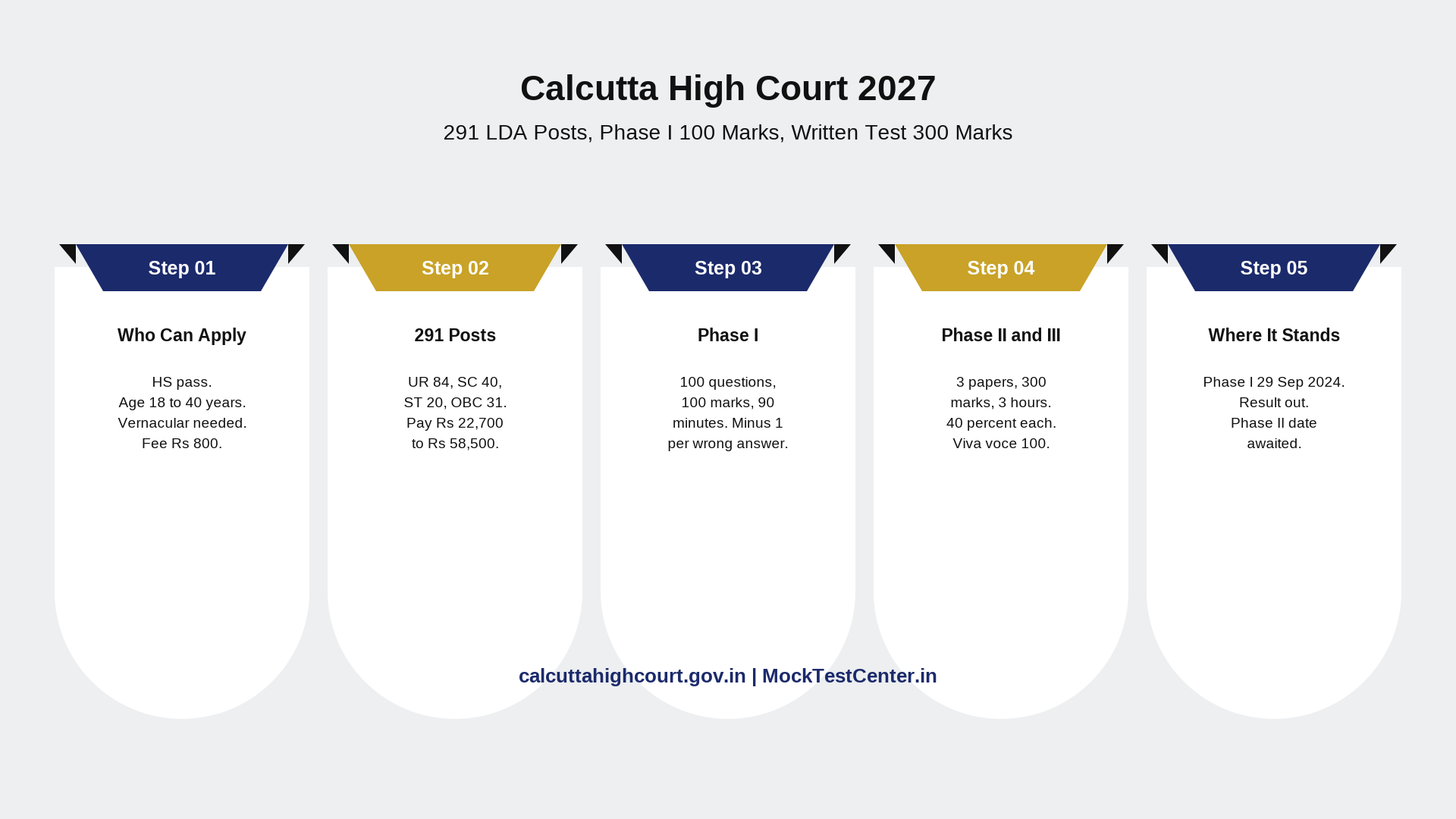
The recruitment has three stages, and the first stage is the one that ends most attempts. A 100 question screening test in 90 minutes, with one full mark deducted for every wrong answer, decides who reaches the written papers. The written test then carries 300 marks across three papers, and a viva voce of 100 marks closes the process. The final merit rests on the written test plus the viva voce. The screening marks do not carry forward, which changes how a candidate should spend preparation time, and this guide explains that trade in full.
Calcutta High Court 2027 at a glance
| Detail | Calcutta High Court 2027, as run in the 2024 cycle |
|---|---|
| Conducting body | High Court at Calcutta, Appellate Side and Original Side establishments |
| Exam | Lower Division Assistant (LDA) |
| Live cycle | 2024, Notification Number 6785-RG dated 1 August 2024 |
| Posts in live cycle | 291 in all, split by category in the table below |
| Applications | 5 to 26 August 2024, online at chc.formflix.org, closed |
| Fee | Rs 800 for most candidates, Rs 400 for SC and ST candidates of West Bengal |
| Education | Higher Secondary (12th standard) pass, plus knowledge of the vernacular of the state |
| Age limit | 18 to 40 years as on 1 January 2024 |
| Pay scale | Level 6, Rs 22,700 to Rs 58,500, minimum pay Rs 24,100 plus allowances |
| Phase I | 29 September 2024, 100 questions, 100 marks, 90 minutes, OMR, result released |
| Phase II | Competitive Written Test, 300 marks, 3 hours, date not announced as of 23 November 2026 |
| Phase III | Viva Voce, 100 marks, date not announced |
| 2027 notification | Not published as of 23 November 2026 |
The 291 posts, and where the 1,537 number came from
Notification Number 6785-RG opened on 1 August 2024 with 291 Lower Division Assistant posts, split across the Appellate Side and the Original Side establishments of the High Court at Calcutta. The category split runs unusually long, because the notification carries separate rows for exempted category candidates, ex servicemen, meritorious sportspersons, and persons with disability inside each caste category. Unreserved carries 84 posts, with 24 more for exempted category, 15 for ex servicemen, 9 for meritorious sportspersons, and 4 each for hearing impairment, locomotor disability and blindness or low vision. Scheduled Caste carries 40 posts, with 21 for exempted category and 6 for ex servicemen. Scheduled Tribe carries 20 posts, with 15 for exempted category. Other Backward Classes A carries 19 posts with 8 for exempted category, and Other Backward Classes B carries 12 posts with 6 for exempted category. The rows add to 291, and a candidate should check the row that matches the exact category and sub category, because the exempted category rows are large enough to change the competition in a category.
The 1,537 figure that search results attach to this recruitment has no advertisement behind it. It does not appear in any notification on the High Court website, and the pages that carry it give no advertisement number, no notification date, and no post split. A number with no advertisement number is a rumour, and a rumour repeated across a dozen tracker pages is still a rumour. The same tracker pages also mix the High Court recruitment with the district court recruitments of West Bengal, which are separate advertisements run by separate district judges. This guide treats the 1,537 figure as unverified and does not use it anywhere in the pattern, the eligibility, or the preparation plan.
The applications for the 291 posts ran online from 5 August to 26 August 2024 through the portal at chc.formflix.org, with a help desk number 9073652776 published in the Testbook summary of the notification. The fee was Rs 800 for most candidates and Rs 400 for Scheduled Caste and Scheduled Tribe candidates of West Bengal, non refundable, paid online. The application window was short at 22 days, and the High Court published a caution notice alongside the notification warning candidates to read the advertisement before applying. A candidate who waits for the last day of a 22 day window risks a server rush and a failed payment, and the fee is non refundable either way.
The Lower Division Assistant post sits in Level 6 of the pay matrix, Rs 22,700 to Rs 58,500, with minimum pay at Rs 24,100 plus allowances admissible under the relevant rules. That is the pay the notification itself states, and it is the figure this guide uses. Some tracker pages quote a different starting pay for the same post, and the difference comes from pages that mix the High Court scale with the West Bengal state government clerk scale. The High Court is a separate establishment with its own pay rules, and the notification figure is the one that decides the salary.
The three stages, and the one that ends most attempts
The Calcutta High Court 2027 selection runs in three stages in a fixed order, and the order is the first thing a candidate should memorise. The Preliminary Screening Test comes first, then the Competitive Written Test, then the viva voce. The screening test is qualifying only. Its marks do not carry forward to the final merit. The final merit rests on the Competitive Written Test marks out of 300 plus the viva voce marks out of 100, making 400 marks in all. A candidate who tops the screening test and writes a weak second stage loses to a candidate who scraped through the screening test and wrote strong papers, because the screening marks vanish the moment the second stage begins.
That structure makes the screening test a gate, not a race. The qualifying line is 50 percent, which is 50 marks out of 100. A candidate needs 50 correct answers with no wrong answers, or more correct answers to cover the wrong ones, because every wrong answer costs a full mark. The High Court calls a limited number of candidates category wise from the screening test to the written test, based on merit in the screening test, so clearing 50 percent is necessary but the actual call depends on how many candidates the Court decides to take forward. The notification does not publish that number in advance, and the sources read for this guide do not state it either, so this guide does not guess it.
The written test then decides most of the merit. Three papers of 100 marks each run in a single sitting of three hours: Arithmetic, English essay and precis writing, and General Knowledge. A candidate must secure at least 40 percent in each subject and 50 percent in aggregate to pass, which is 40 marks in each paper and 150 marks in total. A candidate who scores 90 in Arithmetic and 30 in English fails the stage, however high the total. The subject floor matters more than the total, and it punishes a candidate who prepares one paper and neglects another.
The viva voce carries 100 marks and closes the process. The High Court calls candidates who qualify in the written test category wise according to merit for the viva voce. The final merit list adds the marks from the written test and the viva voce. The viva voce tests general suitability for the post, and a candidate must be present at each stage, because absence at any stage cancels the candidature without further notice. The notification summary states that last rule, and it is worth reading twice, because a candidate who misses a stage for any reason loses the attempt outright.
Phase I in detail: 100 questions, 90 minutes, minus 1 for a wrong answer
The Preliminary Screening Test of the Calcutta High Court LDA exam pattern is an OMR based test of 100 questions, each carrying one mark, to be answered in 90 minutes. The subjects are Arithmetic, General Knowledge, Computer Proficiency, General Intelligence, and English. The question paper is in English only. The negative marking is one full mark for each wrong answer, which is unusually harsh: a wrong answer costs the mark for that question plus one more mark, so two wrong answers cancel one correct answer and one more. A candidate who guesses on 20 questions and gets 5 right and 15 wrong loses 10 marks net on those 20 questions, which is a tenth of the paper.
The subject split inside the 100 questions is reported by the sainikschoolbhubaneswar summary as 25 questions of Arithmetic, and the same summary gives the remaining subjects without a full question count in the pages read. The notification itself lists the five subjects without publishing a question wise split in the summaries available, so this guide states the 25 question Arithmetic figure as reported and does not invent counts for the other four subjects. A candidate should prepare all five subjects and not assume a weight from a tracker table that has no notification behind it.
The 90 minute duration gives 54 seconds per question, and the negative marking makes that time tighter than it looks. A candidate who spends two minutes on a hard Arithmetic question loses the time for two easy questions elsewhere, and a candidate who guesses at the end loses marks instead of gaining them. The sensible approach is to answer the certain questions first, mark the doubtful ones, and return to them only if time remains, leaving a question blank rather than guessing when the choice is between two equally likely options. A blank answer costs nothing. A wrong answer costs a mark. That arithmetic is the whole strategy for Phase I.
The screening test ran on 29 September 2024, a Sunday, from 12 noon to 1.30 pm, at centres across West Bengal. The High Court published the details in Notification Number 8310-R(R and M) dated 13 September 2024, which also opened admit card downloads from 14 September 2024 at 6 pm through chc.formflix.org. The notice said no candidate could enter the centre after 11.45 am. Testbook, last updated on 2 November 2026, reports that the High Court has released the result of the screening test. The sources read for this guide do not state the screening cut off marks or the number of candidates called for the written test, so this guide does not publish either figure.
Phase II: three papers, 300 marks, and the 40 percent rule
The Competitive Written Test of the Calcutta High Court LDA exam pattern is a descriptive test of three papers, each carrying 100 marks, run in a single sitting of three hours. The papers are Arithmetic, English essay and precis writing, and General Knowledge. Three hours for three papers gives one hour per paper, and the descriptive format makes that hour tighter than a multiple choice hour, because every answer has to be written out in full. A candidate who writes slowly in the English paper will eat into the General Knowledge paper, and there is no extra time for a slow start.
The pass rule has two parts, and both must be met. A candidate must secure at least 40 percent in each subject, which is 40 marks out of 100 in each paper, and at least 50 percent in aggregate, which is 150 marks out of 300. A candidate with 45 in Arithmetic, 45 in English, and 45 in General Knowledge has 135 in total and fails on aggregate, even though every subject clears its floor. A candidate with 95 in Arithmetic, 95 in English, and 35 in General Knowledge has 225 in total and fails on the subject floor, even though the total is far above the aggregate line. The rule punishes lopsided preparation in both directions, and the preparation plan in this guide is built around it.
The English paper is the one most candidates underestimate. It is not a multiple choice English test. It asks for essay writing and precis writing, which test a candidate's ability to write connected English under time pressure, to compress a passage without losing its meaning, and to keep grammar and spelling clean across a full page. A candidate who prepares English only through multiple choice questions will arrive at a descriptive paper with no practice in writing at length. The essay and the precis need writing practice, not just reading practice, and the plan below sets aside weekly writing sessions for exactly that.
The Arithmetic paper is at Higher Secondary standard in its methods, and it rewards speed with accuracy rather than advanced mathematics. The General Knowledge paper covers the ground a court clerk needs: current affairs, Indian polity and the Constitution, West Bengal geography and history, and general awareness of the kind a High Court establishment deals with. The notification does not publish a topic wise syllabus for the written test in the summaries read, so this guide describes the papers by their names and by the standard the notification sets, and it does not invent a detailed syllabus.
The High Court has announced no date for the Competitive Written Test as of 23 November 2026. The Testbook page for the recruitment, crawled on 7 November 2026, still shows no date for the written test or the viva voce. That gap is long: the screening test ran on 29 September 2024, and more than two years have passed without a written test date. A candidate preparing now should treat the wait as preparation time, not as a reason to stop, because a date when it comes will leave little room to learn descriptive writing from scratch.
Viva voce: the last 100 marks
The viva voce of the Calcutta High Court LDA exam pattern carries 100 marks, and it is the final stage. The High Court calls candidates who qualify in the Competitive Written Test category wise according to merit for the viva voce, and the final merit list adds the written test marks to the viva voce marks. The viva voce is worth a quarter of the final total, which is 100 out of 400, so it can move a candidate several places up or down the merit list. A candidate who enters the viva voce 20 marks behind a rival can overtake that rival with a strong interview, and a candidate who enters 20 marks ahead can lose the lead with a weak one.
The viva voce tests general suitability for the post, and the panel will look for the things a Lower Division Assistant does every day: accuracy in noting and drafting, familiarity with court procedure and the working of a High Court establishment, the ability to answer in clear English and in the vernacular of the state, and a steady manner under questioning. The notification summary does not publish a syllabus for the viva voce, and this guide does not invent one. The honest preparation is to know the High Court, its two sides, the work of a Lower Division Assistant, and the current affairs of West Bengal, and to practise answering aloud rather than rehearsing speeches.
One practical point matters more than any interview tip. The notification states that candidates must be present at each stage of the selection process, and that absence at any stage cancels the candidature without further notice. The High Court publishes its notices on calcuttahighcourt.gov.in, and a candidate who stops checking the site after the screening test can miss the written test notice entirely. The gap between the screening test and the written test in this cycle is already more than two years, and a candidate who assumes the recruitment is over will be the candidate who misses the call.
Who can apply: the three conditions
The Calcutta High Court LDA eligibility has three conditions, and all three must be met. The first is age. A candidate must be not less than 18 years and not more than 40 years as on 1 January 2024. The upper limit is relaxable for reserved categories under the rules of the Government of West Bengal, and the notification carries the relaxation in its category rows. The second condition is education. A candidate must have passed the Higher Secondary Examination, the 12th standard, from the West Bengal Council of Higher Secondary Education or an equivalent examination from a recognised Council or Board. The third condition is language. A candidate must know the vernacular of the state, which in West Bengal means Bengali, and must hold Indian citizenship.
The age limit of 40 years is generous by the standards of clerk recruitments, and it is one reason this recruitment draws candidates who have aged out of other examinations. A candidate of 38 or 39 years who holds a Higher Secondary pass can apply, and most police and defence recruitments would bar the same candidate. The trade is that the competition includes graduates and older candidates with years of preparation behind them, so the paper is not easy for a fresh Higher Secondary pass candidate. The age window opens the door wide, and the paper then sorts the field.
The Higher Secondary requirement is a pass, not a degree, and that is the second reason this recruitment draws a large field. A graduate can apply, and so can a candidate who stopped after the 12th standard. The notification does not ask for a computer certificate for the Lower Division Assistant post, which sets it apart from the district court Lower Division Clerk posts that do ask for one. The vernacular condition is the one candidates overlook. The notification requires knowledge of Bengali, and a candidate who studied outside West Bengal and cannot read or write Bengali should check the notification text before applying, because the condition is stated as a requirement, not a preference.
The fee is Rs 800 for most candidates and Rs 400 for Scheduled Caste and Scheduled Tribe candidates of West Bengal. The fee is non refundable. The concession applies to SC and ST candidates of West Bengal only, so an SC candidate from another state pays the full Rs 800. The payment is made online through the application portal, and the application is complete only after the payment succeeds. A candidate should keep two printed copies of the completed application form, as the Testbook summary of the notification advises, because the form is the record of the registration number and the payment.
Pay, and what the job actually involves
A Lower Division Assistant in the High Court at Calcutta draws Level 6 pay, Rs 22,700 to Rs 58,500, with minimum pay at Rs 24,100 plus allowances admissible under the relevant rules. The allowances include dearness allowance, house rent allowance, and medical benefits under the state government rules that apply to High Court staff. The post is a permanent post in a sanctioned cadre, on the Appellate Side or the Original Side establishment, and the recruitment fills separate panels for the two sides. A Lower Division Assistant works in the registry and the court sections: noting, drafting, filing, maintaining case records, preparing cause lists, and assisting the higher division staff in the daily work of the court.
The career path runs upward through the ministerial cadre of the High Court. A Lower Division Assistant with service and departmental examinations behind the post can move to Upper Division Assistant and beyond, and the High Court establishment has its own promotion rules. The post is a desk post in Kolkata, at 3 Esplanade Row West, and the work is inside the court building rather than in the field. That matters to candidates who compare this post with field posts like Forest Guard or police constable, because the physical demands are nil and the working hours follow the court calendar.
The 291 posts are not all in one office. The Appellate Side establishment and the Original Side establishment are the two wings of the High Court, and the notification forms separate panels for filling vacancies in both. The Appellate Side handles appeals and the appellate jurisdiction of the court, while the Original Side handles matters filed directly in the High Court. The High Court can post a Lower Division Assistant to either side, and the work differs in detail while the pay and the cadre stay the same. The notification does not state how many of the 291 posts belong to each side in the summaries read, so this guide does not split the number.
The district court drives that look like High Court jobs
Most of the confusion around the Calcutta High Court 2027 recruitment comes from the district court drives, which tracker pages file under the High Court name. The district courts of West Bengal recruit their own staff through advertisements issued by the District and Sessions Judge of each district, and the High Court website carries those advertisements because the High Court supervises the district judiciary. The posts look similar, and the names overlap, but the recruiting authority, the advertisement number, and the selection process are different.
The clearest example is the Kalimpong drive of 2024. The Office of the District and Sessions Judge, Kalimpong, published Advertisement Number RC 01 of 2024 for 37 posts: English Stenographer Group B with 2 posts, Lower Division Clerk Group C with 13 posts, Process Server and Summon Bailiff Group C, Orderly and Office Peon and Farash Group D with 17 posts, Night Guard Group D with 2 posts, and Sweeper, called Karma Bandhu, Group D with 1 post. Applications ran from 17 April to 17 May 2024. The Lower Division Clerk in that drive needed a Madhyamik pass plus a certificate in computer training, with pay of Rs 22,700 to Rs 58,500, and the Group D posts needed a Class VIII pass, with pay of Rs 17,000 to Rs 43,600. The age limit was 18 to 40 years as on 1 January 2024. The fee was Rs 700 for Lower Division Clerk for most candidates and Rs 400 for Group D, with lower fees for SC, ST, and persons with disability.
The Kalimpong drive is a district drive, not a High Court drive, and its 37 posts are not part of the 291 Lower Division Assistant posts. A candidate who adds the two numbers together and reports 328 High Court posts is adding two different recruitments. The same error lies behind the 1,537 figure: district drives, High Court drives, and rumoured drives added together without checking the advertisement numbers. The rule for a candidate is simple. Check the advertisement number and the issuing authority. If a District Judge issues the advertisement, it is a district post. If the Registrar of the High Court issues it, it is a High Court post.
The Group D posts of the district courts deserve a note of their own, because many candidates search for Calcutta High Court Group D jobs and find the district advertisements. The Group D posts in the Kalimpong drive are Orderly, Office Peon, Farash, Night Guard, and Sweeper. The qualification is a Class VIII pass, with basic knowledge of computer operation desirable for the peon posts. The pay is Rs 17,000 to Rs 43,600. The age limit is 18 to 40 years as on 1 January 2024. These are district court posts, and the district judge fills them, not the High Court. No separate Group D recruitment by the High Court itself was found in the sources read for this guide, and this guide does not claim one exists.
How the 2024 cycle has moved so far
The Calcutta High Court LDA 2024 cycle has moved slowly, and the timeline is worth setting out in full, because it tells a candidate what to expect. The notification, Number 6785-RG, came out on 1 August 2024. Applications opened on 5 August 2024 and closed on 26 August 2024. The High Court then published Notification Number 8310-R(R and M) on 13 September 2024 with the details of the Preliminary Screening Test: the test would run on 29 September 2024, a Sunday, from 12 noon to 1.30 pm, as a multiple choice OMR test, with admit cards available for download from 14 September 2024 at 6 pm through chc.formflix.org, and no entry after 11.45 am.
The screening test ran on 29 September 2024 as scheduled. The Testbook page for the recruitment, last updated on 2 November 2026, reports that the High Court has released the result of the screening test. The High Court still has to announce the Competitive Written Test date and the viva voce date, and the same Testbook page, crawled on 7 November 2026, still shows no date for either. More than two years have passed between the screening test and the present date of 23 November 2026 without a written test date. The High Court has published no fresh notification for Lower Division Assistant posts in that period, and no 2027 notification exists.
That slow pace is not unusual for a High Court recruitment, and it does not mean the High Court has cancelled the cycle. High Court recruitments move through the registry at their own speed, and the written test for a descriptive paper needs examiners, venues, and evaluation time that a multiple choice test does not. A candidate who treats the wait as a cancellation will stop preparing and will be unready when the date comes. A candidate who treats the wait as preparation time will arrive at the written test with the essay and precis practice already done. The right move is to check calcuttahighcourt.gov.in regularly and to keep preparing, because the notice will come without a long warning.
The help desk number published with the notification was 9073652776, and the application portal was chc.formflix.org. Both belong to the 2024 cycle, and a candidate should not use them to ask about a 2027 cycle that does not exist. The official website for all notices is calcuttahighcourt.gov.in, and that is the only site a candidate needs to watch. Tracker pages that promise a 2027 notification date are guessing, and the pages that carry the 1,537 figure show how far a guess can travel once tracker after tracker copies it from page to page.
A preparation plan that respects the pattern
The pattern decides the plan, and the pattern of the Calcutta High Court LDA exam pattern has two features that most plans ignore. The first is that the screening test carries negative marking of one full mark, which makes accuracy worth more than attempts. The second is that the written test is descriptive, which makes writing practice worth more than multiple choice practice. A plan that drills only multiple choice questions will pass the screening test and fail the written test. A plan that writes essays and precis from the start will pass both, because the multiple choice subjects overlap with the written papers.
Start with Arithmetic, because it appears in both stages and carries 100 marks in the written test. The Arithmetic syllabus is at Higher Secondary standard: number systems, percentages, profit and loss, simple and compound interest, ratio and proportion, time and work, time speed and distance, averages, and mensuration. Practise 25 questions a day under a timer, and mark every wrong answer with the reason it went wrong, because the screening test punishes a wrong answer with a full mark. Speed matters, and a candidate who solves 25 questions in 20 minutes with 23 right is better placed than a candidate who solves 25 in 35 minutes with 25 right, because the screening test gives 54 seconds per question.
General Knowledge needs two streams. The first is static: the Constitution of India, the structure of the judiciary, the High Court at Calcutta and its history, West Bengal geography and history, and the major articles and schedules a court clerk should know. The second is current: the last twelve months of national and West Bengal news, with attention to court judgments, government schemes, and appointments. Read one newspaper daily and keep a notebook of 10 facts a day, because the General Knowledge paper in the written test rewards a candidate who can write a connected paragraph about a topic, not a candidate who can only tick a box.
English needs writing, not just reading. Set aside two sessions a week for essay writing and one for precis writing. Write one essay of 300 words a week on a current topic, and one precis a week from a newspaper editorial, cutting the passage to a third of its length without losing its meaning. Check every essay for grammar, spelling, and paragraph structure, and rewrite the weak sentences. The essay and precis paper carries 100 marks, and a candidate who has never written an essay under time pressure will lose marks to handwriting, to structure, and to running out of time, not to a lack of ideas.
Computer Proficiency and General Intelligence are the two screening subjects that do not appear in the written test, so they need a smaller share of time. Computer Proficiency at this level covers basic computer knowledge, the parts of a computer, common software, the internet, and email, and a candidate who uses a computer daily will find most of it familiar. General Intelligence covers analogies, series, coding and decoding, blood relations, direction sense, and non verbal reasoning, and it rewards daily practice of 10 questions more than a weekend of cramming. Give these two subjects one session a week each, and do not let them eat the time that Arithmetic and English need.
Mock tests should follow the real pattern, not a generic one. Take a 100 question screening mock in 90 minutes with minus 1 for a wrong answer, and score it the way the High Court scores it. Take a three hour descriptive mock with three papers and the 40 percent subject floor, and mark it strictly. A mock test that gives no negative marking and no subject floor will flatter a candidate into a false sense of readiness. The mock tests on this site follow the screening pattern of 100 questions in 90 minutes, and they are the closest practice to the real first stage.
The mistakes that cost candidates a year
The first mistake is preparing from the 1,537 figure. A candidate who believes in 1,537 posts will expect a low cut off, a large call list, and an easy screening test, and will prepare lightly. The real recruitment has 291 posts, and the screening test has minus 1 negative marking, which makes the cut off higher than a candidate expects. The number of posts changes the whole preparation, and a candidate who prepares from a false number prepares for the wrong examination.
The second mistake is guessing in the screening test. A wrong answer costs a full mark, so a guess between two equally likely options has an expected value of zero, and a guess among four options with no knowledge has a negative expected value. A candidate who guesses on 10 questions and gets 3 right loses 4 marks net. A candidate who leaves those 10 blank loses nothing. The blank answer is the right answer when the candidate does not know, and the screening test rewards the candidate who knows when to stop.
The third mistake is neglecting the descriptive papers. The screening test is multiple choice, so most preparation material is multiple choice, and most candidates practise only multiple choice. The written test is descriptive, and it carries 300 marks against the screening test's zero carried forward. A candidate who cannot write an essay and a precis under time pressure will fail the written test after passing the screening test, and that is the most expensive failure in this recruitment, because it comes after months of waiting.
The fourth mistake is preparing one paper and neglecting another. The written test needs 40 percent in each subject, so a candidate with 90 in Arithmetic and 30 in English fails. The notification states the subject floor, and it is easy to forget while preparing the strong subject. A candidate should check the weakest paper every week, not the strongest, because the weakest paper decides whether the candidate passes the stage.
The fifth mistake is stopping after the screening test. The High Court has released the result of the screening test, and it has announced no written test date. A candidate who stops preparing now will have to restart descriptive writing from scratch when the date comes, and the gap between the announcement and the test may be short. The candidates who keep writing one essay a week through the wait will be ready. The candidates who wait for the date will not.
The sixth mistake is confusing the district drives with the High Court drive. The Kalimpong drive, and the drives of the other district judges, have different advertisement numbers, different posts, different qualifications, and different fees. A candidate who applies to a district drive thinking it is a High Court post will prepare the wrong pattern, and a candidate who counts district posts as High Court posts will misjudge the competition. Check the advertisement number and the issuing authority before applying to any post with Calcutta in its name.
Check calcuttahighcourt.gov.in for the Competitive Written Test date notice before you change anything in this plan, and read Notification Number 6785-RG line by line when the next notice appears. The pattern, the post count, and the dates in the next notice will be the ones that decide your attempt, not the figures in any guide.
Sources
Testbook, Calcutta High Court LDA Recruitment 2024, last updated 2 November 2026, Notification Number 6785-RG dated 1 August 2024, 291 vacancies, applications 5 to 26 August 2024, Preliminary Screening Test 29 September 2024, result released, Competitive Written Test and viva voce to be announced, selection by Preliminary Screening Test, Competitive Written Test and viva voce, Higher Secondary pass eligible, age 18 to 40 years as on 1 January 2024, fee Rs 800 and Rs 400 for SC and ST of West Bengal, pay Level 6 Rs 22,700 to Rs 58,500 with minimum pay Rs 24,100, help desk 9073652776, portal chc.formflix.org. Testbook, Calcutta High Court LDA Syllabus and Exam Pattern 2024, Preliminary Screening Test 100 questions, 100 marks, 90 minutes, OMR, subjects Arithmetic, General Knowledge, Computer Proficiency, General Intelligence, English, negative marking 1 mark per wrong answer, qualifying 50 percent, marks not carried forward, Competitive Written Test 3 subjects of 100 marks each, Arithmetic, English essay and precis writing, General Knowledge, 3 hours, 40 percent in each subject and 50 percent in aggregate, viva voce 100 marks. High Court at Calcutta, Notification Number 8310-R(R and M) dated 13 September 2024, Preliminary Screening Test 29 September 2024, 12 noon to 1.30 pm, admit card download from 14 September 2024 at 6 pm at chc.formflix.org, no entry after 11.45 am, official website calcuttahighcourt.gov.in. IndGovtJobs, Calcutta High Court Recruitment 2024, 291 Lower Division Assistant posts, Appellate Side and Original Side establishments, last date 26 August 2024, pay Level 6 Rs 22,700 to Rs 58,500 with minimum pay Rs 24,100, selection by Preliminary Screening Test 100 marks, Competitive Written Test 300 marks, viva voce 100 marks, fee Rs 400 SC and ST, Rs 800 others. MySarkariNaukri, Calcutta High Court Lower Division Assistant Recruitment 2024, 291 posts, Advertisement Number CalcuttaHighCourt/Rect/2024, Vacancy Circular Number 6785-RG, published 3 August 2024, last date 26 August 2024, application offline by post as listed on that page, full time, Kolkata. GovtJobGuru, Calcutta High Court Recruitment 2024, 37 Stenographer, LDC and Group D posts, Office of the District and Sessions Judge, Kalimpong, Advertisement Number RC 01 of 2024, applications 17 April to 17 May 2024, Lower Division Clerk 13 posts, pay Rs 22,700 to Rs 58,500, Orderly, Office Peon and Farash 17 posts, Night Guard 2 posts, Sweeper 1 post, Group D pay Rs 17,000 to Rs 43,600, age 18 to 40 years as on 1 January 2024, fee Rs 700 Lower Division Clerk and Rs 400 Group D for most candidates. Sainik School Bhubaneswar, Calcutta High Court LDA Syllabus 2024, 291 posts, Preliminary Screening Test 100 marks in 90 minutes OMR, Competitive Written Test 300 marks in 3 hours, viva voce 100 marks, Arithmetic 25 questions in the screening test, negative marking 1 mark, qualifying 50 percent. WBPSC Clerkship Examination 2024, Advertisement Number 12/2024, noted only to separate the West Bengal Public Service Commission clerk recruitment from the High Court Lower Division Assistant recruitment, which is a different examination run by a different body.







