About Punjab High Court 2027 Exam Series
📖 Table of Contents
- Punjab High Court 2027 at a glance
- One High Court, two state drives
- Who can apply for Punjab High Court Clerk
- Fee, pay and job profile
- Punjab High Court Clerk exam pattern
- Punjab High Court Clerk syllabus, subject by subject
- The Computer Proficiency Test
- How the court clerk test differs from the SSSB clerk test
- What came before, and what the older papers show
- A 90 day plan for the Punjab High Court Clerk test
- Mistakes that cost seats every year
- Documents to keep ready
- Sources
Punjab High Court 2027: Complete Exam Guide
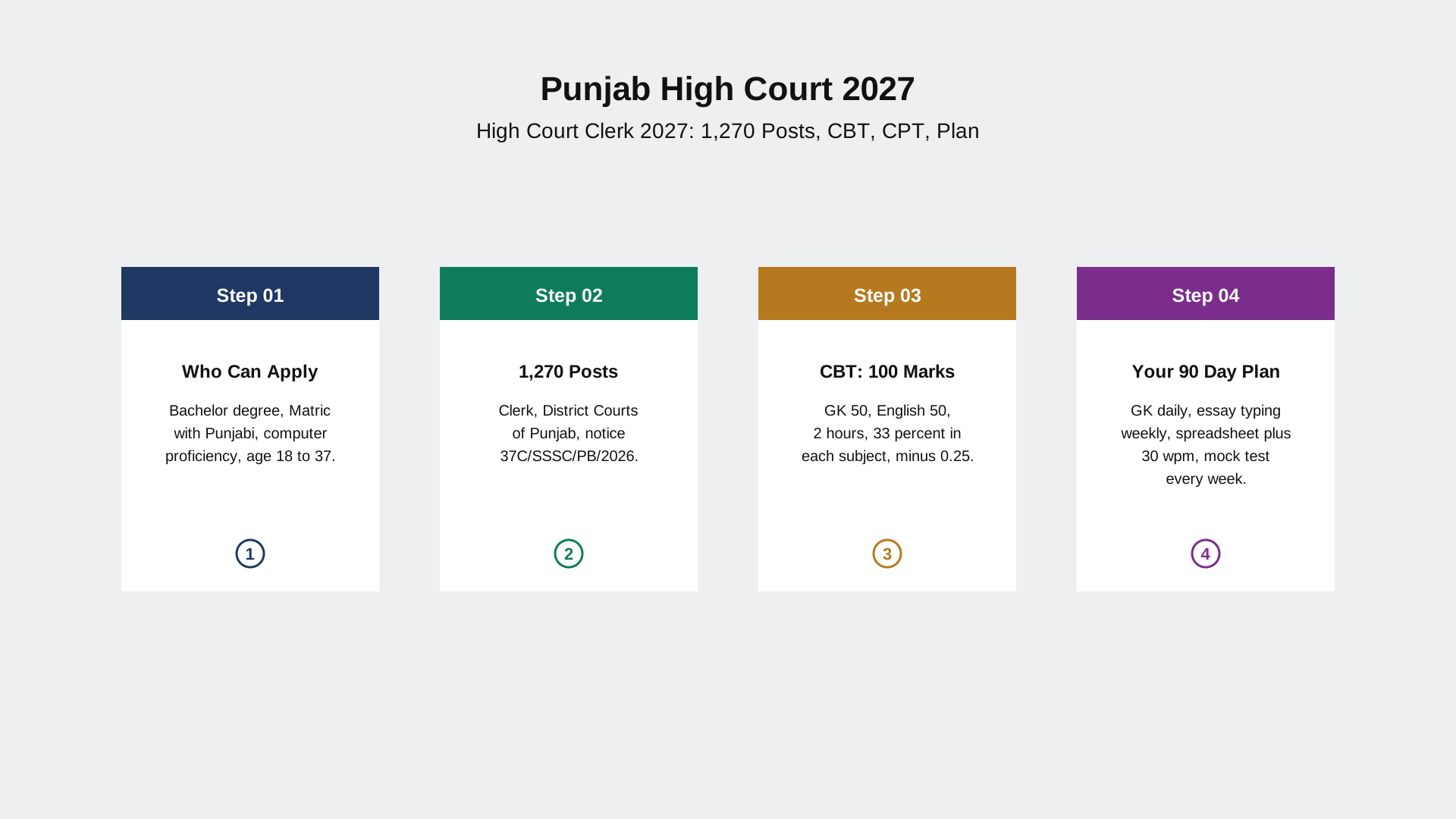
The Punjab High Court 2027 cycle is the largest court clerk opening Punjab has seen in years. The Society for Centralised Recruitment of Staff in Subordinate Courts, known as SSSC, advertised 1,270 Clerk posts for the District Courts of Punjab under Employment Notice Number 37C/SSSC/PB/2026, dated 3 October 2026. Applications ran from 7 October 2026 at 4 pm to 4 November 2026 at 4 pm, through the SSSC website at sssc.gov.in. The SSSC had not announced the written test date as of 21 November 2026, and the notice says the date will come separately.
This package anchors on that notice, and it says so plainly. The name Punjab High Court 2027 is the cycle candidates are searching for, and the 2026 notice is the live drive behind it. There is no separate Punjab only district court drive running beside it. The High Court of Punjab and Haryana at Chandigarh is one court serving two states and the Union Territory of Chandigarh, and the SSSC recruits its subordinate court staff state by state. This drive is the Punjab state drive. The Haryana state drive ran under a separate notice, Number 36C/SSSC/HR/2026, with 1,265 Clerk posts, and this guide keeps the two drives apart wherever a figure could be confused.
A clerk in a district court does work that keeps the justice system moving. The clerk receives case files and lists them, types orders and despatches them, maintains records, gives dates, and answers litigants at the counter. The post pays Rs 29,200 a month at Level 5 of the pay matrix, with allowances on top, and it is a regular government post in the subordinate judiciary. That mix of a courtroom setting, a fixed routine and a steady career is why more than a lakh candidates will likely chase these 1,270 seats.
Punjab High Court 2027 at a glance
| Detail | Punjab High Court 2027, as notified |
|---|---|
| Conducting body | Society for Centralised Recruitment of Staff in Subordinate Courts (SSSC), under the High Court of Punjab and Haryana at Chandigarh |
| Post | Clerk, District Courts of Punjab |
| Employment notice | 37C/SSSC/PB/2026, dated 3 October 2026 |
| Vacancies | 1,270 Clerk posts |
| Official websites | sssc.gov.in for applications, highcourtchd.gov.in for the High Court |
| Application window | 7 October 2026, 4 pm, to 4 November 2026, 4 pm |
| Age limit | 18 to 37 years as on 1 January 2026 |
| Education | Bachelor degree in Arts, Science or equivalent, Punjabi as a subject in Matriculation, computer proficiency |
| Starting pay | Rs 29,200 a month, Level 5 of the pay matrix |
| Fee | Rs 1,200 all other categories, Rs 710 SC BC OBC ESM EWS of Punjab, Rs 875 persons with benchmark disabilities of Punjab |
| Written test | Computer based test, 100 marks, 2 hours, General Knowledge 50 plus English Composition 50 |
| Second stage | Computer Proficiency Test, qualifying, spreadsheet test plus English typing at 30 words a minute |
| Selection | Computer based test, Computer Proficiency Test, document verification |
One High Court, two state drives
The first fact a candidate must hold is the shape of the court. The High Court of Punjab and Haryana at Chandigarh is a common High Court for the states of Punjab and Haryana and for the Union Territory of Chandigarh. Below it, each state has its own district courts, and the SSSC recruits clerks for each state's district courts under separate employment notices. A candidate from Punjab applies for the Punjab drive, and a candidate for the Haryana drive applies under the Haryana notice. The two drives have different vacancy counts, different dates and different tests, and mixing them up is the fastest way to prepare for the wrong exam.
The Punjab drive, Employment Notice 37C/SSSC/PB/2026, covers 1,270 Clerk posts in the District Courts of Punjab. The notice counts 793 posts available as on 31 August 2026 and 450 anticipated posts up to 28 February 2027. Those two figures add up to 1,243, not 1,270, and this guide flags that gap of 27 posts rather than hiding it. The category wise table in the notice carries the 793 and 450 split, and the headline total carries 1,270. The notice also says the number of vacancies may rise or fall without notice, depending on the vacancies available when the merit list and postings are prepared, so the final count will be settled at that stage.
The category wise split shows where the seats sit. Unreserved general candidates take 201 existing posts plus 71 anticipated posts. Economically weaker sections of Punjab take 96 plus 45. Scheduled Castes of Punjab from the Balmiki and Mazhbi Sikh groups take 99 plus 70, and Scheduled Castes from other groups take 83 plus 60. Backward classes and OBC of Punjab take 69 plus 64. Freedom fighters of Punjab take 11 plus 9. Sportsmen of Punjab take 8 plus 18 in the general group and 22 in the SC group. Persons with benchmark disabilities take 14 plus 8 for low vision, 10 plus 8 for hearing handicap, 8 plus 7 for locomotor disability, and 10 plus 5 for specific learning disability, mental illness and multiple disability. Ex-servicemen of Punjab take 55 plus 85 in the general group, 36 in the SC Balmiki and Mazhbi Sikh group, 36 in the SC others group, and 35 in the BC and OBC group.
The Haryana drive, Employment Notice 36C/SSSC/HR/2026, covers 1,265 Clerk posts in the subordinate courts of Haryana, made up of 1,015 existing posts and 250 anticipated posts. Applications ran from 26 May 2026, and the computer based written test was held from 24 August to 7 September 2026. That drive is already past its written test, while the Punjab drive is still waiting for its test date. A candidate who reads a Haryana result notice and thinks it is the Punjab result has misread the notice number, and the notice number is the one detail that never lies. Punjab is 37C/SSSC/PB/2026. Haryana is 36C/SSSC/HR/2026.
The High Court also recruits other posts through its own establishment, and those drives are separate from the SSSC clerk drives. In February 2026 the High Court advertised 25 Senior Scale Stenographer posts and 25 Steno Typist posts on its own establishment at Chandigarh, with applications from 17 February to 10 March 2026 through highcourtchd.gov.in. The Senior Scale Stenographer age limit was 21 to 30 years as on 10 March 2026, with shorthand at 100 words a minute and transcription at 20 words a minute, and the fee was Rs 1,000 for general candidates and Rs 800 for SC, ST and BC candidates of Punjab, Haryana and Chandigarh. A separate SSSC notice, Advt No. 34S/SSSC/PB/2025, covered Steno Typist and Stenographer Grade 3 posts in the subordinate courts of Punjab, with interaction and checking of original testimonials on 27 April 2026 at the Chandigarh Judicial Academy. One tracker site claims 229 Stenographer Grade 3 posts for that drive, and this guide flags that figure as unverified, because the SSSC interaction notice quoted in trackers does not carry a vacancy total.
Who can apply for Punjab High Court Clerk
The education bar is a bachelor degree in Arts, Science or an equivalent qualification from a recognised university. There is no demand for a particular subject, so graduates from arts, science and commerce all sit the same paper. Two extra conditions sit beside the degree. The candidate must have Punjabi as one of the subjects in the Matriculation examination, and must possess proficiency in operating computers. The qualification must be held by the closing date of online applications, which was 4 November 2026 for this drive.
The age limit is 18 to 37 years as on 1 January 2026 for unreserved general candidates. Scheduled Castes and backward classes of Punjab get 5 years of relaxation. Persons with benchmark disabilities of Punjab get 10 years. Ex-servicemen of Punjab get their military service period plus 3 years. In-service employees can apply up to 45 years under the applicable rules. The relaxation, fee concession and reservation benefits go to residents of Punjab only, except for the age relaxation given to government employees under the rules. Candidates from reserved categories of other states must apply under the unreserved general category, and they pay the general fee.
That domicile rule catches candidates every year. A candidate who holds a Scheduled Caste certificate from another state and claims the Punjab SC fee of Rs 710 will find the claim rejected, because the benefit belongs to Punjab residents. The certificate that matters is the Punjab domicile certificate, and it should be in hand before the form opens. The form also asks for a real time photograph captured on the portal, a scanned photograph and a scanned signature, and the notice advises candidates to keep five copies of the uploaded photograph for later stages. A candidate who uploads a photograph that does not match the person who appears for the test will face questions at the gate.
Fee, pay and job profile
The application fee in the Punjab notice has three slabs, and each slab adds two parts together. The online facilitation charge is Rs 550 for every candidate. The examination fee sits on top of it. SC, BC, OBC, ex-servicemen and EWS candidates of Punjab pay an examination fee of Rs 160, taking their total to Rs 710. Persons with benchmark disabilities of Punjab pay an examination fee of Rs 325, taking their total to Rs 875. All other categories pay an examination fee of Rs 650, taking their total to Rs 1,200. The fee is paid online by internet banking, debit card, credit card or UPI, and it is not refunded. Candidates who select Others in the gender column pay the fee of their respective category.
One tracker page prints a different fee table, with totals of Rs 1,000 for general, Rs 750 for SC, BC and ex-servicemen of Punjab, and Rs 750 for persons with benchmark disabilities. That table does not match the official SSSC notice, which the SSSC published as a PDF on sssc.gov.in and which carries the 550 plus 160, 550 plus 325 and 550 plus 650 split. This guide uses the official notice figures and flags the tracker table as wrong, because a candidate who pays the wrong fee risks a form that the portal treats as incomplete.
The starting pay is Rs 29,200 a month at Level 5 of the pay matrix, and the notice ties that pay to fresh recruitment on or after 17 July 2020. Allowances follow the applicable government rules, and tracker estimates put the monthly take home between Rs 35,000 and Rs 40,000 with allowances, though that range is an estimate and not a figure from the notice. The post is a regular government post in the district courts, with promotion channels inside the court establishment. A clerk who learns the work well moves up to senior clerk and then to higher ministerial posts, and the courtroom exposure gives a grounding in procedure that no other clerk post offers.
The daily work of a district court clerk turns on case files. The clerk receives files, enters them in registers, lists them for hearing, and sends them to the courtroom. The clerk types orders the judge dictates, checks them and despatches them. The office issues certified copies. Records are kept for years, and a file that cannot be found when the judge asks for it holds up a hearing. Accuracy matters more than speed, though speed matters at the typing test, and a clerk who can draft a clean letter in English and read a Punjabi document without hesitation is the one the court relies on.
Punjab High Court Clerk exam pattern
The written test is a computer based test of 100 marks, held over 2 hours. It has two subjects and two kinds of questions. General Knowledge is objective, with 50 questions of 1 mark each, for 50 marks. English Composition is split into an objective part and a subjective part. The objective part has 20 questions of 1 mark each, for 20 marks. The subjective part carries 30 marks, made up of an essay of 150 words for 10 marks, a letter for 5 marks, a precis for 5 marks, and translation from Punjabi to English for 10 marks. The total is 100 marks.
| Subject | Question type | Questions | Marks |
|---|---|---|---|
| General Knowledge | Objective | 50 | 50 |
| English Composition | Objective | 20 | 20 |
| English Composition | Subjective, essay 10, letter 5, precis 5, translation 10 | 4 tasks | 30 |
| Total | Objective plus subjective | 70 plus 4 tasks | 100 |
Negative marking applies to the objective section only. Each wrong answer in the objective part loses one fourth of a mark, which is 0.25 marks. An unattempted question loses nothing and gains nothing. The subjective part has no negative marking, because examiners judge it on the quality of the writing. The board normalises marks in the objective section, while examiners mark the subjective section on actual marks. Normalisation matters when the test runs in several shifts, because the board adjusts the scores of a shift with a harder paper so that no shift suffers for the paper it drew.
The qualifying marks are strict. A candidate must score at least 33 percent in each subject, and must also score at least 40 percent in aggregate in the written test. That means 33 percent in General Knowledge and 33 percent in English Composition, plus 40 marks out of 100 in total. A candidate who scores 45 in General Knowledge and 30 in English Composition fails, because the English subject mark is below the line, even though the total is 75. The subject bar is what trips strong general knowledge candidates who treat English as a minor subject.
There is one more gate inside the pattern. Examiners check the subjective English paper only for candidates who score 33 percent or more in General Knowledge. A candidate who fails General Knowledge never gets the essay read, however well it was written. The order of preparation follows from that. General Knowledge is the gate, English objective is the second gate, and the subjective tasks are the third stage. A candidate who spends a month on essay writing before securing General Knowledge has built the roof before the walls.
Candidates type the subjective paper on a computer within the given time, which means the candidate types the essay, the letter, the precis and the translation on a keyboard in the exam hall. A candidate who writes essays by hand at home and never types them will type slowly in the hall and run out of time on the translation, which carries 10 marks, the largest single subjective item. Typing the subjective answers is a skill of its own, and a candidate practises it by typing every essay during preparation, not by writing it in a notebook.
Punjab High Court Clerk syllabus, subject by subject
General Knowledge carries half the paper, and its syllabus is broad. Current affairs cover national and international news, important events and government schemes. Indian history covers the ancient, medieval and modern periods and the freedom movement. Geography covers Indian and world geography, rivers, mountains and climate. Indian polity covers the Constitution, fundamental rights, Parliament and the judiciary. General science covers everyday science at school level. Sports, awards, personalities, championships and winners appear regularly, along with terms, full forms, heritage and arts, dance, currencies, birds, animals, discoveries, diseases and nutrition, songs, flags, monuments, culture, religion, languages, capitals, wars and neighbours.
That list is long, and the way to handle it is to split it into a daily half and a weekly half. Current affairs are daily, with a notebook for schemes, appointments, awards, summits and sports results over the six months before the test. Static general knowledge is weekly, with one topic at a time from a standard book. Lucent's General Knowledge is the book most candidates use, and it should be read twice, once for the story and once for the facts. Punjab history deserves a separate place in the notebook, because the court sits in Punjab and the paper asks about the state, its rivers, its districts, its freedom fighters and its culture.
English Composition is the other half of the paper, and it tests both knowledge and writing. The objective part covers reading comprehension, grammar, subject and verb agreement, articles, verbs, fill in the blanks, vocabulary, antonyms, tenses, adverbs, error correction, idioms and phrases, synonyms, sentence rearrangement and unseen passages. S. P. Bakshi's Objective General English covers this half. The subjective part tests writing directly. The essay is 150 words for 10 marks, the letter is 5 marks, the precis is 5 marks, and the translation from Punjabi to English is 10 marks. A candidate should practise one essay, one letter, one precis and one translation every week, typed on a computer, timed, and checked against a model answer.
The essay topic usually comes from a current issue, a social question or a subject of general interest, and 150 words is short enough that every sentence must earn its place. A candidate who writes 300 words has wasted time and has probably repeated the point. The letter is usually formal, addressed to an officer or an editor, and examiners judge it on format as much as on language. The precis must cut a passage to about a third of its length without losing the sense, and a precis that keeps the examples and drops the argument has failed. The translation tests whether the candidate can carry meaning from Punjabi to English without losing the tone, and it is the item where a Punjab candidate should score full marks, because the Punjabi is the language of home.
The Computer Proficiency Test
The SSSC calls candidates who qualify in the written test for the Computer Proficiency Test, known as CPT. The CPT is mandatory, and its marks are not added to the final merit. It is a qualifying test, which means it can only remove a candidate, never promote one. A candidate who tops the written test and fails the CPT is out, while a candidate with a lower written score who passes the CPT moves on to document verification. The CPT has two parts, and both must be passed.
Part one is a spreadsheet test in MS Excel, carrying 10 marks over 10 minutes. A candidate needs at least 4 marks, which is 40 percent, to qualify. The test asks for basic spreadsheet work, such as entering data, using simple formulas, formatting cells and sorting a table. A candidate who has never opened a spreadsheet will find ten minutes very short, because the first two minutes go to finding the right menu. A candidate who practises one spreadsheet a day for a month will finish with time to spare. The skill is not advanced, and that is the point. The court wants a clerk who can open Excel and do the job on day one.
Part two is a computer typing test in English at a speed of 30 words a minute. The test is held on computer, and the candidate types a passage while the clock runs. Thirty words a minute is the same bar as the SSSB Punjab Clerk typing test, and it takes about eight weeks of daily practice to reach from a two finger start. The practice has to be on a desktop keyboard, thirty minutes a day, with the passage typed from the screen, not copied from memory. A candidate who starts typing practice only after the written result has about three weeks, and three weeks is not enough to rebuild finger habits.
The High Court calls candidates for the CPT in category wise numbers, so not every candidate who passes the written test receives a CPT call at once. The call list follows the merit order, and the number called is a multiple of the vacancies. A candidate near the bottom of the written merit list may not receive a CPT call at all, which is one more reason the written score matters. The CPT does not add marks, yet the written score decides who gets to sit it.
How the court clerk test differs from the SSSB clerk test
Candidates in Punjab often prepare for the SSSB Clerk test and the High Court Clerk test at the same time, and the two tests share a lot. Both need a bachelor degree, both need Punjabi at Matriculation level, both pay a fee in the same range, both test general knowledge and English, and both end with a typing test at 30 words a minute. A candidate who prepares for one is halfway ready for the other, and the shared half is the reason so many candidates apply for both.
The differences are what decide the result. The SSSB test has a qualifying Punjabi paper of 50 marks and a merit paper of 100 marks, with the merit paper split across six subjects including reasoning and ICT. The High Court test has no separate Punjabi paper and no reasoning or ICT section. It has General Knowledge for 50 marks and English Composition for 50 marks, with 30 of the English marks coming from subjective writing. A candidate who is strong in reasoning and computers will score better in the SSSB test, while a candidate who writes good English and reads the news daily will score better in the High Court test.
The second stage differs too. The SSSB typing test covers Punjabi and English, with the Punjabi test in the Raavi font. The High Court CPT covers a spreadsheet test and English typing only, with no Punjabi typing. A candidate who types Punjabi well and English poorly will pass the SSSB typing test only if both languages reach the bar, while the same candidate in the High Court test needs only English typing plus the spreadsheet. The preparation follows from that. A candidate applying for both tests should practise Punjabi typing for the SSSB test, English typing for both, and spreadsheets for the High Court test, and should keep the three skills in separate practice slots so that none of them is dropped.
The fee differs as well. The SSSB fee is Rs 1,000 for general candidates, Rs 250 for SC, BC and EWS, Rs 200 for ex-servicemen and Rs 500 for physically handicapped candidates. The High Court fee is Rs 1,200 for all other categories, Rs 710 for SC, BC, OBC, ex-servicemen and EWS of Punjab, and Rs 875 for persons with benchmark disabilities of Punjab. The High Court fee includes a Rs 550 online facilitation charge in every slab, which the SSSB fee does not split out. A candidate applying for both tests pays both fees, and neither fee is refunded.
What came before, and what the older papers show
The SSSC has run clerk drives for both states for years, and the pattern has stayed stable. The 2016 Haryana clerk drive, Employment Notice 19C/SSSC/HR/2016 dated 24 December 2016, opened applications on 26 December 2016 and closed registration on 27 January 2017, with the written test expected in March or April 2017. Its fee table was Rs 1,000 for general men and Rs 500 for general women, Rs 250 for SC, ST, BC and ex-servicemen men of Haryana and Rs 125 for women in those groups, and its age limit was 18 to 42 years as on 1 January 2016. The age limit has since tightened to 18 to 37 years, and the fee now runs on the facilitation charge, yet the shape of the test, a written test followed by a computer proficiency test, has not changed.
The Haryana drive of 2026 is the closest guide to the Punjab drive, because it ran first and it used the same pattern. Its computer based test ran from 24 August to 7 September 2026, and its syllabus and pattern match the Punjab notice question for question. A candidate preparing for the Punjab test should read the Haryana paper analysis wherever trackers publish it, because the topics that appeared in the Haryana shifts are the topics the Punjab paper is most likely to draw from. The two papers are not the same paper, and no question is guaranteed to repeat, yet the distribution of topics, the difficulty of the English objective, and the style of the subjective tasks will be close.
One warning belongs here. Some preparation sites describe the High Court Clerk test as a paper of 150 to 200 questions over 2 to 3 hours, covering computer awareness, quantitative aptitude, reasoning, English and general science. That description does not match the official notice for the Punjab drive, which sets 70 objective questions plus 4 subjective tasks over 2 hours, covering General Knowledge and English Composition only. A candidate who follows the wrong description will spend weeks on reasoning and computers and will walk into a hall that tests essay writing and translation instead. The notice on sssc.gov.in is the only description that counts, and this guide follows it.
A 90 day plan for the Punjab High Court Clerk test
Ninety days is enough for this test if the days are used in order. The plan below assumes three hours a day, with typing and spreadsheet practice on top, and it fits a candidate starting from zero. A candidate who already knows the syllabus can compress the first month into three weeks, but no shortcut compresses the typing and spreadsheet practice, because hands learn slowly.
Days 1 to 30 build the base. General Knowledge takes 90 minutes a day, with a standard book and a daily current affairs note. English objective takes 45 minutes a day, with grammar and vocabulary on alternate days. Subjective writing takes 30 minutes a day, with one essay, one letter, one precis or one translation each day, typed on a computer from the first week. Spreadsheet practice takes 15 minutes a day, with one small table built from scratch. English typing takes 30 minutes a day, with the target of 20 words a minute by day 30. By day 30, the candidate should have finished the first reading of general knowledge and English, and should have typed at least twenty essays.
Days 31 to 60 turn knowledge into marks. The second reading of general knowledge runs beside one mock test every week, taken on a Sunday under exam conditions, with the full 2 hours and no breaks. Analyse each mock the same day, and give the weak half of the paper an extra hour the next day. Subjective writing rises to one full set a week, essay plus letter plus precis plus translation, timed at 2 hours with the objective paper, so that the candidate learns to split time between the two halves. Typing practice rises to 40 minutes a day, and the target is 25 words a minute. Spreadsheet practice moves to timed tests, one 10 minute test a day, with the target of 4 marks out of 10. By day 60, the candidate should know whether General Knowledge or English leaks more marks, and that half should own the extra hour.
Days 61 to 90 are for revision and speed. Open no new book. Read the mistake notebook every morning. Take one mock test every four days, and take the last mock seven days before the real test, not the day before. Practise the subjective set twice a week, keep the essay to 150 words and check the translation word by word. Typing practice stays daily, and the target is 32 words a minute, two above the pass mark, so that exam nerves have room to cost a little speed. The day before the test is for documents, admit card, travel and sleep, not for study.
Time inside the 2 hour paper needs its own plan. General Knowledge should take about 60 minutes, with 50 questions and a pace of a minute a question, plus a few minutes to return to the marked ones. English objective should take about 25 minutes, with 20 questions and a pace that leaves time to read each question twice. The subjective tasks should take about 35 minutes, with the essay at 10 minutes, the letter at 5 minutes, the precis at 8 minutes, and the translation at 12 minutes. A candidate who spends 90 minutes on General Knowledge will have no time left for the translation, and the translation carries 10 marks, the largest single subjective item. Mock tests teach this split, and a candidate who never times a mock will never learn it.
Mistakes that cost seats every year
The first mistake is preparing for the wrong test. Candidates who follow a generic High Court Clerk description and study reasoning, computers and quantitative aptitude will find a paper that tests General Knowledge and English writing instead. The second mistake is ignoring the subject bar. A candidate who scores 45 in General Knowledge and 30 in English Composition fails, because English needs 33 percent on its own. The third mistake is ignoring General Knowledge until the last month, and then discovering that the subjective paper is never checked for candidates who fail it.
The fourth mistake is writing essays by hand. Candidates type the subjective paper on a computer, and a candidate who has never typed an essay will type slowly, make more errors, and run out of time on the translation. The fifth mistake is ignoring the spreadsheet test. Ten marks over ten minutes looks small, yet it is a qualifying gate, and a candidate who has never opened Excel will spend the first minutes finding the right menu. The sixth mistake is ignoring English typing until the result, and three weeks is not enough to reach 30 words a minute from a two finger start.
The seventh mistake is guessing in the objective section without counting the cost. Four wrong answers erase one right answer, and a candidate who guesses twenty questions loses five marks. The eighth mistake is trusting a single tracker site for dates and fees. The Punjab notice carries the fee split of Rs 550 plus the examination fee, and one tracker page prints a different table that does not match it. The ninth mistake is a careless form. The notice asks for a real time photograph captured on the portal, and a candidate who uploads an old photograph that looks different from the person who appears for the test will face questions at the gate. The tenth mistake is buying too many books. One book for General Knowledge and one for English, read twice, beats five books read once, because the exam rewards depth in a fixed syllabus.
Documents to keep ready
The form asks for details that must match the certificates exactly, so the certificates come first. Keep the degree and all mark sheets, the Matriculation certificate showing Punjabi as a subject, the Punjab domicile certificate, the caste certificate if claiming reservation, the EWS certificate if claiming that category, the disability certificate if claiming that benefit, the ex-serviceman discharge papers if claiming that benefit, and the age proof. Keep five copies of the photograph uploaded on the portal, because the notice asks for them at later stages, and keep the fee payment receipt until the whole process ends.
Check the spelling of the name on every certificate before the form opens. If the degree spells the name one way and the Matriculation certificate spells it another way, get an affidavit or a correction early, because the form does not fix a mismatch between two certificates. Check the date of birth on the Matriculation certificate, because that date is the age proof, and a wrong date there is the hardest error to fix in a hurry. Check the category certificate against the Punjab domicile rule, because a certificate from another state does not bring the Punjab benefit.
Sources
Testbook, Punjab And Haryana High Court Clerk Notification 2026 Out, Apply Online for 1270 Vacancies, Eligibility, Employment Notice 37C/SSSC/PB/2026 dated 3 October 2026, applications 7 October to 4 November 2026, fee table with totals Rs 710, Rs 875 and Rs 1,200, salary Rs 29,200 Level 5, pattern with General Knowledge 50, English objective 20 and subjective 30, qualifying marks 33 percent per subject and 40 percent aggregate, Computer Proficiency Test with spreadsheet 10 marks and typing 30 words a minute. CareerPower, Punjab and Haryana High Court Clerk Recruitment 2026, Apply Online Starts for 1270 Vacancies, SSSC Punjab Courts Clerk, selection by computer based test and Computer Proficiency Test, pay Rs 29,200 Level 5. PW Live, Punjab and Haryana High Court Clerk Recruitment 2026, Last Date to Apply, Employment Notice 37C/SSSC/PB/2026, notification 3 October 2026, 1,270 Clerk posts in District Courts of Punjab, age as on 1 January 2026. Society for Centralised Recruitment of Staff in Subordinate Courts, Detailed Employment Notice No. 37C/SSSC/PB/2026 dated 3 October 2026, published on sssc.gov.in, vacancy table with 793 posts as on 31 August 2026 and 450 anticipated posts up to 28 February 2027, age and fee tables, examination scheme. Testbook, Punjab and Haryana High Court Clerk Syllabus 2026, Check Exam Pattern, written test 100 marks over 2 hours, negative marking one fourth mark in objective section, qualifying marks 33 percent per subject and 40 percent aggregate, Computer Proficiency Test qualifying. JobDex, Punjab and Haryana High Court Clerk Recruitment 2026, Apply Online For 1270 Posts, selection by written test, Computer Proficiency Test and document verification, spreadsheet test 10 marks over 10 minutes with 40 percent qualifying, English typing 30 words a minute, salary Rs 29,200 Level 5. Jetty Study, Punjab and Haryana High Court Recruitment 2026, Senior Scale Stenographer and Steno Typist Vacancies, 25 posts each, applications 17 February to 10 March 2026, age 21 to 30 years for Senior Scale Stenographer, shorthand 100 words a minute, transcription 20 words a minute, fee Rs 1,000 general and Rs 800 SC ST BC. AubSP, High Court of Punjab and Haryana Senior Scale Stenographer Recruitment 2026, 25 vacancies, applications 17 February to 10 March 2026 at highcourtchd.gov.in, spreadsheet test qualifying at 40 percent. High Court of Punjab and Haryana, official website highcourtchd.gov.in, recruitment notices for Senior Scale Stenographer and Steno Typist 2026. Society for Centralised Recruitment of Staff in Subordinate Courts, official website sssc.gov.in, notices for Clerk drives in Punjab and Haryana and for Steno Typist and Stenographer Grade 3 in subordinate courts of Punjab.