About Goa Electricity Department Junior Engineer 2027 Exam Series
📖 Table of Contents
- Goa Electricity Department Junior Engineer 2027 at a glance
- The 88 inside the 245
- The 2025 cycle, from notification to selection list
- CBT-I: the screening test that ends candidatures quietly
- CBT-II: where the merit list is made
- Who can apply
- What the pay and the posting look like
- The other doors in the same advertisement
- A 90 day plan built around the two tests
- Mistakes that cost candidates the post
- How this guide was put together
- Sources
Goa Electricity Department Junior Engineer 2027: Complete Exam Guide
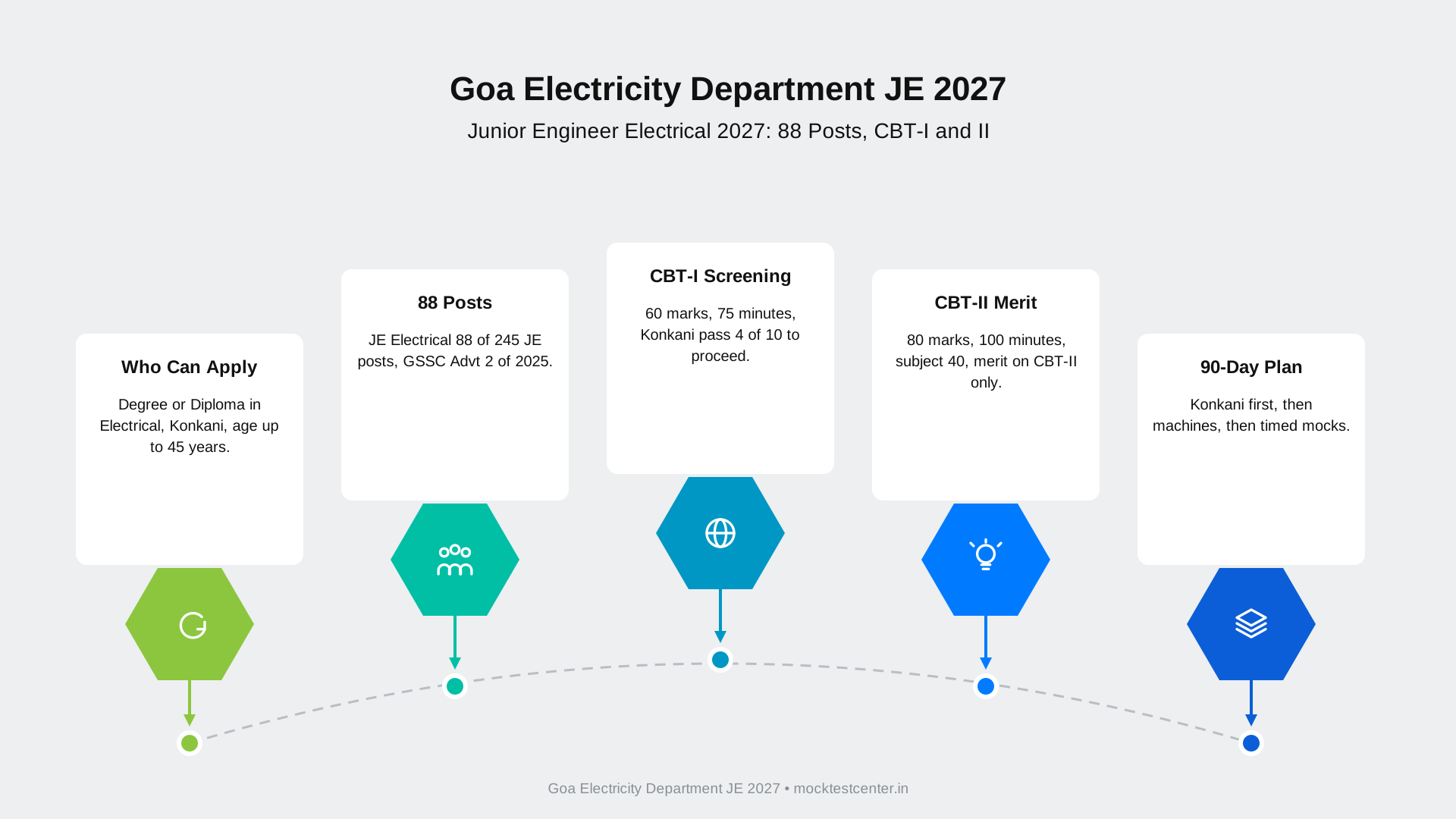
Eighty eight Junior Engineer (Electrical) posts in the Electricity Department of Goa went on offer in 2025, and they sat inside a much larger drive. The Goa Staff Selection Commission advertised 245 Junior Engineer posts in total under Advertisement No. 2 of 2025, across the Public Works Department and the Electricity Department and Rural Development and Water Resources and Agriculture and Panchayats. The Goa Electricity Department Junior Engineer 2027 guide covers the 88 Electrical posts first, because those are the posts this page is for, and it covers the rest of the 245 so a candidate can see exactly where the Electricity Department slice sits.
Applications ran online from 18 July to 8 August 2025 on gssc.goa.gov.in. The fee was Rs 400 for general candidates, Rs 200 for OBC and EWS candidates, and Rs 100 for SC and ST and PwD candidates. The age limit was 45 years, with relaxation as per government rules.
Selection ran through two computer based tests: CBT-I as a screening test and CBT-II as the test that built the merit list. CBT-II was held on 6 December 2025, and the final selection list for Junior Engineer (Electrical) came out on 24 December 2025.
No new GSSC Junior Engineer notification had appeared by late November 2026. The GSSC JE 2025 cycle is therefore the live document for the next cycle, and this guide works from it in full. A candidate who prepares for the Goa Electricity Department Junior Engineer 2027 cycle on the 2025 pattern, with the Konkani section treated as the gate it is, will be ready when the next advertisement opens, and the next advertisement will most likely give about three weeks between the notification and the last date.
One number needs clearing up at the start. The Testbook page on this recruitment carries the figure 259 in its title and the figure 245 in its body. The post wise split settles the question: 25 Mechanical and Electrical posts in the Public Works Department, 88 Electrical posts in Rural Development and the Electricity Department, and 132 Civil posts across departments.
Twenty five plus 88 plus 132 is 245. This guide uses 245, and it flags 259 as a title error.
Goa Electricity Department Junior Engineer 2027 at a glance
| Detail | GSSC Junior Engineer 2025, the live cycle |
|---|---|
| Conducting body | Goa Staff Selection Commission (GSSC) |
| Advertisement | Advertisement No. 2 of 2025, notification 18 July 2025 |
| Junior Engineer (Electrical), Electricity Department | 88 posts in Rural Development and the Electricity Department |
| All Junior Engineer posts | 245 posts: Mechanical and Electrical 25, Electrical 88, Civil 132 |
| Application window | 18 July to 8 August 2025, online at gssc.goa.gov.in |
| Application fee | General Rs 400; OBC and EWS Rs 200; SC and ST and PwD Rs 100 |
| Age limit | Maximum 45 years as on 8 August 2025, relaxation per rules |
| Qualification | Degree or Diploma in Electrical Engineering, knowledge of Konkani |
| Selection | CBT-I screening 60 marks, 75 minutes; CBT-II merit 80 marks, 100 minutes |
| CBT-II date | 6 December 2025 |
| Final selection list, JE Electrical | 24 December 2025 |
| Pay | Level 5, basic pay Rs 29,200 per month |
| Other requirements | Goa residence certificate, Employment Exchange registration |
| Official website | gssc.goa.gov.in |
The 88 inside the 245
Most pages on this recruitment print one number and stop there. The number is 245. It is correct for the whole Junior Engineer drive, and it tells an Electricity Department candidate almost nothing. The drive split the posts three ways, and each slice went to different departments with different work.
The Electrical slice, 88 posts, went to the Rural Development Department and the Electricity Department together, under one line in the vacancy table. The category split for those 88 posts was General 46; ST 10; SC 1; OBC 23; EWS 8, with 3 posts reserved for PwD candidates. A candidate from the general category chased one of 46 posts.
A candidate from the OBC category chased one of 23. Those are the numbers that shaped the competition, and they are very different from the competition for the 245 as a whole.
The Mechanical and Electrical slice, 25 posts, went to the Public Works Department alone. Its split was General 15; ST 2; SC 1; OBC 2; EWS 5, with 2 posts for PwD and 2 for ex-servicemen. The Civil slice, 132 posts, spread across Rural Development and Water Resources and Public Works and Agriculture and Electricity and Panchayats. Its split was General 67; ST 16; SC 1; OBC 33; EWS 15, with 6 posts for PwD and 7 for ex-servicemen.
The distinction matters for a second reason. A Junior Engineer (Electrical) in the Electricity Department works on distribution lines and substations and transformers and metering and consumer complaints. A Junior Engineer (Civil) in Water Resources works on canals and tanks and structures.
The CBT-II subject paper differs by branch, and the posting differs by department. A candidate who prepares for the wrong branch paper has prepared for the wrong job.
The Electricity Department slice also carries a history worth knowing. The Power Minister had earlier announced that 70 Junior Engineers and 600 linesmen would be recruited in the Electricity Department to deal with staff shortages and improve service. That announcement, reported by the Herald, was a declaration of intent, and it was not a notification.
The 88 Electrical posts of Advertisement No. 2 of 2025 are the notification that followed, and they exceed the 70 that the announcement promised. Candidates should treat announcements as signals and notifications as facts.
The 2025 cycle, from notification to selection list
The notification came out on 18 July 2025. Applications opened the same day and closed on 8 August 2025. Three weeks, online, on the GSSC website.
The fee depended on the category and the pay level of the post, and for Junior Engineer posts it was Rs 400 for general candidates, Rs 200 for OBC and EWS candidates, and Rs 100 for SC, ST and PwD candidates. Payment went online, by debit card, credit card, UPI or net banking, and the commission gave no refunds for a wrong category payment, so a candidate who paid under the wrong category lost the money.
The commission then ran the two tier test. CBT-I screened the applicants. CBT-II ranked them.
The GSSC eligibility list for CBT-II for Junior Engineer (Mechanical and Electrical) records that CBT-II was held on 6 December 2025. The CBT-I date does not appear in any source this guide could retrieve, and this guide prints no CBT-I date rather than guessing one. That gap is flagged in the notes at the end.
The final selection list for Junior Engineer (Electrical) came out on 24 December 2025, under file No. 3/17/2025-GSSC. It listed 43 posts in the general category, 10 in the ST category, 1 in the SC category, 23 in the OBC category, and 8 in the EWS category. The top general category score in the list was 65, and the top OBC score was also in the 60s, which shows how tight the merit race was at the top.
The lists seen add to 85 posts against the 88 advertised, and the remaining 3 posts most likely sit in separate PwD lists that this guide could not retrieve. That gap is flagged too.
Three weeks from notification to last date, about four months from the last date to CBT-II, and eighteen days from CBT-II to the selection list. That is a fast cycle by government recruitment standards, and it rewards the candidate who is already prepared when the notification appears. A candidate who starts studying on 18 July has three weeks to cover a technical paper. A candidate who starts in June has five months.
CBT-I: the screening test that ends candidatures quietly
CBT-I is the part of the GSSC JE recruitment that candidates underestimate, and it is the part that ends the most candidatures. It carries 60 marks and runs for 75 minutes. It has four sections: English Language and Comprehension for 20 marks, Numerical Ability for 15 marks, Reasoning for 15 marks, and Konkani Language for 10 marks.
The marks do not count toward the final merit list. The test only decides who reaches CBT-II.
The Konkani section is the gate. A candidate must score at least 4 out of 10 in Konkani to proceed. Four marks out of ten sounds easy, and it is easy for a candidate who reads and writes Konkani.
It is a wall for a candidate who has lived in Goa for years without ever studying the language. The section tests Konkani grammar and usage and comprehension, and a candidate who cannot read a Konkani passage will fail the whole recruitment on ten marks, no matter how strong the technical knowledge is.
The Konkani rule follows the Goa government recruitment pattern. Knowledge of Konkani is an essential qualification for the post, and the commission tests it rather than taking it on trust. Candidates from outside Goa sometimes miss this, and candidates from Goa who studied in English medium schools sometimes miss it too.
The fix is simple and cheap: a Konkani grammar book, a daily passage, and a set of practice questions. Four marks need a week of work, not a month, but they need that week before CBT-I, not after it.
The other three sections of CBT-I are the standard aptitude mix. English tests grammar and vocabulary, plus sentence correction and reading comprehension. Numerical Ability tests percentages; ratio and proportion; averages; profit and loss; time and work; time and distance; simple and compound interest; algebra; geometry; data interpretation.
Reasoning tests coding and decoding; series; analogies; puzzles; blood relations; directions; logical reasoning. None of these sections is deep. All of them reward speed and accuracy under a 75 minute clock, which is 75 seconds per mark.
The screening design has one more consequence. A candidate who treats CBT-I as a formality and scores just enough to pass has spent the same effort as a candidate who tops it, because the marks vanish either way. The smart play is to clear CBT-I with a margin, and to spend the saved energy on CBT-II. The foolish play is to chase a perfect CBT-I score while the technical paper waits.
CBT-II: where the merit list is made
CBT-II is the whole recruitment. It carries 80 marks and runs for 100 minutes, and only its marks build the final merit list. The sections are English Language and Comprehension for 20 marks, Numerical Ability for 10 marks, Reasoning for 10 marks, and the subject specific test for 40 marks.
Half the paper is the branch subject. Half the paper is general aptitude, with English alone worth a quarter of the total.
The subject paper for Junior Engineer (Electrical) covers circuit theory, power systems, electrical machines and control systems. Circuit theory covers AC and DC circuits, and it also covers Ohm law and network theorems and transient behaviour. Power systems means generation and transmission and distribution and protection and load flow in broad terms. Electrical machines means transformers and DC machines and induction motors and synchronous machines, with their characteristics and losses.
Control systems means transfer functions and feedback and stability and time response. A diploma holder who studied these four areas in college has the base. A candidate who revises them with numerical practice has the edge.
English deserves a closer look, because it is the largest single section of CBT-II after the subject paper. Twenty marks out of 80 is a quarter of the merit list, and it is the section where engineering candidates lose the most ground. The syllabus lists grammar, vocabulary, sentence correction and reading comprehension. A candidate who reads one editorial a day and practises twenty comprehension questions a week will pick up marks that a candidate who ignores English will leave behind.
Numerical Ability and Reasoning together carry 20 marks, a quarter of the paper. The topics match CBT-I, so a candidate who prepared them for the screening test carries the preparation straight into CBT-II. The difference is the clock: 100 minutes for 80 marks is again 75 seconds per mark, and the subject questions take longer than the aptitude questions, so the aptitude sections must be answered fast to leave time for the technical paper.
Two tracker pages disagree on the subject weight, and the disagreement needs a note. The Testbook Junior Engineer page prints the subject paper at 40 marks out of 80 for Junior Engineer posts. A general GSSC guide prints a subject paper of 60 marks out of 80, but its example is the Accountant post, not Junior Engineer. This guide uses 40, because the Junior Engineer page is the post specific source, and it flags the 60 mark figure as belonging to a different post.
Minimum passing marks are another tracker reported figure. One GSSC guide prints 45 percent for general candidates, 40 percent for OBC and PwD candidates, and 35 percent for SC and ST candidates. That is 36 marks out of 80 for a general candidate. This guide prints the figure with a flag, because it comes from a general GSSC guide rather than from the Junior Engineer notification itself, and the upload check should confirm it against the notification.
Who can apply
Eligibility for Junior Engineer (Electrical) rests on the degree or diploma, the Konkani rule, the age limit, and two Goa specific requirements that candidates from other states often miss.
The educational qualification is a Degree or Diploma in Electrical Engineering from a recognised university or institute. Both routes are accepted, and the notification does not rank one above the other. A degree holder and a diploma holder sit the same CBT-I and the same CBT-II, and the merit list ranks them together. The Mechanical and Electrical posts in the Public Works Department accept a Degree or Diploma in Mechanical or Electrical Engineering, and the Civil posts accept a Degree or Diploma in Civil Engineering, with equivalent related qualifications accepted for some departments such as Agriculture and Panchayats.
Knowledge of Konkani is mandatory for all Junior Engineer posts. It is not a desirable condition. It is an essential one, and CBT-I tests it with a pass mark of 4 out of 10. Knowledge of Marathi is desirable, and it helps in the posting, but it does not replace Konkani.
The age limit was a maximum of 45 years as on the closing date, 8 August 2025. Relaxation applied as per government norms: 5 years for SC and ST candidates, 3 years for OBC candidates, 10 years for PwD candidates, and ex-servicemen as per rules. Forty five is a generous ceiling, and it means a candidate who finished a diploma at 21 and worked in the private sector for a decade can still apply. It also means the competition includes experienced engineers, not only fresh graduates, and the technical paper rewards that experience.
The two Goa specific requirements are a valid residence certificate issued in Goa and registration with the Employment Exchange, Goa. Both must be in hand before applying. The residence certificate proves the Goa connection, and the employment exchange registration is a standard Goa government requirement. A candidate who applies without either risks rejection at the document stage, after clearing both computer tests.
What the pay and the posting look like
A Junior Engineer (Electrical) in the Goa Electricity Department is appointed at Level 5 of the pay matrix under the CCS Revised Pay Rules, 2016, with a basic pay starting at Rs 29,200 per month. The pay carries Dearness Allowance and House Rent Allowance and Transport Allowance and other benefits as per Goa government rules. Testbook puts the in hand salary at about Rs 38,000 to Rs 42,000 per month, depending on the posting location and the allowances. That in hand figure is a tracker estimate, and this guide flags it as one, because the notification itself prints the level and the basic pay, and the allowances move with the dearness allowance rate.
One general GSSC guide prints the Junior Engineer pay as Level 5 to Level 6, Rs 29,200 to Rs 44,900. That range clashes with the Level 5 figure on the Junior Engineer page, and it most likely mixes the Junior Engineer scale with the scale of another Group C post. This guide uses Level 5 and Rs 29,200, and it flags the Level 6 end of the range as unverified for Junior Engineer posts.
The work itself is field work with a desk attached. A Junior Engineer in the Electricity Department supervises line work and checks substations and transformers. The engineer oversees metering and new connections. The engineer attends to breakdowns and keeps the records that the Assistant Engineer and the Executive Engineer need.
The posting can be anywhere in Goa, North or South, and the job involves outdoor site visits in all weather.
A candidate who wants a desk job should look elsewhere. A candidate who likes machines and lines and the outdoors will find the work suits them.
Career growth follows the government pattern. Regular increments, promotion to Assistant Engineer through departmental routes, and the pension and medical benefits of Goa government service. The 2025 cycle also reserved posts for PwD and ex-servicemen candidates, and the reservation rules of the Goa government applied across the categories.
The other doors in the same advertisement
Advertisement No. 2 of 2025 was a Group C drive, not a Junior Engineer drive alone. It covered 19 Group C posts, and the Electricity Department appeared in more than one of them. A candidate who missed the Junior Engineer cut, or who holds an ITI certificate rather than a diploma, should know the other doors, because they lead to the same department.
Lineman and Wireman took 35 posts in the Office of the Chief Electrical Engineer, Electricity Department. The qualification was an ITI Electrician trade certificate or a National Council for Vocational Training apprenticeship, with two years of electrical experience, plus knowledge of Konkani. The final selection list came out on 19 January 2026, with 20 posts in the general category, 3 in the ST category, 9 in the OBC category, and 2 in the EWS category, which adds to 34 against the 35 advertised.
A later selection list dated 5 November 2026 covered 2 Lineman and Wireman posts: 1 general post and 1 ST post, and it superseded a recommendation made on 23 October 2026. The two lists together show a recruitment that ran in stages, and a candidate who follows only the first list will miss the second.
Station Operator took 35 posts, and it needed SSC plus an ITI Electrician certificate and a National Apprenticeship Certificate, or three years of experience. Meter Reader took 31 posts, and it needed SSC plus an ITI certificate and a computer diploma.
Electrician took 1 post. Helper (Electrician) took 1 post. Assistant Mechanic and Electrician took 3 posts. Assistant Light Operator took 2 posts. All of these sat at Level 2 of the pay matrix, Rs 19,900 to Rs 63,200, which is a step below the Junior Engineer scale, and all of them needed knowledge of Konkani.
The Goa Energy Development Agency ran a separate small drive for Junior Engineer posts in the same season. Notice No. 1/409/Admin/GEDA/2025-26/946, dated 14 November 2025, advertised 11 posts: Junior Engineer 6, Lower Division Clerk 1, Master Craftsman 1 and Field Assistant 3. The Junior Engineer posts needed a Diploma or Degree in Electronics or Electrical or Electronics and Communication, with two years of relevant experience, and the age limit was 45 years.
Applications went offline to the Managing Director at GEDA, 5th Floor, Goa-IDC Building, Patto, Panaji. The last date was 8 December 2025 at 5 pm. GEDA is a different body from the Electricity Department, and its Junior Engineer works on renewable energy and energy conservation rather than on distribution lines, but the qualification overlaps, and a candidate with an electronics background fits GEDA better than the Electricity Department.
Two trackers disagree on the size of the whole Group C drive. One prints 439 vacancies across the 19 posts. Another prints 495 plus. This guide flags the clash and uses neither figure as a headline, because the Junior Engineer figure of 245 is consistent across the post wise tables, and the Group C total is not needed to prepare for the Junior Engineer paper.
A 90 day plan built around the two tests
Ninety days is enough for this recruitment, if the plan respects the order of the tests. CBT-I comes first, and it is a gate. CBT-II comes second, and it is the merit list.
A plan that prepares for CBT-II first and crams Konkani at the end will fail at the gate. A plan that clears the gate early and then builds technical depth will reach the merit list.
Days 1 to 21 belong to CBT-I and to Konkani above all. One hour a day on Konkani grammar and comprehension, with a passage a day and ten practice questions. One hour a day on English and Numerical Ability and Reasoning, rotating the three subjects across the week.
One timed CBT-I mock every fourth day, 60 marks in 75 minutes, on the real clock. By day 21, the Konkani score should sit above 6 out of 10 in practice, and the aptitude sections should be answered inside the time limit.
Days 22 to 60 belong to the technical paper. The four Electrical areas need about ten days each: circuit theory first, then electrical machines, then power systems, then control systems. Each day should mix theory with numerical problems, because CBT-II tests application rather than recall.
A candidate who reads about transformers without solving transformer problems will recognise the questions and still get them wrong. Ten timed subject tests across these forty days, each followed by an hour of review, will show which area leaks marks.
Days 61 to 90 belong to full length CBT-II mocks. One Goa Electricity JE mock test every second day, 80 marks in 100 minutes, with the aptitude sections answered first and fast, and the subject paper answered with the time that remains. Every wrong answer goes back to its topic, and the topic gets an hour of revision the same day. The last week should include two mocks on consecutive days, to test stamina, and a final review of the Konkani passages, because the gate still has to be cleared on the day.
Two habits run through all ninety days. The first is the weekly check of gssc.goa.gov.in for the next notification, because the commission gives about three weeks between the notification and the last date, and a candidate who hears about it in the second week has lost a third of the preparation time. The second is the document check: residence certificate and employment exchange registration and degree or diploma certificate and caste certificate where claimed, all current and in one folder.
Mistakes that cost candidates the post
The first mistake is ignoring Konkani. Four marks out of ten is the pass line, and it ends more candidatures than the technical paper. A candidate who scores 38 out of 40 in the subject paper and 3 out of 10 in Konkani goes home.
A candidate who scores 25 out of 40 in the subject paper and 7 out of 10 in Konkani reaches CBT-II. The arithmetic is blunt, and it rewards the candidate who respects it.
The second mistake is treating CBT-I as a formality. The screening test is easy to pass and easy to fail, and both outcomes come from the same cause: the clock. Seventy five minutes for 60 marks leaves 75 seconds per mark, and a candidate who spends four minutes on one reasoning puzzle has spent the time of three other questions. Timed practice is the only fix, and it has to start in the first week.
The third mistake is preparing for the wrong branch. The 88 Electrical posts need the Electrical subject paper. The 132 Civil posts need the Civil paper.
The 25 Mechanical and Electrical posts in the Public Works Department need the Mechanical or Electrical paper. A candidate who downloads a Civil syllabus for an Electrical post has wasted the preparation. Check the branch in the vacancy table before opening a single book.
The fourth mistake is trusting the 259 figure, or any single tracker number, without checking the split. The post wise table is the source that matters. Twenty five plus 88 plus 132 is 245, and the category split for the 88 Electrical posts is General 46, ST 10, SC 1, OBC 23 and EWS 8.
A candidate who knows the category numbers knows the real competition. A candidate who knows only the headline number does not.
The fifth mistake is waiting for the notification to start. The 2025 cycle gave three weeks from notification to last date, and the next cycle will most likely give the same. Three weeks covers revision.
It does not cover learning circuit theory from scratch. The candidate who starts now has the season. The candidate who starts on the notification date has three weeks.
How this guide was put together
Every date and post count and mark in this guide comes from a retrieved source, and the sources disagree in six places that a reader should know about.
The first disagreement is the total. Testbook prints 259 in its page title and 245 in its body. The post wise split adds to 245, and this guide uses 245.
The second disagreement is the size of the whole Group C drive. One tracker prints 439 vacancies across 19 posts. Another prints 495 plus. This guide uses neither figure as a headline, because the Junior Engineer split is consistent and the Group C total is not needed for this post.
The third disagreement is the pay level. The Junior Engineer page prints Level 5 with a basic pay of Rs 29,200. A general GSSC guide prints Level 5 to Level 6, Rs 29,200 to Rs 44,900.
This guide uses Level 5 and flags the Level 6 end as unverified for Junior Engineer posts. The in hand figure of Rs 38,000 to Rs 42,000 is a tracker estimate, and it is flagged as one.
The fourth disagreement is the subject weight in CBT-II. The Junior Engineer page prints the subject paper at 40 marks out of 80. A general guide prints a subject paper of 60 marks, but its example is the Accountant post. This guide uses 40 and flags 60 as belonging to a different post.
The fifth disagreement is arithmetic inside the selection lists. The JE Electrical final list dated 24 December 2025 shows 43 general; 10 ST; 1 SC; 23 OBC; 8 EWS posts, which adds to 85 against the 88 advertised. The Lineman and Wireman list dated 19 January 2026 shows 20 general; 3 ST; 9 OBC; 2 EWS posts, which adds to 34 against the 35 advertised. The missing posts most likely sit in separate PwD lists, and this guide flags both gaps.
The sixth point is not a disagreement but a gap. No source this guide could retrieve states whether CBT-I or CBT-II carries negative marking, and no source states the CBT-I date. This guide prints neither, and the upload check should confirm both against the GSSC notification on gssc.goa.gov.in. The minimum passing marks of 45 percent for general, 40 percent for OBC and PwD, and 35 percent for SC and ST candidates come from a general GSSC guide, and they are flagged as tracker reported rather than notification confirmed.
The official GSSC site was the source for the selection lists and the CBT-II eligibility list, and the notification details were read through Testbook and the GSSC Group C guides that reproduce the advertisement. The upload check should confirm the fee, the age relaxation, the CBT-I and CBT-II marks, and the passing marks against the official notification before the page goes live.
A candidate who starts now has the whole season. The next notification will give about three weeks, and the technical paper rewards the candidate who has already done the ninety days. Konkani first, then the machines, then the mocks on the real clock: that is the whole preparation, and it fits in ninety days.
Candidates preparing for Goa Electricity Department Junior Engineer 2027 also practise with mock tests for UPPSC Assistant Engineer 2027, JKSSB JE Civil 2027, KPTCL AE JE 2027, Karnataka PWD AE JE 2027, SSC CGL 2027, RRB NTPC 2027, IBPS Clerk 2027, UP Police Constable 2027, UGC NET Paper 1 2027 and KPSC KAS 2027.
Sources
Goa Staff Selection Commission Advertisement No. 2 of 2025, Junior Engineer, 245 posts, notification 18 July 2025, applications 18 July to 8 August 2025, as reproduced by Testbook, on gssc.goa.gov.in.
Goa Staff Selection Commission final selection list for Junior Engineer (Electrical), file No. 3/17/2025-GSSC, dated 24 December 2025, on gssc.goa.gov.in.
Goa Staff Selection Commission eligibility list for CBT-II for Junior Engineer (Mechanical and Electrical), CBT-II held 6 December 2025, on gssc.goa.gov.in.
Goa Staff Selection Commission final selection list for Lineman and Wireman, file No. 3/3/2026-GSSC, dated 19 January 2026, on gssc.goa.gov.in.
Goa Staff Selection Commission final selection list for Lineman and Wireman, 2 posts, dated 5 November 2026, on gssc.goa.gov.in.
Testbook GSSC JE syllabus and exam pattern page, CBT-I 60 marks and CBT-II 80 marks.
GSSC Group C Recruitment 2025 guide, 19 posts, on Government Daily Jobs and Make It Easy Hub.
Goa Energy Development Agency Recruitment 2025, Notice No. 1/409/Admin/GEDA/2025-26/946, 14 November 2025, last date 8 December 2025.
Herald Goa report on the Power Minister announcement of 70 Junior Engineer and 600 linesmen posts for the Electricity Department.