
About Karnataka PWD AE JE 2027 Exam Series
📖 Table of Contents
- The latest cycle in plain numbers
- AE and JE are not one exam
- Who runs the exam
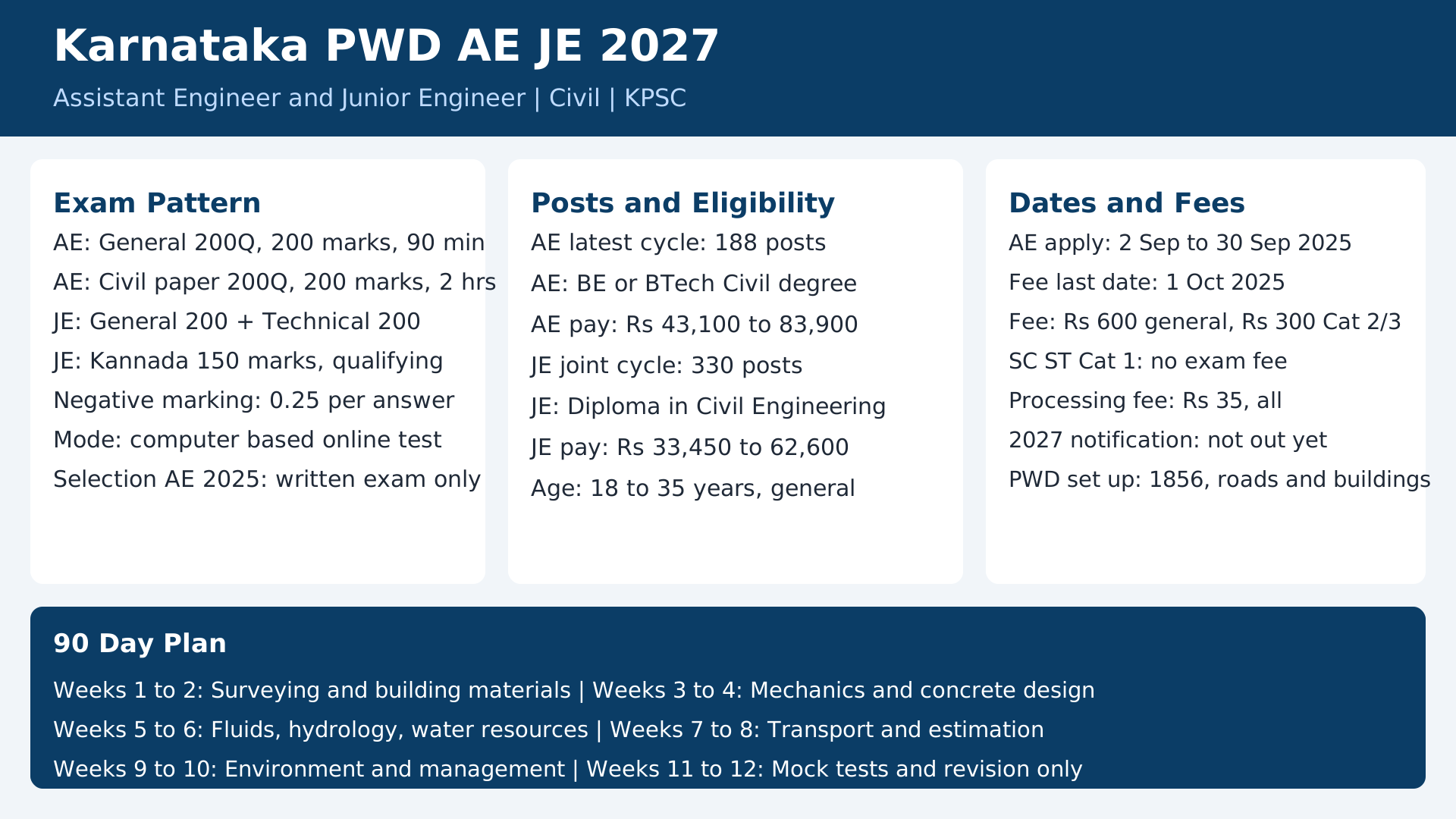
- The Assistant Engineer pattern for the 2025 cycle
- The Junior Engineer pattern and how it differs
- Compulsory Kannada: who writes it and what it asks
- Eligibility: degree for AE, diploma for JE
- What the department does, and why the job is what it is
- General Paper syllabus: what to cover
- Technical syllabus for Assistant Engineer: the civil core
- Technical syllabus for Junior Engineer: same subjects, diploma depth
- A 90 day plan for Karnataka PWD AE JE 2027
- Mistakes that cost marks
- How to apply when the notification comes out
- What to check before you trust any tracker
- Sources
Karnataka PWD AE JE 2027: Assistant and Junior Engineer Guide
Karnataka PWD AE JE 2027 is the next chance for civil engineers to join the Karnataka Public Works Department as an Assistant Engineer or a Junior Engineer. The most recent cycle was an Assistant Engineer only cycle run by the Karnataka Public Service Commission, and it carried 188 Assistant Engineer Civil posts with applications open from 2 September to 30 September 2025. No 2027 notification had been published as of 19 November 2026, so every 2027 date in this guide is unannounced until the Commission or the department publishes it. This guide uses the latest real cycles as its facts, and it says plainly where the sources disagree.
The department builds and maintains the roads and government buildings of Karnataka. An Assistant Engineer in this department supervises road works, checks estimates, measures work done by contractors, and keeps records that decide payments. A Junior Engineer does the same work at site level, with smaller stretches and smaller estimates. The job is a field job. You will spend more time on a road stretch or a building site than behind a desk, and the exam tests the civil engineering you will actually use there.
The latest cycle in plain numbers
| Item | Detail |
|---|---|
| Latest cycle | Assistant Engineer Civil, 188 posts, KPSC |
| Applications open | 2 September 2025 |
| Applications close | 30 September 2025 |
| Fee payment last date | 1 October 2025 |
| Conducting body | Karnataka Public Service Commission |
| Department | Public Works Department, Karnataka |
| Post group | Group B |
| Pay scale | Rs 43,100 to Rs 83,900 |
| Qualification | BE or BTech in Civil Engineering |
| Age, general | 18 to 35 years |
| Age, SC ST and Category 1 | Up to 40 years |
| Age, Category 2A 2B 3A 3B | Up to 38 years |
| Fee, general | Rs 600 plus Rs 35 processing fee |
| Fee, Category 2A 2B 3A 3B | Rs 300 plus Rs 35 processing fee |
| Fee, SC ST and Category 1 | No exam fee, Rs 35 processing fee |
| Selection | Written exam only, computer based online test |
| 2027 notification | Not published as of 19 November 2026 |
The 188 posts split into 129 posts for the Hyderabad Karnataka region and 59 posts for the non Hyderabad Karnataka region, as reported by the tracker that reproduced the notification. The general category took the largest share in both regions, with 64 posts in the Hyderabad Karnataka region and 29 posts in the other region. Reservation followed the Karnataka categories, with separate shares for SC, ST, Category 1, Category 2A, Category 2B, Category 3A and Category 3B. Check the official notification for your own category before you apply, because the split changes with every cycle.
One point in that table needs attention. The tracker that reproduced the 2025 notification says selection was by written exam only. Older guides describe a written exam plus an interview of 100 marks. The 2025 notification, as reproduced, has no interview. Do not prepare for an interview until a notification says one exists. Prepare for the written papers, because those decide selection in the latest cycle.
AE and JE are not one exam
Many guides write about Karnataka PWD AE JE as if it were a single exam with one notification. The record shows something else. Assistant Engineer and Junior Engineer have come together in some cycles and separately in others. The last joint cycle carried 990 posts in total, with 660 Assistant Engineer Civil posts and 330 Junior Engineer Civil posts. The most recent cycle, the 2025 one, carried Assistant Engineer posts only, all 188 of them, with no Junior Engineer post in it. A Junior Engineer aspirant who waits for a joint notification may wait a long time. A diploma holder should watch the KPSC site for a Junior Engineer notification of its own, and also watch the Karnataka Examinations Authority, which runs Junior Engineer recruitment for other departments.
The joint cycle itself carries a date conflict in the trackers. One tracker dates the joint notification to 17 August 2020, with applications closing on 16 September 2020. Another tracker gives the same dates, 17 August to 16 September, but labels the cycle 2021, and lists the exam as 13 to 15 December on a tentative basis. The post count is the same in both, 990 posts with 660 for Assistant Engineer and 330 for Junior Engineer, so the cycle is one cycle described twice. This guide treats it as the 2020 joint notification, and flags the 2021 label as a tracker conflict. The number that matters for your preparation is the same either way: 990 posts, split 660 and 330.
There is a second route into the department that candidates often miss. A 2019 notification from the Public Works Department itself, issued by a Special Recruitment Committee in the Chief Engineer office, invited applications for 570 Assistant Engineer Grade 1 posts and 300 Junior Engineer posts under the Public Works Department Recruitment Rules of 2019. That notification did not come from KPSC. It came from the department. So the department has recruited through KPSC and through its own committee in different years. Read the issuing body on every notification, because the body that issues it also sets the pattern, the fee and the last date.
Who runs the exam
The Karnataka Public Service Commission runs the Assistant Engineer Civil recruitment for the Public Works Department in the latest cycle. Applications went through the Commission site, and the syllabus PDF sat on the same site. The Commission is the body to watch for the next Assistant Engineer notification. The department site carries department news and reports, and the Commission site carries the recruitment itself. Bookmark both, and check the Commission site first when a notification is due.
The Karnataka Examinations Authority is a different body, and it matters for Junior Engineer aspirants. In October 2026 the Authority notified 218 Group C technical posts, including Junior Engineer Civil posts, for other departments and bodies, with applications from 31 October to 26 November 2026 and a pay scale of Rs 54,175 to Rs 99,400. Those posts were not Public Works Department posts. The pay scale is higher than the older KPSC Junior Engineer scale, which shows that pay scales get revised between cycles. Do not copy the Authority pay scale onto a PWD Junior Engineer post. The PWD Junior Engineer pay scale in the KPSC notifications is Rs 33,450 to Rs 62,600, and that is the figure this guide uses for the PWD post.
The Assistant Engineer pattern for the 2025 cycle
| Paper | Questions | Marks | Duration |
|---|---|---|---|
| General Paper | 200 | 200 | 90 minutes |
| Civil Engineering Subject Paper | 200 | 200 | 120 minutes |
| Total, written exam | 400 | 400 | 210 minutes |
The 2025 Assistant Engineer pattern is two objective papers in a computer based online test. The General Paper carries 200 questions for 200 marks in 90 minutes, which gives 27 seconds per question. The Civil Engineering Subject Paper carries 200 questions for 200 marks in 120 minutes, which gives 36 seconds per question. Each wrong answer costs 0.25 marks. One mark per question, with a quarter mark lost for a wrong answer, is the whole marking scheme. There is no partial marking, and there is no descriptive paper in this pattern.
Speed matters more here than in most engineering exams. Two hundred questions in 90 minutes leaves no room for long calculations in the General Paper, and the paper is built for that. It tests recall and quick judgment, not worked out solutions. The Subject Paper gives more time per question, and that is where the calculation questions sit. Practice both papers at full length, with a timer, because the time pressure is the real test in the General Paper.
The Junior Engineer pattern and how it differs
The Junior Engineer pattern is where the sources disagree most, and this section gives both versions as reported. The version from the joint cycle, reported by Oliveboard, has three papers. The General Paper carries 200 marks in 1 hour 30 minutes. The Specific Paper carries 200 marks in 2 hours. The Compulsory Kannada language paper carries 150 marks in 3 hours, and a candidate must secure a minimum of 50 marks in it. That adds up to 550 marks across the three papers, with the Kannada paper qualifying in nature.
A second version, reported by other trackers for the same exam, has three papers of 100 marks each, with 2 hours for each paper, and a total of 300 marks. In that version the General Studies paper and the Technical paper are objective, the Kannada paper is descriptive, and the Kannada paper is qualifying, so the written exam carries a weight of 200 marks. That version also adds an interview of 100 marks after the written exam. The two versions cannot both be right. The Oliveboard version, with 200 plus 200 plus 150 marks, is the one this guide follows for the joint cycle, because it matches the fee and eligibility details on the same page and it names the Kannada pass mark of 50. The 100 mark version still circulates widely, so check the pattern in the notification for your own cycle before you plan your time.
What is common to both versions is the shape of the exam. A General paper, a Technical paper, and a Kannada paper. The General and Technical papers are objective. The Kannada paper tests language ability and is qualifying. No version of the Junior Engineer pattern drops the Kannada paper. A diploma holder who cannot write Kannada should start on the language paper early, because it can block an otherwise strong candidate.
| Item | Assistant Engineer, 2025 cycle | Junior Engineer, joint cycle |
|---|---|---|
| Conducting body | KPSC | KPSC |
| Posts in latest cycle | 188 | 330 in the joint cycle, none in 2025 |
| Group | Group B | Group C |
| Qualification | BE or BTech Civil | Diploma in Civil Engineering |
| Pay scale | Rs 43,100 to Rs 83,900 | Rs 33,450 to Rs 62,600 |
| General paper | 200 questions, 200 marks, 90 minutes | 200 marks, 90 minutes |
| Technical paper | 200 questions, 200 marks, 120 minutes | 200 marks, 120 minutes |
| Kannada paper | Not listed in the 2025 pattern | 150 marks, 3 hours, qualifying, pass 50 |
| Negative marking | 0.25 per wrong answer | 0.25 per wrong answer |
| Selection | Written exam only | Written exam, interview reported in older guides |
Compulsory Kannada: who writes it and what it asks
The Compulsory Kannada language paper applies to candidates who have not studied Kannada in SSLC or higher studies. That is the rule reported by Oliveboard for KPSC technical posts. If you studied Kannada at SSLC level, you may not need to sit for it. If you did not, you will. Check your own SSLC record against the notification, because this is a yes or no question with no middle ground.
The paper is qualifying. You must secure a minimum of 50 marks in it, and its marks do not add to your merit total. That sounds easy, and it is easy for a candidate who writes Kannada every day. It is not easy for a candidate who studied in English medium outside Karnataka and never wrote a Kannada letter. The syllabus lists comprehension, grammar, summary and precis writing, translation to Kannada, and letter writing. Translation and letter writing carry the most risk, because they need regular practice more than reading. Write one Kannada letter and one translation every week from the start of your preparation, and the paper stops being a threat.
One gap in the record needs a plain statement. The 2025 Assistant Engineer pattern, as reproduced by the tracker, lists only two papers, General and Civil, with no Kannada paper named. The older joint cycle pattern names the Kannada paper clearly. It is possible that the Kannada requirement applied separately in 2025, through the Commission general rules, and simply did not appear in the two paper pattern summary. It is also possible that the 2025 cycle dropped it. This guide does not guess. If you have not studied Kannada in SSLC, read the next notification for the Kannada rule before you assume anything.
Eligibility: degree for AE, diploma for JE
| Item | Assistant Engineer | Junior Engineer |
|---|---|---|
| Qualification | BE or BTech in Civil Engineering, or equivalent, from a recognised university | Diploma in Civil Engineering, General, from the Board of Technical Education, Government of Karnataka, or equivalent |
| Accepted degree variants, AE | Civil Engineering and related degree titles named in the notification, including Construction Technology and Management and Structural Engineering in the 2019 department notification | Not applicable |
| Accepted diploma variants, JE | Not applicable | Civil Engineering, Construction Technology and Material Management in the 2019 department notification |
| Minimum age | 18 years | 18 years |
| Maximum age, general | 35 years | 35 years |
| Maximum age, SC ST and Category 1 | 40 years | 40 years, as per KPSC rules |
| Maximum age, Category 2A 2B 3A 3B | 38 years | 38 years, as per KPSC rules |
A BE Civil graduate cannot apply for the Junior Engineer post as a diploma holder, and a diploma holder cannot apply for the Assistant Engineer post as a degree holder. The two posts have separate gateways. That is worth saying clearly, because many candidates ask it. A diploma holder who later completes a BE degree becomes eligible for Assistant Engineer in the next cycle. A BE graduate who wants a Junior Engineer post must wait for a notification that accepts a degree for that post, and the PWD notifications so far have asked for a diploma for Junior Engineer.
Age is counted as on the date the notification names, and the upper age limits above are the ones reported for the 2025 Assistant Engineer cycle. The Junior Engineer age limits follow the same KPSC rules, with 18 to 35 years for general candidates. Other relaxations, for ex servicemen, persons with disabilities, and in service candidates, apply as per the rules in the notification. Do not assume a relaxation. Read the age clause in the notification for your cycle, because the cut off date decides everything.
What the department does, and why the job is what it is
The Karnataka Public Works Department was created as a separate department in 1856, headed by a Chief Engineer with an Assistant Chief Engineer, four Assistant Engineers, eleven Upper Subordinates and nineteen Lower Subordinates. The first Chief Engineer was Col. C. Bowen, and the first Chief Engineer from Mysore State was Y. Srinivasa Rao, in 1909. By 1856 all district headquarters were already connected to Bangalore by road. The department today is the Public Works, Ports and Inland Water Transport Department, and it is responsible for National Highways, State Highways and Major District Roads, and for the construction and maintenance of government buildings.
That history explains the exam. The department builds roads, bridges and buildings, and it maintains them. An Assistant Engineer or Junior Engineer in this department measures road work, checks the quality of materials, prepares estimates, and certifies bills. The technical syllabus is full of surveying, estimation, building materials, and design, because those are the daily tools of the job. The General Paper tests the Karnataka and India knowledge a government engineer needs, because the engineer works with government rules, government money, and the public.
Two department bodies appear in the record and are worth knowing. The Karnataka Road Development Corporation Limited was set up on 21 July 1999 as a wholly owned Government of Karnataka enterprise for road infrastructure development. The Karnataka State Highway Improvement Project is a department initiative to improve 2,381 kilometres of road network with World Bank assistance. Neither body sets the exam, but both show where the department spends its effort: roads, and more roads.
General Paper syllabus: what to cover
The General Paper syllabus, as listed by Oliveboard for the joint cycle, covers Indian Polity, the Indian Constitution, History of India and Karnataka, Geography of India and Karnataka, Current events at international, national and local level, Economy of India and Karnataka, Environment, Science and Technology in administration, Cultural Heritage and Tourism, Personalities in News, and General mental ability and quantitative ability. That is a wide list, and it rewards a candidate who reads the news every day.
Karnataka carries real weight in this paper. History of Karnataka, Geography of Karnataka, and Economy of Karnataka are named as separate topics, not as an afterthought to the India topics. A candidate who knows India well and Karnataka poorly will drop marks. Learn the districts, the rivers, the major irrigation and power projects, the state budget headlines, and the current schemes of the Karnataka government. The paper also names Cultural Heritage and Tourism, which points to Karnataka monuments, festivals, and heritage sites. Keep a short Karnataka notebook, one page per topic, and add to it every week.
General mental ability and quantitative ability is the scoring part of the General Paper. It needs practice, not reading. Twenty minutes a day on arithmetic, ratios, percentages, averages, time and work, and data reading will lift this section more than any book. In a 90 minute paper with 200 questions, the ability section is where a prepared candidate gains time for the rest of the paper.
Technical syllabus for Assistant Engineer: the civil core
The Specific Paper for Civil Engineering, as listed by Oliveboard, covers Transportation Engineering, Building Materials, Design of Steel Structures, Solid Mechanics, Construction Practices, Planning and Management, Surveying, Design of Concrete and Masonry Structures, Open Channel Flow, Fluid Mechanics, Hydraulic Machines and Hydro Power, Pipe Flow, Water Resource Engineering, Solid Waste Management, Environmental Engineering, and Hydrology. That list is the whole degree in short form, and it is the part of the exam where a BE graduate has the edge.
Start with the subjects that carry the most questions in past papers and the most marks in the syllabus. Surveying, Building Materials, and Construction Practices sit at the centre of PWD work, and they appear in the exam in direct, practical form: levelling, contouring, chain and compass survey, properties of cement, bricks, timber and steel, and the steps of a construction project from estimate to completion. Solid Mechanics and the two design subjects, Steel and Concrete, test the theory a degree holder is expected to know. Fluid Mechanics, Open Channel Flow, Pipe Flow, and Hydraulic Machines form one block, and they reward a candidate who learns the formulas with their units, because the exam asks for numbers, not essays.
Transportation Engineering and Water Resource Engineering carry the department work directly. Roads are the department core business, so geometric design, pavements, traffic, and highway materials deserve extra time. Water Resource Engineering, Hydrology, and Environmental Engineering cover dams, canals, water supply, sewage, and solid waste, which is the other half of public works. Keep the Indian Roads Congress codes and the basic design standards in your notes, and learn the numbers that the exam repeats: standard lane widths, camber, gradient limits, and the common test values for aggregates and concrete.
Estimation and costing deserves a paragraph of its own, because it is the skill that separates a PWD engineer from a classroom engineer. The exam asks about measurement of work, rate analysis, and valuation. Learn how to work out the quantity of brickwork, plaster, concrete, and excavation from a drawing, and learn the units in which each item is measured. A candidate who can do a rate analysis for one cubic metre of concrete, with cement, sand, aggregate, labour and water, will answer several questions from that one piece of preparation.
Technical syllabus for Junior Engineer: same subjects, diploma depth
The Junior Engineer technical syllabus covers the same civil subjects as the Assistant Engineer syllabus, at diploma depth. The topic names match. The depth of the questions differs. A Junior Engineer question asks for the definition, the formula, the standard value, or the direct application. An Assistant Engineer question asks for the derivation, the design step, or the comparison of two methods. A diploma holder who studies degree level design theory will waste time. A degree holder who studies for Junior Engineer with diploma books will find the paper easy and the competition tough, because every diploma holder in Karnataka has the same books.
For Junior Engineer, build your preparation around the diploma syllabus and the Board of Technical Education textbooks. Cover surveying with field procedures, building materials with tests and uses, construction with site practice, and estimation with measurement and rate analysis. Keep design to the working level: know the design steps for a beam and a slab, know the steel ratios in common use, and know the checks for shear and deflection, without going into the theory that a degree paper demands. The exam rewards breadth at diploma level, and a candidate who covers all subjects thinly will score more than a candidate who masters two subjects in depth and leaves the rest blank.
| Subject block | Assistant Engineer depth | Junior Engineer depth |
|---|---|---|
| Surveying | Theory plus field methods, errors, curves, contouring | Field methods, levelling, chain and compass, basic errors |
| Building materials | Properties, tests, standards, new materials | Properties, tests, uses, common defects |
| Solid mechanics and structures | Analysis, design of steel and concrete, masonry design | Working stress basics, beam and slab design steps |
| Fluid mechanics and hydraulics | Flow theory, open channel, pipe flow, machines, hydro power | Flow basics, pipes, channels, pumps, direct formulas |
| Transportation | Geometric design, pavements, traffic engineering | Road types, pavements, materials, basic design |
| Water resources and environment | Hydrology, dams, irrigation, water supply, waste | Hydrology basics, water supply, sewage, waste |
| Estimation and costing | Rate analysis, valuation, contracts, accounts | Measurement, quantities, rate analysis basics |
| Construction management | Planning, scheduling, contracts, quality control | Site practice, planning basics, safety |
A 90 day plan for Karnataka PWD AE JE 2027
| Weeks | Focus | Daily time |
|---|---|---|
| 1 to 2 | Surveying, building materials, and General Paper Karnataka topics, plus one mock test | 3 hours |
| 3 to 4 | Solid mechanics and design of concrete structures, plus daily arithmetic practice | 3 hours |
| 5 to 6 | Fluid mechanics, hydraulics, hydrology, and water resource engineering | 3 hours |
| 7 to 8 | Transportation engineering and estimation and costing, with rate analysis practice | 3 hours |
| 9 to 10 | Environmental engineering, construction management, and General Paper revision | 3 hours |
| 11 | Full mock tests, one General and one Technical paper each day | 4 hours |
| 12 | Revision of notes and formulas only, plus one light mock test | 2 hours |
| Last 3 days | Formula sheets, standard values, Karnataka facts, and Kannada writing for JE candidates | 1 hour |
The plan gives the Technical Paper more than half the time, because it carries half the marks in the Assistant Engineer pattern and the whole scoring edge in the Junior Engineer pattern. It puts surveying and building materials first, because those two subjects appear in every past paper and they are the easiest marks in the exam. It puts estimation in weeks 7 to 8, after the candidate knows materials and measurements, because rate analysis needs both.
Junior Engineer candidates should add one Kannada writing session a week from week 1. A letter and a translation each week, timed, with a Kannada speaker checking the grammar, is enough. Do not leave Kannada to the last week. A qualifying paper that you fail ends the attempt, however high your technical score is. Assistant Engineer candidates should check the Kannada rule in the notification first, and if it applies to them, follow the same weekly habit.
Mock tests deserve a fixed slot, not leftover time. Take one full mock test every Sunday from week 3 onward, in the real time limit, without pausing. For Assistant Engineer, that means 90 minutes for the General Paper and 120 minutes for the Technical Paper, taken separately. Review every wrong answer the same evening, and write the correct formula or fact in a notebook. Track your score by subject, not just in total, because a total of 250 that hides a transportation score near zero is a warning. The last three days are for formula sheets, standard values, and Karnataka facts only. New topics in the last three days cost more marks than they gain, because they displace revision of material you already know.
Previous papers are the best mock tests you can find. The KPSC site carries the syllabus PDF for the Assistant Engineer Civil post, and past papers for the PWD exam circulate through the trackers. Work through at least three past papers before the exam, and note the topics that repeat. The exam repeats its favourite questions in new words. A topic that appeared in two past papers will appear again, and the candidate who has seen it twice will answer it in seconds.
Mistakes that cost marks
The first mistake is preparing for the wrong pattern. Candidates who study from old guides prepare for three papers of 100 marks each with an interview, and then face two papers of 200 marks each with no interview. Candidates who study from the 2025 tracker prepare for two papers, and then face a Kannada paper they never practised. Read the notification for your cycle, and build your plan from the pattern it prints. The pattern in this guide is the latest one the sources report, and it will change again.
The second mistake is ignoring the General Paper. A civil engineer who scores high in the Technical Paper and low in the General Paper loses the exam, because the General Paper carries half the marks in the Assistant Engineer pattern. The General Paper needs daily reading, not a last month crash. Read one Karnataka news item and one national news item every day, and keep a note of the numbers in them. The paper asks about current events, and the news you read in the morning is the revision you need in the evening.
The third mistake is learning formulas without their units. A fluid mechanics question that asks for discharge in cubic metres per second will offer options in litres per second, cubic metres per hour, and cubic metres per second, and the candidate who forgets the conversion will pick the wrong option with the right formula. Write every formula with its unit, and practise converting between the units the exam uses.
The fourth mistake is skipping estimation and costing. Many candidates treat it as a minor topic and then find five or six questions on measurement, rate analysis, and valuation. Those are easy marks for a candidate who has practised them, and lost marks for a candidate who has not. Do one rate analysis a day for a month, and the topic becomes a strength.
The fifth mistake is guessing too much. Each wrong answer costs 0.25 marks, and four wrong answers erase one correct answer. In a 200 question paper, random guessing on 40 questions will cost about 7 or 8 marks after the negative marking, and that gap decides the merit list. Attempt the questions you can narrow to two options, and leave the ones where you know nothing. The last ten minutes are for the marked questions, not for fresh guessing.
The sixth mistake is poor time use in the hall. Two hundred questions in 90 minutes gives 27 seconds per question in the General Paper, and a candidate who spends three minutes on one hard question loses six easy marks elsewhere. Mark the hard question, move on, and return only after the rest of the paper is done. The same rule holds in the Technical Paper, where 36 seconds per question still leaves no room for a five minute calculation on a one mark question.
Engineers who clear a state engineering exam often prepare for other government exams alongside it. The IBPS SO 2027, RBI Grade B 2027, SEBI Grade A 2027, NABARD Grade A 2027, SBI PO 2027, IBPS PO 2027, UPPSC PCS 2027, UPPSC RO ARO 2027, SSC GD 2027 and AFCAT 2027 pages on this site carry the same style of mock test guide, and the exam habit you build here transfers directly to them.
How to apply when the notification comes out
Apply on the Karnataka Public Service Commission site. First time candidates register on the site, then fill the application for the Assistant Engineer or Junior Engineer post, pay the fee online, and print the application for their own record. The 2025 cycle charged Rs 600 for general candidates, Rs 300 for Category 2A, 2B, 3A and 3B candidates, no exam fee for SC, ST and Category 1 candidates, and a processing fee of Rs 35 for all candidates. The fee in the next cycle may change, so read the fee table in the notification before you pay.
Keep your documents ready before the notification comes out. Degree or diploma certificate and marks cards, SSLC marks card for age and Kannada proof, caste or category certificate if you claim reservation, Hyderabad Karnataka region proof if you claim that quota, and a recent photograph and signature in the sizes the site asks for. A missing certificate on the last date is the most common reason a good candidate fails to apply, and it is the easiest to prevent. Scan everything now, and keep the files in one folder.
Check the last date twice. The 2025 cycle closed applications on 30 September 2025 and closed fee payment on 1 October 2025, one day later. The two dates are different, and a candidate who confuses them can pay the fee and still miss the application, or submit the application and still miss the fee. Submit the form two days before the last date, and pay the fee the same day. The site slows down on the last day, and a slow site on the last evening has ended many attempts.
What to check before you trust any tracker
Three checks will keep you safe from wrong information. First, check the issuing body. A KPSC notification, a PWD department notification, and a KEA notification are three different exams with three different patterns, even when the post name is the same. Second, check the year on the notification. Trackers reuse old pages and change the year in the title, and a 2020 pattern with a 2026 title is still a 2020 pattern. Third, check the post count and the dates against a second source. The 188 post figure for the 2025 Assistant Engineer cycle appears with the same dates, 2 September to 30 September 2025, in the tracker that reproduces the notification, and that match is what makes it trustworthy.
The Karnataka PWD AE JE 2027 notification is not out yet. When it comes, it will carry the post count, the dates, the fee, the age limits, and the pattern for that cycle, and those numbers will replace the ones in this guide. Until then, prepare from the latest real cycles, because the syllabus and the pattern change slowly, and a candidate who is ready on the syllabus will be ready when the dates arrive.
Sources
Karnataka Public Service Commission official site, kpsc.kar.nic.in, for the conducting body, the application portal, and the Assistant Engineer Civil syllabus PDF. Karnataka Public Works Department official site, kpwd.karnataka.gov.in, for the department name, its responsibilities, and the Management Information System reports that record the department history from 1856, the first Chief Engineer Col. C. Bowen, the Karnataka Road Development Corporation Limited set up on 21 July 1999, and the Karnataka State Highway Improvement Project covering 2,381 kilometres.
GovtJobOnline KPSC Assistant Engineer Civil PWD page, for the 188 posts, the dates 2 September to 30 September 2025, and the fee payment last date of 1 October 2025. The same page gives the age limits of 18 to 35 years for general candidates, 40 years for SC ST and Category 1, and 38 years for Category 2A 2B 3A 3B. It also gives the pay scale of Rs 43,100 to Rs 83,900, the fee of Rs 600 for general and Rs 300 for Category 2A 2B 3A 3B with Rs 35 processing fee, and the two paper pattern of 200 questions and 200 marks in 90 minutes for the General Paper and 200 questions and 200 marks in 120 minutes for the Civil Engineering Subject Paper with negative marking of 0.25.
Oliveboard Karnataka PWD AE JE page, for the joint cycle of 990 posts with 660 Assistant Engineer and 330 Junior Engineer posts. It gives the three paper pattern of General 200 marks in 1 hour 30 minutes, Specific 200 marks in 2 hours, and Compulsory Kannada 150 marks in 3 hours with a minimum of 50 marks. It also gives the Kannada syllabus, the General and Specific Paper syllabuses, the fee of Rs 600 for general and Rs 300 for Category 2A 2B 3A 3B with Rs 35 processing fee, and the rule that the Kannada paper applies to candidates who have not studied Kannada in SSLC or higher studies.
JagranJosh KPSC Recruitment 2020 page, for the joint cycle dated August 2020 with 1,265 total vacancies including 660 Assistant Engineer and 330 Junior Engineer posts under PWD, and the Junior Engineer pay scale of Rs 33,450 to Rs 62,600. CollegeDisha Karnataka PWD exam pattern page, for the three paper version of 100 marks each with a qualifying Kannada paper and an interview of 100 marks, reported here as a conflicting version.
Scribd copy of the PWD Karnataka recruitment notification, for the 2019 Special Recruitment Committee notification of 570 Assistant Engineer Grade 1 posts and 300 Junior Engineer posts under the Public Works Department Recruitment Rules of 2019. Testbook KPSC Junior Engineer pages, for the Junior Engineer pay scale of Rs 33,450 to Rs 62,600 in the 2022 and 2024 cycles. FreeJobAlert and JobCareerUpdates KEA Junior Engineer 2026 pages, for the Karnataka Examinations Authority notification of 31 October 2026 with 218 Group C technical posts, applications from 31 October to 26 November 2026, and the pay scale of Rs 54,175 to Rs 99,400 for Junior Engineer posts in other departments.







