
About JKSSB JE Civil 2027 Exam Series
📖 Table of Contents
- JKSSB JE Civil 2027 and the 2026 notification in numbers
- What a Junior Engineer (Civil) actually does
- Who can apply for JKSSB JE Civil 2027
- The written exam, section by section
- The syllabus, unit by unit
- How the earlier cycle ran
- How hard is it to get in
- Mistakes that cost marks
- A 90 day plan that fits around a job
- Books and papers that actually help
- How to apply, and the documents to keep ready
- Previous papers and mock tests: how to use them
- Sources
JKSSB JE Civil 2027: Junior Engineer Civil Guide
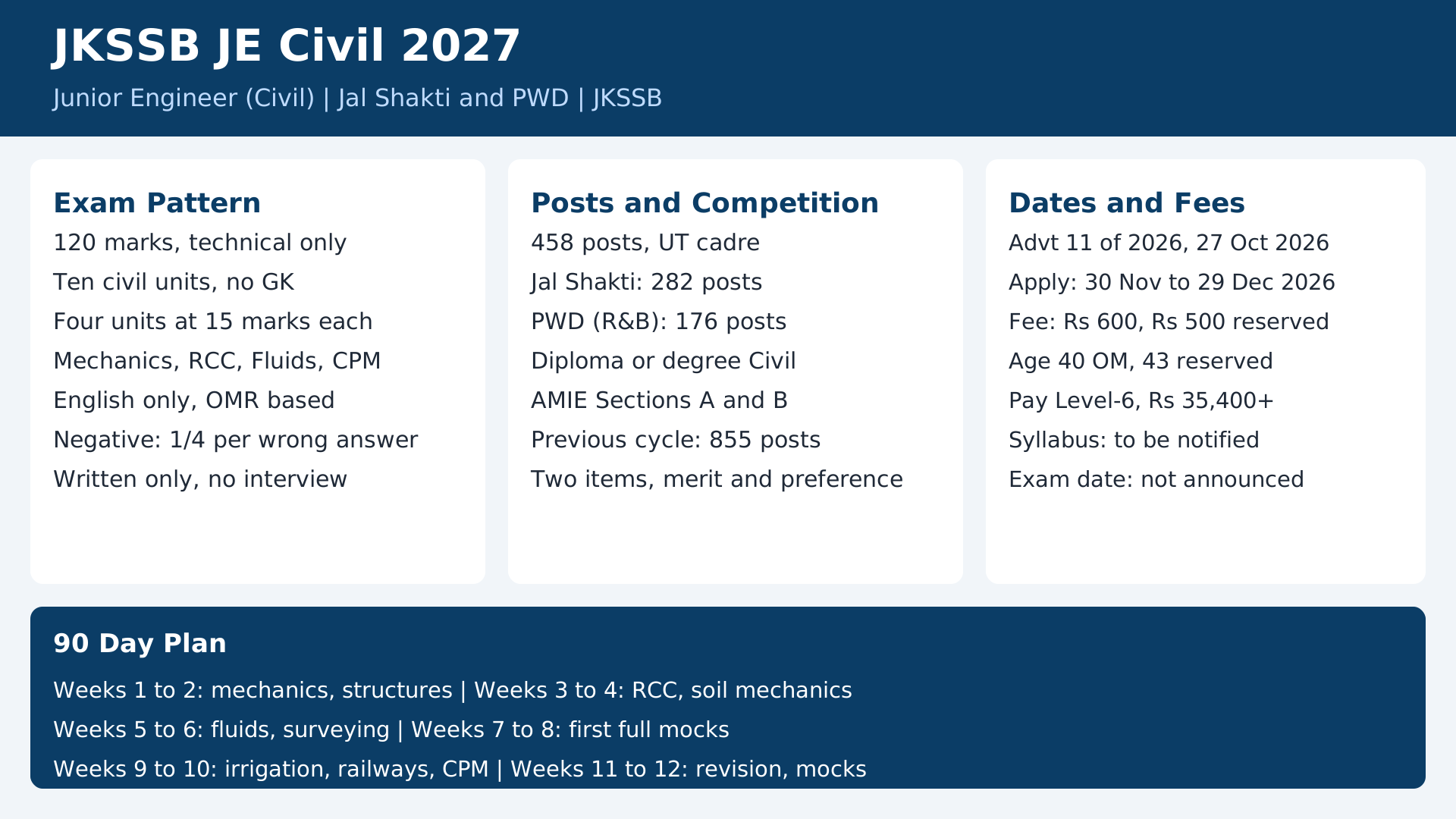
JKSSB advertised 458 Junior Engineer (Civil) posts under Advertisement Notification No. 11 of 2026, dated 27 October 2026, with 282 posts in the Jal Shakti Department and 176 in the Public Works (R and B) Department. The Jammu and Kashmir Services Selection Board opens applications on 30 November 2026 and closes them on 29 December 2026. JKSSB JE Civil 2027 is the live cycle, and every fact in this guide comes from that notification and from the previous JE Civil syllabus, because the 2026 notification says the syllabus will be notified separately. If you hold a diploma or a degree in Civil Engineering, this is the paper to prepare for.
The selection is a written examination only, with objective multiple choice questions in English, and one-fourth negative marking. There is no interview and no second stage. The previous JE Civil paper was entirely technical, with ten civil engineering units for 120 marks and no general knowledge section at all. That is the single most important fact about this exam. A civil engineering graduate who prepares the ten units properly will outscore a general candidate by a wide margin, and a candidate who spends the weeks on general knowledge will find that none of it appears.
JKSSB JE Civil 2027 and the 2026 notification in numbers
| Item | Detail |
|---|---|
| Conducting body | Jammu and Kashmir Services Selection Board (JKSSB) |
| Advertisement | Notification No. 11 of 2026, dated 27 October 2026 |
| Posts | 458 in total, UT cadre |
| Jal Shakti Department | 282 posts, Item 266 |
| Public Works (R and B) Department | 176 posts, Item 267 |
| Application window | 30 November 2026 to 29 December 2026, online only |
| Pay scale | Level-6, Rs 35,400 to Rs 1,12,400 |
| Application fee | Rs 600, Rs 500 for SC, ST-1, ST-2, EWS and PwD |
| Exam date | To be notified separately |
| Syllabus | To be notified separately by JKSSB |
| Previous cycle | Advertisement No. 06 of 2022 and No. 05 of 2023 |
The two departments are separate items, and the merit is drawn item-wise, which means a candidate is selected for Jal Shakti or for Public Works according to merit and preference. The Jal Shakti share is larger at 282 posts, and the Public Works share is 176, so the Jal Shakti cut will usually be a little lower than the Public Works cut for the same category. Fill the preference carefully, because the item decides the department you will work in.
Four hundred and fifty eight posts is a large JE recruitment by JKSSB standards, and it is a UT cadre post, which means the posting can be anywhere in the Union Territory. The application window is a month long, from 30 November to 29 December 2026, and the qualification and the domicile certificate must both be held on or before the last date. Documents issued after 29 December 2026 are not accepted, so get the certificates in order before the window opens.
What a Junior Engineer (Civil) actually does
A Junior Engineer in the Public Works Department supervises the construction and maintenance of roads, buildings, bridges and other government works. The day involves reading drawings, checking measurements, maintaining the measurement book, supervising contractors, checking the quality of materials, and reporting progress to the Assistant Engineer. The Junior Engineer is the officer on the site, and the quality of the work depends on whether the Junior Engineer measures carefully and keeps the records straight.
In the Jal Shakti Department the work is water. The Junior Engineer supervises water supply schemes, pipelines, storage tanks, pumping stations, sewerage works and irrigation structures, and the same skills apply: measurement, quality checking, supervision and record keeping. The two departments share the post and the paper, but the work after selection is different, and a candidate who prefers water works should rank Jal Shakti first, while a candidate who prefers roads and buildings should rank Public Works first.
The post is the entry point to the engineering services of the Union Territory, and the career path runs upward through Assistant Engineer and Executive Engineer as vacancies and seniority allow. The pay is Level-6, from Rs 35,400 to Rs 1,12,400, with the allowances that apply to Union Territory employees. For a diploma holder, it is one of the best starting pays in the JKSSB system, and the reason the competition for these 458 posts will be sharp.
One confusion to clear up at the start is the difference between this post and the Assistant Engineer post. The Junior Engineer needs a three year diploma or a degree, while the Assistant Engineer needs a degree, and the two posts have separate notifications, separate papers and separate pay scales. The Junior Engineer Mechanical post under Advertisement No. 10 of 2026 is also separate, with 127 posts, and its syllabus is mechanical, not civil. Candidates should check the item number on their application and prepare for the civil paper only.
Who can apply for JKSSB JE Civil 2027
The qualification is a three year Diploma in Civil Engineering from a government recognised institute, or a Degree in Civil Engineering from an Indian university, or AMIE Sections A and B, India. The qualification must be held on or before the last date of applying, 29 December 2026. A diploma in another branch does not work, and a degree in another branch does not work either. The branch is civil, and the board checks it at document verification.
Domicile of the Union Territory of Jammu and Kashmir is compulsory, with a valid domicile certificate in the prescribed format issued on or before 29 December 2026. Reserved category candidates must upload the category certificate in the prescribed format with the application, because the board gives no later chance to upload it. In-service candidates must also send a printout of the online form, with the certificate at its end signed and stamped, through their Head of Department to the Secretary of the Board by the last date of document verification.
| Category | Maximum age | Not born before |
|---|---|---|
| Open Merit | 40 years | 1 January 1986 |
| SC, ST-1, ST-2, RBA, ALC/IB, EWS, OBC | 43 years | 1 January 1983 |
| Physically challenged | 42 years | 1 January 1984 |
Age is counted as on 1 January 2026, and no candidate may be born after 1 January 2008. Ex-servicemen may deduct their service from their age and are eligible if the result is not more than three years above the limit. The fee is Rs 600, or Rs 500 for SC, ST-1, ST-2, EWS and PwD candidates, paid online only through net banking or a credit or debit card, and it is not refunded.
The application window runs from 30 November to 29 December 2026 on jkssb.nic.in. The exam date and the syllabus will both be notified separately, and candidates should check the board site for the syllabus notice first, because the exam date notice usually follows it, and the gap between the two is often short.
The written exam, section by section
Selection is on the merit of a written or OMR examination only, followed by document verification. The notification says the exam will have objective multiple choice questions, set in English only, with one-fourth negative marking. The exam date and the syllabus will be notified separately, and until the syllabus notice appears the best guide is the syllabus the board published for its previous JE Civil written test.
| Unit | Marks |
|---|---|
| Surveying | 10 |
| Mechanics and Structural Analysis | 15 |
| RCC Structures | 15 |
| Soil Mechanics | 10 |
| Fluid Mechanics and Hydraulics | 15 |
| Irrigation Engineering | 10 |
| Water Supply and Waste Water Engineering | 10 |
| Highway Engineering | 10 |
| Railway Engineering | 10 |
| Construction Planning and Management | 15 |
| Total | 120 |
The previous paper was 120 questions for 120 marks, one mark each, with 0.25 negative marking for each wrong answer, and the duration in the previous cycle was 2 hours. The 2026 notification does not state the duration, so the 2 hour figure is the previous duration, not a 2026 fact. The unit-wise marks above come from the previous syllabus under Advertisement No. 06 of 2022, Item No. 201, and they are labelled as the previous syllabus throughout this guide.
Four units carry 15 marks each, Mechanics and Structural Analysis, RCC Structures, Fluid Mechanics and Hydraulics, and Construction Planning and Management, which together make 60 of the 120 marks. Those four units deserve half your calendar. The other six units carry 10 marks each, and they are the steady marks that separate a prepared candidate from a candidate who only read the big units.
The most important feature of the paper is what it does not contain. There is no general knowledge section, no reasoning section, no English section and no computer section in the previous syllabus. The whole paper is civil engineering. A candidate who spends the weeks on general knowledge will find that none of it appears, while a candidate who spends the weeks on the ten units will find that all of it appears.
The syllabus, unit by unit
Surveying carries 10 marks and covers the importance, principles and classification of surveying, measurement of distances and directions, chain and compass surveying, levelling, tacheometry, theodolite, traversing, contouring, plane table surveying and curves. The unit is compact, and the questions are usually direct, which makes it a reliable source of marks.
Mechanics and Structural Analysis carries 15 marks and covers rigid bodies, scalar and vector quantities, laws of forces, moments and friction, centre of gravity, simple machines, torsion, properties of materials, bending moment and shear force in statically determinate beams, simple stress and strain, two dimensional stress and principal stresses, bending and shear stresses, unsymmetrical bending and shear centre, thin walled pressure vessels, columns and buckling, combined stresses, slope and deflection, and analysis of trusses. It is the heaviest unit in the paper, and it needs problem practice rather than reading alone.
RCC Structures carries 15 marks and covers concrete ingredients and technology, water cement ratio, workability, admixtures, special concretes, non-destructive tests, basics of mix design, working stress and limit state concepts, limit state design for flexure, shear, compression and torsion, basics of prestressed concrete, and one way and two way slabs. The limit state design questions reward candidates who practise numericals, because the formulas are few and the numbers are standard.
Soil Mechanics carries 10 marks and covers origin and properties of soil, classification, the three phase system, flow of water, permeability and seepage, effective stress, deformation, consolidation and compaction, shear strength, plate load test, standard penetration test and field density tests, soil exploration, and bearing capacity. The unit is short, and the questions are usually direct definitions and standard values.
Fluid Mechanics and Hydraulics carries 15 marks and covers properties of fluids, hydrostatic pressure and its measurement, flow measurement, flow through pipes and open channels, hydraulic pumps, conservation of mass, momentum and energy, potential flow, applications of Bernoulli's equation, laminar and turbulent flow, pipe networks, boundary layer, uniform, critical and gradually varied flow, specific energy, hydraulic jump, forces on immersed bodies, dimensional analysis and hydraulic modelling, and kinematics of flow. Bernoulli's equation and open channel flow are the topics to master first.
Irrigation Engineering carries 10 marks and covers water requirement of crops, the hydrological cycle, dams, canals and head works, regulation and cross-drainage works, hydraulic structures, river training, water logging and drainage, ground water recharge and well hydraulics. Water Supply and Waste Water Engineering carries 10 marks and covers quantity and quality of water, treatment of water, conveyance and layout of pipes, water supply and plumbing in buildings, sewerage and construction of sewers, characteristics and disposal of sewage, sewage treatment, building drainage, and air and noise pollution. Both units are memory heavy, and they reward a candidate who reads them twice.
Highway Engineering carries 10 marks and covers history and planning of highways, terminology, construction methods, IRC classification of roads, highway surveys and geometric design, road materials and binders, types of pavement, the CBR method, preparation of subgrade, WBM, WMM, bituminous and dense bituminous macadam, and problems of hill roads. Railway Engineering carries 10 marks and covers history of Indian railways, gauges, permanent way and its components, types of rails, creep, welding of rails, fixtures and fastenings, signalling, points and crossings, and bridges with their terminology, classification, components and foundations. Railway engineering is the unit most JE aspirants skip, and it is quick marks for those who prepare it.
Construction Planning and Management carries 15 marks and covers network diagrams, PERT and CPM, cost optimisation, contracts and tenders, depreciation and valuation, organisation, measurement book and cash book, functions of management, construction planning, quality and inventory control, and estimation, costing and types of estimates. The measurement book and cash book topics connect directly to the job, and the questions are usually practical rather than theoretical.
How the earlier cycle ran
The previous JE Civil cycle ran under Advertisement No. 06 of 2022 and Advertisement No. 05 of 2023, with 855 posts reported across the two advertisements. The board replaced the earlier offline OMR screening with an equi-percentile normalised computer based test for that cycle, focused entirely on the core technical civil engineering subjects. The syllabus for that cycle is the ten unit syllabus described above, and it is the best guide to the 2026 paper until the new syllabus notice appears.
The 2026 cycle is larger in a single advertisement, with 458 posts in one notification, and the application window is a month long. The exam date and the syllabus are both still to be notified as of 20 November 2026. Candidates should prepare the ten units now, and check the new syllabus notice the day it appears, because the unit weights may shift even if the subjects stay the same.
One caution belongs here. The 855 post figure for the earlier cycle rests on a tracker page that groups two advertisements, and it is stated here as a tracker figure rather than as a notification figure. The 458 post figure for the 2026 cycle is the notification figure, and it is the one to trust.
How hard is it to get in
Four hundred and fifty eight posts with a diploma or degree in Civil Engineering only is a narrower competition than a general graduate paper, because the eligibility itself cuts the pool. The candidates are civil engineers and diploma holders, and they are all preparing the same ten units, so the paper will be decided by depth in the technical subjects rather than by general knowledge. A candidate who has revised the diploma syllabus properly will find the paper familiar, and a candidate who has not will find it hard from the first question.
The 120 mark paper with 0.25 negative marking makes accuracy the deciding factor. With four units at 15 marks each, the difference between a candidate who has practised numericals in Mechanics, RCC, Fluid Mechanics and Construction Planning and a candidate who has only read the theory will be visible in the score. The six 10 mark units are where the steady candidates pick up marks, and Railway Engineering in particular is a unit where a few hours of reading can add several marks that most candidates leave on the table.
No cut-off for the 2026 cycle exists yet, and no official cut-off for the earlier cycle was retrieved in prep, so no cut-off number is stated here. The useful target is a standard rather than a number: attempt about 100 questions with high accuracy, keep the blind guesses to zero, and make sure the four 15 mark units are the strongest part of your preparation.
Mistakes that cost marks
The first mistake is preparing general knowledge for a technical paper. The previous syllabus has no general knowledge section, and a week spent on current affairs is a week lost from Mechanics or RCC. Read the ten units, and spend the time there.
The second mistake is reading theory without practising numericals. Mechanics and Structural Analysis, RCC and Fluid Mechanics are numerical units, and the questions reward candidates who have solved problems, not candidates who have memorised definitions. Solve fifty numericals in each of the four 15 mark units before the exam, and the paper will feel familiar.
The third mistake is skipping Railway Engineering. Ten marks is a twelfth of the paper, and the unit is short: gauges, permanent way, rails, creep, welding, fixtures, signalling, points and crossings, and bridges. A few hours of reading can add several marks that most candidates leave behind.
The fourth mistake is guessing blindly under negative marking. Four wrong answers wipe out one right answer, and in a technical paper the wrong options are designed to look right to a candidate who half remembers a formula. Attempt what you can work out, and leave the rest blank.
The fifth mistake is waiting for the syllabus notice before starting. The ten units are the preparation that transfers whatever the notice says, and a candidate who starts now will only need to adjust the weights, while a candidate who waits will be starting from zero with weeks left. The notice will come, and the exam date will follow soon after.
JKSSB JE Civil aspirants often prepare for other state and national exams alongside this one. The IBPS SO 2027, RBI Grade B 2027, SEBI Grade A 2027, UPPSC Assistant Engineer 2027, UPPSC Polytechnic Lecturer 2027, NABARD Grade A 2027, SBI PO 2027, IBPS PO 2027, SSC GD 2027, UGC NET Paper 1 2027 pages on this site carry the same style of mock test guide, and the pattern habit you build here transfers directly to them.
A 90 day plan that fits around a job
Weeks 1 to 2 belong to Mechanics and Structural Analysis. Work through forces, moments, stress and strain, bending moment and shear force, slope and deflection, and trusses, solving numericals every day. End each day with twenty questions, and keep a formula notebook from day one.
Weeks 3 to 4 belong to RCC Structures and Soil Mechanics. Limit state design for flexure, shear, compression and torsion in RCC, with slabs and prestressed concrete, and classification, permeability, consolidation, shear strength and bearing capacity in soil. Practise the standard numericals until the steps are automatic.
Weeks 5 to 6 belong to Fluid Mechanics and Hydraulics and to Surveying. Bernoulli's equation, open channel flow, pipe networks and hydraulic jump in fluids, and levelling, theodolite, traversing, contouring and curves in surveying. Add the CBR method and pavement types in Highway Engineering in the second week.
Weeks 7 to 8 are for the first full mocks. Two full 120 mark papers in 2 hours each week, with the whole paper reviewed the same day. Sort every wrong answer into three piles: did not know, knew but rushed, and guessed badly. Shrink the third pile first, because it is the only one you can fix by behaviour alone.
Weeks 9 to 10 are for Irrigation, Water Supply, Railway Engineering and Construction Planning and Management. These four units are memory heavy, and they need reading twice rather than problem practice. Learn the PERT and CPM steps, the contract and tender terms, and the railway terms in full.
Weeks 11 to 12 are for revision and mocks only. No new theory and no new book. Re-read the formula notebook, re-do the numericals in the four 15 mark units, re-read the memory units, and sit for three more full mocks in exam conditions. In the last week, cut the study hours and protect your sleep, because a fresh mind on the exam day is worth more than one more chapter.
Books and papers that actually help
For the technical units, the diploma level standard books are enough, and the best known names are the ones every civil diploma course uses: a surveying book, a structural analysis book, an RCC book, a soil mechanics book, a fluid mechanics book, an irrigation book, a water supply book, a highway book, a railway book and a construction management book. One book per unit, read twice, beats a shelf of books read once.
For practice, the previous JKSSB JE Civil papers and the SSC JE Civil papers cover the same diploma level subjects, and they are the best guide to the level and the style. Solve them in 2 hours with the 0.25 negative marking applied, and score yourself strictly.
The single most useful habit is the formula notebook. Every formula, every standard value and every code provision goes in with the unit it belongs to, and the notebook is revised every Sunday. In the last two weeks, that notebook is your revision, and it is worth more than any new book.
How to apply, and the documents to keep ready
The application for Advertisement Notification No. 11 of 2026 runs online on the JKSSB portal from 30 November to 29 December 2026. The steps are the same as in every JKSSB recruitment, with two points that are specific to this notification and easy to get wrong.
First, read the advertisement in full, including Annexure A, before touching the form. The two items, Jal Shakti at 282 posts and Public Works at 176 posts, are separate, and the form asks for the preference between them, so decide the preference before you start. Second, complete the one time registration on the portal if you have not done so already, and keep the login details safe, because the same login carries the admit card and the result later.
Third, fill the form with the details as they appear on the matriculation certificate, because the board matches the name, the date of birth and the parents names against that certificate. Fourth, upload the photograph and signature in the size and format the notification prescribes, and check the preview before submitting. Fifth, upload the domicile certificate and the category certificate in the prescribed format, with the dates on or before 29 December 2026. Reserved category candidates must upload the category certificate with the application, because the board gives no later chance to upload it.
Keep a folder ready with the matriculation certificate, the domicile certificate, the category certificate if you claim reservation, the diploma or degree certificate and marks sheets, a valid photo identity proof, and two recent passport size colour photographs. In-service candidates must also send a printout of the online form, with the certificate at its end signed and stamped, through their Head of Department to the Secretary of the Board by the last date of document verification. Documents issued after 29 December 2026 are not accepted, so get the certificates in order before the window opens.
Previous papers and mock tests: how to use them
The best practice material for this post is the set of previous JKSSB JE Civil papers, plus the SSC JE Civil papers, because both cover the same diploma level civil subjects at the same level. The ten units in the previous syllabus appear in both sets, and the numericals in Mechanics, RCC and Fluid Mechanics are the same kind of questions. Solve them in 2 hours with the 0.25 negative marking applied, and score yourself strictly, because a mock without negative marking teaches you nothing about this exam.
Use the mocks in three stages. In the first stage, solve unit-wise papers to build depth in each unit, with the four 15 mark units first, because they carry half the paper. In the second stage, solve full 120 mark papers in 2 hours, with the whole paper reviewed the same day. In the third stage, in the last month, solve two full papers a week in exam conditions, at the same time of day as the real exam, with no breaks and no phone.
The review matters more than the score. Write down every question you got wrong and why, and sort the reasons into three piles: did not know, knew but rushed, and guessed badly. The third pile is the one to shrink first, because it is the only one you can fix by behaviour alone. For numericals, re-solve the ones that went wrong after a week, and check whether the steps stick. A mock that is solved and forgotten is a wasted mock, and a mock that is reviewed properly is worth more than a chapter of theory.
Sources
CivilGyan JKSSB JE Civil 2026 page, for Advertisement Notification No. 11 of 2026 dated 27 October 2026, the 458 posts with Jal Shakti 282 and PWD (R and B) 176, the application window of 30 November to 29 December 2026, the Level-6 pay scale, the age limits, the Rs 600 and Rs 500 fee, the written only selection and the previous ten unit syllabus of 120 marks.
CareerPower JKSSB JE syllabus page, for the 120 question and 120 mark paper, the 2 hour duration, the English only medium and the 0.25 negative marking.
Harshya JKSSB Junior Engineer Civil syllabus page, for the previous cycle under Advertisement No. 06 of 2022 and Advertisement No. 05 of 2023, the diploma and degree eligibility and the 120 mark technical syllabus.
SarkariNokaari JKSSB JE Civil and Mechanical recruitment page, for the combined 585 vacancies with 458 Civil and 127 Mechanical posts.







