About KPTCL AE JE 2027 Exam Series
📖 Table of Contents
- What KPTCL is, and why one notification fills posts in six companies
- KPTCL AE JE 2027 at a glance
- The February 2025 cycle, the last real notification
- Assistant Engineer or Junior Engineer, Electrical or Civil: which post fits your degree
- Who can apply: degree, diploma, age, marks, Kannada
- The exam pattern: 100 marks, 75 technical, 25 general
- Assistant Engineer Electrical syllabus: what the 75 marks cover
- Assistant Engineer Civil syllabus: structures, soil, water, roads
- Junior Engineer Electrical syllabus: the diploma core, with field work in mind
- Junior Engineer Civil syllabus: the diploma core, with site work in mind
- General awareness and aptitude: the 25 marks that decide ranks
- The Kannada language test, and who has to take it
- Selection after the written test: merit, documents, medical
- Pay, posting and the job itself
- How the 2024 cycle ended, and what it tells you
- A 90 day plan that works for a final year student and a working diploma holder
- Mistakes that cost marks
- Sources
KPTCL AE JE 2027: Assistant Engineer and Junior Engineer Guide
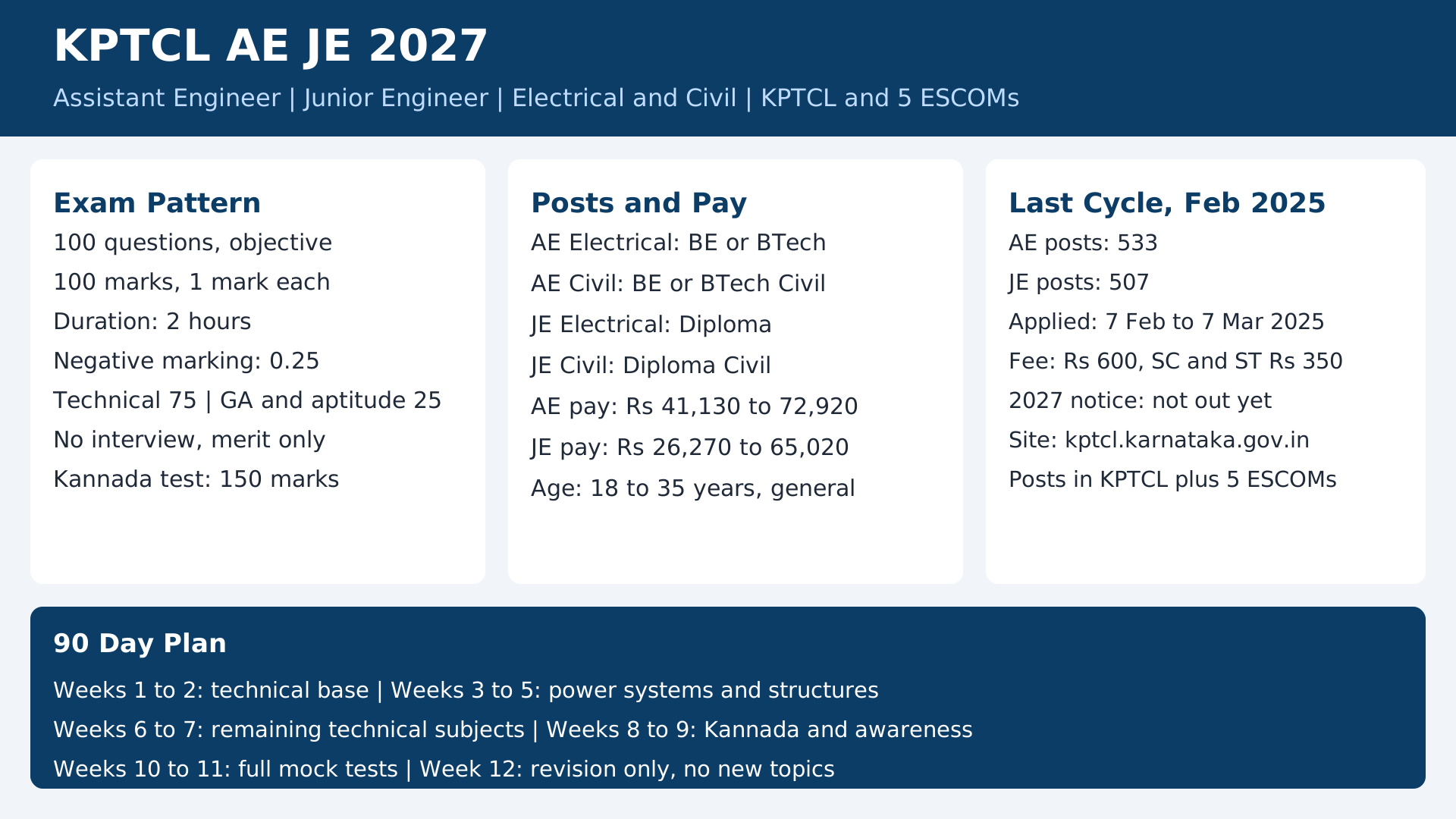
KPTCL AE JE 2027 is the next recruitment for Assistant Engineer and Junior Engineer posts in Karnataka power companies, and no 2027 notification had been published as of 19 November 2026. The last real cycle opened in February 2025, with 533 Assistant Engineer posts and 507 Junior Engineer posts, and applications closed on 7 March 2025. This guide uses that cycle as its facts, because it is the newest complete record, and it says plainly wherever trackers disagree or a detail still needs the next notification to confirm it.
The exam itself is short and sharp. One paper carries 100 questions for 100 marks in 2 hours. Seventy five marks test your engineering subject and 25 marks test general awareness and aptitude. Each wrong answer costs 0.25 marks. There is no interview for Assistant Engineer or Junior Engineer posts. Your written score decides your rank, and then document verification and a medical test follow. That shape has held across recent cycles, so a candidate who starts now is not guessing about the pattern.
What KPTCL is, and why one notification fills posts in six companies
Karnataka Power Transmission Corporation Limited, or KPTCL, is the state transmission utility of Karnataka. The company was incorporated on 28 July 1999 and started operations on 1 August 1999, after the old Karnataka Electricity Board was dissolved. Its registered office is at Kaveri Bhavan, K.G. Road, Bengaluru. Under the Electricity Act, 2003, KPTCL is a transmission licensee and the State Transmission Utility for Karnataka. It moves power from generating stations to the distribution companies, and a tariff order of the Karnataka Electricity Regulatory Commission records that its network serves about 285.97 lakh consumers across about 1.92 lakh square kilometres.
Selling power to homes is the job of the ESCOMs, the electricity supply companies. In June 2002 the distribution business was unbundled from KPTCL and four ESCOMs were formed: Bangalore Electricity Supply Company (BESCOM), Mangalore Electricity Supply Company (MESCOM), Hubli Electricity Supply Company (HESCOM) and Gulbarga Electricity Supply Company (GESCOM). A fifth ESCOM, Chamundeshwari Electricity Supply Corporation (CESC), was created in 2005 by splitting MESCOM, and it serves Mysuru and nearby districts. BESCOM serves Bengaluru and nearby districts, MESCOM serves the coastal districts, HESCOM serves north west Karnataka and GESCOM serves the Kalyana Karnataka region.
The recruitment follows that structure. KPTCL issues one joint notification for Assistant Engineer and Junior Engineer posts, and the posts sit in KPTCL and in the five ESCOMs. The February 2025 Assistant Engineer notification listed posts in BESCOM, GESCOM, MESCOM, CESC and HESCOM, and the Junior Engineer notification used the same spread. A candidate applies through the KPTCL portal at kptcl.karnataka.gov.in, and the posting can land in the transmission company or in any of the distribution companies. That matters when you choose preferences, because a BESCOM posting means city distribution work and a KPTCL posting means transmission lines and substations.
Two mix ups waste time every cycle. First, KPTCL is not KPCL. Karnataka Power Corporation Limited, KPCL, generates power, and its Assistant Engineer and Junior Engineer recruitment runs through the Karnataka Examinations Authority, with a re-examination held on 27 and 28 December 2025 for 622 posts after a court order. KPTCL recruits separately, through its own portal. Second, some ESCOMs also publish their own notifications. MESCOM, for one, published a 2025 notification for 441 posts of Assistant Engineer, Junior Engineer, Assistant and Junior Assistant, with a last date of 15 February 2025. So check the KPTCL site first, and then check the ESCOM sites for your region.
KPTCL AE JE 2027 at a glance
| Item | Detail |
|---|---|
| Conducting body | Karnataka Power Transmission Corporation Limited, with posts in KPTCL and five ESCOMs |
| Posts | Assistant Engineer (Electrical and Civil), Junior Engineer (Electrical and Civil) |
| 2027 notification | Not published as of 19 November 2026 |
| Last cycle | February 2025: 533 Assistant Engineer posts, 507 Junior Engineer posts |
| Last cycle applications | 7 February 2025 to 7 March 2025, fee payment to 9 March 2025 |
| Exam | 100 questions, 100 marks, 2 hours, 1 mark per question, negative marking 0.25 per wrong answer |
| Paper split | 75 marks technical subject, 25 marks general awareness and aptitude |
| Interview | None for Assistant Engineer and Junior Engineer posts |
| Age limit, general | 18 to 35 years, with relaxation for reserved categories |
| AE pay scale | Rs 41,130 to Rs 72,920 per month |
| JE pay scale | Rs 26,270 to Rs 65,020 per month |
| Official site | kptcl.karnataka.gov.in |
Read that table with one caution. The 533 and 507 totals come from the February 2025 notifications as reported by more than one tracker, and the application dates match across them. The post wise split between Electrical and Civil is less clean, and the conflicts are listed near the end of this guide. Electrical carries the large majority of posts in both AE and JE, and Civil carries a small number, roughly two dozen Assistant Engineer posts and about a dozen Junior Engineer posts in the last cycle. Treat any exact Civil number as unconfirmed until the 2027 notification prints it.
The February 2025 cycle, the last real notification
The February 2025 cycle is the base for every number in this guide. KPTCL opened online applications on 7 February 2025 for 533 Assistant Engineer posts in Electrical and Civil, and the window closed on 7 March 2025, with fee payment allowed to 9 March 2025. The Junior Engineer notification ran on the same window, with 507 posts in Electrical and Civil. Both notifications covered KPTCL and the five ESCOMs, and both split the posts between Non Kalyana Karnataka and Kalyana Karnataka regions, with separate category wise tables for each region.
The fee in the Assistant Engineer notification was Rs 600 for most candidates and Rs 350 for SC and ST candidates. One tracker records a wider band of Rs 500 to Rs 600 for general and other categories and Rs 300 to Rs 350 for SC and ST, which may reflect the Junior Engineer notification or a service charge on some payment modes. The Rs 600 and Rs 350 figures come from the detailed Assistant Engineer page, so use those as the working figures and check the 2027 notification before you pay.
No exam date for the February 2025 cycle could be verified from a reliable source in this research. One tracker lists exam dates of 23 and 24 July and 7 August 2025, but it ties those dates to the older 1,492 post cycle, so this guide does not present them as the 2025 exam dates. If a site gives you a 2027 exam date today, it is guessing. The notification has not come out, and no exam date exists until it does.
The cycle before that one shows how long these recruitments can run. KPTCL published its notification on 25 January 2024 for 1,492 posts of Assistant Engineer, Junior Engineer and Junior Assistant, with applications from 7 February to 7 March 2024. In May 2025, more than a year later, the energy department issued appointment orders for 902 posts from that cycle. Counselling in March 2024 had covered 368 Assistant Engineer Electrical, 17 Assistant Engineer Civil and 15 Junior Engineer Civil candidates, and 502 of 535 Junior Engineer candidates were appointed through counselling. A candidate should read that as a warning about patience. The exam is only the first step, and the counselling and appointment stages can stretch for months after it.
Assistant Engineer or Junior Engineer, Electrical or Civil: which post fits your degree
The four posts look similar on a notification page. The differences sit in the qualification each one needs. Assistant Engineer needs a BE or BTech degree. Junior Engineer needs a diploma. Electrical needs an electrical qualification, and Civil needs a civil qualification. You cannot cross over. A diploma holder cannot apply for Assistant Engineer, and a BE Civil graduate cannot apply for Assistant Engineer Electrical. Pick the post that matches the certificate you hold, then pick the stream that matches it.
| Post | Qualification | Pay scale per month | Posts, Feb 2025 cycle |
|---|---|---|---|
| Assistant Engineer Electrical | BE or BTech in Electrical or Electrical and Electronics | Rs 41,130 to Rs 72,920 | 533 AE posts in total, Electrical the large majority |
| Assistant Engineer Civil | BE or BTech in Civil Engineering | Rs 41,130 to Rs 72,920 | Small share of the 533, roughly two dozen |
| Junior Engineer Electrical | Diploma in Electrical or Electrical and Electronics | Rs 26,270 to Rs 65,020 | 507 JE posts in total, Electrical the large majority |
| Junior Engineer Civil | Diploma in Civil Engineering | Rs 26,270 to Rs 65,020 | Small share of the 507, about a dozen |
Assistant Engineer is the senior post. An AE supervises substations and transmission lines, clears maintenance work, checks protection systems, prepares estimates, and signs off on the work a Junior Engineer executes. A JE works at the field level: site execution, routine maintenance, testing, fault attendance, meter work and record keeping. An AE who joins at 22 can expect to move up to Assistant Executive Engineer with service and departmental exams, while a JE builds seniority on the field side and can also rise through internal exams. Both are permanent state government company posts, with dearness allowance, house rent allowance, medical benefits, provident fund and pension as per Karnataka government rules.
Civil candidates face a different arithmetic from Electrical candidates. Electrical carries hundreds of posts in each cycle, so the cut off moves with the paper and the crowd. Civil carries a handful of posts, so a small change in score can move a candidate many ranks. A Civil candidate should not study less because the syllabus is smaller. The competition is tighter because the seats are fewer. An Electrical candidate should not relax because the seats are many. The applicant pool is also many times larger, and the 75 mark technical section decides almost everything.
Who can apply: degree, diploma, age, marks, Kannada
For Assistant Engineer, the rule in the February 2025 notification is a BE or BTech in Electrical, Electrical and Electronics, or Civil Engineering from an AICTE approved institute. The degree must match the post. Electrical and Electronics counts for the Electrical post. A BE in Electronics and Communication does not count for it in the notification as reported, so check the exact eligible branches in the 2027 notification before you pay the fee. For Junior Engineer, the rule is a diploma in Electrical or Civil Engineering from a polytechnic in Karnataka, under the State Board of Technical Education. Trackers phrase this in two ways, one saying a Karnataka polytechnic and one saying a recognised State Board of Technical Education, and both point to the same thing: a Karnataka diploma.
The age limit for general candidates is 18 to 35 years. For SC, ST and Category 1 candidates the upper limit is 38 years, and for Category 2 and Category 3 candidates it is 40 years. That grouping comes from the detailed February 2025 Assistant Engineer page. One older Testbook page on Junior Engineer eligibility groups it differently, with Category IIA, IIB, IIIA and IIIB at 38 years and SC, ST and Category I at 40 years. The two versions agree on the numbers 38 and 40 but attach them to different groups, so confirm your own category limit in the 2027 notification. Age is counted as on the date the notification prescribes, and that date changes every cycle.
Marks in the qualifying exam carry a condition that many candidates miss. One tracker reports that general candidates need a minimum of 60 percent aggregate marks in the degree or diploma, Category 1, 2A, 2B, 3A and 3B candidates need 50 percent, and SC and ST candidates need only a pass. That rule rests on a single tracker page, and no second source confirmed it in this research, so treat it as a flag, not a fact. Read the eligibility clause of the 2027 notification line by line. A candidate with 58 percent in BE Electrical who applies on the belief that only a pass is needed could lose the fee and the attempt.
Kannada is a separate condition, and it catches out of state candidates. The rule reported for Junior Engineer is that a candidate must have studied Kannada in SSLC or PUC or a higher class. A candidate who has not studied Kannada must appear for a Kannada Language Test, held before the written exam. The same condition is reported for Assistant Engineer posts in the older pattern pages. Karnataka domicile is also mentioned by trackers for Junior Engineer posts. If you studied outside Karnataka or did not take Kannada at school, settle this question before the application window opens, because the language test is a gate, not a formality.
The exam pattern: 100 marks, 75 technical, 25 general
The pattern is the same for all four posts, and it is simple enough to plan around. The paper has 100 objective questions for 100 marks, and it runs for 2 hours. Each question carries 1 mark, and each wrong answer costs 0.25 marks. Unattempted questions carry no marks. The technical subject carries 75 questions for 75 marks, and general awareness and aptitude carries 25 questions for 25 marks. That split is consistent across the February 2025 trackers, the Testbook pattern page and the detailed notification pages.
| Post | Technical, 75 marks | General awareness and aptitude, 25 marks | Total |
|---|---|---|---|
| Assistant Engineer Electrical | VTU BE syllabus, Electrical and Electronics | General awareness and aptitude | 100 marks, 2 hours |
| Assistant Engineer Civil | VTU BE syllabus, Civil Engineering | General awareness and aptitude | 100 marks, 2 hours |
| Junior Engineer Electrical | Diploma syllabus, Electrical and Electronics, Dept of Technical Education | General awareness and aptitude | 100 marks, 2 hours |
| Junior Engineer Civil | Diploma syllabus, Civil Engineering, Dept of Technical Education | General awareness and aptitude | 100 marks, 2 hours |
Two details need care. First, the mode of the exam is reported both ways. The February 2025 pages call it an OMR based test, while the Testbook pattern page calls it an online aptitude test. Older KPTCL cycles used an online test, and the 2025 trackers say OMR. The notification for your cycle settles it, and the preparation does not change much either way, except for practice: if it is OMR, practise bubbling answers under time, and if it is online, practise on screen. Second, the language of the paper is reported as English for the technical paper, with general awareness and aptitude in both English and Kannada. The Kannada Language Test is a separate paper, described in its own section below.
The arithmetic of the paper rewards accuracy more than speed. At 72 seconds per question, a candidate has time to read each question twice, and the 0.25 negative mark punishes guessing. A candidate who attempts all 100 questions with 60 correct and 40 wrong scores 50, because the 40 wrong answers cost 10 marks. A candidate who attempts 80 questions with 60 correct and 20 wrong scores 55. The second candidate attempted fewer questions and scored more. That is the whole game in this paper: attempt what you know, mark what you half know, and leave what you do not know alone until the end.
Assistant Engineer Electrical syllabus: what the 75 marks cover
The Assistant Engineer Electrical technical section follows the Visvesvaraya Technological University BE syllabus for Electrical and Electronics Engineering. That is a wide syllabus, and the paper samples it rather than covering it in full, so the candidate who knows the core subjects well beats the candidate who has skimmed all of them. Power systems, electrical machines and switchgear with protection carry the most weight in practice, because they match the job: transmission, distribution, transformers, lines and the protection that keeps them safe.
Start with the base. Basic Electrical Engineering, network analysis, field theory and engineering mathematics sit under everything else. A candidate who is weak in network theorems will struggle in machines and in power system analysis, because the same ideas return in harder form. Then take electrical machines in full: DC machines, synchronous machines, transformers and induction machines, with their construction, working, losses, efficiency and testing. Transformers deserve extra time. A transmission company lives on transformers, and questions on tap changers, parallel operation, cooling and testing appear in every cycle of papers of this kind.
Power systems come next, and they are the heart of the KPTCL paper. Electric power generation, transmission and distribution, power system analysis and stability, power system planning, and computer techniques in power system analysis form one block. Learn how power flows from a generating station to a substation to a feeder, what a load flow study does, what keeps a system stable after a fault, and how a planner picks a line route or a substation site. Then take switchgear and protection with high voltage engineering: circuit breakers, relays, earthing, insulation coordination, and the protection schemes for lines, transformers and busbars. A protection question is often a one line question with a one line answer, and it is a free mark for a candidate who has revised the schemes.
Finish the technical block with power electronics, control systems, measurements and instrumentation, electrical power utilisation, signals and systems, digital system design, logic design, microcontrollers and electronic circuits. These subjects carry fewer questions than power systems and machines, but they carry some, and they are the subjects where a candidate either knows the answer at once or does not know it at all. Revise them from short notes, not from full textbooks, and keep a formula sheet for measurements and control systems. The VTU syllabus is the reference, and the notification for your cycle names it, so use the VTU syllabus document as the checklist and tick each topic off as you finish it.
Assistant Engineer Civil syllabus: structures, soil, water, roads
The Assistant Engineer Civil technical section follows the VTU BE syllabus for Civil Engineering, and it is just as wide as the Electrical one. The core is structures and geotechnical engineering, and the rest is water, transport and construction management. A Civil candidate for KPTCL should think about the job while studying: transmission towers stand on foundations, substations need buildings and roads, and lines cross rivers and hills. The syllabus matches that work more closely than it first looks.
Start with engineering mathematics and strength of materials, then move to analysis of determinate and indeterminate structures. Design of RC structural elements, design of steel structural elements, and design of prestressed concrete elements form the design block, and they reward a candidate who can work a problem rather than recite a definition. Learn the load paths, the failure modes and the code provisions that govern each design, and practise one numerical problem from each topic every week.
Geotechnical engineering is the second pillar. Basic geotechnical engineering, soil mechanics and foundation engineering decide whether a tower stays up, so learn bearing capacity, settlement, earth pressure and the types of foundations used for towers and substation structures. Fluid mechanics, applied hydraulics, hydrology and irrigation engineering form the water block, and water supply and treatment engineering and environmental engineering sit beside it. Surveying, basic and advanced, with computer aided building planning and drawing, covers the measurement side, and highway engineering and transportation engineering cover roads and pavements.
Close with the construction block: building materials and construction, concrete technology, construction management and entrepreneurship, quantity surveying and contracts management, and engineering geology. These are the subjects where the paper asks direct factual questions, and they are also the subjects a site engineer uses every day. A candidate who has done a site internship will find this block easier than a candidate who has only read it, because the words match things seen on site. Keep a notebook of quantities, rates and contract terms as you go, and revise it in the last month.
Junior Engineer Electrical syllabus: the diploma core, with field work in mind
The Junior Engineer Electrical technical section follows the diploma syllabus of the Department of Technical Education, Government of Karnataka, for Electrical and Electronics. The topics overlap with the Assistant Engineer syllabus, but the level is diploma level, and the emphasis shifts toward practical work: installation, maintenance, testing, safety and the rules that govern field work. A diploma holder who has done lab work and industrial training has an edge here, because the paper rewards familiarity with equipment as much as theory.
The core subjects are the same names as in the degree paper, at a simpler depth. Basic electronics, electronic circuits, network analysis, electrical and electronic measurements and instrumentation, transformers and induction machines, DC machines and synchronous machines, power electronics, control systems, logic design and signals and systems all appear. Transmission and distribution is the subject that matters most for a JE, because a JE spends the working day on lines and substations. Learn the components of a line, the types of insulators and conductors, the layout of a substation, the earthing arrangements, and the routine tests done on a transformer before it is charged.
Two topics deserve special attention at diploma level. The first is switchgear and protection, at the level of what a JE operates and checks: breakers, isolators, relays, fuses and the sequence of operations during a fault and during restoration. The second is safety and the Indian Electricity Rules, now framed under the Electricity Act and the Central Electricity Authority regulations, which govern clearances, earthing and safe working practice. A JE who knows the safety rules can answer the questions and can also stay safe on the job, and the paper treats those rules as examinable knowledge rather than background.
Do not study the diploma syllabus from a degree book. The depth is wrong, the language is wrong, and the time is wasted. Use the diploma textbooks and the Department of Technical Education syllabus, solve the previous year diploma papers, and practise the numerical problems at diploma level, where the numbers are smaller and the steps are shorter. The 75 marks are won on accuracy in the core subjects, not on knowing advanced topics that the paper will not ask.
Junior Engineer Civil syllabus: the diploma core, with site work in mind
The Junior Engineer Civil technical section follows the diploma syllabus for Civil Engineering from the Department of Technical Education. The subjects are the diploma versions of the degree Civil syllabus, with the same shift toward site work. A JE Civil supervises the civil works at substations and along tower lines: foundations, buildings, roads, drains and water supply. The paper tests the knowledge that supervision needs.
Start with engineering mathematics, basic surveying and surveying practice, strength of materials, and building materials and construction. Then take concrete technology and the testing of building materials, design of RC structural elements and design of steel structural elements, analysis of determinate and indeterminate structures, and design of prestressed concrete elements at the level the diploma syllabus sets. Fluid mechanics, applied hydraulics, hydrology and irrigation engineering, water supply and treatment engineering, and highway engineering follow, with basic geotechnical engineering and engineering geology beside them.
Construction management and entrepreneurship, quantity surveying and contracts management, and computer aided building planning and drawing close the syllabus. These are the subjects where a JE Civil earns marks quickly, because the questions are direct and the answers are standard: the quantity of concrete in a footing, the rate analysis of an item, the documents in a contract, the stages of a project. Practise quantity problems by hand until the steps are automatic, because the paper gives 72 seconds per question and a quantity problem that needs five minutes will eat the time of four other questions.
General awareness and aptitude: the 25 marks that decide ranks
Twenty five marks look small next to 75, and they decide ranks. Two candidates with the same technical score are separated by these 25 marks, and a candidate who scores 20 here against a rival who scores 12 has a lead of 8 marks, which is a large lead in a paper of 100. The section covers general awareness, current events, Karnataka general knowledge, Indian polity and the Constitution, Indian geography and history and culture, general science, and quantitative aptitude. It is the same for all four posts, and it is the section where a non technical candidate can gain ground.
The aptitude half is the more predictable half. Fractions, decimals, number system, HCF and LCM, percentage, ratio and proportion, partnership, profit and loss, average, simple interest and compound interest, time and distance, and time and work recur every cycle. These are school level topics, and the questions are short. Practise them in sets of 25 with a timer, and learn the shortcut for each topic rather than the long method. A candidate who can do a percentage question in 30 seconds has time for a hard technical question later in the paper.
The awareness half needs a routine, not a last minute rush. Read Karnataka news every day, with attention to power, energy, water and infrastructure, because KPTCL questions lean toward the state. Learn Karnataka polity and geography as a fixed block: districts, rivers, dams, power stations, and the departments that run them. Follow national current events and the Union Budget in outline, and keep a one page note of the big numbers and names of the month. General science and IT and space appear as short factual questions, so revise them from a standard general knowledge book rather than from newspapers.
One habit separates the candidates who score well here from the ones who do not. They revise this section every week, in small doses, instead of reading it once at the end. Awareness fades fast, and a fact read in week 2 is gone by week 10 unless it is revised. Keep a weekly current affairs note of one page, and rewrite it from memory every Sunday. The rewrite is the revision, and it takes twenty minutes.
The Kannada language test, and who has to take it
The Kannada language test is the part of the process that surprises the most candidates, because it sits outside the 100 mark paper. The pattern page reports it as a separate test of 150 marks, with a minimum of 50 marks to pass, and a candidate must pass it to become eligible for the general aptitude test. A candidate who has studied Kannada in SSLC or PUC or a higher class is reported as exempt, and a candidate who has not studied Kannada must take the test before the written exam.
The syllabus reported for the Kannada test covers Kannada literature, history of the Kannada language, articles, grammar, adjectives, tenses, prepositions, modal auxiliaries, vocabulary, active and passive voice, error correction, conjunctions and antonyms. That is a school level language syllabus, and a candidate who studied Kannada at school can clear it with light revision. A candidate who never studied Kannada needs real preparation: basic reading, writing and comprehension, with a focus on grammar and vocabulary.
Be careful with this section. The 150 mark figure and the 50 mark pass mark come from the Testbook pattern page, which describes the 2023 pattern, and the exemption rule comes from the Testbook Junior Engineer eligibility page for the 2022 cycle. Neither was confirmed against the February 2025 notification in this research. The rule may have changed, or it may apply differently to Assistant Engineer and Junior Engineer posts in the next cycle. Check the 2027 notification for the language clause before you assume you are exempt. If you need the test, start Kannada preparation with the 90 day plan, not in the last week.
Selection after the written test: merit, documents, medical
Selection for Assistant Engineer and Junior Engineer rests on the written exam alone. Trackers are consistent on this point: there is no interview for these technical posts, and the merit list is prepared from written exam scores. That is good news for a candidate who is strong on paper and weak in interviews, and it is a warning for a candidate who expects a second stage to rescue a low written score. The written paper is the whole contest.
After the merit list, the stages are document verification and a medical test. Document verification checks the originals of the degree or diploma certificates and mark sheets, the SSLC mark sheet for age proof, the category certificate if reservation is claimed, the Kannada study proof if exemption is claimed, and the domicile proof where it applies. Keep every original in one folder from the day you apply, and keep two photocopy sets with it. A missing certificate at verification can cost a seat that the written score had already won.
The medical test checks fitness as per KPTCL standards, and it is a qualifying stage rather than a scored one. The 2024 cycle shows the order of events: the written exam, then the merit list, then counselling, then appointment orders. Counselling in that cycle ran in March 2024 for the Assistant Engineer and Junior Engineer Civil posts, and the appointment orders followed in stages, with 902 orders issued in May 2025. The gap between counselling and appointment can be long, so keep your documents and your phone number current with the corporation through the whole period.
Pay, posting and the job itself
An Assistant Engineer in KPTCL or an ESCOM starts in the pay scale of Rs 41,130 to Rs 72,920 per month, and a Junior Engineer starts in the scale of Rs 26,270 to Rs 65,020 per month. Those are the scales reported across the February 2025 notification pages and the tracker summaries. Dearness allowance, house rent allowance, medical benefits, provident fund and pension apply as per Karnataka government rules, and the exact take home pay depends on the posting place and the allowance rates in force at joining. Do not trust any take home figure quoted on a job site, because the allowances change and the posting changes the house rent allowance.
The job itself is field work, not desk work. An Assistant Engineer Electrical supervises a substation or a section of transmission lines, plans maintenance, attends faults, checks protection relays, and coordinates with the load despatch centre. A Junior Engineer Electrical executes that work on the ground, with a team of linemen and technicians. An Assistant Engineer Civil supervises the civil works: tower foundations, substation buildings, control rooms, approach roads and drainage. A Junior Engineer Civil measures the work, checks the materials, and keeps the site records. Power supply does not stop at 6 in the evening, so fault duty, night calls and work in rain are part of the job, and a candidate who wants only office hours should know that before applying.
Promotion runs through service and departmental exams. An Assistant Engineer can move to Assistant Executive Engineer, and a Junior Engineer can move up the technical ladder with service and internal exams. The precise promotion rules sit in the service regulations of the corporation, and they differ between KPTCL and the ESCOMs in detail, so confirm them after joining rather than planning a career on a tracker page. The stable fact is the starting point: a permanent post in a state power utility, with a defined pay scale and a defined promotion path.
How the 2024 cycle ended, and what it tells you
The 2024 cycle is worth a closer look, because it shows the full arc from notification to appointment. The notification came on 25 January 2024 for 1,492 posts across Assistant Engineer, Junior Engineer and Junior Assistant. Applications ran from 7 February to 7 March 2024. Counselling for 368 Assistant Engineer Electrical, 17 Assistant Engineer Civil and 15 Junior Engineer Civil candidates took place in March 2024, before the Model Code of Conduct for the general election. Then the process slowed, and the appointment orders for 902 posts were issued only in May 2025, with 502 of 535 Junior Engineer candidates appointed through counselling in that round.
Three lessons follow. First, the notification to appointment arc can take more than a year, so do not plan your finances around a joining date in the same year as the exam. Second, the counselling numbers show the shape of the competition: hundreds of Electrical posts against a handful of Civil posts, in both the Assistant Engineer and Junior Engineer lists. Third, the 1,492 total for the 2024 cycle covered three posts, while the February 2025 cycle split Assistant Engineer and Junior Engineer into separate notifications of 533 and 507 posts. The totals are not comparable across cycles unless you check which posts each total includes, and many tracker pages mix them up.
That mixing is the reason this guide flags its conflicts instead of hiding them. One tracker page lists 2,975 vacancies for Junior Station Attendant and Junior Powerman from an October 2024 notification, and another lists 1,492 plus for a 2026 cycle that has not been notified. Those are different drives for different posts, and they do not add to the Assistant Engineer and Junior Engineer totals. Keep the drives separate in your notes: AE and JE in February 2025, Junior Station Attendant and Junior Powerman in October 2024, and the 2024 AE, JE and Junior Assistant cycle before them.
A 90 day plan that works for a final year student and a working diploma holder
| Weeks | Focus | Daily time |
|---|---|---|
| 1 to 2 | Technical base: networks and machines for Electrical, strength of materials and surveying for Civil, plus aptitude basics | 3 hours |
| 3 to 5 | Power systems and protection for Electrical, structures and geotechnical for Civil, plus Karnataka general knowledge | 3 to 4 hours |
| 6 to 7 | Remaining technical subjects, control systems and measurements for Electrical, water and transport for Civil | 3 hours |
| 8 to 9 | Kannada language test preparation if needed, plus general awareness and current affairs notes | 3 hours |
| 10 to 11 | Full mock tests, one 100 question paper every Sunday in 2 hours, with same day review | 3 hours |
| 12 | Revision only, formula sheets, short notes, no new topics | 2 to 3 hours |
| Last 3 days | Formulas, protection schemes, Kannada grammar, and one light mock test | 2 hours |
The plan assumes three hours a day, which is realistic for a final year student and for a diploma holder in a job. Weeks 1 to 5 carry the technical core, because 75 marks sit there, and the plan gives power systems and structures the longest stretch because they carry the most questions. Keep one notebook for formulas and one for short notes, and rewrite both from memory once a week. Reading the same page five times builds recognition, and recognition fails in the exam hall when the options look alike. Writing from memory builds recall, and recall is what the paper tests.
Mock tests deserve a fixed slot, not leftover time. Take one full 100 question mock test every Sunday from week 10 onward, in 2 hours, without pausing, and review every wrong answer the same evening. Track your score by section, not just in total, because a total of 55 that hides a technical score of 35 out of 75 is a warning. The last three days are for formulas, protection schemes, Kannada grammar and short notes only. A new topic in the last three days costs more marks than it gains, because it displaces revision of material you already know.
If you are a working diploma holder, use the mornings for technical study and the evenings for aptitude and awareness. If you are a final year BE student, use your semester subjects as preparation: the power systems and machines you study in class are the same subjects the paper tests, so align your semester notes with the VTU syllabus checklist and treat the class tests as mock tests. If you need the Kannada test, give it one hour a day from week 1, because a language cannot be crammed in a week.
Mistakes that cost marks
The first mistake is studying the wrong syllabus. Assistant Engineer follows the VTU BE syllabus, and Junior Engineer follows the diploma syllabus of the Department of Technical Education. A JE candidate who studies from a BE book wastes time on depth the paper will not ask, and an AE candidate who studies from a diploma book misses the depth the paper will ask. Check the syllabus line in the notification, and study from the books that match it.
The second mistake is ignoring the 25 marks. Candidates spend three months on the technical section and three days on general awareness and aptitude, and then lose ranks by 5 or 6 marks in that section. Give it one hour a day from week 1, and treat it as a scoring section rather than a leftover.
The third mistake is guessing. With negative marking of 0.25 per wrong answer, a guess with no elimination is a losing bet across 100 questions. Attempt the questions you can narrow to two options, mark the rest, and return to them only after the rest of the paper is done. The fourth mistake is confusing KPTCL with KPCL, and the KPTCL notification with an ESCOM notification. Read the name of the recruiting body on the notification itself, and apply only through the portal named in it.
The fifth mistake is trusting a tracker date. Exam dates, cut offs and vacancy splits on job sites are often copied from older cycles, and this guide found exactly that problem in the category wise tables for the February 2025 cycle, where the tables sum to numbers from the 2022 cycle rather than the 2025 totals. Use tracker pages for orientation, and use the notification PDF for every fact that decides your application: eligibility, age, fee, syllabus and dates.
The sixth mistake is leaving Kannada to the last week. If you need the language test, it is a gate that stands before the written exam, and failing it ends the attempt before the 100 mark paper begins. Settle your exemption status in week 1, and start language preparation at once if you need it.
Engineers who prepare for KPTCL often prepare for other government exams alongside it. The IBPS SO 2027, RBI Grade B 2027, SEBI Grade A 2027, SIDBI Grade A 2027, NABARD Grade A 2027, PFRDA Grade A 2027, IBPS PO 2027, SBI PO 2027, RBI Assistant 2027 and UPPSC PCS 2027 pages on this site carry the same style of mock test guide, and the exam habit you build here transfers directly to them.
Sources
KPTCL official site, kptcl.karnataka.gov.in, for the conducting body, the recruitment portal, the registered office at Kaveri Bhavan, K.G. Road, Bengaluru, and the company identity number U40109KA1999SGC025521. The homepage crawl in this research returned only the privacy policy text in Kannada, so notification level facts rest on the tracker pages below, and the upload pre-check should read the live notification on the official site.
GovtJobOnline KPTCL Assistant Engineer page, for the 533 Assistant Engineer posts, applications 7 February to 7 March 2025, fee payment to 9 March 2025, fee Rs 600 and Rs 350 for SC and ST, pay scale Rs 41,130 to Rs 72,920, age 18 to 35 years for general with 38 for SC, ST and Category 1 and 40 for Category 2 and 3, BE and BTech eligibility, the 100 mark OMR test, 75 marks VTU syllabus and 25 marks general awareness and aptitude, and negative marking of 0.25.
Karnataka KPTCL Latest Recruitment guide, for the 533 Assistant Engineer and 507 Junior Engineer posts in February to March 2025, the Junior Engineer pay scale Rs 26,270 to Rs 65,020, the diploma eligibility, the 60 percent and 50 percent marks conditions, the OMR mode, the 100 mark and 2 hour pattern, and the selection stages of written exam, merit list, document verification and medical test.
Testbook KPTCL syllabus and exam pattern page, for the 100 mark aptitude test, 1 mark per question, negative marking 0.25, the 75 plus 25 split for each post, the Kannada language test of 150 marks with a 50 mark pass mark, the general awareness and aptitude topics, the VTU and diploma syllabus topics for Electrical and Civil, and the selection stages of aptitude test, medical test and document verification.
CollegeDisha KPTCL exam pattern page, for the 2 hour online aptitude test, 100 questions of 1 mark each, the English medium for the technical paper with general awareness and aptitude in English and Kannada, and the VTU syllabus for Assistant Engineer and the Department of Technical Education diploma syllabus for Junior Engineer.
NewsDrum report of the May 2025 appointment orders, for the 902 posts filled from the 2024 cycle, the March 2024 counselling of 368 Assistant Engineer Electrical, 17 Assistant Engineer Civil and 15 Junior Engineer Civil candidates, and the appointment of 502 of 535 Junior Engineer candidates.
Electricity supply companies in Karnataka, for the 1999 formation of KPTCL, the June 2002 unbundling into four ESCOMs, the creation of CESC in 2005, and the districts served by BESCOM, MESCOM, HESCOM, GESCOM and CESC. Karnataka Electricity Regulatory Commission tariff order, for the 1999 incorporation dates, the State Transmission Utility status under the Electricity Act, 2003, and the scale of about 285.97 lakh consumers across about 1.92 lakh square kilometres.
Where this guide could not verify a fact, it says so in the text and in the package note, and the next notification is the authority. Open the KPTCL recruitment page today, check whether the 2027 notification is live, and if it is, download the PDF and read the eligibility, age, fee, syllabus and dates before you fill any form.