
About UPPSC Assistant Engineer 2027 Exam Series
📖 Table of Contents
- What an Assistant Engineer does in Uttar Pradesh
- Where the 2027 cycle stands right now
- The three stages, and what each one decides
- Prelims in detail: 150 questions in two hours
- Mains in detail: two papers, 750 marks
- The interview and the final merit list
- Who can apply: the eligibility rules
- Age limit and relaxations
- Branches and departments: where the 604 posts sat
- Civil syllabus: the subjects that carry the paper
- Mechanical, electrical, and agriculture syllabus
- General Hindi and General Studies: the 150 marks many ignore
- The 2024 cycle: what actually happened
- Fee and salary: the numbers that stay fixed
- Books that cover the syllabus without waste
- A 90 day plan that fits real life
- Mock test strategy: how to use mocks without wasting them
- Mistakes that cost good candidates marks
- What to check the day the 2027 notice arrives
- Sources
UPPSC Assistant Engineer 2027: Pattern, Eligibility, Syllabus and Cut Off
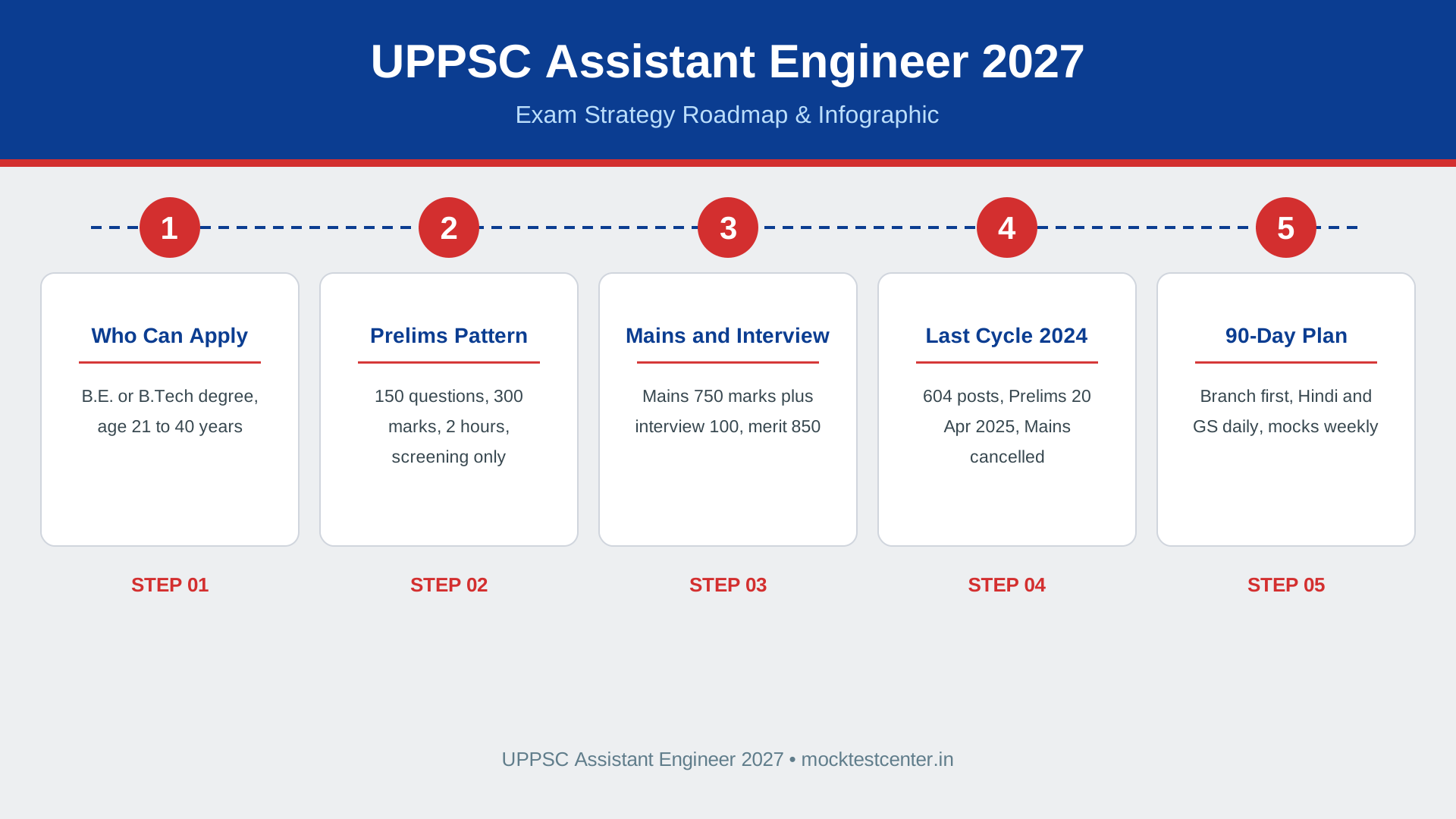
UPPSC Assistant Engineer 2027 will open engineering posts in Uttar Pradesh government departments for B.E. and B.Tech graduates. The selection runs in three stages. A Prelims screening test carries 150 questions for 300 marks. A Mains written exam carries 750 marks. An interview carries 100 marks. Only Mains and interview marks decide the final merit list.
The 2027 notification has not come out yet, as of 19 November 2026. This guide rests on the last cycle, advertisement A-9/E-1/2024, and it says clearly where the facts end and the waiting begins. Any website that gives you a fixed 2027 exam date today is guessing.
What an Assistant Engineer does in Uttar Pradesh
An Assistant Engineer in Uttar Pradesh builds and looks after public works. A civil engineer in the Public Works Department supervises road work, checks estimates, measures work done on site, and signs the bills that pay contractors. An engineer in the Irrigation Department looks after canals, regulators, and the water that reaches fields in the cropping season. An engineer in the Rural Engineering Department works on village roads, drains, and small buildings in blocks far from the district headquarters.
The job mixes office work and field work in a way few other government posts do. Mornings can start with a site visit and end with a file. A junior engineer reports to the Assistant Engineer, and the Assistant Engineer reports to the Executive Engineer. The post carries responsibility from the first month, because the signature on a measurement book is a legal record.
Promotion runs up a clear ladder. An Assistant Engineer can rise to Executive Engineer, then to Superintending Engineer, and then to Chief Engineer over a career, subject to vacancies and the service rules of the department. The starting pay sits in Level 10 of the pay matrix, and the post carries dearness allowance, house rent allowance, and travel allowance as per government rules.
Many candidates prepare for this exam alongside the UPPSC PCS 2027 exam, because the General Studies and General Hindi portions overlap, and one preparation feeds both attempts.
Where the 2027 cycle stands right now
No UPPSC Assistant Engineer 2027 notification exists yet. UPPSC releases its notifications on the official portal, uppsc.up.nic.in, and the Assistant Engineer 2027 notice will appear there first. As of 19 November 2026, no 2027 dates, no 2027 vacancy count, and no 2027 fee exist in any official notice.
One tracker page, crawled on 6 November 2026, says the next notification may come in August or September 2026 and speaks of 370 plus vacancies. That claim stays unverified in this pass, because no official notice backs it, and the page itself marks the dates as to be announced. Treat the 370 plus figure as a rumour, and wait for the advertisement.
The honest way to use the waiting time is to start with the pattern and the syllabus from the last cycle. The pattern has stayed stable across cycles, and the syllabus for each branch changes little. Preparation that starts now will still count when the notice arrives. Only the dates, the fee, and the vacancy count will change with the new advertisement.
The three stages, and what each one decides
The UPPSC Assistant Engineer 2027 selection has three stages, and each stage has a different job. Prelims screens. Mains ranks. The interview tests the person behind the marks.
Prelims is an objective test of 150 questions for 300 marks, held in two hours. It only shortlists candidates for Mains. Prelims marks stay out of the final merit list, so a high Prelims score earns nothing beyond a Mains admit card, and a score just above the cut off earns exactly the same chance in Mains as a top score.
Mains is the stage that decides rank. It has two papers of 375 marks each, 750 marks in all, and each paper runs for two and a half hours. Both papers are objective. Each question carries three marks, and a wrong answer costs one mark.
The interview carries 100 marks. A panel tests the candidate's knowledge of the branch, awareness of Uttar Pradesh, and fitness for field responsibility. The final merit list adds Mains marks and interview marks, 850 marks in all, and the appointment follows that list, category by category.
That split shapes the whole preparation. Prelims needs speed and breadth, because 150 questions in 120 minutes leave less than a minute per question. Mains needs depth in the branch, because 600 of the 750 Mains marks come from the engineering subject itself. The interview needs the habit of explaining technical ideas in plain words.
Prelims in detail: 150 questions in two hours
The UPPSC Assistant Engineer 2027 Prelims has three parts. General Knowledge carries 25 questions for 50 marks. General Hindi carries 25 questions for 50 marks. Engineering Aptitude carries 100 questions for 200 marks. Each question carries two marks, and the paper runs for two hours in a single sitting.
General Knowledge covers history, geography, polity, economy, science, current events, and Uttar Pradesh. The Uttar Pradesh portion matters more here than in most other state exams, because the commission tests knowledge of the state the candidate will serve, its districts, its rivers, its schemes, and its history.
General Hindi tests grammar, vocabulary, comprehension, and the correct use of words. Candidates who studied in English medium often leave Hindi for the last month, and that delay costs them marks, because Hindi carries the same weight as General Knowledge in this paper.
Engineering Aptitude tests the core of the candidate's branch. A civil candidate faces questions on structures, soil, water, and transport. A mechanical candidate faces questions on thermodynamics, machines, and production. An electrical candidate faces questions on circuits, machines, and power systems. An agriculture candidate faces questions on farm machinery, soil and water engineering, and post harvest technology.
One detail needs a flag. Sources disagree on the Prelims penalty for a wrong answer. The commission's pattern gives each question two marks, and one set of sources records a penalty of one third of the question's marks. A tracker table records 0.33 marks per wrong answer. The 0.33 figure looks like the fraction, not the marks, and the safer reading is a penalty of one third of the marks of the question. Check the advertisement when it arrives, because the penalty changes how many questions you should attempt in the last ten minutes.
Speed decides Prelims more than knowledge does. A candidate who knows the answer but reads slowly will leave questions unmarked. Practise with a timer from the first week, and learn to skip a hard question in seconds instead of fighting it for three minutes.
Mains in detail: two papers, 750 marks
Mains Paper 1 mixes General Hindi with the first half of the branch subject. General Hindi carries 25 questions for 75 marks. The branch subject, Paper 1, carries 100 questions for 300 marks. The paper runs for two and a half hours, and the total comes to 375 marks.
Mains Paper 2 mixes General Studies with the second half of the branch subject. General Studies carries 25 questions for 75 marks. The branch subject, Paper 2, carries 100 questions for 300 marks. The paper also runs for two and a half hours, and the total comes to 375 marks.
Both papers are objective, and each question carries three marks. A wrong answer costs one mark, which is one third of the marks of the question. One tracker table records the penalty as 0.33, and that figure conflicts with the advertisement based sources that record one mark. This guide uses one mark, because it matches the three mark question value, and it flags the conflict here.
The branch subject decides the result. General Hindi and General Studies together carry 150 of the 750 Mains marks. The two branch papers carry 600 marks. A candidate who scores high in the branch and average in the general parts will beat a candidate who scores the other way round, in almost every case.
Paper 1 of the branch subject usually covers the core theory of the branch, the subjects a student meets in the second and third year of the degree. Paper 2 usually covers the applied subjects, design, construction, machines, systems, and the practice of the branch. The exact split comes from the syllabus in the advertisement, and the syllabus section of this guide gives the topic list for each branch.
Candidates who sit for UPPSC RO ARO 2027 will find the General Hindi and General Studies portions familiar, because the same two subjects appear there with a similar weight, and the preparation carries over.
The interview and the final merit list
The interview carries 100 marks, and it follows Mains. Only candidates who clear the Mains cut off reach the panel. The panel usually has senior officers and subject experts, and it tests the candidate in conversation, not in a written paper.
Expect questions that start from the candidate's own degree and branch. A civil candidate may face questions on why a road fails in the rains, or how to estimate the cost of a culvert. A mechanical candidate may face questions on a pump that loses prime, or a boiler that needs inspection. An electrical candidate may face questions on a feeder that trips on load, or a transformer that hums too loud. The panel wants to see whether the candidate can apply classroom knowledge to a real site problem.
General awareness also enters the interview. The panel may ask about a current scheme in Uttar Pradesh, a recent flood or drought, or a project in the news. A candidate who reads the news with an engineer's eye, asking what went wrong and what would fix it, answers these questions better than a candidate who only memorises headlines. Candidates who prepare for UPPSC APO 2027 face a different interview, because the law panel tests case knowledge instead of site knowledge, and the two interviews should not be prepared the same way.
The final merit list adds Mains and interview marks, 850 in all. The commission prepares the list category by category, and the appointment follows the list. Medical examination and document verification follow selection, and the candidate joins the department named in the appointment letter.
Who can apply: the eligibility rules
The degree rule is simple. A candidate needs a Bachelor of Engineering or a Bachelor of Technology degree in the relevant branch from a recognised university or institution. Civil candidates need a civil degree. Mechanical candidates need a mechanical degree. Electrical candidates need an electrical degree. Agriculture candidates need an agriculture engineering degree.
One source says AMIE Sections A and B also count, under the rules of the advertisement. That claim comes from a single tracker, and this guide flags it, because the advertisement itself is the only final word on AMIE, and candidates with AMIE should read the advertisement line by line before they apply.
Final year students face a strict rule. The advertisement for the last cycle asked for the degree as a completed qualification, and a candidate who had not finished the degree by the last date could not claim the post. A final year student should check the new advertisement for the exact cut off date for the degree, and should not assume that appearing in the final semester is enough.
Indian citizenship is required. The commission also applies the domicile rules of Uttar Pradesh for reservation benefits, so a candidate from another state can apply, but the reservation benefit goes only to Uttar Pradesh domicile candidates in the reserved categories.
There is no limit on the number of attempts in the advertisement, as long as the candidate stays within the age limit. A candidate who misses the cut off in one cycle can sit again in the next, and many selected engineers qualified on their second or third attempt.
Age limit and relaxations
The age limit for the last cycle ran from 21 years to 40 years, counted as on 1 July 2024. That means a general category candidate needed to be born between 2 July 1984 and 1 July 2003. The new advertisement will name its own cut off date, and the new date will shift the birth window by the same number of years.
One tracker records the lower limit as 18 years instead of 21. That figure conflicts with the majority of sources and with the advertisement based vacancy tables, and this guide uses 21 as the lower limit while flagging the 18 year claim.
Relaxation in the upper age limit follows the rules of the Uttar Pradesh government. Reserved category candidates from Uttar Pradesh get extra years, and the exact relaxation differs by category. One tracker records five years for OBC, SC, and ST candidates. That figure comes from a single source, and candidates should confirm the exact relaxation table in the new advertisement, because a wrong age calculation can waste a whole application.
Ex-servicemen, dependents of freedom fighters, skilled players, and persons with disabilities get relaxation under separate rules, and each group needs the certificate that proves the claim. The certificate check happens at document verification, and a missing certificate at that stage ends the candidature, even after selection.
Age counts from the date the advertisement names, not from the exam date. A candidate who turns 41 a month after the cut off date still qualifies, and a candidate who turns 21 a month after the cut off date does not. Read the date in the advertisement first, and count from there.
Branches and departments: where the 604 posts sat
The last cycle, advertisement A-9/E-1/2024, carried 604 posts. The general recruitment covered 582 posts, and a special recruitment covered 22 posts for OBC and ST candidates in the Irrigation Department. The split by department shows where the work lies.
The Public Works Department took the largest share, 226 civil posts. The Public Works Department builds and maintains state highways, major district roads, and government buildings, and its Assistant Engineers spend most of their time on site.
Uttar Pradesh Jal Nigam (Rural) took 107 civil posts and 14 electrical or mechanical posts. Jal Nigam runs rural water supply schemes, and its engineers work on pipelines, overhead tanks, and pumping stations in villages.
The Irrigation and Water Resources Department took 77 mechanical posts and 20 civil posts in the general recruitment, plus 22 civil posts in the special recruitment. Irrigation engineers work on canals, dams, and regulators, and their year follows the cropping calendar, with the busiest months before the sowing season.
The Rural Engineering Department took 65 civil posts. Its engineers build village roads, drains, and small public buildings, and they work closely with block level officers.
The Housing and Urban Planning Department took 40 civil posts and 8 electrical or mechanical posts in the centralised service of the development authorities. The Agriculture Department took 12 posts in the engineering branch of the Uttar Pradesh Agriculture Service, Group B, Grade 2. The Energy Department took 7 posts of Assistant Director in the electrical branch. The Medical, Health and Family Welfare Department took 6 civil posts.
The new advertisement will carry its own vacancy table, and the shares will change. The pattern will stay the same, though, with the Public Works Department and Jal Nigam taking the largest civil shares, and the Irrigation Department taking the largest mechanical share. Civil candidates face the most posts and also the most competition, because civil engineering has the largest number of graduates in the state.
Candidates who also track UPPSC ACF RFO 2027 should note that the forest service follows a different selection, with a physical test, while the engineering service has no physical test at all.
Civil syllabus: the subjects that carry the paper
The UPPSC AE syllabus for civil covers the full degree, and the paper tests the subjects in pairs across the two Mains papers. A candidate who knows the weight of each subject can plan the months better than a candidate who reads the syllabus in order.
Strength of Materials and Structural Analysis open the syllabus. Strength of Materials covers stress, strain, bending, shear, torsion, deflection, and columns. Structural Analysis covers determinate and indeterminate structures, influence lines, arches, and frames. These two subjects appear in almost every paper, and they reward a candidate who practises numerical problems daily.
RCC and Steel Design follow. RCC covers beams, slabs, columns, footings, and the limit state method, with the code provisions a designer uses on site. Steel Design covers tension and compression members, beams, connections, and plate girders. Design questions often give a small problem and ask for a section size or a reinforcement detail, so practise with the code book open, not closed.
Building Materials and Construction cover cement, concrete, bricks, timber, steel, and the tests that check their quality. Construction covers foundations, masonry, flooring, roofing, and the sequence of work on a building site. Soil Mechanics and Foundation Engineering cover soil properties, compaction, consolidation, shear strength, bearing capacity, and pile foundations. These subjects connect directly with site work, and the interview panel often asks about them.
Fluid Mechanics, Hydrology, Irrigation, and Water Resources cover flow in pipes and channels, pumps, turbines, rainfall, runoff, floods, canal design, and water logging. Environmental Engineering covers water supply, waste water, solid waste, and air pollution. Transportation Engineering covers highways, traffic, pavements, and railways. Surveying covers levelling, theodolite work, curves, and modern instruments. Estimation and Construction Management cover rate analysis, valuation, contracts, and the planning of work on site.
General Studies and Uttar Pradesh general knowledge, with General Hindi, fill the general portion of both Mains papers. A civil candidate who gives the branch six hours a day and the general portion one hour a day will cover the syllabus in four to five months, if the study stays regular.
Mechanical, electrical, and agriculture syllabus
The UPPSC AE syllabus for mechanical covers thermodynamics, heat transfer, fluid mechanics, theory of machines, machine design, production, and industrial engineering. Thermodynamics covers cycles, properties of steam, and the working of engines. Heat transfer covers conduction, convection, radiation, and heat exchangers. Theory of machines covers mechanisms, governors, flywheels, and vibrations. Machine design covers shafts, gears, bearings, and joints. Production covers casting, welding, machining, and measurement. Industrial engineering covers work study, inventory, and quality control.
The electrical syllabus covers networks, electrical machines, power systems, control systems, measurements, and electronics. Networks cover circuits, theorems, and transients. Machines cover transformers, induction motors, synchronous machines, and DC machines. Power systems cover generation, transmission, distribution, protection, and load flow. Control systems cover transfer functions, stability, and compensators. Measurements cover instruments, bridges, and error analysis.
The agriculture syllabus covers farm machinery, soil and water engineering, post harvest technology, and agricultural structures. Farm machinery covers tractors, tillage, sowing, and harvesting equipment. Soil and water engineering covers irrigation, drainage, wells, and pumps. Post harvest technology covers drying, storage, processing, and the handling of grain. Structures cover farm buildings, storage godowns, and greenhouses.
Each branch has its own standard books, and the books section of this guide names them. A candidate should pick one book per subject, finish it, and then solve previous year papers, instead of buying three books for the same subject and finishing none. Candidates who prepare for UPPSC Polytechnic Lecturer 2027 will find the engineering aptitude portion familiar, because the technical base overlaps with this exam.
General Hindi and General Studies: the 150 marks many ignore
General Hindi and General Studies together carry 150 marks in Mains, and 100 marks in Prelims. That is 250 marks across the two written stages, and candidates who ignore the general portion lose the margin that separates selection from rejection.
General Hindi in Mains runs to high school standard. It tests grammar, synonyms, antonyms, idioms, one word substitution, correction of sentences, and comprehension. The best preparation is a standard Hindi grammar book, read a little every day, with a notebook for the words that keep coming back in previous year papers.
General Studies covers Indian history, geography, polity, economy, science, current events, and Uttar Pradesh. The Uttar Pradesh portion deserves a separate notebook, with the districts, the rivers, the folk arts, the schemes of the state government, and the recent decisions that affect the state. A candidate who lives in Uttar Pradesh already knows half of this from daily life, and the notebook turns that knowledge into marks.
Give the general portion one hour a day from the start. That hour will feel small next to the branch study, and it will pay back in the final list, because the general marks separate candidates whose branch scores are close. Candidates who prepare for UPPSC Lecturer GIC 2027 can share the General Hindi and General Studies books with this exam, because the general portion overlaps.
The 2024 cycle: what actually happened
The last cycle ran under advertisement A-9/E-1/2024, and its story carries a lesson that no other source in this guide can give. The commission released the notification on 17 December 2024. Applications ran from 17 December 2024 to 17 January 2025. The fee was 125 rupees for Unreserved, EWS, and OBC candidates, 65 rupees for SC and ST candidates, 25 rupees for persons with disabilities, and 65 rupees for ex-servicemen.
Prelims was held on 20 April 2025, from 11 in the morning to 1 in the afternoon, at centres across the state. The answer key came on 23 April 2025, with objections open till 29 April 2025. The result came on 26 May 2025. The numbers tell the scale of the exam. A total of 78,798 candidates registered. A total of 31,639 candidates appeared. A total of 7,358 candidates qualified for Mains, against 604 posts.
That ratio matters. About 40 in every 100 registered candidates appeared, and about 23 in every 100 who appeared reached Mains. The gap between registration and appearance is normal in state exams, and it means the real competition is smaller than the registration number suggests.
Then the cycle took a turn that candidates should know about. Mains was scheduled for 28 September 2025, with some sources recording 28 and 29 September as the two days. The commission then cancelled the Mains examination, after a court order that asked for a revision of the Prelims result merit list, following discrepancies noticed in the initial results. The cancellation left the 604 posts in limbo, and the 7,358 Mains qualified candidates waiting for a fresh decision.
The 2026 exam calendar, released on 30 January 2026, lists an Assistant Engineer Prelims for 22 March 2026 and an Assistant Engineer Mains from 28 June 2026, for three days. Candidates who track UPPSC Medical Officer 2027 should note that the medical selection runs on a single screening test and an interview, not on a Prelims and Mains pair, so the two exams need different plans. No source in this pass confirms that a Prelims was actually held on 22 March 2026, or that a result followed it. The calendar dates and the cancelled 2025 Mains do not fit together cleanly, and this guide flags the gap instead of hiding it. A candidate who prepares for 2027 should watch the official portal for the commission's decision on the 2024 cycle, because that decision will shape the 2027 advertisement.
Candidates who track UPPSC Staff Nurse 2027 will see a different rhythm there, because the nursing selection runs on a screening test and an interview, with no Prelims and Mains split, and the two exams should not be confused.
Fee and salary: the numbers that stay fixed
The fee for the last cycle was 125 rupees for Unreserved, EWS, and OBC candidates, 65 rupees for SC, ST, and ex-servicemen, and 25 rupees for persons with disabilities. The fee is non refundable, and the candidate pays it online at the time of application. The new advertisement will carry its own fee table, and the figures may change, so check the table before you pay.
The salary sits in Level 10 of the pay matrix. The starting basic pay in the 7th Pay Commission is 56,100 rupees a month, running up to 1,77,500 rupees. One tracker quotes the older scale of 15,600 to 39,100 rupees with a grade pay of 5,400 rupees, and that figure comes from the 6th Pay Commission. This guide uses the Level 10 figure, because it matches the current pay matrix, and it flags the older figure.
Dearness allowance, house rent allowance, and travel allowance add to the basic pay as per government rules. The in hand salary depends on the posting, because house rent allowance differs between a city posting and a rural posting, and a field posting adds travel allowance. A new Assistant Engineer should expect a comfortable starting salary, and the real value of the post lies in the career ladder and the job security, not in the first month's pay alone.
Books that cover the syllabus without waste
Civil candidates should start with a handbook that covers the whole branch in one volume, and then use subject books for the weak areas. A handbook for civil engineering from Made Easy gives the formulas and the short notes for quick revision. Civil engineering through objective type questions by S. P. Gupta and S. S. Gupta gives practice in the objective format that both Prelims and Mains use.
For depth, use a standard book per subject. Strength of Materials by R. S. Khurmi covers the numerical base. Structural Analysis by R. C. Hibbeler covers the theory with clear examples. RCC design by B. C. Punmia covers the code provisions in detail. Soil Mechanics by B. C. Punmia covers the subject from the basics to the advanced problems. Fluid Mechanics by R. K. Modi and S. M. Seth covers the numerical side. Highway engineering by S. K. Khanna and C. E. G. Justo covers the transport portion. Surveying by B. C. Punmia covers the field methods.
Mechanical candidates should use Mechanical Engineering by R. K. Khurmi for the base, Design of Machine Elements by V. B. Bhandari for design, and a handbook from Made Easy for revision. Electrical candidates should use Objective Electrical Technology by V. K. Mehta, Electrical and Electronics Measurement and Instrumentation by A. K. Sawhney, and a handbook for revision. Agriculture candidates should use the standard farm machinery and soil and water engineering books from their degree course, and the previous year papers for the pattern.
General Hindi needs one book, Samanya Hindi by Lucent Publications. General Knowledge needs one book, Objective General Knowledge by Lucent Publications, plus a daily newspaper and a monthly current events magazine. Buy the latest edition of each book, and check the edition year before you pay.
A shelf full of unread books helps no one. One book read twice beats three books read once. Finish one book before you buy the next, and keep a notebook for the formulas and the facts that keep slipping from memory.
A 90 day plan that fits real life
Ninety days divide into three parts, and each part has one job. Days 1 to 30 build the base. Read the syllabus subject by subject, two subjects a week, and make short notes as you read. Give the branch three hours a day and the general portion one hour a day. End each week with a previous year paper, solved without a time limit, and mark the questions you got wrong.
Days 31 to 60 build speed. Start timed practice, one full branch set every third day, and one Prelims paper every week. Revise your notes every Sunday, and rewrite the notes that feel thin. This is the phase where weak subjects show themselves, and the honest move is to give the weakest subject the most hours, even when the strongest subject feels better to study.
Days 61 to 90 build exam fitness. Sit for a full mock every second day, in exam conditions, with a timer and no phone. Analyse each mock the same evening, and write down three things, the subjects that cost marks, the question types that ate time, and the silly errors. Revise only from your notes and your error list in the last ten days, and stop learning new material five days before the exam.
Working candidates can follow the same plan with smaller daily hours. Two hours a day for ninety days beats six hours a day for thirty days, because the syllabus needs repetition more than it needs long sittings. Keep a simple daily log, date, hours, subjects covered, questions solved, and the log itself will keep you honest when motivation dips.
Candidates who also prepare for UPPSC Assistant Professor 2027 can use the same log, because the habit of a daily record works for every exam, and one log can serve both preparations.
Mock test strategy: how to use mocks without wasting them
A mock test measures, and the analysis after it teaches. Sit for the mock in exam conditions, two hours for Prelims, two and a half hours for a Mains paper, one sitting, no break, no phone, no notes. Engineering mocks test numerical speed and formula recall, so practise those two skills in every mock.
Analyse the mock the same day, while the questions still feel fresh. Sort every wrong answer into three piles, concept gap, silly error, and time pressure. Concept gaps need a return to the book. Silly errors need a slower reading habit. Time pressure needs more timed sets. A mock without this sorting wastes hours, because the score alone teaches nothing.
Use the negative marking rule in the last fifteen minutes of every paper. With a penalty of one mark for a wrong answer in Mains, a blind guess costs marks, so mark an answer only when you can remove at least one wrong option. Guess with sense, remove the options you know are wrong, and pick from what remains. A mock is the place to practise this, so that the habit feels natural on exam day.
Take mocks from the full syllabus, and mix branches only for the general portion. Your branch mocks should stay inside your own branch, because a mixed mock hides your weak subjects. Keep a running table of your mock scores, Prelims and Mains separately, and watch the trend across weeks, because a rising trend tells you the plan works and a flat trend tells you to change the plan.
Mistakes that cost good candidates marks
The first mistake is starting without the syllabus. Candidates read random books for months and then find the paper asking about subjects they never opened. Print the syllabus, pin it on the wall, and tick each subject as you finish it.
The second mistake is reading the general portion last. General Hindi and General Studies carry 250 marks across the two written stages, and candidates who leave them to the final month score far below their branch level. One hour a day from day one keeps the general portion level with the branch, and a level general score saves many borderline results.
The third mistake is collecting books instead of finishing them. Many engineering candidates memorise formulas and skip the concepts. The paper tests concepts through numerical problems, so a candidate who knows the formula and not the idea behind it gives away marks.
The fourth mistake is taking mocks and skipping the analysis. A mock score without analysis is a number without a lesson, and a candidate who repeats the same errors in ten mocks learns nothing from any of them. Analyse every mock, write the error list, and fix one error type before the next mock.
The fifth mistake is trusting unofficial dates. Websites guess the 2027 dates every year, and candidates who plan around a guessed date lose weeks. Trust only the official portal, and plan around the syllabus until the notice arrives. Candidates who prepare for UPPSC TGT 2027 face the same guessing game, and the same rule applies there, trust the portal, not the rumour.
What to check the day the 2027 notice arrives
Read the UPPSC Assistant Engineer 2027 notice on the official portal, uppsc.up.nic.in, and check six things in order. First, the application window and the last date for fee payment. Second, the vacancy table by department and branch, to confirm that your branch has posts. Third, the age cut off date, to confirm that you fall inside the 21 to 40 window.
Fourth, the fee for your category. Fifth, the exam pattern and the syllabus link, to confirm that the Prelims and Mains scheme has stayed the same. Sixth, the correction window dates.
Apply early in the window, and keep a copy of the filled form, the fee receipt, and the application number. Check your photo, your signature, your category, and your branch before you submit, because the correction window fixes small errors and never fixes a wrong branch. Then return to your plan, and let the notice change your dates, not your study.
Your preparation starts before the notice, and the notice only sets the dates. A candidate who has covered the syllabus, solved the previous year papers, and taken the mocks will meet the notice with calm, and a candidate who waits for the notice will meet it with panic. Start now, and let UPPSC Assistant Engineer 2027 find you ready.
Sources
The facts in this guide come from the UPPSC official portal, uppsc.up.nic.in, and from tracker pages that quote the official advertisement A-9/E-1/2024 and the UPPSC exam calendar 2026, including Testbook, PW, CareerPower, Adda247, and CivilGyanTests. The 2024 cycle dates, the vacancy table, the fee, and the Mains cancellation rest on those trackers, because the official advertisement PDF could not be fetched directly in this pass. Re-check every date and every figure against the official notice when the 2027 advertisement arrives.







