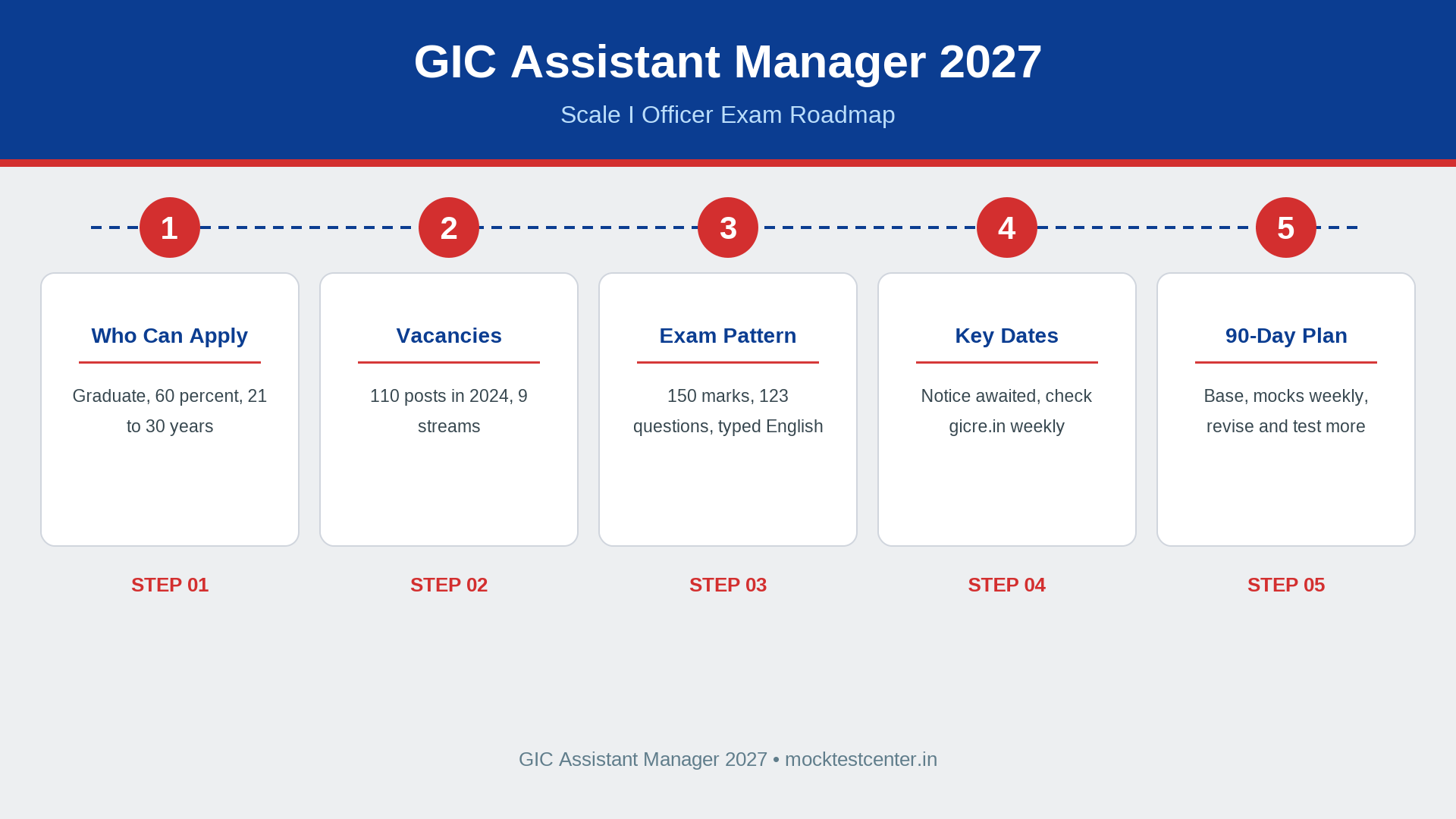
About GIC Assistant Manager 2027 Exam Series
📖 Table of Contents
- What GIC Assistant Manager 2027 is
- What GIC Re is, and why this post is different
- Where things stand: the 2024-25 cycle in full
- Streams and vacancies: all nine streams
- Who can apply: education, stream by stream
- Age limit and fee
- The online test pattern, part by part
- The 60 percent bar that surprises everyone
- Group discussion and interview
- Pay: what an Assistant Manager actually earns
- Probation, the Licentiate exam and the four year undertaking
- GIC next to NIACL, NICL, LIC and IRDAI
- What to study for each part
- A 90 day plan that fits around a job or a degree
- Mistakes that cost GIC candidates a year
- What to check before the next notice comes out
GIC Assistant Manager 2027: Scale I Pattern, Salary, Dates
What GIC Assistant Manager 2027 is
GIC Assistant Manager 2027 is the expected recruitment of Scale I officers by the General Insurance Corporation of India, known as GIC Re. The post is Assistant Manager in Scale I, and it is the officer entry point into the company that reinsures almost every general insurer in India. A reinsurer insures the insurers. When a direct insurer writes a large fire, marine or crop policy, it passes part of that risk to GIC Re, and GIC Re pays part of the claim if the loss happens. An Assistant Manager at GIC Re works on that risk, in underwriting, claims, accounts, legal, IT or actuarial teams, from the head office in Mumbai.
One fact must come first, before any pattern or pay figure. GIC Re has not released an Assistant Manager notification for 2027. No advertisement number exists, no vacancy count exists, and no apply dates exist for GIC Assistant Manager 2027. The latest completed cycle is the 2024-25 recruitment, advertised on 4 December 2024 for 110 posts, with the online test on 5 January 2025 and the final result on 26 April 2025.
As of November 2026, the careers page at GIC Re lists that 2024-25 exercise as the latest Assistant Manager recruitment, and later notices on the page are for contract and apprentice positions. Any site that prints a GIC Assistant Manager 2027 vacancy number or an exam date today is guessing. This page says so plainly, and it builds the rest of the guide from the 2024-25 advertisement, which is public in full.
Check the official careers page at gicre.in for every notice, because only the official notice is final. The pattern, eligibility rules and pay figures in this article come from the detailed advertisement Ref. GIC-HO/HR/Recruit_Scale1/874/2024-25 dated 4 December 2024, its written examination information handout, and its result notice dated 26 April 2025. They show what the next GIC Assistant Manager notice will most likely look like. They are not the 2027 notice. When the real notice comes out, read it first and treat this page as a starting point, not as the final word.
The exam is small and infrequent, and that shapes everything about it. The 2024-25 cycle offered 110 posts across nine streams, and the whole exercise, from registration to joining, took about five months. GIC Re does not publish a recruitment calendar, so nobody can say when the next notice will come. Candidates who wait for the notice to start preparing will find an apply window of about two weeks and a test about a month after that. Candidates who prepare now, on the 2024-25 pattern, will be ready whenever the notice lands.
What GIC Re is, and why this post is different
GIC Re is the Indian reinsurer. It was incorporated on 22 November 1972, and it worked first as the holding company of the four public sector general insurers. In November 2000 it was reborn as a pure reinsurance company, and it holds registration from the Insurance Regulatory and Development Authority of India, IRDAI, to carry on reinsurance business. Its shares are listed on the Bombay Stock Exchange and the National Stock Exchange, and the Government of India holds about 85.78 percent of the company. The head office is in Mumbai, and the initial posting for an Assistant Manager is at the corporate office in Mumbai.
A reinsurer is not an insurance company that sells policies to the public. Nobody walks into GIC Re to buy a motor policy. GIC Re takes on risk from the companies that do sell those policies, in India and abroad, across property, marine, engineering, aviation, agriculture, health and liability lines. That makes the work different from a direct insurer. An officer at the New India Assurance Company or the National Insurance Company deals with customers and agents. An officer at GIC Re deals with other insurers, with treaties, with large claims files, and with the numbers behind whole portfolios of risk.
That difference shows up in the exam too. Most bank and insurance officer exams test general aptitude plus a little banking awareness. The GIC Assistant Manager exam tests the same general aptitude, then adds a 40 mark paper that is either higher order reasoning for General stream candidates or technical and professional knowledge for specialist stream candidates. A law graduate faces insurance law questions.
A finance graduate faces accounting and reinsurance questions. An IT graduate faces networking and security questions. The exam rewards depth in your own subject, not just speed in puzzles.
The regulator connection matters for preparation. IRDAI regulates the insurance market, and its rules shape what GIC Re does every day. Candidates who follow IRDAI circulars and insurance news will find the general awareness section easier, and they will sound sharper in the group discussion and the interview. The IRDAI Assistant Manager 2027 exam is the regulator side of the same market, and its syllabus overlaps with the insurance awareness this exam needs.
Where things stand: the 2024-25 cycle in full
The last GIC Assistant Manager cycle ran on a tight clock, and the dates are worth knowing because the next cycle will most likely run the same way. The detailed advertisement came out on 4 December 2024. Online registration ran from 4 December to 19 December 2024, which is fifteen days. The online examination was held on 5 January 2025, about two weeks after registration closed.
Group discussions and interviews were held from 7 April to 18 April 2025. The result of the group discussion and interview was declared on 26 April 2025. Medical examination took place on 12 May 2025, and induction training ran from 13 May to 24 May 2025.
Count the gaps. Fifteen days to apply. Seventeen days from the last date to the test. Three months from the test to the interview.
About five months from the advertisement to joining. A candidate who starts on the day of the notice has roughly a month before the test, and that month has to cover a descriptive English paper that most bank exam candidates have never typed under a timer. That is the single biggest planning fact in this whole guide, and it is why the preparation sections below assume you start before the notice comes.
| Stage, 2024-25 cycle | Date |
|---|---|
| Advertisement Ref. GIC-HO/HR/Recruit_Scale1/874/2024-25 | 4 December 2024 |
| Online registration | 4 to 19 December 2024 |
| Online examination | 5 January 2025 |
| Group discussion and interview | 7 to 18 April 2025 |
| Result of GD and interview | 26 April 2025 |
| Pre-employment medical | 12 May 2025 |
| Induction training | 13 to 24 May 2025 |
No newer Assistant Manager notice has appeared on the GIC Re careers page as of November 2026. That does not mean the post is closed. It means the next notice has no date yet, and the 2024-25 pattern is the only solid base to prepare from. When the next advertisement comes, check four things first: the stream wise vacancy table, the cut off date for age and qualification, the fee, and any change in the exam pattern. Everything else in this guide follows from the last advertisement, and the new one can change any of it.
Streams and vacancies: all nine streams
The 2024-25 advertisement offered 110 posts spread over nine streams. You may apply for one stream only. If you submit more than one application, only the last one is valid and the other fees are forfeited. Pick your stream with care, because it decides both your eligibility and your Part A paper, and you cannot switch later.
| Stream | Posts | Minimum qualification |
|---|---|---|
| General | 18 | Graduation in any discipline |
| Finance | 18 | B.Com |
| Insurance | 20 | Graduation plus a post-graduate degree or diploma in general insurance, risk management or life insurance, or FIII or FCII |
| IT | 22 | B.E. or B.Tech in Computer Science, IT or listed electronics branches, or any graduate with MCA |
| Legal | 9 | Bachelor's degree in law recognised by the Bar Council of India for enrolment as an advocate |
| HR | 6 | Graduation plus post-graduation in HRM or Personnel Management |
| Engineering | 5 | B.E. or B.Tech in Marine, Aeronautical, Mechanical, Civil or Electrical, one post each |
| Actuary | 10 | Graduation plus at least 7 papers of the Institute of Actuaries of India or the Institute and Faculty of Actuaries, London, with CS2 compulsory |
| Medical (MBBS) | 2 | MBBS, registered with the Indian Medical Association, internship finished by 1 November 2024 |
| Total | 110 |
The IT stream took the largest share, with 22 posts, followed by Insurance with 20, General and Finance with 18 each, Actuary with 10, Legal with 9, HR with 6, Engineering with 5, and Medical with 2. That spread tells you where GIC Re is hiring. Technology and insurance knowledge lead, and the generalist stream is a modest 18 posts, so the General stream is the most crowded per seat even though it asks for the least specific degree.
Reservation for the 108 non-medical posts was General 43, SC 15, ST 10, OBC 34 and EWS 6, with 5 posts held horizontally for persons with disabilities. The two medical posts were filled without a written exam, through two levels of interview only, so the reservation table covers the 108 posts that took the online test.
Two rules in the advertisement deserve attention. First, engineering vacancies are interchangeable among branches if no suitable candidate is found in a branch, so a Marine seat can go to a Mechanical candidate if the Marine list is empty. Second, the advertisement lists desirable qualifications for most streams, and they matter at the interview even though they do not decide eligibility. For Finance it names MBA Finance, CA, CMA, CFA or M.Com.
For Legal it names an LLM or experience. For IT it names post-graduation, project experience and security certifications. For the IT stream it also names essential skills by role: software developers, network administrators, system administrators and information security officers. If you hold one of those desirable qualifications, say so clearly in the interview, because the panel reads it as readiness for the actual job.
Who can apply: education, stream by stream
The education rule is a percentage rule first and a degree rule second. For most streams the advertisement asks for 60 percent marks for General and OBC candidates, and 55 percent for SC and ST candidates, in the qualifying degree. Qualifications must be held as on 1 November 2024, and all candidates need computer proficiency. That cut off date matters. A degree completed after 1 November 2024 did not count for the 2024-25 cycle, and the next notice will print its own cut off date. Check it before you apply, because a degree that is one week late is the same as no degree at the document check.
General stream asks for the least on paper and the most in competition. Any graduation degree qualifies, with the 60 or 55 percent rule. That open door is why the General stream draws the largest crowd for 18 posts. If you are a plain graduate with no professional qualification, this is your stream, and your Part A paper is higher order reasoning, not a subject paper. That sounds easier than a technical paper. Higher order reasoning at 40 marks in 30 minutes is the paper that separates candidates who think from candidates who memorise.
Finance asks for a B.Com, with the same percentage rule. The desirable list is long: MBA Finance, CA, CMA, CFA or M.Com. A B.Com graduate with a CA Inter or a CFA level behind them stands out in this stream, both in Part A and at the interview. The Part A paper for Finance tests technical and professional knowledge in the discipline, so revise your degree syllabus with an insurance and reinsurance tilt: accounting standards, financial statements of insurers, investment rules, and the way reinsurance premiums and claims flow through the books.
Insurance asks for graduation plus a post-graduate degree or diploma in general insurance, risk management or life insurance, or the Fellowship of the Insurance Institute of India, FIII, or the Chartered Insurance Institute, FCII. This is the stream for candidates who have already committed to insurance as a career, and its 20 posts make it the second largest stream. The Part A paper tests insurance knowledge in depth, so a diploma alone is not enough. You need the principles behind it: the Insurance Act, the IRDAI regulations, the types of reinsurance treaties, and the claims process.
IT asks for a B.E. or B.Tech in Computer Science, IT or listed electronics branches, or any graduate with an MCA, with 60 or 55 percent in both degrees for the MCA route. With 22 posts it is the largest stream, and it is the most open to a career switch, because any graduate with an MCA qualifies. The Part A paper names skills by role, so revise networking, databases, operating systems and information security with real examples from your own projects, not just definitions.
Legal asks for a bachelor's degree in law recognised by the Bar Council of India for enrolment as an advocate. An LLM or experience is desirable. Actuary asks for graduation plus at least 7 papers of the Institute of Actuaries of India or the Institute and Faculty of Actuaries, London, with CS2 compulsory. That is a hard bar, and it keeps the stream small, with 10 posts for a small pool.
HR asks for graduation plus post-graduation in HRM or Personnel Management, for 6 posts. Engineering asks for a B.E. or B.Tech in the relevant branch, one post each in Marine, Aeronautical, Mechanical, Civil and Electrical. Medical asks for an MBBS registered with the Indian Medical Association, with the internship finished by the cut off date, for 2 posts, and those candidates skip the written test entirely.
Age limit and fee
The age rule in the 2024-25 advertisement was 21 to 30 years as on 1 November 2024, which means born not earlier than 2 November 1994 and not later than 1 November 2003. The relaxation table is generous, and it is one place where GIC Re differs from most banks. SC and ST candidates get 5 years. OBC candidates eligible for reservation get 3 years. Persons with disability get 10 years.
Ex-servicemen and disabled ex-servicemen get their service period plus 3 years, or 8 years for disabled ex-servicemen from SC and ST, up to age 45. Widows, divorced women and judicially separated women who have not remarried get 9 years. Confirmed employees of public sector general insurers, including GIC and the Agriculture Insurance Company, get 8 years. Unlike many notices, GIC Re allows these relaxations on a cumulative basis, subject to a maximum age of 45.
That cumulative rule is worth a second look if you fall in two categories at once. A 34 year old OBC ex-serviceman with 5 years of service can add the service period, the 3 years for ex-servicemen and the 3 years for OBC, up to the cap of 45. Most notices force you to pick one relaxation. This one lets you stack them. Read the relaxation table in the new notice line by line, because it can be the difference between eligible and ineligible.
The fee in the 2024-25 cycle was 1,000 rupees plus 18 percent GST, non-refundable. SC and ST candidates, candidates with disabilities, female candidates, and employees of GIC and the GIPSA member companies were exempt. That is a higher fee than most bank exams, and the GST on top takes it to 1,180 rupees for a General male candidate. Keep the payment receipt and the application printout, because the fee is non-refundable and a failed payment can still show as a pending application. The next notice will print its own fee, and it may change, so do not treat 1,180 rupees as fixed.
The online test pattern, part by part
The online test carries 150 marks, with 123 questions, in 150 minutes. It has three parts. Part A is objective and carries 40 marks in 30 minutes. Part B is objective and carries 80 marks in 60 minutes.
Part C is descriptive and carries 30 marks in 60 minutes. Shortlisting for the group discussion and the interview is on the combined objective and descriptive score out of 150, so the descriptive paper carries real weight. It counts in the same total that decides who gets called.
| Part | Test | Questions | Marks | Minutes |
|---|---|---|---|---|
| A, objective | Higher Order Reasoning Ability and Critical Thinking, General stream; Technical and Professional Knowledge, specialist streams | 40 | 40 | 30 |
| B, objective | Reasoning | 20 | 20 | 60 for all of Part B |
| B, objective | English Language, grammar and vocabulary | 25 | 25 | |
| B, objective | General Awareness | 20 | 20 | |
| B, objective | Numerical Ability and Computer Literacy | 15 | 15 | |
| C, descriptive | English: essay, precis and comprehension | 3 | 30 | 60 |
| Total | 123 | 150 | 150 |
Part A decides a lot. Forty marks for higher order reasoning in the General stream, or professional knowledge in the specialist streams, in 30 minutes. That is 45 seconds per question, and the questions are not the quick puzzles of a bank prelims paper. General stream candidates should practise critical reasoning, statement and assumption, cause and effect, inference and data sufficiency, not just seating arrangements. Specialist candidates should revise their degree syllabus with a bank and insurance tilt: insurance law and contract for Legal, reinsurance and accounting standards for Finance, networking, databases and information security for IT.
Part B is a compressed bank PO paper. Eighty questions in 60 minutes across reasoning, English, general awareness and numerical ability with computer literacy. That is 45 seconds per question again, and accuracy matters more than reach, given the penalty and the qualifying bar below. The English test carries grammar and vocabulary, so it rewards reading more than it rewards rules. The numerical ability section is paired with computer literacy, which is unusual, so revise basic computer terms, abbreviations, file types and security concepts alongside the arithmetic.
Part C is the paper that catches most candidates out. Three questions for 30 marks in 60 minutes: an essay, a precis and a comprehension, all typed in English on the keyboard. The questions appear on screen and the answers are typed, so handwriting speed is useless here and typing speed is everything. If you have not typed an essay against the clock, practise it. A candidate who writes well on paper and types slowly will run out of time on the second question, and the third question carries marks that decide the shortlist.
Other rules from the advertisement and the handout are short but sharp. Negative marking takes one fourth of the marks of a question for each wrong objective answer. The objective tests are bilingual, in English and Hindi, except the English test, which is English only. The descriptive paper is in English only. The total for the online test, the group discussion and the interview is 200, and the final merit list is in descending order of consolidated marks.
The 60 percent bar that surprises everyone
This is the part of the GIC Assistant Manager exam that surprises most candidates, and it deserves its own section. The advertisement prints minimum qualifying marks of 60 percent for General and OBC candidates, and 50 percent for SC and ST candidates, both in the online test and in the overall selection, and it adds that the minimum must be secured in each stage of the selection process separately. That means the online test, the group discussion and the interview each have their own pass mark.
Work out the numbers. For a General candidate, 60 percent means at least 90 of 150 in the online test, at least 12 of 20 in the group discussion, and at least 18 of 30 in the interview. For an SC or ST candidate, 50 percent means at least 75 of 150 in the online test, at least 10 of 20 in the group discussion, and at least 15 of 30 in the interview. Those are the arithmetic figures from the percentage rule, and they are high.
A bank PO exam with a 40 percent sectional bar lets a strong total carry a weak section. This exam does not. A candidate who scores 120 of 150 in the online test and 10 of 20 in the group discussion fails the selection, because the group discussion bar is separate.
The Corporation reserves the right to relax or raise the online test bar depending on the number of candidates and vacancies, so the published percentages are the starting point, not a promise. In practice, treat 60 percent as the floor and aim higher. The online test bar is the one that ends the most runs, because 90 of 150 with negative marking needs both speed and accuracy. Four wrong answers erase one right answer, so wild guessing in Part A or Part B can pull a 95 down to an 88, and an 88 is a fail for a General candidate.
The lesson for preparation is simple. Do not chase a high total by attempting everything. Attempt what you know, and leave the rest. In Part B, eighty questions in sixty minutes tempts every candidate to rush, and rushing is what the penalty punishes.
A candidate who attempts 65 questions with 60 right scores far more than a candidate who attempts all 80 with 55 right and 25 wrong. The second candidate loses more than six marks to the penalty alone. Accuracy is the strategy, and the 60 percent bar is the reason.
Group discussion and interview
For every stream except Medical, selection has four steps: the online test of 150 marks, the group discussion of 20 marks, the interview of 30 marks, and a medical examination. The total for the online test, the group discussion and the interview is 200, and the final merit list runs in descending order of consolidated marks. Medical, MBBS, candidates are selected through two levels of interview only, with no written test and no group discussion.
The group discussion is a real stage with its own pass mark, not a formality. With 12 of 20 needed for a General candidate, you must speak, and you must speak well. The topics in an insurance group discussion usually come from the news: a new insurance law, a crop insurance claim dispute, the growth of health insurance, climate risk and reinsurance, or the role of a reinsurer after a large natural disaster. Read the business page for two months before the interview, and form a view on each story. A group discussion rewards a candidate who can state a position in two sentences, listen to the next speaker, and build on it, not a candidate who talks the longest.
The interview carries 30 marks, and it needs 18 of 30 for a General candidate. The panel will ask why a reinsurer, why your stream, and what your stream does inside an insurer. A Finance candidate should be able to explain how reinsurance premium and claims move through an insurer's accounts. A Legal candidate should know the Insurance Act and the IRDAI regulations that govern reinsurance.
An IT candidate should be able to talk about the systems that price risk and settle claims. A General stream candidate should be able to explain, in plain words, what reinsurance is and why India needs a national reinsurer. Prepare with your own words, because the panel can tell at once whether your answers come from real study or from a guidebook.
Document verification runs alongside these stages, and it is where the percentage and cut off rules bite. GIC Re will read your degree certificate, your mark sheets, your caste or disability certificate, and your law or actuarial papers, and check them against the cut off date of 1 November 2024 in the last cycle. A candidate who scored 59 percent in graduation and applied under the 60 percent rule is out, whatever the test score. A candidate whose degree result came after the cut off date is out. Get the papers right before you apply, and keep originals plus scanned copies ready.
Pay: what an Assistant Manager actually earns
The advertisement printed a basic pay of 50,925 rupees a month in the scale 50,925 to 96,765 rupees. The scale runs as 50,925 with annual increments of 2,500 rupees fourteen times to 85,925, then increments of 2,710 rupees four times to 96,765. On top of the basic pay come dearness allowance, house rent allowance, city compensatory allowance and other allowances. The advertisement states that total emoluments will be approximately 85,000 rupees a month, plus benefits including the New Pension Scheme, leave travel subsidy, medical benefits and subsidised loans as per rules.
That starting basic of 50,925 rupees is higher than the Scale I basic in most public sector banks, where the starting basic is 48,480 rupees. The gap is real, and it is one reason the exam draws bank PO candidates. A bank PO and a GIC Assistant Manager both start as Scale I officers, but the GIC officer starts about 2,400 rupees a month higher in basic pay, and the emoluments of about 85,000 rupees a month at the start are higher than a bank PO in a metro city. The trade is the posting. A bank PO can be posted in a home state branch. A GIC Assistant Manager starts in Mumbai, where the cost of living is the highest in the country.
On housing, the advertisement is plain. Corporation-owned accommodation is not presently available, and leased accommodation is permitted as per norms, with the present lease limit at Mumbai of 45,000 rupees a month. That lease limit is generous, and it matters, because a two bedroom flat near the GIC Re office in Mumbai costs more than the house rent allowance of most banks. Read the leased accommodation rules in the new notice, and check whether the limit has changed, because it is the single biggest factor in your monthly budget in the first year.
Put the pay beside the other insurance exams and the picture is fair. The NIACL AO 2027 exam and the NICL AO 2027 exam lead to Scale I officer posts in direct general insurers, with a starting basic of 50,925 rupees in the current cycle, the same scale as GIC Re. The LIC AAO 2027 exam leads to an Assistant Administrative Officer post in the life insurer, with a starting basic near 88,635 rupees in the current cycle, which is higher, but LIC AAO is a different job in a different company with far more seats and a different exam. The money at GIC Re is strong for a first officer post. The job is smaller, quieter, and more technical, and that suits some candidates and bores others.
Probation, the Licentiate exam and the four year undertaking
Read these clauses before you resign from anything. They are the part of the advertisement that candidates skip, and they are binding from the day you join.
Probation is one year, extendable by up to one more year, with training during it. The Corporation may terminate service during probation without notice if a probationer is found unsuitable. That is standard language, but the next clause is not standard. During probation you must pass the non-life Licentiate Examination of the Insurance Institute of India.
Confirmation depends on it, and failing to pass within the extended probation makes the officer liable to termination. The Licentiate is the entry level professional exam of the insurance industry, with papers on the principles of insurance, the practice of general insurance, and regulation. Start it early in probation, not in the eleventh month, because confirmation depends on it.
The service undertaking is the clause that changes career plans. Before joining, you undertake to serve at least four years including probation. If you leave earlier, you pay liquidated damages equal to one year's gross salary paid during the probation year, which may be reduced in proportion to service rendered. You also submit an indemnity bond with two unrelated sureties for an amount equal to one year's gross salary.
Resigning during probation makes you liable to pay back the salary received plus the cost of training incurred on you. One year's gross salary is a large sum, so treat the four year undertaking as a real commitment, not a formality. If you are also preparing for the civil services or a regulator exam, decide before you join, because the bond prices an early exit.
Posting is the last clause to weigh. The initial posting is at the corporate office in Mumbai. The posts are permanent and officers can later be transferred anywhere in India or abroad. GIC Re has offices abroad and in GIFT City, so a transfer can be interesting, but the first years are in Mumbai. If you want a posting in your home state, this is not the exam for you. If you want Mumbai, a specialist job, and a four year runway in reinsurance, it is.
GIC next to NIACL, NICL, LIC and IRDAI
The insurance exams form a family, and the right choice depends on your degree and your appetite for a specialist paper. The NIACL AO 2027 exam and the NICL AO 2027 exam are the direct insurer side of the same market. They recruit Administrative Officers for general and specialist streams, they test general aptitude plus a professional knowledge paper for specialists, and they post officers across India. Their seats run into hundreds, while GIC Re offers 110. If you want the best chance of selection in insurance, NIACL and NICL give you more seats. If you want the highest starting basic in general insurance and a specialist job in Mumbai, GIC Re gives you that, with fewer seats and a harder qualifying bar.
The LIC AAO 2027 exam is the life insurance side, with a higher starting basic and a much larger intake, and the LIC ADO 2027 exam is the sales side, with an apprenticeship and a field job. Neither tests reinsurance, and neither asks for a four year bond of one year's gross salary. The IRDAI Assistant Manager 2027 exam is the regulator side, with a Phase 1 and Phase 2 pattern, a descriptive paper, and an interview, and it posts officers in Hyderabad. It is the hardest of the family to crack, and its pay is higher, but its seats are few and its syllabus is the widest.
The banking exams sit beside this family, and the preparation overlaps heavily. The RBI Grade B 2027 exam, the NABARD Grade A 2027 exam and the SEBI Grade A 2027 exam all test reasoning, English, general awareness and quantitative aptitude, and all add a specialist paper. The IBPS PO 2027 exam is the volume option, with thousands of seats and the same aptitude base. The NHB Assistant Manager 2027 exam is the closest cousin in size, with a small intake, a descriptive English paper, and an interview, in a housing finance regulator. Apply for every exam you are eligible for, and decide when the offers come, but give GIC Re its own preparation time, because its Part A and its descriptive paper do not come free with bank PO preparation.
The way to choose is to ask one question. Do you want a specialist job in reinsurance, in Mumbai, with a four year commitment and a high qualifying bar at every stage? If yes, GIC Re is your exam, and it deserves your main effort when the notice comes. If no, the direct insurers give you more seats and more postings, and the banks give you more seats still. That is the whole decision. Do not spend a year preparing for a posting you do not want, and do not pick GIC Re only because the pay is higher, because the bond and the bar will test that choice.
What to study for each part
Part A for the General stream needs critical reasoning, not puzzles. Statement and assumption, statement and conclusion, cause and effect, inference, course of action, data sufficiency, and strong and weak arguments. Work through one set a day, and write down why the wrong options are wrong, because the paper tests the reason, not the answer. For specialist streams, Part A needs your degree syllabus with an insurance tilt.
Finance candidates should revise accounting standards, financial statements, ratio analysis, and the investment regulations for insurers. Legal candidates should revise the Insurance Act, the IRDAI Act, contract law, and the law of reinsurance. IT candidates should revise networking, databases, operating systems, and information security, with real examples from their own projects.
Part B reasoning needs the standard bank PO list: puzzles, seating arrangements, syllogism, blood relations, coding and decoding, inequalities, and direction sense. Twenty questions in a shared sixty minutes means you cannot spend four minutes on one puzzle. Learn to judge a question in ten seconds. If it is a long puzzle with five questions attached, do it. If it is a single question with a long setup, skip it and come back.
Part B English needs grammar and vocabulary, with reading as the base. Error spotting, fill in the blanks, sentence improvement, synonyms and antonyms, and reading comprehension. Read one editorial a day and mark the sentence structures you would have written differently. That habit alone lifts the score, because the paper tests the same structures again and again.
Part B general awareness needs insurance awareness first and current affairs second. IRDAI circulars, the public sector insurers, reinsurance, recent insurance law changes, government insurance schemes such as the crop insurance scheme and the accident insurance schemes, and the Union Budget as it touches insurance. Add six months of current affairs: major appointments, the RBI monetary policy, and the big economic numbers. Part B numerical ability with computer literacy needs simplification, number series, data interpretation, percentages, ratio and proportion, and time and work, plus computer basics: abbreviations, file types, operating systems, networks, and security terms. The computer questions are easy marks for a candidate who has used a computer daily, and lost marks for a candidate who skips them.
Part C needs typing practice more than writing practice. An essay, a precis and a comprehension in sixty minutes, typed. Write one timed essay a week on a business or insurance theme: the growth of health insurance, the role of reinsurance after a flood, the need for crop insurance, or the future of digital insurance. Type it in sixty minutes with the other two questions, not alone, because the paper gives one hour for all three. A precis needs the skill of cutting a passage to a third of its length without losing its sense, and that skill comes only from practice. Do five precises before the test, and time each one.
A 90 day plan that fits around a job or a degree
Most GIC candidates are working or in a final year degree, so the plan below assumes two hours a day, not eight. Two hours a day for ninety days is 180 hours, which is enough for this exam, because the syllabus overlaps with the bank PO exams and the specialist paper is your own subject. Start now, before the notice comes out, because the apply window will be about two weeks and the test will follow about a month later.
Days 1 to 30 are for the base. Study two hours a day. Cover one Part A topic and one Part B topic each day. For the General stream, that means one critical reasoning set plus one reasoning or English topic. For specialist streams, that means one chapter of your degree syllabus plus one aptitude topic.
Read the business page every morning and write five lines on insurance news. Type one essay a week, untimed at first, to build the habit. Take one mock at the end of week two and one at the end of week four. Do not worry about the score. The first mocks only show you where you stand.
Days 31 to 60 are for speed and for the descriptive paper. Your score will move most in this phase, because the paper gives 45 seconds per objective question and the descriptive paper needs typing speed. Take two mocks a week now, with the descriptive section included and timed. After each mock, spend as much time on analysis as you spent on the test. Write down every question you got wrong and why.
Was it a concept gap, a silly mistake, or a time problem? Concept gaps go back into your study list. Silly mistakes need a checklist before you submit each section. Time problems need easier questions first and hard ones last. Type one timed essay plus one precis every week now, in a single sixty minute sitting, exactly like Part C.
Days 61 to 90 are for the real thing. Take three mocks a week. Revise your error notebook every second day. Stop learning new topics in the last ten days.
New topics in the last week add stress and no marks. In the last three days, take one full mock at the same time as your real test slot, then rest. Sleep matters more than one more chapter in the final week. A candidate who walks into the test hall tired will make the same mistakes a fresh candidate makes, and the degree will not save the score.
If you have less than ninety days, cut the base phase, not the mocks. Ten mocks with full analysis beat thirty days of reading without a single test. The paper rewards candidates who have sat through the two and a half hour sitting many times. It punishes candidates who know the syllabus and have never felt the Part A timer run out.
Mistakes that cost GIC candidates a year
The first mistake GIC candidates make is waiting for the notice to start. The apply window in the last cycle was fifteen days, and the test followed seventeen days after the last date. A candidate who starts on the day of the notice has about a month. A candidate who starts now has the whole year. The syllabus overlaps with the PO and insurance exams so much that every hour you spend now counts for those exams too, even if the GIC notice comes late.
The second mistake is ignoring the descriptive paper. Candidates who prepare only for objective tests walk into Part C and discover they cannot type an essay, a precis and a comprehension in sixty minutes. Thirty marks decide the shortlist, and a blank third question is a lost shortlist. Type every week from the first month, and treat Part C as a subject, not an afterthought.
The third mistake is guessing too much. Four wrong answers erase one right answer, and the qualifying bar is 60 percent, not 40. In a paper where you know sixty answers for sure, twenty wild guesses can pull your score down by five marks. That is often the gap between selection and rejection in a stream with nine posts. Guess only when you can rule out two options.
The fourth mistake is applying for the wrong stream. A graduate with a B.Com and no insurance diploma cannot apply for the Insurance stream, and a law graduate who applies for the General stream wastes the legal knowledge that would have carried Part A. Read the stream table before you apply, and pick the stream where your degree gives you the most marks, not the stream with the most posts. The IT stream has 22 posts, but it has the deepest applicant pool of graduates with an MCA. The Actuary stream has 10 posts for a small pool of candidates with seven actuarial papers. The small pool is the opportunity.
The fifth mistake is forgetting the bond. Candidates join GIC Re while still preparing for other exams, then discover that leaving in the first year costs a year's gross salary plus the training cost, and that the undertaking runs for four years. Decide before you join. If GIC Re is your destination, the bond is a fair price for a strong job. If it is a stop on the way to another exam, the price is high, and you should know it before you sign.
What to check before the next notice comes out
Keep four things ready. First, your degree certificate and mark sheets, with the percentage matching the 60 or 55 percent rule, and your degree result dated before the cut off date the new notice will print. Second, your professional papers, if you are in a specialist stream: the law degree, the actuarial papers with CS2, the insurance diploma, or the MCA degree. Third, a mock test routine with the descriptive paper typed and timed, so the two and a half hour sitting feels normal by the time the notice comes out. Fourth, a habit of checking gicre.in careers twice a week, because the notice will appear there first and the apply window will be short.
Start with one GIC Assistant Manager 2027 mock this week, built on the 2024-25 pattern: 123 questions, 150 marks, two and a half hours, with a typed essay, precis and comprehension in the last hour. Score it against the 60 percent bar, not the 40 percent bar of a bank exam. List your weak part, and give that part thirty minutes a day. That single habit, repeated for ninety days, is what turns a graduate into an Assistant Manager at the Indian reinsurer.
Before that first mock, run a five minute check on your own eligibility, because it decides whether the preparation is worth it at all. Read the stream table and confirm your degree and percentage fit one stream. Check your age against the 21 to 30 rule and the relaxation table if it applies to you. Confirm your degree result date falls before the cut off date the notice prints.
If you are in a specialist stream, confirm the extra paper you need, such as the law degree, the actuarial papers with CS2, or the insurance diploma, is in hand. Then check your typing speed with one essay against a sixty minute clock. If any of those five checks fails, fix it first. A candidate who clears the checks and then prepares for ninety days walks into the test knowing the paper, the bar and the bond, and that is the candidate the merit list is built from.