
About APPSC Group 2 2027 Exam Series
📖 Table of Contents
- APPSC Group 2 2027 in numbers
- What the 720 posts are
- Who can apply for APPSC Group 2 2027
- The exam in three stages
- Screening: five blocks of 30 marks
- Mains: two papers, four blocks of 75 marks
- The computer test that ends runs
- What the last cycle teaches you
- Cut offs: what APPSC has actually published
- Books that cover the syllabus
- A 90 day plan for the Screening on 21 February 2027
- Mistakes that cost marks
- Sources
APPSC Group 2 2027: Complete Exam Guide
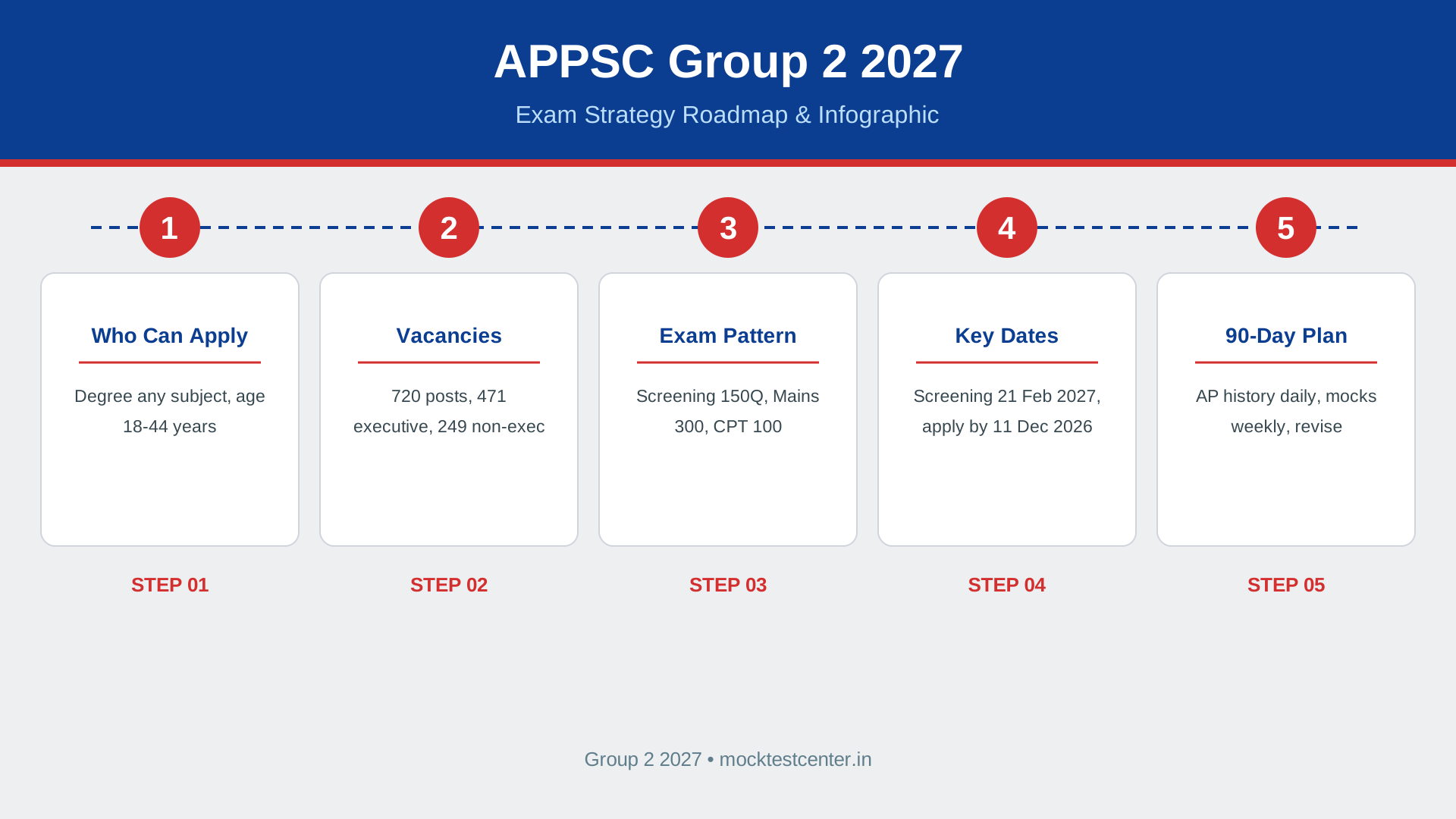
APPSC Group 2 2027 is a live exam with a fixed date. The Andhra Pradesh Public Service Commission issued Detailed Notification 37/2026 on 10 November 2026 for 720 posts, and the Screening Test is set for 21 February 2027. Applications close on 11 December 2026. APPSC Group 2 2027 has three stages and no interview: a 150 mark Screening that only shortlists, a 300 mark Mains that decides your rank, and a 100 mark computer test that you must pass. If you are starting now, you have about 90 days to the Screening, and this guide covers the posts, the pattern, the syllabus, the age limits, the fee and a 90 day plan built for that date.
Group 2 fills executive and non-executive posts across Andhra Pradesh government departments. The two biggest posts in this cycle are Deputy Tahsildar with 203 posts and Deputy Mandal Parishad Development Officer with 176 posts. A degree in any subject makes you eligible for most posts. The exam is held in English and Telugu, and the English paper is the one used for valuation. Selection rests on Mains merit alone, so the Screening is a gate you must clear and then forget, because its marks never reach your rank.
APPSC Group 2 2027 in numbers
| Item | Detail |
|---|---|
| Conducting body | Andhra Pradesh Public Service Commission (APPSC) |
| Exam name | Group-II Services, known as APPSC Group 2 |
| Current notification | Detailed Notification 37/2026, dated 10 November 2026 |
| Brief notification | 37/2026, dated 13 October 2026, with 686 posts |
| Posts in the current cycle | 720, with 471 executive and 249 non-executive, in 30 post codes |
| Application window | 10 November 2026 to 11 December 2026, up to 11:59 PM, online only |
| Screening Test date | 21 February 2027, offline mode on an OMR sheet |
| Main Examination date | To be announced, in Computer Based Recruitment Test mode |
| Age counted on | 1 July 2026, most posts 18 to 44 years |
| Fee | Rs 250 processing fee plus Rs 80 examination fee |
| Previous cycle | Notification 11/2023, 905 posts, selection list of 891 candidates on 27 January 2026 |
The post count moved twice before it settled. G.O.Ms.No.81 of 22 August 2026 cleared 673 Group 2 posts. The brief notification of 13 October 2026 listed 686 posts. The detailed notification of 10 November 2026 raised the count to 720 posts. Apply against the 720 figure, because that is the number in the detailed notification, and the detailed notification is the rulebook for this cycle.
The age limit moved too, and it moved in your favour. G.O.Ms.No.187 of 14 September 2026 raised the upper age limit from 42 to 44 years for non-uniform posts notified up to 30 September 2027. The 2023 cycle used 18 to 42 years. The 2026 cycle uses 18 to 44 years for most posts, counted on 1 July 2026. That two year rise brings back candidates who aged out under the old limit, and it is one more reason the 2027 Screening may draw a bigger crowd than the last cycle did.
What the 720 posts are
The 720 posts split into 471 executive posts and 249 non-executive posts. Two posts carry more than half the cycle between them. Deputy Tahsildar in the Revenue Department has 203 posts, and Deputy Mandal Parishad Development Officer in the Panchayat Raj and Rural Development Department has 176 posts. Together that is 379 posts, or about 53 in every 100 posts in the cycle. If you clear this exam, the odds say you will land in one of those two posts, so read their work before you fix your post preferences.
A Deputy Tahsildar works in revenue administration at the mandal level, handling land records, revenue collection, certificates and the day to day work of the tahsildar office. A Deputy Mandal Parishad Development Officer works in rural development at the mandal level, handling panchayat raj programmes, rural schemes and development works. Both posts put you in charge of field work in a mandal, dealing with the public every day. Candidates who want a desk job in the Secretariat should look at the Assistant Section Officer posts instead, and candidates who want accounts work should look at the Senior Accountant and Junior Accountant posts.
| Post | Posts | Starting basic pay, Rs per month |
|---|---|---|
| Deputy Tahsildar, Revenue | 203 | 44,570 to 1,27,480 |
| Deputy Mandal Parishad Development Officer, PR and RD | 176 | 45,830 to 1,30,580 |
| Senior Accountant, Heads of Departments | 90 | 34,580 to 1,07,210 |
| Assistant Section Officer, General Administration | 71 | 40,970 to 1,24,380 |
| Junior Accountant, various departments | 47 | 25,220 to 80,910 |
| Goods and Services Tax Officer | 40 | 44,570 to 1,27,480 |
| Junior Office Assistant, 17 departments | 31 | 25,220 to 80,910 |
| Prohibition and Excise Sub-Inspector | 29 | 40,970 to 1,24,380 |
| Assistant Registrar, Co-operative Societies | 10 | 45,830 to 1,30,580 |
| Sub-Registrar Grade II, Registration and Stamps | 7 | 44,570 to 1,27,480 |
| Municipal Commissioner Grade III | 6 | 45,830 to 1,30,580 |
| Assistant Section Officer, Finance | 5 | 40,970 to 1,24,380 |
| Assistant Section Officer, Law | 4 | 40,970 to 1,24,380 |
| Senior Accountant, Districts | 1 | 34,580 to 1,07,210 |
| Total | 720 |
The pay figures in the table are the starting basic pay on the 2022 pay scales, taken from the notification. Gross pay adds dearness allowance and house rent allowance on top of basic, so the amount credited each month is higher than the basic figure, and it varies with the place of posting. The notification gives no gross figure, so this guide gives none either. Pay barely separates most of the list. Eleven of the fourteen post groups start within 4,860 rupees of each other in basic pay, so order your post preferences by the work and the place, and let pay break a tie.
Three facts about the list deserve a second look. First, the Goods and Services Tax Officer post is new in this shape. It did not appear as a separate Group 2 post in the 2023 cycle, where the tax work sat with other posts. Second, the Assistant Section Officer posts are split across three departments, General Administration with 71 posts, Finance with 5 and Law with 4, and each is a separate post code with its own vacancy count. Third, the Junior Office Assistant post covers 17 departments under one post code, so the place of posting can vary widely. Read the department against each post before you submit your preferences, because the post name alone does not tell you where you will work.
Who can apply for APPSC Group 2 2027
Eligibility rests on a degree, an age inside the limit, and Indian citizenship. A bachelor degree from a recognised university qualifies you for most posts, in any subject. The degree must be held on the date of the notification. A few posts ask for a named subject, so check the qualification column for the post you want before you apply. You apply online at psc.ap.gov.in, and first time applicants register through One Time Profile Registration, which gives you a user ID on your mobile number and email ID. That registration alone is not an application. You must still fill the application form for this notification and pay the fee.
| Category | Age on 1 July 2026 |
|---|---|
| Most posts, open category | 18 to 44 years |
| BC, SC, ST and EWS, most posts | 18 to 49 years, five years more |
| Persons with benchmark disabilities | Ten years more, up to 54 years |
| Municipal Commissioner Grade III | 21 to 44 years |
| Sub-Registrar Grade II | 20 to 44 years |
| Prohibition and Excise Sub-Inspector | 18 to 30 years |
The Prohibition and Excise Sub-Inspector post is the exception in the age table. It is a uniform post, and G.O.Ms.No.188 keeps its upper limit at 30 years, with two extra years for uniform posts up to 30 September 2027 already built into that figure. If you are over 30, you can still apply for every other post in the cycle, but not for the Excise Sub-Inspector post. The notification also gives ex-servicemen and NCC instructors three years on top of their length of service, and serving regular Andhra Pradesh state government employees up to five years. Those relaxations depend on your own service record, so read the age paragraph of the notification itself if you claim one of them.
The Excise Sub-Inspector post also carries physical standards, and they are the only physical standards in this exam. Men must be at least 165 cm tall, with a chest of at least 81 cm on full expiration and a minimum expansion of 5 cm. Women must be at least 152.5 cm tall and weigh at least 45.5 kg. Vision must be 6/6 distant and 0.5 near in each eye, with a full field of vision. Colour blindness, squint, knock knees, flat foot and similar conditions are listed as disqualifications for this post under G.O.Ms.No.950 of 28 November 1998. The standards are checked by medical boards after the written stages, and the last cycle selected candidates only after that check. If you aim for this post, measure yourself against these numbers before you spend months preparing for it.
Two reservation rules shape who gets which post. Local candidates get 95 percent of the zonal posts under the AP Public Employment Order 2025, with 5 percent open to all. The 2023 cycle used the 1975 order, which gave 70 percent to locals. The new order is a big change, and it applies to the zonal posts in codes 01 to 07 and the one district post. The other posts are state-wide, with no local quota. Women get one third of the posts as horizontal reservation under Rule 22A. Horizontal reservation cuts across the vertical categories, so a woman selected against the women quota still sits in her own category, SC, ST, BC, EWS or open, in the roster.
The fee is Rs 250 towards the application processing fee plus Rs 80 towards the examination fee, so Rs 330 in all for an open category candidate. The Rs 80 examination fee is waived for SC, ST, BC, persons with benchmark disabilities and ex-servicemen, for families holding a white ration card issued by the Civil Supplies Department, and for unemployed youth of Andhra Pradesh who submit the declaration. Everyone pays the Rs 250 processing fee. The fee is paid online only, through net banking, credit card or debit card. It is not refunded under any circumstances. Candidates from other states pay the full Rs 330 and cannot claim the exemption or any reservation.
The exam in three stages
| Stage | Format | Marks | What it decides |
|---|---|---|---|
| Screening Test | Objective, one paper, 150 questions, 150 minutes | 150 | Who sits the Mains; marks do not count in merit |
| Main Examination | Objective, two papers, 150 questions each, 150 minutes each | 300 | Your rank |
| Computer Proficiency Test | Practical, 60 minutes | 100 | Qualifying only; marks do not count in merit |
Three facts in that table decide how you prepare. The Screening marks stay out of the final merit, so a high Screening score earns you nothing beyond a Mains seat. The Mains carries all 300 merit marks, so the two Mains papers decide your rank entirely. The computer test carries 100 marks and not one of them reaches the merit list, but failing it ends your run after you have cleared both written stages. There is no interview in APPSC Group 2. Rank comes from the 300 mark Mains alone, subject to passing the computer test and clearing verification.
Appearance in every paper is compulsory. Absence in any paper of the Screening or the Mains renders the candidature liable for disqualification, and that rule is printed in the notification itself. The Screening shortlists candidates for the Mains at 50 times the number of vacancies, irrespective of communities. Against 720 posts, that is about 36,000 candidates going through to the Mains, on one list with no category-wise relaxation at this stage. The 2023 notification fixed no such ratio, and the Commission picked candidates who reached a qualifying standard it fixed at its discretion. The 50 times rule is new for 2026, and it makes the Screening cut a plain numbers game: finish inside the top 36,000 and you move on.
Negative marking is one third of the marks prescribed for the question, under G.O.Ms.No.235 of 6 December 2016. It applies to the Screening and to both Mains papers. On one mark questions, that is 0.333 marks per wrong answer, so three wrong answers cancel one correct answer. A blind guess between four options breaks even at best, and it loses on any question where you cannot rule out at least one option. Count your guesses in timed practice papers and learn whether your guessing pays or costs you marks. That habit is worth more than one more chapter of reading.
Screening: five blocks of 30 marks
The Screening is one paper, General Studies and Mental Ability, with 150 questions in 150 minutes for 150 marks, at degree standard. That gives you 60 seconds per question, and the paper splits into five blocks of exactly 30 marks each. The even split is worth fixing in your mind, because Mental Ability carries the same weight as Indian History, and Current Affairs carries the same weight as Geography. Candidates who treat Mental Ability as a leftover subject are discounting a fifth of the paper.
| Block | Marks |
|---|---|
| Indian History | 30 |
| Geography | 30 |
| Indian Society | 30 |
| Current Affairs | 30 |
| Mental Ability | 30 |
| Total | 150 |
Indian History covers ancient, medieval and modern India. Ancient history runs from the Indus Valley Civilisation through the Vedic Age, Buddhism and Jainism, and the Mauryan and Gupta empires, with their administration, society, economy, religion, art, architecture and literature. Medieval history covers the Chola administration, the Delhi Sultanate, the Mughal Empire, the Bhakti and Sufi movements, Shivaji and the Maratha Empire, and the arrival of the Europeans. Modern history covers the Revolt of 1857, British expansion, administrative and social changes, reform movements, the Indian National Movement with its key leaders, and post-independence consolidation and reorganisation. The questions test facts and their links, so read each period for what changed and why it changed, and keep the dates inside that story.
Geography covers physical geography, the geography of India and the geography of Andhra Pradesh. Expect questions on landforms, climate, rivers, soils, agriculture, minerals, industry, transport and population, with an Andhra Pradesh angle on several of them. Indian Society covers the structure of Indian society, social issues, welfare and development, and the social changes that shape current debates. Current Affairs covers events of national, international and regional importance, with a strong Andhra Pradesh component. General Science and its applications to daily life, and current developments in science and technology and information technology, sit inside the current affairs and science reading rather than as a separate block.
Mental Ability covers comprehension, logical reasoning and analytical ability, decision making and problem solving, basic numeracy, and data interpretation through charts, graphs, tables and data sufficiency. It is the most trainable block in the paper. A candidate who practises 20 questions a day from the start builds speed that no amount of last month cramming can match. The block also rewards calm. Sixty seconds per question means you must move on when a question resists you, because a stuck question costs you the next two questions as well.
Mains: two papers, four blocks of 75 marks
| Paper | Subjects | Questions | Duration | Marks |
|---|---|---|---|---|
| Paper I | Social and Cultural History of Andhra Pradesh, and Indian Constitution | 150 | 150 minutes | 150 |
| Paper II | Indian and AP Economy, and Science and Technology | 150 | 150 minutes | 150 |
| Total | 300 | 300 |
Each Mains paper splits into two equal halves of 75 marks. Paper I gives 75 marks to the social and cultural history of Andhra Pradesh, the history of the various social and cultural movements in Andhra Pradesh, and 75 marks to a general overview of the Indian Constitution. Paper II gives 75 marks to Indian and AP economy, and 75 marks to science and technology. So the Mains is four blocks of 75 marks each. Science and Technology is worth exactly as much as the Indian Constitution, and the social and cultural history of Andhra Pradesh is worth as much as the whole of Indian and AP economy. A candidate used to treating science as a current affairs footnote needs to rethink the weight here.
Paper I starts with Andhra Pradesh itself. The social and cultural history block covers the Satavahanas, the Ikshvakus, the Eastern Chalukyas, the Kakatiyas, the Vijayanagara Empire and the Qutb Shahis, the social reform movements, the freedom movement in Andhra, the formation of Andhra State in 1953 and Andhra Pradesh in 1956, and the social and cultural movements that shaped the state. The Constitution block covers the making of the Constitution, its salient features, fundamental rights and duties, directive principles, the Union and state executive, the legislature, the judiciary, local government, and the constitutional bodies. The two halves of Paper I reward the same habit: reading a topic for its structure, then for the facts that hang on that structure.
Paper II starts with the economy. The Indian and AP economy block covers national income, planning, economic growth, the 1991 reforms, NITI Aayog, agriculture, industry, services, banking, public finance, welfare schemes, and the economy of Andhra Pradesh with its agriculture, industry, irrigation, power and development programmes. The science and technology block covers general science, information technology, space, biotechnology, health, energy and environment. The Andhra Pradesh Economic Survey and the state budget feed questions in this paper, and they feed the Screening current affairs block too, so read them as source documents in full.
Two rules of the Mains deserve attention. First, the minimum aggregate marks for selection are 40 percent for open category and EWS candidates, 35 percent for backward classes, and 30 percent for SC, ST and persons with benchmark disabilities, under G.O.Ms.No.103 of 3 February 1967. On 300 marks, that floor is 120, 105 and 90 marks. The notification adds a warning that matters: merely securing the minimum qualifying marks does not confer any right to be considered for selection. Clearing the bar keeps you eligible, and selection above it goes by rank. Second, if two candidates tie on Mains marks, the older candidate ranks higher. The tie rule is a small thing until it decides a post, and it has decided posts before.
One more caution belongs here. An old syllabus PDF still hosted on the APPSC site shows a three paper Mains with 450 marks, and that scheme belonged to an earlier cycle. The current scheme, in Notifications 11/2023 and 37/2026, is two papers of 150 marks each, 300 in all. Any guide, book or video that still teaches a three paper Mains is out of date, and following it would waste your time on a paper that no longer exists. Check the notification number on any syllabus you download. If it does not cite 11/2023 or 37/2026, treat it with care.
The computer test that ends runs
The Computer Proficiency Test is the stage most candidates have never heard of, and it is not optional. Candidates shortlisted after the Mains must qualify a practical test of proficiency in office automation with usage of computers and associated software, under Rule 14A of the AP State and Subordinate Service Rules 1996, read with G.O.Ms.No.28 of 12 March 2024. The test runs for 60 minutes and carries 100 marks. It has a short multiple choice part, typing, a document, a spreadsheet and a presentation. The qualifying marks are 40 for open category, 35 for backward classes, and 30 for SC, ST and persons with benchmark disabilities.
The test is qualifying only, and its marks never reach the merit list, but failing it ends your candidature after you have cleared both written stages. That is exactly what happened to candidates in earlier cycles who ignored it. The last cycle held the computer test on 5 July 2025, months after the Mains, and candidates who had stopped studying by then had to pick up a keyboard again. If you rarely use a computer, a little typing and spreadsheet practice each week from now is enough preparation to plan for. The test checks whether you can do ordinary office work on a computer, and that is a skill you can build in an hour a week.
What the last cycle teaches you
The last cycle ran on Notification 11/2023, and it is the best evidence you have for how this exam behaves. The notification came out on 7 December 2023. The detailed notification followed on 20 December 2023. Applications ran from 21 December 2023 to 10 January 2024, then extended to 17 January 2024. The brief notification advertised 897 posts, with 331 executive and 566 non-executive. The detailed notification listed 899 posts, with 333 executive and 566 non-executive, because it added the carried forward vacancies in full. An addendum of 7 March 2024 raised the total to 905 posts. That is the number the cycle finally recruited against.
The post list in that cycle looked different from the 2026 list. Assistant Section Officer in the General Administration Department led with 218 posts, including 7 carried forward vacancies. Prohibition and Excise Sub-Inspector had 152 posts, including 3 carried forward. Deputy Tahsildar had 114 posts. Assistant Labour Officer had 28. Sub-Registrar Grade II had 16. Assistant Registrar in Co-operative Societies had 16. Municipal Commissioner Grade III had 4. Extension Officer in Panchayat Raj and Rural Development had 2 carried forward posts. Assistant Development Officer in Handlooms and Textiles had 1 carried forward post. Junior Assistant posts were spread across dozens of departments, with the largest shares in the Chief Commissioner of Land Administration with 31 posts, the Public Service Commission itself with 30 posts, and Public Health and Family Welfare with 19 posts. The executive total was 333 and the non-executive total was 566, which adds to 899 before the addendum.
| Stage | Date | Count |
|---|---|---|
| Screening Test | 25 February 2024 | About 4,04,037 appeared |
| Qualified for Mains | 10 April 2024 | 92,250 |
| Mains first scheduled | 28 July 2024 | Postponed for administrative reasons |
| Mains rescheduled | 5 January 2025 | Postponed again |
| Mains held | 23 February 2025 | About 79,500 appeared |
| Post preference window, second round | 4 to 10 March 2025 | Preferences taken again after Mains |
| Computer Proficiency Test | 5 July 2025 | Qualifying test after Mains |
| Selection notification | 27 January 2026, published 28 January 2026 | 891 selected |
Read that table for the ratios. About 4,04,037 candidates sat the Screening, and 92,250 went on to the Mains. That is about 23 in every 100 who sat the Screening. About 79,500 sat the Mains, and 891 were finally selected. That is about 1 in every 89 who sat the Mains, and about 1 in every 453 who sat the Screening. The Screening cut is the generous one. The Mains cut is the hard one. Your first job is to land inside the top 36,000 in the 2027 Screening, because the 50 times rule fixes that number in advance. Your second job, and the one that decides your post, is to finish high in the Mains.
The Mains dates carry a warning of their own. The Mains was first set for 28 July 2024 and postponed for administrative reasons. It was reset to 5 January 2025 and postponed again. It was finally held on 23 February 2025, in two shifts, from 10:00 AM to 12:30 PM and from 3:00 PM to 5:30 PM. That is seven months of delay between the first date and the exam, and the candidates who kept studying through the postponements were the ones who held their form. A fake web note circulated on 22 February 2025 claiming one more postponement, and APPSC called it false the same day and said a police complaint was being given. Trust only psc.ap.gov.in for dates. Social media posts about postponements have been wrong before, and they will be wrong again.
Post preferences were collected twice in the last cycle. Candidates gave their post and zonal or district preferences with their centre preferences in June 2024, from 5 to 18 June 2024. After the Mains, APPSC opened a fresh window from 4 to 10 March 2025 and asked candidates to give their preferences again before the selection list was drawn up. That second window matters, because your view of the posts changes after you have sat the Mains. The 2026 notification follows the same pattern, so expect a preference window after the Mains again, and keep your login details safe until the whole process ends.
The selection notification of 27 January 2026 picked 891 candidates against 905 posts, so 14 posts stayed unfilled, and the Commission said it would review the remaining vacancies separately. The list is provisional, and the selections are subject to writ petitions pending before the Andhra Pradesh High Court, including Writ Petition numbers 27119/2025 and 25040/2025. Candidates whose names appear in italics in the list were selected tentatively, and their posts, zones or districts may change on court orders. The Commission also made clear that qualifying in the examination does not automatically confer the right to appointment, and the process ends only when the appointment order arrives.
Cut offs: what APPSC has actually published
APPSC printed no cut off for the 2024 Screening or the 2025 Mains. The qualified list of 10 April 2024 and the selection notification of 27 January 2026 carry register numbers only, with no marks beside them. The one Group 2 cut off the Commission has published is for the Screening of notification 25/2018, held on 5 May 2019 and announced on 25 July 2019: 81.2 out of 150 for the open category, with BC-A, BC-B and BC-D on the same mark, BC-C on 66.67, BC-E on 77.31, SC on 78.37 and ST on 69.15. That cut off is seven years old and belongs to a different cycle with different posts, so use it as a rough sense of the level and nothing more.
Any 2024 or 2025 Group 2 cut off table that names no Commission document is an estimate, and most of them are guesses dressed as data. The honest way to set a target score is to work from the shortlist rule. The 2026 Screening takes the top 36,000 candidates out of whoever appears. If about 4,00,000 appear, as they did in the last cycle, you need to finish in the top 9 in every 100. On a 150 mark paper with one third negative marking, a score around 100 to 110 marks is a sensible target to aim for, and a score above 115 leaves you safe in most outcomes. The real cut depends on the paper, the crowd and the day, and nobody knows those numbers in advance.
The Mains target is simpler to state and harder to reach. The floor is 120 marks out of 300 for open category, 105 for backward classes and 90 for SC, ST and persons with benchmark disabilities. The floor keeps you eligible. Selection goes by merit, and the last cycle picked 891 candidates out of about 79,500 who sat the Mains. Aim well above the floor. A Mains score around 200 out of 300 puts you in the running for a post, and a score above 220 puts you in the running for the post you actually want. Those are working targets from the arithmetic of the last cycle. The Commission has published no Mains cut off.
Books that cover the syllabus
Start with the books that cover the most marks per page. For Indian history, use Spectrum for modern India and the NCERT history books for the base. For the social and cultural history of Andhra Pradesh, use the Telugu Academy degree books, because the state specific questions come from that material more than from any national book. For the Constitution, use Indian Polity by M. Laxmikanth. For the economy, use Indian Economy by Ramesh Singh with the NCERT economics books. For geography, use Certificate Physical and Human Geography by G.C. Leong with the NCERT geography books. For environment and science, use the Shankar IAS material and the NCERT science books from classes 6 to 10. For mental ability, use Quantitative Aptitude by R.S. Aggarwal and a modern reasoning book. For current affairs, use a monthly magazine for national coverage and the Andhra Pradesh Economic Survey and the state budget speech for the state part.
Books alone will not clear the Screening. Previous year papers will tell you how APPSC asks what it asks, and that matters more than how much you have read. APPSC repeats themes even when it never repeats a question: the Satavahanas and the Kakatiyas, the formation of Andhra State, the state budget, the big welfare schemes, and the geography of the Godavari and Krishna basins return year after year in new forms. Solve the last five years of Screening papers under time, 150 questions in 150 minutes, with the one third negative marking applied to your score. A mock score without negative marking is a score you made up. Track your score by block, not just in total, because a total of 105 that hides a Mental Ability block of 12 out of 30 is a warning that your practice is thin where it is cheapest to fix.
Current affairs need two separate notebooks, one for national and international events and one for Andhra Pradesh. The paper splits them that way in practice, so your notes should split them that way too. The Andhra Pradesh notebook holds state government programmes, the state budget, the Andhra Pradesh Economic Survey, appointments, welfare schemes, irrigation and infrastructure projects, and developments in agriculture, industry and power in the state. Update it weekly. A monthly current affairs magazine gives you national coverage, but no national magazine covers Andhra Pradesh schemes in the depth that the paper demands. Read the state government releases and the budget speech itself for that part.
Mains preparation starts before the Screening, not after it. The gap between the Screening result and the Mains is short, and a candidate who has never studied the Constitution and the economy in depth cannot learn two 75 mark blocks in that gap. Half of the Mains, the Constitution and the economy, sits in subjects the Screening has no block for. Start those two blocks in the first month of preparation, alongside the Screening subjects, and keep them going every week. That single habit separates the candidates who clear the Screening and then stall from the ones who go on to take a post.
A 90 day plan for the Screening on 21 February 2027
Today is 20 November 2026, and the Screening is on 21 February 2027. That is 93 days, so a 90 day plan fits the gap almost exactly. The plan below runs from 23 November 2026 to 21 February 2027, at two to three hours a day, which is realistic for a working candidate. It puts Andhra Pradesh first, because the state carries the marks that other candidates skip, and it starts the Mains blocks early, because the Mains decides your rank.
| Weeks | Focus | Daily time |
|---|---|---|
| 1 to 2 | Indian History, ancient and medieval, plus AP history from Satavahanas to Kakatiyas, and one Screening mock | 2 hours |
| 3 to 4 | Geography, Indian and AP, plus Indian Society notes, and daily Mental Ability practice | 2 hours |
| 5 to 6 | Current Affairs, national and AP, plus Constitution basics for Mains Paper I | 2 to 3 hours |
| 7 to 8 | Modern History and freedom movement, plus Indian Economy for Mains Paper II | 2 to 3 hours |
| 9 to 10 | Science and Technology for Mains Paper II, plus AP welfare schemes and state budget | 2 to 3 hours |
| 11 | Two full Screening mocks, revision of weak blocks, and computer test practice | 3 hours |
| 12 | Full mock tests, revision of notes, and no new topics | 2 hours |
| Last 3 days | AP facts, dates, schemes, and one light mock test | 1 hour |
The plan assumes two hours a day, and it puts the state first because the state carries the most marks that other candidates skip. Weeks 1 to 4 build the Screening base, with history, geography and society taking the largest share. Weeks 5 to 6 add current affairs and the Constitution, the Mains block that most Screening-only plans ignore. Weeks 7 to 10 shift to the economy and science, because those two blocks carry 150 of the 300 Mains marks. Week 11 tests the whole plan under exam conditions. Week 12 is revision only. New topics in the last week cost more marks than they gain, because they displace revision of material you already know.
Mock tests deserve a fixed slot, not leftover time. Take one full 150 question Screening mock every Sunday from week 3 onward, in one sitting of 150 minutes, without pausing, and review every wrong answer the same evening. Track your score by block, because a total that looks safe can hide a weak block that the cut will expose. From week 7, add one hour a week of computer practice, typing, a document, a spreadsheet and a presentation, so the computer test never catches you cold. The last three days are for Andhra Pradesh facts, dates, schemes, and one light mock test. Sleep matters more than one more chapter in those three days, and the candidates who reach the hall rested answer better than the ones who studied through the night.
Mistakes that cost marks
The first mistake is treating the Screening as a formality. About 23 in every 100 who sat the Screening in the last cycle moved to the Mains, and that cut falls on candidates who read widely but never practised under time with negative marking. The second mistake is starting the Mains subjects after the Screening. Half the Mains sits in subjects the Screening never tests, and the gap between the two stages is too short to learn them from scratch. The third mistake is guessing blindly. A wrong answer costs one third of a mark, so a guess with no elimination loses marks across a full paper, while a guess between two options still pays. Learn the difference and apply it in every mock.
The fourth mistake is reading only national current affairs. The paper gives heavy weight to Andhra Pradesh, and the state budget and the Andhra Pradesh Economic Survey feed both the Screening and the Mains. The fifth mistake is trusting an old pattern. The Mains has two papers and 300 marks. The computer test is 100 marks with 40 to pass for open category. Older guides list three Mains papers and 450 marks, and a 50 mark computer test with 20 to pass. Those figures belong to earlier cycles. Any guide that still lists the old figures will mislead your plan. The sixth mistake is ignoring the computer test. It is qualifying only, and candidates who treat it as a formality have lost their selection after clearing both written stages. The seventh mistake is trusting tracker cut offs from the last cycle. APPSC published no cut off for the 2024 Screening or the 2025 Mains, so any number quoted as the 2024 or 2025 cut off is an estimate, and building your target on an estimate is building on sand.
One last mistake is specific to this cycle. The application window closes on 11 December 2026, and the fee once paid is never refunded. Candidates who wait for the last day risk a server rush, a payment failure, or a wrong post preference entered in a hurry. Apply early, check your post preferences twice, and keep your OTPR login details safe until the whole process ends. The exam rewards the candidate who shows up ready, and readiness starts with the application form.
APPSC Group 2 aspirants often prepare for other state and national exams alongside this one. The UPPSC PCS 2027, KPSC KAS 2027, UPSC CSE Prelims 2027, SSC CGL 2027, IBPS PO 2027, SBI PO 2027, RBI Grade B 2027, JKAS 2027, UPPSC RO ARO 2027 and SSC GD 2027 pages on this site carry the same style of mock test guide, and the pattern habit you build here transfers directly to them.
Sources
APPSC Detailed Notification 37/2026 of 10 November 2026, for the 720 posts, the application window of 10 November to 11 December 2026, the Screening date of 21 February 2027, the 50 times shortlisting rule, the age limits under G.O.Ms.No.187 and G.O.Ms.No.188, the fee of Rs 250 plus Rs 80, and the post-wise vacancy list. APPSC Brief Notification 37/2026 of 13 October 2026, for the 686 posts in the brief notification. G.O.Ms.No.81, Finance Department, 22 August 2026, for the 673 posts cleared. APPSC Notification 11/2023, dated 7 December 2023, with the detailed notification of 20 December 2023, for the 897 posts in the brief notification, the 899 posts in the detailed notification with 333 executive and 566 non-executive posts, the post-wise vacancy, pay scale and age table, the fee, the physical standards for the Excise Sub-Inspector post, the one third negative marking rule, the local reservation under the 1975 order, and the selection procedure. APPSC Group 2 syllabus of 27 April 2023, for the five 30 mark Screening blocks and the two Mains papers of 150 marks each. BLOOM APPSC Group 2 page, checked 20 November 2026, for the post-wise 2026 list with pay scales, the 92,250 candidates qualified for the Mains, the 4,04,037 who sat the Screening, the 891 selected on 27 January 2026, the 2019 cut off of 81.2 for open category, and the computer test scheme of 100 marks with 40, 35 and 30 to pass. BeInSarkari APPSC Group 2 syllabus page, checked 20 November 2026, for the Mains paper split, the qualifying marks of 40, 35 and 30 percent, and the computer test details. Times of India, Hindustan Times and Scroll reports of November 2024, for the Mains reschedule from 28 July 2024 to 5 January 2025 and then to 23 February 2025. JagranJosh report of 5 March 2025, for the post preference window of 4 to 10 March 2025. Times of India and Telegraph India reports of 28 January 2026, for the selection of 891 candidates and the writ petitions before the Andhra Pradesh High Court. The Andhra Pradesh Public Service Commission site at psc.ap.gov.in, the official source for the notifications, the syllabus and the exam calendar, which could not be reached from this machine on 20 November 2026, so the notification text above rests on the full reproduction of the 11/2023 detailed notification and on the two tracker pages that read the 37/2026 notification in full, and should be checked against the official notification before you apply.







