About APPSC Group 1 2027 Exam Series
📖 Table of Contents
- APPSC Group 1 2027 and the current cycle in numbers
- What the 13 posts are
- Who can apply
- The exam in three stages
- Prelims, paper by paper
- Mains: seven papers, and the two that only qualify
- The interview and the final 825
- What the last cycle teaches you
- The Andhra Pradesh layer is where ranks are made
- A 90 day plan that ends on 24 January 2027
- Books that cover the syllabus without wasting your time
- Mistakes that cost candidates a year
- How to apply, step by step
- Sources
APPSC Group 1 2027: Complete Exam Guide
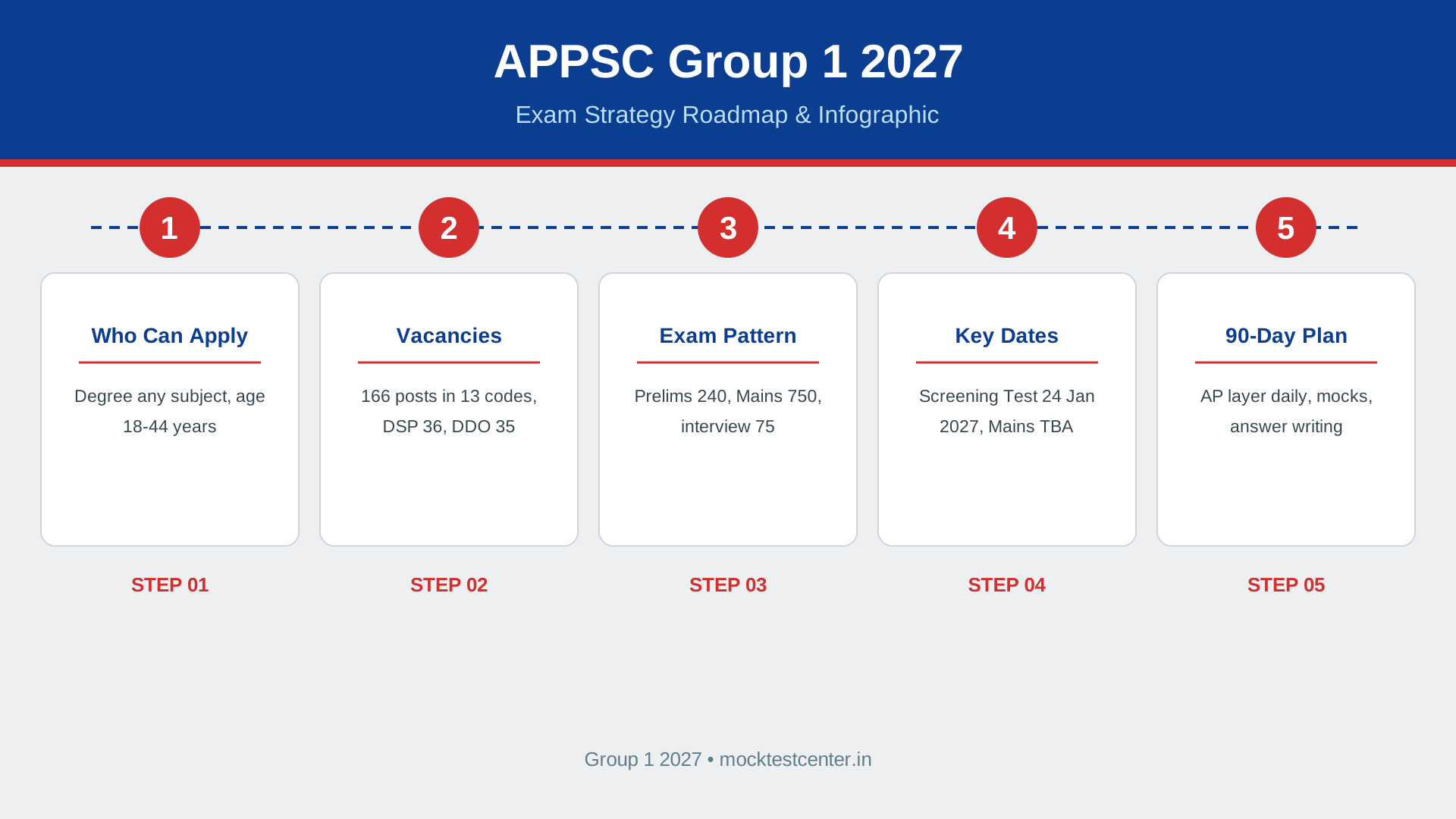
The Andhra Pradesh Public Service Commission has notified 166 Group 1 posts for the cycle that ends with the Screening Test on 24 January 2027. The Andhra Pradesh Public Service Commission issued the detailed notification, number 07/2026, on 6 October 2026, and applications closed on 9 November 2026 after one extension. APPSC Group 1 2027 is the name this guide uses for that cycle, because its Screening Test falls in January 2027 and its Mains and interview will follow in 2027. Every fact below comes from Notification 07/2026 or from the last completed cycle, Notification 12/2023, and the source of each number is named where it matters.
Group 1 is the senior-most recruitment the commission runs. It fills gazetted posts that head sub-divisions and departments: Deputy Collector, Assistant Commissioner of State Tax, Deputy Superintendent of Police, District Educational Officer and nine other post types in the current cycle.
A degree in any subject makes you eligible for most of the posts. The exam runs in three stages, Screening Test, Mains and interview, and only the Mains and the interview count in the final merit. The Screening Test only decides who reaches Mains.
APPSC Group 1 2027 and the current cycle in numbers
| Item | Detail |
|---|---|
| Conducting body | Andhra Pradesh Public Service Commission (APPSC), Vijayawada |
| Latest notification | Number 07/2026, detailed notification 6 October 2026, brief notification 15 September 2026 |
| Posts in the current cycle | 166, across 13 post codes, including 5 carried forward posts |
| Application window | 6 October 2026 to 9 November 2026, online only, extended from 27 October 2026 |
| Screening Test date | 24 January 2027, offline, OMR based, in all district centres |
| Mains | Descriptive, 7 papers, dates not announced yet |
| Interview | 75 marks, after the Mains result |
| Final merit | 825 marks, Mains 750 plus interview 75 |
| Age reckoned on | 1 July 2026 |
| Fee | Rs 370 general, Rs 250 for exempted categories |
Three numbers in that table decide how you should read the whole cycle. The first is 166, the second largest Group 1 vacancy count since 2016, behind only the 169 posts of the 27/2018 cycle, and up from 89 in the 12/2023 cycle and 90 in the 2022 cycle. The second is 24 January 2027, which falls 65 days after 20 November 2026, so the preparation window is short and the Screening Test rewards candidates who are already deep into revision.
The third is 50, the ratio at which the commission admits candidates to Mains. Fifty times 166 is 8,300 Mains seats, which means the Screening Test is a wide gate compared with the interview call, which runs at 2 candidates per vacancy, or about 332 people for 166 posts.
The vacancy count itself has a short history that explains why different websites quote different figures. G.O.Ms.No.81 of the Finance Department, dated 22 August 2026, sanctioned 149 posts. The brief notification of 15 September 2026 listed 163 provisional vacancies. The detailed notification of 6 October 2026 lists 166, because one more Deputy Collector post, one more Deputy Registrar post and one more Assistant Audit Officer post were added.
Some pages still show 163 because they copied the brief notification and never refreshed it, and a figure of 91 posts circulates on a few trackers with no document behind it. This guide uses 166, from Para 1.2 of the detailed notification, and the notification itself says the count can still change if a department sends a fresh indent before the Screening Test, with an addendum to follow.
One more point about the name. The commission calls this recruitment Notification 07/2026, and some guides call it the 2026 cycle. This package calls it APPSC Group 1 2027 because the Screening Test, the first exam in the cycle, is held on 24 January 2027, and that is the date aspirants search for. No separate 2027 notification exists, and none is expected while this cycle is still running.
What the 13 posts are
The 166 posts split across 13 post codes. Two codes hold nearly half the recruitment. Deputy Superintendent of Police (Civil) has 36 posts, including 3 carried forward, and Divisional Development Officer has 35 posts. Together they make 71 of the 166 posts, or about 43 in every 100.
Deputy Collector, the post most aspirants aim for first, has 12 posts. Assistant Commissioner of State Tax has 14, District Educational Officer has 14, Deputy Registrar has 16, and Assistant Audit Officer has 15. The rest are small cadres of 1 to 12 posts each.
| Code | Post | Vacancies | Age | Pay scale (Rs) |
|---|---|---|---|---|
| 01 | Deputy Collector, A.P. Civil Service (Executive Branch) | 12 | 18 to 44 | 61,960 to 1,51,370 |
| 02 | Assistant Commissioner of State Tax, A.P. State Tax Service | 14 | 18 to 44 | 61,960 to 1,51,370 |
| 03 | Deputy Superintendent of Police (Civil) Cat-2, A.P. Police Service | 36 (3 carried forward) | 21 to 30 | 61,960 to 1,51,370 |
| 04 | DSP (Communications), A.P. Police Service | 3 | 18 to 30 | 61,960 to 1,51,370 |
| 05 | District Educational Officer, A.P. Educational Service | 14 | 18 to 44 | 61,960 to 1,51,370 |
| 06 | Regional Transport Officer, A.P. Transport Service | 3 | 18 to 44 | 57,100 to 1,47,760 |
| 07 | District Tribal Welfare Officer, A.P. Tribal Welfare Service | 1 | 18 to 44 | 57,100 to 1,47,760 |
| 08 | Deputy Registrar, A.P. Cooperative Service | 16 (1 carried forward) | 18 to 44 | 57,100 to 1,47,760 |
| 09 | Municipal Commissioner Grade-II, A.P. Municipal Administration Service | 12 | 18 to 44 | 54,060 to 1,40,540 |
| 10 | Assistant Treasury Officer / Assistant Accounts Officer, A.P. Treasury and Accounts Service | 2 | 18 to 44 | 54,060 to 1,40,540 |
| 11 | District Employment Officer, A.P. Employment Exchange Service | 3 (1 carried forward) | 18 to 44 | 54,060 to 1,40,540 |
| 12 | Assistant Audit Officer, A.P. State Audit Service | 15 | 18 to 44 | 54,060 to 1,40,540 |
| 13 | Divisional Development Officer, A.P. Panchayat Raj Service | 35 | 18 to 44 | 65,360 to 1,54,980 |
| Total | 166 |
Read the list with the last cycle beside it, because the list changes every time. The 12/2023 cycle had 81 posts in 14 codes at notification, raised to 89 posts in 15 codes by an addendum dated 16 March 2024, one day before the Screening Test. The original list included Deputy Superintendent of Jails, Divisional or District Fire Officer, District B.C. Welfare Officer and District Social Welfare Officer, none of which appear in the 07/2026 list.
The 07/2026 list adds DSP (Communications), District Educational Officer, District Tribal Welfare Officer and Divisional Development Officer. If you prepared for Group 1 from an old book or an old video, check the post list in the current notification before you fix your target, because the posts you are studying for may not exist in this cycle and the posts that do exist may be ones you never prepared for.
Pay follows four bands in the notification. Divisional Development Officer sits alone in the top band at Rs 65,360 to Rs 1,54,980. Deputy Collector, Assistant Commissioner of State Tax, both DSP posts and District Educational Officer sit at Rs 61,960 to Rs 1,51,370. Regional Transport Officer, District Tribal Welfare Officer and Deputy Registrar sit at Rs 57,100 to Rs 1,47,760.
The remaining four posts sit at Rs 54,060 to Rs 1,40,540. These are scales of pay under the Andhra Pradesh Revised Pay Scales 2022. Dearness allowance, house rent allowance and other allowances follow state government rules and sit on top of the basic pay, so the monthly in-hand figure is higher than the bottom of the scale. The notification also says the commission can assign you to any notified post you qualify for, so the post and zone preferences you enter are indicative and not binding.
Who can apply
Eligibility rests on four things: citizenship, a degree, an age inside the limit on 1 July 2026, and the health and character conditions in the notification. You must be a citizen of India. You must hold a bachelor's degree from a recognised university in India, or an equivalent qualification, and the degree must have been held on 6 October 2026, the date of the detailed notification.
The degree subject does not matter for twelve of the thirteen posts. The exception is DSP (Communications), which needs a B.E. or B.Tech in Electronics and Communication Engineering, Electronics and Telecommunication Engineering or Radio Engineering.
The age limits changed in this cycle, and the change is the single most important eligibility fact for older aspirants. For most posts the maximum age is now 44 years, up from 42 in the 12/2023 cycle, under G.O.Ms.No.187 and G.O.Ms.No.188 of the General Administration Department, both dated 14 September 2026.
The minimum age is 18. DSP (Civil) keeps a narrower window of 21 to 30, and DSP (Communications) runs from 18 to 30. Age is counted on 1 July 2026 under Rule 12 of the A.P. State and Subordinate Service Rules.
| Category | Relaxation in upper age |
|---|---|
| SC, ST, BC and EWS | 5 years |
| Persons with Benchmark Disabilities | 10 years |
| Ex-servicemen | 3 years plus length of service in the armed forces |
| NCC instructors | 3 years plus length of service |
| Regular A.P. State Government employees, not corporation or municipal staff | Length of regular service, up to 5 years |
| Retrenched temporary employees of the State Census Department, minimum 6 months of service | 3 years |
Work the arithmetic for your own case before you assume you are out of age. A general category candidate for a non-uniform post can be 44 on 1 July 2026. An SC, ST, BC or EWS candidate in the same post can be 49. A candidate with a benchmark disability can be 54.
For ex-servicemen and NCC instructors, the age after deduction must not exceed the maximum age fixed for the post, so read Para 5 of the notification before you apply. There is no separate attempt limit published in the notification, so age is the binding limit, and each cycle takes more than a year from notification to final list.
Local status decides where your post sits, and it catches out candidates who studied outside the state. You are local to the area where you studied for at least four consecutive years up to and including the year you appeared for Class 7. If you did not study in any institution during that period, a residence certificate is accepted. If you studied up to Class 7, study certificates are compulsory.
Ninety five percent of posts in each multi-zone go to local candidates of that multi-zone, and 5 percent are open to locals and non-locals together on merit. DSP (Communications) is a state-level post, so the local rule does not apply to it in the same way. Post code 12, Assistant Audit Officer, is filled by six zones, while all other posts are filled by Multi-Zone I and Multi-Zone II. Candidates who moved to Andhra Pradesh from Telangana between 2 June 2014 and 1 June 2024 must obtain a Local Status Certificate and produce it at verification.
Certificates have dates that matter. The BC non-creamy-layer certificate and the EWS certificate must be issued by a Tahsildar on or after 1 April 2026, and not later than the closing date of applications. The EWS certificate must be digital and based on income for 2025-26, with a family income below Rs 8 lakh.
Candidates from other states get no reservation and no fee exemption, except for Persons with Benchmark Disabilities and ex-servicemen. Horizontal reservation runs across categories at 33 and one third percent for women and 3 percent for meritorious sportspersons.
On 13 October 2026 the Commission issued an addendum that rewrites the reservation clause. Open competition vacancies are filled on merit irrespective of caste, community or gender, and candidates from SC, ST, BC, EWS and Persons with Benchmark Disabilities who use the upper age relaxation are still considered for open competition vacancies. The vacancy count did not change.
The two DSP posts carry physical and vision standards, and they are strict. Men must be at least 167.6 cm tall with a chest of at least 86.3 cm and an expansion of 5 cm. ST men need 164 cm and 83.8 cm. Women need a height of at least 152.5 cm and a weight of at least 45.5 kg.
Colour blindness is not a ground for rejection for the DSP (Civil) post, though the fact is noted in the proceedings. Squint and morbid conditions of the eyes or eyelids cause rejection, and each eye must have a full field of vision. Persons with Benchmark Disabilities have no reservation in the two DSP posts. If you are aiming for DSP, measure yourself against these numbers early, because no amount of written marks cures a failed physical standard.
The fee is simple and it is the same structure as the last cycle. Every candidate pays a processing fee of Rs 250. General candidates also pay an examination fee of Rs 120, so the total is Rs 370. The examination fee is exempt for SC, ST, BC, Persons with Benchmark Disabilities and ex-servicemen, for families with an A.P. white ration card, and for unemployed youth who submit a declaration later, so those candidates pay Rs 250 in total.
Candidates from other states pay both fees, except Persons with Benchmark Disabilities and ex-servicemen. The fee is not refunded. Corrections after the last date are allowed for 7 days at Rs 100 each, but name, fee and age relaxation fields cannot be changed, and community cannot be changed later. A false declaration can lead to debarment from all APPSC exams for up to five years.
The exam in three stages
| Stage | Type | Marks | Counts in final merit |
|---|---|---|---|
| Screening Test | Objective, 2 papers, OMR | 240 | No, screening only |
| Main Examination | Descriptive, 7 papers | 1,050 | Partly, see below |
| Qualifying language papers | Descriptive, Telugu and English | 150 each | No, must pass each |
| Merit papers in Mains | Descriptive, 5 papers | 750 | Yes |
| Interview | Personality Test | 75 | Yes |
| Final merit | Mains merit plus interview | 825 | Yes |
The scheme follows G.O.Ms.No.158 dated 26 December 2018, read with G.O.Ms.No.100 dated 30 September 2022, as shown in Annexure II of the notification. Three facts in that table decide how you prepare. Screening Test marks stay out of the final merit, so a high Screening Test score earns you nothing beyond a Mains seat.
Mains merit papers carry 750 of the 825 merit marks, about 91 in every 100, so the descriptive papers decide your rank almost entirely. The interview carries 75 marks, about 9 in every 100, which looks small until you see how tightly Mains scores bunch near the cut off, where a few marks move a candidate across dozens of ranks.
The ratios between stages matter as much as the marks. The commission admits candidates to Mains at 50 times the vacancies, irrespective of community, which is 8,300 candidates for 166 posts. After Mains, candidates are called for the interview at 1 to 2, which means two candidates for each vacancy, or about 332 people.
The Mains ratio is the generous one. The interview ratio is the tight one. A candidate who scrapes into Mains still has a real chance, because Mains starts everyone at zero again, but a candidate who scrapes into the interview list faces a field where 75 marks must separate 332 people chasing 166 posts.
Minimum qualifying marks apply at each stage. The minimum qualifying aggregate is 40 percent for open competition, sportspersons and EWS, 35 percent for BC, and 30 percent for SC, ST and Persons with Benchmark Disabilities.
On the 240 mark Screening Test that means 96 marks for open competition, 84 for BC, and 72 for SC, ST and Persons with Benchmark Disabilities. There is no waiting list. If candidates tie on Mains marks, the older candidate ranks higher.
Prelims, paper by paper
The Screening Test has two objective papers. Each paper carries 120 questions of 1 mark each, runs for 120 minutes, and the two papers together total 240 marks. Both papers are degree standard.
The test is offline and OMR based, and appearing in both papers is compulsory. Absence in either paper can lead to disqualification. Use only a blue or black ball point pen. Pencil, ink pen and gel pen are not permitted, and a wrong or blank booklet series invalidates the OMR sheet. The question paper is set in English and translated into Telugu, and if the two versions differ, the English version is treated as authentic.
| Paper | Section | Questions | Marks |
|---|---|---|---|
| Paper I, General Studies | A. History and Culture | 30 | 30 |
| Paper I, General Studies | B. Constitution, Polity, Social Justice and International Relations | 30 | 30 |
| Paper I, General Studies | C. Indian and Andhra Pradesh Economy and Planning | 30 | 30 |
| Paper I, General Studies | D. Geography | 30 | 30 |
| Paper I total | 120 | 120 | |
| Paper II, General Aptitude | A. General Mental Ability, Administrative and Psychological Abilities | 60 | 60 |
| Paper II, General Aptitude | B(i). Science and Technology | 30 | 30 |
| Paper II, General Aptitude | B(ii). Current events of regional, national and international importance | 30 | 30 |
| Paper II total | 120 | 120 | |
| Both papers | 240 | 240 |
Negative marking is one third of the marks for a question, so each wrong answer costs one third of a mark. That sounds small, and it is small on a single question, but it adds up fast across a paper.
A candidate who guesses on 30 questions and gets 10 right and 20 wrong gains 10 marks and loses about 6.7 marks, which leaves a net gain of about 3.3 marks for 30 guesses. A candidate who guesses on 60 questions with can rule out at least one option, and leave a question blank when you know nothing about it, because a blank answer carries no penalty.
Paper I rewards steady reading more than cleverness. History and Culture runs from the Indus Valley Civilization through the Vedic age, Mahajanapadas, Jainism and Buddhism, Mauryas, Satavahanas, Sangam age and Guptas, then the South Indian dynasties such as the Badami and Eastern Chalukyas, Rashtrakutas, Cholas, Kakatiyas and Reddis, then the Delhi Sultanate, Vijayanagara and Mughal empires, Bhakti and Sufism, European trading companies, the Revolt of 1857, reform movements, the freedom movement, Gandhi, Patel and Bose, Dr B.R. Ambedkar and the making of the Constitution, and the reorganisation of states after Independence.
The polity section covers the evolution and features of the Constitution, the Preamble, Fundamental Rights and Duties, Directive Principles, amendments and basic structure, Union and State functions, Parliament and State Legislatures, constitutional authorities and Panchayati Raj, the impact of liberalisation on governance and regulatory bodies, rights issues, and India and its foreign policy and international institutions. The economy section covers the features of the Indian economy, NITI Aayog, human development and sustainable development, national income, poverty, unemployment and rural and urban development, agriculture, industry, energy and trade, the RBI, banking, GST, finance commissions, public debt and the budget, and the Andhra Pradesh economy after the 2014 bifurcation. Geography covers general geography, plus physical, social and economic geography of the world, India and the state.
Paper II is the paper that separates candidates who prepared for aptitude from candidates who only read theory. Sixty of its 120 questions test General Mental Ability, Administrative and Psychological Abilities: logical reasoning, number series, coding and decoding, relations, Venn diagrams, clocks, calendars and ages, ratio and proportion, averages, percentages, simple and compound interest, time and work, time and distance, mensuration, geometry, algebra, data interpretation, data sufficiency and probability, plus emotional intelligence, social intelligence, decision making and critical thinking.
Thirty questions test Science and Technology: the nature and scope of science and technology, national policy on science and innovation, ICT and e-governance, cyber security, space and defence, energy resources and policy, environmental science, biodiversity and climate change, biotechnology and nanotechnology. Thirty questions test current events of regional, national and international importance. That last block is where daily newspaper reading pays, and it is also where candidates who only study static subjects lose marks they could have picked up in fifteen minutes a day.
The commission publishes an initial key after the Screening Test. Objections must be filed within three days at Rs 100 each, and the fee is refunded if the objection is sustained. The final key cannot be challenged again. Read the initial key when it comes out, because a single sustained objection can move the cut off for hundreds of candidates, and the candidates who file careful objections are often the ones sitting just below the line.
Mains: seven papers, and the two that only qualify
Mains has seven papers of 150 marks each, and every paper runs for 180 minutes. Two of them, Telugu and English, are qualifying only. Their marks stay out of the merit total. You must still pass each of them, and failing either one ends your run even if your merit papers are strong.
The pass mark in each qualifying paper is 40 percent for open competition, sportspersons and EWS, 35 percent for BC, and 30 percent for SC, ST and Persons with Benchmark Disabilities. Both language papers are set at SSC standard, which is lower than degree standard, but that does not make them safe to ignore. A candidate who writes well in English and never practises Telugu composition can fail the Telugu paper on grammar and precis alone.
| Paper | Subject | Time | Marks | Nature |
|---|---|---|---|---|
| Telugu | SSC standard | 180 minutes | 150 | Qualifying |
| English | SSC standard | 180 minutes | 150 | Qualifying |
| Paper I | General Essay on contemporary themes of regional, national and international importance | 180 minutes | 150 | Merit |
| Paper II | History, Culture and Geography of India and Andhra Pradesh | 180 minutes | 150 | Merit |
| Paper III | Polity, Constitution, Governance, Law and Ethics | 180 minutes | 150 | Merit |
| Paper IV | Economy and Development of India and Andhra Pradesh | 180 minutes | 150 | Merit |
| Paper V | Science, Technology and Environmental Issues | 180 minutes | 150 | Merit |
Paper I, the General Essay, asks for three essays of about 800 words each, one from each of three sections covering current affairs, socio-political, socio-economic and socio-environmental issues, and cultural, historical, civic and reflective topics. Three essays of 800 words in 180 minutes leaves about 60 minutes per essay including thinking time, so the paper tests planning under pressure as much as knowledge. A candidate who writes one strong essay and two rushed ones scores less than a candidate who writes three steady essays with clear structure.
Paper II takes the Prelims history themes and goes deeper, then adds the history and culture of Andhra Pradesh from ancient to modern times, then physical, economic, social, fauna and flora, and environmental geography. Paper III covers the federal structure, local governance, the judiciary, public administration, good governance and e-governance, RTI, ethics in public service, human values, attitude and emotional intelligence, and basic knowledge of civil, criminal, labour, cyber and tax laws. Paper IV pairs every Indian economy topic with its Andhra Pradesh counterpart: challenges of the Indian economy, resource mobilisation, government budgeting, inclusive growth, agriculture, industry and infrastructure, each with the state version beside it. Paper V covers science and technology institutions, ICT, the space programme, energy and nuclear policy, environment and pollution, environmental legislation, disaster management, biotechnology, human diseases and intellectual property rights.
The qualifying papers have their own syllabus. English asks for essay, letter, press release, report writing, writing on visual information, formal speech, precis, reading comprehension, grammar and translation. Telugu asks for essay, explaining verses from Vemana and Sumathi Satakam, precis, comprehension, speech, letter, application, report writing, translation, word meanings, synonyms and antonyms. If Telugu is not your first language, start the Vemana and Sumathi Satakam verses early, because explaining a verse you have never read is hard under exam pressure.
One choice in Mains deserves thought before the exam, not during it. Papers I to V can be answered in English, Telugu or Urdu. You choose the medium online before Mains and you must write all five papers in that one medium.
Pick the language you write fastest and clearest in, not the language you think sounds more impressive. Mains will be held at four centres: Visakhapatnam, Vijayawada, Tirupati and Ananthapuramu. The commission has not yet announced the Mains dates.
The interview and the final 825
The interview, called the Oral Test or Personality Test, carries 75 marks. The final merit list is prepared out of 825 marks: 750 from the five Mains merit papers and 75 from the interview. Screening Test marks are not added.
Mains decides about 91 percent of your final score and the interview about 9 percent, which means the interview cannot rescue a weak Mains score, but it can decide the rank of two candidates whose Mains scores sit within a few marks of each other. The interview panel tests knowledge, confidence and suitability for civil service, and it draws heavily on your detailed application form, your home district, your degree subject and current affairs. A candidate who cannot explain why they chose Group 1, or what their own district is known for, gives away marks that were theirs to keep.
What the last cycle teaches you
The 12/2023 cycle is the closest thing to a rehearsal for the current one, because it ran under the same scheme and the same three stages, and it is now fully complete. Its notification, number 12/2023, came on 8 December 2023 for 81 posts in 14 codes, and an addendum dated 16 March 2024 added 8 carried forward posts, taking the cycle to 89 posts in 15 codes. Applications ran from 1 January 2024 to 21 January 2024.
The Screening Test was held on 17 March 2024. The Screening Test result came on 12 April 2024, and 4,496 candidates qualified for Mains. That is about 51 candidates for each of the 89 posts, which shows how wide the Mains gate is.
The Mains story is the part every aspirant should study. Mains was first scheduled for 2 to 9 September 2024, and it was postponed. It was eventually held from 3 to 9 May 2025, from 10 in the morning to 1 in the afternoon, in four district centres with 13 venues, for all seven papers.
The Mains result came on 10 June 2025, and 182 candidates qualified for the interview. Interviews ran from 23 to 30 June 2025 at the commission office in Vijayawada, in the New HOD's Building on M.G. Road. The final selection notification followed on 30 January 2026. From notification to final selection, the cycle took about 26 months.
Two lessons sit in those dates. The first is that Mains dates move, and a candidate who stops studying when a postponement is announced loses months that a candidate who keeps writing answers gains. The 12/2023 Mains moved by eight months, and the candidates who treated the postponement as extra preparation time, not as a holiday, were the ones who reached the interview.
The second lesson is about scale. The cycle ended with 89 posts, admitted 4,496 candidates to Mains, and called 182 to the interview, which is about 2 candidates per post, almost exactly the 1 to 2 interview ratio in the notification. The funnel is steep at the end, not at the start.
The 12/2023 post list also shows how much changes between cycles. Deputy Collector had 9 posts then and 12 now. Assistant Commissioner of State Tax had 18 then and 14 now. DSP (Civil) had 26 then and 36 now.
District Employment Officer had 4 then and 3 now. Assistant Audit Officer had 2 then and 15 now. The 12/2023 cycle had a Deputy Superintendent of Jails post and a Divisional or District Fire Officer post, and the current cycle has neither. The current cycle has a Divisional Development Officer post with 35 seats, the second largest block in the whole recruitment, and the 12/2023 cycle had no such post at all. Anyone who builds a preparation plan around a post list from an old cycle is planning for an exam that no longer exists.
One more change came late in the last cycle. An addendum dated 16 March 2024, one day before the Screening Test, added 8 carried forward posts: 1 more Fire Officer, 1 more Deputy Registrar, 2 more Municipal Commissioners, and 4 Mandal Parishad Development Officers, a post the original list never had. The cycle total rose from 81 to 89 posts, and the post count rose from 14 codes to 15.
Cut off marks need an honest paragraph, because this is where tracker pages mislead most often. The commission publishes qualifying marks and the Screening Test result carries the cut off for the cycle, but no official cut off figure for the 2024 Screening Test was retrieved during the preparation of this guide, so no cut off number for that cycle is stated here.
Some tracker pages quote a Prelims cut off of 90.42 out of 240 for the general category and a Mains cut off of 330 out of 825, but those figures come from an older cycle, not from the 12/2023 cycle, and presenting them as the last cycle cut off would be wrong. The only official thresholds you can plan on are the minimum qualifying marks: 40 percent for open competition, 35 percent for BC, and 30 percent for SC, ST and Persons with Benchmark Disabilities. Aim well above those marks, because the real cut off sits far above the minimum when thousands of candidates chase a few hundred Mains seats.
The Andhra Pradesh layer is where ranks are made
Andhra Pradesh appears in almost every merit paper, so treat it as its own subject rather than as a garnish on the national syllabus. In history and culture, the notification names the Satavahanas, Ikshvakus, Salankayanas, Pallavas, Vishnukundins, Eastern Chalukyas, Renati Cholas, Kakatiyas, Reddis, Gajapatis, Vijayanagara rulers and Qutb Shahis, plus Telugu language, literature and art, European trade in Andhra and Company rule, social reformers such as Gurajada Apparao and Kandukuri Veeresalingam, the Andhra movement, Alluri Sitarama Raju and Potti Sreeramulu, the formation of Andhra State in 1953 and Andhra Pradesh in 1956, and the bifurcation of 2014 and its impact. That is a long list, and it is the list the paper is set from.
In geography, the notification asks for the physical features, rivers, soils, minerals, forests, population, agriculture, industry, natural hazards and environmental issues of Andhra Pradesh.
In economy, it asks for the AP economy after bifurcation, the A.P. Reorganisation Act 2014, central assistance, special status and special assistance, the Visakhapatnam railway zone, the Kadapa steel factory, the Dugarajapatnam airport, expressways and industrial corridors, the State budget, and the current schemes for inclusive growth. The Mains economy paper asks for all current Andhra Pradesh government schemes for inclusive growth and financial inclusion, plus agriculture schemes, so keep a schemes notebook and update it from the latest State budget and the Andhra Pradesh Economic Survey. Amaravati gets no direct mention in the syllabus text. The syllabus covers the loss of the capital city, the building of a new capital and its financial implications, and central assistance for a new capital, so prepare Amaravati under those headings.
Most candidates prepare the national syllabus well and the state syllabus thinly, because national books are easy to find and state material is scattered. That is exactly why the state layer decides ranks. Two candidates with equal national knowledge can sit 20 marks apart on the Andhra Pradesh questions alone, and 20 marks in Mains is often the difference between a post and a place on no list at all. Read the Andhra Pradesh Economic Survey, the State budget speech, and the state government scheme pages on the official portal, and keep notes district by district, because the paper asks about districts, not just about the state as a whole.
A 90 day plan that ends on 24 January 2027
The Screening Test is on 24 January 2027, which is 65 days after 20 November 2026. This plan uses those 65 days to win the Screening Test, then uses the remaining 25 days of the 90 to start Mains answer writing, because Mains dates are not announced yet and the candidates who start writing early carry an advantage that no amount of last minute reading can match.
| Phase | Dates | Focus | Target |
|---|---|---|---|
| 1. Foundation | 20 November to 10 December, 21 days | Read the Annexure II syllabus line by line. Cover History and Culture of India and Andhra Pradesh, and Polity. Start a daily current affairs notebook and a schemes notebook. | First reading of history and polity done |
| 2. Core subjects | 11 December to 31 December, 21 days | Economy of India and Andhra Pradesh, Geography, Science and Technology. Practise 30 minutes of aptitude every day. Revise Phase 1 notes twice. | First reading of every Paper I and Paper II topic done |
| 3. Test phase | 1 January to 24 January, 24 days | Full-length mocks for both papers, one every three to four days. Keep an error log. Practise negative marking discipline and OMR filling under time. | Stable accuracy on both papers, no unforced errors |
| 4. Mains transition | 25 January to 18 February, 25 days | Start answer writing. Practise the three-essay format of about 800 words each. Study the Mains papers on history, polity and economy in depth. | Two written answers a day, one timed paper a week |
Phase 1 is reading, and it should be slow. Read each syllabus line, then read the material for that line, then write a one page note in your own words. A candidate who reads without writing notes has nothing to revise in January, and January revision is what the test phase runs on. Give Andhra Pradesh topics equal time with national topics from the first day, because the state layer is half the paper in practice even though it looks like a small part of the syllabus.
Phase 2 is where most candidates fall behind, because economy and geography feel heavier than history and polity. Keep the same method: read, write notes, revise the Phase 1 notes twice before the month ends. Aptitude needs 30 minutes every day, not a weekend binge, because speed in mental ability comes from daily practice and fades fast when you stop. Science and Technology needs a different habit: read the science pages of a newspaper every day and file each item under the syllabus heading it belongs to, so that revision is a matter of reading your own file.
Phase 3 is mocks, and mocks only work if you treat them like the real exam. Sit for the full two papers in one sitting, fill an OMR sheet, keep the 120 minute limit, and score yourself with the one third negative marking rule. Keep an error log with four columns: the question, your answer, the right answer, and the reason you got it wrong.
Most candidates find that the same three or four reasons explain most of their errors: a rushed reading of the question, a guess on a question they knew nothing about, a confusion between two similar facts, or a blank left on a question they actually knew. Fix the reasons, not just the questions. In the last week, stop learning new material and revise your notes, your error log and the current affairs of the last six months.
Phase 4 starts the day after the Screening Test, whether the result is out or not. Write two answers a day, and sit for one full timed paper each week. Practise the three-essay format of about 800 words each, because 800 words in about 60 minutes is a pace you have to train, not a pace you discover on exam day.
Practise the Telugu and English qualifying papers too, because a failed qualifying paper ends a run that the merit papers earned. If the Mains dates are announced during this phase, shift the plan to the announced schedule and keep the daily writing habit.
Books that cover the syllabus without wasting your time
Buy fewer books and finish them twice, rather than buying more books and finishing none of them once. For polity, M. Laxmikanth on Indian Polity covers almost the whole Paper I polity section and most of the Mains polity paper, and the NCERT Class 11 book on the Constitution at work fills the gaps.
For modern history, Spectrum by Rajiv Ahir is the standard book, and the NCERT Class 12 book on politics in India since Independence covers the post-1947 part that Spectrum treats briefly. For economy, Ramesh Singh on the Indian Economy covers the national syllabus, and the Andhra Pradesh Economic Survey and the State budget cover the state half, which no national book covers. For geography, G.C. Leong on physical geography and the NCERT Class 11 and 12 geography books cover the physical and human parts, and a good atlas is worth more than a third geography book.
For Andhra Pradesh history and culture, use Telugu Academy books and the state board history texts, because they carry the dynasties, the reformers and the Andhra movement in the detail the notification asks for.
For current affairs, read one national newspaper every day and one monthly current affairs compilation for revision, and keep your own notes rather than collecting other people's notes, because your notes match your memory and theirs do not. For Paper II aptitude, R.S. Aggarwal on quantitative aptitude and a standard reasoning book cover the arithmetic and logic, and the administrative and psychological abilities part needs practice in decision making and emotional intelligence questions from previous papers rather than from theory. For the English qualifying paper, Wren and Martin on grammar and regular precis practice are enough. For the Telugu qualifying paper, a Telugu grammar book and the verses of Vemana and Sumathi Satakam are the core material.
Previous papers are the most useful book of all, and they cost nothing. The scheme in this notification follows G.O.Ms.No.158 of 2018, read with G.O.Ms.No.100 of 2022, so previous Group 1 Screening Test and Mains papers remain a useful guide to question style and difficulty. Solve papers from earlier cycles after you finish the first reading, not before, because a previous paper taken too early only tells you what you do not know, while the same paper taken after the first reading tells you how the commission asks what you know.
Mistakes that cost candidates a year
The first mistake is treating the Screening Test as if its marks count. They do not. A candidate who spends the last week polishing Screening Test scores instead of resting and revising has spent the week on marks that vanish on the day of the result.
The second mistake is ignoring the Telugu qualifying paper. It is set at SSC standard, so it looks easy, and it ends the run of candidates who never practised it.
The third mistake is guessing blindly. One third negative marking looks gentle, and across 240 questions it is not. Leave a question blank when you know nothing about it.
The fourth mistake is preparing the national syllabus and skipping the Andhra Pradesh layer. The state questions are the ones most candidates get wrong, so they are the ones that decide ranks. The fifth mistake is starting Mains writing only after the Screening Test result. The result comes months after the exam, and the candidates who wrote answers in that gap are months ahead.
The sixth mistake is choosing the wrong Mains medium. Pick the language you write fastest and clearest in, and write all five papers in that one medium. The seventh mistake is paperwork: a BC or EWS certificate issued before 1 April 2026, a missing Local Status Certificate, or a wrong local status entry can cost a candidate a post after the interview, when nothing can be fixed. Check every certificate against the notification before you apply, not after the result.
The eighth mistake is OMR carelessness. A wrong booklet series, a pencil mark, or a half-filled circle can invalidate a paper that the candidate otherwise passed.
Fill the OMR sheet in the mock tests exactly as you will fill it on 24 January 2027, with a blue or black ball point pen, and check the series before you start. The ninth mistake is believing a cut off number from a tracker page. No official cut off for the 2024 Screening Test was retrieved for this guide, and the figures quoted on some pages come from an older cycle. Plan on scoring well above the minimum qualifying marks and let the cut off take care of itself.
How to apply, step by step
Applications for the current cycle closed on 9 November 2026, so the steps below describe the process that ran for Notification 07/2026 and that the next cycle will follow in the same shape.
First, create your One Time Profile Registration, called OTPR, on the commission website. OTPR alone is not an application. Fill it carefully, because the OTPR data on the day you apply is the data used for the notification.
Second, log in with your OTPR ID, click Online Application Submission, and click Fill Application against the Group 1 notification. Third, check the pre-filled data and fill the application-specific details such as local or non-local status and white ration card details, which decide your fee.
Fourth, fill the rest: qualification details, post preferences and exam centres. Choose three Screening Test centres from the 26 district centres and one Mains centre from Visakhapatnam, Vijayawada, Tirupati and Ananthapuramu. Upload your own photo and signature in JPG format.
Fifth, click Save and Submit and pay by net banking, credit card or debit card. Clicking only Save does not submit the form. The fee is not refunded.
Sixth, download the filled form and keep the payment reference.
Keep your degree, community, BC non-creamy-layer or EWS certificate, Class 1 to 7 study certificates and any disability or local status certificate ready for verification, because the commission checks them after the written stages and a missing certificate at that stage cannot be created in a day. Hall tickets for the Screening Test will be hosted on the commission website, and the date for downloading them had not been announced as of 20 November 2026. Check the commission website for the hall ticket notice and for any addendum to the vacancy count, because the notification allows added vacancies before the Screening Test date.
APPSC Group 1 aspirants often prepare for other state and national exams alongside this one. The UPPSC PCS 2027, UPPSC RO ARO 2027, UPPSC PCS J 2027, RBI Grade B 2027, NABARD Grade A 2027, UGC NET Paper 1 2027, UGC NET Economics 2027, SBI PO 2027, IBPS PO 2027 and SSC GD 2027 pages on this site carry the same style of mock test guide, and the pattern habit you build here transfers directly to them.
Sources
Andhra Pradesh Public Service Commission Notification No. 07/2026 dated 6 October 2026, read in full from the official PDF on psc.ap.gov.in on 20 November 2026, for the 166 vacancies in 13 post codes, the post-wise split, the age limits, the fee of Rs 250 plus the examination fee, the Screening Test date of 24 January 2027, the application window of 6 October to 27 October 2026, the Prelims and Mains pattern, the qualifying marks, the 1 to 50 Mains ratio and the 1 to 2 interview ratio, the local status rules, the DSP physical standards, the pay scales and the syllabus in Annexure II. The brief notification of 15 September 2026, the deadline extension to 9 November 2026, and the vacancy history from 149 sanctioned to 163 provisional to 166 detailed come from Sreedhar's CCE, verified on 30 October 2026 against the detailed notification and the deadline extension, and corroborated by the Testbook, JobCareerUpdates, Bloom APPSC, ExamDetail, Dishalu, APTeacher, BeInSarkari, CareerPower and GovJobDesk pages on the same notification. The 13 October 2026 addendum on the reservation clause is reported by TestKart alone and is flagged as single-sourced in the package notes.
Andhra Pradesh Public Service Commission Notification No. 12/2023 dated 8 December 2023, for the 81 posts in 14 codes, the application window of 1 January to 21 January 2024, and the Screening Test date of 17 March 2024, as reproduced in the Scribd copy of the notification and quoted by Adda247. The addendum to Notification 12/2023 dated 16 March 2024, read in full from the official PDF on psc.ap.gov.in on 20 November 2026, for the 8 added carried forward posts, the new Mandal Parishad Development Officer post code, and the revised total of 89 posts in 15 codes.
The Telegraph India, Jagran Josh, Moneycontrol, Times of India, NDTV and Edex Live reports of 10 and 11 June 2025, for the Mains examination held from 3 to 9 May 2025, the Mains result of 10 June 2025, the 182 candidates shortlisted, and the interviews from 23 to 30 June 2025 at the commission office in Vijayawada. StudyIQ, Adda247 and CareerPower on the Prelims result of April 2024, for the 4,496 candidates qualified for Mains and the minimum qualifying marks of 40 percent for open competition, 35 percent for BC, and 30 percent for SC, ST and Persons with Benchmark Disabilities. Testbook on the cut off page, for the previous year cut off figures of 90.42 out of 240 for Prelims and 330 out of 825 for Mains, which belong to an older cycle and are not used as 2024 cycle figures anywhere in this guide. GovtJobGuru and AsomLive on the 12/2023 cycle, for the post-wise age limits and pay scales of that cycle and the fee of Rs 370 for general candidates and Rs 250 for exempted categories.