
About ICAR AO 2027 Exam Series
📖 Table of Contents
- The exam in one page
- Who runs this exam and where an AO works
- Tier I: the qualifying gate
- What each Tier I section tests
- Tier II: four descriptive papers decide your rank
- Tier III: the structured interview
- Eligibility, age limit and fee
- Vacancy history and cut offs
- Salary, allowances and the job after selection
- The ICAR AO 2027 90 day plan
- Mistakes that cost marks in ICAR AO
- How to use mock tests for a three tier exam
- Before you apply, check these things on the ASRB site
- Where AO preparation overlaps other exams
- Sources
ICAR AO 2027: Administrative Officer Exam Guide
The Agricultural Scientists Recruitment Board, ASRB, runs the ICAR Administrative Officer exam, and the latest real cycle is the 2021 notification. That notification, Advt No. 2(2)/2021-Exam.II, offered 44 Administrative Officer posts and 21 Finance and Accounts Officer posts, 65 in total. Applications ran from 23 July to 23 August 2021, the Tier I computer test was held on 10 May 2022, and ASRB announced the result and cut off marks on 7 May 2024.
No new AO notification had been issued as of 19 November 2026. The ASRB notification of 11 November 2026 that many job sites are reporting is a different recruitment, for 1,393 Technical Assistant and Senior Technical Assistant posts, and it has nothing to do with the AO post. This guide uses the 2021 cycle as the working pattern and says plainly where the next cycle is still awaited.
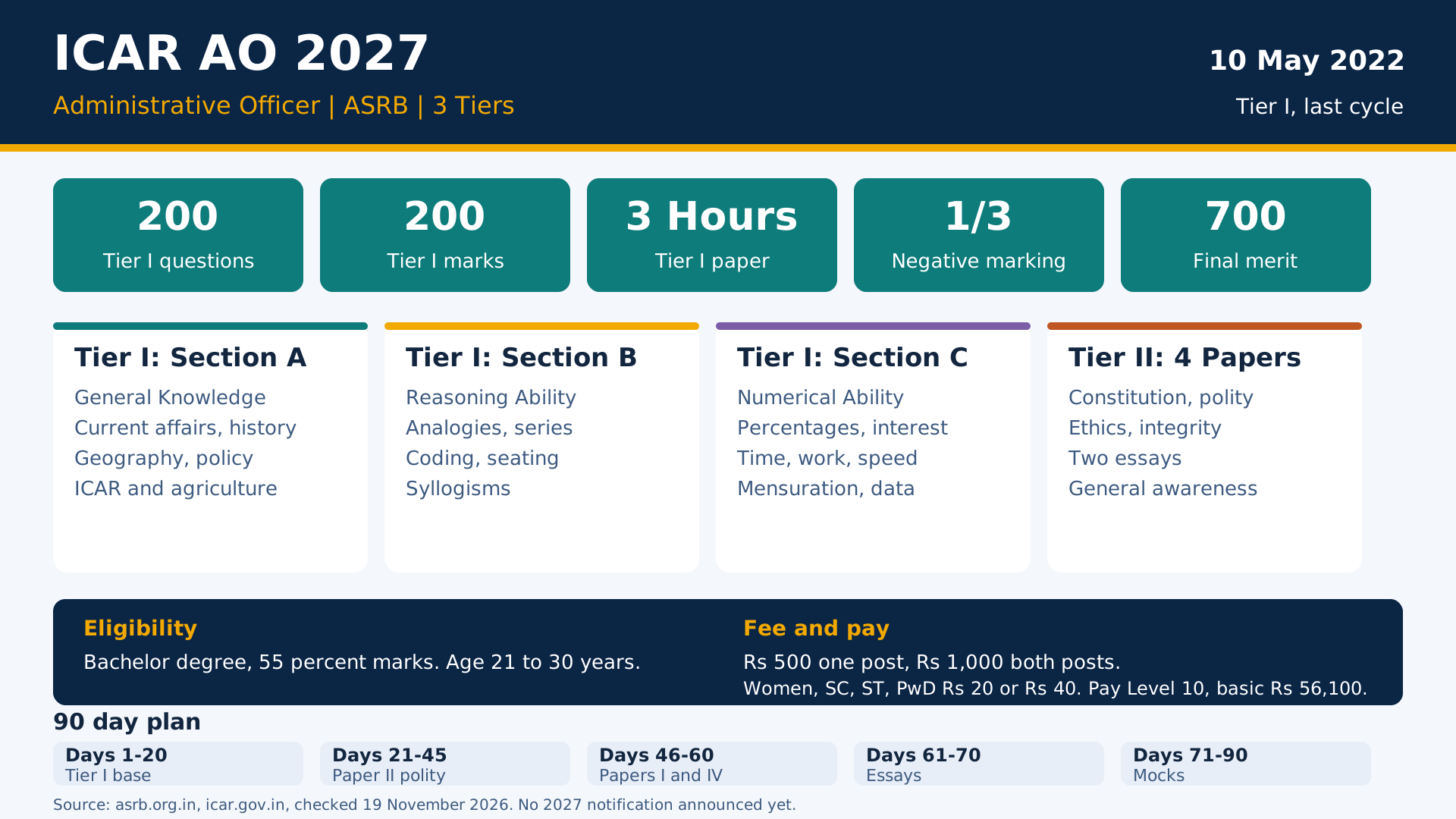
The exam has three tiers. Tier I is an objective paper of 200 questions for 200 marks, held over 3 hours, and it only qualifies you for the next stage. Tier II is a descriptive written exam of four papers for 600 marks. Tier III is a structured interview for 100 marks. Your final rank comes from Tier II and the interview together, 700 marks in all. Tier I marks do not count in the final merit, so the first paper is a gate and the real fight starts in Tier II.
That shape makes this exam unlike most officer exams. A candidate who only practises objective questions will clear the gate and then hit a wall, because four descriptive papers of 150 marks each decide the rank. You need to write long answers on the Constitution, on ethics, on economic and social development, and you need to write two essays. This guide covers every tier in that order, then eligibility, fees, cut offs, salary and a 90 day plan that gives writing practice from the first week.
Every date and number here comes from the ASRB notification as reported by trackers, or from the result and cut off lists ASRB published. The sources sit at the end of the page. Check the ASRB official website before you pay any fee, because ASRB can change a date, a fee or a vacancy count between cycles.
The exam in one page
| Item | Detail |
|---|---|
| Post | Administrative Officer, ICAR institutes |
| Conducting body | Agricultural Scientists Recruitment Board, ASRB |
| Latest notification | Advt No. 2(2)/2021-Exam.II, 23 July 2021 |
| Vacancies in latest cycle | 44 AO posts, plus 21 Finance and Accounts Officer posts |
| Tier I | 200 objective questions, 200 marks, 3 hours, qualifying only |
| Tier I negative marking | One third of a mark deducted for each wrong answer |
| Tier II | 4 descriptive papers, 150 marks each, 600 marks, 3 hours per paper |
| Tier III | Structured interview, 100 marks |
| Final merit | Tier II 600 plus interview 100, total 700 marks |
| Age limit | 21 to 30 years on the closing date |
| Qualification | Bachelor degree in any stream with at least 55 percent marks |
| Pay | Pay Level 10, basic pay Rs 56,100 per month plus allowances |
| Next cycle | 2027 notification not announced as of 19 November 2026 |
Who runs this exam and where an AO works
ICAR, the Indian Council of Agricultural Research, is an autonomous body under the Department of Agricultural Research and Education, and it coordinates agricultural research and education across India. It was set up on 16 July 1929 as the Imperial Council of Agricultural Research, and its headquarters is in New Delhi.
It runs one of the largest agricultural research systems in the world, with 111 ICAR institutes and 71 agricultural universities in its network. ASRB is the board that recruits scientists, technical staff and administrative officers for this system, and the AO exam is its recruitment for the administrative side.
An Administrative Officer is the officer who keeps an ICAR institute running. The work covers establishment matters, recruitment files, service records, purchase and stores, budget and accounts coordination, and correspondence with the ICAR headquarters. A scientist runs the research. The AO runs the office that lets the research happen. That is why the exam tests general knowledge, reasoning, numbers, language, the Constitution, ethics and essay writing, rather than agriculture. You do not need an agriculture degree for this post. Any graduate with 55 percent marks can apply.
Posting is at ICAR institutes across India, and the institute you join decides your daily work. A large institute such as the Indian Agricultural Research Institute in New Delhi has a big administrative wing with sections for establishment, accounts, stores and security. A smaller institute has a leaner office where one AO handles several sections. Transfers between institutes happen under ICAR rules, so an AO should expect to move during a career. The post carries Pay Level 10, which is the same level as many Group A entry posts in the central government, and the basic pay starts at Rs 56,100 per month plus dearness allowance, house rent allowance and other allowances as per rules.
One point of confusion needs clearing up early. ICAR AO is not the same as ICAR AIEEA, and it is not the same as the ASRB NET or ARS exams. AIEEA is an entrance exam for admission to postgraduate agriculture courses, run by the National Testing Agency. NET and ARS recruit lecturers and scientists, and they need a masters degree in agriculture. The AO exam recruits administrators, and it needs only a bachelor degree. Candidates who mix these up prepare for the wrong syllabus, so keep the three apart.
Tier I: the qualifying gate
Tier I is a single objective paper of 200 multiple choice questions, one mark each, with 3 hours on the clock. The paper has four sections of 50 questions each. Section A is General Knowledge. Section B is General Intelligence and Reasoning Ability. Section C is Arithmetical and Numerical Ability. Section D is Language Comprehension, in Hindi or English, as the candidate picks. The paper is set in English and Hindi, except for the language section, which tests the language you choose.
| Section | Subject | Questions | Marks |
|---|---|---|---|
| A | General Knowledge | 50 | 50 |
| B | General Intelligence and Reasoning Ability | 50 | 50 |
| C | Arithmetical and Numerical Ability | 50 | 50 |
| D | Language Comprehension, Hindi or English | 50 | 50 |
| Total | 200 | 200 |
Every wrong answer costs one third of a mark. A blank answer costs nothing. The paper is qualifying in nature, so the marks do not carry into the final merit list. ASRB fixes minimum qualifying marks, and then calls twenty candidates per vacancy for Tier II from each category, in order of Tier I score. With 44 AO vacancies, that meant roughly 880 candidates per category list reached Tier II in the last cycle, though the exact call depends on the category wise vacancy count and on how many candidates clear the qualifying marks.
The penalty shapes how you should attempt the paper. A blind guess on a four option question has an expected value of zero, because you gain one mark one time in four and lose one third of a mark three times in four. The maths is simple: 0.25 minus 0.75 times 0.33 equals zero. If you can rule out one option, the guess turns positive, and if you can rule out two options it turns clearly positive, with an expected gain of about one third of a mark per attempt. So the rule for Tier I is plain. Attempt a question when you can rule out at least one option with confidence. Leave it blank when all four options look equally likely. That discipline matters more here than in exams with a quarter mark penalty, because one third is a heavier cut.
Speed matters too. Three hours for 200 questions gives 54 seconds per question on average. The reasoning and numbers sections eat time, so the candidates who finish are the ones who bank the easy marks first. General knowledge and language comprehension usually take less time per question than reasoning puzzles and long arithmetic. A practical order is to clear the language section and the general knowledge questions you know, then work through reasoning, then numbers, and keep the last 15 minutes for review and for the questions you marked for a second look. Do not spend four minutes on one reasoning puzzle while ten easy questions wait.
What each Tier I section tests
General Knowledge covers current events in India and the world, history, geography, economic science, general policy and scientific research. For this exam, current affairs linked to agriculture, rural development, government schemes and ICAR itself carry extra weight, because the paper is set by a board that works in agriculture. Learn the structure and functioning of ICAR, the names of major ICAR institutes, the Department of Agricultural Research and Education, and the big central schemes for farmers. That slice of general knowledge is the one part of Tier I where an AO candidate can outscore a generalist.
General Intelligence and Reasoning Ability covers verbal and non verbal reasoning of the standard officer exam kind: analogies, series, coding and decoding, blood relations, direction sense, ranking, seating, syllogisms, statement and conclusion, and non verbal patterns. The questions are of graduation level, not of specialist puzzle level, so steady practice with a question bank beats clever tricks. The section rewards accuracy under time pressure, and it is the section where a careless candidate loses the most marks to the one third penalty.
Arithmetical and Numerical Ability covers number systems, percentages, profit and loss, simple and compound interest, ratio and proportion, time and work, time speed and distance, averages, mensuration and data interpretation. The level is class 10 to graduation, and the questions test calculation speed more than deep maths. Keep a formula sheet and revise it every week, because a forgotten formula in this section costs the same as a forgotten fact in general knowledge.
Language Comprehension tests reading comprehension, vocabulary, grammar and usage in Hindi or English, whichever you pick at the time of application. Pick the language you actually read fast in, not the one you think looks better on a form. A candidate who reads English newspapers daily should pick English. A candidate who reads Hindi comfortably should pick Hindi. The section is worth 50 marks, a quarter of the paper, so a weak language choice can cost the Tier II call.
Tier II: four descriptive papers decide your rank
Tier II is where this exam is won or lost. Four descriptive papers, each of 150 marks and 3 hours, add up to 600 marks, and these marks count in the final merit along with the interview. There are no objective questions here. You write answers in your own words, and an examiner reads them. That changes everything about preparation, because knowing a fact and writing a clear 250 word answer about it are two different skills.
| Paper | Subject | Marks | Duration |
|---|---|---|---|
| I | General Awareness of Development of Economic, Social, Scientific and Cultural Fields, History and Geography of India and the World | 150 | 3 hours |
| II | Constitution of India, Polity, Governance, Social Justice | 150 | 3 hours |
| III | Essay Writing I, 75 marks, and Essay Writing II, 75 marks | 150 | 3 hours |
| IV | Ethics, Integrity, Aptitude | 150 | 3 hours |
| Total | 600 | 12 hours |
Paper I tests whether you understand how India and the world have changed, in economics, society, science and culture, and whether you know the history and geography behind that change. The questions are broad and analytical, not one line facts. A question may ask how the Green Revolution changed Indian agriculture and rural society, or how a new technology changes jobs in a sector. The answer needs facts, a clear structure and a view of your own. Reading a good newspaper daily and keeping short notes on big developments is the only honest preparation for this paper, and the notes should be in your own words from the start, because copying a newspaper line will not help you write under exam pressure.
Paper II tests the Constitution, polity, governance and social justice. This is the most syllabus bound paper of the four, and it rewards systematic study. Learn the Preamble, fundamental rights, directive principles, the structure of Parliament and state legislatures, the judiciary, centre state relations, constitutional bodies, and the major amendments. Then learn how governance actually works: ministries, regulatory bodies, welfare schemes, and the issues of social justice that schemes try to fix. A candidate who has prepared for the UPSC Civil Services mains will find this paper familiar, and a candidate who has not should still study it like a mains paper, with answer writing every week.
Paper III is two essays of 75 marks each. Essay writing tests thought, structure and language in one go. A good essay opens with a clear line, builds an argument in three or four paragraphs, uses facts and examples that fit, and closes with a line that follows from the argument. The topics usually touch economic, social, scientific or cultural development, so the reading you do for Paper I feeds Paper III directly. Practise one essay a week from the first month, in the full time limit, and get it read by someone who will mark it hard. An essay that nobody reads is practice only in typing.
Paper IV tests ethics, integrity and aptitude. It covers the values a public servant needs, the difference between rules and right action, and case studies where you must decide what to do. The paper follows the UPSC ethics paper in spirit, so the standard approach works: learn the basic concepts, probity in governance, codes of conduct, work culture, and then practise case studies with a clear method. State the facts, list the people affected, name the values at stake, and then give a decision with reasons. A case study answer that only lists values without deciding anything scores poorly.
The Finance and Accounts Officer paper differs slightly from the AO paper in Tier II, because the F and AO post needs accounts knowledge. If you apply for both posts, check the F and AO Tier II papers separately on the ASRB site. The fee for both posts together is Rs 1,000 for general, OBC and EWS candidates, against Rs 500 for one post, so many candidates apply for both. The Tier I paper is common to both posts.
Tier III: the structured interview
ASRB calls candidates for the interview in the ratio of five per vacancy, category wise, on the basis of Tier II merit. The interview carries 100 marks, and the board awards marks out of 100. The final merit is the sum of Tier II, out of 600, and the interview, out of 100, which is 700 marks in all. Tier I plays no part in this total.
The interview is structured, which means the board follows a set pattern rather than chatting at random. Expect questions on your education, your reasons for choosing ICAR, your understanding of the AO role, current affairs, and situational questions about office work. A candidate may be asked how to handle a delayed file, a dispute between sections, or a request that bends a rule. The board is testing judgement, communication and steadiness, not memory. Short, direct answers beat long, wandering ones. Say what you know, say plainly what you do not know, and do not bluff, because the board can tell.
Prepare for the interview by knowing ICAR properly. Learn what ICAR does, the names of a few major institutes, the role of the Department of Agricultural Research and Education, and one or two current issues in Indian agriculture, such as water use, crop diversification or farm incomes. Also know your own degree subject well enough to answer basic questions on it. The board often starts there, and a confident start sets the tone for the rest of the interview.
Eligibility, age limit and fee
The eligibility rules for the AO post are simple, and that is part of why the exam draws a large crowd. You need a bachelor degree from a recognised university with at least 55 percent marks in the final degree examination, or an equivalent qualification. The degree can be in any stream. There is no requirement of an agriculture degree, and no work experience is needed. The age limit is 21 to 30 years on the closing date of the application, with relaxation for reserved categories as per government rules.
| Item | Detail, 2021 cycle |
|---|---|
| Qualification | Bachelor degree in any stream, at least 55 percent marks |
| Age limit | 21 to 30 years on the closing date, 23 August 2021 in the last cycle |
| Fee, one post, UR OBC EWS | Rs 500, including Rs 20 registration fee |
| Fee, one post, women SC ST PwD | Rs 20, registration fee only |
| Fee, both AO and F and AO, UR OBC EWS | Rs 1,000 |
| Fee, both posts, women SC ST PwD | Rs 40 |
| Mode | Online application and online fee payment only |
The 55 percent rule catches out more candidates than any other rule. A graduate with 54 percent cannot apply, however strong the rest of the profile is. Check your final degree marksheet before you plan anything. Also note that the age is counted on the closing date of the application, not on the exam date. In the last cycle the closing date was 23 August 2021, so a candidate had to be between 21 and 30 on that date. The next notification will fix its own closing date, and the age will be counted on that date.
Vacancy history and cut offs
The AO exam is not held every year. The last notification came in July 2021, and the process ran for nearly three years, from application in August 2021 to the result and cut off announcement on 7 May 2024. That long gap is normal for this exam, and it is the single most important fact for planning. A candidate who waits for the notification and then starts preparing will be months behind a candidate who started early. The pattern, the syllabus and the papers are stable, so preparation done now will still be valid when the next notification appears.
| Stage, 2021 cycle | Date |
|---|---|
| Notification, Advt No. 2(2)/2021-Exam.II | 23 July 2021 |
| Online application window | 23 July to 23 August 2021 |
| Tier I exam, first scheduled | 3 October 2021, postponed |
| Tier I exam, actually held | 10 May 2022 |
| Result and cut off marks announced | 7 May 2024 |
The vacancy split in the 2021 cycle was 44 AO posts and 21 Finance and Accounts Officer posts. The AO split by category was 17 unreserved, 14 OBC, 4 EWS, 7 SC and 2 ST. The F and AO split was 13 unreserved, 4 OBC, 2 EWS, 2 SC and no ST post. These are the only vacancy figures in this guide, because they are the only ones verified from the notification. No vacancy figure for a future cycle exists, and any site that quotes a 2027 vacancy number before ASRB publishes it is guessing.
ASRB published cut off marks with the result on 7 May 2024. The figures below are the cut offs for the interview call and for final selection, as reported by trackers from the ASRB result lists. They are scored out of 600 for the interview call and out of 700 for final selection. Treat them as the real benchmark for the last cycle, and note that the next cycle will set its own cut offs based on its own paper and its own vacancies.
| Category | Cut off for interview call, out of 600 | Final selection cut off, out of 700 |
|---|---|---|
| Unreserved | 351 | 434.5 |
| OBC | 344 | 417.75 |
| SC | 309 | 394.375 |
| ST | 310 | 384.5 |
Read the table with care. The interview cut off of 351 out of 600 for unreserved candidates is about 58 percent of the Tier II marks, and the final cut off of 434.5 out of 700 is about 62 percent. That tells you the standard. A candidate needs roughly six out of ten marks in the descriptive papers to reach the interview, and then needs a strong interview to convert the call into a selection. The gap between the interview cut off and the final cut off is about 83 marks for unreserved candidates, which is the interview score plus the margin above the Tier II cut off that the last selected candidate carried. In plain terms, a bare pass in Tier II is not enough. You need a clear margin above the Tier II cut off before the interview, or a very strong interview, to make the final list.
One gap in the record should be stated plainly. The sources retrieved for this guide do not give a separate published Tier I cut off, only the rule that ASRB fixes minimum qualifying marks and calls twenty candidates per vacancy for Tier II. That is consistent with Tier I being a qualifying screen rather than a ranked stage. Do not trust a site that quotes a precise Tier I cut off for this cycle without showing the ASRB list it came from.
Salary, allowances and the job after selection
The AO post carries Pay Level 10 of the 7th Central Pay Commission pay matrix, with basic pay starting at Rs 56,100 per month. The pre revised scale was Rs 15,600 to Rs 39,100 with grade pay of Rs 5,400. On top of basic pay, an AO gets dearness allowance, house rent allowance and transport allowance as per central government rules, and the allowances depend on the city of posting. A posting in New Delhi pays more house rent allowance than a posting in a small town, so two AOs in the same level can take home different amounts. The post also carries the usual central government benefits, including medical facilities, leave, pension under the National Pension System, and LTC as per rules.
The career path runs through the administrative hierarchy of ICAR. An AO gains experience in establishment, accounts, purchase and stores, and over time moves to senior administrative roles at institutes and at the ICAR headquarters. The exact promotion rules sit in the ICAR administrative posts recruitment rules, which ICAR amended in April 2026 for Group B administrative posts, and the rules for the AO grade itself are notified by ICAR from time to time. A new AO should read the recruitment rules for the post on the ICAR official website once selected, because promotion depends on service, vacancies and the rules in force at that time.
The work is office work, and it suits a candidate who likes files, rules and order. An AO drafts notes, puts up files for approval, handles recruitment and service matters, coordinates with sections, and answers audit queries. The work is steady rather than dramatic, and the satisfaction comes from an institute that runs smoothly. A candidate who wants field work or laboratory work should look at the ASRB technical and scientific posts instead, because the AO post is firmly administrative.
The ICAR AO 2027 90 day plan
Ninety days is enough to build a serious base for this exam if you study every day and write from the first week. The plan below assumes three to four hours a day, which adds up to about 300 hours. If you have more time, add mock tests and answer writing rather than more reading. Reading without writing is the most common waste of time in this exam, because Tier II is entirely written.
Days 1 to 20 cover Tier I basics and the start of Tier II writing. Learn the Tier I syllabus section by section, and practise 50 objective questions a day across the four sections. In the same weeks, start a daily newspaper habit and write one short answer a day on a current topic, about 150 words, in your own words. Also start Paper II by reading the Constitution chapter by chapter. The aim of this phase is to build the daily habit of writing, not to finish any book.
Days 21 to 45 cover Tier I in depth and Paper II in full. Finish the reasoning and numbers syllabus, and take one full Tier I mock test every week under the 3 hour limit. For Paper II, cover fundamental rights, directive principles, Parliament, the judiciary, centre state relations and constitutional bodies, and write two answers a week on polity topics. Start Paper I notes on economic and social development, with one page per big topic. By day 45 you should have written at least 20 short answers and 8 longer ones.
Days 46 to 70 cover Paper I, Paper IV and the essays. Read economic, social, scientific and cultural development in a structured way, and write two Paper I answers a week. For Paper IV, learn the ethics concepts and practise one case study a week. For Paper III, write one full essay a week in the time limit, and get it marked. Keep taking a Tier I mock test every week, and keep the daily newspaper habit going, because Paper I and the essays both feed on current affairs.
Days 71 to 90 are for revision and mock tests only. No new book, no new chapter. Revise the one page notes, redo the questions you got wrong, and take two Tier I mock tests a week. Write two full Tier II papers under exam conditions, which means 3 hours of continuous writing, and review them against the marking points you missed. In the last week, revise the Constitution articles, the ethics concepts, the essay structures and the Tier I formula sheet, because those are the facts that fade first. Sleep well the night before any mock test, because a tired mind writes slowly and guesses badly.
Mistakes that cost marks in ICAR AO
The first mistake is treating Tier I as the whole exam. Many candidates spend six months on objective questions and then discover that Tier II needs a different skill entirely. The fix is simple. Start answer writing in the first week, even if the answers are short and rough. A candidate who writes 50 answers before Tier I will write Tier II with confidence, and a candidate who writes none will stare at a blank page.
The second mistake is guessing blindly in Tier I. The penalty is one third of a mark, which is heavier than the quarter mark penalty in most other exams. A candidate who guesses on 30 questions without ruling out any option gains about 7 or 8 marks from the right guesses and loses about 7 or 8 marks to the penalty, which is a waste of time and a risk to accuracy. The same candidate who guesses only after ruling out one option gains marks on balance. Keep a strict rule. No elimination, no attempt.
The third mistake is reading the Constitution as a list of articles to memorise. Paper II tests understanding, not recall. A question asks how a provision works in practice, or what happens when two provisions pull in different directions. Learn the articles, but also learn the cases and the debates around them, and practise writing answers that explain a provision in plain words and then apply it to a real situation.
The fourth mistake is writing essays without a structure. An essay that wanders from point to point scores poorly even when the facts are right. Every essay needs an opening line, a clear stand, three or four paragraphs that build the argument, and a closing line that follows from what came before. Practise the structure until it is automatic, and then the facts will have a frame to sit in.
The fifth mistake is ignoring the interview. Candidates who clear Tier II sometimes treat the interview as a formality, and then lose 20 or 30 marks to a candidate who prepared. The interview is 100 marks out of 700, which is about 14 percent of the final total, and the final cut off gap shows that it decides selections. Prepare for it as a separate stage, with mock interviews and honest feedback.
How to use mock tests for a three tier exam
Mock tests serve different purposes at each tier, so use them differently. For Tier I, a mock test is a timing drill. Take it in one sitting of 3 hours, with no break, and score it with the one third penalty applied. Then spend an hour on analysis. Mark every question you got wrong, and sort the errors into three kinds: a fact you did not know, a concept you misunderstood, and a careless slip. Facts go into a revision list. Concepts go back to the book. Slips go into a checklist you read before the next mock test. A mock test without this analysis is only a rehearsal, and rehearsal alone does not raise scores.
For Tier II, a mock test is a writing drill. Take one paper at a time in the full 3 hours, and write every answer by hand if the exam is handwritten, or type it if the exam is typed. The point is to practise writing at exam speed for three hours without stopping. After the test, read your answers as an examiner would. Ask whether each answer has a clear opening, a structure, facts, and a closing line. Mark the answers that drifted, and rewrite one of them properly. That rewrite is where the learning happens.
For the interview, a mock interview is a feedback drill. Record it if you can, and watch for filler words, long pauses, and answers that run past a minute. The board has many candidates to see, so a crisp answer of 30 to 45 seconds usually beats a rambling answer of two minutes. Practise the standard questions until the answers sound natural rather than memorised, because a memorised answer sounds flat and a natural answer sounds confident.
Track your Tier I mock scores over time, and watch the trend rather than one score. A candidate who moves from 120 to 140 to 155 over six mocks is improving, even if one mock dips. A candidate who scores 150 every time without analysis is stuck. The trend tells you whether the plan is working, and the error analysis tells you what to fix next.
Before you apply, check these things on the ASRB site
First, confirm that a fresh AO notification exists on the ASRB official website. As of 19 November 2026 there is no new AO notification, and the live ASRB notice is the Technical Assistant and Senior Technical Assistant recruitment of 11 November 2026, which is a different exam. Do not apply for that recruitment thinking it is the AO exam. The two recruitments have different posts, different qualifications and different patterns.
Second, check your degree percentage against the 55 percent rule, and check your age against the closing date in the notification. Third, confirm the fee for your category and for the posts you choose, because the fee for one post and for both posts is different. Fourth, pick your language for the Tier I language section carefully, because the choice is made at application time. Fifth, keep your registration receipt, your admit card and your scorecard safe, and check the admit card details as soon as it is available, because a wrong centre or a wrong paper on the card is easier to fix early.
Also confirm the exam centre list and the documents needed for the interview stage. The notification lists the documents for verification, and a missing certificate at that stage can cost a selection that three tiers of exams earned. Keep your degree certificate, your marksheet showing 55 percent, your age proof and your category certificate ready in advance, not in the week of the interview.
Where AO preparation overlaps other exams
ICAR AO preparation overlaps with several other officer exams, and that overlap is useful for a candidate who wants a second option. The Tier II papers on the Constitution, ethics and essay writing match the UPSC mains pattern closely, so a candidate preparing for UPPSC PCS 2027 will find Paper II and Paper IV familiar. The agriculture and rural economy reading in Paper I matches the core of UGC NET Economics 2027, and the general awareness work overlaps with NABARD Grade A 2027 and NABARD Grade B 2027, both of which test rural development and agriculture in depth.
The Tier I objective practice overlaps with the banking exams, because reasoning, numbers and language are common to all of them. A candidate who practises for IBPS SO 2027 or for RBI Grade B 2027 will find the Tier I sections familiar, though the AO penalty of one third is heavier than the quarter mark penalty in banking exams, so the guessing rule needs adjusting. The regulatory exams SEBI Grade A 2027 and CAIIB Rural Banking 2027 also share the economics and finance reading that Paper I needs. JAIIB RBWM 2027 is a different kind of exam, a professional banking paper, but its reading on retail banking and the rural economy still helps with the general awareness base.
For candidates from a defence background, AFCAT 2027 preparation overlaps with the reasoning and general awareness parts of Tier I, and the discipline of a daily plan is the same. The point is not to prepare for five exams at once, which spreads effort too thin. The point is to pick one main exam, and to know which second exam your preparation already covers, so that a second application costs little extra work.
Sources
ASRB official website, asrb.org.in, checked 19 November 2026. The current ASRB notice on the site is the Centralized Combined Examination 2026 for Technical Assistant and Senior Technical Assistant posts, F. No. 2(2)/2025-Exam, dated 11 November 2026, with applications from 18 November to 17 December 2026. No new AO notification was listed. Oliveboard ICAR AO page, exam pattern and syllabus, Tier I 200 questions and 200 marks in 3 hours with one third negative marking, Tier II four papers of 150 marks each, Tier III interview 100 marks, final merit 700 marks, Pay Level 10 with basic pay Rs 56,100.
Testbook ASRB AO recruitment page, 2021 cycle, 65 vacancies, application window 23 July to 23 August 2021, Tier I held 10 May 2022, fee Rs 500 for one post and Rs 1,000 for both posts for UR, OBC and EWS candidates, Rs 20 and Rs 40 for women, SC, ST and PwD candidates. EduGorilla ASRB AO and F and AO page, vacancy split AO 44 and F and AO 21, category split, age 21 to 30 years, Pay Level 10, pre revised scale Rs 15,600 to Rs 39,100 with grade pay Rs 5,400.
GovtJobGuru ASRB AO and FAO vacancy 2021 page, Advt No. 2(2)/2021-Exam.II, result and cut off marks announced 7 May 2024, qualification bachelor degree with at least 55 percent marks. Testbook ASRB AO cut off page, previous year cut offs for interview call and final selection, unreserved 351 and 434.5, OBC 344 and 417.75, SC 309 and 394.375, ST 310 and 384.5. CEPTAM ASRB Administrative Officer exam pattern page, Tier I sections, Tier II papers, twenty candidates per vacancy for Tier II, five per vacancy for interview.
ICAR official website, icar.gov.in, checked 19 November 2026. ICAR history and structure from the ICAR Wikipedia page and the FAO AGRIS provider page, established 16 July 1929, headquarters New Delhi, 111 ICAR institutes and 71 agricultural universities. ICAR Group B Administrative Posts Recruitment Rules First Amendment 2026, notified 17 April 2026, on the ICAR site.







