
About Bank of Maharashtra AFO 2027 Exam Series
📖 Table of Contents
- There is no separate Bank of Maharashtra AFO exam
- Bank of Maharashtra as an employer
- The exam in one page
- The 2026 pattern change most pages still get wrong
- What a wrong answer really costs
- Who can apply
- Professional Knowledge: the 100 mark paper
- The other mains tests and the descriptive paper
- Interview and final merit
- Vacancies: how many seats Bank of Maharashtra actually takes
- Salary and the job after selection
- Cut offs: read the numbers with care
- A 90 day plan
- Mistakes that cost agriculture graduates this exam
- How to use mock tests for this pattern
- Before you register, check these things on the official sites
- Sources
Bank of Maharashtra AFO 2027: Agriculture Field Officer Exam Guide
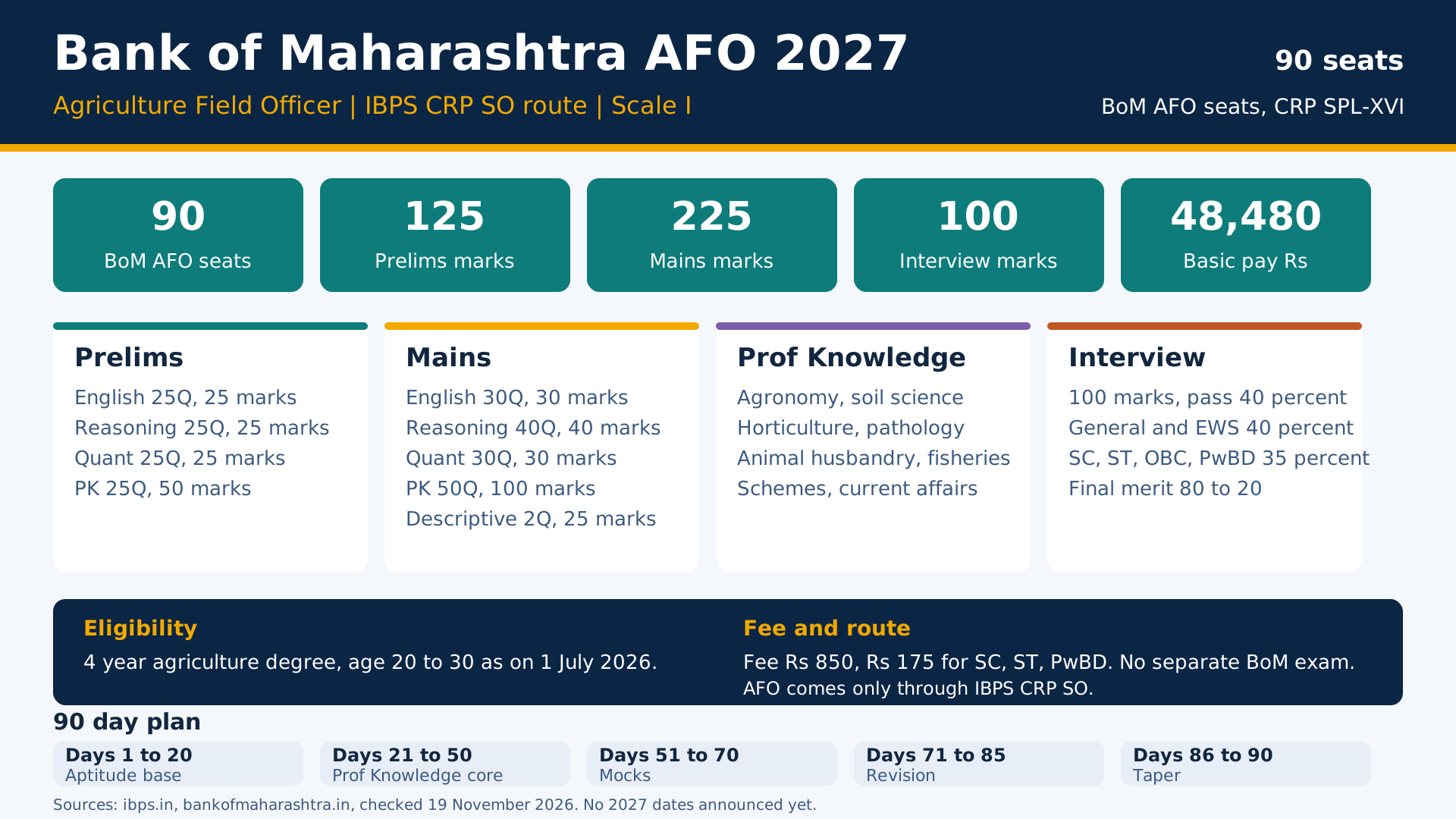
Bank of Maharashtra takes its Agriculture Field Officers through the IBPS Specialist Officer exam, not through a separate exam of its own. In the latest cycle, CRP SPL-XVI, the bank reported 90 Agriculture Field Officer seats out of 190 announced at notification, and that number stayed at 90 when IBPS revised the total to 370 in July 2026. If you want to work as a Bank of Maharashtra Agriculture Field Officer, the IBPS AFO paper is the only door, and this guide walks through it from the bank's side of the table.
The 2027 cycle has no announced dates yet as of 19 November 2026. Everything in this guide uses the latest real cycle, CRP SPL-XVI, which ran through 2026 with a preliminary exam on 29 August 2026 and a mains exam on 1 November 2026. Treat the dates as history, not as a timetable for 2027, and check the IBPS official website before you plan leave or pay a fee.
Bank of Maharashtra AFO 2027 is a useful search term, but read it as a target, not as a notification. There is no Bank of Maharashtra AFO 2027 notification on the bank's site, and there never has been one under that name. The bank's own recruitment drives hire specialist officers in senior scales, and those drives have never listed an Agriculture Field Officer post.
The AFO seats come through IBPS, and the bank's name appears in the IBPS vacancy table. That single fact shapes the whole preparation plan, because IBPS sets the syllabus and the pattern, and it fixes the fee, while Bank of Maharashtra decides the posting and the daily work in its branches.
This guide covers both halves. It explains the bank, the 90 seats, the revised 2026 pattern that most tracker pages still get wrong, the exact cost of a wrong answer, the degree list, the salary, the cut offs, and a 90 day plan that gives the 100 mark Professional Knowledge paper the weight it deserves. Every number here comes from a source listed at the end. Where trackers disagree, the guide says so instead of picking the neater figure.
There is no separate Bank of Maharashtra AFO exam
Say it plainly, because several pages on the internet blur it. Bank of Maharashtra has never published a standalone Agriculture Field Officer notification. Its Agriculture Field Officers arrive through the IBPS Common Recruitment Process for Specialist Officers, and the bank reports its vacancies to IBPS along with the other public sector banks. You apply on the IBPS site, you sit the IBPS exam, and IBPS allots you to Bank of Maharashtra if your rank and your preference line up.
The bank does run direct recruitment, and that is where the confusion starts. On 10 September 2025 it notified 350 Specialist Officer posts in Scales 2 to 6, with applications open from 10 to 30 September 2025. The published post list names Senior Manager Credit, Chief Manager Digital Banking, Deputy General Manager IT, Assistant General Manager, Chief Manager Data Protection and other senior posts.
No Bank of Maharashtra Agriculture Field Officer post appears in that list, and no agriculture post appears in it at all. Selection for that drive was an online exam if required plus an interview or discussion.
A second direct drive followed in 2026 for economists. The bank notified 4 Specialist Officer posts in its Economic Cell, Chief Economist, Chief Manager Economist and Senior Manager Economist, under advertisement AX1/ST/RP/Specialist Officer/Phase I/2026-27, with applications from 23 June to 10 July 2026. The fee was Rs 1,180 for General, EWS, OBC candidates.
SC, ST, PwBD candidates paid Rs 118. Selection was screening plus a personal interview, with a written exam only if required. Again, no Agriculture Field Officer post.
So the position is simple. If you are an agriculture graduate who wants a Scale 1 officer job in Bank of Maharashtra, ignore the bank's direct specialist drives and watch IBPS. The direct drives hire experienced specialists into senior scales.
The AFO post is an entry level Scale 1 post, and it comes only through CRP SPL. One tracker page puts the September 2025 direct drive at 500 vacancies instead of 350, so the 350 figure rests on two tracker pages that agree with each other, and the 500 figure is flagged here rather than silently dropped.
This matters for your calendar too. IBPS opens the SO notification around July each year, with registration running for about three weeks. In 2026 the window was 1 to 21 July 2026.
If you wait for a Bank of Maharashtra AFO notification on the bank's own site, you will miss the IBPS window, and the window does not reopen. Check the IBPS site in June and July, and check the bank's current openings page only to confirm that no separate AFO drive exists.
Bank of Maharashtra as an employer
Bank of Maharashtra was registered on 16 September 1935 in Pune, under the direction of the Mahratta Chamber of Commerce, and it commenced business on 8 February 1936. The founders named in the bank's history are D. K.
Sathe and V. G. Kale.
The bank was nationalised in 1969, when it had 153 branches. Its head office is Lokmangal, 1501 Shivajinagar, Pune. The Government of India holds the majority of its shares. The bank's tagline is Ek Parivar Ek Bank, one family one bank.
The network is the reason an AFO posting here looks different from an AFO posting in a bank with a thin rural presence. As of September 2026 the bank had 2,859 domestic branches, of which 645 were rural branches, 847 semi urban, 652 urban, 715 metro. Maharashtra alone accounted for 1,163 branches.
The bank also reported 2,775 ATMs and 17,122 employees at the same date. At the end of March 2026 the branch count was 2,782, so the network added branches through the year. An AFO who joins this bank has a strong chance of a posting in Maharashtra, and a real chance of a rural or semi urban branch where farm lending is the core business rather than a side counter.
That posting shapes the job. An Agriculture Field Officer in Bank of Maharashtra appraises farm loan proposals, sanctions crop loans, monitors term loans for allied activities, manages Kisan Credit Card accounts, links borrowers to crop insurance, follows up on recovery, keeps the branch's priority sector lending on track. The Reserve Bank of India requires domestic commercial banks to direct 40 percent of adjusted net bank credit to the priority sector, with 18 percent to agriculture, under the Priority Sector Lending Directions of 2025.
Those targets are concrete in a rural branch. They decide how much the branch must lend to farmers, and the AFO is the officer who makes the numbers move.
The Kisan Credit Card sits at the centre of the work. It gives a farmer a single card with a credit limit that covers crop production, allied activities, some consumption needs, and the farmer can draw and repay within the limit as the season demands. The government gives interest subvention on prompt repayment.
An AFO who understands the card, the scale of finance for each crop in the district, and the insurance that sits behind the loan will do the job well. An AFO who treats farm lending as paperwork will struggle, because the appraisal happens in the field, not at the desk.
Check the Bank of Maharashtra official website for the branch network and the current openings before you apply. The site is the only place that carries the bank's own recruitment notices, and it is the site that proves the AFO route runs through IBPS rather than through a bank level exam.
The exam in one page
| Stage | What it is | Marks | Time |
|---|---|---|---|
| Preliminary exam | English, Reasoning, Quantitative Aptitude, Professional Knowledge; qualifying only | 100 questions, 125 marks | 80 minutes |
| Main exam, objective | English, Reasoning, Quantitative Aptitude, Professional Knowledge; only Professional Knowledge counts for merit | 150 questions, 200 marks | 125 minutes |
| Main exam, descriptive | English writing, two questions, typed; qualifying only | 2 questions, 25 marks | 30 minutes |
| Interview | Common interview, 100 marks, qualifying minimum applies | 100 marks | As notified |
The preliminary exam is a screen. Its marks stay out of the final merit, but you must clear the sectional cut off in each of its four tests to reach the mains. The mains is where the selection is made, and inside the mains only the Professional Knowledge score counts for merit.
The other mains tests and the descriptive paper are qualifying, which means you must clear their minimum scores, and then they stop mattering. The interview carries 100 marks, and the final merit combines the mains and the interview in the ratio 80 to 20.
Each section has its own time limit, so you cannot borrow minutes from English to spend on Professional Knowledge. The preliminary exam gives 20 minutes to each of its four sections. The mains gives 25 minutes to English, 35 minutes to Reasoning, 25 minutes to Quantitative Aptitude, 40 minutes to Professional Knowledge, and 30 minutes to the descriptive paper. Time management is therefore a section by section skill, not a paper level skill, and your mocks must practise it that way.
The 2026 pattern change most pages still get wrong
IBPS rebuilt the AFO pattern in CRP SPL-XVI, and a large share of the pages that rank for this exam still show the old pattern. In the 2025 cycle the preliminary exam had three tests and no Professional Knowledge at all: English for 25 marks, Reasoning for 50 marks and Quantitative Aptitude for 50 marks, in 120 minutes. The 2025 mains was a single Professional Knowledge paper of 60 questions for 60 marks in 45 minutes. That pattern is gone.
The 2026 preliminary exam has four tests and 100 questions for 125 marks in 80 minutes. Professional Knowledge now appears in the prelims, with 25 questions carrying 50 marks, which is 40 percent of the prelims total. The 2026 mains has four objective tests plus a descriptive paper, 152 questions for 225 marks in 155 minutes. The wider specialist officer pool is covered in the IBPS SO 2027 guide, and the same revised pattern applies across the SO posts.
| Stage | 2025 pattern, CRP SPL-XV | 2026 pattern, CRP SPL-XVI |
|---|---|---|
| Preliminary exam | 150 questions, 125 marks, 120 minutes; English, Reasoning, Quantitative Aptitude; no Professional Knowledge | 100 questions, 125 marks, 80 minutes; English, Reasoning, Quantitative Aptitude, Professional Knowledge |
| Main exam | Professional Knowledge only, 60 questions, 60 marks, 45 minutes | 150 objective questions, 200 marks, 125 minutes, plus descriptive paper, 2 questions, 25 marks, 30 minutes |
| Interview | 100 marks | 100 marks, final merit mains to interview 80 to 20 |
Check any page you read against that table. If a page tells you the mains is 60 questions in 45 minutes, it is describing 2025, and its advice on time and weightage will mislead you for 2027. If a page tells you the prelims has no agriculture in it, it is also describing 2025. The 2026 pattern puts agriculture into both stages, which is good news for an agriculture graduate and bad news for anyone who planned to clear the prelims on aptitude alone.
What a wrong answer really costs
IBPS deducts one fourth of the marks assigned to a question for every wrong objective answer. A blank answer costs nothing. That rule sounds gentle until you apply it to the Professional Knowledge paper, where each question carries 2 marks.
A wrong answer in Professional Knowledge costs 0.50 marks, not 0.25. A wrong answer in English, Reasoning or Quantitative Aptitude costs 0.25 marks, because those questions carry 1 mark each.
Run the numbers before you decide how freely to guess. In the mains Professional Knowledge paper, 50 questions carry 100 marks in 40 minutes. Suppose you attempt 40 questions, get 30 right and 10 wrong.
You score 60 marks for the right answers and lose 5 marks for the wrong ones, which leaves 55. If you had left those 10 blank, you would have kept 60. The 10 guesses cost you 5 marks, which is a large slice of a paper where the 2025 shortlist cut off was 33.50 out of 60.
Blind guessing in this paper costs real marks. It is the fastest way to drop below a cut off you would otherwise have cleared.
The rule that follows is simple. Attempt a Professional Knowledge question only when you can rule out at least two of the four options, or when you are sure of the answer. With two options ruled out, a guess between the remaining two is a fair bet at 2 marks against a 0.50 penalty.
With only one option ruled out, the maths turns against you, because a wrong guess costs half a mark and the chance of being right is one in three. In the 1 mark aptitude sections the penalty is smaller, so a guess after ruling out one option is less damaging, but it still costs marks across a full paper. Never leave a question blank out of fear alone, and never attempt one out of hope alone. Rule options out first, then decide.
One more point on the penalty. The descriptive paper has no negative marking, because it is typed English writing, not objective questions. The interview has no negative marking either. The penalty applies only to the objective tests, in both the prelims and the mains.
Who can apply
Eligibility for the AFO post is narrow, and that is the point. You must hold a 4 year graduation degree in one of the disciplines IBPS lists. The list is long.
It covers Agriculture, Horticulture, Animal Husbandry, Veterinary Science, Dairy Science, Fishery Science, Pisciculture. It continues with Agri Marketing and Cooperation. Cooperation and Banking, Agro Forestry, Forestry, Agricultural Biotechnology, B.Tech Biotechnology, Food Science follow.
It ends with Agriculture Business Management, Food Technology, Dairy Technology, Agricultural Engineering, Sericulture, Fisheries Engineering. The degree must come from a university, institution or board recognised by the Government of India, and your final result must have been declared on or before the last date of registration, which was 21 July 2026 in the latest cycle.
A three year B.Sc. in Agriculture does not meet the rule, because IBPS asks for a 4 year degree. A B.Sc.
in a subject outside the list does not meet it either. Check your degree certificate against the list before you pay the fee, because the fee is not refunded when an application is rejected on eligibility. Candidates with a degree in agriculture and allied fields who studied in a state agricultural university will usually find their degree on the list, but the check takes two minutes and it is worth doing.
IBPS also asks for a computer qualification. You must hold a certificate, diploma or degree in computer operations or language, or you must have studied Computer or Information Technology as one of the subjects in high school, college or institute. Most agriculture graduates meet this through a computer paper in their degree, but if you never studied computers formally, get the certificate before you apply.
The age limit is 20 to 30 years as on 1 July 2026, which means candidates born between 2 July 1996 and 1 July 2006, both dates included. Relaxation applies in the usual way: 5 years for SC and ST, 3 years for OBC non creamy layer, 10 years for persons with benchmark disability, and 5 years for ex servicemen and commissioned officers with at least 5 years of military service. The OBC certificate must have been issued on or after 1 April 2026 in the latest cycle, so check the date on your certificate rather than assuming an old one will do.
Nationality follows the standard IBPS rule. You must be a citizen of India, or a subject of Nepal or Bhutan, or a Tibetan refugee who came to India before 1 January 1962 with the intention of settling permanently, or a person of Indian origin who migrated from Pakistan, Burma, Sri Lanka or the East African countries of Kenya, Uganda, Tanzania, Zambia, Malawi, Zaire, Ethiopia or Vietnam with the intention of settling permanently. Candidates in the last four groups must hold a certificate of eligibility issued by the Government of India.
The application fee in the latest cycle was Rs 850 inclusive of GST for General, EWS, OBC candidates. SC, ST, PwBD candidates paid Rs 175 inclusive of GST. The fee is payable online only, inside the registration window, and bank transaction charges fall on the candidate. Registration ran from 1 to 21 July 2026, with an edit window of two days after the closing date for corrections.
Professional Knowledge: the 100 mark paper
Professional Knowledge is the paper that decides selection, so it deserves the largest share of your time. In the mains it carries 50 questions for 100 marks in 40 minutes, which is 48 seconds per question, and only this score counts for merit. In the prelims it carries 25 questions for 50 marks in 20 minutes, which is the same 48 seconds per question. Speed matters as much as knowledge, because a candidate who knows the answer but takes 90 seconds to reach it will leave the last ten questions unread.
The syllabus covers general agriculture and the allied subjects. The core list runs from General Agriculture through Agronomy, Weed Science, Soil Science, Horticulture, Entomology, Pathology, Nematology, Crop Physiology, Agricultural Economics, Agricultural Extension, Agricultural Microbiology, Agricultural Biochemistry, Agricultural Biotechnology, Forestry. Genetics and Plant Breeding and Seed Science and Technology belong to the same core list.
The allied list adds Animal Husbandry, Agricultural Engineering, Fisheries, Apiculture, Sericulture, Lac Culture, Mushroom Farming. Schemes and current affairs close the list, and that last head is where many candidates lose marks, because it changes every year while the core subjects stay the same.
Give the core subjects their due in this order. Agronomy and soil science carry the most weight in practice, because they cover crops, seasons, soils, fertiliser use, water management that an AFO deals with every day. Horticulture, entomology, pathology follow, because they cover pests, diseases, fruit crops, vegetable crops that fill the field questions.
Genetics and plant breeding, seed science, crop physiology test the science behind the varieties and the seed that the bank finances. Agricultural economics and extension test farm management, marketing, transfer of technology that the job itself is about. Agricultural economics in this syllabus overlaps with the UGC NET Economics 2027 syllabus, so a candidate with an economics background will find that part familiar.
The allied subjects reward short, focused notes rather than deep study. Animal husbandry covers breeds, feeding, common diseases, dairy management. Agricultural engineering covers farm machinery, irrigation methods, post harvest handling.
Fisheries covers the main cultured species and pond management. Apiculture, sericulture, lac culture, mushroom farming are small heads, and each one usually yields one or two direct questions, so a single page of notes per head is enough. Do not spend a week on mushroom farming while agronomy sits unread.
Schemes and current affairs need a different habit. Keep a running note of the agriculture schemes that the government runs, with one line each on what the scheme does and who it covers. The Kisan Credit Card, crop insurance, interest subvention on prompt repayment, soil health cards, the agriculture infrastructure fund and the minimum support price system all appear in this head.
Read the agriculture pages of a newspaper twice a week and add one line per story to your note. A scheme you read about in the month before the exam is more likely to appear than a scheme you memorised a year ago.
Study the Professional Knowledge paper from your degree notes first, then from a standard AFO guide, then from mock tests. Your degree notes are the closest match to the syllabus, because the paper is built from the same subjects you studied for four years. A guide helps you organise the facts and fill gaps in subjects outside your specialisation.
Mock tests show you which topics the paper actually asks about, and they teach you the 48 second rhythm. If your degree was in horticulture, give extra days to agronomy and animal husbandry. If your degree was in agriculture engineering, give extra days to agronomy and horticulture.
Your specialisation gets no weight in this paper. The paper tests the full list.
The other mains tests and the descriptive paper
English, Reasoning, Quantitative Aptitude appear in both stages, and they are qualifying in the mains, which tempts candidates to ignore them. That is a mistake, because qualifying still means clearing a minimum score in each test. A candidate who scores 80 in Professional Knowledge but misses the English minimum does not reach the interview. Give these three tests enough time to clear their minimums with comfort, and give them no more than that.
The prelims gives each of them 25 questions for 25 marks in 20 minutes. The mains gives English 30 questions for 30 marks in 25 minutes, Reasoning 40 questions for 40 marks in 35 minutes, and Quantitative Aptitude 30 questions for 30 marks in 25 minutes. The prelims syllabus for Reasoning covers puzzles, seating arrangement, inequalities, blood relations, syllogism, alphanumeric series, data sufficiency.
Order and ranking is one more head. Input and output is one head. Coding and decoding and distance and direction need practice too.
Verbal and non verbal reasoning completes the reasoning list. Quantitative Aptitude covers number series, data interpretation, simplification, quadratic equations, data sufficiency. Ratio and proportion, discounts, averages, mixtures, percentages follow.
Profit and loss is one head. Time work and distance, rate of interest, probability need practice. Permutation and combination is the last head.
English covers cloze test, reading comprehension, para jumbles. Improving sentences and paragraphs, completion of paragraphs need practice. Detection of errors, fill in the blanks, parts of speech, prepositions, modes of narration, voice change complete the list.
The descriptive paper is two questions for 25 marks in 30 minutes, typed in English on the computer in the same sitting as the objective mains. Trackers describe the two tasks as an essay and a letter, while one tracker calls the second task comprehension, so check the IBPS information handout for your cycle before you practise. Either way, the skill is the same: write plain, correct English under time pressure. Practise one essay and one letter a week from the eighth week of your plan, and type them rather than writing them by hand, because the exam is typed and typing speed decides how much you finish.
Interview and final merit
The interview carries 100 marks, and you must score at least 40 percent if you are a General or EWS candidate, and 35 percent if you are SC, ST, OBC or PwBD. That minimum is a hard gate. A candidate who clears the mains but scores below the interview minimum is not considered for allotment, whatever the mains score was.
The final merit combines the mains and the interview in the ratio 80 to 20. Only the Professional Knowledge score from the mains enters that calculation, because the other mains tests are qualifying. The interview panel is run by the participating public sector banks and coordinated by IBPS, and it tests personality and technical knowledge together.
Expect questions on your degree subject, on the crops and the farming of your home district, on the work of an AFO, on priority sector lending and the Kisan Credit Card, and on why you chose Bank of Maharashtra. A candidate who can talk about the farming of one district in detail will impress the panel more than a candidate who recites definitions from a guide.
Bank preference matters at the allotment stage. You list your preferred banks when you apply, and IBPS allots on merit and preference. If Bank of Maharashtra is your first choice, say so in your preference list, and be ready to explain why in the interview.
A clear reason, such as the bank's rural network in Maharashtra or a posting near your home district, reads better than a vague compliment. The allotment in the latest cycle was provisional in January 2027, after interviews in November and December 2026.
Vacancies: how many seats Bank of Maharashtra actually takes
Vacancy numbers for this post swing sharply from year to year, and the swing itself is the lesson. IBPS calls the numbers indicative, and banks can revise them during the process. Plan for a small number of seats and a large number of applicants, and do not build your plan on the hope that the next cycle will be bigger.
| Cycle | Total AFO seats | Bank of Maharashtra seats | Other banks with seats |
|---|---|---|---|
| CRP SPL-XV, 2025 | 310 | 80 | Indian Overseas Bank 80, Punjab National Bank 150 |
| CRP SPL-XVI, 2026, at notification | 190 | 90 | Bank of Baroda 100; all other participating banks 0 or not reported |
| CRP SPL-XVI, 2026, revised 20 July 2026 | 370 | 90 | Indian Bank 180, Bank of Baroda 100; Bank of Maharashtra unchanged at 90 |
Bank of Maharashtra's own share is the steadier part of the story. It took 80 seats in the 2025 cycle and 90 seats in the 2026 cycle, while the all India total moved from 310 to 190 and then to 370. In the 2026 cycle the bank's 90 seats split as 13 SC, 6 ST, 24 OBC, 9 EWS, 38 General, with 1 seat each for hearing impaired, orthopedically challenged, visually impaired candidates.
No seat is earmarked for intellectual disability. The revision of 20 July 2026 added Indian Bank with 180 seats and left Bank of Maharashtra untouched, which shows that a revision can add seats without adding any to your chosen bank.
Several tracker pages still show the 190 total without the revision, and some show a garbled bank wise table that does not add up. Use the revised table. The total for the 2026 cycle is 370, with Indian Bank at 180, Bank of Baroda at 100 and Bank of Maharashtra at 90, plus two banks that did not report.
The 2027 cycle will have its own table, and it may look nothing like this one. Check it on the IBPS site when the notification comes, and check whether Bank of Maharashtra has reported seats at all before you fix your preference list.
Salary and the job after selection
A Bank of Maharashtra Agriculture Field Officer joins as a Junior Management Grade Scale 1 officer, on a basic pay of Rs 48,480 per month. The scale runs to a maximum of Rs 85,920, with annual increments of Rs 2,000 for seven years, then Rs 2,340 for two years, then Rs 2,680 for seven years. Dearness allowance, house rent allowance, transport allowance, provident fund, medical benefits, pension apply on top of the basic pay, as per the bank's rules. The starting pay is the same across the participating banks, because it follows the industry settlement, so Bank of Maharashtra pays what Bank of Baroda pays for the same post.
The job itself is field work as much as desk work. A new AFO in a rural branch spends the morning on loan proposals and the afternoon in the villages, verifying crops, meeting borrowers, checking the end use of a loan, and following up on recovery. The branch manager leans on the AFO for every agriculture decision, because the AFO is the only officer in the branch who can tell a genuine crop loan from a risky one. That responsibility is the reason the post needs an agriculture degree, and it is also the reason the interview tests your field knowledge rather than your memory of definitions.
Promotion follows the bank's promotion policy, from Scale 1 upward through the management grades. JAIIB and CAIIB add one increment each for officers. The rural credit syllabus in CAIIB Rural Banking 2027 overlaps with the AFO's daily work, so an AFO who takes that elective studies the same priority sector rules and the same institutions that the job already uses.
Officers who want to move into rural development finance later often look at NABARD Grade A 2027 and NABARD Grade B 2027, which recruit for the apex institution that refinances the rural credit system. Graduates who want a rural posting through a different route prepare for IBPS RRB PO 2027, and the generalist officer route is IBPS PO 2027. The regulator side of the same world is RBI Grade B 2027, and SEBI Grade A 2027 sits on the markets side. JAIIB RBWM 2027 covers the retail side that a branch officer also handles.
Expect a rural or semi urban posting in your first years, most likely in Maharashtra, given that 1,163 of the bank's 2,859 branches are in the state. Transfers follow the bank's transfer policy, and an officer who does the field work well will find that rural postings build the record that later promotions ask for. Candidates who join hoping for a city posting in the first year will be disappointed. Candidates who join knowing the job is in the villages will settle faster.
Cut offs: read the numbers with care
Cut offs for this exam need care, because the pattern changed in 2026 and the old figures do not compare with the new ones. IBPS published the preliminary cut offs for CRP SPL-XVI on 22 October 2026. The Professional Knowledge sectional minimum was 16.50 for General candidates and 12.50 for reserved categories, out of 50.
The overall cut off reported from the same IBPS document is 63.50 out of 125. That overall figure rests on a tracker reading of the IBPS document, so treat it as reported rather than as a number you saw on the IBPS site yourself.
The mains cut offs from the 2025 cycle belong to the old pattern, and they are out of 60, not out of 100. In 2025 the Professional Knowledge qualifying minimum was 25.75 for General and EWS candidates, 21.75 for SC, ST, OBC, PwBD candidates, out of 60. The shortlist cut off for the interview was 33.50 for General candidates.
Those numbers tell you how high the bar was in a 60 mark paper. They do not tell you what the bar will be in a 100 mark paper, and they should not be used as a target score for 2027.
Do not plan around a single final cut off number either. Two trackers publish different final cut off figures for 2025, and the gap between them is wide enough to make any single number useless as a target. Aim instead for a Professional Knowledge score that clears the sectional minimum by a wide margin in the prelims and sits well above the old shortlist level in the mains, because the interview shortlist is drawn from the Professional Knowledge score alone.
A safe target is 70 or more out of 100 in the mains Professional Knowledge paper, with the other tests cleared comfortably, and a prelims Professional Knowledge score above 35 out of 50. Those are planning targets, not official cut offs, and the real cut off will depend on the paper and the seats.
A 90 day plan
Ninety days is enough for this exam if you already hold an agriculture degree, because the Professional Knowledge paper tests what you studied for four years. It is not enough if you start from zero in agriculture, and no plan can fix that in three months. The plan below assumes a working candidate with three to four hours a day, and it gives the Professional Knowledge paper about half the total time.
Days 1 to 20 build the base. Revise agronomy and soil science from your degree notes, two hours a day, and practise one hour of aptitude daily, rotating English, Reasoning, Quantitative Aptitude. Take one short Professional Knowledge quiz each evening, 25 questions in 20 minutes, to build the 48 second rhythm from the start. Do not touch full length mocks yet.
Days 21 to 50 cover the rest of the Professional Knowledge syllabus. Genetics and plant breeding, horticulture, entomology, pathology, seed science, crop physiology take a day each. Agricultural economics, extension, microbiology, biochemistry, biotechnology, forestry take a day each.
The allied subjects take one day each, with a single page of notes per head. Keep the aptitude hour going, and add one descriptive writing task a week, typed, on an agriculture or banking topic.
Days 51 to 70 are mock test weeks. Take full length mocks from the seventh week, two prelims plus two mains a week, under the real sectional time limits, and spend as long reviewing each mock as you spent taking it. Review means writing down every question you got wrong, the correct answer, and the one line reason you got it wrong. A mock you do not review is an afternoon spent, not an afternoon used.
Days 71 to 85 are revision. Re-read your Professional Knowledge notes, your one page allied subject notes, and your schemes note. Re-attempt the questions you got wrong in the mocks.
Practise the descriptive paper twice a week. Cut the aptitude practice to 30 minutes a day, because the aptitude tests only need their minimums cleared.
Days 86 to 90 are the taper. Take one final full length mock on day 86, review it on day 87, and spend the last three days on light revision, your schemes note, and rest. Do not start a new topic in the last week. A new topic in the last week costs you the revision of three topics you already know.
Mistakes that cost agriculture graduates this exam
The first mistake is preparing for the old pattern. Candidates who practise a 60 question mains paper and a prelims paper with no agriculture in it will walk into a different exam. Check the pattern on the IBPS notification itself, not on a page that was written for 2025 and never updated.
The second mistake is ignoring the descriptive paper. It is only 25 marks, but it is a qualifying gate, and a candidate who has never typed an essay under time pressure will write slowly and finish half a question.
The third mistake is guessing blindly in Professional Knowledge. A wrong answer costs 0.50 marks, and ten blind guesses can cost 5 marks, which is more than the gap between clearing the shortlist and missing it. Rule out options first.
The fourth mistake is studying agriculture alone and ignoring the aptitude tests. The aptitude tests are qualifying, but qualifying still means clearing a minimum in each one, and a zero in English ends the attempt whatever the agriculture score was.
The fifth mistake is waiting for a Bank of Maharashtra notification that will never come. The bank does not publish an AFO notification, and candidates who wait for one miss the IBPS window. The sixth mistake is trusting a single tracker page for dates, fees or cut offs.
The pages disagree with each other on the notification date, on the direct drive vacancies, on the descriptive paper tasks and on the final cut off. Cross check the important numbers against the IBPS notification, and treat every tracker figure as provisional until it matches the official document.
How to use mock tests for this pattern
Mock tests for this exam must copy the sectional time limits, or they teach you the wrong skill. A mock that lets you spend 40 minutes on Professional Knowledge and 10 minutes on English does not prepare you for a paper where each section closes after its own minutes. Use mocks that enforce the limits, and sit them in one stretch, without a phone and without a break between sections.
Take sectional tests for Professional Knowledge twice a week from the third week, 25 questions in 20 minutes for the prelims level and 50 questions in 40 minutes for the mains level. The two levels use the same syllabus, so the same notes serve both, and the only difference is the length. Take full length mocks from the seventh week, two prelims plus two mains a week, and review each one the same day.
Track three numbers after every mock: your Professional Knowledge score, the number of questions you attempted after ruling out two options, and the number you attempted on a pure guess. The third number should fall to zero by the final weeks.
Use mocks to find the topics you keep missing, not to collect a high score. A mock score of 80 that hides five weak topics is less useful than a mock score of 65 that shows you exactly which five topics to revise. After each mock, add the missed topics to your revision list, and re-attempt the same questions a week later. If you still miss them, the notes need rewriting, not rereading.
Before you register, check these things on the official sites
First, confirm the notification, the dates, the fee, the vacancy table for your cycle on the IBPS official website. The 2027 schedule was not announced as of 19 November 2026, and the 2026 dates in this guide are history. Second, confirm that Bank of Maharashtra has reported AFO seats in the vacancy table, and note the category split for your category. Third, check your degree against the 4 year degree list and your age against the cut off date, because both are checked at the application stage.
Fourth, confirm the computer qualification rule against your own certificates. Fifth, check the Bank of Maharashtra official website current openings page, to confirm that no separate AFO drive exists and to see the direct specialist drives for what they are. Sixth, keep your registration receipt, your admit cards and your scorecards safe, because IBPS removes old links after the cycle closes and a lost scorecard is hard to recover.
The post is small, the competition is large, and the bank is a good employer for an agriculture graduate who wants field work. The route is clear, the pattern is published, and the syllabus is the degree you already hold. Start with Professional Knowledge, respect the penalty, and check the official notice before you believe any other page, including this one.
Sources
IBPS official website, ibps.in, CRP SPL-XVI notification dated 1 July 2026, registration 1 to 21 July 2026, preliminary exam 29 August 2026, mains 1 November 2026, as reported by trackers. Bank of Maharashtra official website, bankofmaharashtra.in, bank history, head office, current openings, direct Specialist Officer notifications. Oliveboard IBPS AFO notification 2026, CRP SPL-XVI pattern tables, vacancy table with Bank of Maharashtra at 90, fee Rs 850 and Rs 175, age 20 to 30, basic pay Rs 48,480 and pay scale, interview weightage 80 to 20, mains 2025 cut offs.
AgriBook IBPS AFO 2026 syllabus and pattern. It gives preliminary and mains tables, negative marking at one fourth of assigned marks, the eligibility list, the computer qualification, revised vacancies 370 with Indian Bank 180, Bank of Baroda 100, Bank of Maharashtra 90.
TestBook IBPS AFO vacancy 2026. Bank of Maharashtra 90, Bank of Baroda 100. Notification and registration dates included.
PW IBPS AFO 2026, revised vacancies 190 to 370, pattern tables. Adda247 IBPS AFO notification 2026, preliminary exam 29 August 2026, mains 1 November 2026. AgriPrep IBPS AFO exam pattern 2026 and cut off 2026, 2025 versus 2026 pattern comparison, preliminary cut offs published 22 October 2026, Professional Knowledge sectional minimum 16.50 General and 12.50 reserved, descriptive paper tasks, negative marking 0.50 on a 2 mark question. PracticeMock IBPS AFO notification 2025, CRP SPL-XV total 310 vacancies, Bank of Maharashtra 80, Indian Overseas Bank 80, Punjab National Bank 150, prelims 30 August 2025, mains 9 November 2025.
TestBook Bank of Maharashtra SO Recruitment 2025, 350 vacancies, notification 10 September 2025, applications 10 to 30 September 2025, Scales 2 to 6, selection online exam if required and interview. CareerPower Bank of Maharashtra SO notification 2025, 350 vacancies, post list including Senior Manager Credit, Chief Manager Digital Banking, Deputy General Manager IT, Assistant General Manager, Chief Manager Data Protection. BankersAdda Bank of Maharashtra Specialist Officer Recruitment 2026, 4 Economist posts, advertisement AX1/ST/RP/Specialist Officer/Phase I/2026-27, applications 23 June to 10 July 2026, fee Rs 1,180, Rs 118, selection screening, interview.
Wikipedia Bank of Maharashtra, founded 16 September 1935, nationalised 1969, head office Lokmangal Shivajinagar Pune, 2,641 branches June 2025. Kalkine Bank of Maharashtra September 2026 results, 2,859 domestic branches, 645 rural, 1,163 in Maharashtra, 2,775 ATMs, 17,122 employees. Equitymaster Bank of Maharashtra versus Punjab National Bank, 2,782 branches as of 31 March 2026.
Krishijob top agriculture jobs after B.Sc Agriculture, AFO work covering farm loans, Kisan Credit Card accounts, crop insurance linkage and recovery in rural branches. RBI Priority Sector Lending Targets and Classification Directions 2025, domestic commercial banks 40 percent of adjusted net bank credit, agriculture 18 percent.







