
About IBPS AFO 2027 Exam Series
📖 Table of Contents
- The exam in one page
- The pattern changed in 2026, and old tables still circulate
- Preliminary exam pattern
- Main exam pattern
- Interview and final merit
- Vacancies: 190 became 370, and the split tells a story
- Who can apply: the degree list, the age, the fee
- Syllabus: what to study, and what carries the marks
- Prelims: English, Reasoning, Quantitative Aptitude
- Professional Knowledge: the agriculture syllabus
- Descriptive English in Mains
- Cut offs: the official 2026 numbers, and what older numbers mean
- Salary and the job itself
- The IBPS AFO 2027 90 day plan
- Mistakes that cost marks in AFO
- Before you register, check these things on the IBPS site
- Where IBPS AFO 2027 fits in your exam plan
- Sources
IBPS AFO 2027: Agriculture Field Officer Exam Guide
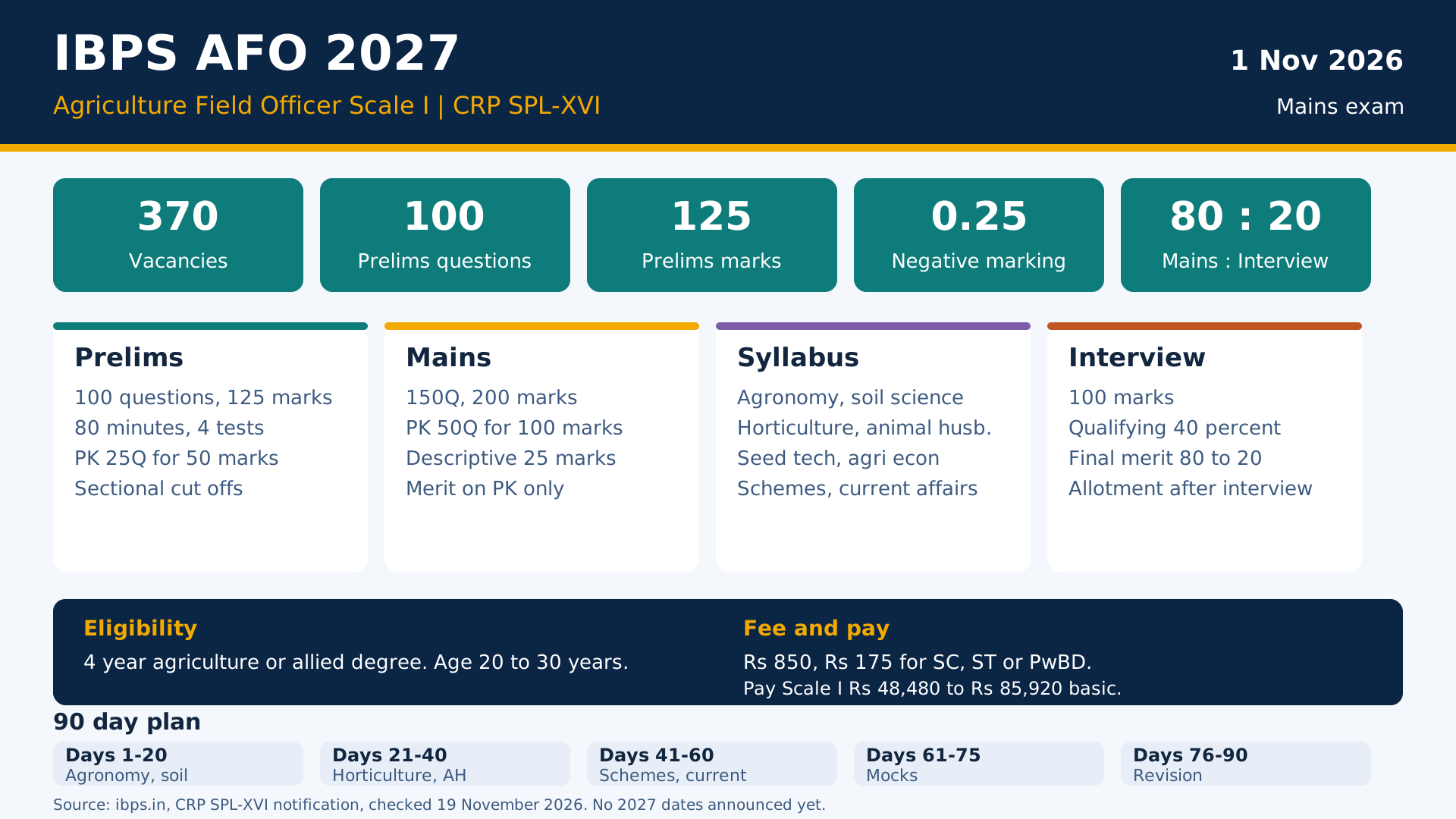
IBPS released 370 Agriculture Field Officer posts in its 2026 cycle, and the exam that fills them looks different from the one many tracker pages still describe. The Institute of Banking Personnel Selection, IBPS, runs this post under its Common Recruitment Process for Specialist Officers, CRP SPL-XVI. The notification came out on 1 July 2026, the Preliminary exam was held on 29 August 2026, and the Main exam was held on 1 November 2026.
The 2027 cycle has no announced dates yet as of 19 November 2026, so this guide uses the latest real cycle and the current pattern. That is the starting point for any plan.
The post is Agriculture Field Officer, Scale I, in participating public sector banks. It is the one IBPS post that asks for an agriculture degree and then tests agriculture in the exam itself. A graduate in agriculture, horticulture, animal husbandry or one of the allied subjects listed in the notification can apply.
A general graduate cannot, however strong their reasoning or quant score may be. That degree gate is what makes AFO a separate track from IBPS PO and IBPS Clerk, and it is why a general IBPS SO guide is not enough for this post.
Three stages decide selection. The Preliminary exam screens candidates. The Main exam decides who reaches the interview, and only the Professional Knowledge score in Mains counts for that merit list.
The interview carries 100 marks. The final merit combines Mains and interview in the ratio 80 to 20. Prelims marks stay out of the final merit.
This guide explains the new pattern in full, because that is where most candidates lose marks before they start. It covers the vacancy story, the full eligibility list, the syllabus topic by topic, the official cut offs that IBPS published on 22 October 2026, the salary, the job itself, and a 90 day plan. Every date and fee in this guide comes from the IBPS notification as reported by trackers that quote the official documents.
The cut offs come from the same place, and the sources sit at the end of the page. Check the IBPS official website before you pay any fee, because IBPS can change a date or a fee between cycles.
The exam in one page
| Item | Detail |
|---|---|
| Post | Agriculture Field Officer, Scale I |
| Recruitment | CRP Specialist Officers XVI, 2026 to 27 cycle, vacancies for 2027 to 28 |
| Conducting body | Institute of Banking Personnel Selection, IBPS |
| Participating banks | 11 public sector banks |
| Vacancies | 370, revised from 190 by Annexure I dated 20 July 2026 |
| Notification | 1 July 2026 |
| Registration | 1 July to 21 July 2026 |
| Preliminary exam | 29 August 2026, 100 questions, 125 marks, 80 minutes |
| Main exam | 1 November 2026, 150 objective questions and 200 marks plus a 25 mark descriptive paper |
| Interview | 100 marks, minimum qualifying 40 percent, 35 percent for SC, ST, OBC or PwBD |
| Final merit | Mains 80 percent and interview 20 percent |
| Negative marking | One fourth of the marks assigned to the question, in Prelims and in Mains |
| Age | 20 to 30 years as on 1 July 2026 |
| Fee | Rs 850 for most candidates, Rs 175 for SC, ST or PwBD, inclusive of GST |
| Pay scale | Scale I, Rs 48,480 to Rs 85,920 basic, plus allowances |
| Next cycle | 2027 dates not announced as of 19 November 2026 |
Read that table twice before you read anything else. Two facts in it decide your whole preparation. First, Professional Knowledge now appears in Prelims, and each of its 25 questions carries 2 marks, so it is worth 50 of the 125 Prelims marks.
Second, Mains is no longer a single agriculture paper. It has four objective tests plus a descriptive English paper, and only the Professional Knowledge test decides the merit list. A candidate who treats Mains as a pure agriculture paper will waste the 125 minutes on the wrong priority.
The pattern changed in 2026, and old tables still circulate
Up to CRP SPL-XV, the pattern was simple. Prelims had 150 questions for 125 marks, with English at 25 questions and Reasoning at 50, plus Quantitative Aptitude at 50, and no agriculture at all. Mains was a single Professional Knowledge paper of 60 questions for 60 marks in 45 minutes.
That pattern is gone. CRP SPL-XVI replaced it in the 2026 cycle, and the new pattern is the one that will shape the 2027 cycle unless IBPS changes it again.
Many tracker pages still carry the old tables. Some show the old Mains table of 60 questions and 60 marks next to the new 2026 dates, which cannot both be right. A few pages mix the two patterns in the same table. This guide follows the notification as quoted by Oliveboard and Testbook, and also by PW.live and CareerPower.
The IBPS cut off documents agree on the new structure too. If a page you read shows Mains as 60 questions in 45 minutes, it is describing the old cycle. Close it.
The change matters most in Prelims. Agriculture now decides who clears Prelims, because Professional Knowledge carries 40 percent of the Prelims marks and has the highest sectional minimum of the four tests. In the 2026 Prelims, a general category candidate needed 16.50 out of 50 in Professional Knowledge, against 11.25 in English, 6.00 in Reasoning and 8.00 in Quantitative Aptitude.
A candidate who is strong in reasoning and quant but weak in agriculture can now fail Prelims on the agriculture section alone. The old advice to leave agriculture for Mains no longer works.
The change matters in Mains in a different way. The other three objective tests and the descriptive paper are qualifying in nature. You must clear their minimum scores, but their marks do not decide your rank.
Only the Professional Knowledge objective score decides who gets called for interview. That makes Mains a strange paper. You must spend enough time on English and Reasoning, plus Quant to clear them, and then spend your best energy on the 50 Professional Knowledge questions, because those 100 marks are the whole merit list.
Preliminary exam pattern
| Test | Questions | Marks | Time |
|---|---|---|---|
| English Language | 25 | 25 | 20 minutes |
| Reasoning | 25 | 25 | 20 minutes |
| Quantitative Aptitude | 25 | 25 | 20 minutes |
| Professional Knowledge | 25 | 50 | 20 minutes |
| Total | 100 | 125 | 80 minutes |
Each test is separately timed at 20 minutes. You cannot carry unused minutes from English into Professional Knowledge, and you cannot start Professional Knowledge early. That timing shapes your practice. A mock test that lets you move freely between sections does not match the real exam, so take at least some mocks with the same 20 minute blocks.
Each Professional Knowledge question carries 2 marks. A wrong answer in that test costs half a mark, because the penalty is one fourth of the marks assigned to the question. A wrong answer in the other three tests costs a quarter mark.
A blank answer costs nothing in any test. The penalty section later in this guide works through what that means for guessing, with numbers.
You must clear the cut off in each of the four tests and the overall cut off for your category. Miss the minimum in one test and you are out, even with a high total. The official 2026 sectional cut offs are in the cut off section below, and they show that Reasoning had the lowest minimum while Professional Knowledge had the highest. Plan your sectional targets from those numbers, not from a guess.
Main exam pattern
| Test | Questions | Marks | Time |
|---|---|---|---|
| English Language | 30 | 30 | 25 minutes |
| Reasoning | 40 | 40 | 35 minutes |
| Quantitative Aptitude | 30 | 30 | 25 minutes |
| Professional Knowledge, objective | 50 | 100 | 40 minutes |
| Descriptive English | 2 questions | 25 | 30 minutes |
| Total | 150 objective plus descriptive | 225 | 155 minutes |
The objective part runs for 125 minutes and the descriptive paper runs for 30 minutes, which adds up to 155 minutes in total. The descriptive paper has 2 questions for 25 marks, which tests written English. IBPS describes the descriptive paper as qualifying, like the other three objective tests. Only the Professional Knowledge objective score of 100 marks goes into the Mains merit list.
That rule is easy to misread, so here it is in plain words. Two candidates can score the same in Professional Knowledge and different totals everywhere else, and they will stand equal on the Mains merit list, provided both cleared the qualifying minimums. The reverse is also true.
A candidate who scores high in Reasoning and Quant but average in Professional Knowledge will rank below a candidate who scored lower everywhere else but higher in agriculture. Your Mains preparation must follow that logic. Agriculture first, the qualifying tests second, and the descriptive paper third.
One more point about Mains timing. Professional Knowledge gives you 50 questions in 40 minutes, which is 48 seconds per question. That is less time per question than Prelims gives you for the same subject, because Prelims gives 25 questions in 20 minutes. Speed in agriculture matters as much as knowledge, and speed only comes from timed practice on agriculture questions, not from reading notes.
Interview and final merit
Candidates shortlisted on the Mains Professional Knowledge score are called for interview. The interview carries 100 marks and tests personality and technical knowledge together. The minimum qualifying marks are 40 percent for most candidates and 35 percent for SC, ST, OBC or PwBD candidates. Clear the interview minimum and your Mains and interview scores combine in the ratio 80 to 20 for the final merit, out of 100.
IBPS does not share Mains scores with shortlisted candidates until the interviews are over. That means you walk into the interview without knowing your Mains score, and you cannot calculate where you stand. The practical lesson is simple.
Prepare for the interview as if your Mains score were average, because it probably is. A strong interview can lift a middle Mains score into allotment, and a weak interview can waste a strong one. The final cut offs in the cut off section show how close the margins are.
Provisional allotment follows the interview. IBPS allots candidates to banks based on the final merit and the vacancies reported by each bank. The allotment for the 2026 cycle was expected around January 2027, and the exact date comes from IBPS. Vacancies are indicative until allotment, which means the final number can move from the number in the notification.
Vacancies: 190 became 370, and the split tells a story
The notification of 1 July 2026 announced 190 Agriculture Field Officer posts. Two banks had reported vacancies at that point. Bank of Baroda reported 100 posts and Bank of Maharashtra reported 90.
That was the whole list. Candidates who read only the notification saw a small recruitment, and some may have skipped applying.
On 20 July 2026, IBPS released an updated Annexure I, the indent for Specialist Officers for 2027 to 28, and the AFO total rose to 370. Indian Bank had joined with 180 posts, which is nearly half the revised total. The category split of the 370 posts is 152 for UR, 55 for SC, 27 for ST, 100 for OBC and 36 for EWS.
A further annexure dated 27 August 2026 put the total Specialist Officer vacancies at 1,043, while AFO stayed at 370. The two annexures disagree on the Rajbhasha total, 94 against 102, but they agree on AFO.
| Bank | Posts |
|---|---|
| Bank of Baroda | 100 |
| Bank of Maharashtra | 90 |
| Indian Bank | 180 |
| Total | 370 |
Three lessons sit in that table. First, a vacancy number in July is not final, because banks report their indents through the cycle. Second, a single bank can change the whole recruitment, because Indian Bank alone added 180 posts after the notification.
Third, the 2027 cycle may look different again, because each bank reports fresh indents every year. Do not plan your 2027 attempt on the assumption that Indian Bank will report 180 posts again. Check the annexure when the notification comes out.
For scale, the two previous cycles allotted 674 posts in CRP SPL-XIII and 946 posts in CRP SPL-XIV. Those were bigger recruitments than the 2026 cycle, and they ran on the old pattern. The 370 posts of 2026 are smaller, but they are real posts in three banks, and the competition is limited to agriculture graduates.
That is the number that matters. A general banking exam draws lakhs of graduates from every stream. AFO draws only the agriculture stream, which is a far smaller pool.
Who can apply: the degree list, the age, the fee
Eligibility for AFO has three parts, and all three are checked against fixed dates. The educational qualification is checked as on 21 July 2026 for the 2026 cycle, and the age is checked as on 1 July 2026. A candidate who finished the degree after the result date, or who was born outside the age window, does not qualify, even if the exam is months later.
The degree must be a 4 year Bachelor degree in one of the disciplines below, from a university or institution recognised by the Government of India or approved by a government regulatory body. A 3 year BSc in Agriculture does not qualify. A degree in a subject that is not on the list does not qualify, even if it sounds close. Read the list slowly and match your degree certificate against it, not against a summary.
| Eligible 4 year degrees |
|---|
| Agriculture |
| Horticulture |
| Animal Husbandry |
| Veterinary Science |
| Dairy Science |
| Fishery Science |
| Pisciculture |
| Agri Marketing and Cooperation |
| Co-operation and Banking |
| Agro-Forestry |
| Forestry |
| Agricultural Biotechnology |
| BTech Biotechnology |
| Food Science |
| Agriculture Business Management |
| Food Technology |
| Dairy Technology |
| Agricultural Engineering |
| Sericulture |
| Fisheries Engineering |
Two conditions sit beside the degree. The candidate must have a Certificate, Diploma or Degree in Computer Operations or Language, or must have studied Computer or Information Technology as one of the subjects in High School, College or Institute. Most agriculture graduates meet this through a computer paper in their degree, but check your mark sheets. The final result of the degree must have been declared on or before 21 July 2026 for the 2026 cycle.
The age limit is 20 to 30 years as on 1 July 2026. That means the candidate must have been born not earlier than 2 July 1996 and not later than 1 July 2006, both dates inclusive. Relaxation in the upper age limit applies as per government rules: 5 years for SC and ST, 3 years for OBC, 10 years for PwBD, and 5 years for Ex-Servicemen. There is no relaxation in the minimum age.
The application fee is Rs 850 for all candidates except SC, ST or PwBD, who pay Rs 175. Both figures are inclusive of GST, and the fee is payable online only. The registration window for the 2026 cycle ran from 1 July to 21 July 2026.
One tracker page says the window ran to 26 July, but the notification and most trackers say 21 July, and this guide uses 21 July. Do not rely on a tracker page for the last date in the 2027 cycle. Read the notification itself on the IBPS official website.
Syllabus: what to study, and what carries the marks
The AFO syllabus has two layers. The first layer is English and Reasoning, plus Quantitative Aptitude. Those three appear in both Prelims and Mains and are qualifying in Mains. The second layer is Professional Knowledge, which is agriculture, and it is the layer that decides selection.
Most candidates get this backwards. They spend months on reasoning and quant because those feel like exam subjects, and they leave agriculture to the last weeks because it feels like their degree. That is the wrong order. Agriculture is half the Prelims marks and the whole Mains merit list.
Prelims: English, Reasoning, Quantitative Aptitude
English Language in Prelims tests reading comprehension, cloze test, error spotting, sentence improvement, para jumbles, fill in the blanks and vocabulary. The level is the standard IBPS level, and the 25 questions must be finished in 20 minutes, which means about 48 seconds per question. A candidate who reads slowly will not finish. Daily reading of 20 minutes, plus one comprehension set a day, builds the speed.
Reasoning in Prelims tests puzzles and seating arrangement, syllogism, inequalities, coding decoding, blood relations and direction sense, plus alphanumeric series, plus input output. Puzzles take the most time and carry the most marks, so practice them under a timer. A puzzle solved in 6 minutes is a pass in a mock. A puzzle solved in 12 minutes is a failure in the real exam, even if the answers are right.
Quantitative Aptitude in Prelims tests simplification, number series, data interpretation, quadratic equations, arithmetic word problems. Time and work. Speed and distance, profit and loss, plus interest, all appear. Ratio and proportion appear too, and so does probability.
Data interpretation sets carry the most marks per minute when practised, because one table gives five questions. Arithmetic word problems take longer per mark, so learn the short methods for the common types and skip the long ones in the exam.
Professional Knowledge: the agriculture syllabus
Professional Knowledge is the same subject in Prelims and Mains, but the depth differs. Prelims tests 25 questions in 20 minutes, which rewards quick recall of facts. Mains tests 50 questions in 40 minutes, which rewards the same recall under the same pressure, plus a wider spread of topics.
The topic list below comes from the syllabus as reported by Oliveboard and CareerPower, and also by Testbook and Prepp, which agree on the heads. IBPS does not publish a detailed topic wise syllabus with weightage, so no one can tell you exactly how many questions each topic gets. The priorities in this guide come from previous year trends as reported by those trackers, and they are labelled as such.
Agriculture in India covers types of cultivation, major crops of India, irrigation in India, agriculture based research institutes in India, animal husbandry in India, and genetically modified crops. Learn the major crops by season, kharif, rabi or zaid, and by state, because questions ask which state leads in which crop. Learn the research institutes by name and place, because a question may name an institute and ask what it works on. The Indian Council of Agricultural Research, ICAR, sits at the centre of this topic, and its institutes appear again and again.
Agricultural practices cover soil preparation, sowing, manuring, irrigation, weeding and harvesting, plus storage. This is the working sequence of a crop, and the exam asks about each step in order. Learn the methods, not just the names. Know how a seed is sown, how a field is manured, how a crop is harvested and stored, because the question usually asks for the method that fits a given crop or soil.
Agronomy covers the basics of crop production, types of cultivation, major crops, cropping patterns and soil fertility, plus management, irrigation methods such as drip and sprinkler, plus flood, organic farming, and agro climatic zones. Agronomy is the largest single block in the Mains paper according to tracker analysis of previous years, and it deserves the most days in your plan. Cropping systems and nutrient management are two heads inside agronomy that appear most often, and weed management is the third. Learn the nutrient deficiency symptoms, because a question that describes a yellow leaf is asking for a nutrient, not a crop.
Soil science covers types of soils and their properties, fertility of soil, tillage, nutrient deficiencies and fertilizer use, plus fertilizer consumption, soil related facts, and green manure. Indian soils have names that the exam asks for directly. Learn alluvial and black soils first, then red and laterite, plus desert and mountain. Each has a region and a character.
Learn the soil and the region, plus the crop that suits it, as one fact, because the question usually joins two of the three. Fertilizer consumption figures change every year, so learn the concept and the order of the major fertilizers rather than memorising one year number.
Horticulture covers fruits and vegetables cultivation, amateur horticulture, commercial horticulture, plantation crops and floriculture, plus greenhouse technology. Horticulture questions ask for varieties and seasons, plus the practice that fits a fruit or a vegetable. Learn the major fruits and vegetables by their season and their leading state, and learn the plantation crops, tea, coffee, rubber, coconut, as a separate set, because they behave differently from field crops.
Animal husbandry covers dairy, poultry and fisheries, plus livestock management, breeds of animals and animal nutrition, plus health management, and diseases. Breeds are the fact heavy part of this topic. Learn the cattle breeds, buffalo breeds, sheep breeds and goat breeds, plus poultry breeds, by their home region and their use, milk, meat, wool or eggs.
A question that names a breed is asking for its region or its purpose, so learn those two facts for each breed. Diseases appear as one line questions, so learn the disease and the animal, plus the cause, as a set.
Seed technology covers the basics of seed science and the different seed tests. Seed is a small topic with a steady presence in the paper. Learn seed classes, breeder and foundation seed, plus certified seed, and the tests that check germination and purity. A question on seed usually asks for the class or the test, so two facts per item are enough.
Agricultural economics covers the basics of agricultural economics and agricultural cost, plus schemes, farm management and agricultural marketing, plus agricultural finance. Costs of cultivation have a language of their own, with cost A1 at the bottom and C3 at the top, and the exam asks what each cost includes. Learn that ladder carefully, because it is one of the few topics where a single question can separate a prepared candidate from an unprepared one. Agricultural finance covers crop loans, the Kisan Credit Card, priority sector lending and NABARD, and it overlaps with the banking part of the job, which is why it matters twice.
Irrigation covers lift irrigation and drip irrigation, plus sprinkler irrigation, plus the sources of irrigation and the methods that suit each crop and soil. Drip and sprinkler are the two methods the exam asks about most, because they save water and they suit horticulture. Learn the efficiency and the cost, plus the crop and the soil, for each method, and learn where each method fails.
Farm machinery and agricultural engineering cover agricultural machinery and farm implements, plus the machines used for sowing and harvesting, and for threshing. This is a smaller topic, but it appears every year. Learn the machine and its job as a pair, because the question usually names one and asks for the other.
Plant protection covers plant pathology, entomology, different diseases in plants, and the pests that attack major crops. Learn the disease and the crop, plus the cause, as a set, and learn the major insect pests by the crop they attack. A question that names a pest is asking for its crop, and a question that names a crop is asking for its pest.
Agroforestry covers the trees that grow with crops, their uses, plus the systems that combine trees and farming. It is a small topic, but it has a steady presence because it sits in the degree list itself. Learn the common agroforestry species and their products.
Government schemes and current affairs cover the insurance schemes for agriculture, the schemes for farmers, and the current data on agriculture. The Pradhan Mantri Fasal Bima Yojana, the Kisan Credit Card, the PM Kisan scheme and the soil health card appear in the paper as scheme questions. Learn each scheme by its job, who it covers, and what benefit it gives, not by its launch date.
Current affairs in agriculture means the latest crop production figures, the latest minimum support prices, and the latest budget announcements for agriculture. Read the last six months of agriculture news before the exam, and keep a one page note of the numbers.
Descriptive English in Mains
The descriptive paper has 2 questions for 25 marks in 30 minutes. It tests written English, usually an essay and a letter, or a precis and a comprehension. It is qualifying, but a candidate who fails it does not reach the interview, so it cannot be ignored.
Practise one essay and one letter a week in the last month, and write them by hand or by typing exactly as the exam demands. The exam is online, so type your practice answers on a keyboard under a timer.
Cut offs: the official 2026 numbers, and what older numbers mean
IBPS published the official Prelims cut offs for CRP SPL-XVI on 22 October 2026, in the document called Process for Arriving at Scores. Those are the only official Prelims cut offs for AFO that exist as a public document. IBPS did not publish AFO Prelims cut offs for 2023 to 2025 as public documents. The figures that circulate for those years come from student feedback compiled by trackers, and they are labelled unofficial wherever this guide quotes them.
The 2026 Prelims cut off has two layers. The first layer is the sectional minimum in each of the four tests. The second layer is the overall cut off on the total of 125 marks. You must clear both layers.
| Test, out of | General and EWS | SC, ST, OBC or PwBD |
|---|---|---|
| English Language, 25 | 11.25 | 8.25 |
| Reasoning, 25 | 6.00 | 3.00 |
| Quantitative Aptitude, 25 | 8.00 | 5.00 |
| Professional Knowledge, 50 | 16.50 | 12.50 |
| Category | Overall cut off out of 125 |
|---|---|
| UR, General | 63.50 |
| OBC, NCL | 63.50 |
| EWS | 63.50 |
| SC | 63.50 |
| ST | 60.75 |
| PwBD, HI | 39.00 |
| PwBD, OC | 40.25 |
| PwBD, VI | 45.50 |
| PwBD, ID | 49.75 |
Three things stand out in that table. First, the overall cut off of 63.50 out of 125 is about 51 percent of the total, and it is the same figure for General, OBC, EWS and SC, with ST at 60.75. Second, Professional Knowledge has the highest sectional minimum, 16.50 for general candidates, which is one third of its 50 marks.
Third, Reasoning has the lowest sectional minimum, 6.00 for general candidates, which is less than one fourth of its 25 marks. The paper was hard in reasoning and easier in agriculture, or the candidates were strong in agriculture and weak in reasoning. Either way, the sectional minimums tell you where the paper bit.
Older Prelims cut offs are not comparable, because the pattern was different. The unofficial overall cut offs from student feedback were 36.88 for UR in 2023, 51 in 2024 and 50.13 in 2025, all out of 125 on the old pattern without Professional Knowledge. Those numbers show a rising trend, but they come from unofficial sources and a different paper.
Use them only as a rough sense of direction. The 2026 figure of 63.50 is the only official benchmark for the new pattern, and it is the one to aim above.
The Mains cut off for 2026 had not been published as of 19 November 2026, because the Mains exam was held on 1 November 2026 and the result was still awaited. The older official Mains cut offs come from CRP SPL-XIII, which ran on the old pattern of 60 Professional Knowledge questions for 60 marks. In that cycle, the qualifying cut off on Professional Knowledge was 22.00 for UR and EWS and 17.75 for OBC, SC and ST.
The cut off for interview shortlisting was 29.00 for UR, OBC and EWS, 27.75 for SC, and 23.25 for ST. Those numbers are out of 60, so they do not translate directly to the new Mains, where Professional Knowledge is out of 100. They show the shape of the competition, not the score to aim for.
The final cut offs, which are the lowest combined scores that got a provisional allotment out of 100, show how close the final merit is. In CRP SPL-XIII, allotted in April 2024, the lowest allotted score was 66.67 for UR, 65.33 for OBC, 64.33 for EWS, 58.27 for SC, 54.53 for ST. In CRP SPL-XIV, allotted in April 2025, the lowest allotted score was 62.27 for UR, 58.67 for OBC, 57.40 for EWS, 47.60 for SC, 45.67 for ST.
The reserve list scores were a little lower again. A candidate who treats the interview as a formality will find that the final cut off is decided there, because a difference of 5 marks in the interview is worth 1 mark in the final score, and the gap between allotment and the reserve list is often less than that.
Set your targets from the official numbers. Aim for 75 out of 125 in Prelims mocks, because the real cut off was 63.50 and a mock score of 75 leaves room for a hard paper and a bad day. Aim for 65 out of 100 in Mains Professional Knowledge mocks, because the old shortlist cut off was about half the marks and the new paper is longer. And treat the interview as 20 percent of your final score, because that is what it is.
Salary and the job itself
An Agriculture Field Officer joins as a Scale I officer, which is Junior Management Grade Scale I. The pay scale printed in the notification is Rs 48,480 to Rs 85,920 basic, with annual increments of Rs 2,000 for seven years, then Rs 2,340 for two years, then Rs 2,680 for seven years. The starting basic pay is Rs 48,480 per month.
On top of basic pay, the officer gets dearness allowance, house rent allowance, city compensatory allowance where applicable, and other allowances and perquisites as per the rules of the bank joined. The total in hand salary is about Rs 52,000 to Rs 55,000 per month according to tracker estimates, and that figure varies by place of posting and by the allowances in force. Treat the in hand figure as a tracker estimate, because IBPS prints only the pay scale.
The job is field work, and that is the point of the post. An AFO visits villages, meets farmers, appraises crop loan applications, inspects the crop and the land, sanctions loans within the delegated power, follows up on recovery, and handles government schemes that run through the bank. The officer also handles the Kisan Credit Card, agricultural term loans for dairy, poultry and fisheries, plus farm machinery, and the priority sector lending targets of the branch. A branch in a rural area can have most of its advances in agriculture, so the AFO is often the officer who decides whether the branch meets its targets.
The work has a season. Sowing season brings a rush of crop loan applications, and harvest season brings recovery work. A good AFO knows the crop calendar of the district, the water situation, the mandi prices and the local pests, because those facts decide whether a loan will be repaid.
The degree helps here, but only if the officer keeps learning after joining. The exam tests the degree. The job tests the district.
Promotion follows the normal Scale I path. An officer can move to Scale II and beyond through internal promotion exams and interviews, and the agriculture background stays useful at every level, because rural credit is a large part of every public sector bank. Some AFOs move into specialist roles in agricultural credit departments at the regional or zonal office.
Some move into general banking. The first years are field years. Promotion then opens other roles, but a candidate who dislikes field work should think twice before applying.
The IBPS AFO 2027 90 day plan
Ninety days is enough for AFO if you study every day and keep the plan simple. The plan below assumes two hours on working days and four hours on holidays, which adds up to about 200 hours. If you have more time, add mock tests rather than more reading.
Reading the same chapter twice rarely adds marks. Answering questions on it does.
Days 1 to 20 cover agronomy and soil science, because those two topics carry the most Professional Knowledge marks. Read crop production, cropping systems, nutrient management, weed management, soil types, soil fertility and fertilizers, plus green manure. Make a one page note per topic, and write the facts that the exam asks for directly, the crop, the season, the soil, the nutrient. Do 30 agriculture questions per day from a question bank, and mark every wrong answer with the reason you got it wrong.
Days 21 to 40 cover horticulture, animal husbandry, seed technology and agricultural economics, plus farm machinery. These are the fact heavy topics, so use flashcards for breeds, varieties and diseases, plus costs. Learn the cost ladder of cultivation, cost A1 to C3, in this phase, because it takes a few days to stick. Start English reading in this phase, one comprehension set a day, and start reasoning puzzles, one puzzle set a day.
Days 41 to 60 cover irrigation, plant protection, agroforestry, agricultural finance and government schemes, plus current affairs. Read the schemes by their job, and keep a one page note of the last six months of agriculture news, with the minimum support prices and the production figures. Start quantitative aptitude in this phase, one data interpretation set a day, and keep the agriculture questions going at 30 a day.
Days 61 to 75 are for mock tests and revision. Take two full Prelims mocks per week under the real timing, four tests of 20 minutes each, and review every wrong answer the same day. Revise the one page notes for agronomy and soil science, because those are the topics that fade first. Write one descriptive essay and one letter per week.
Days 76 to 90 are for revision and mock tests only. No new book, no new chapter. Revise the one page notes, redo the questions you got wrong, and take three mocks per week.
In the last week, revise the breed lists, the soil table, the cost ladder and the scheme list, because those are the facts that fade first. Sleep well the night before the exam. A tired mind confuses a breed with a disease, and that confusion costs marks.
Mistakes that cost marks in AFO
The first mistake is preparing from the old pattern. Candidates who practise Prelims with 50 Reasoning questions and 50 Quant questions are practising a paper that no longer exists. Candidates who prepare for Mains as a single 60 question agriculture paper are preparing for a paper that no longer exists. Check the pattern on the IBPS official website when the 2027 notification comes out, and practise the pattern that is actually in force.
The second mistake is ignoring Professional Knowledge in Prelims. It carries 50 of the 125 marks and the highest sectional minimum. A candidate who scores 20 in English, 20 in Reasoning and 20 in Quant but only 10 in Professional Knowledge will fail Prelims, because the sectional minimum for general candidates is 16.50. Agriculture belongs in Prelims preparation too, and it decides who reaches Mains.
The third mistake is guessing blindly. A wrong answer costs one fourth of the marks assigned to the question. In Prelims, a wrong Professional Knowledge answer costs half a mark, because the question carries 2 marks.
A wrong answer in the other tests costs a quarter mark. Work through the maths before you guess.
If you guess on 20 questions and get 5 right, you gain 5 marks on 1 mark questions and lose 3.75 marks on the 15 wrong ones, which leaves you with 1.25 marks for 20 guesses. If those 20 questions are Professional Knowledge questions at 2 marks each, you gain 10 marks and lose 7.5, which leaves 2.5 marks. Blind guessing adds almost nothing, and it adds risk.
Guess only when you can rule out at least two options, and leave the rest blank. A blank answer scores nothing, and that is better than a wrong answer that takes marks away.
The fourth mistake is spending Mains time in the wrong order. Candidates who spend 40 minutes on Reasoning and then rush Professional Knowledge in 20 minutes have inverted the paper. Professional Knowledge is the only test that decides the merit list, so it deserves your freshest mind and your full 40 minutes. Clear the qualifying tests first with steady work, then give agriculture the time it deserves.
The fifth mistake is skipping the descriptive paper. It is qualifying, but failing it ends the attempt. One essay and one letter a week in the last month is enough to clear it, and skipping that practice is a needless risk.
The sixth mistake is applying without checking the degree list. A 3 year agriculture degree, or a degree in a subject that is not on the list, does not qualify. The fee is not refunded, and the application is rejected at document verification even if the candidate clears the exam. Match your degree certificate against the list in this guide before you pay the fee.
Before you register, check these things on the IBPS site
First, confirm the notification date, the registration window and the exam dates for your cycle on the IBPS official website. The 2027 schedule was not announced as of 19 November 2026. Do not plan leave or book travel on the basis of a tracker page alone.
Second, confirm the vacancy annexure, because the number can rise after the notification, as it did from 190 to 370 in 2026. Third, confirm the fee for your category, which was Rs 850 for most candidates and Rs 175 for SC, ST or PwBD in 2026.
Fourth, confirm your degree is on the eligible list and your result was declared on or before the date in the notification. Fifth, confirm the age window and the relaxation that applies to you. Sixth, confirm the pattern, because IBPS changed it in 2026 and may change it again. Keep your registration receipt and your admit card safe, and check the admit card details as soon as it is available, because a wrong centre or a wrong post on the card is easier to fix early.
Where IBPS AFO 2027 fits in your exam plan
AFO is one post in a larger banking exam map, and it helps to see where it sits. The parent process is IBPS SO 2027, which covers all six specialist streams. The generalist route runs through IBPS PO 2027, which takes graduates from any stream and tests no agriculture. The rural banking route runs through IBPS RRB PO 2027 and IBPS RRB Clerk 2027, which place officers and clerks in regional rural banks where agriculture is the daily work.
The clerk route runs through IBPS Clerk 2027, which is the entry level post in public sector banks. The development finance route runs through NABARD Grade A 2027 and NABARD Grade B 2027, which work on rural credit and agriculture policy from the apex institution.
The central bank route runs through RBI Assistant 2027, which is the clerical post at the Reserve Bank. The large bank route runs through SBI PO 2027, which is the State Bank probationary officer post. The banking knowledge route runs through CAIIB Rural Banking 2027, which is the elective paper that covers the same rural credit ground from inside the bank. A candidate with an agriculture degree can sit for all of these, but only AFO tests the degree itself, and only AFO puts the candidate in the field from the first day.
Sources
IBPS official website, ibps.in, checked 19 November 2026. Oliveboard IBPS AFO notification 2026, CRP SPL-XVI, notification 1 July 2026, 370 vacancies revised from 190, eligibility degree list, age 20 to 30, fee Rs 850 and Rs 175, pay scale Rs 48,480 to Rs 85,920. Oliveboard IBPS AFO syllabus 2026, with the revised Prelims and Mains pattern and the Professional Knowledge topics.
Testbook IBPS AFO notification 2026, with the vacancy split of Bank of Baroda 100 and Bank of Maharashtra 90, plus the fee and the pay scale. PW.live IBPS AFO 2026 notification, revised vacancy 370, Annexure I dated 20 July 2026.
CareerPower IBPS AFO recruitment 2026, Prelims 29 August 2026, Mains 1 November 2026, vacancy 370 with category split. Karmsakha IBPS SO 2026, CRP SPL-XVI, with the Prelims and Mains pattern. It also gives the negative marking of one fourth, the interview at 100 marks, and the final merit at 80 to 20.
Agriprep IBPS AFO cut off 2026, official Prelims cut offs published 22 October 2026. The page gives sectional and overall tables, Mains SPL-XIII cut offs, final cut offs for SPL-XIII and SPL-XIV, and posts allotted 674 and 946. Freejobalert and CareerPower, plus Prepp, IBPS AFO syllabus pages, Professional Knowledge topic lists, and old pattern tables shown for contrast.







