
About ICAR IARI Technician 2027 Exam Series
📖 Table of Contents
- The exam in one page
- What a Technician T-1 actually does
- Three exams you must not confuse
- The paper: 100 questions, 90 minutes, four equal parts
- General Knowledge: 25 questions
- Mathematics: 25 questions
- Science: 25 questions
- Social Science: 25 questions
- Qualifying marks and the real cut off
- Eligibility, age limit and fee
- Vacancy history
- Salary and the job after selection
- IARI: the institute behind the exam
- The ICAR IARI Technician 2027 90 day plan
- Mistakes that cost marks in Technician T-1
- How to use mock tests for a 90 minute paper
- Before you apply, check these things on the IARI site
- Where Technician preparation overlaps other exams
- Sources
ICAR IARI Technician 2027: Technician T-1 Exam Guide
The Indian Agricultural Research Institute, IARI, runs the IARI Technician T-1 exam for the Indian Council of Agricultural Research, and the latest real cycle offered 641 posts. The notification, Advt No. 1-1/2021/Rectt. Cell/Technician (CBT), came out on 18 December 2021. Applications ran to 20 January 2022, the computer based test was held on 28 February and on 2, 4 and 5 March 2022, and the result and cut off were published on 11 June 2022. No new Technician T-1 notification had been issued as of 19 November 2026. The ASRB notification of 11 November 2026 that job sites are reporting is a different recruitment, for 1,393 Technical Assistant and Senior Technical Assistant posts, and it has nothing to do with the Technician T-1 post. This guide uses the 2021 cycle as the working pattern and says plainly where the next cycle is still awaited.
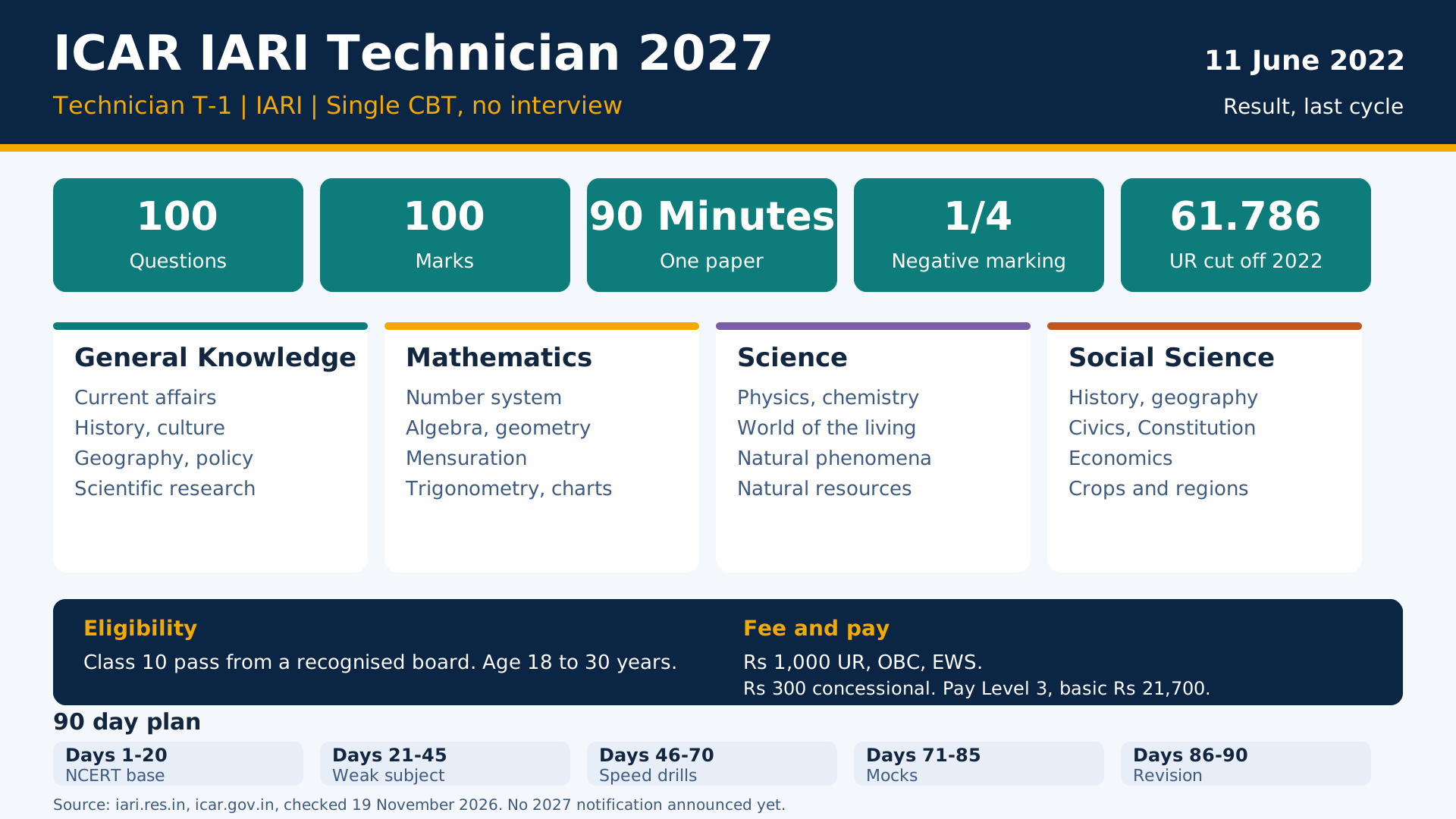
The exam is a single computer based test of 100 objective questions for 100 marks, held over 90 minutes. Four subjects share the paper equally, with 25 questions each: General Knowledge, Mathematics, Science and Social Science. Every question is of matriculation level, which means class 10 level. There is no interview and no skill test in this recruitment. Selection rests on the written test alone, followed by document verification. That makes this one of the simplest exam patterns in government recruitment, and also one of the most competitive, because the only qualification needed is a class 10 pass.
The simplicity is deceptive. A single paper of 100 questions means every question counts, and the cut off for the last cycle was 61.786 marks for unreserved candidates out of 100. The minimum qualifying mark for unreserved candidates is only 40 percent, but qualifying alone does not put you on the merit list. You need more than 60 marks to make the merit list, and the gap between 40 and 62 is where most candidates fall. This guide explains the pattern, the syllabus subject by subject, the cut offs, the salary, and a 90 day plan built for a class 10 level paper.
Every date and number here comes from the IARI notification as reported by trackers, or from the result and cut off lists IARI published. The sources sit at the end of the page. Check the IARI official website before you pay any fee, because IARI can change a date, a fee or a vacancy count between cycles.
The exam in one page
| Item | Detail |
|---|---|
| Post | Technician (T-1), Group C technical post |
| Conducting body | Indian Agricultural Research Institute, IARI, for ICAR |
| Latest notification | Advt No. 1-1/2021/Rectt. Cell/Technician (CBT), 18 December 2021 |
| Vacancies in latest cycle | 641 posts at ICAR headquarters and research institutes |
| Exam | Single computer based test, 100 questions, 100 marks, 90 minutes |
| Subjects | General Knowledge 25, Mathematics 25, Science 25, Social Science 25 |
| Level | Matriculation, class 10 level |
| Negative marking | One fourth of a mark deducted for each wrong answer |
| Qualifying marks | UR 40 percent, SC OBC EWS 30 percent, ST 25 percent |
| Interview | None. Selection by written test and document verification |
| Age limit | 18 to 30 years on the closing date |
| Qualification | Matriculation, class 10 pass from a recognised board |
| Pay | Pay Level 3, Rs 21,700 to Rs 69,100, basic pay Rs 21,700 |
| Next cycle | 2027 notification not announced as of 19 November 2026 |
What a Technician T-1 actually does
Technician T-1 is a Group C technical post at ICAR research institutes. The work is hands on. A technician in a field farm group works on the institute farm, helping with sowing, irrigation, harvesting and the upkeep of experimental plots. A technician in a laboratory group assists scientists with samples, instruments and records. A technician in a workshop group helps with machinery, repair and maintenance. The notification used one common question paper for all functional groups, and the group a candidate joins depends on the vacancy and the institute.
The post suits a candidate who likes practical work more than desk work. The day is spent in the field, the laboratory or the workshop, not in an office file. The work supports research directly, because the experiments that scientists design need technicians who can run them properly. A field trial that is sown late or watered wrong gives wrong results, so the technician's care decides the quality of the research.
This is also the post to pick if you want a central government job with only a class 10 pass. Most central government posts need a degree, and the few that need only class 10 draw very large crowds. The Technician T-1 exam drew candidates from across India for 641 posts, and the cut off shows how tight the race was. The low qualification bar is exactly why the competition is fierce, so the exam deserves serious preparation.
Three exams you must not confuse
ICAR runs several recruitments with similar names, and candidates mix them up every cycle. Technician T-1 is a Group C post that needs a class 10 pass and one written test. ICAR AO is a Group A administrative post that needs a bachelor degree with 55 percent marks and three tiers, including four descriptive papers and an interview. The two posts sit at opposite ends of the ICAR hierarchy, and their syllabi have almost nothing in common. A candidate who prepares for one cannot walk into the other.
ICAR AIEEA is a third exam. It is an entrance exam for admission to postgraduate agriculture courses, run by the National Testing Agency, and it tests agriculture subjects at graduation level. It recruits no one to a post. A candidate who searches for ICAR exam material will find AIEEA pages first, because that exam runs every year, while Technician T-1 runs only when vacancies arise. Check the advertisement number before you trust any page. Check the advertisement number first. A page about any other exam is the wrong page.
The new ASRB Technical Assistant recruitment of November 2026 is a fourth exam to keep apart. Technical Assistant T-3 needs a bachelor degree or a three year engineering diploma, and Senior Technical Assistant T-4 is for Krishi Vigyan Kendras. Both are higher posts than Technician T-1, and both use a preliminary and a mains computer test with no interview. A class 10 pass candidate cannot apply for T-3 or T-4, and a T-1 candidate should not prepare from T-3 material, because the level and the syllabus are different.
The paper: 100 questions, 90 minutes, four equal parts
The computer based test has 100 multiple choice questions, one mark each, and 90 minutes on the clock. That gives 54 seconds per question, the same average as many longer exams, but the short duration means there is no time to recover from a slow start. The paper is bilingual, in English and Hindi, for all four sections, and the same paper serves all functional groups.
| Section | Subject | Questions | Marks |
|---|---|---|---|
| I | General Knowledge | 25 | 25 |
| II | Mathematics | 25 | 25 |
| III | Science | 25 | 25 |
| IV | Social Science | 25 | 25 |
| Total | 100 | 100 |
Every wrong answer costs one fourth of a mark, which is 0.25 marks. A blank answer costs nothing. The penalty matters less here than in exams with a one third penalty, and the maths is worth knowing. A blind guess on a four option question gains one mark one time in four and loses a quarter mark three times in four, which works out to a small positive expected value of about 0.06 marks per guess. Wild guessing across the paper still costs marks. A question where you can rule out one option is clearly worth attempting, and leaving questions blank in the last minutes is worse than attempting them. The rule for this paper is simple. Attempt a question when you can rule out at least one option. In the final minutes, attempt what is left rather than leaving it blank, because the penalty is light and the clock is gone anyway.
The four sections carry equal marks, so no section deserves more time than the others. A candidate who spends 40 minutes on mathematics and 10 minutes on social science has misread the paper. Give each section about 20 minutes, keep 10 minutes for review, and move on from a question that resists you. A stuck question costs two things, the mark and the time, and the time is worth more in a 90 minute paper.
General Knowledge: 25 questions
General Knowledge tests current events relating to India and its neighbouring countries, with a focus on history, culture, geography, economic science, general policy and scientific research. The questions are of matriculation level, which means they test awareness rather than deep study. Daily news reading is the base, and a standard general knowledge book covers the static parts. For this exam, pay attention to agriculture and rural news, because the paper is set by an agricultural institute, and to science news, because the science section of the paper overlaps with this one. Learn the names of major ICAR institutes, the states where they sit, and the crops and regions they work on, because that is the one part of general knowledge where an IARI candidate can outscore a generalist.
Current affairs should cover the last six to twelve months before the exam. Learn the big government schemes by their job, not by their launch date, and learn the names of constitutional office holders, state capitals, major rivers and mountain ranges, and the important days and awards. A question usually asks for one fact, so the revision method is short notes and repeated recall, not long reading.
Mathematics: 25 questions
Mathematics is set at matriculation level and covers the number system, fundamental arithmetical operations, algebra, geometry, mensuration, trigonometry and statistical charts. The questions test calculation speed and accuracy, and they are the section where practice shows fastest. Keep a formula sheet for mensuration, algebra and trigonometry, and revise it every week. Practise 20 questions a day from a class 10 level question bank, and time yourself, because the section is worth 25 marks and a slow candidate will not finish it.
The common errors in this section are small ones: a misread number, a wrong unit, a formula applied to the wrong shape. Check the unit in every mensuration question, and check whether the question asks for area or perimeter, simple interest or compound interest, speed or time. A candidate who gets 20 out of 25 in mathematics has already banked a fifth of the paper, and the cut off analysis below shows how much that matters.
Science: 25 questions
Science is set at class 10 level and covers physical and chemical sciences, the world of the living, natural phenomena, the effects of current, and natural resources. The base is the class 10 NCERT science book, and a candidate who reads it twice will cover most of the syllabus. Learn the basic laws of motion, light, electricity, acids and bases, metals and non metals, life processes, heredity, reproduction, and the natural resources chapters. The questions test understanding of concepts, not memory of the book, so learn why a thing happens, not only what happens.
Science overlaps with general knowledge in the scientific research part, so the two sections feed each other. A science discovery in the news can appear as a general knowledge question and as a science question, and a candidate who reads science news will catch both. Keep a short list of recent science developments, with one line each, and revise it weekly.
Social Science: 25 questions
Social Science is set at matriculation level and covers history, geography, civics and economics. The history part covers the freedom movement and modern India. The geography part covers physical geography, climate, resources and Indian agriculture. The civics part covers the Constitution, democratic institutions and the rights of citizens. The economics part covers basic economic ideas, sectors of the economy and development. The class 10 NCERT social science books cover this syllabus, and they are the safest base, because the paper is set at that level and the books match it.
Geography deserves extra attention in this exam, because it connects to agriculture directly. Learn the major crops and the states that grow them, the rivers and their basins, the soil types and where they are found, and the climate zones of India. A question on why a crop grows in one state and not in another is a geography question and an agriculture question at the same time, and it is exactly the kind of question this paper asks.
Qualifying marks and the real cut off
The notification fixes minimum qualifying marks in the written test: 40 percent for unreserved candidates, 30 percent for SC, OBC and EWS candidates, and 25 percent for ST candidates. Those are the floor. A candidate below the floor is out, whatever the vacancies. But the floor is not the selection line, and the 2022 result shows the gap clearly.
IARI published the result and the cut off on 11 June 2022. The cut off marks for the 2022 cycle, out of 100, were 61.786 for general candidates, 58.166 for OBC, 57.843 for EWS, 52.902 for SC and 49.893 for ST. The cut offs for persons with disabilities and ex servicemen were lower, at 36.700 for orthopaedically handicapped, 43.330 for hearing handicapped, 56.098 for visually handicapped, 43.427 for other disabilities, and 36.130 for ex servicemen.
| Category | Minimum qualifying marks | Cut off 2022, out of 100 |
|---|---|---|
| General, UR | 40 | 61.786 |
| OBC | 30 | 58.166 |
| EWS | 30 | 57.843 |
| SC | 30 | 52.902 |
| ST | 25 | 49.893 |
Use the table as a target for your mock test scores. An unreserved candidate needs about 62 marks out of 100, which is 22 marks above the qualifying floor. An OBC candidate needs about 58, and an SC candidate needs about 53. That means a candidate must get roughly three out of every five questions right, after the penalty, to make the list. A candidate who scores 45 marks has qualified and still failed, because qualification only opens the door to the merit list and the merit list is drawn in order of marks.
One conflict in the tracker record should be stated plainly. Some tracker pages say the Technician cut off was released on 10 December 2024. That date belongs to the IARI Assistant recruitment cut off. Those pages mix the two recruitments. The Technician result and cut off came out on 11 June 2022, as reported by BankersAdda, Unacademy and other trackers, and the figures in the table above are the same across all of them. Check the advertisement number on any cut off page you read. Check the advertisement number first. A page about any other exam is the wrong page.
Trackers also list cut offs for the 2016 and 2018 Technician cycles, which shows the exam ran before 2021. The figures for those cycles were not re-verified against a source retrieved for this guide, so they are not quoted here. The 2022 figures above are the verified benchmark, and the next cycle will set its own cut off based on its own paper and its own vacancies.
Eligibility, age limit and fee
The eligibility rules are the simplest of any ICAR exam. You need a matriculation pass, class 10, from a recognised board. No higher qualification is needed, and no work experience is needed. The age limit is 18 to 30 years on the closing date of the application, with relaxation for reserved categories as per government rules. In the 2021 cycle the closing date was 10 January 2022, later extended to 20 January 2022, and the age was counted on 10 January 2022. Serving regular employees of ICAR had a higher upper age limit of 58 years on the closing date.
| Item | Detail, 2021 cycle |
|---|---|
| Qualification | Matriculation, class 10 pass from a recognised board |
| Age limit | 18 to 30 years on the closing date |
| Age relaxation | SC ST 5 years, OBC 3 years, PwBD 10 years, ICAR serving staff up to 58 years |
| Fee, UR OBC EWS | Rs 1,000, including Rs 300 registration fee |
| Fee, women SC ST ex servicemen PwBD | Rs 300, registration fee only |
| Application window | 18 December 2021 to 20 January 2022, extended from 10 January |
| Mode | Online application and online fee payment only |
The fee split catches out candidates who read only the headline figure. The total fee for unreserved, OBC and EWS candidates was Rs 1,000, made up of a Rs 700 examination fee and a Rs 300 registration fee. Women, SC, ST, ex servicemen and persons with benchmark disabilities paid no examination fee, only the Rs 300 registration fee. Check the fee table in the next notification before you pay, because the fee can change between cycles.
One more detail from the notification is worth noting. Candidates had to enter the percentage of marks obtained in matriculation, calculated to the nearest two decimals, in the application form. Keep your class 10 marksheet ready before you start the form, and enter the percentage exactly as the marksheet shows. A wrong percentage at application time can cause trouble at document verification, when the marksheet is checked against the form.
Vacancy history
The 2021 cycle offered 641 Technician T-1 posts at ICAR headquarters and its research institutes. The notification was issued on 18 December 2021, and the exam was first scheduled for 25 January to 5 February 2022. It was then postponed because of the Covid pandemic, and finally held on 28 February and on 2, 4 and 5 March 2022. The result came out on 11 June 2022, and selected candidates went on to document verification.
| Stage, 2021 cycle | Date |
|---|---|
| Notification, Advt No. 1-1/2021/Rectt. Cell/Technician (CBT) | 18 December 2021 |
| Online application window | 18 December 2021 to 20 January 2022 |
| Exam first scheduled | 25 January to 5 February 2022, postponed |
| Exam actually held | 28 February and 2, 4, 5 March 2022 |
| Result and cut off published | 11 June 2022 |
These are the only vacancy figures in this guide, because they are the only ones verified from the notification. No vacancy figure for a future cycle exists, and any site that quotes a 2027 vacancy number before IARI publishes it is guessing. One tracker page mentions 802 Technician vacancies for a 2023 cycle. That figure does not match any IARI Technician notification retrieved for this guide, and it appears to mix the Technician recruitment with another IARI recruitment. Do not plan on 802 posts. Plan on the pattern, and wait for the real notification for the number.
Salary and the job after selection
The Technician T-1 post carries Pay Level 3 of the 7th Central Pay Commission pay matrix, which runs from Rs 21,700 to Rs 69,100. The basic pay at joining is Rs 21,700 per month, plus dearness allowance, house rent allowance and transport allowance as per central government rules. The allowances depend on the city of posting, so the take home pay differs between a posting in New Delhi and a posting in a smaller town. The post also carries the usual central government benefits, including medical facilities, leave, pension under the National Pension System, and LTC as per rules.
The career path runs through the technical grades of ICAR. A Technician T-1 gains experience in the field, the laboratory or the workshop, and over time moves to higher technical grades under the ICAR technical service rules. The exact promotion rules sit in the ICAR technical posts recruitment rules, and they depend on service, vacancies, qualifications and the rules in force at the time. A new technician should read the service rules for the post on the ICAR official website once selected, because promotion is not automatic and it rewards further study and good service records.
The work is physical and practical, and it suits a candidate who likes working with their hands. A field technician spends the day outdoors in all seasons. A laboratory technician handles samples and instruments with care. A workshop technician works with machines and tools. The work is steady rather than dramatic, and the satisfaction comes from research that works because the practical work was done right. A candidate who wants desk work should look at the ICAR Assistant post instead, because the Technician post is firmly practical.
IARI: the institute behind the exam
IARI, the Indian Agricultural Research Institute, is known as the Pusa Institute, and it is India's national institute for agricultural research, education and extension. Its history began in 1905 at Pusa in Bihar, with a grant of 30,000 pounds from the American philanthropist Henry Phipps. It began as the Agricultural Research Institute, with five departments: Agriculture, Cattle Breeding, Chemistry, Economic Botany and Mycology. The name changed to the Imperial Institute of Agricultural Research in 1911, and to the Imperial Agricultural Research Institute in 1919.
A devastating earthquake on 15 January 1934 damaged the Pusa campus, and the institute shifted to New Delhi on 29 July 1936. After independence it was renamed the Indian Agricultural Research Institute, and in 1958 it was granted the status of a deemed university. The present campus in New Delhi covers about 500 hectares, about 8 km west of New Delhi railway station, and it houses 20 divisions, 5 multi disciplinary centres, 8 regional stations and several all India coordinated research projects.
IARI is called the mother of several ICAR institutions, because many ICAR institutes grew out of its divisions. It also led the research behind the Green Revolution of the 1960s and 1970s, including high yielding wheat varieties that changed Indian agriculture. A technician who joins IARI or any ICAR institute works in that tradition, and the general knowledge section of the exam sometimes asks about it. Learn the dates: 1905 at Pusa, 1936 shift to Delhi, 1958 deemed university. Those three dates cover most of the history questions this paper can ask.
The ICAR IARI Technician 2027 90 day plan
Ninety days is enough for this exam if you study every day and test yourself every week. The plan below assumes two to three hours a day, which adds up to about 200 hours. If you have more time, add mock tests rather than more reading. Reading the same chapter twice rarely adds marks. Answering questions on it does.
Days 1 to 20 cover the base. Read the class 10 NCERT books for science and social science, and start a general knowledge notebook with daily news. Practise 25 mathematics questions a day, and revise the formula sheet every week. Take one short test of 25 questions per subject at the end of this phase, and mark the weak subject. Most candidates find one subject clearly weaker than the rest, and knowing which one it is early saves weeks later.
Days 21 to 45 cover the weak subject first and the rest second. Give the weak subject half your study time, and split the rest between the other three. Read the NCERT books a second time, faster, and make one page notes per chapter. Take one full mock test of 100 questions in 90 minutes every week, and analyse every wrong answer. Mark each error as a fact you did not know, a concept you misunderstood, or a careless slip. Facts go into a revision list. Concepts go back to the book. Slips go into a checklist you read before the next mock test.
Days 46 to 70 are for speed and balance. Take two mock tests a week in the full 90 minutes, with no break. Practise the section order that suits you, and keep each section to about 20 minutes. Revise the general knowledge notebook daily, because current affairs fade fast. Redo the questions you got wrong in earlier mocks, and watch whether the same errors repeat. A repeated error is a concept gap, not bad luck, and it needs the book, not another mock test.
Days 71 to 90 are for revision and mock tests only. No new book, no new chapter. Revise the one page notes, the formula sheet, the general knowledge notebook and the science concepts, because those are the facts that fade first. Take two mock tests a week, and in the last week take one final mock test three days before the exam, then rest. Sleep well the night before the exam. A tired mind confuses formulas and misreads questions, and that confusion costs marks in a 90 minute paper.
Mistakes that cost marks in Technician T-1
The first mistake is spending too long on one section. The four sections carry equal marks, but candidates love one subject and fear another, so they give the loved subject 40 minutes and the feared subject 10. The paper punishes that. A candidate who scores 22 in mathematics and 12 in social science has wasted the easy marks in social science. Keep each section to about 20 minutes, and move on when the time is up. You can return to a hard question in the review time if any is left.
The second mistake is treating the qualifying marks as the target. The floor for unreserved candidates is 40 percent, but the cut off was 61.786. A candidate who aims for 45 marks will qualify and still fail. Aim for 70 marks in mock tests, because a mock test score of 70 leaves room for a harder real paper and for exam day nerves. A target of 70 in practice gives a real score near 62, and a target of 45 in practice gives a real score near 40.
The third mistake is ignoring the penalty. A quarter mark per wrong answer looks small, but 20 wrong answers cost 5 marks, and 5 marks is the gap between the OBC cut off and the general cut off. The penalty is light enough that a question with one option ruled out is worth attempting, and heavy enough that wild guessing across the paper costs a rank. Keep the rule. Rule out at least one option, then attempt. Attempt the rest only in the final minutes, when the clock has run out anyway.
The fourth mistake is reading advanced books for a class 10 paper. The syllabus is matriculation level, and the questions come from class 10 books. A candidate who reads graduation level science or degree level mathematics wastes weeks on material the paper will never ask. The class 10 NCERT books, a standard general knowledge book, and a class 10 level question bank are enough. Depth beats breadth here, because the paper tests the basics thoroughly.
The fifth mistake is skipping document verification preparation. Selection rests on the written test, but the post is given only after documents are verified. Keep your class 10 certificate and marksheet, your age proof, your category certificate and your fee receipt ready. A missing certificate at verification can cost a post that a written test earned, and it is the most avoidable loss in the whole process.
How to use mock tests for a 90 minute paper
A mock test for this exam is a timing drill first and a knowledge test second. Take it in one sitting of 90 minutes, with no break, and score it with the quarter mark penalty applied. Then spend 45 minutes on analysis. That analysis is where the marks come from, because it shows which subject leaks marks and which kind of error repeats.
Track four numbers after every mock test: the score in each section, the number of questions attempted, the number of wrong answers, and the marks lost to the penalty. A candidate who attempts 95 questions and gets 25 wrong loses 6.25 marks to the penalty and scores about 64. A candidate who attempts 85 questions and gets 12 wrong loses 3 marks and scores about 70. The second candidate attempted less and scored more, because accuracy beats attempts in a paper with negative marking. Watch the penalty column in your tracker, and if it stays above 5 marks, tighten your guessing rule.
Track your mock scores over time, and watch the trend rather than one score. A candidate who moves from 52 to 58 to 64 over six mocks is improving, even if one mock dips. A candidate who scores 60 every time without analysis is stuck. The trend tells you whether the plan is working, and the section scores tell you what to fix next. Aim to cross 70 in mock tests before the real exam, because the real paper and exam day nerves usually pull the score down a few marks.
Before you apply, check these things on the IARI site
First, confirm that a fresh Technician T-1 notification exists on the IARI official website. As of 19 November 2026 there is no new Technician T-1 notification, and the live ASRB notice is the Technical Assistant and Senior Technical Assistant recruitment of 11 November 2026, which is a different exam with different qualifications. Do not apply for that recruitment thinking it is the Technician T-1 exam. The two recruitments have different posts, different qualifications and different patterns.
Second, check your class 10 marksheet and your age against the closing date in the notification. Third, confirm the fee for your category, because the fee for unreserved, OBC and EWS candidates is different from the fee for women, SC, ST, ex servicemen and persons with disabilities. Fourth, enter your matriculation percentage to two decimals exactly as the marksheet shows. Fifth, keep your registration receipt and your admit card safe, and check the admit card details as soon as it is available, because a wrong centre or a wrong paper on the card is easier to fix early.
Also confirm the exam centre list and the documents needed for verification. The notification lists the documents, and a missing certificate at that stage can cost a selection that a written test earned. Keep your class 10 certificate, your age proof and your category certificate ready in advance, not in the week of verification.
Where Technician preparation overlaps other exams
Technician T-1 preparation overlaps with several other class 10 level exams, and that overlap is useful for a candidate who wants a second option. The general knowledge, mathematics, science and social science syllabus matches the SSC GD 2027 paper closely, and the speed and accuracy habits transfer directly. SSC Delhi Police Constable 2027 tests the same four areas at a similar level, and Bihar Police Constable 2027 also draws on general knowledge and reasoning at this level.
The agriculture and rural knowledge in the general knowledge section overlaps with NABARD Grade A 2027, which tests rural development and agriculture in depth, though that exam needs a degree and a much deeper syllabus. The food and agriculture reading overlaps with FSSAI Technical Officer 2027, which also tests science at a technical level. A candidate preparing for IBPS Clerk 2027 or IBPS RRB Clerk 2027 will find the mathematics and reasoning practice familiar, though the banking exams test English and computer knowledge that this paper does not. IBPS SO 2027 is a specialist officer exam at degree level, and it shares only the general awareness base.
For candidates aiming higher, UPPSC RO ARO 2027 and UP Police Sub Inspector 2027 both reward the same general knowledge and current affairs habit, at a higher level. The point is not to prepare for five exams at once, which spreads effort too thin. The point is to pick one main exam, and to know which second exam your preparation already covers, so that a second application costs little extra work.
Sources
IARI official website, iari.res.in, checked 19 November 2026. The IARI site lists the Technician T-1 notification and the result pages under its recruitment section. IBPS Guide ICAR IARI Technician syllabus 2022 page, Advt No. 1-1/2021 Rect Cell/Technician (CBT), 641 posts, CBT between 25 January and 5 February 2022, 100 questions, 100 marks, 90 minutes, one fourth negative marking, four subjects of 25 questions each.
BankersAdda ICAR IARI Technician syllabus 2022 page, notification on behalf of ICAR for 641 Technician T-1 posts, CBT on 28 February and 2, 4 and 5 March 2022, matriculation level questions, no interview, result and cut off 11 June 2022, cut off general 61.786, OBC 58.166, SC 52.902, ST 49.893, EWS 57.843. Oliveboard ICAR IARI Technician syllabus page, Advt No. 101/2021 Rectt Cell/Technician, notification 18 December 2021, 641 vacancies, negative marking 0.25 per wrong answer, qualifying marks UR 40 percent, SC OBC EWS 30 percent, ST 25 percent.
JagranJosh ICAR Technician exam pattern and syllabus 2022 page, exam on 28 February and 2, 4 and 5 March 2022, 641 vacancies, 100 questions of 100 marks, 1.5 hours, one fourth negative marking, bilingual English and Hindi, common paper for all functional groups. Times of Mizoram IARI recruitment 2022 page, Technician T-1 under direct recruitment in Pay Level 3 of 7th CPC Pay Matrix, age 18 to 30 years as on 10 January 2022, class 10 pass, fee Rs 1,000 for UR, OBC and EWS and Rs 300 for women, SC, ST, ex servicemen and PwBD.
EasyJobAlerts IARI recruitment 2022 page, pay Level 3 Rs 21,700 to Rs 69,100, fee split Rs 700 examination fee plus Rs 300 registration fee, last date extended to 20 January 2022, serving ICAR employees upper age limit 58 years. CareerPower ICAR IARI Technician cut off page, cut off 2022 category wise, and the note that the 10 December 2024 cut off release belongs to the IARI Assistant recruitment. IARI history from the IARI Wikipedia page and the IARI official about page, founded 1905 at Pusa, Bihar, with a grant of 30,000 pounds from Henry Phipps, shifted to Delhi 29 July 1936 after the 1934 earthquake, deemed university 1958, campus about 500 hectares.
ICAR official website, icar.gov.in, checked 19 November 2026. ASRB Centralized Combined Examination 2026 for Technical Assistant T-3 and Senior Technical Assistant T-4, F. No. 2(2)/2025-Exam, dated 11 November 2026, 1,393 posts, applications 18 November to 17 December 2026, as reported by Careers360 and the Telegraph. ICAR history from the ICAR Wikipedia page and the FAO AGRIS provider page, established 16 July 1929, headquarters New Delhi, 111 ICAR institutes and 71 agricultural universities.







